← Iran: The Latest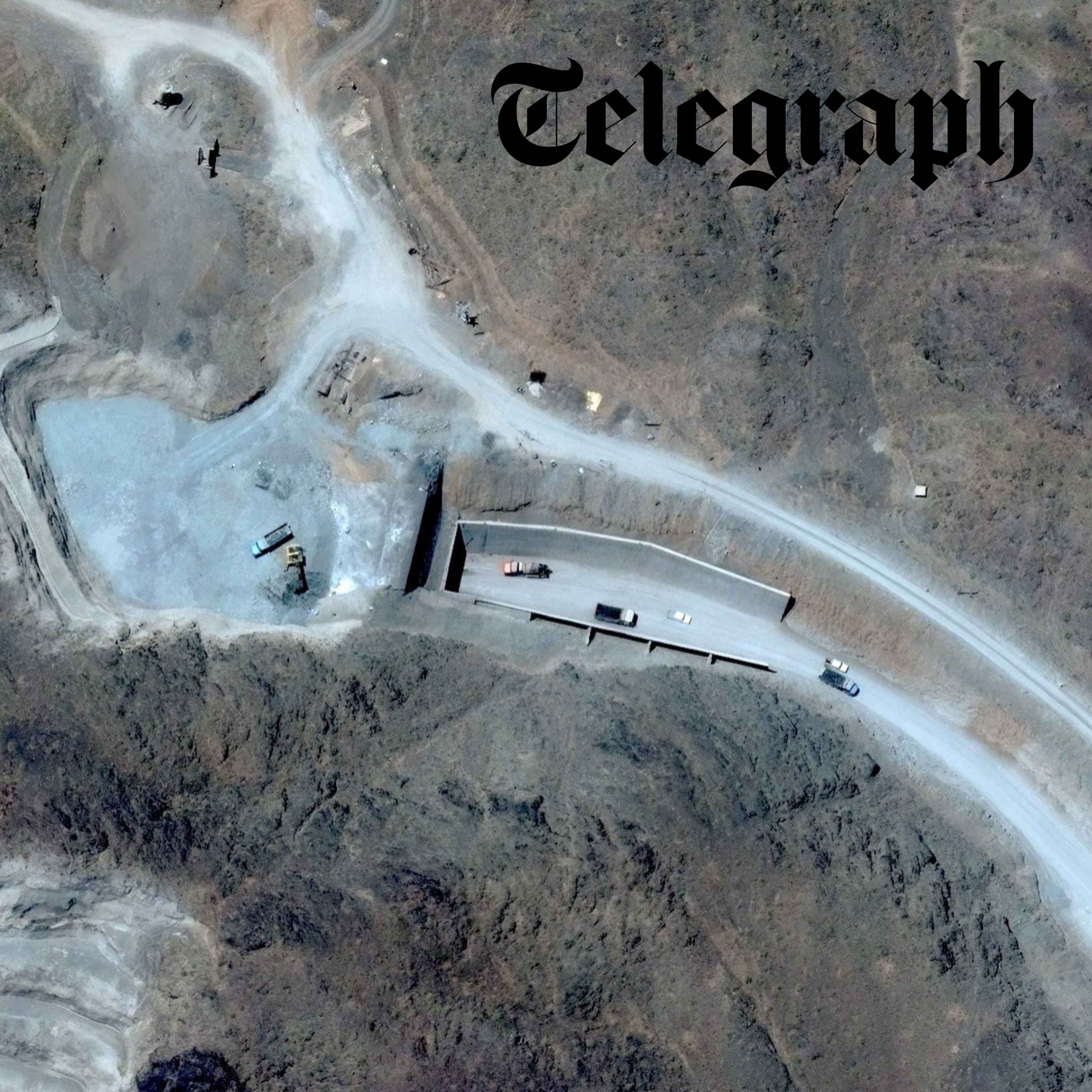
Iran: The Latest
Trump vows to target Pickaxe Mountain & infiltration, executions and fear inside Iran
00:47:31
Loading summary
Transcript95 lines
- [00:04]
Tara Kangaloo
The telegraph.
- [00:10]
Pete Hegseth
Santana Oneness Tour 2026 from Woodstock to
- [00:14]
Tara Kangaloo
Supernatural and beyond with very special guest the Doobie Brothers. Get tickets now@livenation.com
- [00:25]
Empower Advertiser
say you've always wanted to have a backyard oasis. Here's the thing. If you get smart with your money, you can do things like that. With Empower, you can start making the most out of your money so you can go out and live a little. Isn't that why we work so hard to have some fun with our money? So use Empower and get good at money so you can be a little bad. Join their 20 million customers today@empower.com not an Empower client, paid or sponsored.
- [00:55]
Venetia Raney
I'm Venetia Raney and this is Iran. The Latest It's Wednesday, 22nd of July 2020, the 11th consecutive day of American strikes on Iran and Iranian retaliatory strikes on the Gulf and Middle East. On today's episode, we'll be looking at why Trump is talking about targeting Pickaxe Mountain in Iran, plus the news that America is going to help Saudi Arabia develop its civilian nuclear program. We'll also be talking to Tara Pangaloo, an Iranian journalist, about what it's like inside the country amid this latest round of fighting.
- [01:27]
Donald Trump
A short time ago, the United States military began major combat operations in Iran.
- [01:35]
Oregon Lottery Advertiser
Iran's supreme Leader, Ayatollah Ali Khamenei, was killed in the attacks.
- [01:44]
Venetia Raney
For the first time ever, the US Navy used a surface sea drone in combat to strike Iranian targets.
- [01:51]
Donald Trump
The Strait of almost completely closed again.
- [01:55]
Tara Kangaloo
Does anyone really think that someone can tell President Trump what to do?
- [02:00]
Empower Advertiser
Come on.
- [02:01]
Venetia Raney
To discuss today's news with me, I'm joined by Sophie o', Sullivan, Telegraph journalist and producer, on the latest. Sophie, welcome to Iran. The latest. Let's start with what the Americans have hit overnight in Iran.
- [02:12]
Sophie O'Sullivan
Yes, so this was the 11th night of striking from the U.S. according to a statement from Centcom, they targeted Iranian military operation centers, maritime capabilities, aircraft hangars, drone storage facilities, and military logistics infrastructure, all in an effort to further degrade Iran's ability to threaten commercial shipping. So the Strait of Hormuz explosions were had in the city of Serik, which overlooks the Strait of Hormuz. Chabahar and Konarag in the southeast saw explosions and local media reported seeing fighter jets flying overhead. Iranian state media also reported that air defenses were activated in the capital, Tehran. Also, explosions were reported in the northwest city of Tibrits. The East Abzerbaijani Provincial Crisis Management Office said a military site there had been struck. Additionally, the Southern city of Bushehr heard strikes in the early morning. This is the city which is home to Iran's only nuclear power plant. But the governor has reportedly said that there have been no reports of damage to urban infrastructure so far. Strikes have also been reported in Kangavar and Kabadurang and near Bennett in the Kurdistan province in the northwestern side of Iran, marking the first reported strike there and in the Khujestan province in the west.
- [03:23]
Venetia Raney
Okay, so it seems to be quite wide ranging, not just along those coastal areas. So as we've seen every single night for the last 11 days and nights, as you said, Iran has retaliated, hitting again three countries across Middle east and Kuwait, Jordan and Bahrain. So Jordan's military said it's intercepted four Iranian missiles targeting the kingdom. Two other missiles fell into remote uninhabited areas. According to the local Petra news agency, no casualties or material damage reported yet. But interestingly, down in the south, plumes of smoke could be seen overhead in the Red Sea city of Aqaba. So the Jordanian Red Sea city of Aqaba. And these were according to videos filmed by people in Eilat, Israel, just over the border. That's their southern port city. Another recent attack on Aqaba saw Israeli warn that there could be a spillover of Iranian attacks into Israel. Israel has not been targeted by Iran yet, but clearly things getting closer and closer to the border there. We had a statement from Iran's military. They claimed that they hit Jordan's Muwafak Salty Air Base again. So that was the one where two American soldiers, possibly three, were killed last week. There's some video circulating online showing American soldiers apparently at that base. It's been geolocated by OSINT sources to that base. American soldiers running into a shelter. And you can see sort of explosions in the sky, no sounds of impact, but gives you a sense of what like to be on these bases while they're being attacked. The Iranian military also claimed they targeted Bahrain's Issa Air Base, again targeted it with drones. They said they were targeting housing and welfare buildings and equipment, warehouses of the American armies. And this does marry with what we're increasingly seeing, that they're targeting planes, radars, but they're not managing to hit those. What they are managing to hit is housing units to try and increase the casualty toll for America. So that's what's been targeted so far across the Middle east and Gulf by Iran. We're getting an increasing sense of how this might continue to escalate. One of the areas that's come up repeatedly now is Pickaxe Mountain. Trump mentioned it yesterday in his meeting with Lebanese President Joseph Al.
- [05:17]
Tara Kangaloo
Do you believe that Iran has moved nuclear centrifuges into Pickaxe Mountain? And when you say we're not done yet, what is left to finish?
- [05:25]
Donald Trump
Well, I think that they, they may have. We don't have it on record. All we do is read the fake news. You know, we see the news is so wrong so many times. So, you know, maybe, maybe this one they have. Right. But it's okay. It doesn't mean anything unless they have the material. You're talking about the centrifuges. Yeah, it doesn't mean anything unless they have the material they don't have. We follow the material, that's where the action is. And we'll be hitting that area very probably pretty soon and there's not, not a thing they can do about it. You know, normally I wouldn't say that. If I thought they could do something about it, I would never say that, but we'll be hitting that area pretty soon and very heavily.
- [06:06]
Venetia Raney
Just tell us a bit about what Pickaxe Mountain is. Why is it significant?
- [06:10]
Sophie O'Sullivan
Pickaxe Mountain is this fortified underground nuclear site which Israel believes Tehran is storing part of its enriched uranium stockpiles inside. So it's about 220 kilometres from Tehran, but it's next to the Natanz nuclear facility, which is one of the country's two primary nuclear enrichment facilities. So the belief is that 100 metres inside Pickaxe Mountain, the Iranians are keeping some of this enriched uranium and is building centrifuges to enrich more uranium inside the mountain. And the concern is that there's very little knowledge about what's going on in there, how far into production it is, but it's also a very difficult area to strike. Experts are essentially looking at satellite imagery to try and work out what's going on, but really only they're seeing the entrances and the exits which seem to have been strengthene given these threats from the US. It was built in 2020, so they've been preparing it for a long time. And really the drive to build it was that there was a sabotage on the Natan site. And so they started looking for a more secure alternative inside the mountain.
- [07:20]
Venetia Raney
And the reason it's coming up now is because, as you say, Israeli intelligence suggests that the Iranians moved a bunch of centrifuges, as you say, used to enrich uranium there after the 2025 summer war that we saw last year to try and protect them further Trump hasn't attacked this target yet. Could he? How could he?
- [07:38]
Sophie O'Sullivan
As I said, it's a very strengthened target. It's 100 metres inside a mountain and there seem to be small entrances at exits. But realistically, experts are doubtful whether even the most powerful bunka buster bombs in the US arsenal could make a difference. The ISIS think tank has said that the site would be more suitable for ground force attack or sabotage. And vulnerabilities like ventilation, heating, cooling, deliveries, all of that still needs to go inside the mountains. So there are vulnerabilities which they could take advantage of. But a lot of experts have really raised doubts of whether anything could be achieved against such a deep base. So that is the concern. Iran has said that an attack on it would be considered an extension of the war in the region, so they're taking it very seriously. But Trump does just keep bringing it up. He's even said that it's a possible target for a nice big fat shot right in the front door. So we'll have to see what happens with that one. But it does seem like a very, very fortified stronghold.
- [08:41]
Venetia Raney
That probably explains why they haven't targeted it so far. Later on in the episode, we're speaking to our guest, Tara Kangaloo, and she'll be talking about why she thinks this intelligence is coming out now and a bit about the timing of these things, which we always should take into account. We should also just give a quick update on the Strait of Hormuz and the Bab El Mandab. So start with the Bab El Mandab, because, as we've been hearing this week, the Houthis has been warning that they are going imposing a blockade on any Saudi ships and ports transiting via the Red Sea. And we have now seen the first diversions of ships. So according to marine traffic data, two ships have turned around two laden crewed tankers after departing Saudi Arabia. One was supposed to be going to China, turned around in the Red Sea, and the other was supposed to be going to India. That's interesting. That is suggesting that that blockade is starting to have an impact. And if we see the Bab El Mandab closing up to the same extent as the Strait of Hormuz does, that will have a huge impact on the global economy. In Saudi Arabia in particular, if they can't ship their oil anywhere, that's going to be very significant. And then in the Strait of Hormuz, escalation continuing. And we've seen visible vessel traffic just falling off a cliff. Only the Iran lane has seen Vessels transiting with their transponders on, as far as we know, nothing in that southern Omani route, which we saw traffic increasingly going through over the weeks before this latest round of fighting. Bloomberg has reported that tanker owners are apparently being offered six months worth of pay if crews make the voyage in and out of the Strait of Hormuzza. The risk that they're taking absolute speaks to the risk. It's not just the cost of insurance going up. It's the cost of people's lives potentially. We have seen ships being sunk by Iranian attacks.
- [10:16]
Sophie O'Sullivan
Well, CENTCOM reclaimed just today that over the last three months Iran had attacked more than 30 commercial vessels transiting the strait. But they've still said that despite the Iranian aggression, it remains open for commercial vessel transit.
- [10:29]
Venetia Raney
The facts on the ground, on the water, just do not support that at all. This strait is closed. All of this suggests that the cost of the war is rising. That's globally, but also specifically for the American military and for Washington. We had Pete Hegseth, Secretary of Defense, testifying yesterday about the cost of the war for the first time since April. How much did he estimate it's costing them?
- [10:47]
Sophie O'Sullivan
US$37.5 billion. So that's close to 28 billion pounds is the cost so far. That's up by nearly US$8 billion since the May estimate. So really significant. We've not heard from him for a long time on that. This came up when he was at the Senate Appropriations Committee urging them to approve an $87 billion congressional funding for the Pentagon with around $67 billion of that destined to the operation in the Middle East. That was met with a lot of pushback from the Democrats. He saw interruptions from anti war protesters. Let's hear a clip of that.
- [11:22]
Pete Hegseth
Now the supplemental funding request is not a substitute for The President's full $1.5 trillion base budget request. 1.5 trillion.
- [11:34]
Tara Kangaloo
Stop bombing our children in Iran and Palestine.
- [11:37]
Joseph Aoun
This is
- [11:39]
Tara Kangaloo
Mr. Secretary, please suspend until the order is restored in the hearing room.
- [11:47]
Anti-war Protester
You, sir, are the failure. Not the men and women who are on that front line. Not the, the men and women who hold up their honor with distinction. But if there's a lack of a winning strategy, they're in harm's way. Their leaders have failed them and that's what's happening. We have political leadership. You, you don't have a strategy, you don't have a long term plan to actually win this war. Win the war. The men and women are going to be able to do it, but they need to have leadership.
- [12:13]
Pete Hegseth
When will you show leadership?
- [12:15]
Anti-war Protester
When will you show leadership?
- [12:16]
Pete Hegseth
Why don't you show some leadership and stand up to your fellow Democrats who won't fund the troops, who stand and play partisan politics while you don't give us the money. You want to stand up here and talk about the troops? You won't show any political courage to actually fund our department because you have Trump derangement syndrome and can't actually commit to anything meaningful.
- [12:34]
Sophie O'Sullivan
So before last week's attacks, the center of Strategic and International Studies estimated the total cost to have reached between $34 billion and $42 billion for the cost of the war to the U.S. but other estimates are placing it much higher, up to more than $100 billion. So it's interesting to see this number from Pete Hegseth. Do we know how accurate it is? I think we'll have to see.
- [12:58]
Venetia Raney
He said some of the sort of future operations expected operations are included in that. But of course, that could continue to rise if things continue to escalate. Two more stories we want to flag to people before we wrap. One is a very significant deal between America and Saudi Arabia on nuclear power plants. So President Donald Trump has approved a nuclear deal with Saudi Arabia, 30 year agreement. It's expected to be announced today, Wednesday. And it would essentially allow American companies to build an enrichment facility in Saudi Arabia still needs a joint study to approve the program, but would involve American companies providing technology expertise to help developed this nascent ongoing Saudi civilian nuclear power program. But crucially, most countries with a nuclear power program, they import enriched uranium, quite rare to enrich your own uranium. Iran is the only country in the Middle east that currently enriches its own uranium. Saudi Arabia would gain this capacity if this deal goes ahead. Now, there's one country which is very upset about that, and that's Israel. They are the only country with nuclear weapons in the Middle East. And they've long been wary of Saudi Arabia, traditionally a foe of theirs, accessing advanced nuclear technology. They fear that it would pave the way for the kingdom to develop their own nuclear weapons. That's not what Saudi Arabia said. But Saudi Crown Prince Mohammed bin Salman has previously said that if Iran were ever to get a nuclear weapon, Saudi Arabia would pursue one as well. So you're locked in that sort of proliferation trap, basically, that we thought we'd left behind in the Cold War, but we seem to be entering it again. Sophie, before we let you go, you're producer on Ukraine, the latest. And there is another massive story happening in Ukraine today that you'll be covering on the episode. Give us a little taste of what that is and then we'll hear a clip.
- [14:37]
Sophie O'Sullivan
So last night the chief of the Ukrainian army was fired, Oleksandr Syrsky, he was let go. It wasn't a surprise. There'd been a lot of upheaval all week. Mikhailo Fedorov, the minister of defense, was let go last week. There have been protests, but last night Zelenskyy said that a new person would be in charge. This is called Mihailo Dropachi. Anyway, so it's a huge shakeup in Zelenskyy's defense department. So we're now going to hear a clip from Ukraine, the latest today where they're discussing this in a lot more detail.
- [15:07]
Narrator (Ukraine the Latest)
He was previously in charge of Ukraine's ground forces and Joint Forces Command, but is one of Ukraine's most famous battlefield commanders, made legendary for being the one steering the BMP2 that broke through Russian backed barricades in Mariupol in 2014 when Russian backed militants were attempting to seize control of the city. He led the armored breakthrough that helped Ukrainian forces regain the initiative and prevent that city from falling. A defining symbol of Ukraine's resistance in the early stages of the war before the full scale invasion. He's now 43 and trained as a tank officer and accumulated 26 years of army experience. After the invasion he built a reputation as the trusted commander sent to manage some of Ukraine's most desperate battles. He helped to stall the Russian advance in Kryvy Ri, Mr. Zelenskyy's hometown and was one of the commanders of the counteroffensive that liberated Kherson, the only regional capital captured by Moscow's forces forces during the full scale war.
- [16:07]
Venetia Raney
And so to our listeners and viewers, if you want to see more of that, head over to Ukraine the latest. We'll put a link in the show. Notes Sophia o', Sullivan, thank you so much for joining us on Iran the latest. Look forward to having you back on the show again next week. We're going to take a short pause now. Coming up after the break, we'll be speaking to Iranian journalist Tara Kangaloo who tells us what's happening inside Iran amid this latest round of fighting.
- [16:33]
Tara Kangaloo
All new drinks are now at McDonald's with refreshers like the Strawberry Watermelon Refresher and the Mango Pineapple Refresher with popping Boba to crafted sodas like the Sprite Berry Blast with berry flavors and cold foam. Who knew ice cold drinks could be so fire six. All new drinks are here now at McDonald's. Refreshers contain caffeine.
- [17:02]
Acast Advertiser
Here's a tip for you. There's a podcast out there with fans waiting to be your next customer. They tune in every week. They trust the host and that host wants to talk about brands like yours in their own words to their audience. The problem is you just haven't been introduced yet. We're Acast, where that introduction happens. As the world's largest podcast marketplace, we let you browse shows, see who's listening and book, host red sponsorships or run your own ads, all from one platform. Transparent pricing, real time data, complete control. Start advertising on podcasts by visiting acast.com advertise.
- [17:46]
Venetia Raney
Welcome back. You're listening to Iran, the latest with me, Venetia Raney. Tara Kangaloo, welcome to Iran, the latest global affairs journalist, author of the Heartbeat of Iran, adjunct professor at Georgetown University's School of Foreign Service. Lovely to have you in the studio with me.
- [18:03]
Tara Kangaloo
Thank you, Venetia. Good to be with you.
- [18:05]
Venetia Raney
So we're going to talk about Trump potentially attacking pickaxe Mountain, how this war is going for the Iranian regime a bit later. But I want to start with something that we don't often get to hear or talk about properly as much as we should. What are people saying inside Iran? The mood there on the ground at the moment amid this outburst of more fighting, just when people thought the war was wrapping up, it's starting all over again and seems to be intensifying. What have you been hearing?
- [18:29]
Tara Kangaloo
Indeed, I often say, you know, having covered Iran for nearly 15 years, and in fact, I was born and raised in Tehran until I was about 17 years old. That is a long time ago, by the way, is that Venetia, Iran is a country of 90 million people of human beings rather than 90 million nuclear heads. And I think that is a story that we've often missed in our coverage of this country in the West. And quite frankly, I think so much of that is being seen now. I think the Iranian people have very rarely been humanized and the focus has often been on the political establishment, on the rogue behavior of the Islamic regime and everything that they're doing wrong, rather than the potential of this country and the people who live there. And I think the diversity of this nation again has come to the forefront. Of course, just a few weeks ago, we saw the processions of the funeral of the supreme leader. So those many thousands of people we saw on the ground are indeed supporters of the regime. But that can easily sum up to 10%, 15% of this entire population and the majority of the Iranian public are ordinary people, highly educated. I always say Iran is the only place in the world where a taxi driver has a PhD or a master's degree or is a doctor or a lawyer, can recite 14th century poetry, is pretty much unemployed and is driving a cab. Right, and also speaks English. So you have a highly talented, educated public who is essentially stranded in between the rogue behavior of the Islamic regime and also the lunacy of world powers who they are confident does not have their interest at heart. And actually, before coming on the show, I spoke with a friend and a long source of mine, and he's a photographer. And he said, tara, I've told you this before, but once again, our life is like a ball. You throw it on, you know, up in the air and it's turning and turning and turning and it's not coming down.
- [20:36]
Venetia Raney
So a sense of no control over the events that are unfolding.
- [20:39]
Tara Kangaloo
And again, he said, everywhere else in the world, life goes forward, but ours is frozen. We have no idea where we're going next. We just want to know what our life is going to look like.
- [20:51]
Venetia Raney
And where is your friend based? Are they exposed to this latest round of strikes?
- [20:55]
Tara Kangaloo
He's actually based in Tehran. And I think for the second time, the air defence systems were heard in Tehran, in the northwestern town of Tabriz. There were attacks there. So again, this sort of isolated attacks that are moving into the 12th day rather, are no longer in the south, but expanding and in the south. I spoke with a young woman, she has a PhD degree, she's an environmental activist. She fights for the rights of women in her little village, all the while being blind. She's just the firecracker. And I spoke with her. She's in the port city of Chaubahar. And she said, tara, tell me, are we going to see troops on the ground? Are the US military coming in? I want to know what to think. I want to know what to do next. We don't know who to believe. We're afraid.
- [21:44]
Roland Oliphant
Can't you tell her?
- [21:45]
Tara Kangaloo
And I said, I don't know either. I wish I had the answer because quite frankly, I don't know. And this again speaks to the lack of policy of this U.S. administration. And I know you've been talking about this on the program throughout the course of this war, but again, we're once again reminded of how this lack of policy and this prolonged conflict that quite frankly does not have a military solution, but rather a diplomatic one, is having an impact on this population that over 50% of them meaning more than 45 million people, are living below the poverty line.
- [22:17]
Venetia Raney
Let's talk a bit more about the impact specifically of the last week or so of strikes that we've seen because civilian infrastructure has increasingly been a target. The Americans describe it as dual use, but these are things that obviously have very clear civilian use. Water plants, bridges, ports. I found some information about some civilian deaths. So last week during the strikes on around five bridges in Iran's Hormgazand province to cut off the port city of Bandar Abbas, which is also where Iran's naval base is, a 32 year old called Humayun Chatrazin and an 11 year old Mazaya Chhatrazin, two brothers currently with disabilities killed, and also two students, Sogunt Darmand and Fatima Zahra Akbari. Also, more than 6,000 housing units damaged or destroyed in the coastal province of Bahesha. That's where Iran's only functioning nuclear power plant is, according to the governor of Bahasha. Tell us a bit more about what you've learned about the impact on ordinary Iranians of what we've seen over the last week or so.
- [23:09]
Tara Kangaloo
Of course, and just to put in context, these provinces and these cities are oftentimes considered rural. You know, they're not large cosmopolitan cities. You have a lot of villages, you have a high rate of poverty. But again, all the while people are highly educated, they work and they, they're vibrant in their societies. So already life is difficult for these people. And top that with the fact that strike hit desalination plants, cutting water to nearly 10,000 people in 20 villages. So that was reported by Iran's Health Ministry. And the death toll as of just a few days ago by the Health ministry was surpassing 50 people, 500 people injured. And again, these are ordinary civilians.
- [23:55]
Venetia Raney
We don't know the distinguishing between the combatants and civilian deaths. Is my understanding correct?
- [23:59]
Tara Kangaloo
Yes. No, no, no, indeed. But the death toll that the Health Ministry reported was focused on civilians. And again, these numbers, when you have an ongoing and fluid situation is of course very difficult. But the bottom line is that the bulk of the hit is being felt by ordinary people. And also we need to mention Qechem island and Kish Island. Kish in particular is an extremely vibrant island full of shops and stores. And I remember watching an interview with this shopkeeper and he said, I haven't sold thing in weeks. And this was a store that six young people worked in. And I feel I'm an extra here. I shouldn't even be here. And this is a man, I think he was probably in his early 50s and he started crying. And, and, and when you have again, an. A vibrant society stripped from their dignity, topped with the daily challenges, of course, of living, you know, life under war, but also this economic strain, that tells you a lot. And of course, you mentioned Buchere. There was, there were reports, nuclear facility that is under construction also being hit not too far from there. So we're also dealing with an extremely dangerous territory. And this is something we've covered throughout the course of this war. At any moment, if there's a tiny leak that's going to be catastrophic to the people of that province, but also, let's not forget, it's adjacent to the Persian Gulf and then, you know, the Gulf of Oman. So what's going to happen there? And the Iranians, equally, the Iranian regime, rather, they are hitting some sites in the gcc, two desalination plants, in Kuwait, power plants. So they too are bearing the brunt. And this war to date has claimed over 7,000 lives in Iran, Lebanon, the region at large, for what? Really, that is my biggest question as a journalist. What has this war achieved? And when you ask the ordinary Iranians, they tell you nothing, because they are exactly where they were before the start of the war, in fact, in a worse place, because they're dealing with a more emboldened, hardline regime in an economy that is plummeted and a country that is battered.
- [26:09]
Venetia Raney
You mentioned the economy there, and we had the president, Masoud Pezeshkian, this week warning that people's livelihoods are now Iran's main battlefield. This sense that it is becoming very difficult. And we know as well that the Internet blackout had a huge impact on a lot of people who had online businesses. The problems in the economy was part of what drove the protests in January. And we sense fears in the Iranian regime that could drive further protests if the economy continues to be in trouble. Tell us a bit more about what you're hearing about in terms of people's livelihoods and how they're managing to cope, how they're managing to feed their families through all of this.
- [26:44]
Tara Kangaloo
Well, it's extremely difficult. And again, I want to underscore that when you have an educated public who feel that they have the knowledge, the talent, the know how to make ends meet, but they're robbed of that opportunity by the powers to be at home and the powers abroad, that's just unbearable. And that really is the feeling amongst people right now in Iran. Top that with sanctions. I mean, when you hear how people are struggling to find medicine, just ordinary medicine for diabetes, for cancer. These are medication that are abundantly available elsewhere in the world, and it should be available in Iran. You know, you have a father who goes to the hospital. He's struggling to find a bed for his sick child while that gets sorted. He's struggling to pay for the medication, he's struggling to pay for the treatment. It shouldn't be like that. When you have people who have been laid off by the hundreds of thousands from jobs that are dependent on the human resources that Iran has, that tells us something, is that we are putting talent on the side because we are in survival mode.
- [27:51]
Venetia Raney
Mode.
- [27:52]
Tara Kangaloo
And that's the reality. The average salary of a person in Iran who works, you know, as a teacher or in a bank is somewhere roughly around 13 to 15 million toman. And that is so little. That is, again, the currency rate changes all the time. But I want you to think around $150. That does not make a family sustain. So we're at a situation where inflation on some of the Items is over 100%. And again, for a country that was already suffering, as you mentioned back in January, from a dismal economic crisis, this is just unbearable. This is just unmanageable. All the while, people cannot even find jobs.
- [28:30]
Venetia Raney
Could this lead to further protests? Or is the grip of the Iranian regime, which, as you mentioned is now more hardline, is it tighter than before?
- [28:39]
Tara Kangaloo
It is tighter than before. I don't think in short term we will see protests that. That's just not going to happen for, again, a society that's battered, tired, fatigued, because right now, even on the streets in Tehran, in fact, the young woman that I mentioned to you in Choa Bahar, she was telling me that you see security forces on the street elsewhere, around town, around the country, you see security forces. So the bottom line is, in short term, we are not going to see those mass protests that we saw because, mind you, that as we're speaking, executions are being carried out against the individuals that were arrested during the protests. Protesters remain in prison and people are afraid.
- [29:21]
Venetia Raney
Yeah, I was going to ask you about that. So we've had the announcement of, I think three people executed, hanged in the past week or so that were involved in the January protest. So Irofan Sfahan Diari and Gol Mohammed Mohammadi accused of being connected to the killing of four police officers and Mohamed Amini Dahagani for setting fire to a governor's office office. We should say these are accusations. Rights groups say the charges are fabricated, and also that their trials were held without any access to independent legal counsel. According to the Norway based Iran human rights group, that's now 23 protesters from January executed. Amnesty say at least 45 politically motivated executions have occurred since the war began. And there are warnings that with hundreds more facing capital punishment charges, that number will rise. Do you think there's a risk that the authorities will use this latest escalation in fighting as cover to ramp that up?
- [30:09]
Tara Kangaloo
Of course. And also that has been the trend. When you look at the years following the Iran Iraq war, we saw that. And this is something that if we look back at history, we can see. Any time there was a war or conflict or an uprising of such, the Iranian regime came back full force and more emboldened, and that will undoubtedly be the case. And again, that adds another. Another layer of stress and anxiety to ordinary people who, again, has the same fatigues and disillusionment and apathy that they had before the start of this war.
- [30:43]
Venetia Raney
So any sense of opposition to the regime, any visible sense of opposition to the regime, both internally and it feels externally, because we haven't heard of Reza Pahlavi for a while, have we? Has just disappeared.
- [30:55]
Tara Kangaloo
The opposition leadership of Mr. Pahlavi, the
- [30:59]
Venetia Raney
exiled Iranian crown prince, we should say,
- [31:01]
Tara Kangaloo
yes, indeed, has come under a whole lot of scrutiny. Scrutiny. And quite frankly, so many people that I've been speaking with in Iran would argue that he's lost his credibility, his legitimacy. Some people argue that, you know, he put the lives of ordinary Iranians at risk, promising change, promising that he's behind them, will come to Iran at some point, and he has, you know, an army waiting to support, and nothing has come of that. And another person I spoke with also in Tehran, this is midwarf, she was having trouble to fathom. How can you not grieve over the killing of ordinary Iranian people, ordinary civilians? Because, again, as part of the scrutiny was in the earlier days of the war, when the elementary school Shajar Tariebe was hit in a small town of Minob, again, an incredibly rural town, hundred thousand inhabitants, very poor. And he. He didn't send any message of condolence. And so this woman that I spoke with, she said every direction we look is darkness, and we're caught in this darkness. And I actually lost contact with her up until maybe two weeks ago, just because she couldn't get access to Internet.
- [32:12]
Venetia Raney
You don't think she's been killed in strikes or something?
- [32:15]
Tara Kangaloo
No, no, no. She's well, but she also suffers from an autoimmune disease. And she's one of the people that I've been speaking with in an effort to, to understand the challenges when it comes to medical access and so on. And again, this sentence that she kept repeating over and over throughout the course of our conversations is every direction we look, there's darkness.
- [32:35]
Venetia Raney
I'm glad you brought up Minab, because it's something that we've returned to repeatedly on this podcast. We did an episode early on in the war. The facts have not really changed since a couple of weeks in. We know a Tomahawk missile hit this school. We know only America had access to Tomahawk missiles and that they were firing on that day. This happened on February 28, first day of the more than 150 people killed, most of whom were schoolchildren. You were part of a SKY investigation into that attack. You had reporters who went to Minab to see the site of the strike, just briefly. What did you guys learn?
- [33:05]
Tara Kangaloo
Indeed, on two occasions. And this is a story that we were chasing and following through for months. And this is not an easy story. And we produced that documentary that quite frankly captures I think, more than anything the humanity that was lost when you have mothers and fathers look into the camera and cry and ask why? Why did this happen to our child, our little 6, 7, 8, year old who's no longer with us? Why were they killed? For what? And this, I think, is a question that is asked by millions of Iranians across the board. And by the way, today, Wednesday,
- [33:44]
Sophie O'Sullivan
third,
- [33:45]
Tara Kangaloo
34 children, their body parts were found after months of forensic investigation and were buried in Manob.
- [33:53]
Venetia Raney
And we should say that the Americans have still not released an investigation into that attack. We'll put a link in the show notes to our listeners and viewers, to the SKY investigation and also to the episode on this podcast that we did early on. I want to move on. We've had Trump last night talking about targeting Pickaxe Mountain, where Israel claims that Iran moved centrifuges last autumn following the June war in 2025. What are your thoughts on that intelligence and the potential of striking it?
- [34:20]
Tara Kangaloo
Indeed, what's most striking for me, though, is the timing of it. First of all, the Israelis have been peculiarly quiet in all of this. And you know, again, as we move into this 12 day of the perpetual striking of Iran by the United States, the Israelis have not been involved and Iran has not retaliated against Israel. And also as we see the Houthis, Houthis, by the way, get involved. We haven't seen them carry out strikes against Israel. So that I find quite interesting. Some may argue it's because of all that's happening between Lebanon and Israel. So they want to keep that file separate. But the mountain that you mentioned in Farsi is called Khuhe Kolang. It is actually 2km south of Natanz, you know, the infamous Natanz area where Iranian uranium was thought to be held. And quite frankly, to. To this point, some argue that is still there. It also came under fire by the B2 bombers. So the Isfahan site is known to be one of the hubs of Iran's nuclear infrastructure and nuclear planning and so on and so forth. So I find the timing of this quite telling. And could it be that this is a pretext for an attack that Donald Trump may carry out so that he once again comes and concludes that Iran can no longer attain or build a nuclear weapon? Because, again, every single time we hear from the President of the United States, he repeats the same sentence, Iran cannot have a nuclear weapon. Some argue, well, you destroyed their capacity last year during the 12 Day War. What's happening right now? Does he need that extra bombast to say, we did it again, now it's fully gone and this is his offense ramp?
- [36:01]
Venetia Raney
Do you think there's a risk that this conflict, the killing of Ali Khamenei, will lead to the Iranian regime concluding that it must seek a nuclear weapon at some point?
- [36:11]
Tara Kangaloo
I don't know if I can answer that question. As a journalist, I look at facts, I look at numbers. And I think if we look at the statements that have been coming out of the Iranian officials, whether it be the president, the foreign minister, and quite frankly, anyone else, is that Iran does not want to pursue a nuclear weapon. We want a civilian nuclear program, which, by the way, the United States and Saudi Arabia just signed a deal to pursue, which, again, I find that timing quite fascinating. So I wonder if it's beneficial for a post war Iran to start its nuclear ambitions. I don't think so. But then again, you have rogue actors within the IRGC apparatus. You have players who want to do everything to sabotage any form of peace deal with the United States. And quite frankly, Venetia, I think what we're seeing right now, this resumption of fire, is precisely because of that. You have the hawks, you have the spoilers, both in Iran and the United States, who don't want a deal. And that's what's at play right now. So would they continue acting as spoilers post war in an effort to push Iran's nuclear program toward weapons grade uranium enrichment? I don't know. Maybe that's a possibility. Mind you, again, worth reminding listeners that highly enriched, nearly 400 kg of uranium, nowhere to be found, is still there. So even if Mr. Trump hits the Ko Lang Mountains, where's that? What's going to come of that?
- [37:48]
Venetia Raney
Who do you think is winning the argument within Iran in terms of trying to scupper the deal or trying to make a deal? You know, we hear lots of different signals. We hear written statements from Moshtabak Khamenei, the new Supreme Leader, who we still haven't seen clearly very against the Memorandum of Understanding. How do you pass? We know there are lots and lots of groups in Iranian politics. It's not a monolith at all. How do you pass? Who's of winning that argument at the moment? Is the fighting that we're seeing at the moment a sign that the people who don't want the deal to go ahead are winning?
- [38:17]
Tara Kangaloo
I wouldn't say they're winning, but they're doing everything they can to sabotage. And the Iranian Foreign Minister did an interview with this young man, Mr. Mogui, who actually I managed to get through and talk to him literally for one second in the middle of this war, just because he was the only person who again, at the height of the war, back in March, April, would essentially ride along with with the IRGC in the Persian Gulf and Gulf of Oman. And we'd have a lot of tapes and a lot of footage and a lot of videos. And I just wanted to get a sense of what is it like to be around the sites that are being hit.
- [38:55]
Venetia Raney
He's like an Iranian state media influencer,
- [38:57]
Tara Kangaloo
YouTube influencer, kind of like a Rambo esque, you know, influencer. He does a lot of these action filled videos. It's just fascinating. But of course he didn't do the interview with you, with me,
- [39:11]
Venetia Raney
but he
- [39:11]
Tara Kangaloo
did one with the Foreign Minister of Iran, Abbas Arakchee, who's been part of the mediation negotiations and so on, along with the speaker of the Parliament, Mohammad Barak Ali Bof, who again, an IRGC insider, mayor of Tehran at one point, head of police, responsible for a whole lot of arrests and quailing of protests. We should not forget that. And in that interview, again, what became evident is these hardline, emboldened, radicalized IRGC supporters wanting to, to torpedo and sabotage any inch in light of diplomacy. And the fact that this foreign minister was trying to dance and make the argument as to why diplomacy should work and should be the first, essentially resource and tool in dealing with the west rather than the continuation of the fight and the strikes. Manisha There are factions and people on the ground in Iran, within the IRGC apparatus, apparatus, who fundamentally believe that they put up a good fight and that they can fight against the United States with all its great military might. But back to your question as to who's the winner, who's calling the shots. You can argue that it is the irgc, a consolidated irgc. This is something that many people have spoken about. But within that system there are actors that, quite frankly, unilaterally don't want any engagement. But then the rest see no solution but an off ramp to bring Iran to a deal.
- [40:41]
Venetia Raney
Now, Abbas Aragchi interview was really interesting, wasn't it? I was reading that there's been quite a bit of criticism in conservative Iranian media outlets. They say he gave away state secrets. So just to bring our listeners and viewers up to speed, he was Speaking to this YouTube influencer, Javed Mogui, on their YouTube program Majaray Story of War, and he was discussing the war between the US And Israel. He touched on issues that Iranian officials I don't think often discuss publicly in the way that he was doing. Internal security failures, succession plans, wartime contingency plans. He said that there were security gaps that allowed the attack on former Supreme Leader Ali Khamenei that probably still have not been fully resolved. And I think the host apparently identified locations of underground tunnels and said military commanders frequently used them and came under a lot of flak for revealing sensitive information. What did you make of all of that? What was the purpose of it?
- [41:30]
Tara Kangaloo
Again, bear in mind that Javad Mogui is a figure that has close ties with irgc, right? Top that with the fact that these hardline forces, these conservative factions and figures at any moment want to bring anyone who speaks against their will and their plan of action under fire. And that's precisely why the foreign minister. Minister came under criticism. But I think, you know, the important bit about that interview and also something that we should keep in mind is the extreme infiltration within the IRGC apparatus, the intelligence infiltration by Israel and the United States. I mean, it's marvelous. But why admit that?
- [42:13]
Venetia Raney
Why would the Iranian foreign minister admit that? I mean, everyone knows that, okay?
- [42:18]
Tara Kangaloo
He said that everyone knows that. And, and I think in a way admitting it perhaps is a way to mitigating it down the line. But perhaps he wanted to have a way to speak with that conservative group in their own language, with their own finesse. And, you know, when you Speak Farsi, you know, it's such an equivocal language. And there are 50 ways of saying, you know, one sentence. So perhaps he was. He wanted to target that audience, right? He. And the same, by the way, with the speaker of the Parliament, Kali Baf, who I think a few weeks ago spoke publicly to this conservative audience saying we won, but in a certain way with our resistance, with our faith, but not militarily, to kind of slowly prepare them that, okay, we can't continue this militarily. So these people, these individuals who want engagement, need to prepare the conservative factions who quite frankly, want revenge for the killing of the supreme leader. Because Venetia, let's remember, these are individuals who are ideologically charged. They believe in the ayatollah, they believe in their supreme leader. And that's why, again, I was speaking with another source, a physician. We had a long chat about this. In some ways, it doesn't even matter if Mushabu Khamenei is alive or not, because his idea, his illusion is there and is cherished and worshiped and followed by these staunch supporters. So, okay, how do we then convince that population that we need to engage with the West? That's the hard part. That's the task of these negotiators right now, who, by the way, are faulty themselves. Let's just, you know, add that to
- [44:04]
Venetia Raney
the mix before we let you go. I know you've been in Lebanon recently, and as I mentioned, Trump was speaking with Lebanese President Joseph Owen yesterday. Quite a historic meeting, first in nearly 20 years. What's your sense from having been in Lebanon of how receptive the country at large is to this trilateral deal? Joseph Owen is potentially trying to push a boulder up a hill that might come rolling down and crush him, I feel like. But he's trying to do something that some people in Lebanon definitely support to try and deal with the Hezbollah problem. Whether they'll be fully disarmed, I think very much remains to be seen. And also get Israel out of the South. What's your sense of how that's all going?
- [44:43]
Tara Kangaloo
I think the one thing that I would say the majority of Lebanese want is an end to hostility, an end to the war. They want peace, stability in a country a tiny country of nearly 6 million were. Over 60% live below the poverty line. Over 1 million people have been displaced. What the Lebanese people collectively categorically agree on. We want an end to this. Now, how is that possible? That's the one, you know, the million dollar question. Because that's going to be Difficult. Some Lebanese believe that this is a survival mechanism for the Lebanese government. They have no leverage but to sign a deal with the United States states, some call it surrender, that we as Lebanon are surrendering ourselves to Israel and the United States. Today, I believe again Wednesday, one of the villages, the Israeli troops withdrew. But this is not one of the main villages that had the high presence of Israeli troops. But that is just the first step. The question is who is going to monitor the exodus of the idf. Also yesterday, Donald Trump in his meeting with Joseph Aoun did not say withdraw, said redeployment to where. What is that redeployment going to look like? And you and I both know you also have spent many years in the region. Lebanese army does not have the capacity to come against Hezbollah. And you know, speaking with ordinary Lebanese, they truly, when I was there, they truly fear a civil war.
- [46:11]
Venetia Raney
Yeah, Joseph Alan mentioned that in his meeting with Trump yesterday. Let's just hear a clip of that.
- [46:16]
Joseph Aoun
I think the speaker of the party parliament is really wants to see the end of this war. He's from the south and he knows he did his best to rebuild the south, but unfortunately the south being destroyed in front of his eyes. So he's actually supportive what we are doing. But we need to be careful his position as a speaker and as a leader, leader of the Shiite community, we have to understand how critical is his position. But I can tell you that Speaker Berry is a man of state. He's supportive of what we are doing and he's supportive of ending the state of hostility, ending the war once for all.
- [46:59]
Venetia Raney
Do you feel like civil war is an imminent risk in Lebanon? Aoune is treading such a fine line with trying to keep everyone on side and trying to push some kind of deal that has never been done before.
- [47:12]
Tara Kangaloo
This is a question, actually, I asked a friend of mine, he's also a journalist, the last day I was in Beirut and I asked about the civil war. He said if that happens, that would be the end of Hezbollah because nobody would back them and this would be a suicide mission for them. Now, does that mean we are not going to see clashes? We might. But the bottom line is this is a fatigue nation that at any moment is at the brink. Let's remember, people's money is still in the banks held hostage. Do you remember the scenes where people would rush to the bank with guns, wanting their money back? So this is the same society. But top that with more wounds, more pain, more agony, more anger, but more disillusionment in their own government, but also the foreign powers to be in some ways similar to Iran. But then you have this military Russia being Hezbollah. That, by the way is supported by some people, some factions, some groups. In that country is a political establishment. Following up that question with this journalist friend of mine, he said the only way that this country is going to survive is that Hezbollah further dissolves into a political party and less of a militia and a military. Now, how that's going to happen we have to wait and see. But if any country is close to a civil conflict, it probably would be Lebanon at this moment.
- [48:38]
Venetia Raney
That was Tara Kangaloo, global affairs journalist and author of the Heartbeat of Iran. That's all for today's episode of Iran the Latest we'll be back again tomorrow. Until then, goodbye.
- [48:57]
Roland Oliphant
Iran the Latest is an original podcast from the Telegraph, created by David Knowles and hosted by me, Venetia Rainey and Roland Oliphant. If you appreciated this podcast, please consider following around the latest on your preferred podcast app. And if you have a moment, leave a review as it helps others find the show. For more from our foreign correspondence on the ground, sign up for our new daily newsletter, Cables, or listen to our sister podcast Podcast Ukraine the Latest we're still on the same email address battleionselegraph.co.uk or you can contact us on X. You can find our handles in the show. Notes the producer is Peter Shevlin. The executive producers are Venetia Rainey and Louisa Wells.
- [49:41]
Empower Advertiser
Say you've always wanted to have a backyard oasis. Here's the thing. If you get smart with your money, you can do things like that. With Empower, you can start making the most out of your money so you can go out and live a little. Isn't that why we work so hard to have some fun with our money? So use Empower and get good at money so you can be a little bad. Join their 20 million customers today@empower.com not an empower client, paid or sponsored Oregon
- [50:08]
Oregon Lottery Advertiser
Parks make an Oregon Summer but what makes an Oregon park well, Oregon Lottery gameplay has no matter the game, Megabucks, Video Lottery or Keno. Funds from lottery games help support parks projects across the state, ensuring they stay safe, accessible and open for all. In fact, Discover State Park Scratches are in stores now. It's the perfect way to put a little bit of Oregon's parks in your pocket. The Oregon Lottery Together we do good things. Must be 18 or older to play Lottery games are based on chance and should be played for entertainment only.