Loading summary
Transcript136 lines
- [00:04]
Narrator/Host
The telegraph.
- [00:11]
Jonathan Hackett
ACAST powers the world's best podcasts.
- [00:15]
Narrator/Host
Here's a show that we recommend.
- [00:19]
Jonathan Hackett
Michael Gargiulo stalked and slaughtered his female
- [00:22]
Akhtar McCoy
neighbors in LA in the 2000s until one survived.
- [00:26]
Narrator/Host
She painted a picture that you could never imagine.
- [00:30]
Akhtar McCoy
In a First on Mind of a Monster, we dive into a case that's still active.
- [00:35]
Jonathan Hackett
Did Michael's murderous rampage start in the 1990s when he was just 17?
- [00:39]
Narrator/Host
His impulsivity and his rage was starting to peak around that age.
- [00:45]
Akhtar McCoy
Listen to Mind of a Monster, the
- [00:46]
Jonathan Hackett
Hollywood Ripper Wherever you get your podcasts.
- [00:50]
Narrator/Host
ACAST helps creators launch, grow and monetize their podcasts everywhere.
- [00:56]
Jonathan Hackett
Acast.com.
- [01:01]
Narrator/Host
We simply don't know how many missiles and how many drones the Iranians have left, what their stockpiles are, how long they can sustain this barrage For a
- [01:11]
Jonathan Hackett
short time ago, the United States military began major combat operations in Iran. If you kill Americans, if you threaten Americans anywhere on earth, we will hunt you down without apology and without hesitation, and we will kill you.
- [01:30]
Roland Oliphant
We were not involved in the initial
- [01:33]
Narrator/Host
strikes on Iran and we will not join offensive action now.
- [01:38]
Jonathan Hackett
Today, President Trump says Iran's Supreme Leader, Ayatollah Ali Khamenei, was killed in the attacks.
- [01:51]
Roland Oliphant
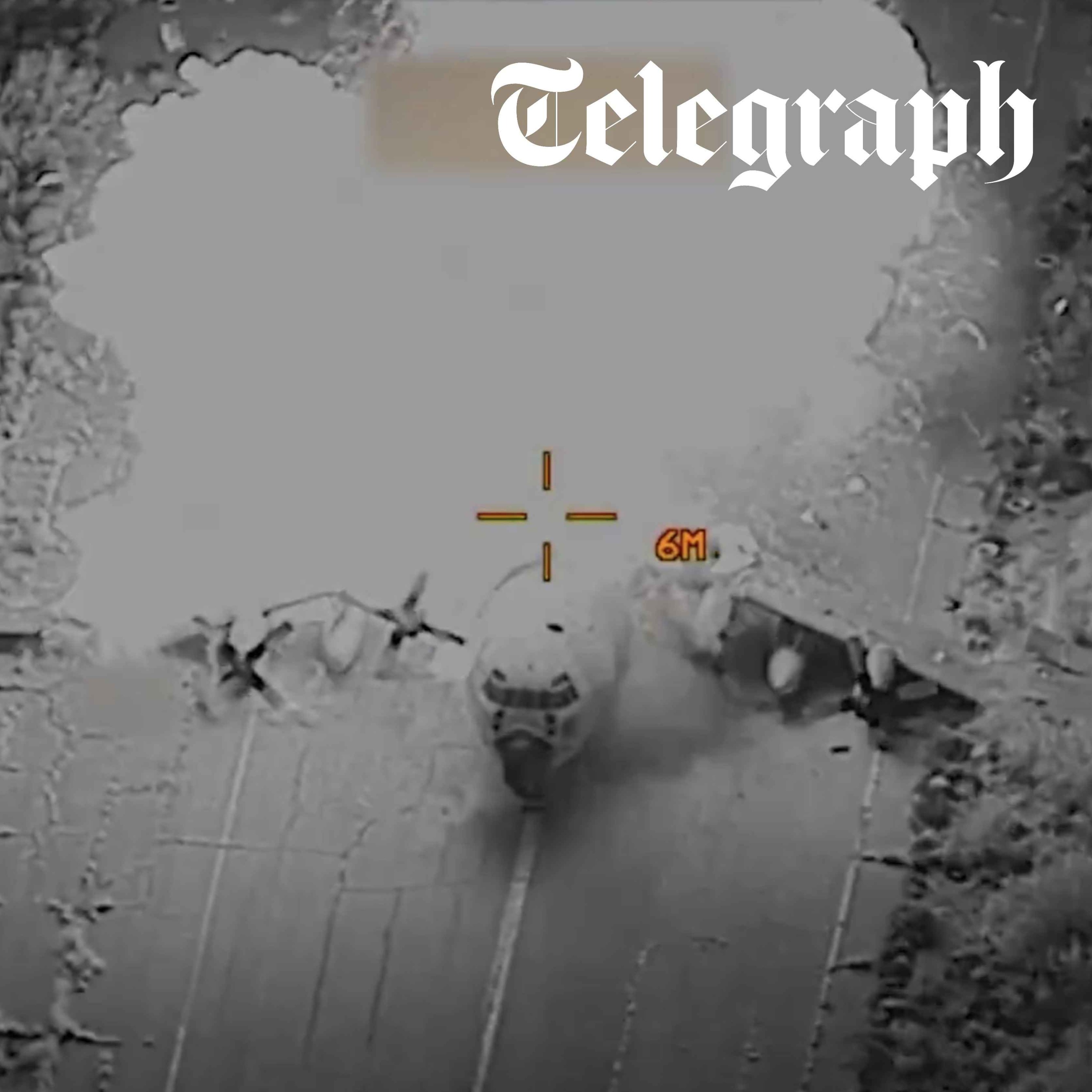
I'm Roland Oliphant and this is Iran. The Latest. It's Friday, March 13, 2026, the 14th day of the American and Israeli war with IR. Over the past 24 hours, a French soldier has been killed in Erbil, a US Refueling plane has apparently crashed, and there have been hits on a British base in Iraq. We'll be talking about the developments over the past day and the past couple of weeks later. I'm joined by Jonathan hackett, the former U.S. marine intelligence operative. But before that, I'm very pleased to say I'm joined in the studio by our foreign correspondent, Akhtar McCoy and the Telegraph's chief foreign affairs commentator, David Blair. Chaps, welcome to Iran. The latest. Akhtar, could I start with you? You've been, as usual, hard at work covering the latest stuff out of Iran. I was wondering if I could start with Mohamenei, who is the new supreme leader. We heard from him yesterday. What did he have to say?
- [02:50]
Akhtar McCoy
Actually, we didn't hear from him anything. There was a state television anchor presenter reading aloud his statement, a very long one, it had seven parts. But initially he was calling on his commanders to keep the Strait of Hormuz shut and he threatened to open new front lines. And he also called, he said, like the revenge is coming and what the American Israelis have Seen so far is just part of it. More attacks would be coming. And he also called on the Arab countries across the Persian Gulf to kick out American bases as soon as they can, or the attacks would continue. The problem is we don't know if he's still alive or dead. So these messages are coming and attributed to him, but we haven't seen him since last summer, and we haven't heard any voice message, any video from him since he became the supreme Leader on Sunday. And inside the country, his commanders, his officials, they have no communication with him. Officially, we only know he is injured. We don't know how badly he is injured. But the structure of the Islamic Republic now has a supreme leader. So before his selection as the supreme leader, so they didn't have a supreme leader, they didn't have a top authority. So the rest of the body, like the irgc, the police, the intelligence, everyone was just working on, like, doing their jobs on the Oran authority without receiving an order from above. That's how it's designed. So that's how Ali Khamenei, the former supreme leader, designed the Islamic Republic. So if you remove him from the
- [04:19]
Roland Oliphant
job, the body can continue without the head.
- [04:22]
Akhtar McCoy
Yeah. The limbs can strike and defend the
- [04:24]
Roland Oliphant
rest Times monster, right?
- [04:25]
Akhtar McCoy
Yeah. So now it has a head. But it's widely known that he is being imposed by the irgc. And so literally, the IRGC is in charge as it was before. And inside the country, people within the regime within the Islamic Republic are telling us that they have not heard from him. Like top commanders. Literally no one.
- [04:47]
Roland Oliphant
Top commanders in the IRGC have not heard from Mojtabahomeneh President.
- [04:51]
Akhtar McCoy
Top commanders, like, no one.
- [04:55]
Roland Oliphant
No one has actually heard from him. We're being told he's alive. A message has been read out by somebody else which is purportedly from him, but nobody's seen him. We're told he's alive but wounded in some way.
- [05:07]
Akhtar McCoy
How badly, we don't know.
- [05:09]
Roland Oliphant
Right.
- [05:10]
Akhtar McCoy
And one thing about Mujtaba, we literally don't know anything about him. We know he was just working in the shadows for decades, and he only spoke on camera for half a minute once in his life. Just saying he's stopping religious teachings as maybe a preparation for getting the job. But other than that, there are just some pictures of him with his father. No public address, no publications, nothing.
- [05:37]
Roland Oliphant
He's not in the phone book?
- [05:38]
Akhtar McCoy
No. And it for now, the Islamic Republic is running same as the Islamic Emirates of Afghanistan in the neighboring country, where they have a supreme leader. And we don't know where he is. We don't know how he lived. There is just one passport picture of him from decades ago, and we still don't know. Is that a lie?
- [05:56]
Roland Oliphant
Bit of a mystery, yeah. David Blair, you've been looking at Iran's retaliation through all this. How formidable has it been? And do you think they are feeling like they're doing okay?
- [06:08]
Narrator/Host
Iran's retaliation has been formidable, and it's been planned for years. And it's also completely predictable that if the regime ever felt that its back was against the wall, it would hit back in every way it could. It's built up the biggest arsenal of ballistic missiles in the Middle east for a reason. And that reason has come. That reason has arrived, and it's very striking. Yesterday, the International Energy Agency released a report which said very bluntly, the war in the Middle east is creating the largest supply disruption in the history of the global oil market. In other words, this supply shock is worse than the Arab oil embargo of 1973 and worse than the oil crisis that arose from the Iranian revolution back in 1979. This is the worst we've ever had. And we've seen the effects on the oil market. And so what Iran is succeeding in doing is imposing maximum possible costs on America and also on the wider world for this adventure.
- [07:12]
Roland Oliphant
That sounds like a part of the Iranian plan that's going to plan. If you'll forgive me, if we look at the war over the past two weeks, because the anniversary is literally tomorrow or overnight when many people will be listening to this podcast, two weeks in, that part of the Iranian plan seems to be going to plan Akhtar. Is there any sense that anything has gone wrong for the Iranians or that parts of their plan haven't come together?
- [07:38]
Akhtar McCoy
We published your plan, published by the Tasnim News Agency affiliate to the irgc. And it had seven steps.
- [07:47]
Roland Oliphant
This is before the war.
- [07:48]
Akhtar McCoy
Yeah. Before the fall. And now we are in the stage. Phase number four, shutting down the Straits of Hormuz. So according to them, according to Iranians, they are going as they planned. So for them, the end game is to make the war very expensive for the Americans and the Israelis. So they come forward, they ask for ceasefire, and then you win. That's the way of winning in the Islamic Republic. And the other way of winning is just to survive. So they have survived so far, and they are going according to their plan. The only problem is that we don't know how much of their missiles and drones are still left. I'm watching State television and we see like several times a day they say, okay, operation through promise four is phase 40. Something is now that would show you missiles and drones firing towards Persian Gulf countries or Israel. But we don't know how much is left. But we do know the Islamic Republic is still there. The structure is still there. They have a new supreme law, even if it's just on paper. Today was Quds Day, the last Friday of Ramadan, which the Islamic Republic commemorates, like, celebrates, like with rallies. And in these rallies, we have seen President Pizzashkian walking without a bodyguard, taking selfies with people.
- [09:01]
Roland Oliphant
This is today.
- [09:02]
Akhtar McCoy
Yeah, today.
- [09:03]
Roland Oliphant
And we saw Calibouf there as well.
- [09:04]
Akhtar McCoy
Kaliba was there. Ali Larijani was there. Mohsen ej, the head of everybody who's
- [09:09]
Roland Oliphant
running Iran except Mushtaba Khambanay.
- [09:11]
Akhtar McCoy
Yeah. Was out under Sid. And the other guy we haven't seen Ahmad Rezar Adan, the police chief was there, but we have not seen the commander in chief of for the irgc. Ahmad Wahidi. Yeah, we have not seen Ahmad Wahidi.
- [09:25]
Narrator/Host
What about Larujani?
- [09:26]
Akhtar McCoy
We saw both Larujanis, Sadiq Larajani and Ali Larajani, both were out there. And the head of judiciary, the President Khaliba, police commander, everyone, literally, except Mushtabal Khamenei and Ahmad E. Wahidi.
- [09:43]
Roland Oliphant
Sounds like they feel quite confident.
- [09:45]
Akhtar McCoy
Bombs were falling when the head of Jesusay Mohsiniji was speaking with people on camera. There were bombs falling around him next to that densely populated area. And in other occasions, there were also some strikes where state television was broadcasting live. And you could see strikes around the area.
- [10:01]
Narrator/Host
I mean, I think we can sum it up by saying that Iran probably has three reasons to feel that they're ahead. One, the regime is intact, even though the condition of Moshtab Al Khamenei himself may be uncertain. Two, their strategy of maximum retaliation has demonstrably succeeded in imposing a big on America and its allies and the rest of the world. Look at the oil price now at about $100 a barrel. And three, and this is an unexpected bonus which they couldn't have anticipated. And that is that America has clearly been caught unprepared by the scale of the retaliation. You can see that in two facts. One is that the American Strategic Petroleum Reserve is at historically a low level. Trump did not fill it up before starting this war, and it's actually below its safe peacetime minimum level of 500 million barrels. And the second is Trump did not send enough warships to be able to escort tankers through the Strait of Hormuz, which is, in the end, the only way that you're going to be able to reopen the strait and get tanker traffic moving again is by physically escorting these vessels. But the Americans simply don't have enough warships in the region to do that. So you can see how they were caught unprepared. And Pete Hegseth, the Secretary of Defense, has more or less said that in a press conference on Tuesday. So from a Iran's perspective, those are three reasons to feel encouraged. However, there's two big qualifications to that. The first is if there is now popular revolution in Iran, the regime could yet be swept away. No one knows whether or when that might happen. If it did happen, no one will be able to control it. None of us can anticipate it, but equally none of us can write it off. Conceivably, it might happen. And the second point is the point that Actar made. We simply don't know how many missiles and how many drones the Iranians have left, what their stockpiles are, how long they can sustain this barrage for. We do know that the number of drone and missile launches is substantially down. The American figure is missile launches are down 90%. Drone launches are down 83% since the beginning of the war. So whether those figures are disputed or not, I don't know. But there's clearly been a big reduction. So the question, I think, which again, none of us can answer, is how many missiles do they still have in the locker for how long can they keep it up? But as of today, day 14, the Iranian regime probably feels that it's doing pretty well.
- [12:39]
Roland Oliphant
The number of rockets, of course, is that's a critical military secret that they will keep close to their chest, just as the Israelis and the Americans will keep close to their chest the number of interceptors they have left, because that's information that either side's the enemy will really, really want. So crucial subject there, Akhtar David mentioned protests.
- [12:58]
Akhtar McCoy
Like there would be anything that any big change would come if people go out and protest. But there is a big problem here or there is a big abstraction limit here. Ahmad Reza Radhandi, commander of the police and also the Basije headquarters, they both threatened protesters yesterday. On Wednesday, Hamad Rezar Adan said if anyone comes out and protests, we would look at them as enemies. And I'm quoting him, he said our boys have their hands ready on the trigger. And the IRGC also is threatening people. Any dissident, any protest would be considered as an act of enemy and streets are filled with the Islamic Republic supported since the war started. And every night after half past seven, state television calls on people to come out, fill the streets, fill the mosques. So there is no space for anyone to come out and protest against the Islamic Republic at the moment.
- [13:51]
Roland Oliphant
So the regime is extremely sensitive to the threat of street protests and therefore they're making sure they control the streets.
- [13:58]
Akhtar McCoy
Yeah, for now they are controlling the streets. The Islamic public supporters are everywhere across the country.
- [14:05]
Jonathan Hackett
Right.
- [14:05]
Roland Oliphant
Aktar, I know you've, I wanted to throw a few listeners questions at you, but first I just wanted to ask you, Akhtar, I know you've been, you've managed to get in touch with some people in Tehran today and I know it's difficult. I know how difficult it is for us to have daily contact with people on the ground. And what are you hearing? What's the latest from ordinary Iranians?
- [14:24]
Akhtar McCoy
So this morning, ordinary Iranians in the capital Tehran, they woke up at around 5am to big explosions. Explosions they said they have not heard during the past nearly two weeks. And I'm going to read you some of the messages we got this morning. So one resident said they hit Tehran in a way that apparently many neighborhoods in Tehran felt a loud roar with ground shaking for several seconds. It was strange. Another resident said Tehran shook in such a way that at first I jumped from a sleep thinking an earthquake had come. When I became a bit more alert, I remembered it swore another one said very, very terrible. I'm a scared. They are leveling Tehran to the ground. So Tehran is still being bombed while there are still people out on the streets. One thing about Tehran is that it's densely populated area city. There are 10 million people living in that city. The Islamic Republic on day one of the war told everyone to leave the city. But not everyone can leave that city. They don't have simply the means to go. So when the American and Israelis are saying, okay, they are targeting this IRGC base or this Bast base or this government office and they're bombing it with like massive munitions. Those are located in very densely populated areas. So there would be massive civilian casualties. So far we know around 1300 civilians have been killed, including 200 children. And prices are going up, but bombs are still falling.
- [15:53]
Roland Oliphant
We've had a few questions from listeners over the past week and I thought this was a good moment to get into it. One question, several people have actually asked this question, but this particular one is from John from West Sussex. Why as far as we know, at least the Houthi regime in Yemen have not attempted to support Iran by closing the Red Sea to maritime trade. And given that they are Iranian allies and proxies, that seems quite strange. Any ideas?
- [16:18]
Akhtar McCoy
According to the Iranians, to the Islamic Republic, that's the next stage of the war for now. So Iranians are saying it's just Hezbollah and the militias in Iraq and themselves. On state television they say Houthis are not involved yet because we are not in full all out war yet.
- [16:35]
Roland Oliphant
So this is the next stage of
- [16:36]
Akhtar McCoy
that plan you were talking about next. I mean, state television said Houthis are not yet in because they are waiting for the full escalation, waiting for the orders from Tehran. We don't know because we have reported before that, before that the Houthis are not listening to the Islamic Republic as they used to. But the Islamic Republic says that in getting the Houthis involved is the next phase of the war. So. And we are not there yet.
- [17:00]
Roland Oliphant
So that's the Islamic Republic's thing. I'll say that. I had a conversation with a Yemeni analyst about a week ago and his take was, look, the Houthis, yeah, they work with the Iranians, but he said they are very much conscious of they have to have their own reasons to do things and that they have a very, a much stronger sense of kind of, I suppose, autonomy than perhaps Hezbollah do. And therefore he thought that it was unlikely that they were going to get involved at this stage. The uranium there is apparently 400 and something kilograms of highly enriched uranium somewhere in Iran. It's been missing since the 12 Day War last year. If that is to be secured, and we keep being told that is a prime objective, isn't that going to mean boots on the ground or perhaps Special Operation forces? Is there any way of securing that?
- [17:51]
Narrator/Host
It's a very interesting issue. So the essential fact is that Iran enriched 440 kilograms of uranium to 60% purity, which is one hair's breadth away from weapons grade. They did this in 2023, 2024, that kind of period. Then when the Americans and the Israelis bombed their nuclear plants last June, the belief is that all or most of that stockpile was in the plants that were bombed, which means that it's now lying under rubble. How exactly you would extract it and get it to safety, if that's the right word, I don't know. If it's not in those locations or the stockpile was broken up and other parts of it are elsewhere, I mean, obviously you would have to locate it first. How On Earth, you would then get it out of the country. Whether it's possible for soldiers to do that kind of thing, I simply don't know.
- [18:53]
Roland Oliphant
A commando raid of some sort.
- [18:55]
Narrator/Host
A commando raid. But can you carry 60% enriched uranium in a backpack? I rather suspect you can't. I think it's probably. It would probably be quite technically a difficult thing.
- [19:05]
Roland Oliphant
Isn't this a real issue? Because if the war ends and that material is, even if it's under rubble, I suppose if I was Mujtab Al Khamenei and I happened to be alive and actually in charge, let's assume that, and I wanted to get a bomb, presumably could just dig it out and retrieve it.
- [19:23]
Narrator/Host
Well, I think this raises the bigger question, which is, if at the end of this operation, you have the Iranian regime not only intact, but more extreme and more hardline than it's ever been, and probably convinced that its only means of survival and guaranteeing itself against something like this ever happening again is by getting a nuclear weapon, then they are going to go all out to do just that and they will rebuild what they have to rebuild and recover whatever stockpiles they can recover and just go for it. And that is the great danger. That is one reason to question whether this operation was really such a good idea after all. I put the point very mildly. Second thing to bear in mind, and this is the irony at the negotiations that were taking place before the war broke out between America and Iran, Iran was prepared in principle to negotiate away the stockpile in return for concessions. So there was a way potentially of solving this problem through diplomacy. But that was the road that was
- [20:27]
Roland Oliphant
not taken, I should say. That question was from Warren in Australia. One last question for you both from Alexander in Berlin. The US accuses Iran of being a terrorist regime. Is it likely that Iran would try to retaliate with acts of terror in the United States for the death of Khamenei? Have there been any terrorist attacks in the US in the past in which Iran was proven or likely to have been involved? I suppose you could extend that question to other parts of the world.
- [20:56]
Narrator/Host
So to address the final point, there have been occasions when Iran has been implicated in acts of terrorism in the United States. For example, an attempt to assassinate the Saudi and ambassador in Washington some years ago, about a decade ago, if memory serves. Secondly, will they do something like that in response to this? Here you have to separate capability and intention. Would they have the intention of carrying out terrorist attacks in America in revenge for what's taking place now? I think we can say with some certainty that they would have that intention. Do they have the capability? Quite another question. And there we would be speculating if we try to answer that, we simply can't know.
- [21:38]
Akhtar McCoy
We have the religious answer for that. Two grand ayatollahs in Iran, they both called for jihad and asked any believer to revenge Khamenei's death by killing Donald Trump. That's according to their statement. Some believers ask them question, okay, when the supreme leader is dead, he's killed, what is the obligation of the Muslim world? And both ayatollahs, both grand ayatollahs, the most senior ones, they called for jihad and said there should be revenge. They have the religious authority for that. Now. A. Fitzwa.
- [22:11]
Roland Oliphant
All right. They have called for this kind of thing to happen.
- [22:14]
Akhtar McCoy
Yeah.
- [22:14]
Roland Oliphant
Akhtamakoy and David Blair, thank you so much. We're going to take a short break now. When we come back, we'll be talking to a US Marine veteran about the tactics and progress of the war so far.
- [22:35]
Jonathan Hackett
ACAST powers the world's best podcasts.
- [22:39]
Narrator/Host
Here's a show that we recommend.
- [22:44]
Jonathan Hackett
What if you laughed all through your commute or if you heard the funniest
- [22:48]
Narrator/Host
story while at the gym? Well, now you can.
- [22:50]
Jonathan Hackett
I'm Jameela Jamil, and guests on my
- [22:52]
Roland Oliphant
new podcast, Wrong Turns, share their most mortifying and hilarious disaster stories.
- [22:57]
Jonathan Hackett
I'm talking people like Mae Martin, Bob
- [22:59]
Narrator/Host
the Drag Queen, Katherine Ryan, Jake Johnson,
- [23:02]
Roland Oliphant
Margaret Cho, Simon Pegg, Penn Badgley, and so many more. So listen wherever you get your podcast.
- [23:08]
Jonathan Hackett
Wrong Turns, where dignity goes to die.
- [23:14]
Narrator/Host
ACAST helps creators launch, grow and monetize their podcasts everywhere.
- [23:20]
Jonathan Hackett
Acast.com. Welcome back.
- [23:26]
Roland Oliphant
You're listening to Iran, the latest, the Telegraph's Foreign Policy and Defense podcast. Now, listeners who have been following us from the beginning of the war two weeks ago may remember a conversation with the former US Marine intelligence operative Jonathan Hackett, who very kindly gave us his predictions for what was then the war that might break out. I'm very pleased to say that Jonathan is joining us again today. He's on the line now to share his review of his own predictions and tell us what he thinks of how the war has gone. Jonathan, thank you so much for joining us Once again, we're two weeks into the campaign, and I think it's fair to say that generals on both sides will be sitting down and looking at the plans they went into this war with. Bearing in mind that old maxim, no plan survives first contact with the enemy. Or as Mike Tyson put it, everyone has a plan until they're punched in the face. And I was wondering if you'd help us reflect on what you think Iranian and also American and Israeli generals will be thinking has gone well and what they'll be disappointed with. And maybe we could start with the American side on that. You told me two weeks ago that General Dan Kain, the chairman of the Joint Chiefs, is a big disciple of the Colin Powell doctrine, which calls for overwhelming force. What do you think he is feeling about how this campaign has gone so far?
- [24:48]
Jonathan Hackett
So in his position, he can't set policy. He can only work with strategy. So he's working with what he's got. And it seems that policy has been a moving goalpost over the past two weeks. I think everyone has seen that and everyone's talking about that, which makes it challenging as a leader in his position because he has the assets available, but he's having a challenge of finding what objectives to use those assets against. And because those objectives seem a little more flexible than a military leader would want them to be.
- [25:15]
Roland Oliphant
That sounds like a diplomatic way of saying that Donald Trump is changing the goalposts all the time, and his general is not quite sure what he's meant to deliver. So what do you think? I mean, you said, look, it's going to be overwhelming force because it's the Colin Power doctrine. Part of the Power doctrine says, of course, you need clear objectives that are attainable. I think that's the thing you're saying is missing. How well do you think this has gone so far from the American perspective? What has gone to plan and what
- [25:42]
Jonathan Hackett
has not so militarily? The clear objectives are the ballistic missiles, the nuclear facilities, these like concrete physical structures that we can easily target and destroy. And we have done so. There's a creep of other objectives in which are not necessarily US Objectives. Specifically, the Israeli military's objectives are diverging with the United States objectives. That's a neutral statement. That's not negative or positive, but that, that puts pressure on the US Execution of the war because it's not a single unilateral actor in the conflict. Now, there are two actors. Well, there are many, but there are two that are actually prosecuting the war. And those two actors have differing end states and differing ways of actually achieving those end states. So, for example, if the US Is looking at a more strike focused campaign, but Israel is looking at a politically focused campaign where the outcome is a political outcome, in other words, regime change, if that's not the same thing that the US has, you're Going to see a continuing divergence of how the war is prosecuted. So if the US Continues an air campaign that's a limited activity, not just because of political will or economic will, but also because of assets. We don't have enough Tomahawks and we don't have enough F15s to continuously prosecute an aerial campaign beyond several hundred days, for example. Whereas Israel, fighting for a different objective, can sustain it. For example, I don't know if you've seen they've been using drone swarms at military checkpoints at a very tactical level, which we can talk about later, but those are two very different ways of fighting a conflict. And they're different not only tactically, but with their military objectives. They're achieving different things essentially. Right.
- [27:26]
Roland Oliphant
So I mean, you're talking about a gap opening up between the two allies here and you're saying we can see that already.
- [27:32]
Jonathan Hackett
Yes.
- [27:33]
Roland Oliphant
In what give you.
- [27:34]
Jonathan Hackett
The.
- [27:34]
Roland Oliphant
Give me, apart from the drone swarms as an example, that demonstrates that gap between Israeli and American objectives and operations.
- [27:42]
Jonathan Hackett
You see this especially with the talk about surrogate forces, for example, the Kurds or the Aeris in the northwest of the country working together in an unconventional warfare campaign. This would be a very important component that would tie together both objectives. Because the US doesn't want to put ground forces inside Iran. That's politically sensitive. Israel wants regime change. How do you marry these two things together where you still succeed on both sides? The surrogate forces is a pretty slam dunk way to unite the air campaign with the ground requirement of a regime change. Without that middle ground, it's very difficult to reconcile these two end states together and to continue fighting the war. It could be that the US Pulled back and stops, but then the objectives are not achieved there either. So that's not palatable probably to the higher level leadership making recommendations to the President. Right.
- [28:36]
Roland Oliphant
Okay. Can we turn to the Iranians then? They've taken a hell of a beating. Their supreme leader is dead. They've got a new one, but they've lost a lot. They've lost most of their navy. The Americans and the Israelis have control of the skies militarily on the battlefield. Tactically, they've really taken a terrific thumping, haven't they? But on the other hand, I suppose the regime is still there. We haven't seen any cracks yet. They have imposed massive economic costs by closing the Straits of Hormuz. And I suppose an added bonus is that the Americans seem not to be prepared for that. Do you think the Iranians feel that things are Actually going, okay, yeah.
- [29:14]
Jonathan Hackett
I think with their strategy, they're using, which I believe we've mentioned before, the Mosaic Doctrine. They've had this doctrine since around 2002, 2003, that they developed in their War College. And the concept is actually based on the German Aufstrag tactic, which is decentralized command and control, pushing authority to execute all the way down to the lowest level. And they issued the command for that on February 28, about two hours after this first salvo of strikes began. And what that does is it actually pushes authority down to the provincial level. There are 31 provinces. Each of those 31 provinces has one IRGC unit that leads in that province and does not require any command and control back to Tehran. So when they killed the chief of staff of the armed forces and the IRGC commander, there actually was no effect on those IRGC units as far as their ability to operate and execute what they believe to be the objectives, because those objectives are set in advance. So looking at that occurring over the past two weeks, the Mosaic Doctrine has actually worked quite well because they've been able to continue operating, especially under fire, in the western part of the country. If you look at the map that Dan Kane showed of the strikes, all in that western area, those units continue to operate today despite being completely severed from Tehran. And in addition to that, Iran has actually used its own way of blacking out the country by shutting off the Internet. Only about 4% of the country has Internet access. But the IRGC leaders, despite being completely blacked out in those provinces, are able to fully execute without any authority from above whatsoever. Of course, mistakes will be made in this situation because you won't have the feedback loop that you need with the command and control element. But I think they're willing to absorb those mistakes. And this way of fighting is actually very similar to what they developed in the Iran Iraq war, when units were under heavy fire, couldn't coordinate. They were poorly trained at that time. Now they've had more training. And I think they've learned a lot of those mistakes from the past. And In Syria in 2016, when they deployed for the first time since 1988, they were able to actually test out those decentralized command and control authorities in Syria in combat. So they've been able to test it a little bit. Not as much as a unit would want to, but I think that they probably, when they're evaluating themselves, they're probably thinking they're doing well.
- [31:25]
Roland Oliphant
So the Iranians will think they're doing well. The Americans and the Israelis will think
- [31:31]
Jonathan Hackett
it sounds like Americans think they're doing well based on the press conferences. Right.
- [31:35]
Roland Oliphant
And what do you think?
- [31:37]
Jonathan Hackett
I think that to be evaluating properly, you have to be honest with yourself and you have to be willing to accept your mistakes, because those are the points that you learn lessons. And if you do not identify your own mistakes, you fail to learn, you fail to adapt. And then when faced with a new problem, you will execute likely poorly.
- [31:56]
Roland Oliphant
So what do you think about who's doing better and who's doing worse? I mean, where is this going?
- [32:01]
Jonathan Hackett
Right. I think that the political pressure on the military to perform a particular way is causing, I wouldn't say failure, but an inability to meet those objectives. Because if we're using an air campaign only without a ground component, and we don't have a plan to secure the shipping lines of communication, in other words, the Straits of Hormuz, we're going to have a very difficult time achieving anything beyond operational level successes. And when I mean operational level successes, I mean taking out radars, taking out communications and things like this. Very military specific objectives. But a grand strategy in a war like this has more than just a military component. It has a diplomatic and informational and economic and a political component. And if those other four components are not on the same plane of importance as the military component, it's very challenging for you to use that military instrument to achieve these other four avenues of end state that do not, they do not intersect with the military instrument. So you're almost having a grand strategic problem here. That's, that's unraveling right now. And that's most easily seen in the Gulf itself, because we haven't taken Card island, which is a very important strategic point that handles 90% of the regime's oil exports, which currently Iran is exporting more oil right now than it was previously and has actually made more money in the last two weeks than before the war started. That's very important. That's economic instrument right there. That's not being pushed.
- [33:27]
Roland Oliphant
I'm wondering if in that case, from what you say, then the kind of, although the political imperative is no boots on the ground, whether you feel like the pressures generated by the campaign are going to push towards that option, whether it's on Carg island or whether it's on a, I don't know, a kind of amphibious operation to clear the kind of literal of the Strait of Hormuz, do you think that's possible?
- [33:53]
Jonathan Hackett
So the US Put itself in a little bit of a bind over the last few years because we had four minesweeping vessels that were specifically built to do exactly what you just mentioned. We decommissioned all four of those. The last one was decommissioned very recently. In this current administration, we have two other vessels that were not built for that. They're called littoral combat ships that were built for war in China because we thought that we were pivoting to China several times. I remember last 20 years we were cheering about the pivot to Asia, which never seems to occur. But those two ships were built for war against China. Now they're in the Middle East. Those ships are not, in a technical way, built for minesweeping, though they could be used for that. And, and the difference there is risk. There's a huge amount of risk using these larger vessels to do it because they're not purpose built. Some of these mines, for example, are magnetic. If you're not wearing the proper equipment, the mine can attach to you. Right? Because think about if you're diving to go work on this mine and you have a metal oxygen tank, for example, the mine will come to you and it will not end well for you. This is at a very granular level, but this is a small problem with large effects, right? So the US has kind of hamstrung itself in its ability to do demining operations in the littorals around the Straits of Hormuz and then the Gulf. That's one problem. The other problem is that we do have forces that are just that, are specifically tasked to organize man, trained and equipped to seize places like Carg Island. We've done things like this in Operation Urgent Fury in Granada. And we also have done it during 1988's Operation Praying Mantis doing Go Platts, which is gas and oil platform operations, which Marine Force reconnaissance and maritime raid forces from the ships in the region are able to do. But we did not think, it seems that we did not think to include that into the mission planning overall for this larger operation that we're doing. And I think the inference I'm gathering is looking at statements the administration has made about perhaps by the end of March we'll be ready to actually escort these ships. That indicates to me that there was not a thought ahead of time that these ships might need to be escorted.
- [35:57]
Roland Oliphant
I mean, a few weeks before this began, we wrote, my colleague Akhtar McCoy, wrote a piece called How Iran Plans to Fight the US And Win, I think it was called, and we wrote up it. It has a big section about blocking the Strait of Hormuz with the mines and so on. But you didn't have to read the Telegraph. We, we picked that up from One of the IRGC's own news agencies who published it in public in Persian in Iran a few weeks before the war. So it, I mean it wasn't a secret what they were planning to do.
- [36:31]
Jonathan Hackett
That's a very interesting point you make actually because, and not just with Iran, but with many non English speaking adversaries, which I suppose all of our adversaries are non English speaking. Somehow we on the, in the west as military planners, first of all, most, almost everyone does not speak that language. Second of all, even if they did speak the language, they're not reading what the other side is saying in their own language. And this is a problem because like Iran, for example, they say what they're going to do, they're extremely clear about what they're going to do. Like the Mosaic Doctrine was not a secret. It's been known for 24 years, but it is. And yet we lack the ability or will to, to, to look at what they're saying. And instead we're kind of working in the shadows to try to figure out what is it that they could possibly want, what could they possibly do? Well, they're going to close the Straits of Hormuz, they're going to decentralize their forces around the provinces and they're going to use a, a level of attrition warfare that they know will impose costs that the west, especially the United States domestically is not willing to bear beyond a particular time horizon. And this isn't me as a military person saying this. This is them. They have said this publicly, as you mentioned in their own press says, extraordinary.
- [37:39]
Roland Oliphant
But I mean the US Military has people like you, kind of Farsi speakers who are focused on this and have to write up reports and, and it's meant to go up the chain. Right? So what's happened here? I mean this is, this, this I think is a really interesting question. Is there a fate? Where is the failure of intelligence? If you see what I mean?
- [37:57]
Jonathan Hackett
In the special operations community, we used to call this problem capacity at rest. And this means that you have people that can do the thing and then you have the thing being done and that there's not a connection between those two things. And that's for usually bureaucratic problem reasons because there are frictions in the system that prevent that Farsi speaker from actually sitting at that desk that's producing that report. The person producing that report may be a 22 year old soldier who doesn't speak Farsi, knows nothing About Iran. They call it Iran, first of all, because they don't even know what the country is called in its own language. And they're writing about whatever it is that their biases tell them to write about based on the intelligence that they're provided. They don't understand how to do asset validation, which means testing the sources they're using. And there's all these problems in there. And this is a large reason we had, especially even with the CIA during the Cold War, the mirror imaging problem where we thought the Soviets thought like us, even though the Soviets produced documents and manuals. I have some of them on my shelf behind me that said, no, they're not thinking like the West. They have completely different views of the world. And yet even these highly trained, proficient case officers were using their own worldview to think about how the adversary thought.
- [39:06]
Roland Oliphant
In that case, let me put this to you. So when we spoke two weeks ago on the eve of this war, you were talking about your time in the Marines, and you said back then, I'm just going to read you the quote. We had a few moments when we were about to go to war with Iran back then. I remember some nights in particular where we were up to 36 hours straight with about to actually invade the country, and we didn't do it. He said that was under John Brolton, his national security adviser. So during Trump won. And the thing that catches my eye with that is you said that's an important thing to highlight between Trump 1 and Trump 2. The way they're approaching this is more deliberate, and a lot of what they're doing is planned much further in advance than it was during Trump won. Nonetheless, we're seeing all these problems that make it look like it hasn't been planned very well. Are you, Are you. I don't know, are you going to take back those words?
- [40:03]
Jonathan Hackett
What you're seeing is the infiltration of political pressure into military operations, which in a democracy is appropriate if it's well intentioned and is pushing it in the right direction. But because we have these domestic political pressures and also leaders at the top who may not understand the implications of the choices that they're forcing the military to make, you might see some outcomes you didn't expect. And I'll also mention that when we say planned in advance, the entire thing is not necessarily planned in advance. Like the, for example, Operation whatever you want to call it that Hegseth comes up with, that whole thing is not in advance, but there are things called preparation in the environment that occur far in advance, perhaps years in advance. There have been troops and forces and intelligence entities working on potential conflict scenario with Iran for decades. And a lot of those structures have been in place waiting to be used as a component of a larger operation that has not yet been thought about. You know, the outlines of a plan haven't been written yet. And, but they're able to pull these contingency plans and the concepts of operation off the shelf and plug them into a larger campaign plan. That could be asset networks, like source networks inside of Iran that could be rat lines and movements and lines of communication that can be activated and used in this situation. And those things aren't just built and then left. They have to be continuously touched to ensure that they're good and validated. And that, that could be humans as well. There might be a human who owns a company that you need to have active. When you say go, that means you have to keep a relationship with that human over many, many years, doing nothing much except just making sure they're still, they're still in it.
- [41:38]
Roland Oliphant
Right. And that's part of the COVID part of this, of this operation, which you said earlier, when we spoke two weeks ago, he said, remember, there's going to be the visible part, there's going to be the COVID part that we don't see. What's your. I mean, we don't see what's happening in the COVID part. But are you able to give us a guess or a review of how well the COVID war is going compared to the visible war?
- [42:01]
Jonathan Hackett
So the most visible part of that covert activity going on is the Israeli side, and that is at the very tactical level, at checkpoints and police locations where the Israeli side is able to use drones that are flying at 45,000ft to coordinate activity on the ground, where an individual on the ground is able to actually do what we call terminal guidance, which is to lead that drone onto the very last, perhaps the last mile, so to speak, to that target, which in this case is a person. Now, at this point, because it's very low level, how does that happen? That's not an Israeli operator on the ground. That's a recruited asset who's typically Iranian, sometimes Aziri, sometimes Kurdish, sometimes Baluchi, sometimes Mujahideen, and in many cases mujahideen on the ground in Iran doing that last mile.
- [42:49]
Roland Oliphant
You say mujahideen. You mean Mujahideen Al Khaq?
- [42:51]
Jonathan Hackett
Exactly, the mdk. And this has been an issue for the regime since 2012, when all the nuclear scientists began dying. A lot of that was Mujidini Khalk on the ground inside Iran who were recruited by Mossad who were doing the last mile terminal guidance on those targets. If you remember Farouk Sadeh, who was the leader of the atomic program, killed with a robot. That robot was bought, brought to the country, assembled, set up and, and used actively by somebody nearby. And that somebody nearby is not an Israeli Mossad agent walking around. That's a recruited asset inside the country. And, and this is the kind of COVID activity we're talking about right now where there are many people inside the country helping to get that last mile targeting. And you're actually going to see a rapid expansion of this, I predict, over the next few weeks, because about three days ago, Israel did the very first strike of this nature, this tactical strike on a police checkpoint and a Basij checkpoint at the same time. To me that looked a lot like a probing operation where they were seeing have we removed air defenses sufficiently to safely allow our guys in the ground to operate with our people in the air to start doing these strikes on these lower level targets, which is probably another phase of the operation on the Israeli side, not necessarily on the US side. But that means that these people are on the ground. They need sustainment, they need logistics, they need air support, they need a lot of background things to make sure that when they're standing there across the street and they see that target enter the house, they can do whatever follow on action is required.
- [44:18]
Roland Oliphant
You're predicting an expansion of that. Would it be fair to say that this is the Israelis moving into their attempted regime change phase, if you see what I mean. Because one of the things that's come out from our reporting in Iran is that the regime has been extremely conscientious about maintaining control of the street, both by kind of flooding it with its own supporters, making sure there's a big presence of pro regime rallies and so on, but also having a lot of Basij and police and whoever on the street to preempt any kind of street uprising. And it sounds like from what you're saying, the Israelis are trying to target those forces, perhaps to create street space for potential protesters.
- [45:05]
Jonathan Hackett
So looking at the shift in target deck, what you're seeing is a shift in center of gravity targeting. And if you're a Clausewitz fan, you know about centers of gravity, it looks like the US calculated the center of gravity for the regime was top level leadership, which is a large mistake. And instead the center of gravity is much lower down. And I think the Israeli Air Force and IDF understand a little Bit better about that center of gravity because they're more penetrated into there. And what they're doing is, as you mentioned, where is it that this regime is still surviving? Where is it that the lifeblood is still flowing and it's not at the higher level. It's not Khamenei, it's not Larijani, it's not Kalibat. It's these basis, which are around 400,000, perhaps 600,000, depending on who believes which numbers. There are many of them. And they have the guns, those are the ones that are keeping this going and keeping the people from actually coming to the streets. Because they've been issuing messages I'm sure you've seen, saying, if you come to the street, we're going to kill you. They're putting this on social media.
- [46:01]
Roland Oliphant
Oh, yeah. You, you will be treated as a traitor as you're collaborating with the enemy.
- [46:04]
Jonathan Hackett
Exactly. So fear is their weapon in addition to the guns they carry. And I think what Israel is trying to do is actually target that threat because that's the thing that's stopping the people from actually going out to the streets and taking their own power back.
- [46:17]
Roland Oliphant
Any guess on whether they'll succeed?
- [46:19]
Jonathan Hackett
I think they're hoping to, and I think it's possible. Because actually, when I was looking at how many strikes have occurred over the last 24 hours, I remember in 2016, when we were in Iraq fighting Daesh or ISIS, we were going to retake Mosul, and my team was working behind enemy lines to actually provide the preparation necessary to move conventional forces in to do that. And what we did was we actually started striking funerals. So we would strike a high level guy and kill him, and plus let's say six to 80 other people in his, in his meeting. Then there would be these big funerals for these big guys that got killed. We would track all those people, see them all go to the funerals, and then we would strike the funerals, because at the funeral, only male fighters attended those funerals. And we can see the same thing happening right now with the Basij funerals. And it looks like Israel's doing the exact same thing. They're targeting those funerals. Those are great locations from a targeting perspective, to hit as many targets as you can at the same time. Instead of having to spread out all over these checkpoints, well, you can just bring them all to one spot. And soon the regime will figure that out. But in the meantime, they're going to lose a disproportionately high number of base and regular Security forces on the ground. I don't know if you saw the imagery of Golly, Baf and Larijani actually walking in the streets on Quds Day, which is today, which I, I was a little bit surprised to see that, and I'm surprised they're still walking because these are the types of, of activities we would strike because those were only males, they were only IRGC or Basij guys walking together. So from a civilian casualties perspective, it's actually quite minimal.
- [47:47]
Roland Oliphant
You were an interrogator at some point in your career, if I'm not wrong. In the course of, you know, all the people that you've spoken to, all of these people, who you've encountered, all of the, all of the studying you've done of who they are, whether that gives you some kind of insight into what makes these people tick. What is it that motivates you? You referred earlier on in our conversation to this problem in the Cold War where you'd have CIA guys kind of just imagining that the Soviets were thinking the same way and they weren't. Why are they doing this? And I suppose the ultimate question is why haven't we seen these cracks in the regime? Why hasn't it come tumbling down the way it was kind of implied that it would?
- [48:34]
Jonathan Hackett
Yeah. So, you know, first want to start by saying the regime is not Iran. And in a country of almost 90 million people, you have a single digit percentage of those people that likely support the regime. So inside that single digit percentage, these are the people I'm going to talk about. These people have a very different way of viewing not only their own individuality, but their value to the world. And this is again philosophical, but this is an important point to your question. Americans, in the west in particular are individualistic. So my actions belong to me. Like we have guilt and innocence, for example. In this particular culture we're talking about, they value something called martyrdom, which is value laden when we talk about it in English. But in, in the Middle east, martyrdom is a positive thing because it's not an individual acting, it's a person acting on behalf of the group. So the thing that they do, the action, is left behind, whether they're there or not. And that thing left behind is the result of martyrdom. So sacrifice does something for the group they belong to. And this is something that in the west feels strange and feels like it's hard for us to understand that because we're a guilt and innocence based culture and we think that, you know, I'm guilty for my action If I hit someone with my car, it's my fault. Well, if you've ever been in the Middle east and you see a car accident, you'll see like 20 people show up and start supporting the different sides against the car accident. Right? Because it's a group that. It was the person's attachment to the group that's important. And when we saw Khamenei died, I think many leaders in the west probably thought, oh, that's it, it's done. Because he's dead. He was the leader, he represented something. And in his death to them, he sacrificed for them, he gave for them. There's even a saying in Farsi that's very sweet, Gorbanet Baraman, which means I die for you, I sacrifice for you, which is a sweet thing that you say to your darling.
- [50:25]
Roland Oliphant
Right?
- [50:26]
Jonathan Hackett
So even built into that on a non military context, there's this feeling of sacrifice, being sweet, being nice, being something that you do for somebody. Where in the west that's not the case. And if you're looking at what the regime is doing, look back to 1980-88 when Iraq invaded Iran. The human waves, they were walking over bodies to get further into the fight. They saw their comrades dying and they celebrated that. I mean, there are actual institutes that have been built after the war to celebrate them killing themselves for the bigger cause. And a lot of times we think about the cause and patriotism, but that kind of is in the background of our own self interest. And that self interest exists in all humans. But it's felt in a different way. It's felt in a group way, in this single digit group of folks that support the regime.
- [51:13]
Roland Oliphant
Given that, can the regime be brought
- [51:16]
Jonathan Hackett
down then I think probably not the way that we want it to be. Not like, oh, the government's gone. Because again, last 25 years we always said you can't kill an idea. This has always been a problem where we in the west believe that we can kill an idea and we'll throw a lot of resources and people at it and we'll just solve this problem. And it could be that we're solving the wrong problem. It could be that the people that have the capacity to actually change something are not empowered to do so. And that's the everyday Iranian on the street who right now, when they want to buy yogurt, they have to put a payment plan to buy yogurt. They're not thinking about regime change, they're thinking about how do I eat, how do I drink clean water? Because there hasn't been fresh water available in Tehran since June, right to everybody. Some people have it, not everybody has it. So there needs to be some way that the people that can actually go out in the streets and say we'd like to have a referendum and go vote in the modules and get a new government, those people need to feel safe enough to do so and be empowered to do so. And that's where the real center of gravity in this conflict should be focused, is how do we help them? And the military component should be a small piece of that. That should not be the overwhelming, awe inspiring component of this conflict, because the conflict is not with bullets. The conflict is at the dinner table.
- [52:29]
Roland Oliphant
That was Jonathan Hacker, the former US Marine Corps interrogator and Special Operations capability specialist. That's all for today. We'll be back on Monday. Over the weekend, you can check telegraph.co.uk for our latest breaking news. We'll be following the war in Iran as closely as we possibly can and thank you once again for being with us. We really appreciate it. If you have any questions, don't hesitate to writing. We're always pleased to hear from our listeners and we do read every email until then. That was Iran the Latest. Goodbye. Iran the Latest is an original podcast from the Telegraph created by David Knowles and hosted by me, Roland Oliphant and Venetia Rainey. If you appreciated this podcast, please consider following Iran the Latest formerly Battle line on your preferred podcast app. And if you have a moment, please leave a review as this helps others find the show. To stay on top of all our news, subscribe to the Telegraph, sign up for our Dispatches newsletter or listen to our sister podcast Ukraine the Latest. We're still on the same email address battlelinestelegraph.co.uk or contact us on X. You can find our handles in the show Notes. The producer is Peter Shevelin, the Executive Producer Producer is Louisa Wells.
- [53:53]
Jonathan Hackett
ACAST Powers the World's Best Podcasts Here's
- [53:58]
Narrator/Host
a show that we recommend.
- [54:01]
Jonathan Hackett
Christian Bale was preparing for his role
- [54:03]
Narrator/Host
in American Psycho, dressing the part, hitting
- [54:06]
Jonathan Hackett
the gym for the first time in his life, even getting his teeth redone. There was just one problem. He didn't actually have the part. Leonardo DiCaprio did. Listen to our podcast what Went Wrong? Every week as we unearth the chaos behind Hollywood's biggest movie flops and most shocking successes Available wherever you get your
- [54:28]
Narrator/Host
podcasts,
- [54:32]
Jonathan Hackett
Acast helps creators launch, grow and
- [54:36]
Narrator/Host
monetize their podcasts everywhere.
- [54:38]
Jonathan Hackett
Acast.com.