Loading summary
Transcript67 lines
- [00:04]
A
The telegraph. ACAST powers the world's best podcasts.
- [00:15]
B
Here's a show that we recommend. What makes a leader worth following? What should you really care about in your job? As technology is changing so quickly, is it just gonna be about machines talking to other machines? I mean, should you quit your job and start something on your own? What would that? What does success and risk look like when we're all at the starting gate together? These are the questions we answer each week on Lead Human with Jack Myers and Tim Spengler. Join us each week and subscribe at your favorite podcast platform and YouTube. We'll tell stories, we'll hear from some of the best, and we'll try to figure this out together. ACAST helps creators launch, grow and monetize their podcasts everywhere. Acast.com the videos are very high quality because they're easier to make with AI models. They push on a lot of current cultural memes and jokes. It makes it very relatable and easy to understand and people love that.
- [01:17]
C
A short time ago, the United States
- [01:19]
A
military began major combat operations in Iran.
- [01:25]
C
Today, President Trump says Iran's supreme leader,
- [01:27]
A
Ayatollah Ali Khamenei, was killed in the attacks.
- [01:35]
B
The Pentagon is weighing a takeover of that island as a way to force the reopening of the Strait of Hormuz. Iran begged for this ceasefire and we all know it.
- [01:46]
C
Does anyone really think that someone can tell President Trump what to do? Come on. I'm Venetia Rainey and this is Iran. The latest. It's Tuesday 19th of May, 2026. We're now on 81 days since the war first began and 41 days since the ceasefire was declared. Well, the war was scheduled to restart today. That's according to Donald Trump. But he says he's postponed his planned attack on Iran at the request of Qatar, Saudi Arabia and the United Arab Emirates. That's because serious negotiations are now taking place, according to him. He said that he told the US Armed forces to stand down for now, but had also warned them to be prepared to go forward with a full large scale assault of Iran on a moment's notice in the event that an acceptable deal is not reached. He went on to say this deal will include importantly, no nuclear weapons for Iran. So that's the big picture status of the war. We are still in the holding pen today. We're going to look at some different theatres in this conflict. Later on in this episode, I'll be looking at what's going on in northern Israel and what they're doing to cope with the growing Hezbollah drone threat there. But first, I want to look at the information war. Now, if you're like me and you spend a lot of time on Donald Trump's Truth Social account looking for statements like the one I read you, you may have noticed quite a lot of AI stuff recently. There have been a series of videos, for example, over the past 24 hours, endorsing fellow Republicans standing for various positions across the us. There have also been pictures of aliens, interstellar warfare and a zombie, Gavin Newsom, the governor of California. Of course, none of this is new. In recent months, Trump has circulated AI, created images and videos that depict himself as a pope, a warrior, winning the Nobel Peace pr. And this is all part of a wider trend, right? AI stuff is now everywhere. And the Iran war has arguably been the first AI conflict. We've previously looked at how AI is being used by the US and Israeli armed forces on the battlefield, but today, like I said, I want to look at how it's being used online in this information space. Earlier, I spoke to Tal Hagan. He's an information warfare analyst and media literacy lecturer who specialises in exactly this stuff. We spoke about some of the worst examples from this conflict and also the significance of the breakdown in people's trust in what they see online. Here's our conversation. Tal, welcome back to around the Latest. We last had you. One woman's podcast was Battle Lines, so I suppose. Welcome to around the Latest. Last time we spoke, we were discussing misinformation and online disinformation in the Gaza war. Now we're in the Iran war and there has been an absolute explosion of AI videos specifically. But also I think distrust of any image that you find online these days, that sort of fog of war is even more intense, I felt, during this conflict than during previous conflicts. You know, we've now got like, AI slop and slopaganda, all these terms that we can get into during this chat. Just give me your sort of overall impression about what it's been like sorting through the world of online misinformation over the last few months.
- [05:00]
B
So really, it kind of started before the outbreak of the war on February 28th. You could say towards the end of January to the end of February, we started to see a lot more different types of false reports that the Americans are about to attack, the Israelis are about to attack, Iran's about to attack. Basically depending on who the activist or supporter was, these are the types of false information that was coming out at the moment. Then once in a while, you would see different types of imagery of false fake explosions or explosions from different time periods being reused to say that this is the beginning of the conflict. But really after February 28, when Israel and then the United States initiated airstrikes on Iran, on various different types of military infrastructures, that is really when the absolute tidal wave of false information started to spread throughout all of different types of social media chats every which way. I mean, I was monitoring the news almost 247 at that, in the first few days of the war, and maybe for the first two weeks, and my feeds were just entirely full of false information. It was almost impossible to understand what was actually happening on the ground, whether the war was going in the US and Israel's favor or Iran's favor. Because almost everything that was filling up our feeds was false information. Because that false information was vibrant, it was attractive, it was interesting to watch. And then, because that's what was interesting for people to see, that's what started to fill up all of our feeds.
- [06:23]
C
Yeah, I guess. And that's where the algorithm has even more of a deleterious effect, because as you say, it sort of picks up these things that people are lingering on that interested, and they might be thinking that's fake, but for the algorithm, they're lingering, they're interested, so it'll keep serving it up more. And these AI videos, I mean, they've got millions of views. Just a few examples. Iranian missiles exploding on the Tel Aviv airport, US soldiers being held at gunpoint by the Iranian military. Iranian military facilities being destroyed. I know. There were also satellite images going around of an American rad in Qatar that have been destroyed by an Iranian drone strike. An absolute deluge of misinformation. I wonder if there's an example that you want to come back to that you found particularly striking from the last few months.
- [07:05]
B
One that I found really interesting was when they started in different individuals or governments. One of the things that's very hard sometimes to figure out is exactly who is behind this disinformation, the purposeful spread of false information. Whether or not it's individual actors and activists or it's a government entity. That's not always easy to prove. And there are entire organizations and companies that focus on that. But one interesting thing was satellite imagery, because the open source intelligence community, one way that they and myself have tried to understand what's actually happening on the ground is looking at satellite imagery. And whoever is behind this type of false publications, they started also putting out AI satellite imagery. Some of it that looked really, really really realistic. And so it became much harder for investigators to actually understand what was happening on the ground because of this false imagery. And the attack that you mentioned in Bahrain, I think it was on a. On a satellite dish during the strikes in the American bases that actually happened. Like, the site was actually struck. And like, a few weeks later, we actually got satellite imagery and it showcased it destroyed. We knew that the base was struck based on geolocation data and verification, but we didn't have imagery of it. And people need imagery, they need to see something destroyed. And so that's where the AI imagery came into play, because it gave people something to look at and they couldn't wait. They couldn't wait a few weeks for the real IM to pop up.
- [08:25]
C
The satellite imagery is really interesting because we did have satellite images at the beginning of the war, but since then there's been like a near total blackout. Right. A lot of the American companies have been told to withhold satellite imagery due to national security reasons. How problematic has that been for people trying to debunk or prove that things did or didn't happen?
- [08:42]
B
It can be very, very hard to get an overall sense of really what's happening on the ground. In Iran in general, the type of Internet connections are heavily restricted in regard to what actually gets out of Iran. So we almost had no information from there. In Israel, we're mainly restricted when it comes to military sites or strategic sites being struck. So then we don't know if they're being struck or not because no videos or photos usually come out from there. And satellite imagery essentially allows the common person, the average citizen, to understand what's actually happening on the ground. But with the removal of that capability, it makes it much, much harder. Now, one response to this is, well, that's okay. At the end of the day, if I'm an American citizen, I want to protect my troops and assets on the ground. But one issue that it brings up for the average citizen, especially in democratic societies, is that in order for us to know how we are to approach our elected leaders in regard to this war, whether we think it should continue or not continue, or we think that devastating, horrific things have happened that require consequences, we can't know how to interact with our leadership because we don't know what's actually happening.
- [09:47]
C
I think one particular example that sticks out to me is the strike on the Minab School, which happened on the very first day of the war. There was still satellite imagery coming out from that. There was a real fog of war around that because the Iranians were clearly trying to make a big deal out of it. But we know that that strike did happen, and OSINT has put together a picture of how that happened with an American Tomahawk missile, although the Americans officially say they're still investigating. It seems relatively conclusive from mult mainstream media reports, but there were a lot of allegations that the images of the cemetery in Minab had been digitally manipulated, that images of people rallying in Iran had been digitally manipulated. Can you just talk us through some of the things that you saw around that attack and how you were sort of sifting through what was true and what wasn't?
- [10:30]
B
Yeah, so I remember when the Minab strike occurred, it started to really fill our social media feeds. One thing that came out when it comes to the lack of information is that people are talking about children that were killed. It's not enough anymore in our current information spaces for just to hear about dead children. We have to see dead children. And so that's why a lot of AI imagery of dead children started to pop up, because we needed to have an imagery. And so that was then also used to say, this is like it's false information that there was no strike on the school because of these AI images. The cemetery is also a great example. That was something that I debunked because essentially I was able to prove that the cemetery was real, because what had happened there, actually, interestingly enough, is it's another example of. Of one of the issues that we face today is the over reliance on LLMs, large language models, which are ChatGPT, Grok, Gemini and all these others, where we don't understand their capabilities and their limitations. And therefore, when Grok the X or formerly known as Twitter, was asked where the photo of the Minab cemetery was actually taken, it started to say that it was from India or the Philippines or different places in South Asia. And it never showed a source, it never actually showcased any proof. It just said it was from there, and this was used as proof that the image was fake. I went ahead and I was able to actually pinpoint exactly where the photo was taken and find multiple different examples of the image from different angles to prove that it was taken from there. But it required a lot of work where all people had to do was just ask the AI, is this real? And they just believed it, as in they didn't trust me, where I had all this verified information that they could check themselves. Instead, they were just heavily reliant on whatever they wanted to believe, because as you said in the fog of War what happens really in war, one of the biggest issues isn't really the fog of war. It's the partisan reactions that people must have. As in, you either have to be for this side or for the other side. You can't be non bipartisan because if you're bipartisan, you are for the enemy because you're helping them. You know, me as an Israeli, when I was looking at that case and I proved that the cemetery photos are real, that the building was actually struck, then some of the reactions are, you know, like, why are you helping the Iranians? But it's not about helping the Iranians, it's about ensuring that we as citizens know the full picture. And that's all that really matters at the end of the day, from my perspective, that we all need to understand the full picture. And as you said, it seems pretty conclusive what occurred. And we're still waiting for the official American response. I don't know if they ever gave one about exactly who is responsible. The Iranians were very clear from the get go. It also helped their media efforts against the United States. But it was a very, very interesting case study of AI being used to debunk information which wasn't true. Using of AI imagery of this partisan reaction to these types of events.
- [13:11]
C
How damaging do you think GROK specifically is? Because so much of this sort of information warfare and then also our gut instinct to try and debunk it or question it or criticize it, that's all happening on X these days. And GROK is right there. You can just ask it a question, you tag it. For those who don't know how it works, you know, you just tag GROK and you say is real or where did this come from? Or is this person lying? What's the evidence for this? And GROK will come back with an answer. As you say, it doesn't always source it and we don't know exactly where it's getting its answers from a lot of the time. How damaging has that been for someone like you who puts in the hard graph to try and prove whether something is true or false?
- [13:47]
B
GROK is not unique in its ability to be damaging, as you said. What is unique is that it's directly connected to the platform as in Facebook or YouTube or TikTok and Instagram don't have this type of feature. And people like to be spoon fed. They like as easy as possible to get their information. And so GROK allows them to very easily get this information without then going to ChatGPT and opening another tab and GROK has been very, very difficult for me handling it as a researcher, because for some reason we still have a misunderstanding of how GROK actually works. I wrote an entire paper on this talking about, it's called AI and fact checking when probability replaces evidence. And essentially in that piece I talk about essentially how LLMs actually function. They're essentially big statistical models that are doing just probability. They don't know anything. When you ask it, for examp, is an apple a fruit? It doesn't know that an apple is a fruit. It's simply looking statistically. What category do we always see apple appear in? And it always appears in fruit. Therefore, statistically it has to be a fruit. That's how it's doing the model. It doesn't know anything. And so when you have these types of events that are happening in real time, especially with wars, where you don't have all the information easily accessible, GROK doesn't know what to do. So it just has to take any information that it gets. So if everybody on the community or on Twitter, the majority of people are saying that the responsible party for the strike was Iran, then GROK will most likely say that Iran was responsible. And the second that you. Everyone starts correcting Grok and saying that it's America, then everyone will say, then GROK will say it's America. But it doesn't. It'll constantly just change its opinion based on what information you give it.
- [15:20]
C
There was another example that sticks out, that Netanyahu put out a video and everyone accused him of having an extra finger. And then some people said he was dead. What did you make of that? What did you make of that video and all the allegations that came out of it.
- [15:32]
B
So I remember when the video was first published and people started, you know, at first I didn't realize how bad it was going to get. I ignored it at first. It was one of those verifications that I didn't. I didn't even talk about it. I thought, this is beneath me to even deal with this. But then it's. It went really viral and people were believing it. And there are some people to this day that still believe it.
- [15:49]
C
Yeah, we've had an email from a listener about it. It speaks to the misinformation, doesn't it? Because once that seed of doubt is
- [15:54]
B
out there, there are some commentators, I still, to this day who still, like, are, are convinced every video and everything is fake. And I looked at the video from an expert point of view as an AI analyst and something that I do day to day, I Found nothing that was out of ordinary. I looked at everything that was rare. But what people do is they, they, they focus on one tiny little error in the video or something that doesn't really make sense, but it can be explained away and that becomes, that becomes a story. And so that's what we saw with Netanyahu. And also one issue that happens, and this happens a lot with online communities, as in no matter what you say, they're always going to go to their opinion. And I see this a lot with online communities where that essentially most people who operate online, they have a core belief system. Israel is bad, Palestine is bad, Iran is bad. These very, very simplistic core identities. And no matter what they see in front of them, it has to align
- [16:44]
C
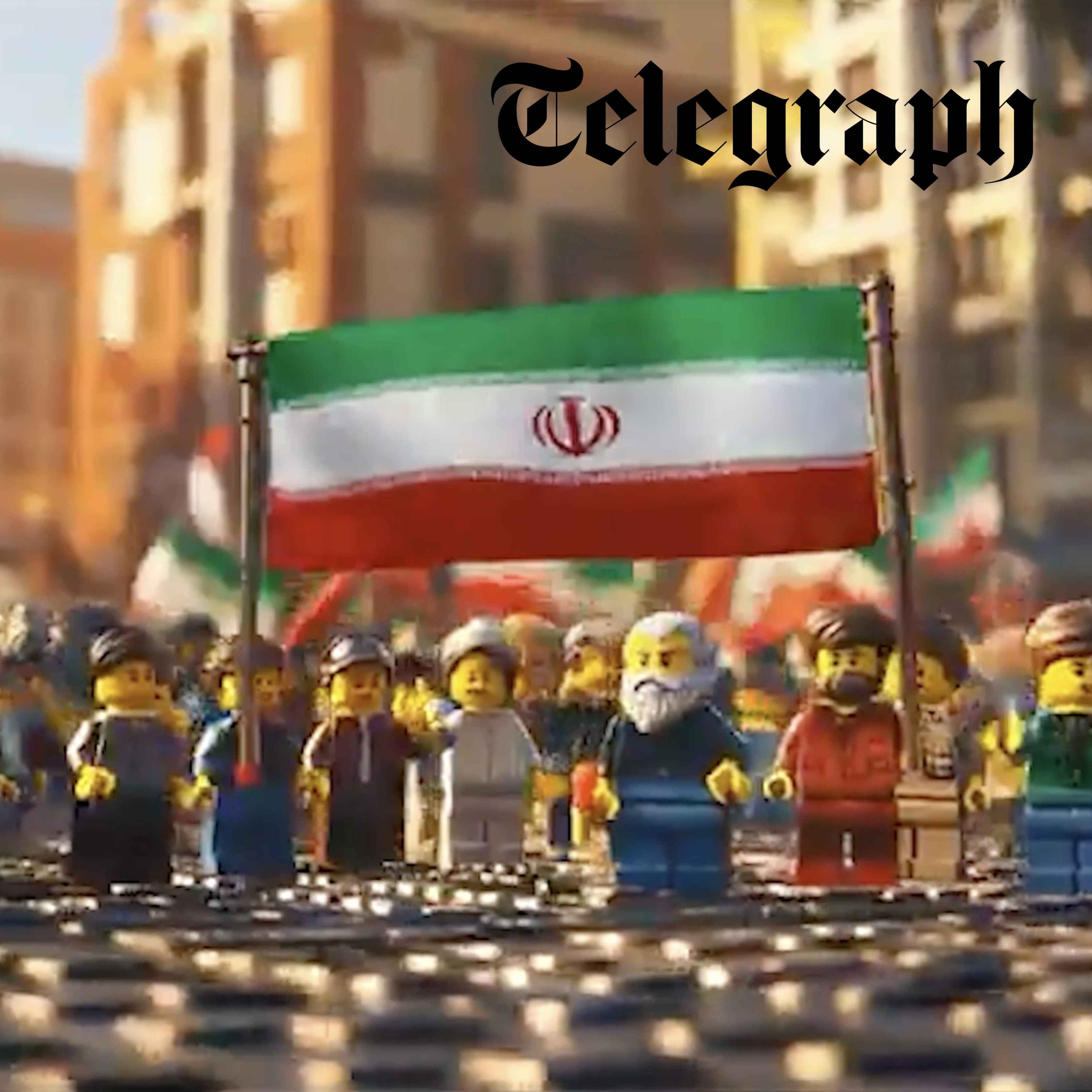
with that part of that core belief system. We've seen these insane propaganda efforts ramp up during this war. From Iran. We've had things like Lego videos from a company, Explosive Media, run by a guy called Mr. Explosive. I'm sure you've seen lots of interviews with him. What do you make of videos?
- [17:00]
B
I think they're a really fascinating take on how propaganda is more effective nowadays. I remember when I was a little kid watching stop motion lego animations on YouTube, as in Lego has always been something that we've all kind of been attracted to that's been interesting to look at. You had the Lego movies that came out and so it's easy to digest from an adult perspective and also as a kid, so kids and adults now can both digest just a piece of propaganda. The videos are very high quality because they're easier to make with AI models and it's easy to digest the message. The messages are very, very simple in those videos and they, they push on a lot of current cultural memes and jokes and things that we have. And so it makes it very relatable and easy to understand and people love that. And I think as a propaganda tool, it's incredibly effective.
- [17:48]
C
American propaganda in response to that has been more these sort of lots of black and white grainy footage of boats being blown up, strike targets, often with like, like Top Gun style music or that kind of military firepower feel to it.
- [18:02]
B
Yeah, you could say that they're both kind of like the two sides of different coins. I would say that the Iranian propaganda, again, it's not from Iran, but the Iranian propaganda, just a lack of a better term, is much more accessible to large portions of society, as in from little kids who can watch these videos all the way up to grownups. While the American propaganda is centered on A specific type of like gamer online niche, where I mean, forget grainy footage, they also put in college duty footage, like they splice in between to make it fun. Like a game. It's a video game, it's cool, it's interesting. Like Call of Duty and battlefield footage. So it's these two. But we're interesting that the propaganda is turning into what the Internet culture is.
- [18:40]
C
Who do you think is winning the information war in terms of this Iran conflict?
- [18:44]
B
It's a good question. Don't really know. But I would say that it seems more like the Iranian propaganda has been much more effective than American or Israeli simply because it seems like their type of propaganda is centered on very, very general themes of progress and justice and fighting for the little guy. And also the amount of fake news that is put out that is specifically of Iranian propaganda has been immense. I mean, the type of information that I've been debunking, I mean, I debunk everything on my feed, both from official IDF or government accounts, all the way up to just Israeli activists. But the type of information that is not just garnering the most amount of views, but also is the most horrific in terms of mis and disinformation is coming from the Iranian side. Isn't they're winning in terms, from a people perspective, in terms of viewership and the amount of people that are viewing that type of content.
- [19:36]
C
Does it worry you that it's dehumanizing conflict?
- [19:40]
B
It's something that's been very worrying to me in the past few years. I've written about it a few different times. As a researcher, I've become quite desensitized to a lot of very, very horrific videos and images. But that's because of my work where I'm trying to verify how victims were killed or where they were killed. We've become incredibly desensitized in the past, I would say 10, 15 years to violence. If you thought about what I said earlier in the conversation, is how it's not enough to hear about dead children in a school.
- [20:08]
C
I need to see it with the Iranian propaganda. There's such strong anti Semitic tropes being evoked in all of that. And we see in the Lego videos, you know, Hasidic Jews running around and I mean, they specifically say Israel controls America. I was reading about pro regime propaganda networks on X sharing AI generated posts depicting Orthodox Jews leading US soldiers to war or celebrating American deaths. There's been an absolute explosion in that online, hasn't there?
- [20:33]
B
Yeah, we've seen a lot of radicalization when it comes to how people are perceived. And the problem is that this leads to real, real consequences. While you could say, well, we're not actually speaking about, it's just representation, we're actually just speaking about how American politics are with the Israeli government and stuff like that, but that's not what actually happens in practice. When you showcase these stereotypes and you say the Jews or all Israelis or all Iranians or all Muslims or Arabs, what happens day to day is those individuals are then attacked. I mean, myself as an Israeli, I have no connection to the Israeli government, have faced a ton of discrimination and anti Semitism specifically against me as an individual, even though I have absolutely no connection to these stuff. I don't have any connection to the American government, no connection to the Israeli government as an individual. I think something to be aware of when are viewing online conflicts is that there are real people behind the screens, that there are real people being killed in these strikes, real people that are facing daily consequences. We need to be very careful about the footage that we share. Not just because the type of information that we share can shape policies, it can shape decision makers, but also that at the end of the day, what you're sharing, when you're sharing a missile crashing into a building, these are real people that you're talking about.
- [21:43]
C
Tal Hagan, thank you very much for joining us on around the latest.
- [21:46]
B
Thank you very much for having me.
- [21:48]
C
That was Tal Hagan, an information warfare analyst and media literacy educator. We're going to take a short break now. Coming up, how can Israel protect its northern border from the growing Hezbollah drone threat?
- [22:06]
B
Seeking, pushing, optimizing, creating, learning, discovering. At Aramco, we believe in harnessing the power of data to push the limits of what's possible. That's how we deliver reliable energy to millions across the world. Aramco, an integrated energy and chemicals company. Learn more about us@aramco.com
- [22:35]
C
Refresh your space for summer during PURA's Summer Savings Event. Enjoy 20% off sitewide with exclusive savings on our smart home fragrance diffusers. The perfect time to upgrade. Visit pura.com Summer smells like summer road trips, ocean breezes and long evenings under the stars. It's a feeling you want to hold on to restore your sense of place. With Pura's new summer fragrance collection, we've captured the magic of the season in clean premium scents that transform your home into your favorite destination. Discover the art of scentscaping and bring the summer in. Visit pura.com to explore the collection. Welcome back. You're listening to Iran. The latest. Now, as I've mentioned, Israel is facing a growing drone threat from Hezbollah on its northern border. And following a number of soldiers being killed by these first person view drones with fiber optic cables that Hezbollah is adopting, Israeli leader Benjamin Netanyahu has convened a special team with his Defense Minister staffers from that ministry and people from outside the government, including the civilian sector, to try and tackle it. Over the weekend. He told the Israeli armed forces they have an unlimited budget to find a solution. So what is the solution? And with a shaky ceasefire in name only in Lebanon and people being killed every day, what's next for this theatre of the Iran war? I'm joined now by Lieutenant Colonel Saret Zehavi. She's an ex Israeli army intelligence officer who currently directs the Alma Center, a think tank dedicated to studying and raising awareness of security threats on Israel's northern border. Saret, welcome to Iran. The latest. Can you just start by outlining how serious is the Hezbollah drone threat for Israel and what can be done to tackle it?
- [24:21]
A
Look, first I want to put things in proportion for now, as long as we don't see barrages of drones, swarms of drones, many of swarms of drones at the same time. It's a tactical threat, mainly against IDF forces, but also against the communities. Because once these are crossing the border, and it happens every day that they are crossing the border, even if they target IDF forces on the Israeli side, Israeli civilians are affected by that and sometimes are getting wounded or killed by that. And it happened a few times, including by the way, an incident this morning of a hit on the Israeli side of the border, which I don't know exactly who the casualties are, but it's a tactical threat and we are working around it. And Hezbollah is doing that in different ways. They are using observe drones like those who are gathering intelligence and then sending those who are attacking, they are using the drones to ambush, like to wait and see whether there is a vehicle on the road and then attack. They are using the drones as baits. So and we've seen this with one difficult to watch for Israelis incident that that they attacked the rescue forces that came to help soldiers that were injured and then another drone attacked the rescue forces.
- [25:47]
C
The video of a helicopter, right where someone's being medevaced. We spoke about it a few weeks ago on the podcast. He's being medevaced and then a drone comes in and attacks them and luckily misses the helicopter. Otherwise the casualty count could have been much higher.
- [25:59]
A
A coordinated attack of many drones or swarms of Drones. At the same time, if this will be increased and they just started to do it more and more, it will become more of a problem. Everything I'm saying that it's things that happened or things that can happen easily by using this type of weapon. And yet I am saying it's a tactical threat. Because eventually, you know, if you compare Hezbollah drones threat to what we faced, comparing it to 2023 and the fact that Hezbollah had thousands of rockets that threatened the the state of Israel, including precision guided missiles that could get anywhere in Israel, or thousands of elite unit of Hezbollah that were deployed physically, literally on the borderline, ready to invade to the communities. Today, Hezbollah is a different organization. The main conflict today is around the question, how do we make sure that Hezbollah is not becoming the monster that it used to be and how do we make sure that Hezbollah is not positioning itself again on the other side of the border, threatening our communities and civilians over there?
- [27:11]
C
You're sanguine about the drone threat. Do you think the Israeli forces will figure something out?
- [27:14]
A
Well, it will not be 100% defense. Yeah, there is no 100% defense. Doesn't matter which weapons. And it's kind of a cat and mouse situation, you know, if we find answers to that and they will develop something else like they had done with the rockets.
- [27:30]
C
How surprised are you by Hezbollah adopting this sort of aggressive drone warfare? We heard during the 2024 war that Hezbollah had been crushed. Now it seems that they've had a lot of training from the IRGC and seem to still have access to new weapons. Were you surprised?
- [27:46]
A
No, not at all. I was not surprised. And I'll explain why. First, we've been following the process that Hezbollah went through around the year between the two campaigns. And during that year, IDF tacked Hezbollah rehabilitation efforts around twice a day. It was called a ceasefire, but as you can understand, it was not exactly a ceasefire as it is today, by the way. And towards the end of that year, meaning towards the beginning of 2026, we all understood that the efforts of Hezbollah to rebuild its military power exceeded the IDF efforts to prevent. Now again, it doesn't mean that Hingzbalah came back to the situation and to the capabilities it used to have in 2023. But it does mean that they are moving forward, as you said, with training and with the assistance of the Iranians, actually deep involvement of the IRGC in this process. As for the drones, it was very clear to us that Hezbollah will adapt things that are happening in the war in Ukraine into what is happening in the Middle East. We wrote about it. We published a report about the drone threat in September 2024. And unfortunately, this is what is happening now.
- [29:02]
C
How should the Israeli army combat Hezbollah when it keeps evolving like this? What's the answer?
- [29:07]
A
So there is what we are doing and there is what we should do, and it's not necessarily the same. I think we are doing part of what we should do, probably because of restraint by international community. But again, I'm not sure. I'm saying probably in the past month since a ceasefire was declared, there is a ceasefire in Beirut and there is a ceasefire in Tel Aviv, except one Israeli attack in Beirut, but there is no ceasefire. There is fighting all the time between IDF and Hezbollah in south Lebanon and northern Israel. And we are all affected by that. I live in northern Israel, nine kilometers from the border. There are sirens every day in northern communities. It poses a lot of difficulties because they are not evacuated and there is no reason to evacuate them now. But it's not normality. It's like sending the kids to school. Sirens in the school, sirens on the way to school, on the way back. We live in an atmosphere of constant noises of war, okay? Blasts and helicopters and drones and jets. And all the time, everything is heard here. The Hezbollah activity and the IDF activity at. the same time. Why is it like this? Because as I've said, as long as Lebanon is not disarming Hezbollah and it refused to disarm Hezbollah, it is saying that it is agreed to disarm Hezbollah. But in reality it is not doing that because to disarm Hezbollah means to confront Hezbollah. And the Lebanese government is not interested in confronting Hezbollah. It is afraid of a civil war. And they are not really doing that. They are collaborating a local disarmament of debt warehouses and these few rockets and this one tunnel. This is not disarmament. Hezbollah has terrorist infrastructure in his Muslim Shiite villages everywhere in Lebanon and specifically in south Lebanon. And this is what IDF is focused on now, in clearing the areas in a distance of few kilometers from the borderline from any weapons of Hezbollah actually fulfilling the promise of the Lebanese government from 20 years ago to disarm Hezbollah in South Lebanon. What we are not doing and I want us to do is to have freedom of operation against Hezbollah rehabilitation process in Beirut and in the. In the. Because this is strategic. This will actually prevent Hezbollah from becoming stronger, threatening Lebanon, threatening Israelis. This will be a thorough change. In reality, what is happening today is that Hezbollah has the capability to make preparation for a long and limited conflict. And I don't like that at all.
- [31:52]
C
I wonder why you think that if the Israeli army was able to conduct operations across the whole of Lebanon, as they have in southern Lebanon, why you think that would achieve more than Israel was able to achieve in 2024 or any of the previous rounds of conflict. To be honest, southern Lebanon in particular has been occupied previously by the ISRA and Hezbollah. GRE out of Aten still exists today. What we're seeing now in southern Lebanon, the whole villages being dynamited. I think the Lebanese Ministry of Health said that more than 3,000 people have now been killed across the country. It's a lot of death and destruction. I wonder if you think there's a risk that you're just radicalizing more people and whether there is a sort of military solution to the problem of Hezbollah for Israel.
- [32:31]
A
If you are entering with a division of a military anywhere in the world into a town that is used for as a base of terror, meaning everywhere there are tunnel shafts of Hezbollah and weapons of Hezbollah everywhere, between the houses, inside the houses, below the houses, et cetera. You cannot start to defer one house to another because people will get killed. People cannot live in a town that you have tanks maneuvering inside. It's impossible. And that's why eventually you have to evacuate the population from these terror bases. So this is for the displaced. Let's talk about the people who were killed. Lebanon is saying that about 3,000 people were killed, but unfortunately, Lebanon is not publishing how many of them are military operatives of Hezbollah. And according to IDF numbers, we understand that the vast majority are military operatives of Hezbollah. So that's very important. We are fighting a war here against the terrorist organization. And yes, military operatives of Hezbollah are getting killed because otherwise we will get killed.
- [33:37]
C
Forgive me a little bit of skepticism around the sort of Israeli casualty figures. You know, we had this very extended debate in Gaza, and it turned out that the numbers, the casualty numbers were broadly correct coming out of Gaza and that the number of combatants were. Yeah, not as high.
- [33:53]
A
Look, it's not in Lebanon. It's easier than Gaza. It's not that complicated because you do see the funerals. You see funerals of many, many military operatives that have been carried out in different places of Lebanon. And actually, it's not that difficult because eventually, if Lebanon would have published itself this distinction between military operatives of Hezbollah and civilians, we didn't have this kind of conversation. And it's not, unfortunately, it's not happening. They are publishing one number for everybody to get third, radicalization. Let's talk about this Issue. This is a very important point. Kisbara build its infrastructures to slaughter us and to occupy our communities and to take U.S. hostages to become human shields. And I'm quoting from a plan that was published in a video in 2014. Hezbollah made the preparations for this plan that I'm talking about from within those towns during the years that Israel had zero presence in Lebanon, meaning between 2006 and 2023, after there was an agreement between Israel and the Lebanese government that Hezbollah will be disarmed in the areas of South Lebanon. Actually, what happened in reality, that Hezbollah became a huge monster on our borders. The basic ideology of Hezbollah is an ideology that is similar to the Islamic Republic. The Islamic Republic of Iran provided Hezbollah not only the weapons and the training and the money, but first and foremost, the ideology. And part of this ideology, other than hate to Western values and democracy and women's rights and human rights, part of this ideology is also the destruction of the state of Israel.
- [35:46]
C
I don't think anyone disagrees with you that Hezbollah is a horrible terror group and Lebanon and Israel would be better off without it. My question is just in terms of the level of death and destruction, do you add more supporters to Hezbollah's cause who previously didn't support Hezbollah?
- [36:01]
A
On the contrary, if you look, Christians,
- [36:03]
C
Shiite Muslims, Sunni Muslims, you know, the patchwork of Lebanon is being united against Israel by this conflict.
- [36:11]
A
Look, I watched a piece of The Guardian yesterday, 16 minutes that the Guardian went in different places in Lebanon. And when he went to the Muslim Shiite base of Hezbollah, what the reporter, the Guardian reporter heard was a support to Hezbollah. And when he went to Christian areas in Lebanon and he asked the people, who do you think is responsible for this catastrophe in Lebanon? And they said, Hezbollah. And in this we agreed. That's why, by the way, there is a place for hope, because many Israelis and many Lebanese agreements upon what's the problem and what's the solution. We agree that the core of the problem is Hezbollah. We agree upon that. Now, is this only a military solution? I agree. No. The answer is no. You cannot defeat an ideology. But unfortunately, the other parts of the solution are not in the hands of Israel. The other parts of the solution are in the hands of the Lebanese government that has to do something against Hezbollah and is afraid of doing that.
- [37:16]
C
Just finally, the ceasefire has been extended for a second time. I think the peace talks are expected to resume in early June. How confident are you that they'll get anywhere?
- [37:24]
A
First, there is no ceasefire. There is ceasefire in Beirut. We only attacked them Once in the past month, and there is a ceasefire in Tel Aviv. But in Israel's north and in south Lebanon, there is no cease. There is a glass ceiling to these peace talks, and the glass ceiling is the willingness of the Lebanese government to fulfill its commitments and its commitment is to ban the activity of Hezbollah in Lebanon. They made a promise, and until today, it's only a promise. They didn't do anything to fulfill their promise. The rockets that were launched to Israel in the past few months were launched from south of Litany river, from the area that the Lebanese government claim is empty from any illegal activity. It's full of illegal activity. That's why the IDF is there.
- [38:11]
C
Israel has seized quite a bit of territory since October 7th. I was reading an FTP today that done some calculations. 570 square kilometers in Lebanon, and they estimate around 230 square kilometers in Syria. Those are sort of buffer zones around northern Israel. Do you think that will become permanent?
- [38:29]
A
Okay, first, I don't know the number of kilometers, but I want to give you proportions around that. That's very important for me. If you look at the map of Syria, you will see that what Israel seized out of Syria is an extremely narrow area next to the border with Israel of between very few kilometers to less than that.
- [38:51]
C
I understand Syria is a big country,
- [38:53]
A
and in Yabenon as well.
- [38:54]
C
Yeah, but it is still territory from another country. And along with the territory In Gaza, around 200 square kilometers, it increases Israel's size by about 5%. You know, it's not insignificant. I'm wondering if you think that will become permanent.
- [39:07]
A
The idea was not to increase the Israeli territory. Okay, that's not the idea. The idea was to create a security buffer area between Israeli civilians that are living on the borders, Syrian, Lebanese, Gaza and whatever, and the enemy, which, unfortunately, as we agree, the enemy is a terrorist group, whether it's Hezbollah, Hamas, or whoever is out there in Syria to make sure that they cannot just walk in to the communities on the borderline. If on the other side of the border there is a sovereign state that is willing to make a peace agreement with Israel, not ceasefire. A peace agreement with Israel that is willing to recognize the very existence of the State of Israel as a legitimate neighbor, we don't need those buffer zones. Those buffer zones mean a lot of money, a lot of reservists that are out of their homes, not working, not with their families. If you ask Israelis in the street, we have no hate to Lebanese. We are praying for the day we can come as tourists to Beirut and have joint venture of agriculture projects with the Lebanese and it's the same with the Syrians. Like there is an Israeli saying one day we will have hummus in Damascus as tourists, not as occupiers or anything as tourists.
- [40:26]
C
But you can understand why the sentiment in those countries. I know it's chicken and egg, but Israel is currently taking over, has a presence on these strips of land in other countries. It doesn't engender good relations, but it's
- [40:40]
A
not chicken and egg because it's not a question of territory, as I proved to you with regard to the 20 years that we were not inside Lebanon at all. It is not a question of territory. It is a question of whether the Lebanese, all of them, including the Muslim Shiites, are willing to be good neighbors of the Israelis. And unfortunately it was proven that even when we were outside of Lebanon, actually, when we were outside of Lebanon, Hezbollah, with its radical ideology against Israel became much stronger. There was no justification for having Hezbollah while Israel was not occupying any land. And the land dispute between Israel and Lebanon during the years, and you probably know that is tactical. It's worth nothing. It's not about the land. It's not about the land between Israel and Hezbollah and between Israel and Syria as well. It's not even with the Garner Heights. It's not about the land. It's the question of how sovereign is the government on the other side of the the border. And in both places, not enough.
- [41:47]
C
Thank you so much, Sarah, for joining us on Iran. The Latest.
- [41:49]
A
Thank you.
- [41:53]
C
That was Lt. Col. Sarah Zahavi from Israel's Alma Center. And that's all for today's episode of around the Latest. We'll be back again tomorrow. Until then, goodbye. Iran the Latest is an original podcast from the Telegraph, created by David Knowles and hosted by me, Venetia Rainey and Roland Oliphant. If you appreciated this podcast, please consider following around the latest on your preferred podcast app. And if you have a moment, leave a review as it helps others find the show. For more from our foreign correspondents on the ground, sign up for our new daily newsletter Cables, or listen to our sister podcast Ukraine the Latest. We're still on the same email address battleionselegraph.co.uk or you can contact us on X. You can find our handles in the show Notes. The producer is Peter Shevlin. The executive producers are Venetia Rainey and Louisa Wells.
- [42:54]
B
What if a marginal gain unlocked greater performance? What if an insight and data could change everything? At Aramco, our focus on detail helps us deliver reliable energy to millions across the world because margins aren't marginal, they're where we can truly push the limits of what's possible. Aramco, an integrated energy and chemicals company. Learn more@aramco.com Ever notice how life's best stories don't happen in your living room? They happen on the open road, out on the water, or parked under the star. At Progressive, they get that you want to focus on the experience, not worry about the what ifs. That's why they offer quality insurance designed for your ride, whether that's a boat, RV or motorcycle. Adventure with confidence. Visit progressive.com and see how easy it is to protect your favorite way to get away. Progressive Casualty Insurance Company and affiliates not available in D.C. prices vary based on how you buy.