← Becoming UnDone® with Dr. Toby Brooks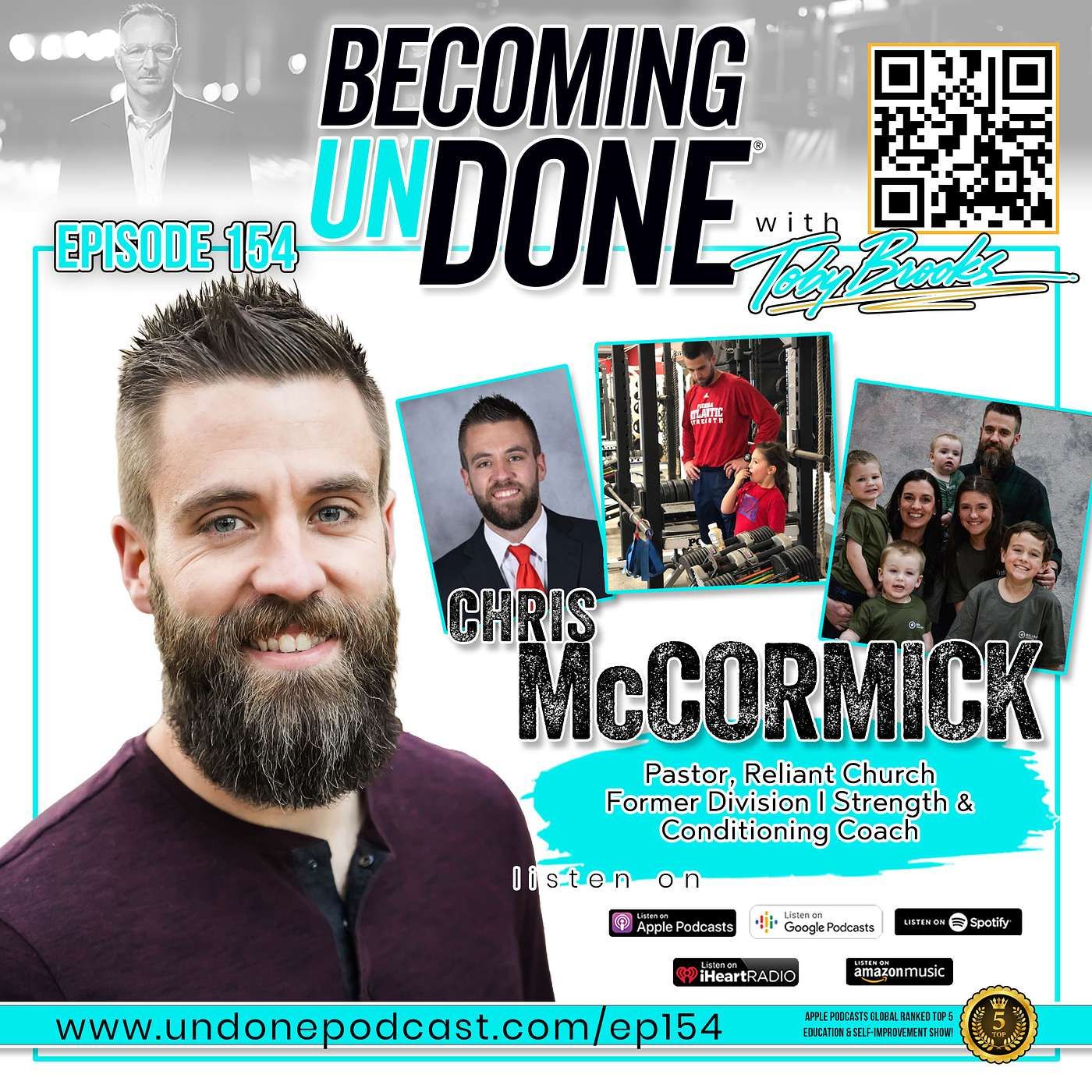
Becoming UnDone® with Dr. Toby Brooks
154 | Courageous Career Changes: Embracing Uncertainty and New Beginnings with Pastor & Coach Chris McCormick
00:56:36
About the Guest Chris McCormick is a former Division 1 strength and conditioning coach who worked at Gardner-Webb University and Florida Atlantic University. Throughout his career, he played a crucial role in athlete preparation and development, initially with aspirations of ascending to an Athletic Director role. However, McCormick's journey took an unexpected turn when he transitioned from collegiate sports to full-time ministry. Today, he serves as the lead pastor at Reliant Church, passio...
Loading summary
Transcript71 lines
- [00:00]
Toby Brooks
Foreign this is Becoming Undone
- [00:09]
Chris McCormick
Garter Web was like everything I ever wanted in a job. And it was like it wasn't what I wanted it to be and it didn't turn out the way I wanted to be. And that kind of gave me one of those moments of, well, then what is the next thing that I actually want if I've gotten what I wanted from a job position? So that kind of sent me reeling. I was March of 2020 going to tell our staff and everybody I'm leaving, and we were at the Conference USA tournament and Covid shut everything down. So it essentially made me go home with my family for the first time and was like, okay, I'm forced to sit here essentially and try to figure out what is the Lord maybe calling me to. And that's where the idea of church planting and being able to talk to other people really became prevalent. Lord, is this actually what I'm even supposed to be like? I have these skills. So it took a lot of unwinding of then realizing how much my identity was actually wrapped up as being a coach. That inevitably led to me leaving coaching in July of 2021 and essentially going into full time ministry. I'm Chris McCormick. I am undone.
- [01:26]
Toby Brooks
Hey friend, I'm glad you're here. Welcome to yet another episode of Becoming Undone, the podcast for those who dare bravely risk mightily and grow relentlessly. I'm Toby Brooks, a speaker, author, professor, and performance scientist. I've spent much of the last two decades working as an athletic trainer and strength coach in the professional, collegiate and high school sports settings. And over the years I've grown more and more fascinated with what sets high achievers apart and how those failures that can absolutely suck in the moment can end up being exactly the push we needed to propel us along our paths to success. Each week on Becoming Undone, I invite new guests to examine how high achievers can transform from falling apart and to falling into place. I'd like to emphasize that this show is entirely separate from my role at Baylor University, but it's my attempt to apply what I've learned and what I'm learning and to share with others about the mindsets of high achievers. This week's conversation has been a long time coming. My guest is Chris McCormick. He's a former Division 1 strength and conditioning coach who cut his teeth first at Gardner Webb University, then Florida Atlantic. And as he rose in the ranks, he lived the grind that so many in our field know all too well. Long hours, low pay, and a relentless pursuit of a dream that always felt just one step ahead. But somewhere along the way, that dream started to crack, and what followed was a pivot that few could have seen coming. Today, Chris is the lead pastor at Reliant Church, and in this conversation we unpack what it looks like when your identity is tied to what you do, when burnout forces hard questions, and when purpose pulls you in an entirely different direction. If you've ever wrestled with the tension between calling career and the cost of chasing both, this one's going to hit close to home. I hope you'll enjoy my conversation with Pastor Chris McCormick in episode 154. Let's get into It. Greetings and welcome back. Becoming Undone is a podcast for those who dare bravely risk mightily and grow relentlessly. Join me, Toby Brooks, as I invite a new guest each week where we examine how high achievers can transform from falling apart to falling into place. This week, this one's been quite a while coming. Chris McCormick reached out to me through LinkedIn, a lot of parallel, we'll call it concerns between athletic trainers and strength conditioning coaches, and particularly in Division 1 sports. Chris today is lead pastor at Reliant Church, but prior to that kind of in another life, he was the director of Olympic sports at Florida Atlantic University, where he was a strength and conditioning coach with aspirations of maybe one day being an ad. So we'll get into that later. But Chris, thanks so much for joining me tonight.
- [03:53]
Chris McCormick
Thanks for having me.
- [03:55]
Toby Brooks
Yeah, I know we've scheduled this one a couple of times and some, some tech issues tonight, but this is our time. This was when we were supposed to have this conversation, so I'm looking forward to getting into it. Lots of times athletic trainers and strength and conditioning specialists have athletic histories of their own. And I, I assume that's you, too. So I always start with a little bit of a softball. What did you want to be growing up and why?
- [04:21]
Chris McCormick
Yeah, that's a good question. I feel like I changed my profession at least three times in my entire career. Initially, I wanted to be a pediatrician. When I was in high school, that was something that I aspired to do. I got into undergrad and went the whole pre med route. Like, I don't know if this is truly for me. So one of my, my first passions was sport, playing football and baseball and swimming and different sports in high school. And so as I went down the route of teaching and looking into teaching, specifically in high school and coaching, I fell in love with history, but also psychology. And that's where my bachelor's was actually in. So even before into my coaching career, I was working on my PhD in neuropsychology, got my master's, and I left that essentially track to go into coaching primarily football, and then transitioned into strength and conditioning. So kind of big divergent across that growing up.
- [05:20]
Toby Brooks
Yeah. So you ultimately find yourself working at a Division 1 university where you're a strength conditioning specialist. That is a job that if you haven't done it, it's kind of hard to really fully appreciate the grind and the hours, the low pay. Before we get to that, who was Chris McCormick when he was just a strength coach chasing that profession? What did you love about that world?
- [05:46]
Chris McCormick
Oh, man, I've been out of it for four years. So even looking back, I've had some recent conversations with colleagues of things we love and things we're like, glad we're not. Who I was. I mean, I was the. The go getter, the go a thousand miles an hour. I used to be made fun of by our ats, the. The gym flooring you have with our athletic shoes. I'd be my. You hear me squeaking down, down the. Kind of the hallway because I was moving so fast. And the next thing. And I was just all about what is the next little thing that would lead to that 1%, that would lead to success for our student athletes. And every single thing that would be incorporated with high performance or any of that, I was enthralled with that. That was my goal. That's where you talk about athletic administration. What's the little things that we can do so we could see the numbers on the scoreboard change and see our athletes be successful. And that's, I mean, who I was, I think, when I was a coach more than anything.
- [06:45]
Toby Brooks
Well, I know that for people that haven't lived in that environment, that culture can be surprising to a lot of people. And I know it varies from. From place to place, even. I mean, in the same place, if you get a coaching change with the head football coach, the culture can change overnight. But for those that maybe aren't as familiar, what does that lifestyle demand of you? And what was it like when you found yourself kind of nostrils deep in a career as a strength and conditioning coach?
- [07:16]
Chris McCormick
Yeah. The only thing I can maybe attribute to is military families. Understand. And it's unlike any job where there's so many imaginary expectations I think that we put on ourselves more than anybody, especially from a support staff perspective. You could easily take the blame, but you don't get the praise as much and just the sheer Hours. When I was at Gartner Webb University, a private Christian school in North Carolina, I was the director of athletic performance. I traded football and basketball, primarily traveled with both. So there was times where I would get home from a basketball game. We played Liberty four hours away. I'd get back to North Carolina, we'd get off the bus at 2am and we'd have football at 5:30 in the morning. And it was just like I'd take a nap, drink some coffee, go work out, and go right back in. And that was a constant, constant thing.
- [08:09]
Toby Brooks
What Chris is describing here, sadly, is true for so many, especially young professionals trying to make their way in college sports. They're eager to grow and learn and move up, lured as much by the enhanced salary and the recognition as by that opportunity to work with more and more elite athletes, whether strength coaches, athletic trainers, equipment managers, media personnel, academic support, and all types of others. What Chris is describing in detail here isn't just an isolated example. For many, it's daily life for months or even years on end. For anybody in that space, it can be a difficult tension between going all in and carving your path and burning out, looking for ways to support yourself and your family and be present in their lives. For Chris, it was already starting to exact a toll. Early in his career at dejuan, Gardner Webb, those dreams and ambitions were still propelling him forward to another step on his journey before he ultimately faced the realities that he could no longer continue to be the strength coach, the husband and the dad that he wanted to be all at the same time.
- [09:12]
Chris McCormick
If you don't love every single thing about it, you will get swallowed up. And everybody talks about grinding. And even now in ministry, I'm like, sports is a different, a different realm. And if you're not about that life, then you'll get chewed up and spit out. I think I've heard you talk about a little bit.
- [09:29]
Toby Brooks
So, yeah, yeah, I oftentimes reflect back to my time at Liberty, actually. And I shared with my wife, I said, you know, I want to work in the NFL or be at a Power 5. And the, the grind and the hours, it just is what it is. There's no way around that. And I realized that that grind was pulling me away from my family. Well, the, the other side of that was we were also almost in poverty. I was the head football athletic trainer making $36,000 a year. And I just couldn't reconcile that anymore, that my family's losing my time and we're suffering financially and at a place like Liberty at a gardener web where it's a Christian institution. Lots of times it was the running joke. Like this is a ministry, so that means they're going to pay you about 20% less than the market rate or more. And it was just, it was kind of a perfect storm of guilt for me as the leader of my family, feeling like I was failing my athletes, I was failing my family, I wasn't the provider. When that starts to accumulate on your shoulders.
- [10:43]
Chris McCormick
Yeah.
- [10:43]
Toby Brooks
What, what was your thought process at that point? I mean, for most people, they might look at a second career, but planting a church maybe isn't necessarily the direction a lot of people go. Although, I mean, I would argue that your, your career as a strength conditioning coach probably prepped well because anything else feels like a part time job.
- [11:06]
Chris McCormick
Yeah. I mean, and that's, it's funny you say that because even now looking back, being a pastor, having the title, the struggles of identity and stuff that coaches have, you just slap pastor on that. It's the same thing. I mean it's at least in strength and conditioning we can formulaically take sports science and get like A plus B equals C. In the spiritual realm, I can do all the right things and the Lord decides to do something completely different with it. So if I want to find identity in this, that's a terrible place to find it as much as coaching. But it is funny. Like in Garter Webb, similar story of just, you know, it's a blessing and it's a ministry. It was my dream job. I wanted to work at a Division 1 Christian school and it really kind of turned into me almost the antithesis of everything that I wanted to be in coaching. And you begin to red tape and draw lines between and animosity and all those things. So coaching is just a unique aspect to that too because you get to do something you love. Got a lot of people that maybe are ditch diggers that make a lot of money that actually hate their job and you get to do something you love, you still get compensated for it very well. And I think that's just a huge piece where some people do make a lot of money, but you only can do so much and wear that badge of honor on your chest. I'm like, I'm doing this for the kids. And it's like, yeah, but I also have kids at home and I have a family that's growing and my wife stayed home most of the time, so I have no idea how we even survived in that. Our story is very similar to the styles what essentially you've been saying, I don't know how we even made it with the salary we were even on with my wife staying home. But I think it just. It goes to show just the badge of honor that we try to wear, especially as support staff. You see other people being compensated in a certain way, especially in a Christian context. You talk about Liberty or Garter Web, your mission field, your calling, but there is a point where it just becomes. It may not be sustainable and I think financially and also emotionally and socially and all those things. And that is such a huge wrestle, especially as a young professional, of when is enough and when do you move on? And I think some of the things that you. You've talked a lot in your sphere.
- [13:26]
Toby Brooks
Yeah, I know. Liberty, Gardener Web, you feel like you're right on the threshold of your dreams. And it's like, if I could just hold on just a little bit longer if my coach makes it big and takes me with him. But you never know. So it's like. And my wife and I have had this conversation. I assume you and yours have as well. Like, do we have to endure this for 6 more months or 6 more years or 10 more years? Am never going to get there. And it's just so hard. I mean, if you're running a marathon and you know how many miles are ahead of you, you can pace yourself, but in this decision, you just have no way of knowing how long do I have to endure this? And it's just so tough. At what point did the job stop being something you loved and start becoming maybe something that you felt like was just too much?
- [14:15]
Chris McCormick
Yeah, I mean, I think. I think the time at Garter Webb was a huge piece of that. Like I said, I was traveling basketball and was taking on teams. We had 23 sports there. I'd have maybe a couple gas, maybe an assistant. There was turnover there because of just factors and people getting better jobs. And, you know, if you're Robin Peter to pay Paul so you can train one team, but you got to train all the other things that comes with it. You know, I loved the managerial side of being a director and helping coaches and seeing them grow. But there was also the aspect with football and basketball. I was around a lot of successful basketball teams, and I think that eventually kind of became my niche. But also for our family, it was just like, I can't do this travel. And that's where I began exploring other jobs. And that's where when I transitioned to Florida Atlantic, I wasn't traveling. I was more on the Olympic side. There wasn't as much of the demand, and it really allowed me to kind of go back into that love of coaching. Plus, living on a beach is obviously an excellent, excellent benefit. But like I said, it was garter Web was like everything I ever wanted in a job, and it was like it wasn't what I wanted it to be and it didn't turn out the way I wanted to be. And that kind of gave me one of those moments of, well, then what is the next thing that I actually want if I've gotten what I wanted from a job position? So that kind of sent me reeling.
- [15:39]
Toby Brooks
Sent me reeling. That's such a precise and descriptive turn of phrase here. Chris acknowledges the confusion and the doubt and the fear that flood in when you finally get everything you thought you ever wanted and yet you still find yourself unhappy, perhaps even miserable when you get there. For so many. We don't have the ability to cut the line and try a role like that on. It takes years of experience, multiple degrees, countless professional credentials and licenses. And when you stop and consider the possibility that you were all wrong about how that dream role or job or business would make you feel, many times you grieve and you grieve more than one thing, all while still trying to do the job. I would say for me personally, first, I grieved the mistake. It was saddening for me to admit that the job I'd spent years chasing was not only not making me happy, it was in fact making me miserable. And all on a pauper salary. And secondly, I grieved the sunk cost. Like we'll talk about in a minute. Years of life. In some cases, tens or even hundreds of thousands of dollars get poured in to make you eligible, only to arrive and discover that you didn't really want it after all. And that grief can linger. Many times it grows. And in the midst of that purpose storm, I found myself frequently asking what the heck was next? What I didn't see and what Chris didn't see in the driving downpours of that storm was that those experiences had shaped us in ways that an easier path simply couldn't have. Just like training can trigger adaptations in your body to be stronger, faster, and have more endurance. Surviving seasons of life like that builds grit and determination, work ethic and resolve, if we let it. For Chris, he found himself at Florida Atlantic but increasingly dissatisfied with the life that he was choosing. And he could have either remained there or make a change. He made a change. We'll be back after this quick message. Have you ever looked in the mirror and thought, what in the hell just happened to my life? When the career shifts, when the relationship ends, when the identity you've built your whole life around disappears overnight, that's not failure. That's what I call a purpose storm. And most high achievers aren't prepared for it because no one ever taught us how to train for a comeback. I'm Dr. Toby Brooks and I built the science of the comeback for people who refuse to stay broken. Inside the app you'll find research backed resilience training, daily prompts and guided reflection tools, performance psychology frameworks, identity rebuilding exercises, and personalized structured pathways to move from burnout and confusion to clarity and momentum. It's not hype, it's neuroscience. It's performance science. And it's hard won experience. If you're listening to becoming undone, I created a special offer just for you. For the next three months, you can get full access for just 49 bucks for an entire year or just 5 bucks a month with no obligation. You can cancel at any time. That's less than the price of a cup of coffee to start rebuilding your life on purpose. Your comeback isn't accidental, it's intentional. Start yours today@scienceofthecumback.com
- [19:09]
Chris McCormick
going to FAU changed a lot because that was around Covid and kind of all those things that factor in. So yeah, wow.
- [19:18]
Toby Brooks
Our stories have so many parallels. When I left Liberty, we went and spent part of a season in Fort Myers with an Arena 2 football team and same thing like mornings on the beach. Working arena ball was like the best job I've ever had, especially Arena 2, because they all had day jobs. So while they were at work, the family and I could go be on the beach. But the problem is you only get paid for six months out of the year. So that wasn't sustainable either. Was there a moment when you realized like something has to change or this is going to break me? What happened?
- [19:54]
Chris McCormick
Yeah, yeah, I think it was, you know, early on, even at fau, I had a great situation. I worked for coach Dusty May who's at Michigan. He hired me. At fau, you start meeting certain people where you talk about the coaches. You're like this, this is the person. Like, this is the person that if there would be success, I would love to stay with and work with. But there was a lot of factors, especially with my own faith, that were impacted of our family began to be involved with foster care and adoption. So we were having children come in through our home. We were involved more with our church and that Balance of. Even if I wasn't traveling and whatnot, there's still a demand with, you know, essentially directing a department and all the sports and all the games and all of those things that I was like, I just don't know if I can do both of these things at a high level. And having a young family, I was like, what's the. What's the give or take here? And some of those external factors really drove me eventually towards ministry, where I'm at indirectly, I think. But it also kind of put me in a position too, where the breaking part, I can talk more a little bit about this, like, the undone part eventually turned me into the, I think the best version of a coach I was, because it kind of just made me not care as much about the things that I thought were so important and it gave me some freedom after I got past that point of like, I can't do this anymore, which is really interesting now looking back of kind of that path leading into coaching and now into ministry.
- [21:29]
Toby Brooks
So you're a believer. We really didn't get into your testimony, but you're working at a faith based institution. You go to a state school. At what point does ministry as a potential vocation start to come into the equation? And when did you really feel that call on your life? And subsequently, when did you surrender to it?
- [21:52]
Chris McCormick
Yeah, so it was right around the time we started foster care adoption. So the, the school we were at, Gardner Webb, the head basketball coach and his wife were involved with foster care. And my wife was tremendously involved with that. I was traveling. I was always like, you know, I don't have enough time. Even though he was kind of doing it, they didn't have that excuse. Then we moved to South Florida. The church we were going to was like the hub for foster care adoption in Palm Beach County. And so the more I was exposed to it, the more this became. There wasn't an exposure excuse anymore. I was like, this is this, this is what I think we're being called to. And my wife was specifically the one that was kind of championing that. So as I got more involved with some of those things outside of sport, that balance piece became okay. Then what does this actually look like for our future? We had two young kids. We were in the process of adopting a child out of foster care, which we did adopt. And so even as I talked to more pastors that I had, I mean, I moved 17 times in my marriage because of coaching. We had different churches and things we went to, A lot of people were like, have you ever thought about ministry? And I'm like, well, I don't want to be a pastor. Like, I, I just, I'm, I'm looking maybe for something else outside of strength and conditioning, if that was athletic administration or ministry. And so I began exploring FCA and kind of seeing like what that would look like. My wife and I are from Indiana, where we live right now. And I thought I had it lined up. I thought it's going to be SCA, start fundraising. And literally like I was March of 2020 going to tell our staff and everybody, I'm leaving. And we were at the Conference USA tournament and Covid shut everything down. So it essentially made me go home with my family for the first time and was like, okay, I'm forced to sit here essentially and try to figure out what is the Lord maybe calling me to. And that's where the idea of church planting and being able to talk to other people really became prevalent. And there was a slippage of time as we were home and then coming back to support and all of those things. But it was around that time frame, which was a very unique time frame as a girl group members inevitably led to me leaving coaching in July of 2021 and essentially going into full time ministry.
- [24:06]
Toby Brooks
Yeah, I know. I've heard this time and time again from students who leave the profession of AT in. You've invested so much time and money getting degrees and certifications and the idea of sunk cost is a real thing. Like, am I just going to abandon this? Am I going to just walk away when I may be on the doorstep of my dreams? But ultimately you made that decision. You pivoted and moved in another direction professionally. Leaving a career that you're invested in for years isn't easy. What did it take emotionally and spiritually for you to walk away from that world?
- [24:51]
Chris McCormick
Yeah, I think early on for me it was, it was easy because there was such an excitement about it. I think just this new venture jumping out. I mean, so many coaching jobs and things, you don't know somebody, you may have a network, you are leaving a week later to go to the next job. We always had that element in our family of like, like life can change and die and we would jump out at an opportunity. Going into ministry is such a unique thing because we were moving home, but I had no, I still have no idea sometimes what I'm doing because I had over a decade of ventured training and expertise and all of those things. So early on it was, I could wipe it clean. And you know, you get into the seasons, you start seeing things. But really, it was probably about a year or two into ministry where everything kind of dies down. And then even, I mean, I left fau and FAU went to the Final Four.
- [25:48]
Toby Brooks
I'm over here sitting with you. Let's see what happens.
- [25:51]
Chris McCormick
Game on the line.
- [25:52]
Toby Brooks
Forest Cash right through the heart.
- [25:55]
Chris McCormick
Three point game. Kansas State now needs a three to tie it.
- [25:59]
Toby Brooks
Clock ticks.
- [26:00]
Chris McCormick
Noel dribbles. He's looking for someone. Masud. Got to put it up.
- [26:04]
Toby Brooks
And that's it. The Owls of Florida Atlantic, they are
- [26:11]
Chris McCormick
headed to the Final Four. And it was like you were part of that. So then you see that and you're like, oh, man, what could be? And then you get people calling about opportunities and jobs that are really good jobs that I had a couple opportunities, and it's like, lord, is this actually what I'm even supposed to be doing? Like, I have these skills. So it took a lot of unwinding of then realizing how much my identity was actually wrapped up in being a coach. Even if I talk to people about it and, and people that were like, wow, that's really cool that you used to do that. And people want to talk to me about it and how easy that I see it as a pastor now. But just the. The term coach is, like, people cling to that. It's cool to talk about. And I thought I had a lot better lock on it, and I did not. And even seeing now more because of the amount of guys I talk to in the profession still that are struggling with that, even though they're still in it, it's a real thing. And I don't know how much you. You struggled with that in the role you're in now when you could even look sometimes and be like, you'll go to a game or something, you're like, man, this is awesome. And then it's like, you, like, snap on and you're like, well, no, no, that's not what I'm doing. So.
- [27:27]
Toby Brooks
Right. Yeah, yeah, the, the, the FOMO is real. And, you know, for me, game days were tough, but just the, the day in and day out, the relationships with the student athletes was just something that was irreplaceable. And for me, I. I went more into a teaching role, and that became my relationships with my students and, you know, pouring into them. And for you, it's parishioners and, you know, members of your church.
- [27:55]
Chris McCormick
Yeah.
- [27:55]
Toby Brooks
One thing I always try to share with my students who are considering making a pivot out of, in particular, a lot of them in the college ranks are just wrung out. They are, you know, they're poor and they're burned out and they're ready for something different. And I always try to reassure them that you're not abandoning a skill set. What you've learned in that setting actually applies in a whole heck of a lot of places. And it will make you a tremendous asset to a lot of organizations because you've got a work ethic that few people on earth actually possess. And learning to live on such a meager amount can mean, you know, if you get a little bump in your salary, it's great. How did your experience as a strength conditioning coach shape the way that you now approach ministry and even leadership?
- [28:48]
Chris McCormick
Yes, that's a great question. The amount of times you can ask my wife that I would sit at the end of the day and be like, why in the world would the Lord call me into this? Like into pastoring, into preaching and all the intricacies of people knowing what full time ministry is. I think it's been the last six months that I've begun to see more as I get to know people more, because there's the relational piece of even the title of pastor versus a coach. And I'm sure, like if you went back in the athletic training room, it's like back your hand, you just go right back into every single thing, how you talked and all those things that you did. But as a pastor, I've worked in a physical development side of things, physical preparation, and now I am in a spiritual preparation side of things. And I think from the elements of depending on what theological people believe. There's a quote that grace is not opposed to effort, it's opposed to earning. And there's effort required of the Christian life and there's the disciplines and spiritual disciplines. And the more you get to know people and realize there is an opportunity, you cannot control the growth, but you can cultivate the environments to what you're in. And that's what I used to do physically. And I'm seeing that more as a pastor of helping other people grow and pushing them in different ways and seeing things in their life. And I mean, that's kind of what I'm. I'm called to do almost. You almost separate it because it's, it's a coach versus it's not the same thing. And it's like. But there is so much element in that. And I think it's. It's blending together more of my coach and my pastor roles coming together. And I feel more comfortable now because I don't feel as much as an imposter of, like, am I doing this right? And, and that's me coming out in my role now. And I think there's just a lot more authenticity because I have 10, 12 years of being like that and doing certain things that does transfer with people because it's relationships. That's truly what it is. And yeah, I mean, it's, it's, it's funny you asked that question because it's more clicked with me now over the past six months than probably the four years I've been in ministry. And it's like, this is almost my niche. Like, I think this is what I've called to in this specific thing with ministry. And it's very helpful in church planning where you get certain kinds of people come to our church. So, yeah, it's been very interesting in the past few months.
- [31:15]
Toby Brooks
Yeah, that's great. I appreciate that insight. Again, we're talking with Chris McCormick. He's the lead pastor at Reliant Church and former strength conditioning coach in Division 1. Are there specific lessons you learned in the weight room that show up in your preaching or your pastoral work? Now, I know we talked kind of generalities in, in leadership, but are there any specific things that. That you carried right over?
- [31:40]
Chris McCormick
Yeah, I mean, I think one thing I've. I've been reminded of and I've learned lately over the past few months, is you can go into the Gospels and look at the parable of the sower, and you can invest in poor seed in certain places, but in the parable, there's only one fourth of that soil produces fruit. You can put effort and put time and put all these things into certain soils, or even you would say certain people. And the ones that really do want to grow, those are the exciting ones. It's just like the athletes that are all in on nutrition and everything, holistically, they're ready to go. That's really exciting. It's really hard with those that aren't about the work and all those different things. And I've seen that more from, as a coach, going into the church where you sometimes just get a pipe dream that everybody wants to grow and everybody wants to things. But if you've ever been in a weight room or a church, you realize that is not the case, even though people say it. And I think that's been a huge thing for me is you got to spend time with the people that really do want the very things that they say they want. And you got to Be careful with spending time and investing my time. As someone who spent a lot of time in sport and doing a lot of different things, it is very similar in ministry where I can invest my time in a lot of things that doesn't. Then it doesn't matter. Ultimately, I think that's been huge for me because again, that's a relational piece that I've, I've taken from coaching. But now I see a ministry ever more because it's really hard and it's not, I used to say all the time it's not for everybody and it's truly not like it. And I think it's. That's a very good parallel I've seen from the sports side to ministry.
- [33:23]
Toby Brooks
Yeah. One thing I've been trying to kind of catch up on, I mean I'm not in an athletic training setting and I'm not working as a strength conditioning coach. But I'm definitely interested in the sports science and all the data, you know, things that really didn't exist when I was working clinically, the catapult data and force plate data and you know, so many things that are measurable and a lot of places are collecting data, but what are they doing with it? And I see that parallel in the work that I do today. If it matters, it needs to be measured. But measuring it isn't enough. We want to make data informed decisions.
- [34:00]
Chris McCormick
Yeah.
- [34:00]
Toby Brooks
Have you seen that carry over into your work? You're not that far removed, moved from the field. So data science was a pretty big thing a few years ago and continues to grow. Do you see that in your work today?
- [34:13]
Chris McCormick
Yeah, I mean, I think the question is, is what are we truly measuring with even in the context of spirituality in the church? Because in the church we usually we joke, we measure but budgets and whatever the other B is, it's like that's not we, we expect. And, and some of the other things are very hard quantitatively or qualitatively to actually measure. Even in the weight room, your vertical, your squat numbers, all those things can go up and you still can be really terrible on the field and I can still get fired for it. Or I can have, we can tag team together a support staff and there's no non contact injuries. And then at a drop of a hat someone fires us because they just don't like us anymore. So you have all this data and it's like, but is the data actually informing some of the decisions to which you're going to make? And I think that's really hard from a discipleship standpoint too, because then it's like the measuring of growth is a lot easier in the weight room than it is in a spiritual realm. And that takes more time. The hard thing with sport is if you don't get results, you're gone. Well, how do we measure that within a church setting too? Because you can't all of it, I guess it early. You can have all the numbers, but then nothing happens within the church. And the Lord does not decide to do anything with what you put together in your perfect plan. So that for me and being an excel life kind of person, it's like, well, I can have a sweet plan, but that doesn't mean it's actually going to work. So I think data is helpful. The question is, are we even asking the right questions?
- [35:42]
Toby Brooks
Yeah.
- [35:43]
Chris McCormick
So you can collect a lot of data and not actually be solving the right problems. And I think that's inevitable in any profession, obviously, because then we can justify essentially by, with metrics and things like that of why we're doing a good job and not get any results.
- [35:59]
Toby Brooks
Yeah, I know in working with athletes the, the notion of high decibel motivation comes up and you know, not very pastoral to kick somebody in the pants when they're underperforming or not growing, but man, sometimes it sure would be nice.
- [36:17]
Chris McCormick
Yeah. That's why I call people like, I don't know how much you trust me from the spiritual sense of leading you, but I can definitely physically and strength and conditioning in the sense lead you. I was like, but I can't put my certain hats on in certain environments. And like I, I've shifted to the shepherd now. I can't be as much as maybe it would work in that other environment. Yeah.
- [36:36]
Toby Brooks
If there's a strength coach or an athletic trainer who's listening right now, who is feeling that same pressure and that burnout that you once felt, what would you want them to hear?
- [36:47]
Chris McCormick
Yeah, it's almost if I was talking to myself on behavior years ago. I mean, I think something I've thought about a lot lately, especially conversations with, with younger professionals being a safer person, I guess, to talk to who's not in the field is this idea that, you know, wherever you're at in your career, you know, pressure in whatever it is, whatever you're putting on yourself, the surrounding profession is putting on you, your boss, whoever it is, pressure is going to essentially expose what's forming you. And once we figure that out, it might be a good thing or a bad thing. And I think that's where identity, I think this idea of who you are, and that's going to eventually lead to what you do. And what you do is eventually going to lead to your behavior and how you live. And if you can't pinpoint some of those things, you might be going down a road that you have no idea that you're actually going down. And if that's burnout, that's a fruit of probably bad roots.
- [37:46]
Toby Brooks
A fruit of bad roots. I need to take a minute here and I want you to take a minute here. And together, let's consider what Chris means when he says that the path to burnout can be a fruit of bad roots. When I was little, I grew up on a small farm in rural southern Illinois. We had 38 acres and about 5 of that had been fenced off in this huge yard. There was a pond, massive swing set that had been built there from telephone poles. Looked like it was about three stories tall to me, and lots and lots of trees. As a kid, I used to despise mowing that yard. It usually took me five or six hours just to do a terrible job with no raking and no weed trimming. You add those things in and do it right and it was an all day deal. What made it the worst was the number of trees that we had. Although I had this rickety old riding lawnmower that got worse every season, every year, every summer. It was a dinosaur era, non zero turn. Mowing around a tree on an old school riding lawnmower can be hard. And trying to get as close to that trunk as possible. More than once, those low hanging branches that I had tried to duck under, they swept me right off the seat and onto the ground as that mower kept chugging right along. By far the worst trees to mow around were the few fruit trees that we had. A couple of apple trees, one pear tree, and what I'd eventually learned was a crab apple tree. Now, stick with me here, I promise I'm getting somewhere with this story. Now you can eat crab apples. I literally had to just Google that because even at my age, decades after this story happened, I wasn't sure. Google says you can. As a kid, I'd eaten off of our apple tree. They were a little bit bigger. They looked just like what we bought from the store. But nearby, that crabapple tree had similar looking but smaller fruit. So I always just thought, oh, they're just not ripe yet. So one day while I was mowing, curiosity got the best of me and one of those little crab apples dropped in my lap and I Thought, what the heck? And I took a bite. And if you've ever tasted a crab apple, you've experienced this, I immediately spit it out. Google also says that the bitter fruit is edible, but it says the seeds can be toxic. I don't know if I ate the seeds or not, but the bottom line is you don't get regular apples from crabapple trees. It wouldn't have mattered what I did. No amount of watering or care or trimming or attention to that tree would have changed the taste or the usefulness of those crab apples. They just weren't apples. And that analogy holds far too often. We try to treat the symptoms of what's ailing us, thinking if we could just get that promotion or that pay raise or that impressive business card to that we'll finally be truly happy. The fruit would be what we wanted. While that bitterness we taste might seem like it's coming from our situation, it's actually deeper than that. It's in the root, and that's what Chris is sharing here. For Chris, fortunately, it was a reality that he was able to face early enough in his career that there was still time to pivot.
- [40:46]
Chris McCormick
Unfortunately, many times when you figure that out, it's too late because you've been putting it off. You haven't had time, all of those things. So, I mean, I think one of the biggest pieces is that you are not your job, and you will be replaced in a heartbeat if you think you're more important than you really are. So you need to take care of yourself, and you need to have people around you who truly do have your best interests. And when you do have that, I think there's a lot more freedom and the burnout and all of those things won't be as prevalent because, like I said, it's so easy. Looking back, the pressures I put on myself that were not even real. And it's like I was the one that put it on there because no one could put more pressure than me on myself. And I think that's a huge thing for people that they really need to evaluate.
- [41:32]
Toby Brooks
Yeah, I think that's a great perspective. If you look back, do you think that God had to break you or break the life that you built in order to get obedience into this calling that you're carrying out today? Or was it really just preordained steps? How do you view the journey that you've taken?
- [41:53]
Chris McCormick
That's. That's a really good question. Not speaking for God, I'll say that. I mean, ministry is the most sanctifying thing I've ever been in. I mean, it really has it. I'm so grateful, regardless of success in ministry and church planning and all those things that the Lord has put us in this, because more than anybody, it's drawing me closer to Jesus. Like, it, it. It. I can't say it any other way coaching did that, but I think more of a superficial way because there was still a lot of, like, I want to be this thing and I could sugarcoat it into my identity. But I think some of it is, yeah, I think even now on this side of things, being out of coaching, I. I wanted to go on athletic administration because I wanted to help coaches. I really did. And now that I'm on the outside of it, I feel like me going through some of these things, especially through ministry, I might actually be able to help coaches now and actually holistically help them and give them maybe more than what they need. I've always felt that. But I think the Lord has had to take me through some things. So then I actually prepared to do that very thing that I think I'm going to be devoting a lot more time to over the next few years. So, yeah, I think it. It was very intentional and also I'm a knucklehead and make dumb mistakes and do those things, but I think it was ordained in some way the sovereignty to get me to this point, because I do have a different perspective. And I've said if I went back into coaching, I would be a totally different coach, like, completely because of seeing and being on this side of things now.
- [43:28]
Toby Brooks
Yeah, I've heard it said that if we've been through what we've been through and Division 1 athletics being the way that it is, you either emerge from that thinking about the next generation. Well, I went through it, so you're going to have to. Or I think a more contemporary approach is I went through it, so let's make sure you don't have to. And I think with your perspective and lived experience through that and now serving in a pastoral role, I really could see how that's a perfect combination for someone who's in the midst of their own purpose storm, trying to figure out what in the world they're here for, if not this, then what. And I think that's something that haunted me for a lot of nights. I knew I couldn't keep doing what I was doing, but I didn't know what else I could do. And I think if there's any hope we could offer that next generation, it's that More than you think. Way more than you think.
- [44:27]
Chris McCormick
Yeah. You said the work ethic thing. I'm like, I would hire somebody in a heartbeat who's been a coach or an athletic trainer. The amount of stuff that you especially, you guys have to do to hold together, the relate. I mean, you are jack of all trades, everything, all the time. And I know the work ethic is bar none. I'm not going to worry about you being lazy. I know side by side what that life looks like and. Yeah. Yeah.
- [44:55]
Toby Brooks
Well, I got two left for you. And I asked these of all my guests, if we were to watch a montage of your life and we laid some music underneath it, what song would you pick and why?
- [45:06]
Chris McCormick
Man, that's a good question. A montage of my life. I'd be interested to hear some of the other podcast people, what they've said. So mine would be. There's a song by Hans Zimmer. He's the orchestra. He does all, like the Christopher movies. It'd be times.
- [45:41]
Toby Brooks
Oh, love it.
- [45:42]
Chris McCormick
My favorite movie.
- [45:43]
Toby Brooks
Yes.
- [45:44]
Chris McCormick
But it's like the point where Leonardo DiCaprio wakes up and that either on the airplane. I've listened to a song many times. I don't know why I listen to it when I study and do things, but it's such a. I don't know, my journey somehow. Interludes with that of like.
- [46:00]
Toby Brooks
Yeah.
- [46:00]
Chris McCormick
Our life and just how things have kind of played out. And I've never guessed I'd be in the position I'm in. So I don't know, it somehow just reminds me of that. So I think that. I think that would be the stock.
- [46:12]
Toby Brooks
Oh, I love it. I put all those together into a mixtape on Spotify. Basically a virtual mixtape on Spotify. Also put a video into the page. Once we create the page for this episode. Last one. The title of the show is Becoming Undone. The idea that we go from unraveling and feeling like we're literally being torn apart to realizing that we've got a purpose left unfulfilled, that we're unfinished, that we're undone. What for Chris McCormick remains undone.
- [46:45]
Chris McCormick
I think it's. It's what we've talked about towards the end. I've a lot of. I've done a lot of different cool things in my life. I've been called to different things. What I'm undone is the state of our profession. Coaching. My wife and I both have a burden for coaching families, especially husbands and wives. That there has to be a better way. We can't. You can't wait for structures and people, people and organizations and alliances of things to fix it. It starts with you and just having mediums, retreats, more conferences about your family and outside of work than just inside of work and X's and O's and talking shop. There's so many things. I think when I was in coaching, if there was more resources and my ego probably wasn't in the way of like, I don't need this, it would have saved a lot of heartache. And I think that's something moving forward, my unique kind of skill will be able to help people with that and more than anything, that there won't be as much burnout. People will truly enjoy what they're doing because and return to why they started doing it and I hope be a small sliver of impact in that in the future.
- [47:57]
Toby Brooks
Yeah, and I have to be careful. I'm on LinkedIn and I've been pretty critical of the professional athletic training. And then adjacently, I've got great friends in strength, conditioning, media relations, the academic folks. If you're working in college sport, you are work to the bone and you're not making a lot unless you're at the peak of the organization. My message isn't everyone get out and do something else. For some people, they can make changes and it's a sustainable life. So I think what you're saying, there's definitely a need for that. Not everyone needs to be to make a hard pivot and become a pastor. For some people, they just need to be more intentional about serving in a way that's sustainable for their family and healthy. Because ultimately, when I was at my worst, my student athletes were suffering. They weren't getting the care that I wanted to give them because my cup wasn't full. And that's. I won't say it's dangerous. It's certainly suboptimal. And if I can't pour all of myself into that relationship, then they're paying the price for that and they deserve better than that.
- [49:04]
Chris McCormick
And I think that's a huge. I've talked to several people who coach coaches from the, like, professional level and not even on the spiritual side. It's just I'm the guy that the head coach can talk to you outside the organization. You know, we talk about buyouts and how the money and all these structures and I'm like, we talk about insurance and liability within sports medicine and athletes and all those things. And I think it's the same with coaches, is what if you can save a coach from blowing up and having to fire somebody because you actually have help for them. And. And what does that look like? And having people even within the organization, that is not just sports psychology, but there's people that coaches can relate to because they've been in their shoes. And I think that's where more of the sages that are retiring. If it's someone like you or someone like me or someone like a head coach who was in it forever are actually coming back to mentor and help, I think that would do tremendous amount of help that. Because I never had that when I was a coach. So I can go to people. But I think that is such a pivotal piece. And like you said, I was called to something. I didn't feel like I ran away from my. Because I loved my job. I just felt like this is what I had to do. And not everyone's going to do that. So you need to support them while they're doing what they're called to do too.
- [50:28]
Toby Brooks
Absolutely. Well, Chris, thanks so much for joining me tonight. I really do appreciate it. It's been a great conversation and I'm thankful for your insights.
- [50:36]
Chris McCormick
I appreciate it, Toby. Thank you. I'm Chris McCormick and I am undone.
- [50:44]
Toby Brooks
What stands out to me from this conversation with Chris is how subtle unraveling can be. There wasn't a single breaking point. He didn't describe that one moment of rock bottom or of existential crisis. Instead, for him, it was a slow realization that the life that he had built and was still building, the one he dreamed of, was no longer sustainable. And I think that's where a lot of people get stuck. Because when you're close to the dream, or maybe even in it, it's hard to admit that it might. Might not be the destination that we thought it was. Chris didn't just walk away from a job. He walked away from an identity, from something he had invested years of training and sacrifice and belief into. And yet what you hear in his story is not regret. It's clarity. That same discipline, that same drive, that same commitment to developing others didn't disappear. It just found a new place to blossom. And maybe that's the takeaway. You're not as stuck as you think you are, friend. The skills that you've built, the resilience you've earned, the perspective that you've gained, those things don't expire when one chapter ends. Sometimes becoming undone isn't about losing everything. Instead, maybe it's about finally seeing what remains and the value that it holds. I'm thankful to Chris for dropping in and I hope you enjoyed our conversation. For more info on today's episode, be sure to check it out on the web. Simply go to undonepodcast.com ep154 to see the notes, links and images related to Today's guest, Chris McCormick. Some quick updates about the show we took a week off to celebrate Easter back in Lubbock with the kids, and it was magical not just to be back in the place we long have called home, but to get the chance to reconnect. It was much needed and always welcome. That said, we did actually climb a little bit in the Education self improvement rankings on Apple, up from 8th to 5th where we stand right now. Sadly, we aren't back in Apple's top 200 at the moment, but I'm working on it. I'd love to get a little help from you in the process as well. If you want to follow along and see our progress for yourself, you can now go to you unless londonpodcast.com rankings and cheer me on in the last month we've had more than 30,000 downloads, but we aren't done yet. If you'd be so kind as to share the show with a friend and leave a comment or a view that would be most sincerely appreciated. This week's Teal of the Week is a shout out to the Palo Alto College Palominos. I stumbled across a picture of their baseball team somewhere on social media and they were rocking this classic white with the teal pinstripe unis that looked like my all time favorite MLB jersey from the early Florida Marlins, so I immediately went to their website and bought some merch. So shout out to Palo Alto College and the Palomino Athletic Department department. It's a program that's quietly building some momentum on the south side of San Antonio, competing at the junior college level. They're developing some local talent and they're making meaningful opportunities for student athletes to continue their careers. They've had recent successes like a conference championship in men's basketball and the return of their baseball program. So there's a sense of growth and energy and maybe most importantly, from my perspective, that killer teal color that they rock helps me stay locked in when I'm hard at at work. So my reminder to you find the thing that makes you feel the most productive or confident and it's under your control and do that thing for me. It's my signature power color for you. It could be anything else, but give it a try and let me know how it goes. Another new quick little feature inspo of the Week. This week's inspo comes from Genesis 49:24 where Jacob is speaking a blessing over all his sons. But this one for Joseph hit me the most where Jacob says, but his bow remained steady, his arms stayed limber because of the hand of the mighty God of Jacob, because of the shepherd, the Rock of Israel. So friend, my prayer for you this week is I hope your bow can stay steady and that your arms can be limber. Stretch them out if you need to. But this week, recognize that those things can happen. But it doesn't have to be because of your hand, but hopefully because of your shepherd. Coming up on the Show, I've got 2026 Milano Cortina Winter Olympian Sarah Warren for you. Sarah has endured close to a dozen knee surgeries and she went from a competitive multi sport athlete growing up to a Big Ten soccer player at the University of Illinois before ultimately making the U.S. winter Olympic team as a long track speed skater. Her story of triumph and overcoming to compete on the sport's grandest stage is full of grit and resolve, but she's not done yet. She's got her sights set on another season or more of competing on the world stage while also prepping for med school and pursuing her dreams of becoming an orthopedic surgeon so she can be like the one that saved her career. Then I've got an incredible conversation with leading concussion researcher and former collegiate athlete Dr. Shawn Eagle. So stay tuned. This and more coming up on Becoming Undone. Becoming Undone is a nitro hype creative production written and produced by me, Toby Brooks. Tell a friend about the show and follow along on Facebook, Instagram and LinkedIn at becoming undone Pot and follow me at Toby Brooks, Ph.D. on Facebook, Instagram and LinkedIn. Check out my link tree at linktr.ee tobybrooksphd. Listen, subscribe and leave me a review at Apple Podcasts, Spotify, iHeartRadio or wherever you get your podcasts. Until next time, Keep getting better.