← Becoming You with Suzy Welch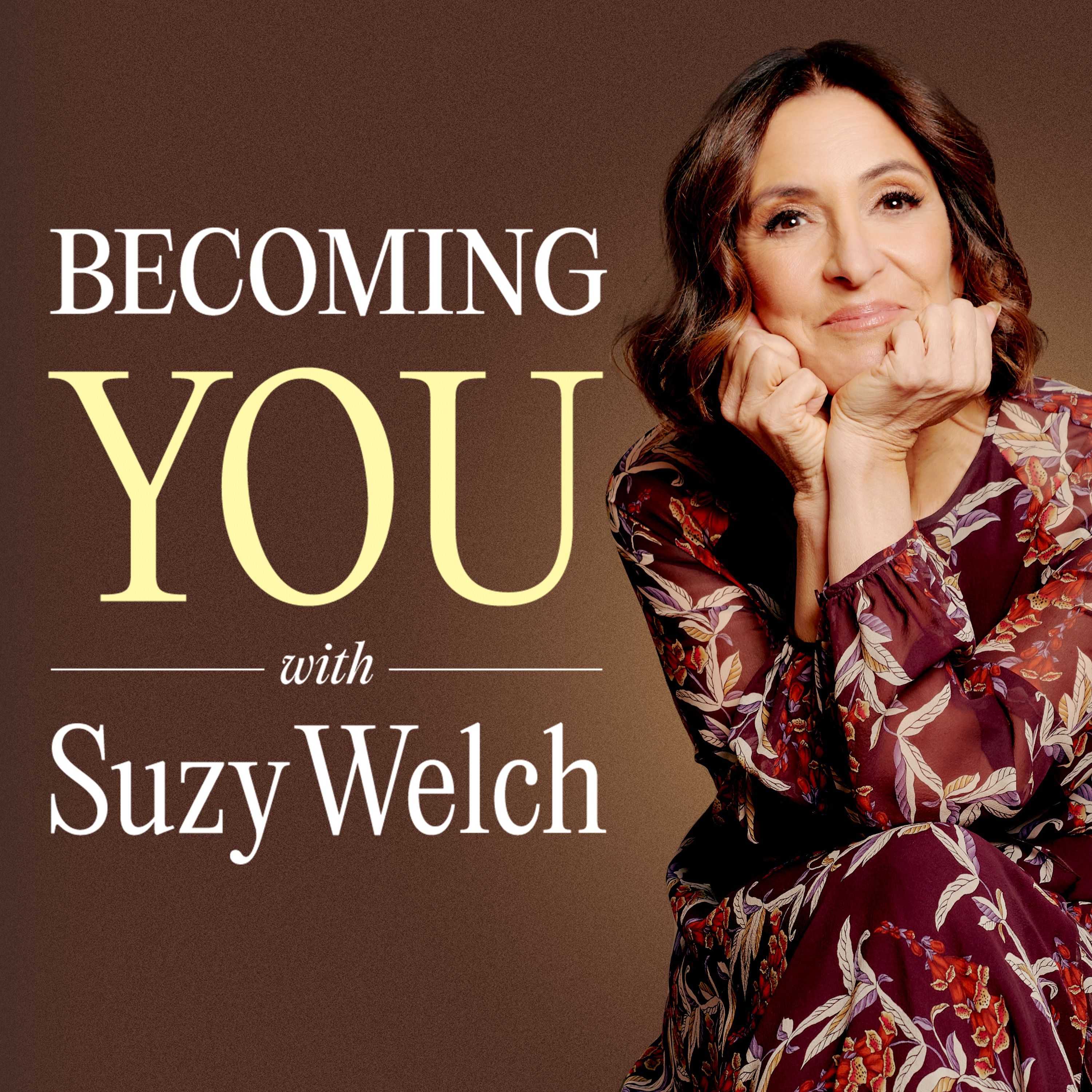
Becoming You with Suzy Welch
It’s Christmas. Please don’t ask me about Christmas. OK, ask me.
00:23:58
Loading summary
Transcript5 lines
- [00:02]
Susie Welch
Come, are ye faithful, Joyful and triumphant.
- [00:11]
Oh, my God. Merry Christmas. Doesn't that music just get you in the Christmas spirit? I hope so, because this is the Christmas episode of becoming you, as you can tell by my amazing Christmas outfit that I'm wearing. And this is the podcast that exists for the very reason that we believe life is a gift. It is the gift. And to continue this Christmas metaphor, it's a gift to be opened each day with wonder and experience, with great deliberation and intention and joy and all those things. But, you know, I'm not woo woo, and I'm not going to get all woo woo and feely goody on you, because, to be honest, this week we're going to be talking about why I kind of lose my mind a little bit every Christmas. I do. In one really good way, I lose my mind, and in one very bad way, because to me, Christmas, I might be the only person. But Christmas is like an emotional minefield, and we're going there. We're going to go there. Now, how could that be? How could that be that Christmas is an emotional minefield? I mean, we're talking about Christmas, which we all love very much. Who does not love Christmas? Well, I have a reason I don't love it. And we'll find out why very, very soon. And spoiler alert, my issue is Santa, okay? Who I'm troubled by. For instance, okay, maybe I don't hate Santa. Santa, exactly. But I don't like him very much, and probably not for the reasons that you're thinking, okay? So I think by the end of this podcast, whether you like Santa or not might be a bit of a litmus test for you, too. That could happen. But at the very least, I'm hoping you understand something about yourself and other people a bit better whether you like Santa or not. Hello. Hi. The Grinch speaking here is Susie Welch. I'm a professor of management at NYU Stern School of Business. It's definitely not working this week at Stern School of Business because all my grading is done and all my students are home, which is great. And at NYU Stern, I teach a class called Management With Purpose, which is about how to be a great boss. But I also teach a class that's called Becoming youg. Just like this podcast, which was actually started a little bit more than a year ago, maybe a year and a half ago, when after class one day, the semester was ended and two students said to me, we're going to miss you over the summer, Professor Welch. And I said, I'm going to Miss you too. And then I said, I know, I'll start a podcast. And they were like, yay. And I said, yay. And here we are. And now you may. And. And I think actually we are very delighted to have discovered that more than those two students apparently wanted to hear that podcast. And if you are one of those regular. One of our regular listeners, thank you so much. You know how much I love you. Thank you. You are a gift to me and to the team at Becoming you Labs. And if you're new to the pod, welcome very much. A special hello to you. Please stick around if you would, next 30 minutes because I think we have a not your usual Christmas episode for you this Christmas. Why? Because I think that this podcast might make you a little uncomfortable. It's actually making me a little uncomfortable. And we've just gotten started because our topic this week is not just Christmas Christmas per se. It is the value that may or absolutely may not underlie Christmas for you, which is faith. Faith. This episode of Becoming youg is about faith. That value. I wish I could cue this scary music here. Wait, we actually can cue scary music. We can. Faith. Faith. This episode of Becoming youg is about faith. All right. By the way, the name of that sound effect is called Mongolian Barbecue. I found it myself. It's a very name. Odd name. But anyway, let's get going now. I want to give you one minute of background about becoming you before we go forward. Just to give us some context here. Becoming youg is a research based, validated methodology to help you find your purpose in life. It has been used by my students at NYU for almost five years. But at this point, because of my book and my travels and so forth and this podcast and other other platforms, about a quarter of a million people worldwide have used the Becoming youg methodology or parts of it. Now, very simply, Becoming you helps people identify their defining aptitudes, emotional and intellectual. And they're defining economically viable interests. And it also helps them identify and rank order their values. Now Becoming you is based on an inventory of 16 human values. And values are life organizing principles. Some of them will sound very familiar to you. Family, centrism, achievement, belonging. Then there's some. There's a value Non sibi, helping people, eudaimonia, self care, work, centrism, agency. That's self determination. And on that list is a value called cosmos. Faith. Not a specific faith, but faith. The belief in a higher power. Now, I don't know where you are in your life and I don't know how you a listener are feeling about faith and how it stands as a value for you. And you know what? For the purposes of this podcast and Becoming youg, it doesn't matter. We have to understand all the values in the world, the ones we have and the ones we don't have, so that we can be in the world with each other, with compassion and understanding. And I might even say we need that now more than ever, given the way the world is. So no matter where you are in terms of your faith, stay with me here, because this is about all of us. It's about all of us understanding all the values. And I actually do have data about all of us when it comes to faith because I have lots of data in general because of the values bridge which 110,000 people have taken. It tells us that 30% of the population overall has cosmos core value. Again, this is irregardless of the faith tradition we're talking about. 30% have it as a top five value and 52% have it as a bottom five. And that leaves 18% having faith of any variety somewhere in the middle. It's really a barbell value if you can visualize that. Either you have it as a top value or you have it as a bottom value. It's only, it's actually the only value like that in the whole inventory. Now, one thing about becoming you, super important to say we are values agnostics. I personally am a values agnostic. I don't care what your values are as long as you're not hurting anyone. Your values are your values to live. My work and the work of Becoming youg Labs is around helping you live your chosen values more fully, expressing them more fully, because that's what leads to an authentic life. But it just so happens, okay, in the context of that, that cosmos is my number one value. I am a Christian person. But again, the my faith tradition doesn't matter. But my faith is my number one value. It defines my life. But here's the irony. I almost did not include faith cosmos in the values measured by the values bridge. After all of my research into values, after all of my studies, after my PhD, everything, why I almost left it out. And here's the reason. Because I was afraid that it would somehow politicize or undermine the acceptance or the credibility of the assessment. I was afraid it would freak out the non cosmos people. And now, as a faithful person myself, I know how faith can be like a lightning rod. It can be very disconcerting to, to non faithful people. It can make people who do not have faith. Think that you're kind of missing a chip. I've experienced that my whole life. But then, here's the truth. I realized I couldn't leave Cosmos out. The values bridge, like every assessment tool, went through a long period of beta testing and validation. And as part of that, we had a lot of focus groups. I attended them all. We had 42 of them. And invariably in the focus groups, invariably, someone or multiple someones would ask, but where's the value of faith, Professor Welch? I mean, the first time it happened, it was a very faithful Jewish student of mine who asked me that. And it came from everybody. It wasn't just Jewish or Christian people. Everybody who asked this question came from a different faith tradition. And after a while, I had to face into this fact that I was leaving out a true value. And we put it into the values bridge, where, oops, it showed up as my number one value. That didn't surprise me because I knew it about myself, but there was a gap because I knew that faith as a value can really trigger people. So speaking of triggering people, what does this have to do with Christmas? Well, for me, kind of everything. At the beginning of the podcast, I said Christmas was triggering for me in some ways, it was an emotional minefield for me in a good way and a bad way. And I want to talk about that. All right, let's start with the bad way. So here's the thing around Christmas. If you are a high cosmos person who happens to be a Christian person, you have to kind of live in a parallel universe. I mean, for you, the holiday is really religious, okay? It's about your cosmos. It's about the birth of the person on whom your entire faith is founded. But for most people, they're celebrating it. Every. Most people around you are celebrating it as, like a massive gift giving event with Santa as the main character. For you, it's really holy. I mean, as holy as it gets. And for almost everyone else, it's like, it's a consumer thing. It's a vacation, it's a party. It's about a Santa fable. And you have to hold this dichotomy in your head and in your heart every waking moment during the Christmas season. And you have to hold it there pretty silently if you want to get along with people. This is a secular world, okay? And this holding of it is kind of like sticking a finger in my socket. I mean, this just happened yesterday. I was visiting with my granddaughter and the topic of Santa came up. And I want to, like, play you a little Clip of the conversation she had with her grandfather, my first husband, Eric. And when they start talking about Santa, he listen to him. He is describing Christmas to her.
- [09:40]
Stockings. Presents go in stockings. Yeah, Presents going under the tree. Presents go in your hands and you rip open the paper and you see what's inside.
- [09:50]
Yeah, yeah. It's so much fun. Wait, what happens when he does now? He has her in a basic frenzy. You don't really hear it. He has in her basic frenzy about Santa coming down the fireplace. And you catch me there at the end saying, you know, wait, what happens at Christmas? But then I drop, I want to tell you right now, I mean, I got the looks from everybody in the room and I dropped it right there because I have spent so much of my life doing exactly that. This is a very Cosmo centered holiday for you. I remember I was about to go to church with my entire family on Christmas Eve. And my family is generally quite faithful. But my mom and dad were along and my mom, as we're walking out the door to get into the car to go to Christmas Eve service, she said to me, I don't like it when they bother with all the religious stuff, but I love the music. And I was like, that's great, mom. And meanwhile, I'm thinking of all the things I really want to say because remember, this is my top value. Right? But you know, it's a good discipline. It's a good discipline. None of us should be judgmental or bossy about anyone's values, no matter what your top value is. If your top value is achievement, if your top value is eudaimonia, your top value is cosmos. People have a right to their values. And what a hypocrite. I would be right if I walked around saying I'm a values agnostic. And then at Christmas I just started bringing it out, you know, and trying to impose it on people. But the truth is I'm actually also a human being. I'm a human being with an inner life, if you will. And Christmas is always the time of year where I have to spend a lot of energy to not do what I want to do in my heart of hearts, which is to tell people I really love my number one top value. And I wish you would try it. As I said, I think we all do this with our top values. You know, if you have eudaimonia and you think that self care is going to save somebody, you tell them. And if you are an achievement person and you see somebody who doesn't have it as a value you want to tell them. And at Christmas, if you're a Christian, cosmos, people want to tell you about the real purpose and the real meaning behind Christmas. And so I have to check this all the time. I think I do. I think I do. I think I do check this all the time. But you know me. Let us trust but verify. Let's call the truth teller. If you're actually. If you are a. If you've been with us for a while on this podcast. You know, nobody tells the truth about me like my daughter Sophia. She's out on Amtrak right now, home from a party in Boston. I'm going to track her down. She does not know I'm calling, but I'm going to call her and I'm going to ask her how good I am at keeping my big mouth shut about my number one value around Christmas. All right, listen, I have a question. I'm doing my podcast on faith, and I want your honest opinion, which is, do I proselytize? Or alternatively, do I keep it in pretty good check, given my value of faith? Oh, come on. You keep it in pretty good check, I think. Oh, thanks. I mean, I think your kids are maybe the exception, but that's fine because. But in general, for the general population, given my proclivities, we would agree that I keep it under control. Yes. I feel like people are often surprised to learn. Okay. Yeah. All right. Thank you, dear. Okay. I think I passed the test there. And actually, that interest, she's a very interesting thing. She says at the end, right. That sometimes people are surprised to know that cosmos is my number one value. And so I think I'm going to pat myself on the back for repressing my number one value, especially, like, when I see all the Santa imagery. And it does trigger me into the stratosphere. And maybe I hope I've explained a little bit why. Now, that said, I actually want to finish by talking about why Christmas triggers me all the right ways and why it's actually in many ways, the best time of the year for me. And that's going to involve me telling a little bit of the story, the crazy, crazy story of how faith came to be my number one value. And it's crazy, crazy, crazy story because my family, my family of origin was not religious. In fact, they were anti religion. They really were. My dad was from a Jewish background, and he was an absolute and complete atheist. And in the 65 years I knew him, he never stepped foot in a temple or celebrated Jewish holiday or spoke a word about God. And one of the reasons was that his Jewish family really rejected my mom, who was culturally from a Catholic family. But, you know, it's ironic because my mom, even though she was culturally Catholic, had a very negative view of religion. She really didn't like priests, and she didn't like organized religion. She didn't like anyone telling her what to do, which her faith often can do. But my grandmother would bring me to Mass, and I really wanted to go. I loved it when she brought me to Mass. I loved everything about the church experience. I went to my first Mass with her when I was maybe four or five. But here's the thing. 1960s, guess what was going on. Christmas Mass was in Latin. If you were Catholic, that changed in the late 60s. It was in Latin. So you'd go into church and you wouldn't understand a ding dang word the priest was saying. But I loved the feeling of it. I love the smell of the incense. There was something holy going on. And you could hear the word Jesus again and again. But I had no idea what was going on, but I sensed it was important. And I would leave church with my grandmother, and I would say to her, why are they talking about Jesus? And she was very dismissive of me. And she said that Jesus was a troublemaker, that Jesus was troublemaker. Well, she could have said anything more interesting to me because I loved troublemakers, and I still do. And I thought, yeah, he was a troublemaker. A lot of wars started because of him. Some wars ended because of him. But a lot of history was made because of him. And I want to understand him, but I, you know, look, I was five or six and seven, but I was really, really intrigued. So I remember coming home from school when I was in first grade, and my sister and I got off the school bus, and there was a mother and her daughter standing there asking kids if they wanted to go to Bible study. And I remember thinking, I want to go. I want to go. And my sister kind of making fun of them and running in the other direction. And I was like, wait, wait, I want to go. So something was calling me, right? But I had no idea what. But I knew one thing for sure. And I knew that what was calling me was something that would make me an outlier in my family. So this bumped along until 9th grade and 10th grade, when I went away to boarding school where chapel was recorded. And I remember showing up the first day in chapel and people kind of grumbling about it, but I was not grumbling. I was, like, so excited to be in A church where they were speaking English. And there was a super charismatic young pastor and named Bobby Thompson. And he started to talk to us about Jesus in a way, like, Jesus was his friend. I mean, like, he was talking about, like he knew the guy. And I remember he told me later that he looked down and he saw me in the front row of chapel. And he remember, said to me, I remember looking at your hungry eyes, Susie. He also said, guess what? We have a Bible study at this church. And if you're interested in this story and this person, Jesus, why don't you come to it? And I was there, and I was surrounded by other kids who had been brought up though, brought up in Christian households. And I was like, they all know all these stories. Like, they're talking about this guy Simeon, and they're talking about this guy Luke and this guy Paul, and they knew who these people were. And I was like. All I could think was like, I want to know who they are. And I thought the stories were so cool. And so I entered it kind of as an intellectual. Like, what I told myself was, I need to know these stories so I can understand. Understand poetry and literature and art. And that's actually what I told my family. I was like, really on this intellectual journey so I could understand art and literature better, but it was not true. And really, the whole story of me coming to faith as my number one value is a story of a very scared person struggling to become real with herself in the world. And one of the great ironies. Oh, there's so many ironies in this story, is that there's one phrase that's repeated more than any other phrase in the New Testament. And if you're a Christian person, you already know what that is because you're taught it from an early day. And that phrase is, be not afraid. It's repeated over and over again. Don't be afraid. Be not afraid. And the reason why it's repeated is that holding faith as a number one value is often very, very scary. The world is not often ready to receive you, and it can be a scary journey. And it really was for me. So I was there at boarding school, coming into this love of this faith, but unable to say it out loud. And then I got to college and there was great preaching at Memorial Chapel. And I went, but so did a lot of people, because it was sort of a thing that you did, because the pastor there, Dr. Gomes, was super famous for giving very, very entertaining sermons. And I went, but still, I did not openly proclaim that I was believing because by then I was. And in fact, ironically, more irony, I was living with two Jewish women who openly proclaimed their faith and talked about their faith, and I'm sure it was their number one value and just still kept mine silent. I was scared. I was scared of my family rejecting me. I was scared of the smart intellectuals at the Harvard Crimson, where I was hanging out all the time, the daily newspaper. I was scared of them rejecting me and thinking I had a screw loose, which is often how Christian people were received. And I just kept my big mouth shut. Hard to believe, isn't it, that I didn't talk about it. Finally, an amazing thing happened, which is when I married Eric, my first husband, and we had children. One of our kids went to preschool in the basement of a Congregational church in Newton Highlands, Massachusetts. And there I was. I found myself in a church. And we went to that church. We tried it on Christmas. And the young pastor Jim Antol and his wife Cindy befriended us. And it was the bridge. It was the bridge for me to figure out what faith really was. I went to, like a Christian formation class and I thought, that's it. This is me. I'm going to say it out loud. I remember the first time I actually said the words, I am a Christian. I just said it to somebody in conversation about Christmas, and I said it to my family. And my sisters were okay with it. A little perplexed, but other members of my family were not okay. I mean, a member of my family said to me, when did you become a Jesus freak? And did not say that with a lot of love. And finally I had to decide that I was not gonna live for their judgment and I was gonna be who I was. And then I fully stepped into it and I made a lot of Christian friends. And once you sort of come out loud with who you are, you find your fellow travelers. And I did. I eventually came to teach Bible school. I taught Sunday school to my kids. One of my happiest memories of my whole life is me teaching Sunday school and doing the part of the Bible where God sends manna down from heaven to the one of the tribes wandering in the desert. And I had a lot of dried bread and I stood up on a chair and I sprinkled breadcrumbs on the heads of a lot of screaming with joy, like little five year olds. And I was, you know, sprinkling breadcrumbs on their heads and reenacting a scene from the Bible. And I was happy, and they were happy, and I was fully living my Faith. And I've been doing that ever since I was around 26 or 27 years old, so 40 years. And so for me that makes Christmas this amazing time of year because I get to sort of celebrate, despite Santa, all of the astonishment of the birth of the central character of my faith, Jesus. And it's. I love this story of Mary so much. I think about her being a young 14, 15 year old girl and this crazy ass thing happening to her where this gigantic angel blows into her very humble abode and says, guess what? You're pregnant with the savior of the universe. And she's got to tell her fiance, who she's never had sex with, that she's pregnant with somebody. And he takes her word for it after a dream. That whole story fills me with so much wonder and so much astonishment. And during the Christmas season, I get to relive it with my fellow faithful people and celebrate it and rejoice in it. So it's a great time of year for me that way because I'm fully living my number one value. I'm fully living it. And you know, no matter what your values are, whether faith is your value or not, you know, you know that living your number, your top values is as good as it gets into feeling authentic and feeling self expressed and feeling fulfilled. And I get to do that at Christmas, I get to do that with, at Christmas time. So I want to say 100,000% I'm not proselytizing here. I can't do that. I shouldn't do that and I won't do that. But I do want to say it is so good to understand this value. I hope maybe I've opened your understanding of it a little bit if you're a person who doesn't have it as a value. With my own story, it may not be your values, I've said, but it is the value of someone. You know, it's the value of somebody you work with no matter what their faith tradition. It could be your Jewish neighbor. It could be like a Buddhist professor you have. If you're in New York City, it could be your new Muslim mayor. I don't, I don't know who it is, but you know, somebody who's got faith. And so maybe the best thing at Christmas is not what Santa brings down the chimney chute, but this act of understanding each other's values with respect and an open heart and an open mind and maybe a reverence for our differences. Maybe, maybe that's what Christmas is all about. And what a great gift that would be. So anyway, that's where we land today. I hope this podcast has been a gift to you. No matter where you are on this particular value, this is becoming you. And I'm Susie Welch.
- [23:24]
Come and be behold him Born the king of angels oh, come let us adore him oh, come let us adore him O come let us adore him Christ the Lord.