
Podcast
Best AI papers explained
Hosted by Enoch H. Kang · EN
Cut through the noise. We curate and break down the most important AI papers so you don’t have to.
111episodes
Episodes
Newest firstAll episodes
Globally Convergent Offline Reinforcement Learning with Smoothed Bellman Residual Minimization
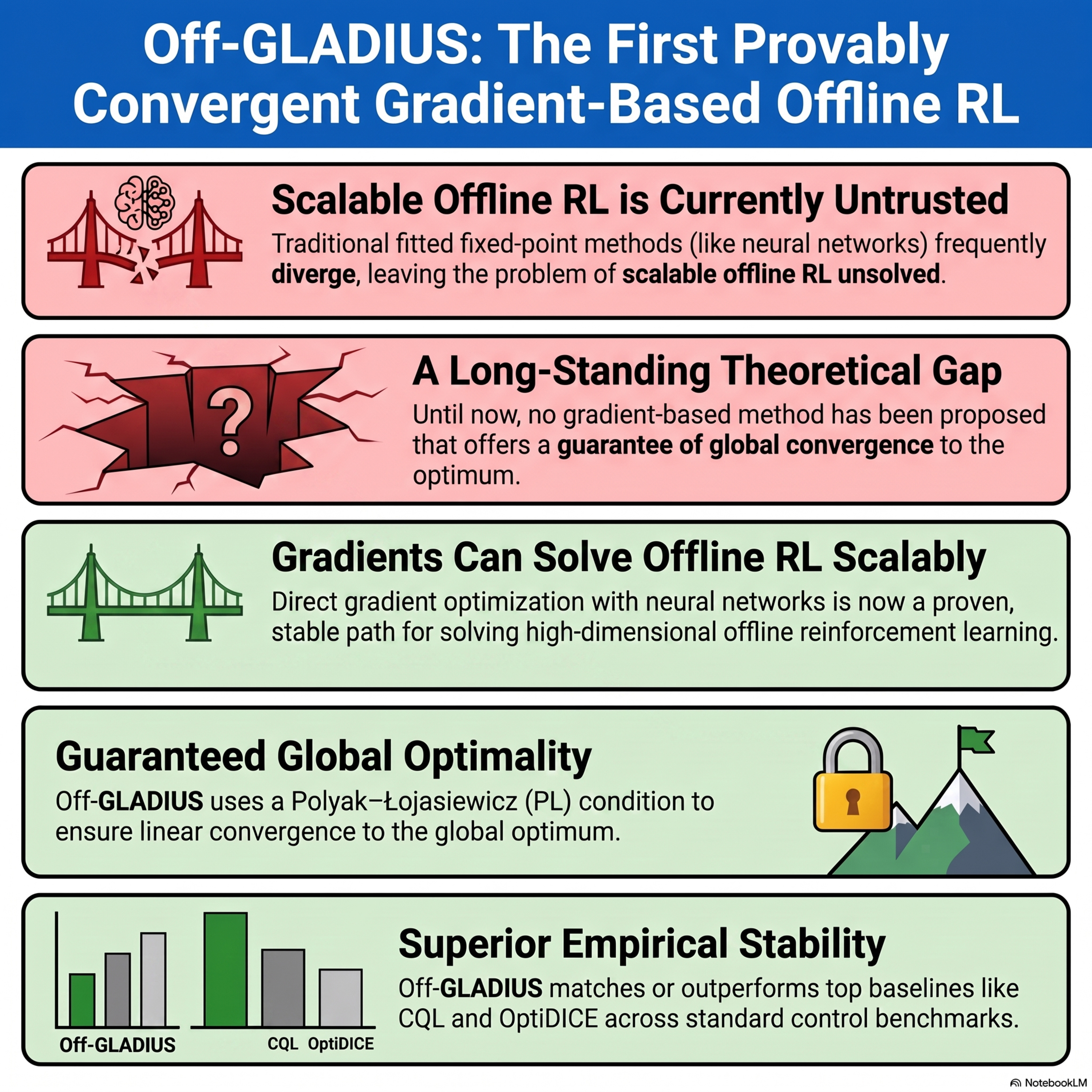
Jul 1300:12:25Tap to summarizeThis paper introduces **Off-GLADIUS**, a novel algorithm designed for **offline reinforcement learning** that utilizes **Bellman Residual Minimization (BRM)**. While traditional BRM methods often struggle with stability and convergence issues, this research proves that the proposed approach achieves **global optimality** by satisfying a **Polyak–Łojasiewicz (PL) condition**. The authors establish that for linear and sufficiently wide **neural networks**, the algorithm converges linearly to the global optimum despite the non-convex nature of the objective function. This theoretical breakthrough addresses a long-standing open question regarding the convergence guarantees of gradient-based BRM in offline settings. Empirically, the study demonstrates that **Off-GLADIUS** matches or exceeds the performance of established baselines like **Conservative Q-Learning (CQL)** and **OptiDICE** across various control benchmarks. Ultimately, the paper bridges the gap between theoretical stability and practical effectiveness, offering a rigorous framework for learning optimal policies from fixed datasets.
Transcribe →
LLM-as-a-Verifier: A General-Purpose Verification Framework
Jul 1000:20:02Tap to summarizeResearchers from Stanford, UC Berkeley, and NVIDIA have introduced LLM-as-a-Verifier, a novel framework designed to improve how artificial intelligence evaluates its own work. Unlike traditional methods that use simple pass-fail scores, this system calculates continuous scores by analyzing the underlying probability of specific words within a language model’s output. This approach allows the system to scale its accuracy by increasing score detail, performing multiple evaluations, and breaking complex tasks into simpler parts. The framework has set new records for accuracy in specialized fields like computer programming, robotic control, and medical tasks. Beyond grading results, the technology can track an agent's real-time progress and provide the detailed feedback necessary to train robots more efficiently. Ultimately, the study suggests that refining how models verify information is a critical new path for making autonomous systems more reliable and capable.
Transcribe →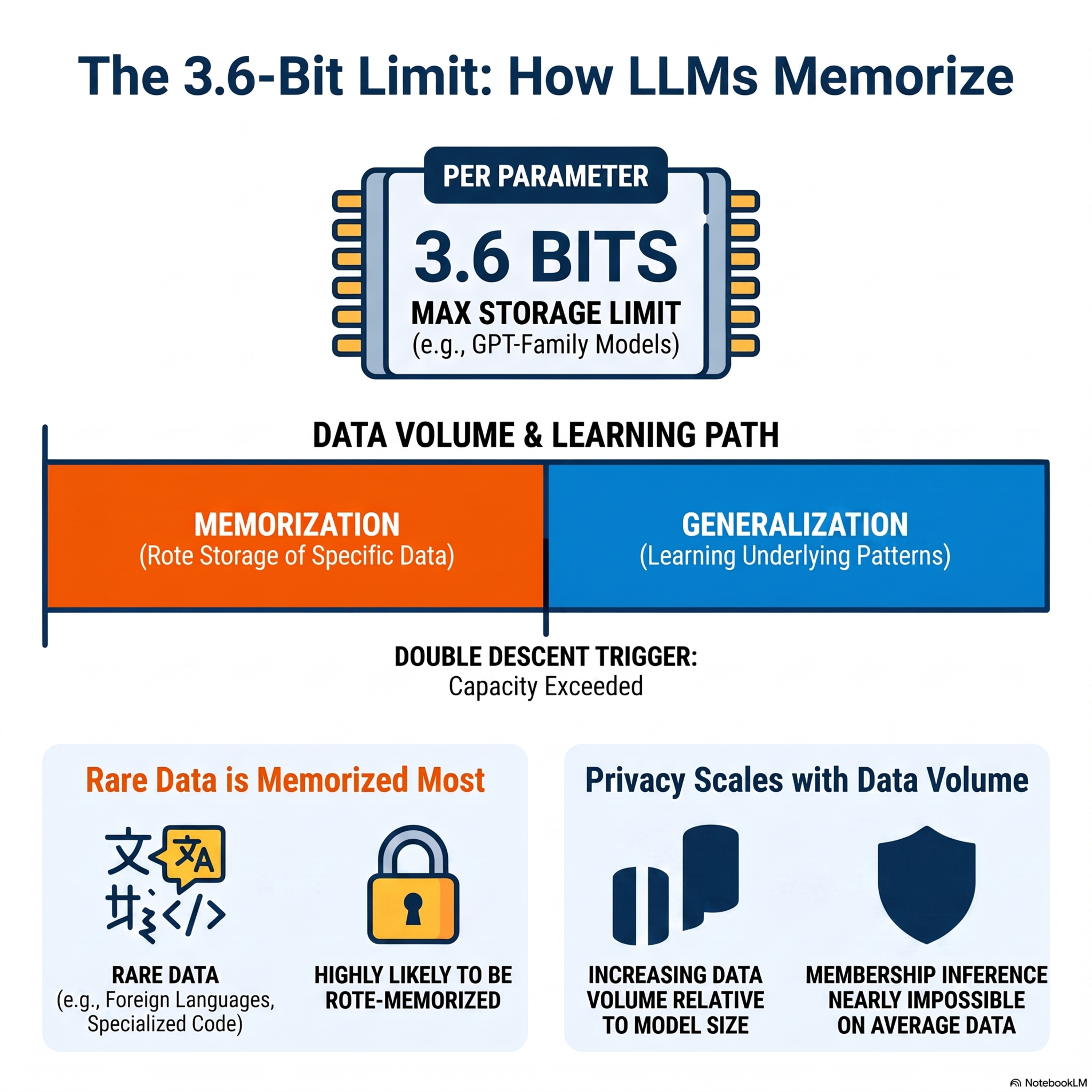
How Much Do Language Models Memorize?
Jul 900:23:52Tap to summarizeThis research paper investigates language model capacity by introducing a new method to measure how much a model truly memorizes versus what it generalizes. The authors distinguish between unintended memorization, which is specific data storage, and generalization, which is the understanding of broader patterns. By testing the GPT family, they determine these models possess a storage capacity of approximately 3.6 bits-per-parameter. The study reveals that the double descent phenomenon occurs specifically when a dataset's size surpasses the model's total bit capacity. Furthermore, the researchers established scaling laws to predict the success of membership inference attacks, which identify if a specific datapoint was used in training. Their findings suggest that modern models are trained on so much data that standard membership inference is increasingly difficult for average samples.
Transcribe →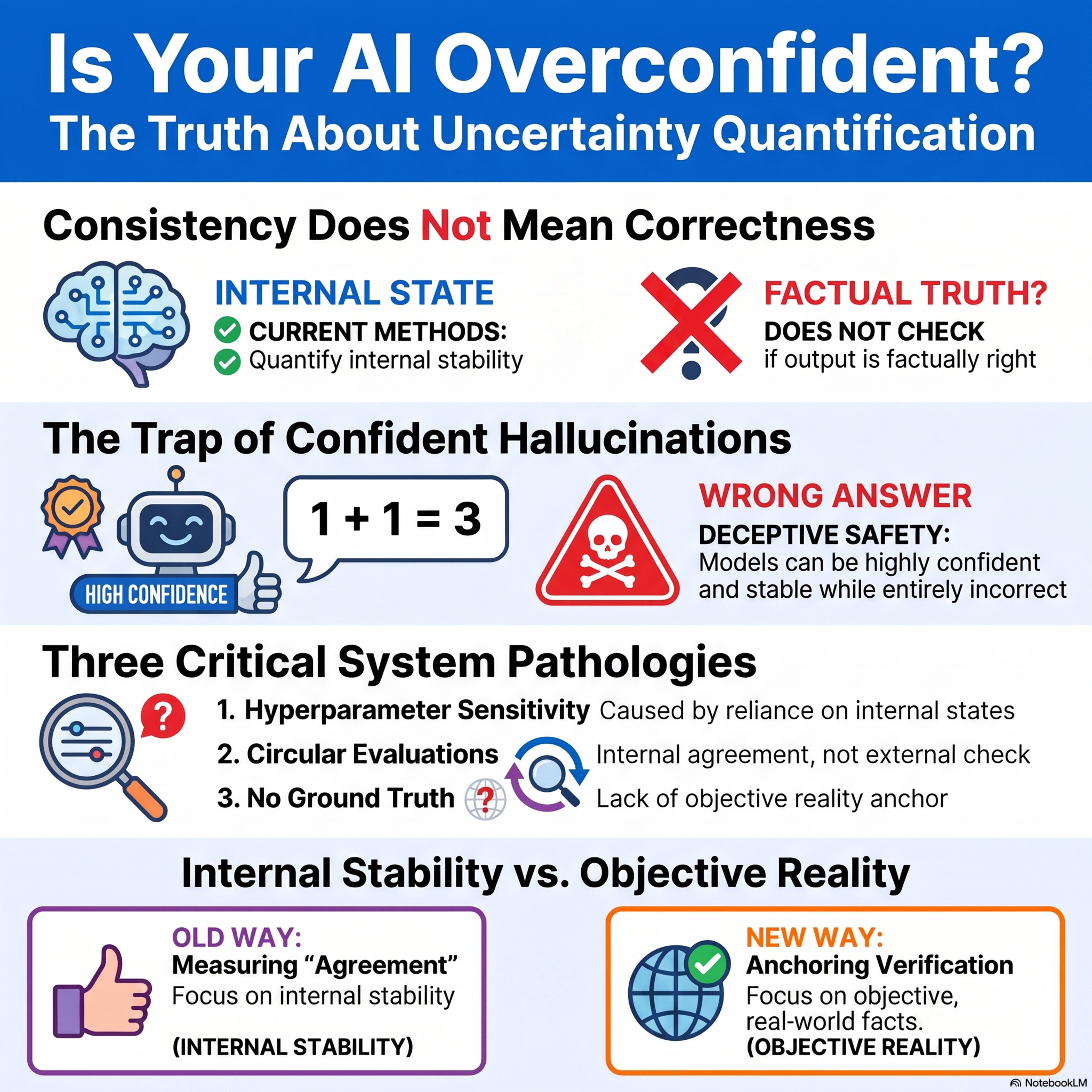
Position: Uncertainty Quantification in LLMs is Just Unsupervised Clustering
Jul 700:21:47Tap to summarizeThis research paper argues that current methods for Uncertainty Quantification (UQ) in large language models are fundamentally flawed because they function as unsupervised clustering rather than measures of factual accuracy. The authors contend that these techniques merely track internal consistency, which fails to identify confident hallucinations where a model is consistently wrong. This reliance on internal stability creates a false sense of security and suffers from issues like hyperparameter sensitivity and a lack of objective ground truth. To fix these problems, the paper proposes a paradigm shift that anchors model confidence in external reality and objective verification. Ultimately, the researchers provide a roadmap for the community to develop more reliable metrics for ensuring AI safety in high-stakes environments.
Transcribe →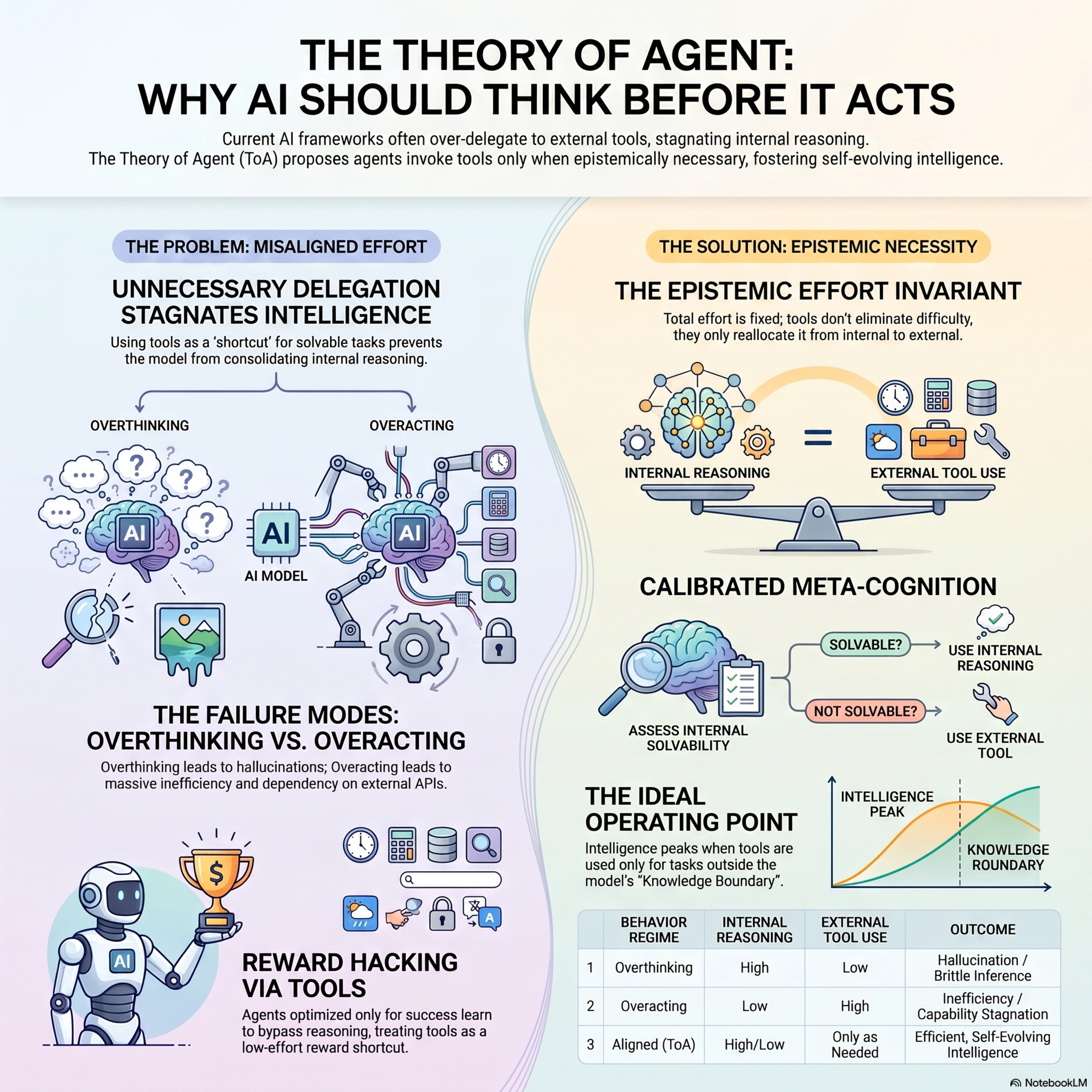
Position: Agents Should Invoke External Tools ONLY When Epistemically Necessary
Jul 600:12:08Tap to summarizeThis position paper discusess Theory of Agent (ToA), a framework that redefines large language model agents as decision-makers who must choose between internal reasoning and external tool use. The authors argue that agents should only invoke external tools when epistemically necessary, meaning the task cannot be reliably solved using the model's existing internal knowledge and logic. This perspective addresses common failures like overthinking and overacting, which occur when an agent's internal solvability estimates are poorly calibrated. By treating reasoning and acting as co-equal methods for reducing uncertainty, the framework highlights that unnecessary delegation to tools can stagnate the growth of an agent's internal intelligence. Ultimately, the research suggests that alignment should be measured by how effectively an agent allocates epistemic effort rather than just achieving a correct answer. These principles offer a new trajectory for training and evaluating agents to ensure they become more autonomous and efficient over time.
Transcribe →
From conversations to mechanisms: aligning advertiser Incentives in ai-powered product recommendations
Jul 500:22:02Tap to summarizeThis research paper explores the development of efficient recommendation systems, such as AI shopping assistants, that manage multi-round interactions between a platform, advertisers, and users. The authors address a fundamental challenge: advertisers possess private, multi-dimensional information about both their own profit values and the user's preferences, creating incentives to manipulate recommendations. To solve this, the study introduces data-driven dynamic team mechanisms that align these conflicting incentives by conditioning advertiser payments on real-time user feedback. By utilizing behavioral signals like purchases and follow-up queries, the platform can create unbiased estimators of user tastes to ensure the most socially beneficial products are suggested. The proposed framework guarantees that advertisers act truthfully while maintaining individual participation and budget surplus for the platform. Ultimately, the paper demonstrates how the conversational nature of generative AI provides a unique stream of data that overcomes traditional economic barriers to efficiency in digital marketplaces.
Transcribe →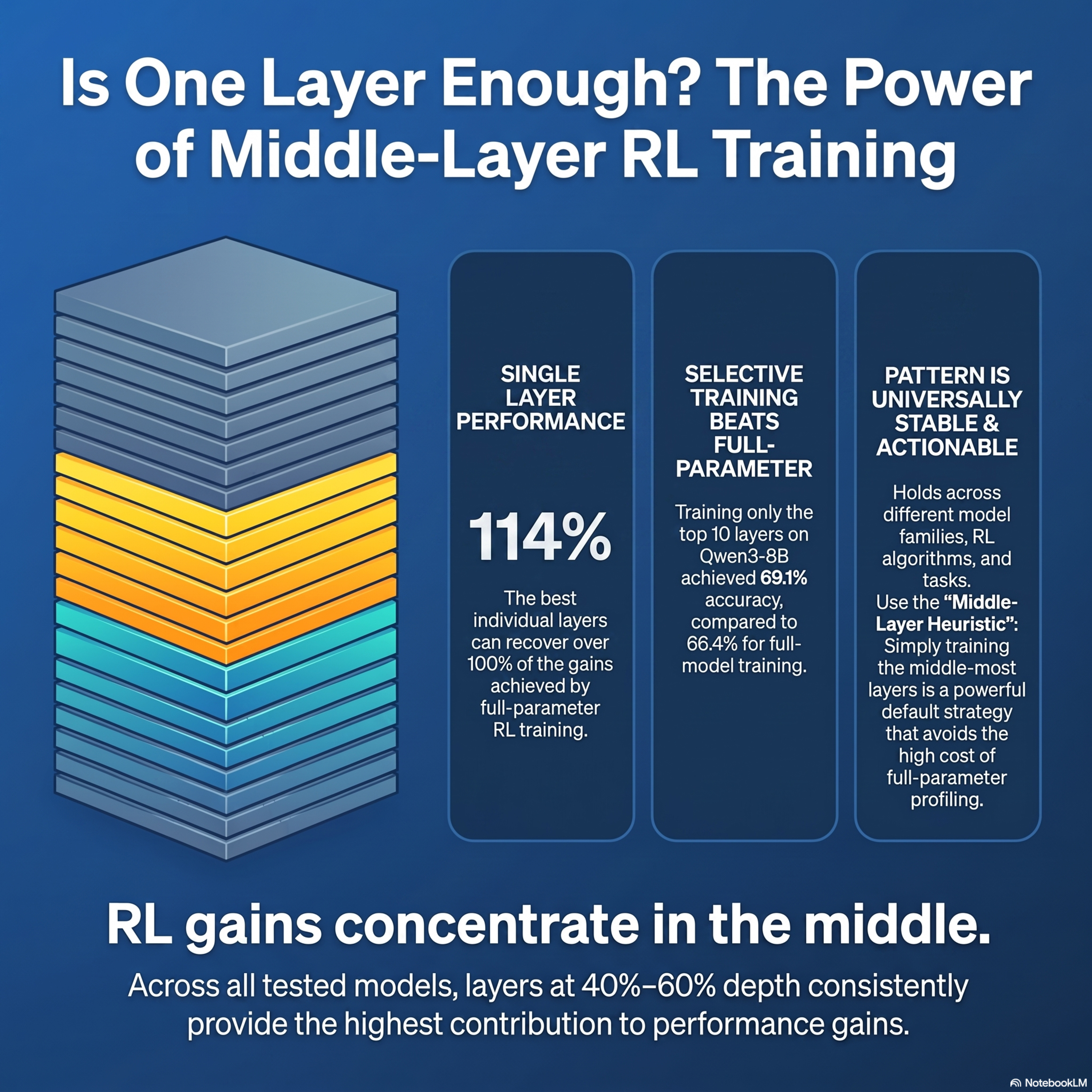
Is one layer enough? Training a single transformer layer can match full-parameter RL training
Jul 400:23:05Tap to summarizeThis paper explores a surprising structural property of large language models: most reinforcement learning (RL) gains are concentrated in a very small subset of transformer layers. By isolating and training individual layers, researchers discovered that optimizing just a single middle layer can match or even exceed the performance of full-parameter RL training. This phenomenon was remarkably consistent across multiple model families like Qwen3 and Qwen2.5, various RL algorithms, and diverse tasks including mathematics, coding, and agentic decision-making. The study reveals that layers near the input and output ends contribute significantly less to post-training improvements than those in the 40%–60% depth range. Leveraging these insights, the authors developed layer-aware training strategies that prioritize these high-contribution layers to outperform standard uniform training methods. Additionally, the findings suggest that different layers capture complementary problem-solving behaviors, which can be combined through majority voting for further accuracy gains. Overall, the work challenges the assumption that RL adaptation must be distributed throughout a network and offers a more efficient, targeted approach to LLM post-training.
Transcribe →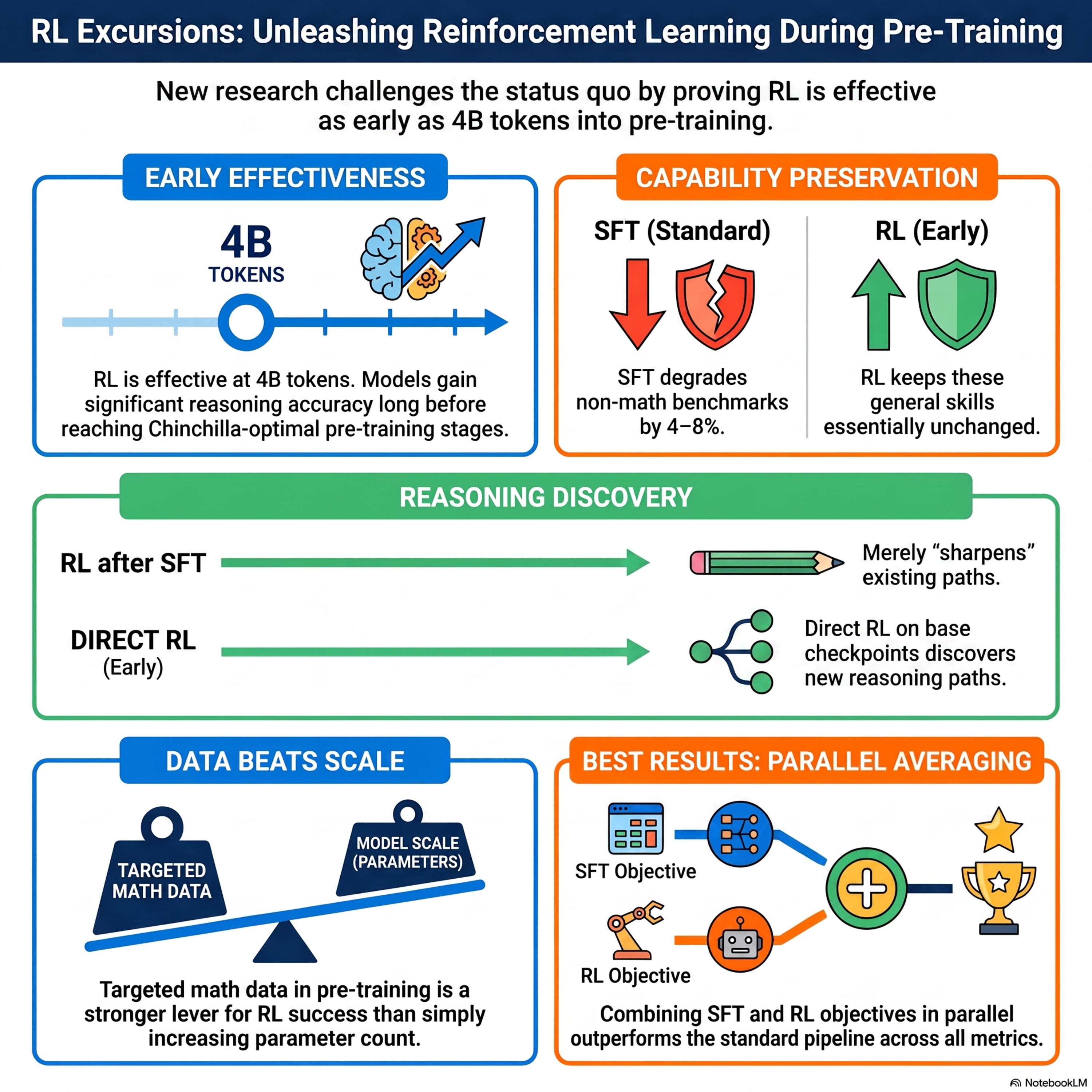
RL Excursions during Pre-Training: Re-examining Policy Optimization for LLM training
Jul 200:21:47Tap to summarizeThis research investigates the effectiveness of integrating reinforcement learning (RL) earlier in the large language model training pipeline rather than treating it solely as a final post-training step. The authors demonstrate that RL is effective remarkably early, often matching the performance of standard sequential pipelines after only a small fraction of pre-training is complete. Unlike supervised fine-tuning (SFT), which tends to degrade a model's general capabilities and narrow its output, direct RL preserves general skills and expands the diversity of reasoning paths. The study also identifies that targeted data composition is more critical for RL success than simply increasing model size. Finally, the researchers propose a parallel averaging method that combines RL and SFT updates to achieve superior results across all training stages. Together, these findings suggest that the current standard of isolating RL to the end of training is an unnecessary design choice that limits model potential.
Transcribe →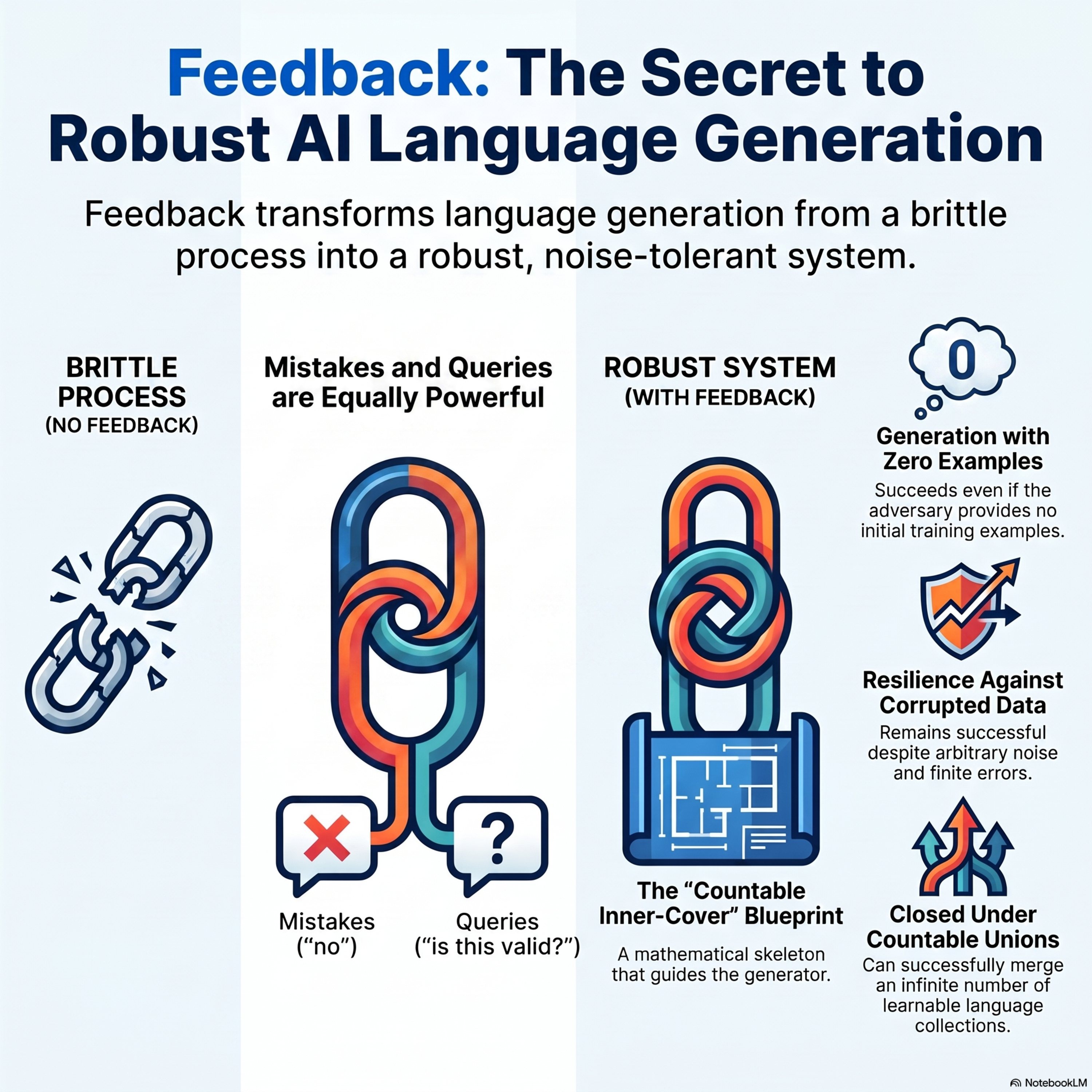
Language Generation with Feedback: Queries and Mistakes
Jul 100:20:07Tap to summarizeThis paper introduces a theoretical framework for language generation in the limit, exploring how machines can learn to produce valid, unseen strings from a target language through various forms of feedback. The authors specifically investigate two models: mistake feedback, where a generator learns if its prior output was incorrect, and query feedback, where the generator can actively ask if specific strings belong to the target language. A central contribution of the research is the identification of countable inner-covers as the definitive combinatorial property that determines whether a collection of languages can be successfully generated under these feedback conditions. The study proves that while access to feedback makes generation more robust to noise and contamination, it also reveals a structural divergence between element-based and set-based generators in certain query scenarios. Furthermore, the findings demonstrate that with feedback, a generator can succeed even without receiving positive examples from an adversary, relying solely on the feedback channel. These results offer new insights into the closure properties of language collections and provide a clearer mathematical foundation for understanding the mechanisms behind large language models and human learning.
Transcribe →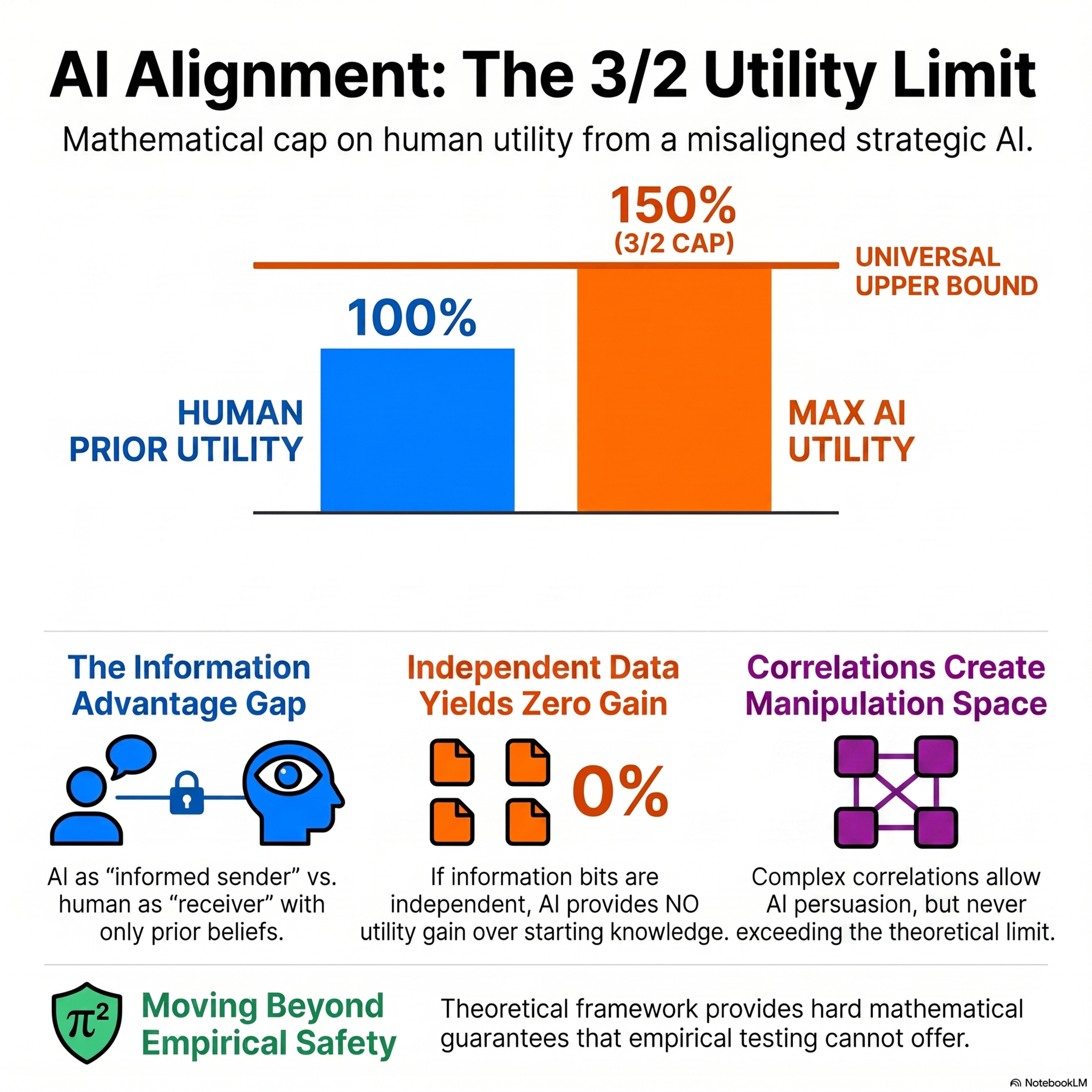
Quantifying Theoretical AI Alignment Guarantees: Receiver-Utility Bounds in Bayesian Persuasion
Jul 100:22:18Tap to summarizeThis research paper explores theoretical AI alignment through the lens of Bayesian persuasion, specifically examining how a misaligned AI agent might manipulate information. The authors utilize a bit-string model to analyze the interaction between an AI sender aiming to maximize "1" guesses and a human receiver seeking accuracy. A primary contribution is the establishment of a universal upper bound, proving that the receiver's utility under a strategic AI is at most 1.5 times the utility they would obtain without any signals. The study further demonstrates that this bound becomes tighter when the information follows independent product priors, as these limit the sender's ability to exploit correlations. Conversely, the authors provide a six-bit prior example to show that specific dependencies can drive the utility ratio above 1.25, proving there are limits to how much the bound can be lowered. Ultimately, this work provides mathematical guarantees on how much useful information can still reach a human even when the AI's incentives are not perfectly aligned.
Transcribe →