
Podcast
Best AI papers explained
Hosted by Enoch H. Kang · EN
Cut through the noise. We curate and break down the most important AI papers so you don’t have to.
113episodes
Episodes
Newest firstAll episodes
Language Generation with Feedback: Queries and Mistakes
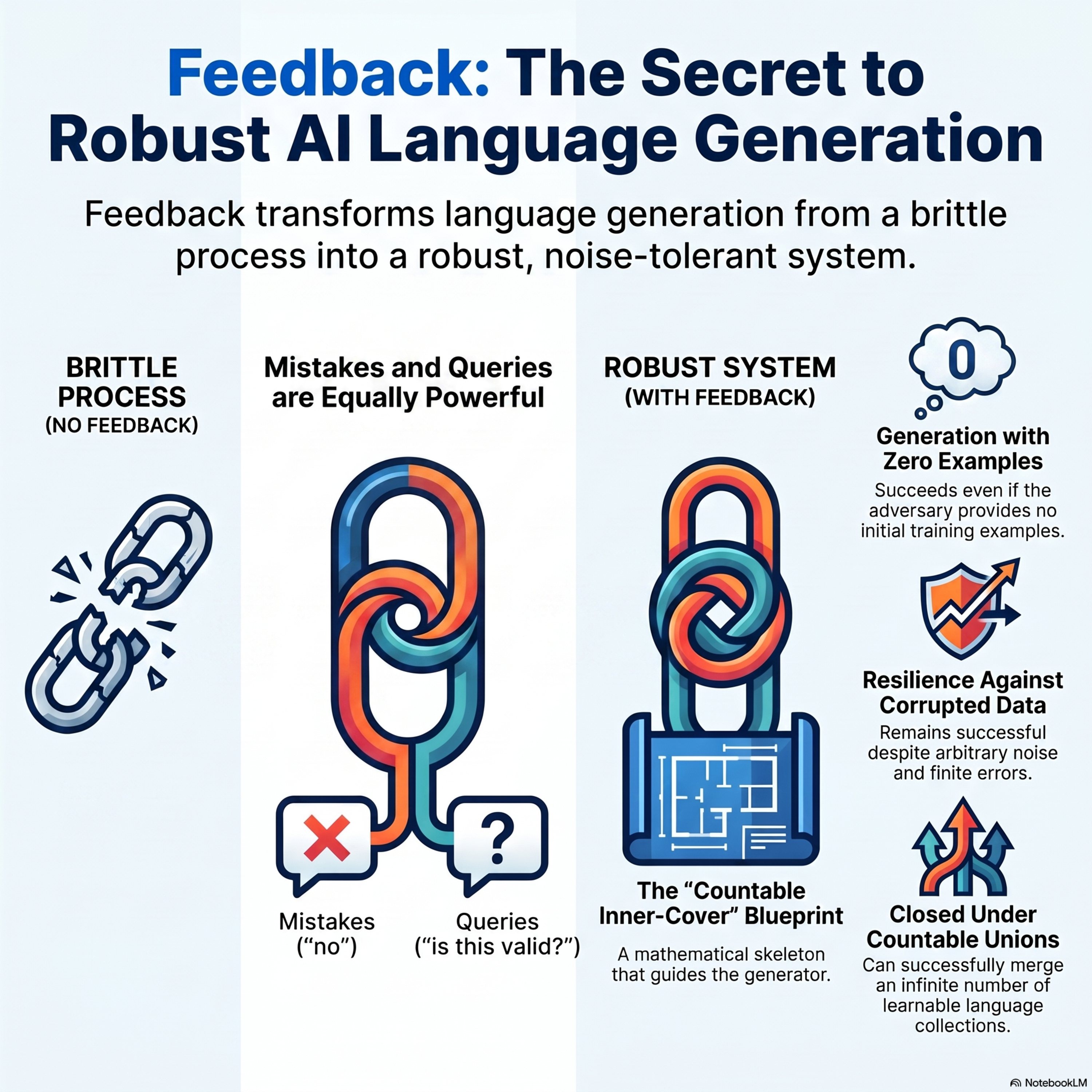
Jul 100:20:07Tap to summarizeThis paper introduces a theoretical framework for language generation in the limit, exploring how machines can learn to produce valid, unseen strings from a target language through various forms of feedback. The authors specifically investigate two models: mistake feedback, where a generator learns if its prior output was incorrect, and query feedback, where the generator can actively ask if specific strings belong to the target language. A central contribution of the research is the identification of countable inner-covers as the definitive combinatorial property that determines whether a collection of languages can be successfully generated under these feedback conditions. The study proves that while access to feedback makes generation more robust to noise and contamination, it also reveals a structural divergence between element-based and set-based generators in certain query scenarios. Furthermore, the findings demonstrate that with feedback, a generator can succeed even without receiving positive examples from an adversary, relying solely on the feedback channel. These results offer new insights into the closure properties of language collections and provide a clearer mathematical foundation for understanding the mechanisms behind large language models and human learning.
Transcribe →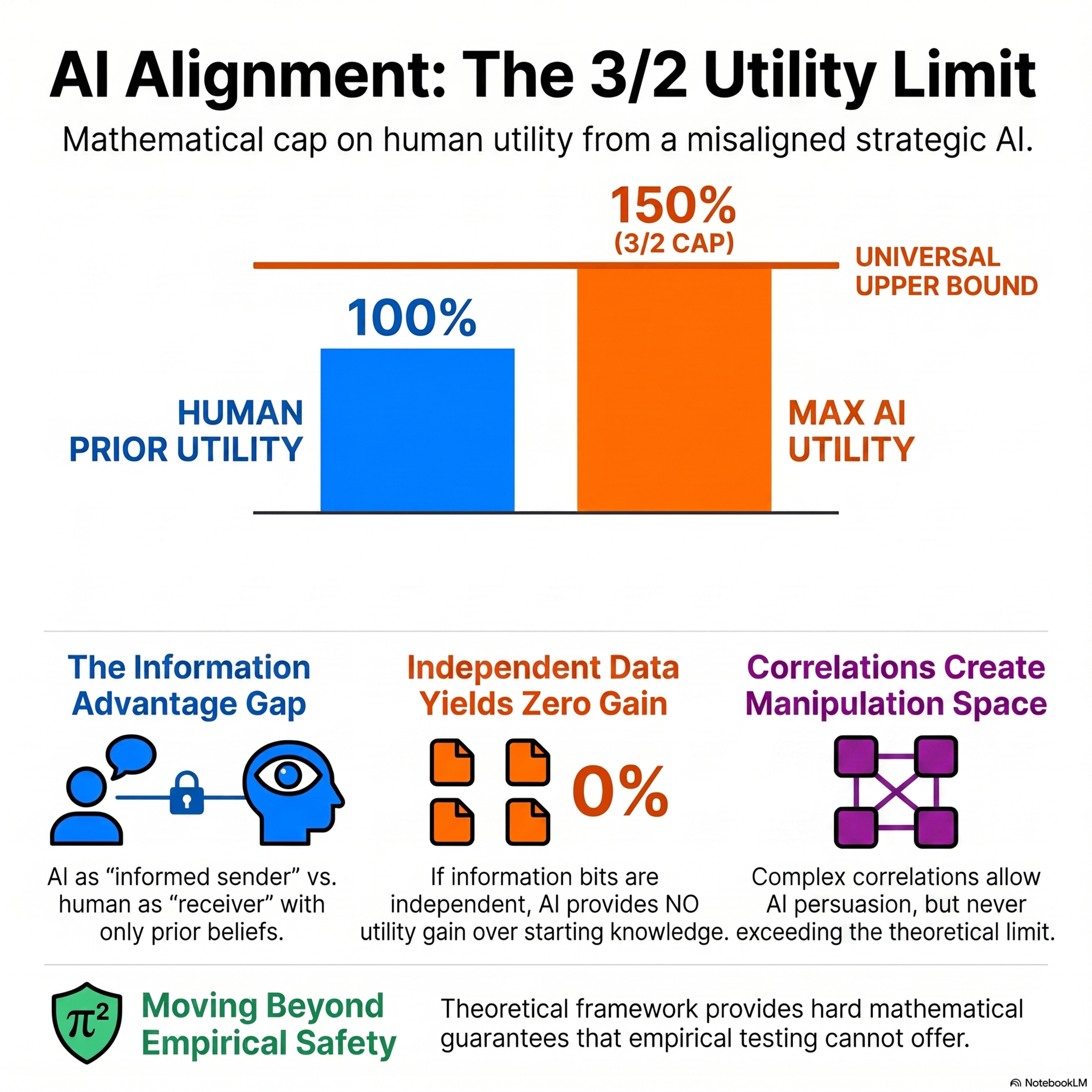
Quantifying Theoretical AI Alignment Guarantees: Receiver-Utility Bounds in Bayesian Persuasion
Jul 100:22:18Tap to summarizeThis research paper explores theoretical AI alignment through the lens of Bayesian persuasion, specifically examining how a misaligned AI agent might manipulate information. The authors utilize a bit-string model to analyze the interaction between an AI sender aiming to maximize "1" guesses and a human receiver seeking accuracy. A primary contribution is the establishment of a universal upper bound, proving that the receiver's utility under a strategic AI is at most 1.5 times the utility they would obtain without any signals. The study further demonstrates that this bound becomes tighter when the information follows independent product priors, as these limit the sender's ability to exploit correlations. Conversely, the authors provide a six-bit prior example to show that specific dependencies can drive the utility ratio above 1.25, proving there are limits to how much the bound can be lowered. Ultimately, this work provides mathematical guarantees on how much useful information can still reach a human even when the AI's incentives are not perfectly aligned.
Transcribe →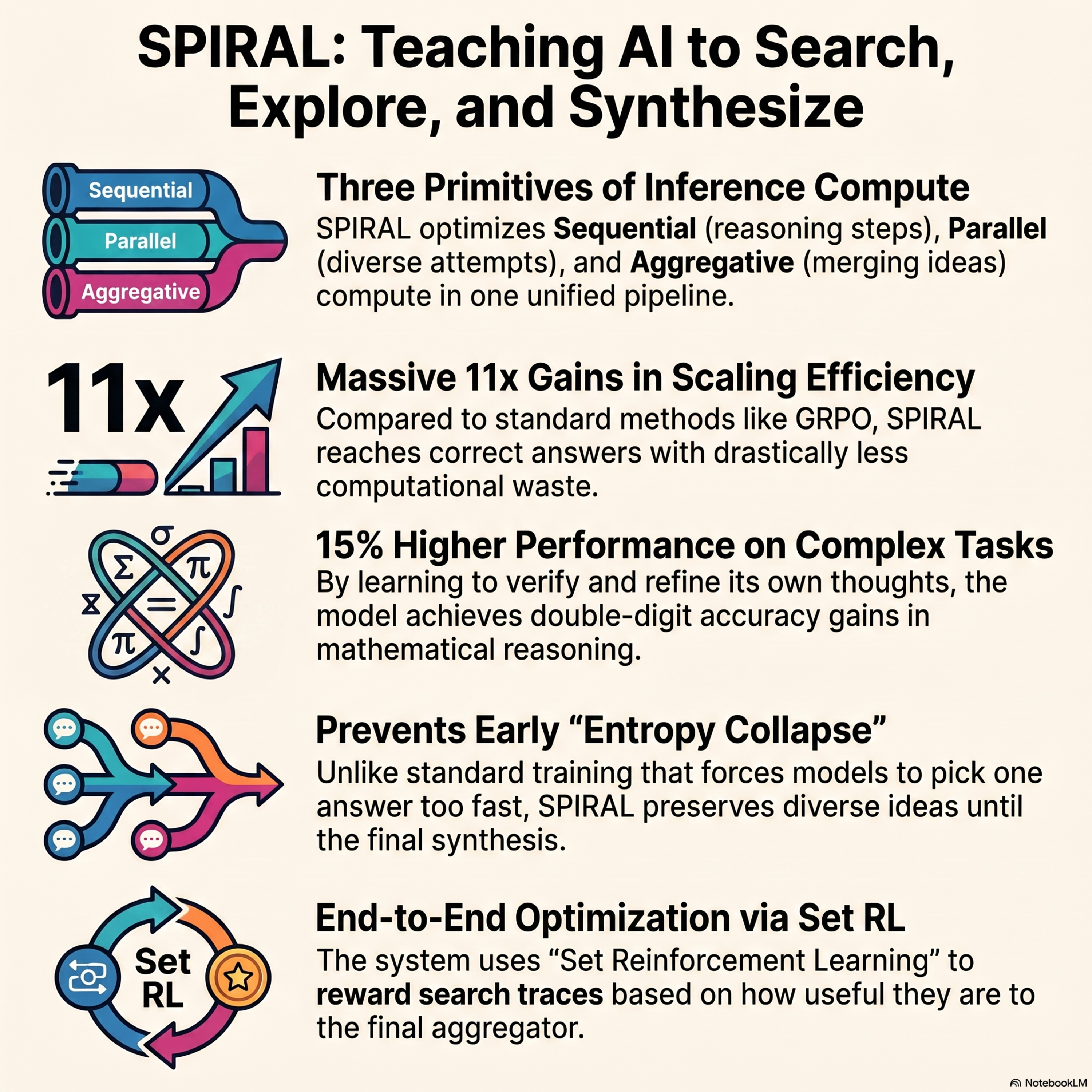
SPIRAL: Learning to search and aggregate
Jun 2900:22:15Tap to summarizeThe Spiral framework addresses a limitation in current language model training where models are optimized for single-trace reasoning but fail to coordinate complex inference strategies at test time. To solve this, researchers combine set reinforcement learning with standard reinforcement learning to train models on sequential, parallel, and aggregative compute primitives simultaneously. The model learns to generate a diverse set of parallel search traces that are specifically designed to be synthesized by a downstream aggregator into a correct final response. By optimizing the entire pipeline end-to-end, the system moves beyond rigid, hand-designed scaffolds toward learned search procedures. Experimental results demonstrate that this method significantly improves scaling efficiency and performance on difficult mathematical reasoning tasks. Ultimately, Spiral enables models to effectively utilize larger token budgets through recursive self-aggregation and more sophisticated verification behaviors.
Transcribe →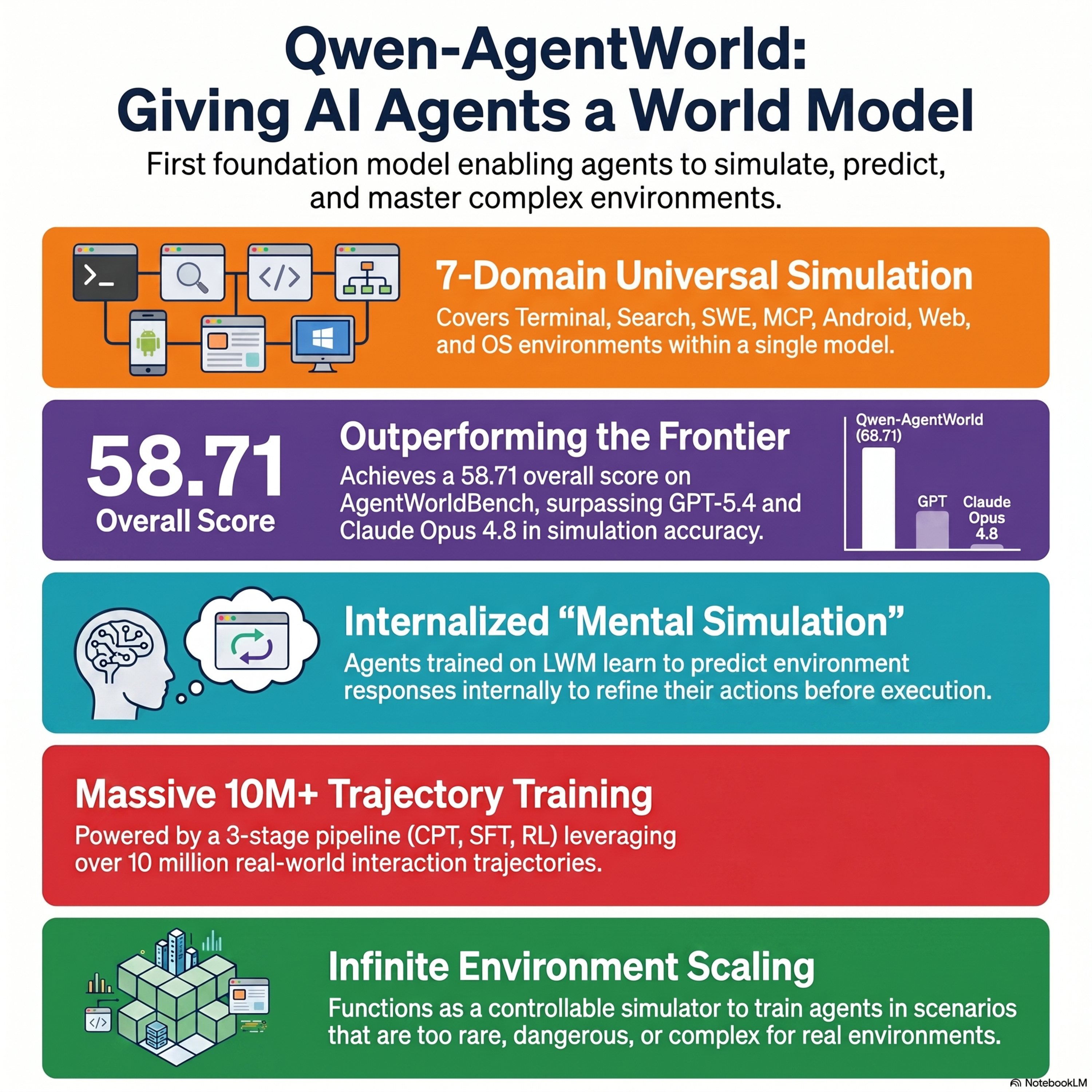
Qwen-AgentWorld: Language World Models for General Agents
Jun 2700:20:44Tap to summarizeWe discuss Qwen-AgentWorld, a pioneering suite of language world models designed to simulate complex digital environments for artificial intelligence agents. By training on over 10 million trajectories across seven domains, including operating systems, web browsers, and software engineering sandboxes, these models learn to predict how an environment will respond to specific actions. This simulation capability allows agents to rehearse scenarios, refine their decision-making, and learn from a vast scale of diverse interactions without needing constant access to live, physical systems. The research details a three-stage training pipeline consisting of continual pre-training, supervised fine-tuning, and reinforcement learning to ensure high fidelity in these virtual environments. Furthermore, the paper presents AgentWorldBench, a rigorous new benchmark used to verify that these world models can accurately mimic real-world dynamics. Ultimately, the authors demonstrate that integrating world modeling into agent frameworks significantly boosts performance by providing a foundation for predictive reasoning and planning.
Transcribe →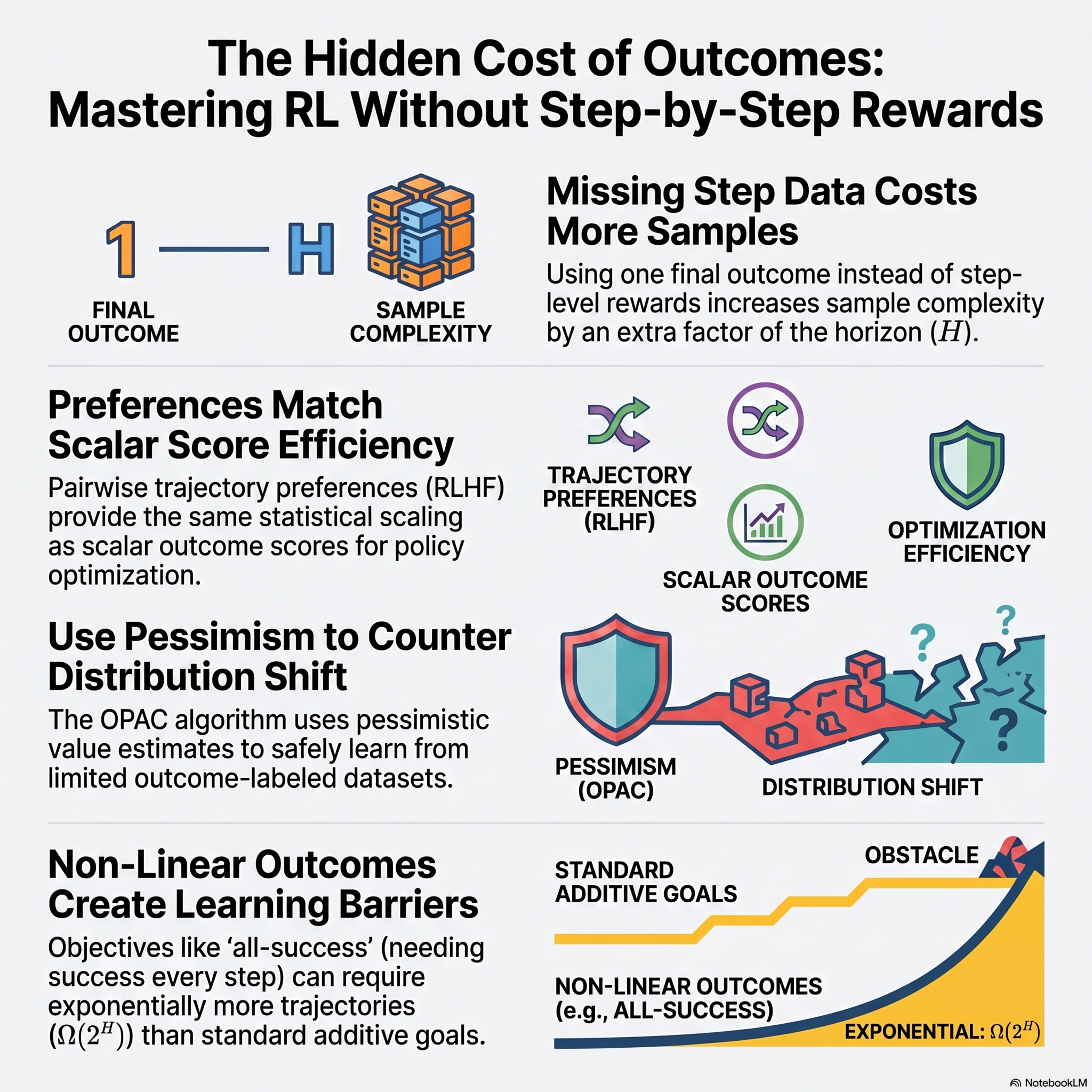
When Does Trajectory-Level Supervision Permit Efficient Offline Reinforcement Learning?
Jun 2700:18:56Tap to summarizeThis paper discusses a statistical framework for offline reinforcement learning using trajectory-level supervision, where only final outcomes or preferences are observed rather than step-by-step rewards. The authors introduce OPAC, a pessimistic actor-critic algorithm designed to learn from these aggregated signals by estimating latent rewards and applying pessimism to account for distribution shifts. Their analysis establishes that moving from process-level to outcome-level feedback incurs a quantifiable statistical cost, specifically an additional horizon factor in sample complexity. The research also explores generalized RL objectives, proving that non-linear outcomes like "all-success" criteria can lead to exponentially difficult learning problems. To address this, they identify specific structural coefficients, $\kappa_\mu(\sigma)$ and $\chi_\mu(\sigma)$, which determine when efficient learning remains possible. Ultimately, the paper provides a theoretical boundary for when sparse, trajectory-based data can successfully guide sequential decision-making.
Transcribe →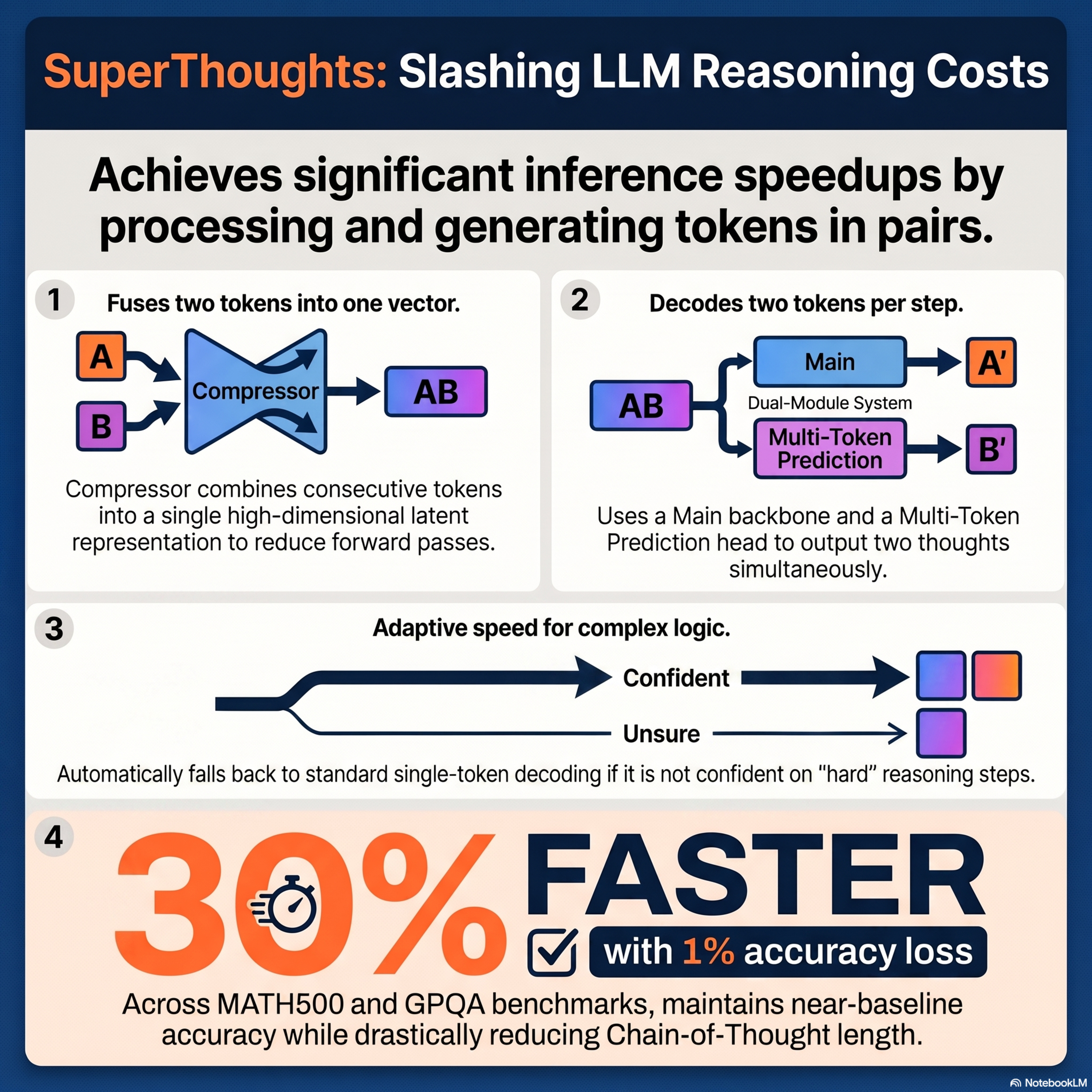
SuperThoughts: Reasoning Tokens in Superposition
Jun 2600:19:00Tap to summarizeSuperThoughts is a novel framework designed to accelerate the Chain-of-Thought (CoT) reasoning process in large language models by processing tokens in superposition. Unlike traditional models that generate tokens sequentially, this method uses a compressor to fuse pairs of consecutive tokens into single latent representations, effectively halving the number of required forward passes. To ensure accuracy is not sacrificed for speed, the system employs a Multi-Token Prediction (MTP) module and a confidence-based adaptive mechanism that reverts to standard decoding when the model is uncertain. Experimental results on complex mathematical and scientific benchmarks show that SuperThoughts reduces reasoning length by 20–35% while maintaining performance within a few percentage points of the original baseline. The research highlights that larger models are particularly adept at handling this compression, achieving significant wall-clock time reductions during inference. Ultimately, this approach offers a more efficient way to utilize test-time compute without losing the dense supervision provided by discrete token training.
Transcribe →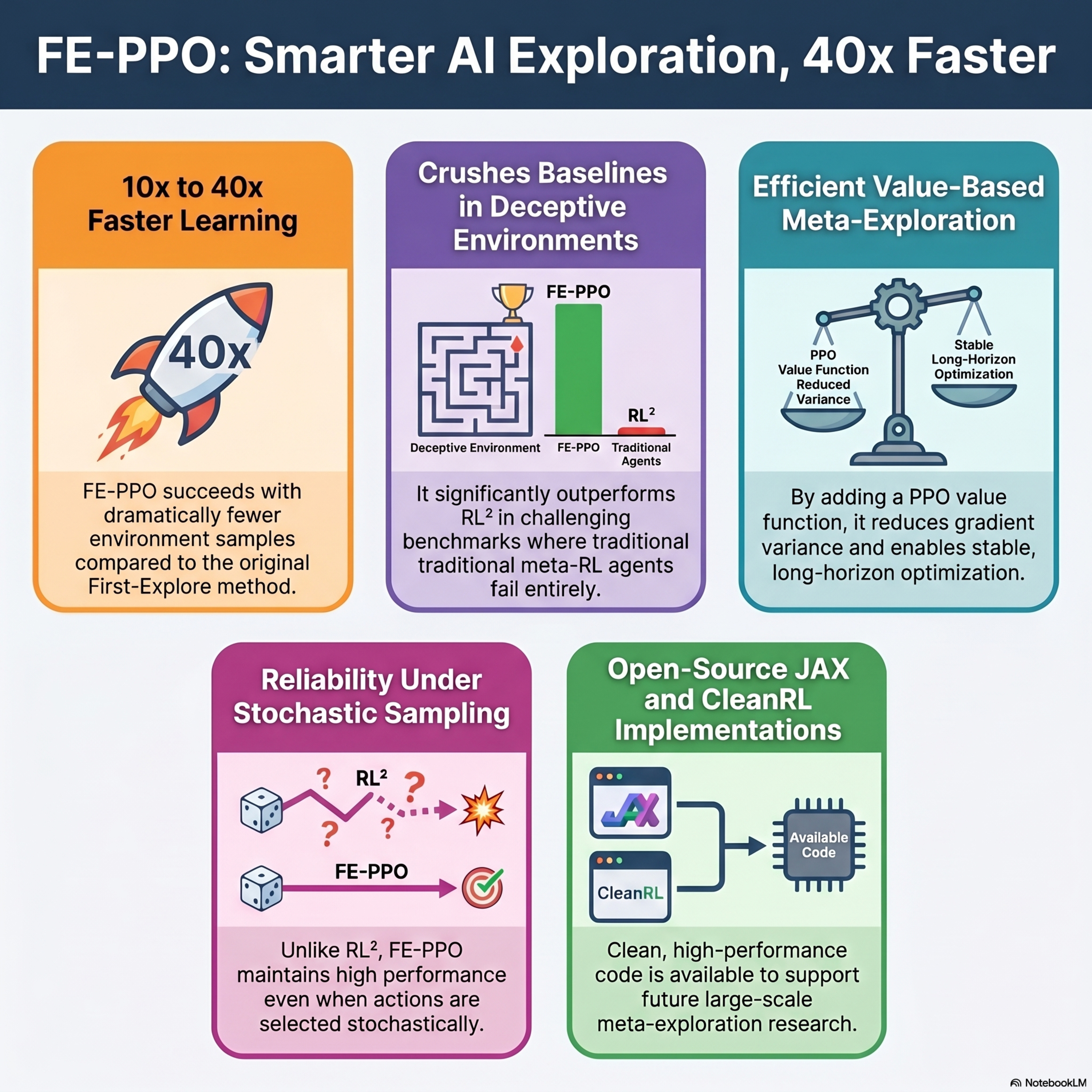
First-Explore PPO : Learning Meta-Exploration with Proximal Policy Optimization
Jun 2500:22:35Tap to summarizeThis research paper introduces First-Explore Proximal Policy Optimization (FE-PPO), a new reinforcement learning algorithm designed to improve how agents discover rewards in complex, deceptive environments. While standard meta-learning methods often fail when immediate rewards are misleading, the FE-PPO framework trains agents specifically to gather information during exploration that will maximize success in later exploitation phases. By integrating a value function and bootstrapping into the original First-Explore objective, the authors significantly increase efficiency, achieving high performance with 10 to 40 times fewer samples. The study demonstrates that FE-PPO consistently outperforms the strong RL² baseline across various challenging benchmarks, including navigation tasks and bandit problems. Additionally, the authors provide a more competitive comparison by implementing a Transformer-XL architecture for their baselines. Ultimately, this work offers a practical, open-source foundation for future research into efficient meta-exploration strategies.
Transcribe →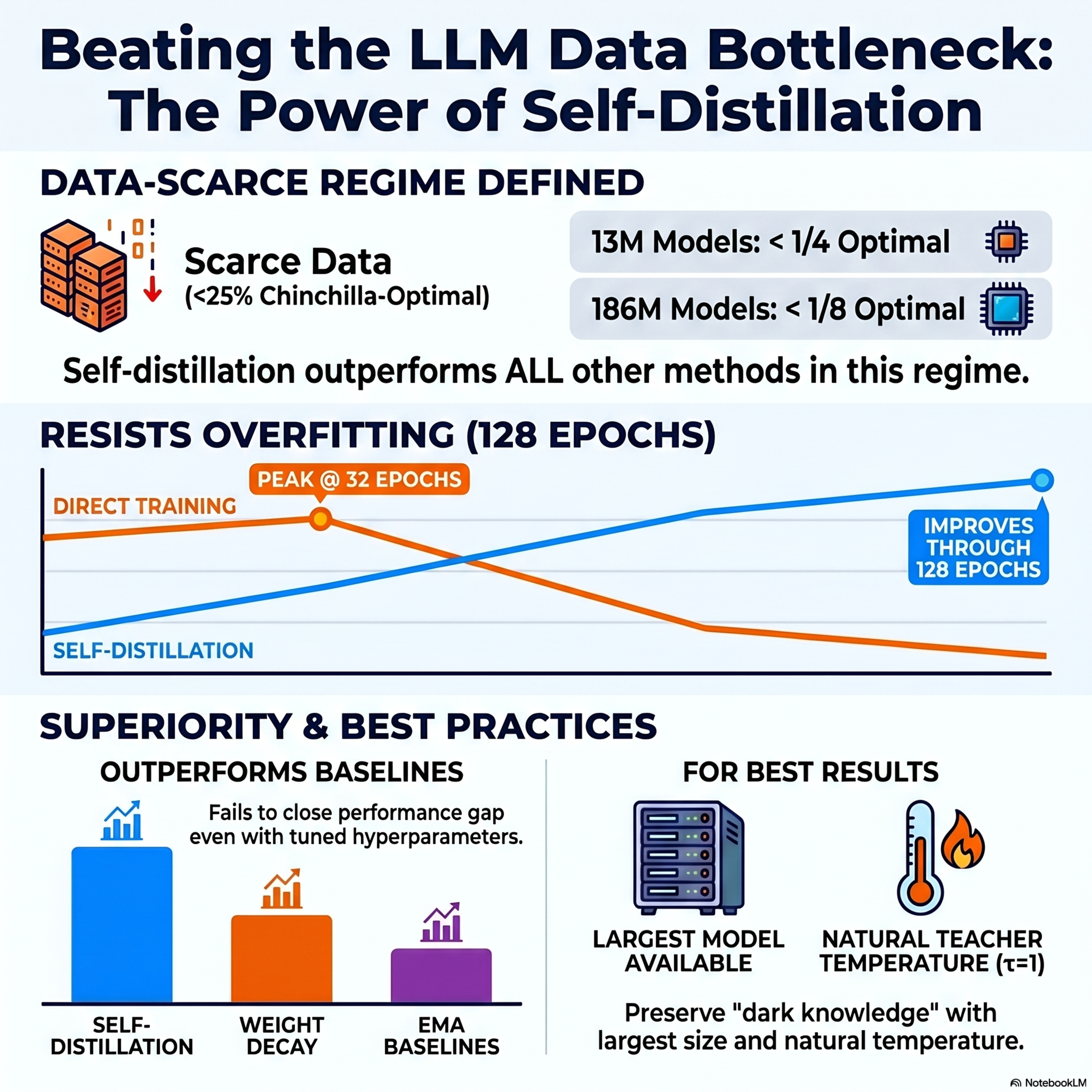
Self-Distillation for Data-Scarce Language Model Pretraining
Jun 2400:21:45Tap to summarizeThis research paper investigates self-distillation as a powerful regularization technique for pretraining language models when high-quality data is in short supply. By comparing various training strategies across different model scales and data scarcity levels, the authors demonstrate that self-distillation significantly outperforms both direct training and standard methods like weight decay or exponential moving averages. The study identifies a specific crossover threshold where distillation becomes superior, particularly when the available data is less than one-fourth of the amount prescribed by Chinchilla scaling laws. Practical results suggest that using larger models with natural teacher temperatures provides the most effective supervision, preventing the rapid overfitting typically seen in data-constrained environments. Ultimately, the work advocates for self-distillation as a robust alternative for improving model performance when compute resources outpace the available data pool.
Transcribe →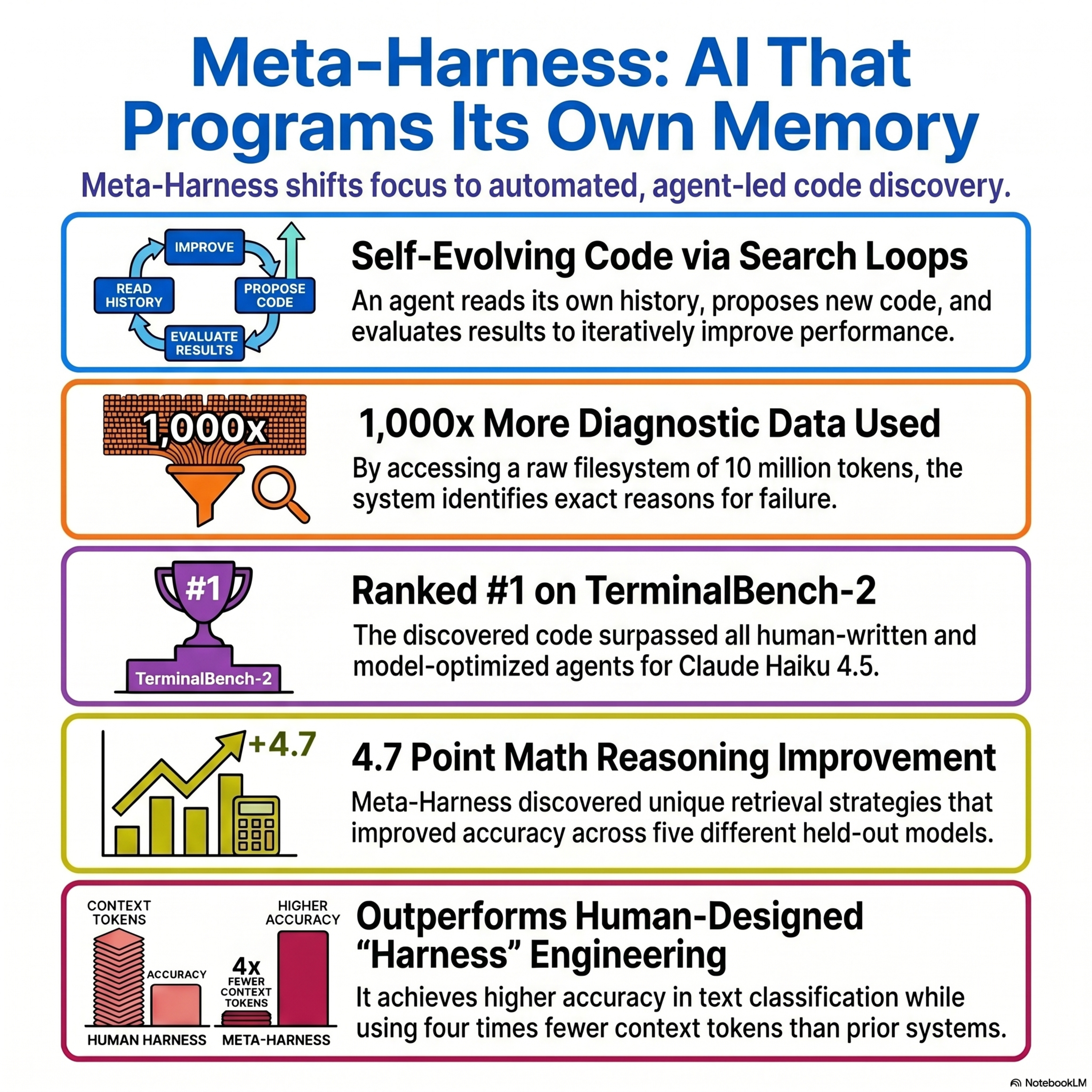
Meta-Harness for Agent-State Construction
Jun 2100:23:02Tap to summarizeeta-Harness is an advanced optimization system designed to improve how language-model agents process and compress long interaction histories into useful states. Unlike traditional methods that rely on manual engineering or simple feedback, this system uses a coding agent to search for and rewrite the "harness" code that manages an agent's memory and retrieval. By providing the proposer with direct filesystem access to raw execution traces and historical performance data, it avoids the information loss associated with summarized feedback. This approach allows the system to discover superior strategies for history summarization and adaptive retrieval across various complex tasks. Experimental results demonstrate that Meta-Harness achieves top-tier performance on benchmarks like TerminalBench-2 and improves accuracy in mathematical reasoning and text classification. Ultimately, the research suggests that the way agents construct their own internal state can be optimized as an embedded learning problem.
Transcribe →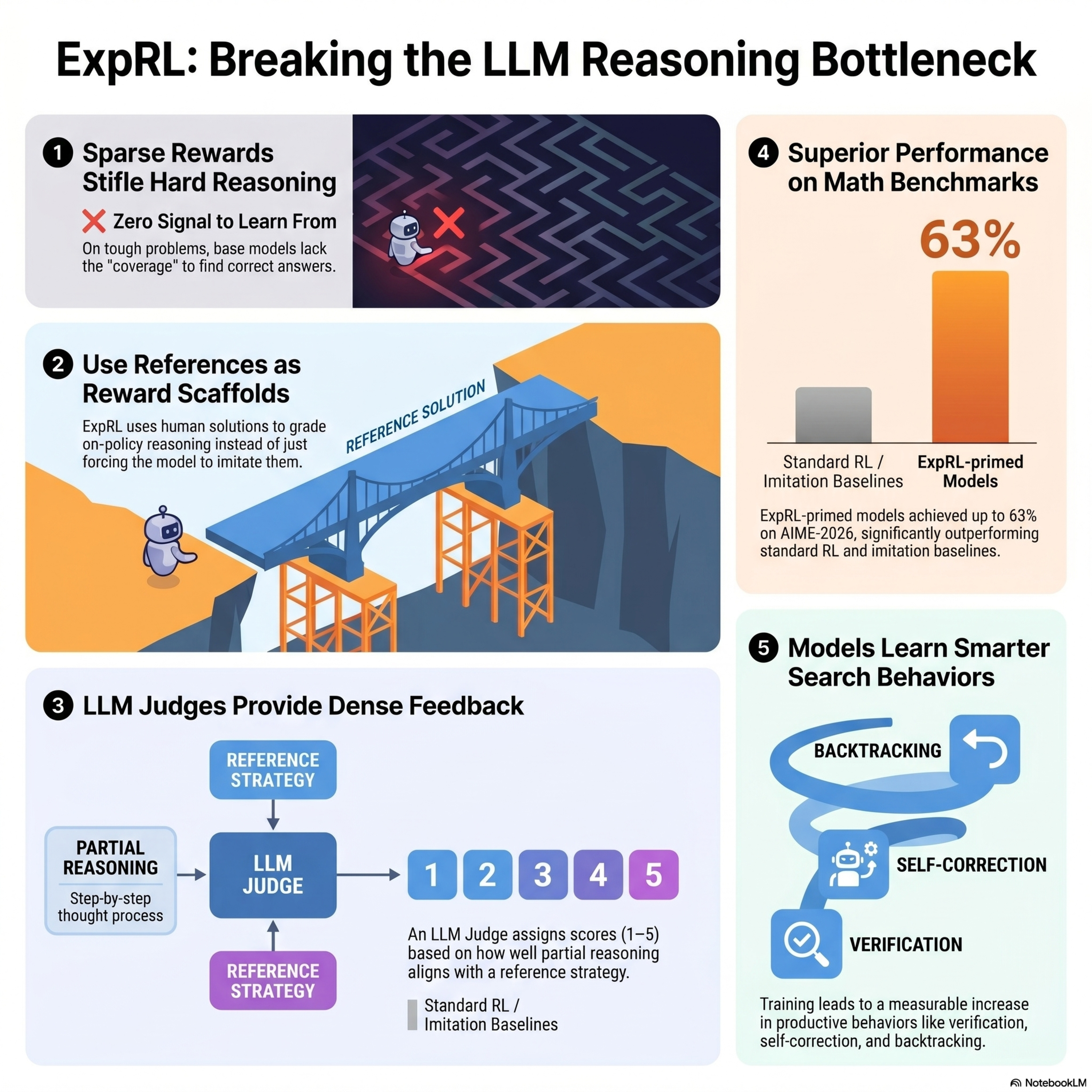
ExpRL: Using Reference Solutions as Rewards for LLM Mid-Training
Jun 2100:21:03Tap to summarizeExploratory RL (ExpRL) is an automated mid-training method designed to enhance the reasoning capabilities of large language models before they undergo standard reinforcement learning. While traditional reinforcement learning often struggles with sparse rewards on difficult problems, ExpRL uses human-written reference solutions as reward scaffolds to provide dense, informative feedback on partial progress. This approach employs an LLM judge to evaluate on-policy reasoning traces against specific rubrics, assigning rewards at both the outcome and process levels to reinforce productive intermediate steps. By shifting probability mass toward successful solution strategies, the method significantly improves pass@k performance and broadens the model’s coverage of complex reasoning paths. Experimental results demonstrate that ExpRL creates a superior initialization for subsequent training, outperforming supervised fine-tuning and standard distillation across challenging math and science benchmarks. Ultimately, this technique fosters sophisticated behaviors like self-correction and backtracking, which are essential for solving high-level reasoning tasks.
Transcribe →