← BETTER! with Dr. Stephanie Estima | Strength, Body Composition & Perimenopause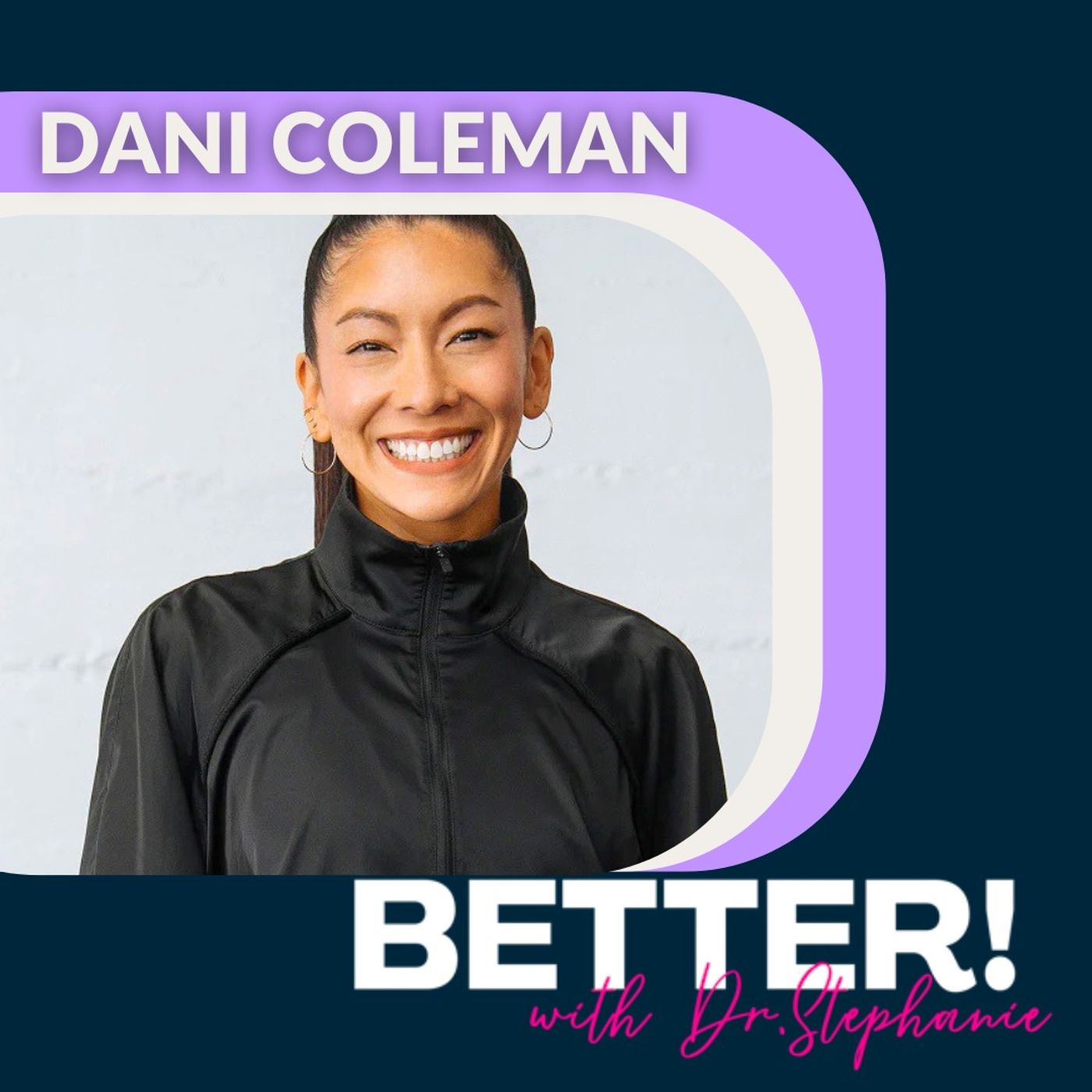
BETTER! with Dr. Stephanie Estima | Strength, Body Composition & Perimenopause
Is Muscle Soreness Progress? Dial in Your Exercise Intensity & Recovery with Dani Coleman
00:53:23
Dani Coleman — VP of Training at Pvolve — dismantles the fitness myths that have kept women stuck: cardio as the path to body composition, soreness as proof of a good workout, and intensity as the goal. This one's for every type-A Betty whose Apple Watch is more charged than she is.
Loading summary
Transcript112 lines
- [00:00]
Dani Coleman
Building muscle is the best investment you can make in your future for independence, for confidence and just overall quality of life. There's to me, truly nothing more powerful, more feminine than being able to operate and live a quality, independent life. Like, to me that sounds like, sign me up.
- [00:19]
Dr. Stephanie Estima
Yeah, you know, sign me up.
- [00:21]
Dani Coleman
You know, if we just listed all of the benefits and didn't just write like, you know, building muscle next to it, who wouldn't want to sign up for that bucket? And I think it's just a big misconception of the cortisol conversation of, you know, cardio is not bad. Your inability to recover is bad. You know, cortisol is not bad. Your inability to recover from your workouts is what can be bad. Problematic.
- [00:43]
Dr. Stephanie Estima
We need cortisol to wake up every day like it has its use case. Right.
- [00:47]
Dani Coleman
It's typically this high performing female client that I deal a lot with and I make the joke that their Apple Watch is more charged than they are. And typically they're coming to me with doing a handful of workouts a week so they're able to, like, exercise consistently. But within that, they are a little under fueled, overstressed, and under slept.
- [01:07]
Dr. Stephanie Estima
All right, finish this sentence, Dani. Women in their 40s and 50s are
- [01:11]
Dani Coleman
capable of blank more than they ever thought possible. And no one is telling them that. And I believe that because I truly think that with all of the education and access that we have now, I'm so happy that women are at the forefront of conversations more especially when it comes to weight training and just in general and sports science. So women can do everything and anything.
- [01:32]
Dr. Stephanie Estima
Amen. Hello, my friends. Welcome back to another episode of better with Dr. Stephanie. It's me, your host, Dr. Stephanie Estima. Let me ask you something. Is your Apple Watch more charged than you are or is the hardest part of your training week your recovery day? If so, I have a conversation that you are not going to want to miss. My guest this week is Dani Coleman. She is the VP of Training and head trainer at pvol. She's a former professional dancer with a Bachelor's of Fine Arts in Dance from Marymount Manhattan College. And she holds certifications from NASM for weight Loss and Corrective Exercise, the gray Institute for 3D Functional Movement, and the Institute for Integrative Nutrition on Hormone health. And since 2021, she is also Jennifer Aniston's personal trainer. And we are talking all about how to change your body composition and how to recover, especially if you are a type A Betty. So without further delay, please enjoy my conversation With Danny Coleman new lower pricing on a molecule that helps with recovery, muscle strength and energy. Hello, Sign me up. It's true. Mitopur containing Urolithin A is now available at a new and lower price. And this is fantastic news because if you are someone concerned with recovering from your workouts, you can make progress faster, preserving the muscle strength and endurance that you already have and create more energy. This is big, big news. I have been in love with and taking timelines might appear for two years now. And it contains something called Urolithin A. And urolithin A helps to get rid of old damaged mitochondria. It helps support muscle function and plays a role in creating more energy. We naturally lose our ability to produce Urolithin A in the gut as we age. So supplementing with it becomes pretty much essential if we're older than 30, because we naturally tend to lose our gut diversity. Now, Timeline is a brand that I trust because it has spent well over $50 million in research, including human trials and, and I'll tell you about one of them. There were participants that improved by 12% in muscle strength over four months with absolutely no change in their exercise regimen. If you want to start recovering like a boss, head over to timeline.com better. What is one fitness rule that you would like to throw in the trash forever?
- [04:22]
Dani Coleman
I would say that cardio is the best way to alter your body composition.
- [04:28]
Dr. Stephanie Estima
Yes. Yeah, let's, let's go there, actually. Why is that incorrect? And why is that what most women, at least my age growing up in the 80s and 90s, think is the way to body composition? Narnia.
- [04:43]
Dani Coleman
I think it was a couple of things. What we were initially fed via media, right? It was like everything mainstream of the stepper class, aerobics and running. And I really think it did us a disservice in a lot of ways because it didn't highlight the importance of strength training. And strength training is where we are going to build our lean muscle mass, which is crucial when we're talking altering our body composition, overall longevity and our future independence and why cardio is important. And I am such a proponent of cardio and I practice cardio weekly. And I think it should be a part of everyone's routine. It is not the sole thing that we should be focused on when we're talking living a well rounded, successfully independent life. And especially when it comes to altering body composition, we need muscle mass to do that. And lifting weights and resistance training are going to be far more effective and efficient over the long term.
- [05:38]
Dr. Stephanie Estima
Well said. And the other thing, I mean, this is. I'll bring this up because I actually see this a lot in my community. I have a lot of people when I talk about something like, you know, Pilates not being the main strategy, it can be an adjunct. And I love Pilates. I do Pilates myself once or twice a week, typically. Same with cardio. I'm a big fan of cardio. I used to be a step class. I used to be a step instructor. That's how I paid for school. So, like, I am right in there with, like, the tae Bow and all of that. But I think that there's this, like, misconception around. Like, just do what you love. Like, if it just feels good, like, that's what you should be doing. And it's like, yes, that is going to improve compliance. But that can't be the whole strategy. Like, it can't just be fun and vibes.
- [06:19]
Dani Coleman
I love that. You said that 100% correct. Yes. We need some sort of external stimulus to build muscle mass and a plan and a program outside of just feeling good and vibes. I love that.
- [06:30]
Dr. Stephanie Estima
Yeah. Okay. So what were you before P. Volve? Were you a cardio bunny? Were you a weight room warrior or something else entirely? Like, what was your sort of exercise Persona, let's say, before?
- [06:41]
Dani Coleman
Before P. So I come from a professional dance background, so I got my Bachelor of Fine Arts in dance. I started dancing when I was 2. So movement has always been the truly most consistent currency of my life. And I think naturally with dance, it was a little bit more aerobic, for sure. And especially then, I just lacked the knowledge. I think there was really high idyllic standards of what we expected a dancer to look like without really having the education and tools that we do now or the social media or the resources like podcast to really get the information out there. So I was leaning towards, you know, climbing the stair climber for an hour, thinking that this was the way to get, you know, toned, which we can go into as well. And we're gonna go there.
- [07:24]
Dr. Stephanie Estima
Yeah, go on.
- [07:26]
Dani Coleman
So I was definitely more of a cardiovascular background and endurance training. And it wasn't until I started working as a front desk at a gym, and I saw the importance of strength training and just women coming into strength train or really just also noticing kind of the dichotomy at the time of the gym where it was more of men on the weight floor and more women on, at that time, more on the cardio machines still. So I think I was just Became, like, a little bit more aware and more educated then. But I was definitely gearing more towards, yeah, the aerobic base, for sure.
- [07:56]
Dr. Stephanie Estima
Same. I was a cardio bunny. I was on the elliptical 50 minutes, you know, five, six days a week. You mentioned toned. This is my favorite swear word. Let's talk. Let's talk about what toned means. Let's talk about why. Okay. Let's talk about the misconception of toned and why this seems to be an ideal end result or end game for women.
- [08:19]
Dani Coleman
I think toned comes with toxic notions of maybe the idea that we're somehow shrinking. And in reality, what toned means is that we are strengthening our bodies. And I think also when people think of toned, there's certain emotional weight that comes with it that makes them feel a little bit more safe with building muscle, because again, of sort of ideas that we've been fed, especially as women, about, you know, what our bodies need to, like, look and operate to be a little bit more mainstream. And I think, you know, so I really have an issue with the word toned. I, you know, as a trainer, understand when people say it to me, but it's not something that I'm going to say, say outwardly to people. I get it when, you know, my clients speak that language to me, but to me, it's just. I'm trying to educate them on. Okay, so we really just want to get stronger. And this is what you mean by toned or what do you mean by tone? Just kind of asking them questions.
- [09:15]
Dr. Stephanie Estima
Right.
- [09:15]
Dani Coleman
I love that. My favorite swear word. I'm putting that in my back pocket for the future.
- [09:20]
Dr. Stephanie Estima
It's all yours.
- [09:20]
Dani Coleman
I just.
- [09:21]
Dr. Stephanie Estima
I feel like I like that you use the word safe specifically. Safe. Safe in building muscle. Because essentially when someone says, I want to be toned, what they're saying is, I want some muscle that's visible. Like, I want this myotonic. Like, I want to be able to see the muscle without flexing, but I don't want too much. Like, I don't want to look like a freak. And I think that there is a bit of unlearning that has to happen for women, because 1, 99.9%. That's an estimate. Don't call me on it, but, you know, like, 99% of us don't have the endogenous hormonal composition to become bulky and to look like the she hulk. Like, it's. It's virtually impossible to do that without some external help. And there are outliers. Like, certainly there are, you know, certain hormonal makeups. Where women can put on an extraordinary amount of muscle. If you've ever seen lifting. Have you ever seen lifting. Pumping iron for women? Have you ever seen that? So pumping iron is the Arnold Schwarzenegger. Everybody knows that with him and. And Lou Ferrigno. But there's also one that they did after that for. For women, and it was expl. Like the Miss Olympia and how the views of women and muscle is a fascinating. There was this one. I forget her name is escaping me now, but she was an Australian competitor and she would be classified as one of these outliers. Like, she had an extraordinary amount of natural muscle and she was penalized for it. Like, she didn't win. I think Rachel McGlish ended up winning it, which is, you know, the original Miss Olympia. But it does examine how women have traditionally looked at putting on muscle. Like, it's often been viewed as masculine, bulky, undesirable. And in my opinion, and I think I'm speaking for you as well, but redirect me if I'm wrong. Putting on muscle and building muscle is incredibly feminine. Like, it is an incredibly nurturing thing to. It's something that you give yourself. And of course, all the metabolic we can talk about, like the insulin resistance and the anabolic resistance and the glucoses, but all the good things and the indoor and the myokines and bdn, all the beautiful things that happen from lifting weights, but it is an incredibly nourishing thing. It is an act of self, love and devotion when you are putting on muscle. And I don't think that a lot of women look at it like that. They look at it as like, oh, I'm going to be thick.
- [11:38]
Dani Coleman
Building muscle is the best investment you can make in your future for independence, for confidence and just overall quality of life. There's, to me, truly nothing more powerful, more feminine than being able to operate and live a quality, independent life. Like, to me, that sounds like, sign me up.
- [11:59]
Dr. Stephanie Estima
Yeah, you know, sign me up.
- [12:02]
Dani Coleman
You know, if we took away all. If we just listed all of the benefits and didn't just write like, you know, building muscle next to it, who wouldn't want to sign up for that bucket? If you were just to list everything that weight training does for you by building lean muscle mass, by having muscle on your body, all of the benefits, the cognitive, the confidence, the emotional, the physical, the. Who wouldn't say, sign me up? So I just, you know, I 100% agree with you, and I want to look up that documentary. Thank you.
- [12:29]
Dr. Stephanie Estima
Yeah, you have to. It's worth the search. So really, really great. Uh, okay. What is one workout that you used to dread that is now becoming one that you love and look forward to?
- [12:40]
Dani Coleman
Controversial running.
- [12:44]
Dr. Stephanie Estima
That. Why?
- [12:44]
Dani Coleman
Why?
- [12:45]
Dr. Stephanie Estima
Tell me why.
- [12:45]
Dani Coleman
I just think a lot of people when I say that, they kind of give me that side eye. But running has been one of the best mental investments I've done for myself this year. It is super challenging for me and I'm always up for a challenge. I personally, I think I thrive there when a challenge is kind of thrown down for me. But what I love about it is I do a lot of mindful work, so I'm constantly checked into my body. When I'm moving my body, it is very present in the moment. And running allows me to kind of tap into that. I can put on my favorite playlist, my favorite podcast, and kind of just move my body and zone out. And I think there's something so freeing about that. So that has been. Yeah. Something I've just. And I. It's been, you know, I'll say this, I'm in my mid-30s and cardiovascularly, I've never felt better. Like I've. My heart health has never felt better. And that is incredible for me to remember as a trainer to stay motivated. And also, like, age is just a number. Onwards and upwards.
- [13:44]
Dr. Stephanie Estima
Yeah, it's just a level. You just keep graduating to a new level. I love the running piece because I think, you know, I have long on this podcast discussed the benefits of muscle health and building muscle and connective tissue health and how that supports the. The muscular system. But I do think that there has been some demonization of cardiovascular. Like any type of cardio. It's like never do cardio.
- [14:05]
Dani Coleman
Just the cortisol. Oh my gosh.
- [14:07]
Dr. Stephanie Estima
Yeah. It's like it drives your car. It's like. No, no, no, no, no. Right? We want adaptation, right. We want to stress the. We want this hormesis, this, you know, transient high stress. You know, for me, it's sprinting. So I love to sprint. I do either on the bike. I'll do a Norwegian 4x4. I'll do that once or twice a week. And if I don't do it twice a week, the second sprinting will be like on a track. And especially in the summertime when it's. I can go out to the track and do that, but all I can focus on during that 10 second sprint is like, left, right, left, right, left, right, left, right, right. Like breathe. You know, it's like I. I am so present to that moment. But the Psychological resistance that I, you know, to get there, it's like, okay, you're gonna work really, really hard. It's gonna be like 15 minutes and then it's done. But the, the Benefits to your VO2 max, the benefits to your cardiorespiratory fitness, like, we have to, we have to be marrying both. It can't just be weight training. It can't just, we have to do. And then I would actually add a third element to it, which I know I want to talk to you about today, which is mobility, which is also, I think, sort of the forgotten, the forgotten vertical, if you will, in that Venn diagram. Like, we always think of, like it's either muscle or it's cardio.
- [15:10]
Dani Coleman
It's like.
- [15:11]
Dr. Stephanie Estima
And we have the connective tissue that's holding it all together.
- [15:15]
Dani Coleman
Yes. Your movement quality. Yeah, yeah, I love that. Yeah. Mobility is so important. But I'm a big proponent too, of. I know, I do believe in the hybrid, the formula. I do think that you need a healthy heart and strong bones and muscle mass to support you. But cardio is important and I think it's just a big misconception of the cortisol conversation of, you know, cardio is not bad. Your inability to recover is bad. You know, cortisol is not bad. Your inability to recover from your workouts is what can be bad. And problem. Yeah, problematic cortisol.
- [15:50]
Dr. Stephanie Estima
We need cortisol to wake up every day. Like it's a good, you know, it has, it has, it has its use case. Right. So talking about recovery, big audience demographic here is women in perimenopause and menopause. And of course, one of the things that we know about this population is that certainly their hormones are changing, but their, their capac for recovery and even just for prolonged bouts of intense exercise also changes. I find that that recovery, that recovery need expands and their tolerance for continuous intense exercise reduces. So what are, what are, how do you think about the intensity question? Specifically for women in that hormonal transition, like, let's say she's a 45 year old or 55 year old woman moving through perimenopause and menopause?
- [16:37]
Dani Coleman
I think intensity just needs to be dosed correctly. I don't think it's bad. I think it's making sure that if you're doing something like a hit style workout or a sit style workout that is very high and, you know, high in the intensity spectrum, then we need to make sure that we are bookending it with proper recovery. So that means we are paying Attention to just our rest days. And what do we do? We just rest. We rest and recover. And it's one of the biggest questions I get is what do I do on my recovery days? You just rest.
- [17:05]
Dr. Stephanie Estima
You know, do I still need to walk 20, 20,000 steps on my recovery rest?
- [17:10]
Dani Coleman
So proper sleep is so important because that's where we build our, our new muscle and our muscle repairs and we reset our nervous system as well. So just making sure you're also getting adequate sleep. But I, I would say I'm not. I'd say if we're doing high intensity workouts, they are probably fewer and far between, especially for someone in midlife. And if you are doing them more than that, then for sure we are absolutely focusing and having a conversation on what your recovery looks like. Not just in your rest, but also in your diet and hydration as well.
- [17:37]
Dr. Stephanie Estima
Yeah, skin aging isn't really about wrinkles. Wrinkles are just a symptom. What's actually declining is your skin quality. So the cellular energy that you have, the hydration retention, barrier integrity, and the tissue's ability to repair itself after stress. Here's the mechanism. NAD levels drop with age. When cellular energy drops because you have low nad, your skin cells lose their ability to repair themselves, renew, and to maintain structural organization. This is when you start losing firmness and texture. Not just because you're getting older and time is passing, but because of the specific biological processes that cannot be addressed. The youth serum and youth moisturizer from Young Goose are formulated to support those NAD dependent cellular pathways in your skin. So when you restore that cellular energy availability, now your skin cells are able to do their job, so they're able to repair and renew and to improve the structural integrity of the skin. Your firmness will improve. The texture of your skin will improve, not just because you've temporarily plumped something up, but because the tissue itself is functioning better. That's what I mean when I say skin quality skin care. This is not just like topical theater and glass skin temporarily. This is working at the level of the cell. I use these daily and my skin has never looked better. Head over to Dr. Stephanie estima.com forward/young goose and use code better for 10% off your first purchase. That's doctorstephanestima.com forward/young goose. Betty's sleep is not a recovery strategy. It is the recovery strategy. And if you are waking up at 3am running hot, or lying there with your brain doing its little highlight reel of everything that you forgot to do that day, this Is your nervous system stuck in output mode because nothing in your evening told you that the day was over? Okay. Cortisol should be at its lowest point when you're trying to sleep. And for a lot of women in midlife, it really isn't. The rhythm is really off. The wind down signal never comes. This is where Peaks Vesper Blend is built for that exact window. It has Ashwagandha to bring cortisol down, magnesium to support the nervous system into rest. Reishi for deep recovery. It's the clinical case for an evening ritual in a single cup. I make it about 45 minutes or so before bed and it becomes a signal that my body recognizes that, hey, we're done for the day. And then I head into my, you know, skincare routine and that permission to stop performing and starting to calm down is not a small thing. If you want to redefine your evening ritual and feel like yourself the next day, you can get 10% off for life. Yes, that's for life. @peaklife.com forward slash better. That's P I Q U E L I F E.com better. Your nervous system will thank you. Your 3am Wake up is not a guarantee. Right? So let's give your nervous system something to work with. Well, let's actually talk about recovery because this is you and I are cut almost from the same cloth because this is the biggest challenge. The challenge for my community is not doing something. They're like, I'll do everything. Put me in coach. I'll do, I'll do the hit five days a week, I'll do the training six days a week. Like they will put things on their plate and punch them out, but it is that recovery piece. So how do we counsel someone who's very motivated, who's been disciplined all her life and is, you know, considers herself a very active, healthy person. How do we counsel her to embrace recovery?
- [21:22]
Dani Coleman
It's typically this hyper high performing female client that I deal a lot with. So I'll speak from my experience and I make the joke that their Apple watch is more charged than they are. And typically they're coming to me with, you know, doing a handful of workouts a week. So they're able to like exercise consistently. But within that they are a little under fueled, overstressed and under slept. So that is where we kind of get in that catabolic state where our body is in, you know, goes into survival mode or cannot recover from our previous workout and then we cannot execute our next workout well, and then we're at Higher risk for just a bunch of things, injury, heart disease, you know, all, all of these things. So for me it's more so making sure that their workouts are quality versus quantity and kind of teaching them about that, that we actually don't need all of this phonetic stress and all this, you know, what they call junk volume. It's okay to lift a weight and then to take your proper two to three minutes of recovery in between your sets. Sets you will get more if you can work quality over quantity. But it's definitely a learning curve that I feel I'm having a big conversation about consistently over and over again.
- [22:37]
Dr. Stephanie Estima
There's an element of surrender too, isn't it? There's just an element of like, okay, this is. I just gotta trust the process and I have to stop trying to white knuckle my way through all of these workouts and convincing myself that I actually don't need a break.
- [22:50]
Dani Coleman
Yeah, because you'll start to also just get diminishing results eventually or your plateau where you won't see the results that you want. So it definitely does like take that moment of surrender for them to kind of trust you or their program to see the results that they want. But I, you know, I promise I'm like, you will get there. It's just going to take a second. And I think also a releasing of shame. I know for me as someone that is like hyper a perfectionist and finds a lot of value in what I produce and do, for me just to be able to take that rest day is honestly more challenging than it is for me to do that high intensity workout. So yeah, it's a constant relearning of quality over quantity.
- [23:28]
Dr. Stephanie Estima
And the teacher and the student are on the same path because yes, I'm the same way. It's much easier for me to go and work out at the gym for hours on end than it is for me to sit and do nothing. Like I'll just get in a walk, I'll get on my walking treadmill and I'll do something, you know. So it is very difficult for me to stay still as well because I find movement very nourishing. Like it's very. It gives me so much in terms of pride and a feeling of accomplishment and all of those things. So to not do it, I find is a little bit more difficult. So I too balance that telling people that they need to recover and then also making sure that I am getting the recovery that I need as well. So I'm, I'm right there with you. Tell me about nutrition. How does nutrition play into recovery? And I specifically want to ask you about carbohydrates.
- [24:09]
Dani Coleman
Yeah. Oh, yeah, let's talk about carbohydrates. I love this. They love to be the enemy. And our body needs carbohydrates as our energy source, especially if you are doing longer sprints and endurance. But just in general, carbs fuel our body and our energy source, and we need them. And your workouts are just gonna feel so much better when you actually fuel with carbs. So I am such a proponent of carbs, and I eat them daily and try to educate my clients on that as well, because I do think that comes with some, you know, misnomers as well. Especially growing up, I know it was very like low carb diet. So I'm happy that we're having that conversation. As far as diet goes, especially with recovery, we obviously want to talk about the low hanging fruit of like, proper hydration, making sure you're drinking your water, and then also just protein. We need our muscles to repair, and protein is imperative in that repair and recovery. And so sometimes when you are so sore from a workout or feeling very depleted, maybe the workout was too hard, but also maybe we're not properly fueling our body with the right diet and not hydrating properly.
- [25:09]
Dr. Stephanie Estima
So, yeah, awesome. You mentioned before, and I actually want to come back to this because we've been talking a little bit about weight, weights and cardio and how they're often pitted against each other. But there is this third pillar, I think, to well rounded movement, which is mobility. And so I would love for you to talk a little bit about how thinking about our connective tissue really does set the stage for movement quality. Like the way that I often talk about connective tissue is like, muscle is the popular girl at the park. She's Beyonce. Like, everyone wants Beyonce. She's gorgeous. She can hit those high notes. She's wonderful to look at. But if you put Beyonce on a rotting stage, right, like, you can't put her on a stage that's about to collapse.
- [25:52]
Dani Coleman
Right.
- [25:52]
Dr. Stephanie Estima
And that's what the connective tissue, when we think about tendons, ligaments, and joints, that's really what it does. It's the stage that holds up Beyonce.
- [25:59]
Dani Coleman
Yes.
- [26:01]
Dr. Stephanie Estima
So talk to us a little bit about why mobility matters and how this feeds into our elastic recoil with the sprinting that we were talking about. And of course, with, with. With our strength training as well.
- [26:13]
Dani Coleman
Mobility is crucial for just feeling good in your body as well. And when you move, you know, if I put it in super layman's terms, mobility is from the moment you wake up and turn your torso to get out of bed, to checking your blind spot in your car, reaching for something, bending down. Mobility plays such a pivotal role and it's something you realize you don't have until you've lost it. And mobility outside of, you know, maybe if that doesn't appeal to you, that doesn't sound sexy, just having, you know, quality movement and daily habits. Let's take it into the gym setting. Mobility makes everything better with your strength work. And what I'm really talking about specifically is when your joints are able to move through a fuller range and especially at their end range, you set yourself up for success with better movement patterns and more efficient just movement patterns in general. Think deeper squats, better pushes easier rotations, and especially when we're talking for explosive movements. If you're an athlete, you know, if you lack, for instance, like internal rotation in your hips, the ability to turn inward in the hip, that is going to impact how you land. And when we think of injuries, right, it's never on the takeoff, it's typically on the landing. So when we lack mobility, we are at an increased risk of injury and overall just, I'd say impacts our strength work negatively when we lack mobility. So I'll start there. But mobility is crucial. It makes your life so much better. When you have better mobility and inside and outside the gym.
- [27:45]
Dr. Stephanie Estima
I can say also from personal experience, this is, you know, clinical work from working with patients, but also when you have proper mobility so you're able to, you know, work through a certain range of motion that's pain free, then you don't develop compensations, which is a such a big problem in strength training because your body is going to find the path of least resistance. So if you, if in your deadlift you have no more hip hinge, it's going to borrow from your back, right? And this is why a lot of people, you hear a lot of people online say, oh, deadlifts are terrible for. You should never do that. They hurt your back. It's like, well, it's not that the deadlift hurt, it's just your patterning is insufficient to drive the stimulus to the target muscle where you want it. Because you don't have sufficient range of motion in the pelvis, like as the pelvis is sort of rotating around, you know, the, the, the hip joint. So I think that that's another thing that people often miss. You don't develop compensations either. I mean, you've probably Seen this. If you're squatting, I don't know if you've ever. I don't know if you call it a butt wink, but I call it like a little butt wink. Right.
- [28:47]
Dani Coleman
And then booty tucks under. Yeah.
- [28:49]
Dr. Stephanie Estima
You're like, oh, yeah, exactly. When you don't have sufficient ankle dorsiflexion and you sort of run out of room to translate forward, your body's like, okay, I'll just borrow it from the pelvis. And that's when you see the pelvis, like the tail tuck under, right?
- [29:04]
Dani Coleman
Yes.
- [29:05]
Dr. Stephanie Estima
So I think that that's also really important if we're thinking about longevity in any sport. Whether you're, you know, you're sprinting, you're running, you're strength training. If you want to have longevity in that, you also need to make sure that over time, you don't create these motor patterns that are, you know, creating. Creating problems for you down the line.
- [29:25]
Dani Coleman
Yeah. Like defunct. You know, we want our body to operate well and efficiently, and proper mobility is. Is crucial there. And I love that you said that. I'm always like, clocking people's mobility. I think it's probably just the trainer in me, but, you know, I just, I challenge listeners. Next time you're just walking around the grocery store to look at people's ankles. Just the, you know, when we lack ankle mobility, you know, our feet are turning out or that could come from the hips as well. But it's mobility really does impact just your everyday movement patterns and totally 100% on the money that if we have movement patterns we're not aware of that we're doing it kind of, we start to compensate and create bad habits for ourselves. So I'm hyper focused as a trainer on proper body mechanics. And mobility is always a part of the workout for sure.
- [30:09]
Dr. Stephanie Estima
This is why we are sisters from different misters, because this is what I rally against all the time, because mobility is not sexy. So I spent 20 years in clinical practice trying to get people to do mobility work. And once people are out of pain, they're like, I love you so much, doc, but I'm totally not doing these ankle dirt. I'm not doing these. These ankle rocks anymore. Like, I love you, but no. So I, I think that this is so important, and this is why I. One of the reasons I wanted to have you on the show because I think, and you can explain a little bit more about P Volve, but I think that this is part of the philosophy of P Volve is like, moving in all different planes. We're talking about frontal, sagittal, transverse. We can talk about that in a moment. But it's also integrating mobility as well into it. Right?
- [30:48]
Dani Coleman
Yes. You know, I. I'm a trainer. I. I work for P Volve, and I train in the P Volve method, which is really, to me, just. We focus on strength training, but with stability and mobility and mind. And the best way that I can describe it for people is, you know, I think when you think of more traditional strength training, sometimes you're a little bit more isolated at a machine focused on one body part. We are going to move dynamically using your full body, and we're going to move you through all three planes of motion because that's how you move in everyday life. It's not just front and back or side to side. It is also with rotations and through all three planes of motion. And we do that because I want you to build strength, but I also want you to build better body mechanics and body awareness is what. What we just touched upon. Because I know if I can get you to execute a squat that you've done maybe a hundred times, but if I can get you to do it in good form with, you know, and help improve your mobility and, and help you. Yeah, I just know that your quality of life is going to get better. And your results also are just quite candidly when you can have better alignment or just more efficient and effective. So. So, yeah, P Volve, we really do train you, I think, for everyday life and the moments outside of just the gym.
- [31:58]
Dr. Stephanie Estima
You know what, nobody told me when I started lifting that the workout isn't actually the hard part. The recovery is. Your joints are doing the invisible work between sessions. Your tendons, ligaments and connective tissue holding the whole system together. That's your infrastructure. And most of us have spent years ignoring it entirely. This is where incrediwear comes in. I wear their elbow sleeve when I'm playing tennis, their knee sleeves when I'm squatting, and when I recover. They're not just compression sleeves. The technology here is different. The fabric woven into them increases the circulation to the tissue, which means that your body is actively repairing between sessions, not just waiting to feel better. That means that you are going to feel less stiffness, you're going to have faster recovery. Your joints are going to actually keep up with the work that you're asking them to do. Now, of course, muscle is the engine, but your joints are the road. Okay, Take care of the road. Whether you're an athlete dealing with chronic Joint pain or just somebody who wants to feel better in your body today? This is worth trying. Head over to drstephaniestima.com incrediware and use code DrSteff20 for 20 off your order. That's drstephaniestima.com forward/incredaware and use code Dr.Steph20. That's D R S T E P H2 0. And what are some of the common squat issues that you see? I know we talked about ankle dorsiflexion. That's probably a big one for you, but are there other things that you typically see? Because it's very rare for me to see it. A good squat. Yes. Done in the gym. So what is a good. What does a good squat look like to you?
- [33:43]
Dani Coleman
We'll definitely start at the feet either being, you know, too excessively turned out or maybe the knees caving in with a little knee valgus, maybe a little compensation with the lats and too much forward lean, a little tuck under the tailbone, rounded shoulders and just really not having the ability either to like find depth in the squat. So looking at the hips as well, but forward head posture in the squat where you're protruding the chin a little bit more, there's a plethora as someone that sees them daily both in the
- [34:13]
Dr. Stephanie Estima
variety of sins and training.
- [34:15]
Dani Coleman
Yes.
- [34:16]
Dr. Stephanie Estima
Yeah, yeah. No, squatting is. And I've heard people in the fitness space say you should never squat, you should never deadlift. It's like these are very technically complex movements. So for. Those are compound movements. Right. So it's many joints working at once. And the squat specifically, it's like, okay, we got, got the hip joint, we got the knee joint, we have the ankle joint. And then we have to figure out bio, individual differences, you know? Yeah, you know, like, are you gonna, is the chest gonna collapse? Can do like all these different things. There's many ways. Like I said, there's a variety of sins that can happen in a squat. But I think that it's important to kind of identify some of those. And what I love to counsel women to do, especially if they're trying to squat at the gym, is just to film themselves. Like, I know. Yes. You're gonna of maybe feel a little awkward that you're filming yourself. And it's like you're telling people, no, I'm not an influencer, I swear. I'm just trying to, just trying to get some feedback. But if you can see yourself squatting, especially at the bottom, right, like as you're descending into that squat, you can evaluate your range of motion. How much depth, like you just said, what happens to your ankles? Does the tibia still translate forward, right. Or does it stop? Do your knees stop bending and then your chest starts to fall? Do we have the butt wink that we were talking? Like, there's so much information that you can get from just filming yourself. I think it's so, so, so, so valuable.
- [35:30]
Dani Coleman
I do this all the time. But it's funny because I think people like, oh, she's influencing in the wild. And I'm like, no. When I was actually just filming myself, I did a barbell back squat and I was just looking at my mechanics so personally as we can, like, just move and geek out a little bit. So I was popping out of my squat, my left heel was lifting a little bit, and I, like, lack a little internal rotation in my right hip and my pelvis is slightly rotated. But it was something I was totally not aware of. So filming was so crucial and helpful to see. So if you haven't done that, I, I think it's a wonderful tool, especially if you don't have access to a mirror or a trainer. Keeping yourself, you know, from the front, the side, the back, it was great. You learn so much.
- [36:06]
Dr. Stephanie Estima
You learn. And the other thing that's really good is what happens when you start to get tired. Because squ, you know, rep 1, rep 2, they're pretty much gonna look great. What happens at rep 10 when you're tired, that's when you can start to see the compensation. That's when you'll start to see the knee valgus on the left. You're gonna start to see her coming in a little bit, or you're going to start to see your. Your head popping. You're going to see all these little things. The heel might lift, you know, so there's all these different little things that'll happen when you're tired. And that's sort of the, you know, I mean, that, that mean that excites me probably more than say it. It's like, these are the things that I live for. I was talking to my husband last night. I'm like, oh, my gosh, I'm so excited to talk about joints and connective tissue and ligaments. And he's like, because I'm going on a. I'm going on a show. And he was like, you know, I don't know how excited people are going to be about connective tissue.
- [36:55]
Dani Coleman
I'm like, what? I know. I came in, I was talking to my husband, Yesterday and I was like, I have a new outer gluten exercise I can't wait for. And he was like, is this what you think about? Like I said, yes. Fixing your body mechanics is very pervasive in my mind.
- [37:10]
Dr. Stephanie Estima
Yes, absolutely. Let's come back to P Vulval for a second because obviously, you know, Jennifer Aniston is a big proponent of it. I've actually had Jessica Shepherd, Dr. Jessica shepherd on the show. She's like one of my favorite people. So she's also very involved in P volve as well. And I think Jennifer, like I know Jennifer, I can call her that. But let's say Ms. Aniston, she's been very vocal about perimenopause and like going through that transition. So how, you know, as you being watching her evolution, how have you seen her skill set, let's say her motor skill set and her approach to training change as she has been moving through that transition.
- [37:48]
Dani Coleman
This is a great also just full circle moment from our beginning conversation. I think the thing with Jen, that's been incredible to witness. You know, I've had the pleasure of training her now for about five, five and a half years and we genuinely work out together. I'd say three times a week, four of her schedule permits. But this has been happening for five and a half years. And the beautiful thing about Jen is obviously she's coming in to P volve with a disciplined practice and always an advocate for movement. You know, even before I had the pleasure of working with her was something I think she was always so passionate about. But I think she's also very honest and outspoken about how she used to equate. You know, that had to be a hard workout. If I wasn't sore, then it wasn't a good workout. I think one of the most fulfilling things is witnessing her mindset shift of what a quality and in quote good workout is. It's been really fun to help retrain some of that with her that if we can actually meet your body where it's at today, it'll be more beneficial for us in our next session or tomorrow. So sometimes that means it's opting for that 30 minute lower impact, slightly less intense workout because she has a lot going on, is filming something and her day to day is like nonstop and her stress levels are very high. So I know as her trainer, sometimes we have to like, okay, we actually need to calm down for a second and bring the workout down to a little bit more grounded of a space to help to help you also just, you Know, make sure we're not injuring ourselves and hitting those high intensity workouts just to hit them. So I'd say her mind shift change has been the most rewarding to see. And then also the importance of lifting heavy weights. It's been incredible to see her continuously challenge herself with weight and resistance training and to see where we started to where we're at now with her strength work has been super impressive and yeah, it's just been very rewarding, honestly.
- [39:39]
Dr. Stephanie Estima
So there's a couple gems in there that I want to highlight first. You said five years working with her for five years. I think that that's really important because I think that there is this thing that continues to perseverate around like a six week boot camp, an eight week shred. No, it's like five years at least that she's been working with you and then, you know, however many years before that. So I think that if you are really thinking about making a meaningful change in your body composition, giving yourself probably triple the Runway than you, than you originally did. So six weeks is just, just, I mean, you're just starting at that point now. If it's six weeks, like you got to be thinking about it in six years. Absolutely 16 years, you know. So I think that that's really important. I also really love that you said soreness as a measure for worth. Right. So really, really unhitching, this idea that we have to murder ourselves in the gym, that there has to be a bucket that we want to vomit into afterwards, you know, that there that we can have as a very efficacious workout that provided the stimulus that you were looking for in a way that does not completely bowl you over. I absolutely love that. And I can tell, you know, you and I are very achievement oriented. So we also want to be successful in the gym as well. And so I used to also equate soreness. How sore I was the next day, how bad were my doms? Like my delayed onset muscle soreness, how bad were those? Like was going up the stairs really painful? Okay, then I'm going to add some volume in next time because I'm not. I think that that's really important. And then the other piece is the lifting heavy weights. So she, I mean, I'm, I, you know, don't know her. I don't know her health status, but I would assume that she is in menopause or close to it. And I think that the piece around lifting heavy weights in menopause and still being able to extract immense benefit from it is so freaking cool. Because I think that we are told online it's like, oh, perimenopause and menopause and now you're just life is over and just, you know, but in menopause you can put on a significant amount of muscle and also continue to work on strength. I love that so much.
- [41:46]
Dani Coleman
Yes. It's, I mean every session we are truly. I'm inspired by her because I'm like, what's my excuse? You know, when I look at her and she's just really a proponent of heavyweight training. And that is something that has also grown though that wasn't always there. And it was also what kind of we talked about of just that slow burn, that trust building and just that, you know, further education. But it did, you know, it was like a nice little simmer and build up together. But it's been incredible to see that year after year we're going for those heavier weights and yeah, it's just better and better.
- [42:19]
Dr. Stephanie Estima
Truly, truly better and better. Great. I love that sleep shouldn't be a project that you manage but, but for a lot of us, especially in perimenopause and beyond, it kind of is. And so I've been building a nighttime wind down ritual with AGZ. This is a melatonin free drink from AG1 and that melatonin free part really matters because melatonin is a hormone and you don't want to be casually supplementing with a hormone long term. AGZ works differently. It supports the conditions that your body needs to actually produce a restful sleep on its own. So inside you have magnesium L Threonate, which is the form of magnesium that actually crosses the blood brain barrier and gets into the brain to calm it down. You have saffron, L theanine, ashwagandha tart, cherry juice and valerian. It's clinically studied, NSF certified for sport, which means it's third party tested for quality and safety. And that is really important to me flavor wise. My favorite as always, is the chocolate. But you also have chocolate mint and mixed berry. I typically warm up the chocolate like a nice nighttime hot cocoa. I like it with hot water. So it's kind of like cocoa with benefits. It's my, it's my chef's kiss in the evening. Pair it with your AG1 in the morning. And now you've got a bookend system. You have nutrition and sleep covered without adding any complexity to your day at all. Head over to drink ag1.com/forward/stephanie for a free frother with your first purchase that's drinkag1.com forward slash stephanie. But let's talk about the University of Exeter study because I know that P Volve was involved in looking at these women, followed them across, you know, they were, you know, full across the full menopausal spectrum and they found that their menopausal status did not blunt results from resistance training. Walk us through what was looked at and tell us about these results because I think that that's incredible.
- [44:16]
Dani Coleman
So we did a 12 week study with women mostly between, I would say the ages of 40 to 60, and I believe there were 72 participants. And over 12 weeks we had them exercise, we had them do the P Volve method from anywhere from like 30 to 55 minutes in a session four times a week. And they were measured against just the general guidelines at the time, which I think were like an overall 150 minutes of exercise, kind of the generic. So, you know, one bucket did the generic and one did P Volve. And what we found in the Exeter study is that after that 12 week trial, the participants saw, you know, increased energy, increased lean muscle mass, better hip mobility and just in general improved health markers just in their general health. So it was pretty great. It's been wonderful to see, honestly, and be, you know, we want to continue. I think one of the, the best parts about that study too is that it was done on women for women. And I think that that is something that I hope continues, especially when it comes to sports science, because it's not always the case, or I'd say most likely not the case that women are at the study, in the study and
- [45:22]
Dr. Stephanie Estima
age is just a number, it's just a new level that you get to, that you get to play with. And I love that you can, you know, 30 to 55 minutes four times a week and then you can see such incredible changes. And you're not limited by your hormonal status, you're not limited by, you know, being a woman. Like it's, it's your, I mean, the best time to start lifting weights and doing a method like p volve maybe 10 years ago. And the second best time is today. Right? So it's like you have lots and lots and lots of opportunity, right? Lots and lots of opportunity. The best is still yet to come.
- [45:52]
Dani Coleman
Yeah.
- [45:54]
Dr. Stephanie Estima
Talk to me about what do you think is more important? Do you think consistency is more important or do you think intensity is more important for seeing results, Changes in body composition? What, what are your thoughts?
- [46:04]
Dani Coleman
There's there consistency over intensity every single time, every Single time. You know, I figure I'll take a bunch of imperfect workouts over one perfect workout, and I think that that is something that is so hard for people to latch onto, or we just get a little ambitious at the start and kind of hit it 0 to 100 and don't really, like, scale up appropriately. So I think that that can do us a disservice when we're trying to stick to our consistency is not matching our intensity with maybe our. Our current skill or meeting our ego appropriately in those moments. So I'll choose consistency over intensity every single time, because it is truly about your life 10 years from now and just still being able to do what you're doing now. And. And I don't want to be bleak, but it is an uphill battle. Like, you know, especially with our hormonal shifts, we have to work harder to build our lean muscle mass and to even just maintain what we have. So consistency, keep it going.
- [46:57]
Dr. Stephanie Estima
Yeah, yeah. You're in. I like to say you're in a. You're in a race against time, because time will steal your muscle, your joints, your ligaments, your tendons, your cardiovascular capacity. So you have to work to keep it. And this is why I was saying, like, yes, you can do the Zumba classes, and, yes, you can do the Pilates, and, yes, you can do the thing, like the step classes, which I love. I mean, I grew up on it. It's how I paid for my education. Like, you can do all of those things because they are your, you know, your soul food, right? It's good for your soul. You're. You're in a community of other Zumba dancers or whatever it is, and you also have to put in the work. You also have to do things like. That's movement and exercise. And sometimes I feel like we've lost the plot a little bit, and it's like, well, let's just. Let's just make it fun. It's like, okay. And we also want to have some real objective outcomes from this movement, you know, as well, we want to make sure that we are moving. Like. I love how you describe mobility. It's like feeling good in your body, right? Contributing to your strength work, being able to lift up your grandchildren from the floor, being able to put a bag in the overhead compartment if you get on an airplane. Airplane. That kind of thing. Like these. These are. You know, these are. These are items of independence, right? And. And what it means to live a life of quality.
- [48:08]
Dani Coleman
I was like, yes, put the suitcase overhead. It's Always my marker. I'm like, I want to be able to do this now. And moving forward, quality of movement is so important and it is uphill battle. So I always am like, what are we doing now to put in and invest, you know, to our future selves? And I always say it's like, like, you know, the choices we're making now we're either going to be linking ourselves in 10 year or paying or paying for it. So.
- [48:30]
Dr. Stephanie Estima
Yeah, well said. What, what does your movement look like? I know being a trainer, I mean I used to be a fitness trainer. I know that I was tr. I was teaching more than I was actually doing my own stuff. Do you find it difficult to manage your own schedule and making sure that you're getting dedicated time for yourself? Like what does it look like for you?
- [48:45]
Dani Coleman
A hundred percent balance is a myth. No, I mean balance is, is, you know, I, my so much of my day is physical. So I tell people my non negotiables are strength training three times a week. And similar to what you touched on, I had a thought of, you know, we've lost the plot. I say that all the time because I'm like, we're in this trillion dollar industry. But really I just need you to wait in resistance train three times a week before we talk about the weighted vest and the supplements and the Zumba and the just, you know, give, give me a good baseline and then we can go up from there. But I strength train non negotiable three times a week. Heavy weight training and that could be, you know, P Volve's weight training classes or barbells like at the gym. But I am one to three reps shy of failure doing full body strength training workouts with most likely a day or two in between. And then I am running three times a week right now and I'm prioritizing a day of sprinting and then an endurance day that's longer distance and then one where I just go and do what I. I feel that day with like out any judgment.
- [49:49]
Dr. Stephanie Estima
The fun day. That's your fun day?
- [49:51]
Dani Coleman
Yeah, yeah, yeah.
- [49:52]
Dr. Stephanie Estima
That's where you do the Zumba and you do all the things. That's great.
- [49:55]
Dani Coleman
Yeah.
- [49:55]
Dr. Stephanie Estima
And anything like sauna or compression boots or cold therapy or anything like that do you find helps augment your recovery in any way?
- [50:05]
Dani Coleman
So I'm personally not drawn to cold therapy, but I think as a high frequency AKA stressed being all the time, I opt for the more grounding heat option. So I love a sauna personally in like a traditional sauna I love a infrared sauna as well, but I like the ability to get like my core temperature a little higher in a sauna. And I am consistently doing some sort of body work, whether that be foam rolling, some light stretching at night. And I'm a big fan of a massage.
- [50:38]
Dr. Stephanie Estima
Yes, thank God for massage therapist. Okay, let's actually talk about one to three reps shy of failure. So this is not just when it starts burning. Describe for me how you know that you have one to three reps left in reserve.
- [50:53]
Dani Coleman
So tempo is probably the easiest one to explain to people. One to three reps shy of reserve is meaning that my rep tempo at which I started. So if I'm executing a bicep curl, maybe it's like a lift for one or maybe like a lift for two, down for two, let's say. And let's say I'm working in a 12 rep range, which is where I typically like to work. I know by my ninth one that my tempo needs to be a lot stickier and slower. So most times what will happen is people think they're at failure because it starts to get heavy or hard, or that they're near failure because a burn sensation starts to come into the muscles. But typically you do want to see a slowing down of lifting of the weight, weight. And then if you were to put the weight down and then try it again shortly after, maybe 20 to 30 seconds after, could you do another rep? And I like to work within a one to three shy of failure, so I'm not 100 taxed out. So for me and for clients that I'm working with, I think a one to three shy of failure works well for overall systematic fatigue. It helps you recover a little quicker for your next workout. And I think what it does is it also helps you manage your soreness a little bit better as well, especially for someone that's just looking to like build a healthy, long life focused on, you know, just moving forward in your life and are not like the athlete looking for the competitive edge. So I think 1 to 3 allows you to get pretty equal gains almost as training straight to failure, but it's a little bit more manageable in your recovery and in like your overall systematic fatigue. Yeah, I like to work there.
- [52:29]
Dr. Stephanie Estima
And well, the science backs that up as well. Right. You don't need to train to failure in order to profit from muscle hypertrophy or from strength. Like those adaptations happen in that one to three reps in reserve range. Or said another way, if you were to mark it out of 10, you would mark it as an 8, a 9, or a 10 out of 10 in terms of effort. And I love that you brought up up slow because this is. I actually wrote about. This is going to be in my, my book coming out in a couple. It's coming out in January 2027. But one of the things I talk about is that the velocity slows down. So even though you started off at a tempo of two and two, let's say now the concentric or even the eccentric becomes much harder. So whether you're. The muscle's getting shorter or longer, it becomes much harder to control. So your range of motion also starts to. You get smaller because you can't go that full range of motion anymore. And then subjectively, the, the weight, even though it's like the safe, the bicep
- [53:26]
Dani Coleman
Curl, the same £10, it starts feeling
- [53:29]
Dr. Stephanie Estima
like a 50 pounder, right?
- [53:31]
Dani Coleman
Yeah.
- [53:31]
Dr. Stephanie Estima
So subjectively, it starts feeling heavy. I'm sure you get this question all the time, like, what's heavy? It's like, this is what's heavy. It's. You can do it with great form. Maybe your form starts to break, like, ever so slightly, but it's not completely garbage anymore. Still, Rep 12 looks mostly like Rep 1. But we have those things that are changing. The change in velocity, the change in subjective, you know, perception of the weight, and then the range of motion also starts to change as well.
- [53:56]
Dani Coleman
Yeah, and the beautiful thing too is, you know, we've all, I think as trainers, we've been reading all the updated standards too. And I think we used to think that it was so specific you had to be within this rep range to get strength and hypertrophy or to build muscle. And now the, the range is wider. It is that like, you know, anywhere from 5 to 30. So it's like, have some, some, you know, I have some fun. I say that in case you are like, you know, feeling maybe if you're newer to the gym and you want to opt for that slightly lighter dumbbell to like build your base, I think it just, yeah. More accessible for people hearing kind of the updated standards.
- [54:26]
Dr. Stephanie Estima
And there's fun and it's fun variety. Right. So you can, you can play with load, but then you can also play with volume. Like, if you don't want to go up in weight, let's say you can say, okay, like, I did 10 reps, now maybe I'll try for 12. Or I did 12 reps, maybe I'll try for 15 at the same weight. So there's still ways that you can Progress. But you don't have to be like, okay, six to eight. Like we used to say, six to
- [54:49]
Dani Coleman
eight is for strength.
- [54:50]
Dr. Stephanie Estima
You know, 10 to 12 to 15 is for this. So we don't have to. You can just play with it. You can. Which is so free. It's so freeing.
- [54:58]
Dani Coleman
Yeah. It makes it just honestly so much easier. Just I think again, just very simple. Just keep it simple. We've lost the plot. Just lift until one to three shy of failure. Pick a rep range and keep working
- [55:10]
Dr. Stephanie Estima
on it and just go for it.
- [55:12]
Dani Coleman
Yeah.
- [55:12]
Dr. Stephanie Estima
All right, my friend. So where can people find you? Where can people find P Volve and Jennifer training and Dr. Jessica shepherd training? And you tell us where all the places that we can find you.
- [55:22]
Dani Coleman
Yeah. So pvolve.com you can access all of our on demand workouts where we have workouts ranging from 15 minutes truly to an hour plus over 1500 to choose from on that as well. You will have access to special programs like Jen's express arms and abs series where you'll get like a firsthand look into some of the exercises we literally do in our sessions weekly together. And then you can also find me at our West Hollywood studio. But we do have studios all across the United States and Canada opening up, so odds are one P Vault studio is probably near you. And then I'm just personally on social at Danny Underscore B. Coleman.
- [55:56]
Dr. Stephanie Estima
Wonderful.
- [55:57]
Dani Coleman
Only on Instagram.
- [55:58]
Dr. Stephanie Estima
On Instagram only. All of these as clickable links in the show notes so people can find out more about you and all of this work. This was such a delight talking to you. It's so wonderful to speak to another person in the fitness industry who is balanced, who's well read on science and is not just how, how will I say it, trying to scare. Scare women away from doing what is going to reap rewards for them in the long term. So just, it's just a breath of fresh air to talk to you. I'm so glad we did.
- [56:24]
Dani Coleman
Thank you. I said this earlier offer, but I just want to be best friends with you. I think you're wonderful. This is so fulfilling and such a great conversation and I love to just everything that you promote and bring to your platform. So thank you.
- [56:36]
Dr. Stephanie Estima
Thank you so much. Hello, welcome to the afterparty where I tell you what I really thought of this episode along with my insights and learnings, places where I disagreed all the things. So if you got through this episode, you probably realize at some point it was just basically two sisters from another Mr. Talking about their almost identical Fitness philosophies. So that was, is really, really lovely for me because I find that I spend a lot of time and I take a lot of pride in educating women on what are some of these science backed, evidence based strategies that are going to fundamentally change your body composition. And sometimes I just feel like I am in a, in a life, I'm in a rafter boat out at sea and I am having to slay all of these sharks that are preying on women's insecurity. So it's actually really lovely to come across somebody who has not only like a similar philosophical premise to the way that she approaches fitness, but it's nearly identical. So I loved. So she used. So right at the beginning I was like, okay, we're gonna have a good conversation. Because she used the word toned and shrinking in the same sentence, which I loved. And I actually really liked how she talked about toned as like almost like a safe word for building muscle. Like it's like women want to build muscle, but they're scared of what that might mean or how that might, what that end result might look like. So it's like their safe word for, for building muscle. So I really, really love that and I loved the. I loved when she was talking about Jennifer Aniston and how her approach to fitness has evolved. So first, as I mentioned, I love that it was a long delta, like five years working with her and then progressively over that time increasing the weight and lifting heavier and heavier, which is a, for one form of progressive overload and then redefining what a good workout is. Right. So that really was very meaningful for me personally because I used to evaluate particularly my leg days with how sore I was the next day if I wasn't sore. I felt like it was a total waste of time and failure. And I've obviously softened that. Well, not obviously, obviously to me, but I'm telling you that obviously now. It is very, it's a very different approach that I use to fitness. So it is being consistent. And I look at weight training as an act of devotion and an act of self love. It's not punitive. I'm not trying to punish myself for whatever I ate or didn't eat or whatever. So I really liked that. And it's really nice to see that, that in somebody who has such a public profile like Jennifer Aniston. I mean, I've done, you know, I've talked about other Hollywood stars who are, you know, just really looking, you know, way more emaciated than they should. So I really love this approach or this embracing, we'll say, of some people in the Hollywood, you know, ecosystem that are embracing that. So that was really great. Loved that. My favorite one liner. If there's like a one liner to take away from this conversation, it was, I have women coming into my studio where their Apple watch is more charged than they are. And when she first said that, I was like, I feel attacked right now because I often make sure that my Garmin watch is charged and ready to go just in case it dies during a workout. And then that workout doesn't count on my stats. So I really, really loved that. At the same time, I was like, oh, damn. Yeah, I totally sometimes have my. My own watch is more charged than I am. What did you think of this conversation? I would love to hear it. What do you want to hear more of? Was there a topic that I missed? Let me know in the comments, on Apple, on Spotify, on all the places that you listen to the show. And until next time, my friends, as always, I bid you adieu. I hope you enjoyed today's episode. And now I must give you the obligatory legal and medical disclaimer. This podcast, Better with Dr. Stephanie, is for general information only. The advice and recommendations we discuss do not replace medical, chiropractic, or any other primary healthcare provider's advice, advice, treatment, or care in the consumption of this podcast. There is no doctor patient relationship and the use and implementation of the information discussed are at the sole discretion of the listener. Please take this information to your primary healthcare provider to make the best choice for you. Remember, I am a doctor, but I am not your doctor, and these episodes are meant for educational purposes only.