Loading summary
Transcript60 lines
- [00:00]
A
They were getting in their own way before they even sat down with the other person or the other company. Everything starts with you. The first person and the most important person you have to negotiate with is yourself.
- [00:16]
B
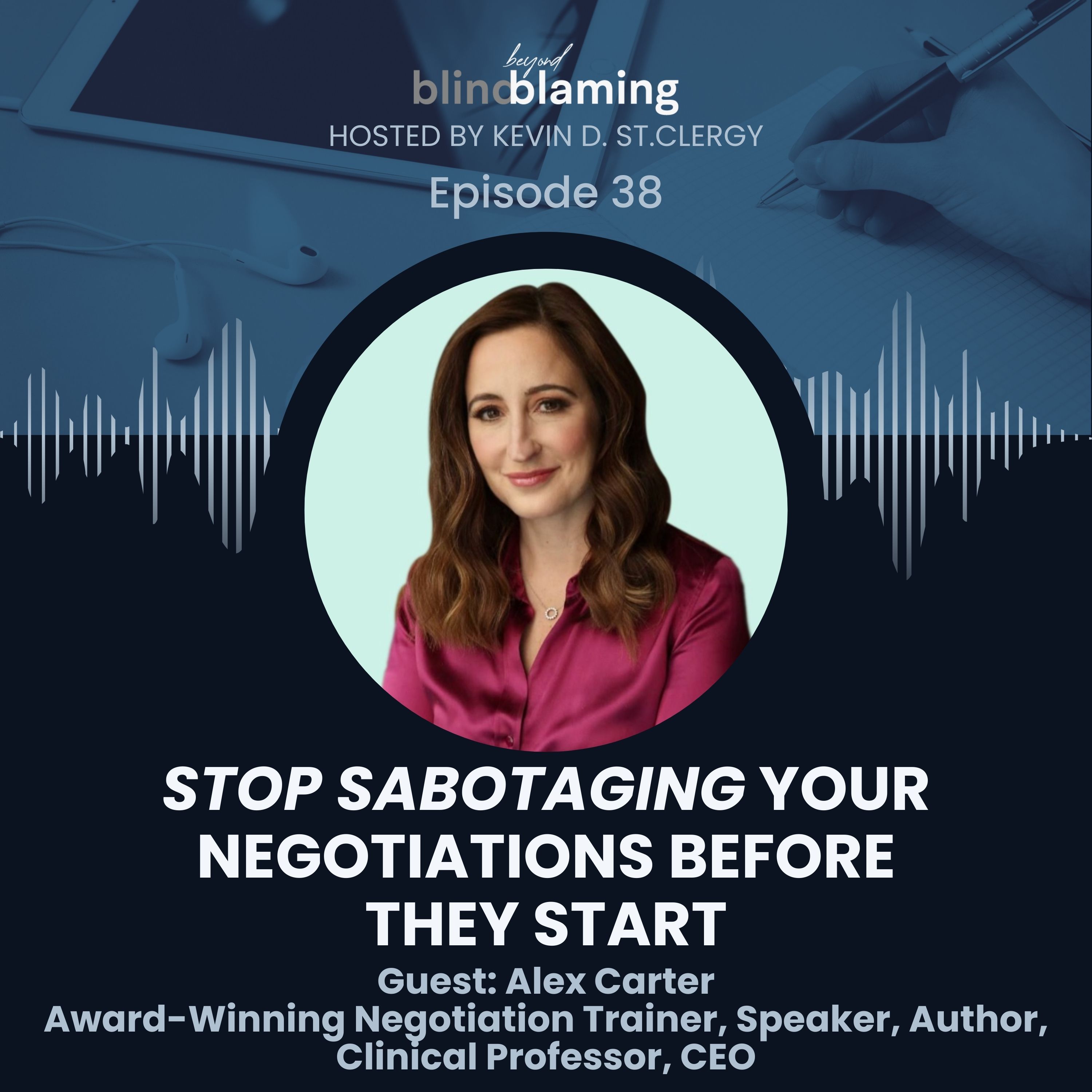
Today I'm joined by Alex Carter. She's a world renowned negotiation expert, clinical professor at Columbia Law School, and the best selling author of ask for 10 questions to negotiate Anything Through. Through her work with the United Nations, Fortune 500 companies and leaders around the world, Alex has shown that negotiation isn't just about salaries or contracts. It's about how we communicate, advocate and take responsibility for creating change.
- [00:40]
A
When we're negotiating, what are we doing? We're just steering. We're steering relationships, we're steering ourselves, we're steering companies. And this is a partnership. This is not a battle.
- [00:55]
B
This. Welcome to Beyond Blind Blaming. This is the place where we explore how easily hidden truths can hold us back, trapping us in cycles of frustration and blame, often without even realizing what's truly stopping us. Each week I'm joined by experts and professionals who share their journey of taking back control of their story and overcoming hidden challenges. And discover how to stop blind blaming from dictating their outcomes. The insights you're about to gain will help you see beyond your current limitations, find the courage to seek new perspectives, and ultimately live a life that's both purposeful and powerful. So if you're ready to break free from blind blaming and discover what's possible, you'll definitely want to listen to my next guest. I'm your host, Kevin St. Clergy and today I'm joined by Alex Carter. She's a world renowned negotiation expert, clinical professor at Columbia Law School, and the bestselling author of ask for 10 questions to negotiate Anything. Through her work with The United Nations, Fortune 500 companies and leaders around the world, Alex has shown that negotiation isn't just about salaries or contracts. It's about how we communicate, advocate and take responsibility for creating change. Her mission is to help people beyond fear, blame, and limiting beliefs by teaching them to ask better questions. Alex, welcome to the show.
- [02:16]
A
Kevin, thanks so much for having me.
- [02:18]
B
Hopefully I got your background correct.
- [02:20]
A
You sure did. Even my mother would be happy with that introduction.
- [02:24]
B
Well, you built a career showing people that negotiation is a daily practice, not just something that happens in boardrooms. What. What first drew you to your work?
- [02:31]
A
You know, Kevin, I was drawn to the work because like a lot of people, I think I had been. I'd received some training in negotiation, but secretly I didn't feel great about it when it came to me. So when it came to other people for clients or for family or friends. If you needed something, I was the fearless junkyard dog negotiator who would go out and get it for you. And somehow when it came to me, I found myself hesitating. And then there came a moment when I called someone who was senior in my field for advice. And they shared with me that actually when I ask for more and I stand in my value, I make it easier, easier for the people who are coming after me. And as somebody who is community minded, right. I want to create opportunities for other people. This reoriented me to negotiation. And I started to think, you know, maybe if I do this, I'm not hurting other people, I'm actually helping them. And so this is my way of helping other entrepreneurs, other women in male dominated spaces. Whoever it is that I might be or, or what I might represent to people, I'm going to bring people along when I stand in my value. You know, the other thing I would say, Kevin, is then I thought to myself, I need to find a way that really works for me to do this, where I feel like I'm negotiating from the best of who I am. I'm not trying to imitate somebody on tv, but I'm doing something where I'm in my integrity. I'm feeling true to what makes me great and what my company stands for. And, and I developed an approach that I feel comfortable using every day. So my mission is to teach millions of people around the world who also maybe secretly feel like there's more they could be doing that. Yes, negotiation is for you.
- [04:31]
B
I love it. Well, in Ask for more you start with self reflection, which I thought was fascinating because in my book I start with awareness. So why do you think it's so important to begin by asking ourselves questions before asking others? And I've had some other negotiation experts on the show before and they seem to really focus on what people should be doing on the outside. I haven't had anybody go self reflection first. So talk to us a little bit more about that.
- [04:55]
A
You know, in my work, Kevin, in my day job at Columbia, I help every year, many thousands of educated, credentialed people negotiate high stakes disputes. And over and over again I was seeing the same thing that people were having what I call a negotiation. One car accident, they were getting in their own way before they even sat that down with the other person or the other company. Everything starts with you. The first person and the most important person you have to negotiate with is yourself. And so what I wanted People to know is that with a few simple questions. Because again, your key is awareness. That's exactly where I like to start. We can't grapple with somebody else's version of a story, somebody else's wants, needs, goals, until we have really drill down on our own. So I like to teach people just a few tools they can use to get that awareness so that then when they sit down at the table, you know what happens? Their minds are clear, they're feeling confident, they have command, and they're ready to listen for all the little micro clues that the other person is dropping that most people won't hear because they're spinning on the hamster wheel still about what should I be doing here?
- [06:21]
B
I love it. Well, you also, I believe you called that the mirror in the book. And I don't want to take people away from reading the book, but it was interesting because I just did a keynote yesterday, a virtual one where I talked about the mirror versus the window. So let's switch to the window now. Now there's questions that you had taught people that they need to ask others. You want to talk about that for a bit?
- [06:41]
A
Yes. So you know, Kevin, in your work, people ask questions all the time. We are asking questions every minute of the day. It's just that normally we're not asking the right questions. You know, you go in your TEDx talk and in your book you talk about somebody seeing a problem, right? There's a kid, a high performing kid on a baseball team and all of a sudden they're not hitting. And what we like to do is either ask blaming questions or closed questions. Okay, so blaming questions, you know, Kevin, why didn't you, why didn't you swing earlier? Why didn't you eat a better dinner last night? Or Kevin, did you work out this week? Right? Did you work out? This week? Is a very closed yes, no diagnostic question that gets a very small amount of information. And the other question is really a blaming question. You clearly did something wrong to end up in this place. And what I like to do is to teach people how to ask magic open questions. Open questions are ones that people cannot say no to. They are not yes or no questions, but more importantly, they're questions that will lead you to what the problem actually is that you want to solve the really big problem, the meaty problem, the problem that maybe is going to unlock your company's potential or your entire industry. Open questions start with three different openers. Okay, One is what, Kevin, what have you been feeling recently? Right? What do you think Might be an issue. What's your experience when you're getting up to the plate? That is an open question. Number two would be how, Kevin, how does this season feel different for you when you're hitting versus last season? Right. Open question. Getting more information. But my number one question, this is the one that I based my own TEDx talk around and that I train people to ask in every scenario, is tell me if you're in a feedback conversation with someone instead of saying, why'd you do this? Okay, tell me what was happening last week. Walk me through this decision. Kevin, tell me more about your experience this year with baseball. Tell me how you're feeling right when you are in a business development meeting. If you're an entrepreneur, instead of walking in and saying, hi, I'm Alex Carter, I'm a speaker and are the things I like to do and here are my packages and the way I like to work with people. No, tell me more about your company. Tell me about you personally. Tell me what's keeping you up at night. Tell me what you'd like to do in the market. What would you like to prevent your competitors from doing? You can see immediately that open questions are ones that do what the name says. They open up an entire world of possibility. They give you more information which helps you make better deals, and they generate more trust along the way. That is the essence of the window you are with your questions. Opening up a window between you and that other person so you can see each other and the situation more clearly.
- [09:54]
B
I love that. It just reminds me of, I want to. Instead of asking like in a sales process, I don't know why you triggered this, but you know, who's the decision maker in your organization? And instead of asking something to the effect of, well, tell me about your decision making process at your company. How does it work?
- [10:11]
A
Absolutely. And what a great tweak. Did you see how with that you went from somebody saying Jane or Bob to well, Kevin, we actually have a committee, you know, and, and now that we're talking about it, I really like you. You know, I'm thinking about what the other people on our decision making committee would say. Great, who are those people? There are so many follow up questions you can ask from that. It gets you so much more information.
- [10:39]
B
I love it. Well, and beyond blind blaming, as we talked about before we started, and I really appreciate you doing your homework before you got on the show, I talk a lot about how people often blame outward instead of looking inward when it comes to negotiation and your experience, how does Blame derail negotiations or conversations.
- [10:56]
A
Blame has a way of. Of shutting us down from gathering information. Blame is a way that human beings seek comfort because, number one, we're saying, well, that's not on me, right? That's on you. So it's a way of preserving psychological comfort by trying to toss a hot potato in somebody else's direction. But blame is also deeply, deeply incurious. It means, I think I've already figured this thing out and so I am just going to go ahead and put a narrative on a situation so that I can get out of it as quick, quickly as possible, and hopefully as psychologically unscathed as possible. Blame stands in direct contrast to curiosity. Blame is also in direct contrast to diagnosis. You know, imagine going into a doctor, I know people who've had this experience, and maybe they're a little bit overweight, and they come in with a bunch of symptoms and the doctor says, well, you need to lose weight. Very, very common experience for people in the medical system. What would happen instead if the doctor asked a bunch of questions, right? Tell me more about what you've been feeling. When are you noticing this? When might this have started? All of a sudden, then you're not blaming. You're moving into diagnosis, and there's a whole world of information that's going to help you then problem solve with that patient. But it's especially tough for people to avoid blame, Kevin, when it comes to conflict or negotiation. Because here we're really trying to preserve our self esteem, right? We're blaming ourselves and therefore we're trying to deflect that blame onto other people. It's one of the reasons that in the mirror, okay, if we could go back for a second. When you're negotiating with yourself, one of the things I don't like to ask myself is why, Alex? Why can't you just do this one thing? Why is it that your business is down or why is it that you can't figure that out? And you know why? I don't like why, Kevin? Because social work research shows it's a blaming question. And the more I ask myself that kind of blaming question, I'm going to feel bad and then I'm going to try to deflect that onto somebody else when I get to the window. Instead, I like to ask myself, what questions, Alex, what's feeling hard about this right now? What are the places where you're feeling stuck? What support might help you get from this place to the place you're looking to go? When I engage with myself like that, I'm in diagnosis mode. I'm saying, let's gather some information. I'm much more likely to then sit down at the table and be able to treat that person the same way.
- [13:41]
B
I love it. And tell me if I'm wrong. I've always been taught that why questions tend to put people on the defensive and what questions open them up. I get that, right?
- [13:50]
A
Does anybody have kids here? Right? You lean down at your child and you say, you know, why did you do that? And the kid puts their hands on their hips and says, because why? Gives you justification and sometimes blame in return. You then get into this blame cycle and nobody's solving anything, nobody's learning anything, nobody is growing in their relationship. You are stuck.
- [14:18]
B
I love it. And we actually call it the blame loop. I'll get you a copy of the book because I'd really just the way you're talking, I'd love to get an opinion on what you think of the book, but we actually did a lot of research on paradigms and paradigm paralysis and things like that. And then it just kind of fit into this perfect blame loop that we all go through. And then when you and the people around you are stuck in that blame loop, there is no negotiation. Everybody's stuck.
- [14:40]
A
Everybody's stuck. And that, Kevin, is when I get called in as a mediator. So that's the work I do in the legal context. And the reason I wrote Ask for More and I came up with this approach and wanted to teach people is I don't want you to wait until you're stuck in this blame spiral and maybe the business relationship is gone or you're in court and things have really gone wrong before you figure out maybe we need a third person to get out of it. I wanted to give people the tools to get out of that spiral or maybe prevent it before it begins. Right. With solid foundations of negotiation, asking great questions. And you know what's amazing is with AI now, we're seeing this being proven out more and more. There have been all of these meta studies of lots of different human interactions. And what they found is that people who ask open ended questions first at the beginning of their negotiations make more money and have better relationships, full stop. So you and I are completely aligned.
- [15:46]
B
I love it. We always, we just had a meeting this morning with actually a CEO who's struggling and she was like, well, I'm telling her to do this, I'm telling her to do that, I'm telling her this. I go, listen, just write this one sentence down for Me stop telling and start asking. And it made her pause, and she's like, oh, my God. I've said that to other employees as I've coached them, but I'm not doing it myself.
- [16:06]
A
Even high performers need coaches sometimes. You know, we're too close to it ourselves. And so that's part of the service you can perform. That's what I call holding up a mirror to someone.
- [16:16]
B
Yeah.
- [16:16]
A
When you have a relationship of trust like that, with a mentor, with somebody who's you've called in to help you, and they hold up a mirror, you can see a little bit more clearly, and you can correct some of those patterns.
- [16:28]
B
Well, in the blind blaming framework, we actually teach this thing called the RCD method. It stands for reflect, which is where you're asking, is there something else going on that I can't see? And then the second stage is called connect. And we encourage people to connect with someone outside of their sphere of influence, because we're all stuck in the blame loop. Even the best root cause analysis isn't going to work. Try to get to the root cause because everybody else is stuck in the same loop you are. And we encourage people to connect with an outside coach or a mastermind group and things like that. So it's great that you just said that, because I wholeheartedly agree.
- [17:00]
A
I mean, high performers are the ones who want to keep learning. And often that comes by humbling yourself to seek help and to seek help from outside your circle so you can then get more information.
- [17:13]
B
Great. Well, fear and avoidance often keep people silent. What hidden cost have you seen when people don't speak up for themselves?
- [17:22]
A
It's really interesting. I have worked with entrepreneurs. I'll give you a story. Was working with this brilliant woman. She was in a larger corporate setting, lots of toxicity going on. She decides to go out for business for herself. And this is somebody with a tremendous Rolodex of contacts, lots of experience, sends out a few proposals, and three people say no. And all of a sudden, the fear grips her and she says, okay, I have to slash my prices. She writes out another set of proposals at a third of the investment. What happens? You could predict it. She's not just booked and busy, she is slammed. She has way too much work, some from the wrong kind of clients. And she feels resentful, bitter, and angry, but mostly angry at herself. Right? And what happens then is that fear, right, gave way to, well, you know, I'm going to. I'm going to blind blame myself and my. And my prices and say, my price Was the issue, clearly. And so the answer is, I need to slash it. So we got on a call again, high performers seek coaches. And I said, okay, let's drop the blame right now, okay? You ran an experiment. You experimented with what it was like to sell yourself at this price. And now we know the results of that experiment. Okay, so let's go back and take a look at your sales process. You know what? We figured out, Kevin? That the problem was not the price. The problem was these were huge contracts. And the sales process to date had been, we're going to get on a call, we're going to talk about your issue, and then I'm going to send over by email this giant proposal with a big number at the bottom for transformational change right in. In a company. Maybe we need to be on a call with people. Because you're telling me when you're on a call, you're at your best walking them through all of this and exactly how they're going to see this come to life. We changed the sales process, not the number. And all of a sudden, the clients started flowing in the door. So a lot of times, fear could be us blind, blaming ourselves or taking a look at a situation and diagnosing it completely incorrectly. Feeling stuck. The answer is, to get curious, let me walk through my sales process. When do I feel great? When do I feel less great? What else might it be that's preventing people from investing at this level? And all of a sudden you're going to start getting to where you want to be.
- [20:03]
B
That's great. What you just described is availability bias, meaning that the first thing that pops into our head is clearly the problem. It's not me. And I actually use that very example in my keynotes. I say, I give examples of blind blaming. When you have one customer or three, as you just said, who say no, and you immediately think it must be my pricing, I need to lower my prices, when actuality the problem is your sales process or lack thereof.
- [20:31]
A
Yes. I like to tell people 1, 2, or 3 no's. That is not a statistically significant data set. Okay, that's a couple of no's. And so let's back off the Nobody wants me. I'm. I'm never going to sell again. We're going to go back, we're going to ask some questions. Right. And that often is where people break through. I love that you've had the same experience.
- [20:54]
B
Oh, very much so. And I did a lot of work in the medical field before this, this journey, this season of my Life. And we saw it a lot on the sales process because they were actually, you know, they didn't see themselves as a salesperson, but they were taking money private, pay money for a product that they were selling. And we had to shift their mindset, their identity, and a lot of other things before we got there. And they never really thought it was a sales process. They called it a counseling process. And whatever they called doesn't really matter. So can you share a story when someone thought the other side was the problem, but the real breakthrough came when they reframed their own approach, which I believe is what your entire book is about.
- [21:32]
A
Yes, I mean, I. To be honest, I see this so often. I. I work with a lot of employment disputes and, and oftentimes people will say, well, you know, the problem is my. My employee, or the problem is my boss. I can think of a situation where, you know, somebody didn't get promoted. And, you know, they. They were really upset about it, and they tried to engage with the boss, and they both ended up coming out feeling like the other person was the issue. This was a much larger organization. And then I got involved, and we actually figured out that the company, company wide, had changed the promotion criteria, and the criteria really weren't clear, and it resulted in a lot of people having confusion about what the KPIs were that they needed to hit. And so as a result, you have people saying, oh, well, you know, Kevin's the problem, or Alex is the problem. When actually, when we zoomed out, we were like, no, it's really this policy, right? And let's look together at this policy, and what might we do to either make this more intelligible, more understandable to people, or to change it? You know, we can also see this with all sorts of business contracts, right? So you're a supplier of a product, and you're negotiating with a distributor, and there's always stuff that goes on. You know, where is my stuff being placed on the shelf? Or why do you want this sku and not that skew, right? And a lot of times it's so easy again, because we resort to blame, we blame ourselves, and then we flip that on someone else. Well, this buyer just doesn't get it right? Or this particular store just doesn't get it, instead of saying, all right, so talk to me about this placement in the store, right? What's the purpose of this? Or what are you hoping it's going to do for our collaboration together? In other words, Kevin, what we do sometimes is in blaming, we forget that we're most of the time not adversaries. When we negotiate, we are partners once that deal is done. If I'm supplying a product to a store, once we negotiate, I want to partner with that store to get the quickest velocity, right, so that the product is fully flying off the shelves. Most situations are like that. And so if we step back and ask what else, right, what's happening or what other support could we seek? We're going to figure out oftentimes that the problem is really something else that we could solve together. Even if the problem is simply we just didn't communicate with each other, we didn't have the right information to understand that we're actually on the same page.
- [24:26]
B
It was almost like you're saying, seek to first understand. I think that was one of Stephen Covey's seven habits.
- [24:32]
A
I'll never forget it. Kevin. So many problems would be solved in business, in politics, around the world if we sought to understand somebody else first. It's not sexy. It doesn't play all the time on social media. This is the work that I like to help people do behind the scenes. And, and it is so, so effective.
- [24:57]
B
Well, I think you've learned and you've definitely taught the audience today that most people see negotiation as a win lose game. And you've just helped them with how to be more collaborative.
- [25:07]
A
You know, if you live long enough, Kevin, you might get served up a true win lose situation. But most of the time, both people can win. Truly. You know, I think about, I have a daughter who's a competitive swimmer. And Kevin, she overcame a lot of disabilities early in life to become an absolutely sensational athlete. And I'll never forget the time that she got put in the pool with a physical disability. She had one leg that was shorter than the other to swim a really long race against some much older girls. And she was scared to do it because she told me, I'm gonna lose. And I remember telling her, this is about your race. Stay in your lane. Literally. Okay, stay in your lane. You swim it the best you can and you focus on that and nothing else. And Kevin, I get to the pool that day and I watch lap after lap as my daughter is behind, further behind, way behind. And I have to admit, I was tearing up on the side of the pool thinking, why did I let her do this? Do you hear that? Why? I started to blame. Why did you let her do this? Right now she's going to feel bad. Is she even going to finish? Well, she did finish dead last. Okay, so she Lost, technically. But you know what she did in the process of losing? She put up the sixth fastest time in the state of New Jersey for a 12 year old girl in the mile. And she did that with one leg that was shorter than the other. This is somebody, my daughter Caroline has taught me more than anyone else on this planet that it really is about swimming your race. And no matter what the result looks like, you can win in the process of moving closer to your goal, no matter what anyone else in the pool is doing. I learned a lesson that day. I've carried it into everything I've done in negotiations since then.
- [27:06]
B
That's a great story. Almost had me crying as we talked about. Me too, I bet. Yeah. What a proud mama moment.
- [27:13]
A
Yeah, it sure was. And I, I see it every day. Right. And I, I think to myself and I, I think with my clients and the companies I'm privileged to work with, okay, regardless of what people are doing, what are the goals that you want to get to, what are the problems you want to solve and how do we move you closer to that? Right. And most of the time, Kevin, if we're working collaboratively with others, if we are seeking first to understand it's going to make us outstanding business developers, outstanding client service people, it's going to mean that our company is solving problems maybe that other people haven't even seen yet. And all of that means we're financially successful. It really starts with a spirit of partnership and thinking about regardless of other people, how do I move closer to my individual goal?
- [28:07]
B
Well, I think what I also hear you saying is you're not only going to be more financially successful, you're going to have better relationships. And for those people who really, really. And I've found that most successful entrepreneurs have one thing in common, is they want to have an impact on their customers lives. And what you're describing, I think that can absolutely happen and probably faster and better than ever before.
- [28:28]
A
Yes. Because you're not just trying to trick someone into one handshake. You want somebody to say, Kevin is my partner in my long term success, you know, and I just to close, I keynoted a sales conference and the company told me a lot of people hear the word sales and they just recoil. They think, ugh, that is not for me. And the last slide I showed was my kitchen table covered in bouquets of flowers. And I told people that my father had passed away three weeks earlier and this was my kitchen table. And all of those flowers were sent to me by long term clients who I now have the privilege to call friends because it's great people with great values, we do great work together, and we also have really satisfying relationships that frankly make it all worthwhile.
- [29:21]
B
Dina, you're getting into something I love building better relationships. The quality and quantity of the relationships you take the time to build is what really makes you successful.
- [29:31]
A
I know. No other kind of success, you know, at the end of your life. Both, I think, your financial success. Right. But also the satisfaction you get out of it, that feeling of connection with other people. It's really a direct measure of the investment you've put in. And I'll say this, Kevin, that I'm only able to invest in other people and foster those relationships as well as I've been fostering the relationship with myself. It all starts in the mirror with how well do I know myself, how much do I know, what kind of things I can offer and what I'm uniquely called to do on this earth? And then how do I meet and foster relationships with people where we can partner to do that great work?
- [30:17]
B
Yeah, you're just, you're describing becoming aware, more self aware so that you can do better for others or with others.
- [30:22]
A
That's right.
- [30:23]
B
Well, you mentioned sales because in medical industry there's a lot of people, or medical profession, whatever you want to call it. There's a lot of people who hate the word sales too. And I always just start off my, my talks with, look, listen guys, sales is not a four letter word. It is five. You can count it, S, A, L, E, S. And it usually got a pretty good laugh.
- [30:41]
A
That's pretty great. I've, I've done a Google image search for sales and then put the most annoying first pictures that pop up up on the screen. And it's usually it looks like a bunch of like, like it, like used car lots or you know, hucksters saying always be closing, you know, abc. And I think that's what we think of when we think of sales. But really sales is problem solving, sales is service. Sales to me is a great conversation where I'm getting to know someone, they're getting to know me. And we figure out, do we have a match here? Could we do something great together? And in the process of doing that, we're going to advance each other and have a whole lot of fun.
- [31:27]
B
I'm finding a lot of people feel the same way when they hear the words negotiation sometimes too. They're like, I don't know, that sounds like I'm going to be taking advantage of somebody. I'm like well, what makes you say that?
- [31:37]
A
It's interesting because I actually did a survey when I was writing Ask for More, and I asked people what words they associated with negotiation. And one of the top words was compromise. And compromise means loss. Think about it, right? I'm compromising on what I want. I'm compromising my values. It's a profound feeling of, I'm going in. It's going to be a battle, and I have to settle for less. And I had my whole world reframed because I learned on my honeymoon that negotiation is actually something totally different. I was in a kayak with my husband. I could get into a longer story. I do, in my TED Talk, where we weren't negotiating well together, and we flipped the kayak because we were trying to steer in two different directions. But I get in the kayak, I'm soaking wet, and our, like, surfer dude guide up ahead is like, all right, folks, let's negotiate these things to the left, because we're going to hit that beach up ahead. And I remember pausing and thinking, oh, my goodness, negotiate these kayaks to the beach. This is it. You know, when we're negotiating, what are we doing? We're just steering. We're steering relationships, we're steering ourselves. We're steering companies. And this is a partnership. This is not a battle. This is just thinking about every time I pick up the phone and I talk to someone, how am I steering this relationship? How are we working together?
- [33:09]
B
And.
- [33:10]
A
And the more I approached it as simply steering, like steering a kayak, the less I was gearing up for battle and moving into blame mode. Instead, I was asking questions. I was staying open. I was staying curious. I was prioritizing the relationship. And what happens when you're treating negotiation as steering? Is that. Yes. Then when you hit a choppy part of the water, you hit a wave, you hit something that's more difficult, like a big money conversation. You're going to be so much better prepared because of all the time that you spent investing in that relationship.
- [33:46]
B
Awesome. Well, Alex, you've been amazing. You and I could go on for hours and hours. But there is one last question I always like to ask every guest. And you've clearly invested in yourself over the years. It sounds like you're well read. You've done your homework. What's your favorite way to invest in yourself? Is it reading? Is it podcast? Is it having a coach mastermind groups? Coaching podcasts? How do you like to invest in yourself?
- [34:11]
A
I take a walk, to be honest, Kevin, when. When I feel stuck When I'm in a blame cycle, when there's something I can't quite work out or I'm feeling stressed or burdened, there's a lot going on. Right. I. I'm a full time professor. I run a training and consulting company where we work with companies and individuals on negotiation. I'm a mom to now a daughter going into high school. There's a lot going on in my life and in my house and my world. And for me, there's something about getting out and taking a walk in nature that solves it all. When I was writing Ask for More and I couldn't work through a particular question, I walked. When my dad was diagnosed with COVID while he was on hospice and during the pandemic and I couldn't go to visit him and I was worried he was going to die before I could get there, I walked. You know, anytime I feel stuck or I need a refresher, I go outside, I take out my headphones, I feel the breeze, and I walk through my problems and that I've invested in myself with coaches, I try to get sleep. I do a lot of other things, but walking is something that automatically connects me to something bigger than myself. And, and I come in and I feel refreshed.
- [35:35]
B
I love it. It's one of the reasons Tony Robbins recommends the first the the way to instantly change your state is to move.
- [35:41]
A
Yes.
- [35:41]
B
So it's great advice. Well, Alex, thank you again. You've been amazing. If people want to get in touch with you, how do they get in touch? And we'll make sure we put it in writing underneath the podcast when we launch it as well.
- [35:51]
A
Absolutely. You can find me at Alex Carter asks a s k s.com I also have an amazing group of people I work with in the ask for more group. You can find us also at that. And you can't avoid me. I'm on LinkedIn and Instagram every day delivering negotiation content. And if you're looking for a little more of the swim mom highlights and to see me cheering like an absolute fool for my daughter in the pool that is on Instagram, you can check that out there as well.
- [36:23]
B
Awesome. Well, thank you, Alex. Like I said, amazing content. There's a lot of similarities in what we do and I can't wait to stay in touch. Thank you.
- [36:29]
A
It's been an absolute pleasure. Look forward to it.
- [36:34]
B
Sam.