← Beyond Blind Blaming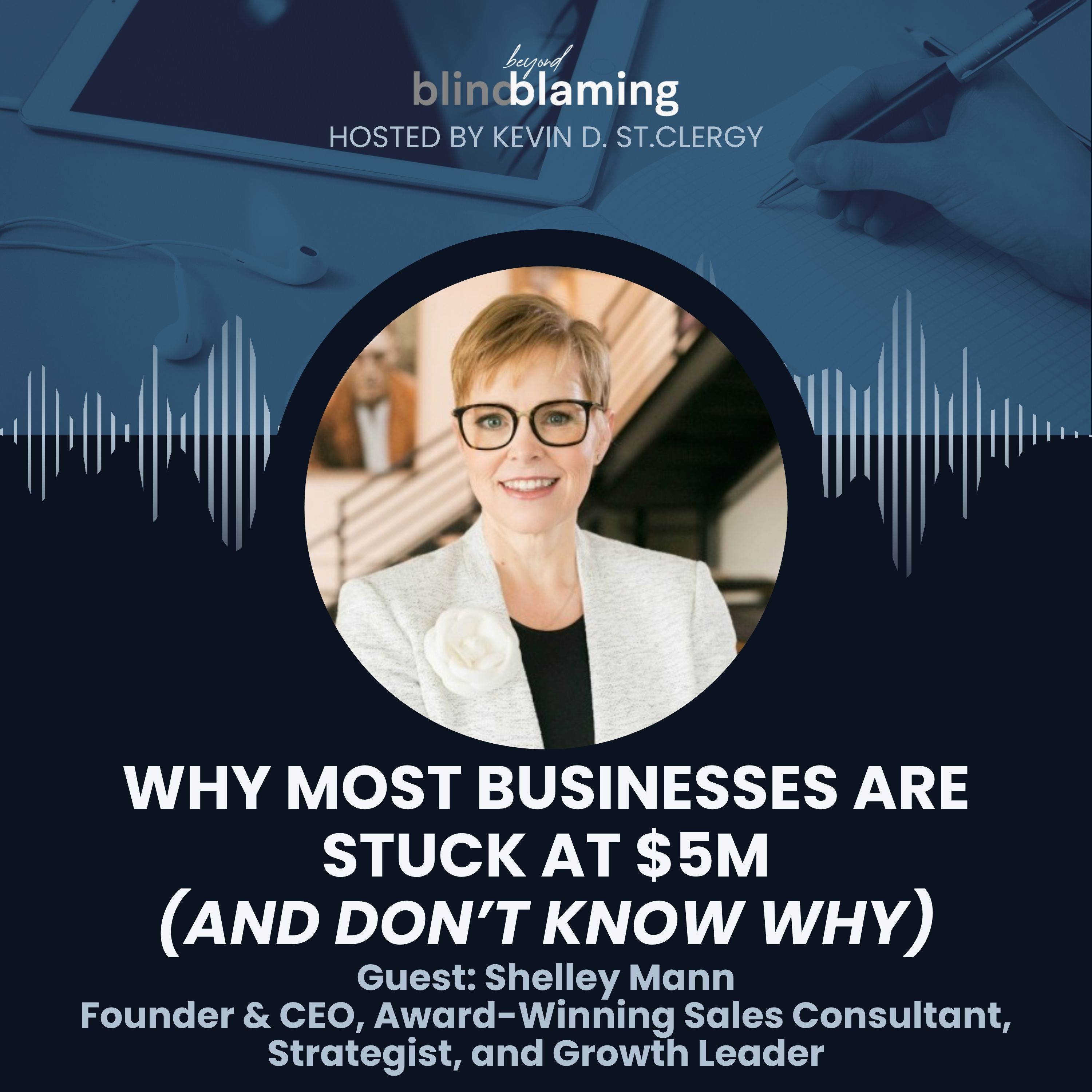
Beyond Blind Blaming
Building Predictable Sales, Owning Revenue, and Beating Commercial Chaos | Shelley Mann
00:44:16
Loading summary
Transcript67 lines
- [00:00]
Shelly Mann
You launch a business not because it's unique in the marketplace, but because you feel like you can do something better than anybody else that you compete with. And so at a certain point in order to grow, you got to get out of that seat. You're always going to be the best salesperson for your company or organization, but you got to get out of that
- [00:16]
Kevin St. Clergy
seat Today I'm joined by Shelly Mann. Shelley is a dynamic and analytical senior executive for more than 25 years of experience in sales and commercial leadership on an international scale. She has a proven history of accelerating revenue and commercial growth by building and mentoring high performance sales teams and navigating the intersection between business models and evolving market conditions. In 2022, after years of traveling more than 170,000 miles annually in corporate leadership roles, Shelley launched Strategic Sales Advisors llc. Today she helps out solopreneurs and small to mid sized businesses and even larger ones get out of commercial chaos and into a structured, repeatable and predictable sales engineering.
- [00:56]
Shelly Mann
If you are not spending your time building relationships, I don't care if it's a very transactional sales or moving into more of that consultant relationship sales, then you are missing a step in there. You're missing clients returning, you're missing clients referring you, and you're actually probably having challenges around Total Account Management and customer lifetime value. Foreign.
- [01:32]
Kevin St. Clergy
Welcome to Beyond Blind Blaming. This is the place where we explore how easily hidden truths can hold us back, trapping us in cycles of frustration and blame, often without even realizing what's truly stopping us. Each week I'm joined by experts and professionals who share their journey of taking back control of their story, overcoming hidden challenges, and discover how to stop blind blaming from dictating our outcomes. The insights you're about to gain will help you see beyond your current limitations, find the courage to seek new perspectives and ultimately live a better life that's both purposeful and powerful. So if you're ready to break free from blind blaming and discover what's possible, you'll definitely want to listen to my next guest. I'm your host Kevin St. Clergy and today I'm joined by Shelly Mann. Shelley is a dynamic and analytical senior executive for more than 25 years of experience in sales and commercial leadership on an international scale. She has a proven history of accelerating revenue and commercial growth by building and mentoring high performance sales teams and navigating the intersection between business models and evolving market conditions. In 2022, after years of traveling more than 170,000 miles annually in corporate leadership roles, Shelley launched Strategic Sales Advisors llc. Today she Helps out solopreneurs and small to mid sized businesses and even larger ones get out of commercial chaos and into a structured, repeatable and predictable sales engine. Her work is grounded in practical execution, focused sales playbooks, defining the ideal client, clarifying the sales process, establishing measurable KPIs and building accountability into the revenue function. Beyond playbook development, she supports clients with pricing strategy, sales goal setting and compensation design, revenue forecasting, fractional sales leadership and sales leadership coaching to ensure strategy translates into sustained performance. Hope I got that right. Shelley, welcome to the show.
- [03:20]
Shelly Mann
Thank you. Thanks. I'm glad to be here. Kevin.
- [03:22]
Kevin St. Clergy
Well, let's start with your journey. After 25 years in global commercial leadership and your travel miles blew me away by the way. So definitely experience travel. What led you to launch Strategic Sales Advisors?
- [03:33]
Shelly Mann
I think it was a couple of different things. So you know, quick recap of the 30,000 foot of the background. Right. I entered the hospitality industry into the hotel space right out of college, got a degree around that and, and thought I'm going to go into food and beverage and learn pretty quickly. That is a 24 hour day, seven day a week, 365 day a year job that I was passionate about doing for myself and not for others. So I transitioned into the sales space very early, in my early 20s, a couple of years into that career and discovered I really loved the ability to connect with others, build relationships and grow in the sales functionality. And, and it has served me exceptionally well because I was able to move to eventually move to Washington D.C. move out of a global sales role and into a strategy role for a major hotel company where I was doing all of that travel globally, which gave me that again, that opportunity to connect and build relationships internationally, to be a part of other, you know, different types of people and to learn different customs. And I don't know if you've ever traveled that much in a year, but it can also drag you down pretty significantly. And so at a certain point I had an opportunity from a property owner who was looking for some strategy help and to really completely rebuild his commercial engine to move back to Texas and did that in November 2019. And we all know what happened in March of 2020. And so I, my goal was how do I get this company to keep the doors open, how do we get travel going through the, the, the facilities and then on the opposite side, how do I build an effective team that can come out of this pandemic, out of this, you know, global shutdown even stronger and so spent a couple of years doing that with this company and at the end of it, thought this was fantastic. This company's not growing as much as they wanted it to for other factors. And it was a great opportunity to separate, but I didn't want to pick up and move yet again, which is very, very common in the hospitality industry. And so I said, well, I rebuilt the engine for this company. I love doing that. I love getting my hands in and understanding what's not working well and what needs to be tweaked or optimized. Right people, right seats, product, all that kind of stuff. So why don't I just launch a business and do that for others? And so that was sort of the start in early 22 of strategic sales advisors and how I kind of said, all right, let's put a stake on the ground and see what I can do for other companies and industries.
- [06:33]
Kevin St. Clergy
I love it. And so have you focused in on it? Because I thought you did. I get it right. Small and medium sized businesses or are you working with larger corporate clients now?
- [06:41]
Shelly Mann
Yeah, my primary clientele are that those that sit in the small to mid to mid market from a business size. And I think that for me, the reason why those are so important to me is the fact that the majority of them can't afford to have a senior leader in that commercial seat. Most of those are founder led sales. They have, you know, an energy behind them when they launch a business. I always joke with an owner, you know, you launch a business not because it's unique in the marketplace, but because you feel like you can do something better than anybody else that you compete with. And so at a certain point, in order to grow, you got to get out of that seat. You're always going to be the best salesperson for your company or organization, but you got to get out of that seat. And they don't usually have the budget or the framework to have a really high sales leader or commercial leader come in. And so they are almost thirsty for knowledge and structure that I can bring them. And so it's really fun to work with them because they get so excited.
- [07:41]
Kevin St. Clergy
I love it. And the way you described it was you worked at the intersection of business models and evolving market conditions. Yeah. Are there any patterns that you repeatedly see that push you towards helping those folks?
- [07:52]
Shelly Mann
Yeah, I think it's a couple of different patterns. I think I mentioned that first one, which is getting an owner to get out of their way. Because from an ownership standpoint you have so many. I mean, the unique thing of being a business owner is learning by doing as well. But you have so many sort of sticking points along the way when, when you are launching that business and you're doing the sales and you're bringing in the revenue, but then you're also having to operationalize it and hire people and, you know, financial, you know, the financial acumen. So there's all these seats that you have to be in. And my favorite conversation was with someone and, you know, he was like, listen, we hit 5 million in top line revenue and we can't get past that. We just can't grow. And I'm like, you can't grow because 70% of that revenue is coming in from you. And so you're either spending your time focused on sales and operations is slipping, which is causing brand challenges, or you're heavy in the operations and all of a sudden sales slipped, so you need to move out of that space. And so that's kind of the first. The second is, is I don't think people understand industry disruptors and what's going on out there. And I think from my background in hospitality, we saw it firsthand from a couple of spaces when, you know, online travel agencies kicked up and they became the owner of the customer relationship versus the hotels having that ownership. All of a sudden we were split away from our primary customer and didn't get to have that direct conversation anymore. Then you had Airbnb come along, right? And now you've got a whole nother disruptor that's coming in and saying, you can stay with us. It's going to be a better, you know, better cost and us having to tell the story around accommodation versus hospitality. What does that mean? And so I think a lot of businesses don't see that or don't look ahead for that from a strategic level and understand how that's going to affect them. And we're seeing a lot of that with peers stepping into a lot of industries and trying to, you know, formulize that business model for everything from service based businesses to even professional services.
- [10:03]
Kevin St. Clergy
Well, I love it. And you mentioned, you mentioned a couple of times is what I wrote down before I get into my next section. But you said build relationships a couple of times and you lost that relationship. How important are relationships and sales?
- [10:15]
Shelly Mann
Relationships are the foundation of sales. So if you think about the commercial engine, I just did a presentation on this with a friend of mine who's in marketing. But so many people think sales and marketing are the exact same thing. And they, they are not. They work in collaboration to drive performance and to, to feed the commercial Engine. But sales is that primary relationship opportunity with a client or customer. Whether you're doing business to business or you're doing direct to consumer sales, there is still a relationship in there. From a sales perspective. Marketing is going to feed the pipeline, it's gonna feed the commercial engine, it's gonna. Sales has to pick that up, build the relationship and cross, you know, take that across the finish line. So if you are not spending your time building relationships, I don't care if it's a very transactional sales or moving into more of that consultant relationship sales, then you are missing a step in there. You're missing clients returning, you're missing clients referring you. And you're actually probably having challenges around, you know, total account management and customer lifetime value from your clients. And so relationships are where sales can perform and move a company or organization into that next level.
- [11:31]
Kevin St. Clergy
I love it. Well, now let's move into blind blaming, since that is the title of the show and that is what you know. So that's how we met. But in sales, blind blaming often shows up as blaming the market, the marketing department, pricing pressure, competitors, or my favorite, bad leads. Where do you see business owners or founders misdiagnosing their real revenue problems when it comes to sales?
- [11:53]
Shelly Mann
I think it's twofold. The first one is that business owners launch a business and their vision is that, well, everybody needs my product or service, and so they try to go after everyone and they don't really narrow it into who are my true value ideal customers that I need to be focused on, who are those clients that I provide the most value to them. Therefore, at the end of the day, when they purchase my product or service, then they're going to not only get the most value out of it, but that's going to be that return sentiment. That's going to be that, that situation where they need to have that engagement. And so everybody tries to market and sell to everyone and then it's not working very well. Well, then it's not my fault. It's the customer's fault. It's the, the market's fault. So I think that's the first thing. The second is that I don't think enough companies and organizations do SWOT analysis enough on their competitors. And I actually did have this conversation with a client that I've been in conversations with coming, coming in and helping him, you know, fractionally manage his team. And I said, you know, SWOT analysis should be done at minimum on an annual basis, if not semi, annually. Because going back to the conversation around industry Disruptors. If you are waiting or if you are not testing the market and seeing what your competitors are doing, where do they excel that you're never going to catch up with them. And we need to just sort of pocke that onto the side and say, that's probably not our space. We're going to go after the stuff that we can truly compete with or that we already excel and we can grow that so that they can't compete with us. If you aren't looking at that and testing that consistently, you're going to fall behind. And all of a sudden your sales team can't have effective talking points around why us versus someone else. And so I think that's another situation where again, it goes to that. It's not me, you know, it's. It's everybody else. It's this situation. The third thing I think for me that I would say I see a lot in businesses is owners will say, this is what our revenue target is for next year, and it will not be based in any kind of data point. And so they do that, and then they start to create goals for their sales team that have no basis in reality on what can actually be achieved. Right? And so you've set up a team that is focused on achieving a revenue number that they're not gonna get to. So you now demoralize your sales team, and you're gonna lose people, and so you're gonna have consistent turnover in that force, which is gonna set everything even further back. Right? And so I think that's another one where an owner can look at it and go, well, you know, it's not me, it's the team, okay? Like, we need to make sure that we are setting good quality goals based in data and understanding that we are looking at forecasting and understanding, you know, like, what the cycle is in the business, so that we are setting up our sales team for success. I'm not saying set sales goals that they can, you know, walk out the door on a Monday and have it fully achieved. I'm saying set sales goals that are based in reality that have a bit of a stretch in there that they have a target that they can actually get to. That's what makes sense. And that's what's going to, you know, get out of that blaming situation or pushing the situation onto others where it's okay, I made that decision, and that was, I need to own up to it.
- [15:15]
Kevin St. Clergy
Well, right now, with the economy kind of in flux, especially because of the war, when you hear companies or salespeople say Sales are down because of the economy. How do you help them determine what's truly external versus internal?
- [15:26]
Shelly Mann
Let me give you a great example. You know, we all know what happened in 2008 around the, you know, the downturn in the market and things like that. And at that time, I was still doing global sales, and so I was in a direct sales role. My client was the US Federal government. Fun times. And I was considered in the industry, a subject matter expert in that. I taught classes to other hotel suppliers on how to sell to the government. Because my opinion is if everybody operates from the same handbook, then we're operating on the best product or service versus the best way of selling. And, you know, during that time frame, we had markets or cities or hotels that in the past would have never taken federal business because the rate was too low. You know, government sets its own per diem, all that kind of stuff. And so they had blown the business off for years and years and years. And then all of a sudden you have a market downturn and it's one of the few businesses that's actually still traveling or still doing business. And everybody comes out of the woodwork and they want, you know, they want you to send business their way. I mean, luxury hotels were coming to me and going, you know, come visit us and we can show you around with what the government. And I'm like, okay, one government's never going to have a conference or a meeting in a luxury property because of the, the optics around that. You know, we were already dealing with things like Muffin Gate and some other things. You know, $16 muffins for the government. Not exactly the story, but okay, Muffin Gate. Yeah. So we have those types of situations where you've already set yourself up as a business owner to say, I, you don't want that business. And then the market slips. And instead of being able to pivot to that because you established and kept relationships and used it where it, it benefits you and benefits the customer, you've pushed it off so much that you can't go back to it and say, nope, I want you now. Right? So when I'm talking to business owners, it is about, we don't say no to everything because it's not the right fit. It's just not the right fit at the right time. We want to keep relation again, going back to relate. We want to keep those relationships so that when we do need or we can help someone, that we can pivot into that at the right time. Again, we need to be watching things. We need to be watching trends in our markets. So I know that was a really very long winded answer.
- [17:47]
Kevin St. Clergy
No, no, no.
- [17:47]
Shelly Mann
Great.
- [17:47]
Kevin St. Clergy
Good stuff. Question. So, no, continue. I. I'm not going to stop you. It's great information and no, the more you can add, the better value the listeners get. So. So you said keep up that relationship when it's not the right time. Do you have any suggestions, maybe a couple of quick tips on how they maintain that relationship when now is not the time? What do you suggest or what do you think?
- [18:10]
Shelly Mann
Yeah, I think that, you know, especially when we're talking about economic downturns or things like that, and this can go across other things, but especially in the economic downturns. I think I've told you this story before, but when Covid hit, you know, basically overnight, the hotel industry went from, you know, my company, we went from running in the mid 70% occupancy, which is to a certain extent considered, you know, pretty full to 4% overnight. I mean, hotels were closing their doors, staff was all being laid off or furloughed, depending upon things. And so our focus was how do. Who's traveling and how do we engage with that? My fight internally, too was I can't lay off everybody within sales because we still have to have people that can continue to reach out to clients that can continue to have conversations even if they don't have business for us. We right now, because the moment that they do have business or they do have opportunity that we can help them with, I want to be the first one out of the gate. I want to be the person that they say. They were still reaching out to me. They were still empathizing with the situation and what's going on. So I know I can reach out to them. And actually, it was incredibly beneficial for us because we had more than one client that told us we were literally the only people that were sitting in seats when they called other hotels. There was no one there because the entire sales team had been laid off or furloughed because there wasn't any business. There wasn't anything for them to do. And so to me, that is that space of we have to keep relationships up even when the business isn't right there. Because the business will come back. It will. It will reengage when it's ready. And if we aren't ready for it, then we're already behind the competition, we're behind others, and we've lost, you know, we've lost traction in that space.
- [20:05]
Kevin St. Clergy
I love it. Well, let's move into Sales playbooks and predictable revenue. Yeah, you talk about that quite a bit. Your, your work centers around building practical sales plays, book or playbooks. What does that mean? And what are some of the foundational elements every business must define to create a predictable sales engine, as you call it?
- [20:22]
Shelly Mann
Yeah, so I think I already mentioned ideal client profiles. You know, we need to know who we're selling to before we can actually sell. We need to know our competition. All of that is part of the strategy of a company or organization. And that's the first section of a true playbook, right. Is understanding. Sales needs to understand the company's mission, vision and values. They need to be able to speak to, you know, like your elevator pitch, which I know a lot of people aren't really keen about anymore. But you truly need to all be talking the same language when it comes to a company organization. You need to be able to, when somebody asks you, you know, oh, tell me about your. Or tell me what you do, you need to be able to have that conversation, whether that's at a networking event or even just an initial conversation with a client. So that's kind of the first section. And then when we get into the methodology side, people often think when I talk methodology, that I'm talking about, you know, challenger sales or medic or, you know, like true method sales methodologies. And it's not necessarily that. It is. Now, how do we qualify a prospect? Right? Because not every prospect is the same. And if we are spinning our wheels on clients that are not going to buy from us or that are going to buy limited amounts from us or that aren't a good fit ultimately for the client. And, you know, you and I have talked about this before. It's that client that comes in and you're like, oh, man, why did I, you know, like, yes, the sale happened, but why is it there? So we need to understand what are those things that we need to engage with them from a qualification space before we take them into the whole sales funnel and the pipeline. Then what's discovery look like? Discovery is probably one of the most important sections of a playbook for a sales team. This is where we can win and lose business. And frankly, discovery is where you do win and lose that business. And so if we are asking the right questions and we are listening authentically to prospects, we will, you know, understand did our qualification metrics are where we. Right. And we need to take them down. Can we help them? Because that's what sales is. We're not there to push a product or service on someone, we're there to solve a problem that they have internally that they can't fix themselves. So qualification is a big section of the playbook. And then we get into the funnel. And the amount of times that I engage with a client that has never documented the different steps in their sales process, it's mind boggling to me. Because if you don't understand the stages and who's involved in it and what you need before you can move to the next stage, how do you expect your sales team to understand that, you know, everybody's kind of just shooting blindly on, you know, on prospects to get them through to convert that business. And then how do you forecast if you don't know how long somebody sits in discovery before they move to that next two, you can submit a proposal or you can get them into the contracting stage. Then how do you forecast business? How do you forecast when you need to operationalize or grow your operations side to get that business right? And then the final step after all of that is now let's get into scripting. Now let's build effective talking points, whether that's to objections that a client might have or that you consistently hear and how we can overcome those. Or it's scripting to, you know, get to that first prospect call. Let's build that out so that everybody has the guidelines, so that you're not telling sales to recreate the wheel every single time that they do something. And here's the cool thing about playbooks and having something like that. When you bring a new salesperson on, you can ramp them up significantly faster. You know, if you have a 90 day ramp for a normal salesperson, usually with a playbook, you're going to drop that to 30 days. If it's a six month ramp, you're going to drop that to probably two months, right? So first of all, now you've got your, your people you're bringing in actually getting revenue for your company faster. And then on the back end, and I always talk about this with exit planners and they are 100% on board with this. When you go to look to sell or exit your company and you have a fully documented playbook on this is how the revenue engine runs in my company, this is how get customers that actually will plus up the value of your company for that next owner, right? So the, the money that you can get out of your company from a sale is going to go up from that. So now you've got a book that's, that's giving you immediate revenue, that's Giving you immediate people coming in and doing that faster. And then on that back side of it, on the exit side of it, you're actually generating, you know, you know, value for your company and you're going to get that money back at that point as well. So that's why Playbooks to me are so valuable.
- [25:09]
Kevin St. Clergy
I think you bring up a great point. And it's one of the reasons when we sold our agency, we got a much higher multiple than everybody. Because they loved our, I can't remember what we called them. We didn't call them Playbooks. We called them something else. But they loved them and they wanted to implement them across all their divisions that they had in that book of business. I enjoy it and I miss it. I've taught it a few times. We had a working call or excuse me, we had a discovery call that we had a working call. Did it make sense for us to work together? And that's where we talk to them again about their goals, make sure we're in line, we got everything right. And does it make sense to work better or together? And can we help you?
- [25:40]
Shelly Mann
Yeah.
- [25:40]
Kevin St. Clergy
But when we implemented a certification program around that, which is, I think what you're describing with your Playbook, we took our onboarding from 60 days to 30. So actually worked for us. Exactly what you just described worked for us years ago. And we got to where we had six full time people selling. And we did something a little differently though, and I'd love to get your opinion on this. We got tired because we were a digital marketing agency and we got really tired of salespeople. And we had it developed between salespeople and account managers. You can probably guess the friction that was created. Salespeople just get them into whatever they want. So then what we did is we were highly training these people to not only be salespeople, but account managers. And so once they sold somebody, they were the account manager. And we got to where people could handle about 150 clients at once before we knew they needed to hire another person. How often do you see that happening and, and do you have a solution? That was our solution. I don't know necessarily the right one. There was good and bad and pros and cons for that. You know, we did have slow, controlled growth. It wasn't 50, 80% growth years, but it was a good 20 to 30% per year. Any thoughts on that?
- [26:42]
Shelly Mann
Yeah, there is a definite battle when you look at sales and then the operationalizing of it. Right. We used to, in the hospitality space, we used to Call it, you know, selling the dream, servicing the nightmare because, you know, yes, we can fit a thousand people in this 500 square foot room. Like it was not that drastic, but it was a situation of you can't sell something and then that we can't operationalize in the right way, that we can't account manage in the right way. And so a couple of things that can happen. One of the things that I do is I teach salespeople that, you know, customer lifetime value and that brand reputation are incredibly important. And if you sell somebody something that then is not going to be able to be operationalized or that they're going to be dissatisfied with at the end of the day, then that customer is not only not going to come back to you, but they're going to tell others about that situation. You know, whether that's lawn care maintenance or you know, the fact that I'm arguing with my pool servicing company right now because, you know, they're cycling through my technicians and you know, service has just not been fantastic. Right. You've sold me that you can do this, but then you can't operationalize it with the people that you continue to put onto my route that can't handle the amount of clients. Right. So that's kind of the first thing is to get sales out of the mindset of I'm just gonna, I'm gonna do anything to close the sale. I need to, I'm just gonna do whatever it makes so that I can get my commission or bonus or whatever it is. The second thing is, is that I've worked with companies and organizations where we have created teams when it comes to sales and account management. So sales team members are assigned or there's a partnership in there. They have one specific account manager that they work with, right. So they work together to not only make that sale, but then in that account manage situation. The conversation we have is 30 minutes into that. I mean, 30 minutes, 30 days into that relationship or how long, you know, like long enough to kind of get, get started in that is for the account manager to sit down with that client and basically say, you know, how are things going? What else is going on within your company organization? Almost, you know, re qualifying that customer to then, you know, hey, that's great. Let me, let's, let's loop in, you know, Frank from sales, who you worked with and let's bring him in because it sounds like that maybe there's some other things that we could do for you that could be successful. Right where it is. This sort of Ongoing relationship where they work together and then incentivizing them to do that, where there is that relationship working. And then, you know, I think sometimes it can be going back to your conversation around, like, when can you scale, when can you add? Sometimes it can be really difficult to understand. When do you add more sales or more account management perspective. I think the challenge for, for me is teaching owners that you need to add salespeople before you think you need to add them. You know, I have a list that I keep for clients of like four or five different things for them to look at. You know, if they're. Especially if they're hiring their first salesperson, if they can. If they are only doing sales and they can't do anything for their company operationally, you need to hire someone. If you have so many clients coming in or that are reaching out to you that you don't have the opportunity to engage with them within a day or two, then you need to hire a salesperson. A great. I was helping a gentleman that's a. He is a software development company. And his conversation with me was, you know, the majority of our business is inbound. I'm. I don't have anybody in sales right now. It's just me. And, you know, I can go on to, you know, fiverr or upwork or, you know, some of these things, and we can pick up clients left, right and center. But it's all inbound. And I'm petrified of when those channels start to dry up because we have no outbound force. And I said, you don't have the time for that. And if you don't start your outbound resources now, if you don't bring someone in to do outbound sales for you now, you won't be prepared when some of that other business slows down. So we need to create a strategy around that. And you're going to have to pay for someone before they're producing revenue for you, but that revenue will actually be there and it will actually, you know, multiple the. The cost of them before they do it. And then you have to give them the time and the energy so that they understand what their role is within the organization and what the expectations are and hold them accountable.
- [31:15]
Kevin St. Clergy
I like that. What was the quote you said at the beginning? Because I got half of it selling
- [31:18]
Shelly Mann
the dream service and then servicing the nightmare.
- [31:21]
Kevin St. Clergy
Servicing the nightmare. That's what I was missing. Servicing. Yeah. That's awesome. Yeah, that is so good. I've seen companies that change things when they purchase them.
- [31:29]
Shelly Mann
Yeah.
- [31:29]
Kevin St. Clergy
And it usually Goes really badly. Because what got them there when they change it thinking it'll be great. Usually put some five steps back before.
- [31:37]
Shelly Mann
Yeah.
- [31:37]
Kevin St. Clergy
So it is.
- [31:38]
Shelly Mann
I mean.
- [31:39]
Kevin St. Clergy
Yeah. The. Keep going.
- [31:40]
Shelly Mann
I was just going to say. I mean the biggest mistake I have ever seen a Fortune 100 company make. And I won't say who it is but at the time we were looking for a new again with a major hotel company. We were looking for a software system to come in and be a part of and manage the system because we had tried to build one and we weren't software developers. So don't make hospitality people make software. And we made an agreement. Within five years we would have 50,000 plus users on it. So they're looking at it from a financial standpoint. They had to come in and do the build and the integration and they hired 26 people to do that. And they were so far behind and there were so many arguments around things that you know, you sold us that you could do this. We made the commitment that we would get this many users on within five years. And within the first year you. You can't keep up with the numbers. I mean you did not plan for operationally for any of this. And now you've got to bring in other people and train them on things and stuff like that. It was just, it was a horrible mess. So.
- [32:50]
Kevin St. Clergy
Wow. And we always tried to stay one person ahead. We. We tried to stay just one person ahead. That way we were. Because you know, I know that for us anyway there was a lot of things that we did that sometimes salespeople didn't work out that we hired. Let's put it that way. As great as I think we got at creating that dream profile and the personality type, some people were just really good interviewers.
- [33:11]
Shelly Mann
Yeah.
- [33:12]
Kevin St. Clergy
But one ahead seemed to be the magic number for us. I don't know if you have any recommendations. It sounds like you like to stay similar or do something similar or just be prepared because we always. More business coming in. That wasn't our issue. It was just making sure that we created the great experience making you. You said the number that we liked. I liked new leads to get in to see a salesperson within one to two days.
- [33:31]
Shelly Mann
Yeah. Yeah.
- [33:31]
Kevin St. Clergy
I also liked the two sale. I don't know how you feel about this but I also like the two sales calls approach because one, for the work that we were doing it was very important that clients could manage their schedule and show up. So doing a two call sales process ensured that we had at least the right person from the Start that could schedule the time, show up, do the work, etc. Any thoughts on that?
- [33:51]
Shelly Mann
Yeah, I think it's, it's industry or business dependent, to be honest. You know, if you think about it. So let's take very, very basic service based when it comes to arbor care, tree care. I worked with a company for over a year in that space and just rebuilding their infrastructure and you know, for that space they're either doing a single call or they're doing, they're going out, you know, scheduling and going out to a property. And so they may do five to seven property visits a day to, to look at things. And here in Texas that could be, you know, a home or it could be a ranch, you know, with thousands and thousands of trees on it. So that could be a full day. In professional services. Chances are it's probably a two call situation. It's, you know, an initial discovery call to really understand and then it's probably now let's walk through some type of proposal or what we need to work through together on as you know, me coming in as an expert in other industries. It could be, you know, a six month, you know, multi, multi call situation. So it really is dependent on that. But I think that's something that, as you do this right again, going back to our playbook, we need to document that and then we need to review it consistently so that if there are changes that are happening, that we are documenting those changes and that we're ready to understand that and everybody kind of knows and then we can track when are we getting stalled into a situation? You know, that's always important too. Like let's look at the trends and when is a step in the process getting stalled and we need to figure out why are we stalling or has the messaging changed, has the market changed and we need to be talking about things a little bit different, that type of stuff.
- [35:30]
Kevin St. Clergy
I love it. You mentioned before, I just wrote it down that some people are against elevator speeches. Tell me more about that comment. I've never heard that because I think it's important. I loved which you said because I've said the same thing. A consistent sales language throughout the organization. But why are people going against elevator pitches now?
- [35:45]
Shelly Mann
I think a lot of people are thinking that elevator pitches are old school, you know, and then, and then, and the new version is, it's, it's all about networking. And I'm like, yeah, but elevator pitches are included in networking. But that's okay. But it's really interesting. I'm starting to hear from other spaces that the elevator pitch is dead. It's about being authentic. And I'm like, well, but here's the deal. To me, an elevator pitch is authentic. I, I say a lot of times, you know, I'll my elevator pitch when people, you know, so tell me, you know, strategic sales advisor, what is that? You know, like, tell me, what do you do? And I'm like, I get companies and organizations out of commercial chaos and that's all I tell them. And, and the whole purpose of that is for them to go, oh, that's really interesting. Like, tell me more. I like that's. I want people to get engaged and I don't want to over share. And it's always fun to tell somebody, well, you're a sales, I'm a sales consultant. And they're like, oh no, yeah, what are you going to try to sell me tomorrow? And I think that's where people think elevator pitches happen. That it's this, I'm pitching my business to you. No, I'm just telling you what to do, you know, or what my business does. And then you get to make that decision on, is it something that I need or is that interesting or do I want to know more? And so I think that's where the difference is, is what people think an elevator pitch is.
- [37:01]
Kevin St. Clergy
And I love that. I think they're important. Stephanie listeners. I mean, sounds like you do as well. I haven't heard that yet. I've had to help people redo theirs because it's just not very good. Like we had one recently and she takes businesses from chaos to calm.
- [37:14]
Shelly Mann
Yeah.
- [37:14]
Kevin St. Clergy
Which I liked. It was a good key phrase. Oh, tell me more about that. And you know, we take service based businesses and agencies and coaches and other businesses from transactional to transformational.
- [37:24]
Shelly Mann
Yeah.
- [37:24]
Kevin St. Clergy
From what have you done for me today? To thank you for changing my life. And that seems to get a lot of people or people just sometimes just say, yeah, I want that now. How do we do it? And that's where they need us. So I think elevator speeches are important. I've just not heard that. I don't know who's out there teaching that, but there's a lot of social media crap out there where people have to go against the grain to get your attention. It doesn't always mean. My new phrase for this year is just because you can do something doesn't mean you should.
- [37:50]
Shelly Mann
Yeah, yeah. And I think that people have to remember in the elevator pitch, it's not about feature dumping. That's another hospitality saying. You Know, like you come to my hotel and I'm showing you around and you know, and if you're there to, just because you, you have business travel, so you have your traveler staying in the hotel accommodations, you're not concerned with the meeting space and all this kind of stuff. And if I'm, you know, doing a site tour and I'm showing you around and I'm like, here's that beautiful ballroom, you don't care, I'm feature dumping on you. And so like in an elevator pitch, I'm not there to tell you the 17 different services that I can do or the, you know, four different products that I have in my product line. I'm there to just tell you what we do in general and then, and then we can have a deeper conversation if it's something that engages with you or that you feel is relevant to what's going on.
- [38:39]
Kevin St. Clergy
So, yeah, I've always heard that. Well, I've always taught that people buy outcomes, not services. At least long term clients buy outcomes.
- [38:47]
Shelly Mann
Yeah.
- [38:47]
Kevin St. Clergy
But I'm finding a lot of people just go into pitch mode really quickly. Do you run into that often? Or they're just pitch, pitch, pitch, pitch, pitch. And they're not really focused on asking the best questions.
- [38:55]
Shelly Mann
Yeah, it is one of the foundational challenges in sales is that the moment you hear something that you can fix, you want to say, I can fix that and here's how I would do it. And that is a deep conversation I have around discovery. Because again, discovery is where you win and lose that business. And, and if you are asking all of the questions in discovery, if you are truly understanding and even if a client sits down with me and they're like, okay, well, but tell me what you do. And I'm like, you know what, we're absolutely going to get to that. But before I can tell you that and I can let you know that I can help you, I need to understand more about what's going on and I need to really. So I'm going to ask you a ton of questions and I'm just going to, you know, you just tell me things. And so I think that's where, if you are trying to pitch too early, one, you're going to lose the business or there's a prospect in there of losing the business. And two, you truly haven't understood the, what is the underlying driver of the challenge that they're dealing with. Because once you get to that, the business is one. Because at that point now, you know, I can fix this. I understand what's driving that. And here's the solution that's actually going to make the fix versus here's a solution that might. Because, you know, because you had this problem, it's so challenging for me listening to others pitch or do discovery and watching them jump into that. And so with clients, a lot of times that's what we'll rehearse. Like we will practice discovery is. I don't want you to sell me on anything. Like the first whole conversation is we are just talking about that client and what's going on. We're asking the questions. I mean, my favorite question is, if you don't make it six, if you don't do anything today, what's going to happen to your company tomorrow?
- [40:42]
Kevin St. Clergy
You know, that's so good. I love that. I love. Sorry to interrupt you. That is one of my. I used to say it a little differently. I just say, well, if you don't fix this problem, what are the consequences to you personally?
- [40:51]
Shelly Mann
Yeah.
- [40:52]
Kevin St. Clergy
So it was a different way to say it, but I love that you brought that up. Great question.
- [40:55]
Shelly Mann
Yeah. And for me it's if a client's business is doing well and they just are saying stuck for growth, then it's if we do this today, where will your company be tomorrow? So companies underperforming get a little bit of a different question than those that are performing so well.
- [41:11]
Kevin St. Clergy
That's good because you can still help them go to the next level if they're doing well. And it's nice that they're on the phone with you because they want to keep that momentum going. It sounds like.
- [41:17]
Shelly Mann
Yeah, absolutely.
- [41:18]
Kevin St. Clergy
Cool. Well, we're getting to the end of our time. I could talk forever. Thank you. Amazing episode. But there's one question that I always like to ask every guest that I have and it's you've clearly learned to invest in yourself over the years. And what are your favorite ways to do that? Is it reading? Is it podcast? Is it masterminds? Coaching conferences? How do you like to invest in yourself?
- [41:38]
Shelly Mann
I really find the value in true mastermind groups because especially in the small business space, small to mid market business space, we don't have the luxury of having, you know, a board of directors or a key advisory groups. And that's to me, where masterminds play a central role. Sitting around the table with other business owners that are in the same space that are dealing with the problems or have dealt with the problems that you deal with is such a great opportunity to get that feedback that you need on your business. But then Also to be able to give back to them as well when you've dealt with a problem or situation. And so I really find that mastermind groups, and especially, you know, in consulting space where you so often are working on your own and it can get a bit lonely sitting around the table on a monthly basis with a group of other business owners gives you that opportunity too to just engage and be a part of a community that, you know, frankly, when you worked in corporate America for so long, it's a big community or company that you work. There's a built in community there. So mastermind groups kind of give that, that feed feedback to you in that space. So I think that's a really key space for me.
- [42:51]
Kevin St. Clergy
I love it. Well, that's what we do too. So we have plenty of masterminds out there. Well, Shelly, thank you. If somebody wants to get in touch with you and has more questions about how you can help them, how can they get in touch?
- [43:01]
Shelly Mann
Best way if you want to get in touch is probably through my website, Strategic Sales Advisors. It's www.strigmaticsalesadvisorsllc.com. and I think one of the best things that's on there, you know, I have a form that you can fill out to reach out to me, but I have built a sort of pulse check sales assessment that you can take. 28 questions sounds terrible, you know, but it's multiple choice and it gives you direct feedback immediately. But it gives that opportunity where you can see how do you feel and what's going on with your company right now, how do you feel about sales and you know, that kind of thing. And I think for a lot of people, just taking something like that can give that opportunity to say, oh, maybe I'm, maybe I'm not doing or hey, I am, I'm doing better than I thought I was. So that's probably the best way to reach out.
- [43:51]
Kevin St. Clergy
Awesome. We'll make sure we put it in the show notes. Thank you for being here. Amazing time together. You and I could talk all day long about sales. It's one of my favorite things to talk about. So thanks again for being here and we'll see you hopefully next time.
- [44:02]
Shelly Mann
Sounds good.