← Beyond Blind Blaming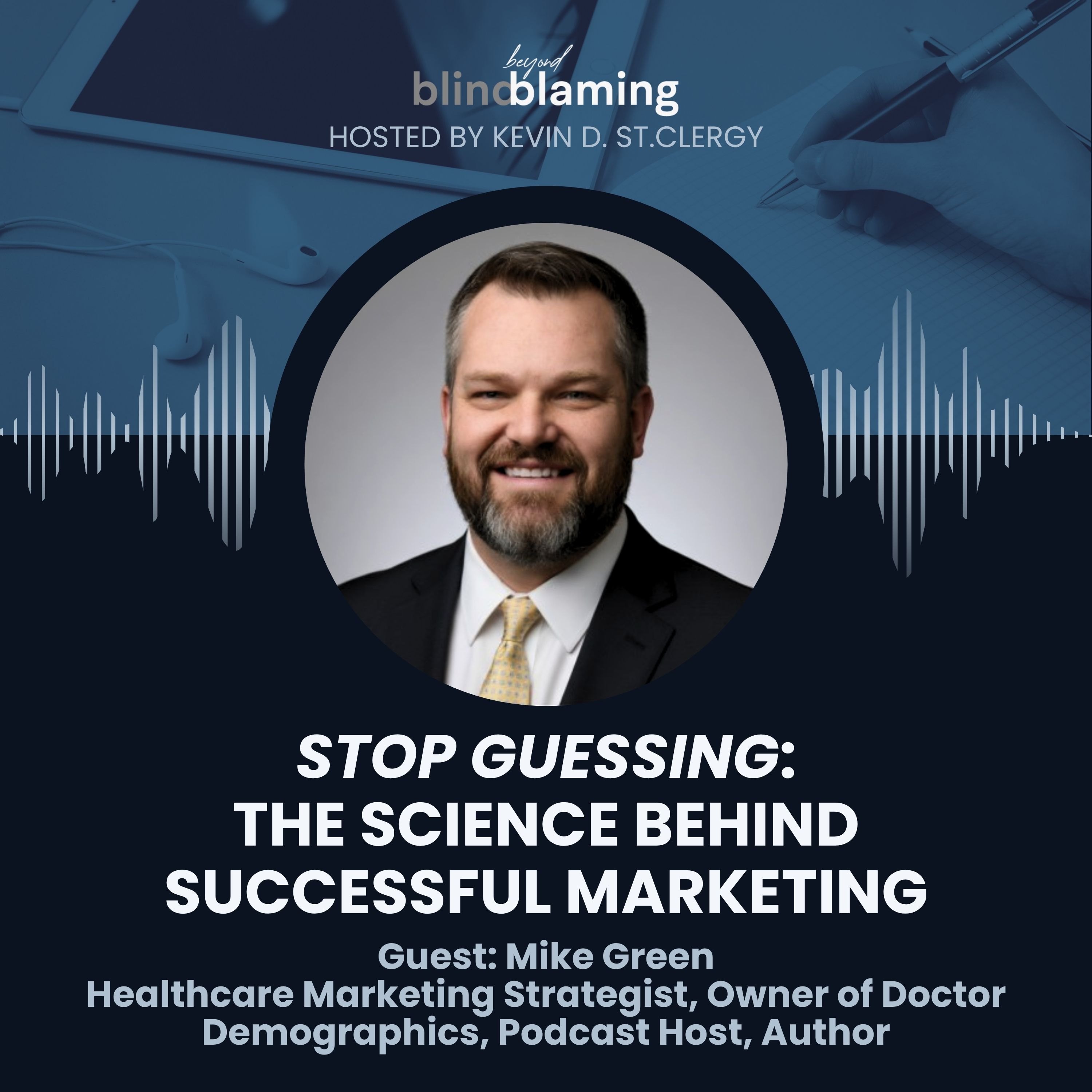
Beyond Blind Blaming
Data-Driven Practice Success, Demographics, and Strategic Positioning | Mike Green
00:26:51
Loading summary
Transcript39 lines
- [00:00]
A
I've always believed that marketing is a science. It's not just a, you know, I hope this work and I hope that works and I'm going to throw all this against the wall. I've always believed that there is a particular equation for every practice, every business, every anyone that's trying to communicate a message. There is an equation that they just need to find that's going to create consistent results. And so I always tell our doctors that if your marketing's not putting in a nickel and getting back a dime, then probably something wrong.
- [00:30]
B
Today I'm joined by Mike Green. Mike is the owner of Dr. Demographics and a seasoned healthcare strategist with over 30 years of experience helping doctors and practice owners build thriving patient centered businesses. He specializes in practice placement, demographics and psychographics using data driven insights to help healthcare entrepreneurs identify the right location, attract the right patients and create long term success. Over the course of his career, Mike has conducted more than 10,000 market studies, transforming complex data into practical strategies that help practices not just compete, but excel.
- [01:04]
A
I think that psychographics transcends just marketing. I think that if a doctor really wants to have a or not just a doctor, any business, frankly, if they want to have a long term relationship with the community that they're going to serve and they ignore the psychographics, I think there's some risk there that there's going to be a conflict between who they need to market to and themselves.
- [01:40]
B
Welcome to Beyond Blind Blaming. This is the place where we explore how easily hidden truths can hold us back, trapping us in cycles of frustration and blame, often without even realizing what's truly stopping us. Each week I'm joined by experts and professionals who share their journey of taking back control of their lives, overcoming hidden challenges, and discover how to stop blind blaming from dictating their outcomes. The insights you're about to gain will help you see beyond your current limitations, find the courage to seek new perspectives, and ultimately live a life that's both purposeful and powerful. So if you're ready to break free from blind blaming and discover what's possible, you'll definitely want to listen to my next guest. I'm your host, Kevin St. Clergy and today I'm joined by Mike Green. Mike is the owner of Dr. Demographics and a seasoned healthcare strategist with over 30 years of experience helping doctors and practice owners build thriving patient centered businesses. He specializes in practice placement, demographics and psychographics using data driven insights to help healthcare entrepreneurs identify the right location, attract the right patients and create long term success over the Course of his career, Mike has conducted more than 10,000 market studies, transforming complex data into practical strategies that help practices not just compete, but excel. Through his work, Mike helps professional practices move from guesswork and uncertainty into clear strategic decisions that drive growth, profitability, and stronger community connections. Mike, welcome to the show.
- [03:05]
A
Yeah, it's good to be here, Kevin. Thanks for inviting me.
- [03:07]
B
Well, let's start with your journey. What led you into the world of demographics and helping practices make sense?
- [03:13]
A
It's so funny because I was just at a family reunion a week ago and you know, everybody's kind of mixing and mingling and we've got all my nieces and nephews and, you know, different extended parts of the family. And there wasn't a single person there that knew exactly what it is that I do. Matter of fact, they told me that they think I must work for the government or the mafia or something like that because nobody could really define what it is. What is it that Uncle Mike actually does for work. I don't even think my own mom knows exactly what I do. So my, my path is really kind of interesting. I kind of fell into a marketing role for a big master planned golf course community in southern Utah. And so think Del Webb think, you know, these big, you know, on the golf carts. Retirees. 55 plus. Right when I got into my working stage of my life as an adult, kind of fell into that job and worked there for 10 years. The project was really pretty small when I started and really kind of cut my teeth in marketing in that position. And so we were very successful and I learned a ton about age based marketing and being really funneled in on a particular demographic. Anyways, so 10 years doing that, then bounced around different marketing companies and my own thing and old clients and you know how that is where you just kind of, you're just kind of raising a family at the same time and all the things and so about, I would say, Gosh, 13 years ago I happened to bump into the grandfather of demographics when it comes to practices and, and for him specifically dental practices. So he worked for the California Dental association and he back in the 70s and 80s, before it was even really legal to, to market your practice. And so when that became legal, like in early 80s, I think he invented this niche of demographics and why that was important for practice owners and especially with these, the at the time of boom of new dental offices in not only California, but across the country, deciding where they were going to be based on a demographic profile that then they could set their practice up and Be successful. And so he really wrote the book literally on practice demographics and why that's important to a practice owner. And so had done that for about 20 years. I happened to bump into him. We hit it off really, really well. He wanted to add some marketing IQ to what it was that he was doing that turned into a fantastic partnership. Several years ago, he. He decided to be a grandpa full time. And so he, he retired and I purchased the company from him. But that's what led me kind of to this particular niche in demographics. And it fit me really well because I, I've always believed that marketing is a science. It's not just a. You know, I hope this work and I hope that works. And I'm going to throw all this against the wall. I've always believed that there is a particular equation for every practice, every business, anyone that's trying to communicate a message, there is an equation that they just need to find that's going to create consistent results. And so I always tell our doctors that if your marketing's not putting in a nickel and getting back a dime, then probably something wrong. And so, so we bring demographics to that equation. Say, hey, take all this data, take this demographics, take this psychographic information, give it to your marketing company or give it to your marketing coordinator who, whatever it is, and build a campaign based around that. So that was a really long answer to your, to your question, Kevin.
- [07:11]
B
So it was great. I'll never forget that. Psychographics just blow me away because we, I was in a meeting years ago with my buddy Ron, and, you know, the company was selling us on how they can pull psychographics and the industry we were at the time, and, and Ron and I just kept hammering these guys and he's like, listen, if I can tell you what kind of beer you have in your refrigerator, will you shut up and let me finish? And we started laughing. It was a great inner pattern interrupt. And we, we started laughing. We're like, okay, yeah, we'll leave you alone. And he looks, yeah, he's like, what's your address, Kevin? I give him my address. He's like, okay, look, you probably have Amstel lighter Miller Light in your fridge. You probably drive a GMC Yukon or something similar. You're more likely to own a boat or like boats. And I stopped and I was like, all right, I love Amstel Light. I just bought a brand new Tahoe and I just got back from the boat show and I'm thinking about buying a boat. How the hell do you know that? And they nailed Ron too. Ron. They're like, you're probably, your religion is this. And yeah, you probably drive one of these and your net worth is probably here. And he's like, oh my God. Okay, well, shut up now. You know.
- [08:08]
A
So, yeah, it's, it's incredible. And I, I am fascinated with the world of psychographics. I, from a marketer standpoint, it's the silver bullet in my opinion. You know, everybody wants to know what is the thing that I can do. And it's very rarely some marketing technique because that's commoditized. Everyone is doing that or every. Or there's going to be a lot of people that are going to be doing the same thing. But if you can dial in on a psychographic level and really understand who that target person is, whether that is a potential patient or an existing patient that you're trying to build a relationship with, if you can understand them on that level now, everything becomes scientific. Everything now has a potential equation that's going to reach a result that you want. And, and oftentimes. And it's really interesting in the world of demographics, I have a lot of doctors who aren't in practice yet, or maybe they're an associate somewhere and they will say, hey, I, I want to open an office in this town and this is kind of what I like, what I want. We'll run the report. And it's demographically might be perfect, but psychographically does not match what they want.
- [09:24]
B
Interesting.
- [09:25]
A
And so I get to tell them, and I think it's a great opportunity that I get to tell them, hey, this is not the right place for you because you are going to be disappointed and you're going to hate your life in 20 years when you're driving to work every day and you're like, I can't stand working with these people another day because psychographically it doesn't match who you are. And so I think that psychographics transcends just marketing. I think that if a doctor really wants to have a, or not just a doctor, any business, frankly, if they want to have a long term relationship with the community that they're going to serve and they ignore the psychographics, I think there's some risk there that there's going to be a conflict between who they need to market to and themselves or maybe the staff that they hire in themselves. And so I think that it's a pretty fascinating field. And in the world of business and certainly the world of marketing, it's a extremely overlooked indicator that they should be really educated on. Yeah.
- [10:26]
B
And I think it's interesting, too, because tell me if I'm wrong, and I know this applies to not just doctors, but any business. My dad always used to say, location, location, location, son. That was his big thing. But he used to work with one of his biggest customers was Goodyear, and he would always get excited when they'd open up a new location. But he always met with the people and the demographic studies that they did in the psychographics towards the end. He's retired now, but I always remember talking about location, location, location. But you don't just go into an area and open up an office or a location because nobody else is there.
- [10:58]
A
You.
- [10:58]
B
You do the research first. And I've seen a lot of practice owners who are struggling that go open up a practice because nobody's there, and they think they can get in and do their thing. But I think the important thing to note is that there's probably a reason why nobody's there. It's not necessarily an underserved market that they don't do that research. Talk about the dangers if they don't do the research. You just mentioned one thing, but anything else you want to add to that?
- [11:21]
A
I always tell them when they're a business owner and they're. They're wanting to market a practice, they do have to be somewhat agnostic or they have to approach it agnostically in that they do need the market to drive you, want the market to tell you what they want. Right. And then that business, that practice, whatever, then curates their products in a way and presents their products in a way that matches what the client wants. Most practice owners that I know don't have deep enough pockets to change the public in what they want. You know, that's. We're going to leave that to Elon and we'll leave that to, you know, Jeff Bezos or whatever. We'll let them do that. But most practice owners, they don't have that capacity or the time to do that. And so it's really interesting when we get a practice owner, here's an example, had a doctor just the other day that was coming from Pakistan. English, definitely not his first language. And he was going to a relatively small town in the heartland of America. And we needed to be really honest with him of what the challenges were. But there were huge opportunities, too. Like, if he could. If he could present his practice in a way that matched what the people wanted, he had a really high likelihood of being successful. But if he went into a Market and just did the same thing every other dentist or doctor does. He's going to struggle. Right. Because he'll have a hard time connecting with the people. They'll worry when they see his picture, oh, I'm not going to be able to communicate with this doctor or whatever it is, which was a shame because it's a great guy, you know, super, super guy, and wanted to be successful. And, And I, I'm also, like, I'm a. I'm a marketer salesperson at heart. And so I do believe that any practice it put in, in almost any situation, if they have the right data, if they have the right understanding of the psychographics, they can find a way to be successful with the right campaigns, with the right approach. But it's when they go just based on location, like what you were saying, or just based on even the demographics, that's when they're going to run into the problem.
- [13:27]
B
Interesting. So, well, that probably leads to the whole concept that we teach in our, in my book and my coaching programs and then on this podcast was blind blaming. So in healthcare practices, blind blaming often shows up as blaming. They don't normally blame the location. They'll blame competition, insurance companies, and just because I used to own a digital marketing agency, the next. Usually the first person they blame when things are slow is their marketing company.
- [13:50]
A
Yeah.
- [13:51]
B
And where do you see owners misdiagnosing their real challenges?
- [13:54]
A
Yeah, I think that a lot of is internal. A lot of it is themselves. I mean, to be honest with you, like, I think that, you know, one of the things that they don't do or is often overlooked is they don't truly survey the patients well enough to understand exactly what's going on. And so they'll get so wrapped up in the marketing and the new patients through the door every single month and not be tracking the retention. And how many times they've seen that patient in the past, that's actually the indicator they need to be watching a lot more than how many new patients are getting through the door at the first part. And usually the retention numbers is really telling a really important story. And did they have someone rude to them at the front desk? Did they not feel like they connected with the doctor in this way or that way? Was there a paperwork problem? Was there a billing problem? Was there something like that that happened internally? That may not be enough for them to write a nasty review on Google about, but is enough for them to go find another provider. And doctors will often, like you say, first one to go is a marketing company, they're easy to cut, like they're easy to blame. But also it does have a. I was just thinking of this doctor that called me and he was going to move location, like what you were saying. And the reality was location was not the problem and the other offices he was looking at were not going to solve the core issue that I love that you talk about in your book, that the thing that was actually causing the problem that everybody was overlooking and that location piece was going to cost them so much money and so much time to recoup the cost of moving the office from one spot to the, to the other, when in reality is he just needed to fire his front, front desk person because she was a nightmare. That was the truth of it. And he was too afraid to do that. And so he was going to lose, what, a couple million dollars over the course of several years because he wouldn't face that one problem. So it's, it's a tragedy, but it is an area that a lot of practice owners certainly overlooked.
- [15:53]
B
Okay, and so you've talked a lot about the role of data and how it plays into building a successful practice. Have you ever seen people misuse it or completely misunderstand it?
- [16:05]
A
Yeah, I think a lot of business owners will get data just to get their loan. They'll get their business loan, practice loan, whatever, then they'll totally disregard it. That happens, I think a lot. I'm pretty passionate about this stuff. And so when we do a marketing study or, or an in depth demographic study of an area, I'll lay in it out for them exactly what they need to do. And then we'll do our follow up six months, a year later. And they haven't followed any of that advice. Even though we've done 10,000 of these over the last 30 plus years. You'll have that new doctor that just got out of school and is like, yeah, we'll do it the way that grandpa did it always and expect to be successful. And so that I would say, happens a lot. The other thing that happens a lot, Kevin, is there are areas of this country that are changing so quickly that if you have demographic data when you first open your business or your practice five years ago and you live in Austin, Texas, or you live in Jacksonville, Florida, or Raleigh, North Carolina, those numbers are probably going to look drastically different today. And you might be living off of your existing patients, your existing clients, clients that you have, but at some point, somebody younger, faster, maybe deeper pockets than you is going to move in. That's going to understand that new market better, and then you're going to do a slow death march until you change as a business owner. And so I would say that's the other thing is not staying updated on their demographic and psychographic numbers. We usually say every other year is a good rate to stay updated on.
- [17:41]
B
And so by the way, slow death march, it made me laugh. So, yeah, that's, that's a great comment. Every other year, huh? So that's interesting. So they, let's say they do the demographics and psychographics every other year. How do they use that new data? What if they're, I mean, so what I'm hearing you say is it's not always about just the location. I heard you mention how demographics and psychographics plan to the marketing. So can you give an example of when somebody did another analysis two or three years later or whatever, and what changes did they need to make based on that data? I would love to hear an example.
- [18:12]
A
Yeah, so, so one of the really interesting that we all lived through was the COVID time. And the COVID time changed so many areas pretty dramatically. And one thing that it did, I would say the year or two after the primary Covid time, so we're talking 2022, 2023. Ish. We started to see a lot of practices moving out of the areas that were the most restrictive. And so New York City was one of them, that Chicago was another, that they basically told these, these doctors, hey, you can't open your practice. And that was devastating, obviously, for so many business owners. And so what we saw was this massive influx of business or doctors, practice owners leaving some of those states and moving to areas, so different areas of the country. And so north Atlanta, for example, rapidly grew with, with new practices that were coming out of New York, New York state, moving to that area. And so, so that changed the dynamic, the competition dynamic, the population makeup, the psychographic makeup of those areas, and changed it not only for the doctors that were moving from New York, but also changed it for the doctors that were already in north Atlanta. And so they needed to change the way that they were doing business and to change the way that they were marketing based on that new data. Now we also see that another good example is back when Katrina took out New Orleans, when that happened, Houston got a massive influx of population because they moved a lot of people from New Orleans to Houston. And so those, a lot of those neighborhoods almost overnight had a massive change demographically that the ones that were prepared on top of those numbers, they, they capitalized. And the Ones that weren't, that just stayed the way that they always did it, were not able to capitalize on that new influx of population. And the same thing is, is to be said about the practices in New Orleans, because as much as had an influx in Houston, New Orleans had a change demographically, a rapid way. And so across the, across the lake, some of those practices thrived because they made a change, because they knew economically the population was going to be different. Their new people moving to the area was going to be very different. And they built their marketing practices based on that new data. One practice, specifically, I shouldn't say their name, but they dominated because they were on top of the numbers, they were on top of the demographics. They were, they were ready for the change and they made the adjustments they needed to, to capitalize.
- [20:59]
B
I love it. Great example. Well, what's one actionable step a practice owner can take today to better understand their market, improve their positioning?
- [21:06]
A
Yeah, so I always say the, the very best thing for an existing office to do is to look at who they already have. I think that's always the first step. And that's the marketer in me. Right when I, when I have a new business that comes to me and say, hey, I need help, I always say, who do you already have? Right before we talk about who, who you can go get, which is, you know, a conversation for, for the next day. But the first conversation is who you already have. And so if you're a, if you're a doctor and you're in an area that is, is growing and, and economically doing well, and so you have new competition moving to town and you're finding your numbers are on a downturn, One of the first things that you should do is look at your existing patients, look at that retention number, look at the age range of those of those people. Did you establish a lot of them 10 years ago, which means now they're 10 years older, which means maybe the population of their family is different, their values are probably different. Get a really good understanding of your existing patients first and then move to, okay, now what are my opportunities locally? What are my competition doing or what are they not doing? What are the gaps there that I can now fill with my greater knowledge of the population in this town? Does that make sense?
- [22:21]
B
It makes perfect sense. Yeah. And I love it. So you've been doing this for several decades. What do you think or what have you learned about the connection between strategy, mindset and long term success?
- [22:31]
A
I, you know, Kevin, I think it's, I think it's everything. I think especially, and I'm talking a lot, private practices, I know that your, your reach is much broader than that with regular business owners, with, with beyond blind blaming. But in my experience working very, very closely with professional practice owners, dental, audiology, veterinary, anything that's private practice, they're in a highly commoditized industry, meaning that the dentist around the corner does the same thing, that the five next dentists probably do the same services for the most part. And so if they don't approach every single day very strategically when it comes to their acquisition practices, their, their marketing strategies, even the way that they deal, hire and fire with their staff, if they're not acting in a very strategic way, somebody is going to come in, if they haven't already, and beat them to the punch. And so as a practice owner, they do have to put down the clinician hat for a minute and they have to put on the business owner hat. They have to put on that agnostic marketer hat and be able to look at things objectively and say, okay, what are my true opportunities here? Or where are we really missing out as a practice? Where are we weak and where can we strengthen that and be humble enough, I guess, is the right way to say, where do I need help? What type of a consultant do I need to add to my executive team? Is that a marketing person? Is that a. A better financial person? Whatever it is to help me make these better decisions and help me see things more objectively than what I can inside the forest, if that makes sense.
- [24:15]
B
It does. Well, Mike, this has been amazing. There's one question I like to usually end with every guest, and that's simply, you've clearly learned to invest in yourself. What are your favorite ways to do that? Is it reading? Podcast masterminds, Coaching? How do you like to invest in yourself?
- [24:30]
A
Yeah, I'm a data nerd, Kevin. So I consume data like it's a breakfast cereal. And in my industry, and especially now with AI and how much data is actionable that we can get so quickly, I'm in a constant consumption phase of as much data as I can, and it fascinates me. I love to see how communities are changing. I love to see what different sectors of the population are doing and then with my marketing strategy, mind putting that together of how we can help practice owners be more successful in it. And so my investment time in myself is to make sure that I'm staying as sharp as I can in what the latest trends are, the latest data to help my clients be successful.
- [25:18]
B
I love it. Now, do you work with only medical practices, or have you done some stuff outside of the medical industry?
- [25:24]
A
No, I mean, data is data. Right. And so my brand, my name is definitely known in the professional practice space, but I've got clients in all sectors of business. Because, again, understanding people on a psychographic level, that certainly is not just relevant for a doctor. That's relevant for a service worker, a franchise owner. I mean, anybody that services a client is where is where they can use my services.
- [25:54]
B
I love it. And if they want to get in touch with you, how do they get in touch?
- [25:56]
A
Yeah. Best way to go, just go to Dr. Demographics.com. that's Dr. Spelled out. Email me at mike Dr.Demographics.com. happy to have a conversation with them.
- [26:05]
B
Awesome. All right, buddy. Well, thanks for being here. Awesome information. Stuff that we ignore often. And I think my favorite line that you said is, people use this to get a loan, and then they ignored it, which kind of scared the heck out of me. So great message. Great, great time together. I'm sure we could spend more time, but we're at the top of the hour where I need to go.
- [26:22]
A
Perfect. All right.
- [26:23]
B
Anything else you want to leave the audience with?
- [26:25]
A
Nope. I look forward to. If anybody has. If this perplexes people that they don't understand, it's data, data, data. Let's have a conversation. We can lay it out pretty simply.
- [26:34]
B
Awesome. Well, thanks for being here, man. Amazing information. Appreciate it very much.
- [26:37]
A
You bet. Sam.