← Beyond Blind Blaming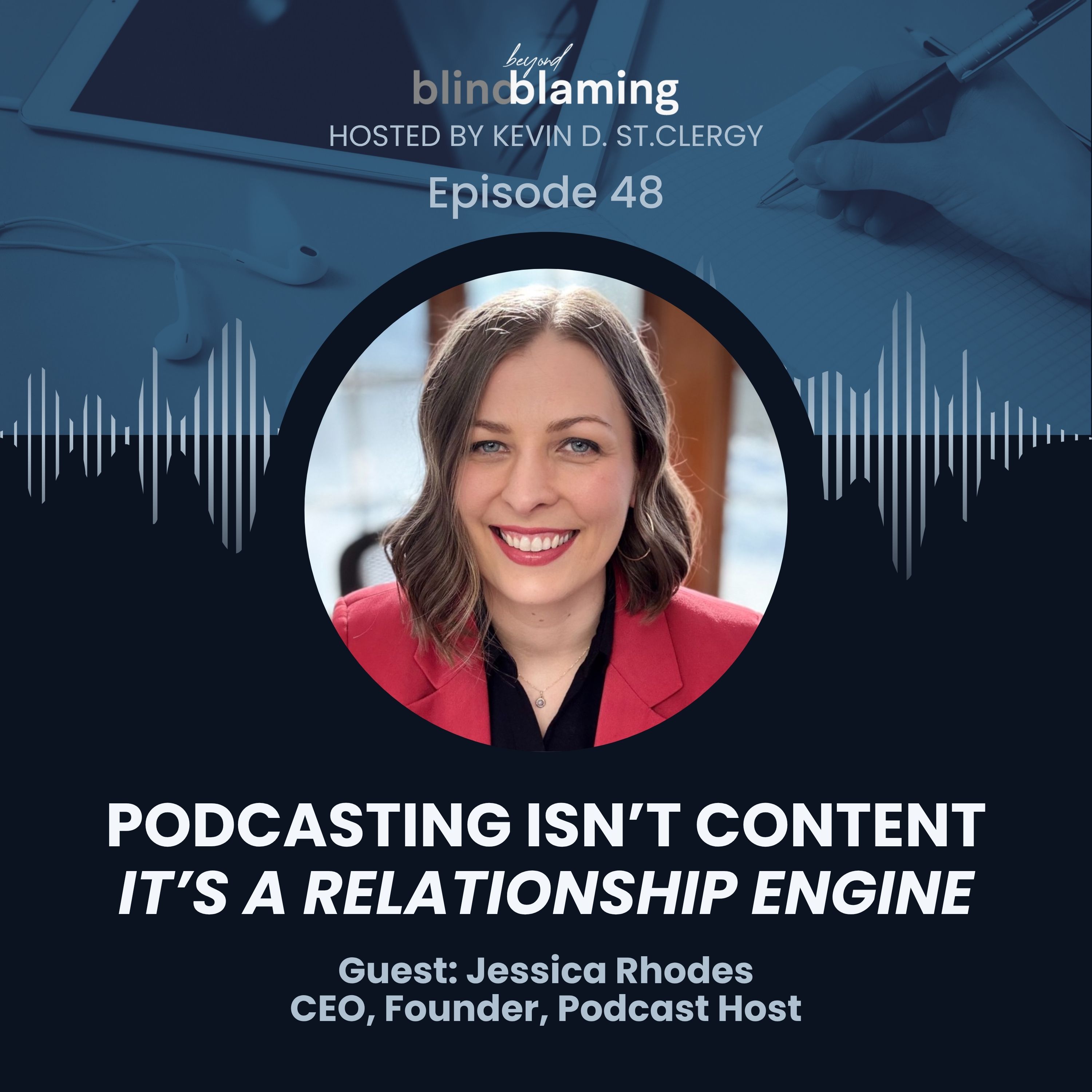
Beyond Blind Blaming
From Invisible to Influential – Visibility Strategies for Entrepreneurs | Jessica Rhodes
00:30:49
Loading summary
Transcript79 lines
- [00:00]
A
The ego gets in our way and we just don't want to take responsibility for our results. And I think that's what gets that's the downfall of so many business owners is just pointing the finger, blind, blaming and not just taking responsibility for the results.
- [00:14]
B
Today I'm joined by Jessica Rhodes. Jessica is the founder and CEO of Interview Connections, the world's first and leading podcast booking agency, helping entrepreneurs, authors and experts leverage podcast guesting as a powerful strategy for authority building and revenue growth. With a background in virtual assistance and online business operations, Jessica built Interview Connections from the ground up into a multimillion dollar agency serving clients across industries. She's helped thousands of thought leaders clarify their message, expand their reach, and turn podcast interviews into tangible business results.
- [00:47]
A
If you have a bucket with a lot of holes in it and you don't have any sales closing and you're like, I just need more water in the bucket. I need that visibility. I need to go get in front of new audiences. But there's all these holes, which is your pricing and your positioning and your sales process. Your if all these holes are there, it doesn't matter how much water you put in the bucket, it's always going to run dry.
- [01:22]
B
Welcome to Beyond Blind Blaming. This is the place where we explore how easily hidden truths can hold us back, trapping us in cycles of frustration and blame, often without even realizing what's truly stopping us. Each week, I'm joined by experts and professionals who share their journey of taking back control of their story, overcoming hidden challenges, and stopping blind blame from dictating their outcomes. The insights you're about to gain will help you see beyond your current limitations, find the courage to seek new perspectives, and ultimately live a life that's both purposeful and powerful. So if you're ready to break free from blind blending and discover what's possible, you'll definitely want to listen to my next guest. I'm your host, Kevin St. Clergy, and today I'm joined by Jessica Rhodes. Jessica is the founder and CEO of Interview Connections, the world's first and leading podcast booking agency, helping entrepreneurs, authors and experts leverage podcast guesting as a powerful strategy for authority building and revenue growth. With a background in virtual assistance and online business operations, Jessica built Interview Connections from the ground up into a multimillion dollar agency serving clients across industries. She's helped thousands of thought leaders clarify their message, expand their reach, and turn podcast interviews into tangible business results. She's deeply passionate about visibility, leadership, and helping entrepreneurs show up confidently in conversations that matter through her own agency, her own Podcast her speaking. She teaches that podcast guesting isn't just about exposure. It's about positioning, messaging and strategic relationship building. Beyond building a successful agency, Jessica is also a leader in creating sustainable team culture, transparent operations and scalable service based businesses. She believes that authority is built through consistency, clarity and courage. Jessica, welcome to the show.
- [03:06]
A
Thanks for having me, Kevin.
- [03:09]
B
Well, let's start with your journey. What led you to create Interview Connections and what gap did you see in the podcasting and marketing world?
- [03:16]
A
So I started my business because I very simple. I wanted to be a stay at home mom. It was my son will actually be 13 years old tomorrow as as we're recording this. And so coming up on my 13th anniversary in business and I really just wanted to be a stay at home mom. I had had a background in nonprofit organizing and community door to door work and when I got pregnant wanted to be a stay at home mom. So got some advice from my dad, who was my first business coach. His name is Jim Palmer and he told me about starting a virtual assistant business. So, so that's how I got my start. My dad was my first client and after I was booking him on podcasts as a guest and finding guests for his podcast, I got bit by the entrepreneurial bug and wanted to create a business model that was a bit more scalable because I was just billing by the hour as a freelance virtual assistant. And my dad helped me see this opportunity for offering podcasts booking and podcast placement to more clients at with packages versus charging by the hour. And that's how I got my start because nobody else was offering that service. PR firms weren't booking on podcasts. Nobody had founded a podcast booking agency. So I started Interview Connections and we were the first.
- [04:32]
B
Awesome. I love it. And I know your dad, which was wild when we first met. And then I was like, your dad's freaking Jim Palmer. I can't believe it. So small world.
- [04:40]
A
Yeah, that was, that was crazy that
- [04:42]
B
you knew my dad well before you launched Interview Connections. Let's spend some time on the virtual assistant stuff. How did that early experience shape the systems and leadership style that you use today?
- [04:52]
A
I mean, it's shaped me because at the core, so my, you know, incorporated name and what my virtual assistant business name was was Entrepreneur Support Services. I've always loved supporting entrepreneurs and it really shaped me because it taught me like to look for what business owners need. One of the best pieces of advice that I got early on from my dad was to follow the money. And really what he meant by that was to look for what business owners need, what is in demand, what are people willing to pay for? And so that's what led me to then turning my virtual assistant business into a podcast booking agency is because I was offering a variety of different services as a va. I was helping with social media management. I like took a course on Pinterest. I learned how to design infographics. Like, I would just do anything that my clients needed and always kind of responding to what was in most demand. Where were they getting the most value and then adapting the business to that. I think so many entrepreneurs will just start a business doing what they want and then they're like, why aren't people buying this? It's like, well, did you figure out if people actually want it, are they getting a return on investment from this? So that's kind of how it shaped me is like always keeping my finger on the pulse of what do my clients need, what are they getting value from? What's in demand?
- [06:08]
B
I love it. And I'm assuming, well, I know that you use VAs yourself. How important do you think it is for most entrepreneurs to use a va? Because I talk to a lot of them, they don't even think about the assistance that they need to hire. And I think that's probably one of the first hires that I would recommend people make if they're a solopreneur. Any thoughts around that?
- [06:26]
A
Oh, for sure. So my first hire was a VA as well. And she was actually way more experienced in business than I was. She was a virtual assistant in the US And I needed somebody that could help me with like organizing everything. Because a lot of us entrepreneurs, you know, we're visionaries, we've got big ideas. But then when it comes down to it, you know, my first va, she would help me get set up in a project management software and like get everything organized. Like, that's why VAs are so, so important. I have a team of local employees and I have a team of virtual assistants because there are so many administrative tasks that just fall through the cracks. If you don't have a VA or, you know, an executive assistant, it could be somebody in your, in your in house team. But having people with administrative skill sets is so important and I love it because I'm also a doer and that's one of my biggest skills. And you know, it's a, it's a big plus for me. But it also means that at times I will just go do something that I could have my VA do for far less money than it would cost. Like me to do in my time. So it can really help an entrepreneur grow faster by delegating the things that they really shouldn't be doing.
- [07:42]
B
Well, sometimes you don't give yourself enough credit. So when we started working together, I was amazed at how much you do do things, but I was also amazed at how well you use a va. So congrats.
- [07:52]
A
Yes, I, well, it's, it's been a work in progress. I think working with you for the listeners maybe that don't know I'm your client, working with you definitely forced me to uplevel and be really mindful about what I'm spending my time on and what tasks and initiatives are going to move the needle.
- [08:11]
B
I love it. Well, thank you. Well, you see many entrepreneurs, especially the coaches, consultants, authors that you work with, say things like marketing doesn't work. Oh, the algorithms change. No one's paying attention. Where do you see blind blaming show up? Mostly invisibility and authority building.
- [08:28]
A
I mean, what you're saying right there is just confirmation bias. I see it all the time because I'm, you know, do one on one discovery calls, you know, probably 50 to 100amonth, depending on the month. And I talk to so many business owners and entrepreneurs and whatever you believe is happening, you can find someone to confirm that belief. So they're like, social media doesn't work, or, you know, the algorithm is horrible, or this pod, you know, whatever they want to say, they'll find people, people that can confirm that. So I find that happening all the time. And people just want to, they want to be right and they don't want to be the reason that they're not doing well. And so it's so much easier to say podcast gusting doesn't work because the shows aren't big enough, or social media doesn't work because the algorithm is bad. Like it's so much easier to say that than podcast guests doesn't Podcast guessing didn't work for me because my stories weren't compelling enough or my call to action wasn't good enough, or, you know, social media didn't work for me because I don't know how to create content that makes people stop scrolling and read and watch. Like it's easier to just blame it on the things that we can't control
- [09:35]
B
or God forbid, they're a bad speaker and they're not really good at it. They've never been trained how to do a podcast correctly or speak professionally in a public setting.
- [09:44]
A
Exactly. It's. It takes the ego gets in our way and we just don't want to take responsibility for our results. And I think that's what gets. That's the downfall of so many business owners is just pointing the finger, blind, blaming, and not just taking responsibility for the results.
- [10:01]
B
Well, you must be psychic, because you kind of already answered my next question, which was, you know, when people say podcast guesting didn't work for them, and I know you run into them, are there any other hidden obstacles or misconceptions that you uncover? We went over a few just now, but is there anything we didn't talk about?
- [10:16]
A
Yes. Okay, so first, it might not work because of, you know, your speaking skills, your ability to tell stories that are compelling and connect with the listeners emotionally. But the other reason it might not work is because you might be blind blaming what is actually holding your business growth back. You know, when I meet with entrepreneurs who are interested in getting on podcasts and I do a true discovery, where I figure out, like, is this what they actually need? A lot of the times they don't need more visibility. They don't need to be on podcasts right now. They need to work on their pricing. They need to figure out who their ideal client is. They need to figure out, you know, they need to have a website and a conversion funnel that actually works on a consistent basis. If you have a bucket with a lot of holes in it and you don't have any sales closing, and you're like, I just need more water in the bucket. I need that visibility. I need to go get in front of new audiences. But there's all these holes, which is your pricing and your positioning and your sales process. Your mark. If all these holes are there, it doesn't matter how much water you put in the bucket, it's always going to run dry.
- [11:25]
B
Great. Love the analogy. It's funny how great minds think a lot because they use the holes in the bucket all the time. Gotta plug the holes in the bucket.
- [11:32]
A
Yeah, my dad would always talk about that.
- [11:35]
B
Yeah, well, we don't steal. We ethically swipe and redeploy when we've heard other people saying it. Or what I always like to say is, the secret to originality is not revealing your sources.
- [11:43]
A
Oh, I don't know who came up with the bucket analogy. I just go with it.
- [11:48]
B
Yeah, that's fine. Well, some people blame. I see a lot of business owners who blame lack of exposure for slow growth. In your experience, how often is the real issue clarity of message rather than lack of opportunity? Or like you did for me on my first Podcast is you don't just throw people out there and book them, you give them feedback. And you found out that I would had too many calls to action at the end of my podcast that you and one of your team members listen to.
- [12:14]
A
Yeah. So I don't know if I can truly answer the question of how often it is one thing or the other. You know, it's different for every business owner. But, you know, getting to the root cause of why you're not growing is so important, and that's why it's important to audit the whole process. So that when you are getting on podcasts, it's not just saying, okay, I'm on podcasts now, is it working? But it's looking at what is the call to action and what is it and how are you delivering it, and the host that you're connecting with and how you're building relationships with them and the stories that you're sharing. Because if all of that is being executed flawlessly and you're still not seeing the growth, then you definitely want to look at, like, go underneath the hood of your business and look at the landing page that you're sending people to. And are people going, are they converting? Are you nurturing them? I mean, business has so many different KPIs and metrics and leading indicators that you can't just write off an entire strategy or an entire initiative without doing a lot of diagnosis and auditing. Which is why I track all of my numbers. And I firmly believe in having a spreadsheet for, like, every aspect of your
- [13:24]
B
business, which, you know, you are the spreadsheet queen. But it's impressive because a lot of times I see owners where they think it's one problem ends up being something else, but really the root cause is lack of information.
- [13:36]
A
Yes.
- [13:36]
B
They don't have enough information on their business. You don't have that problem, Jessica.
- [13:40]
A
No.
- [13:41]
B
You are a tracking queen, king, whatever you want to go by. But you're amazing with how you track things. I mean, every time I ask you for something, you have it within, like, five minutes at the most.
- [13:50]
A
Well, and I've learned that that is the greatest way for me to get rid of any anxiety around business stuff is just clarity, because a problem you can see is better than a problem you can't. So if I'm ever stressed about business stuff, I just actually look at the numbers, because numbers don't lie. Just tell you the truth with no emotion, and that's can really help you come up with a good plan.
- [14:16]
B
I like that. And similar to there's no such thing as failure, only results.
- [14:21]
A
Wins and learns.
- [14:22]
B
Yep, wins and learns. Well, when people are trying to judge the success of. Of podcast guesting, which is what you do, how do you suggest they measure that success? Do you have a few that you like or is it different for each person?
- [14:35]
A
I do think it's different for each person because it does depend on what your goals are and what. What success looks like to you. Obviously, for a lot of people, it's how many leads, how many clients am I getting from podcast guesting? For a lot of coaches, that is the metric that they are looking for. And it's important to give it enough time for enough interviews to be published for the people to listen. Because as a podcast host myself, when I look at the downloads on episodes that I'm publishing, it probably takes a good six to eight weeks for the majority of my listeners to download and listen to the episode. Not everyone's going to listen the minute you put the episode out, so you have to give it enough time. But I also have clients that they're not looking for leads from their podcast interviews. And that seems like, wait, what? Why. Why wouldn't you be looking for leads and clients? But this may be a way, you know, I've. I have an executive coach client, and he's like, I have a wait list. Like, I'm full. I don't have a scalable group program. I work with people one on one. But I do podcast casting so that I always have people following me that when maybe a client ends their contract, there's always somebody ready to go in the wing. So it's just building up that pipeline. So for them, it's not about how many new clients am I signing up, but it's just about growth. It's about having a lot of content, building up your authority footprint online, having better SEO. I mean, there's so many different metrics that you can look at to see how you're growing.
- [15:54]
B
And I think that's something you help everyone with. Right. If they're a little lost in the beginning, it's something you can help them with, get a bit more clear.
- [15:59]
A
Exactly. Yeah. To see it from all sides, see all of the possible ways that you can grow through podcast. Guessing it's not just a one thing. It could be. You know, I've had. Had people that will hire the podcast host that interviewed them as their coach, and like, that's now an investment you're making. But ultimately that connection is helping you grow your business in other ways. So it's it's helpful to look at it from all sides.
- [16:21]
B
I love it. Well, you built a company centered around strategic guesting, not just random appearances. So talk to us about that. What does that mean?
- [16:28]
A
So a lot of coaches will just do podcast guesting with whatever podcaster happens to reach out to them on LinkedIn, which is all the time now that people are hosting a podcast just to do prospecting, you know, they'll, they'll start a podcast and they'll just reach out to people who, they look like a great client. I'll just say, hey, do you want to come on my podcast? And so a lot of people think, oh, I'm just doing podcast guesting with whoever asks me. And I end up doing a couple every month and they're kind of checking that box of like, I'm consistently podcast guesting. But it's not strategic if you are not actually clear on what you're being interviewed about, the types of shows you're going on, really vetting each appearance, analyzing your success as a podcast guest by listening back to the interviews, looking at the results, being intentional about where you're sending the listeners, having a plan around how you're networking with the host. So if you're just responding to incoming requests, you might get a handful of interviews every couple of months. But when you're really strategic and you're choosing the podcast and being intentional about how you're leveraging the interviews once they go live, that's when real predictable growth happens in your visibility, in your brand, in your confidence. Because when you're getting interview consistently on really great shows, your confidence grows because you're being interviewed about different topics, you're building relationships. It's so much different. It's like being proactive versus just being reactive. We, we want to be proactive.
- [17:49]
B
Cool. I love it.
- [17:50]
A
Yeah.
- [17:50]
B
Well, you also talk about podcast casting as relationship building, how important is follow up and long term strategy and making it truly effective.
- [17:58]
A
Podcast hosts are not going to remember you if you don't keep in touch with them. I mean, a weekly podcast there, that host is interviewing a minimum of 52 people a year, most of them probably double that. So they always have at least one episode in the can, so to speak. And so think about 100, 150 guests per year, they're not going to remember every single person. But if you want to be someone that stands out, that is top of mind when they have another guest say, hey, do you know anyone that does what you do? You want to be top of mind. So staying in touch. Doing things like sending a thank you card in the mail, which is something I know you talk a lot about because it's the one marketing that has a hundred percent open rate and people get that handwritten note. I've got my handwritten note from Kevin right here on my desk. So, you know, doing things that really make the host remember you promoting the episode, that's huge. I always see a direct correlation between guests that promote their episode and guests that don't in terms of the downloads and how many people are listening to their episodes. So yeah, I'll land the plane there because I could keep rambling about.
- [19:06]
B
No, that's okay. We got plenty of time. So you're good. I like what you're talking about.
- [19:10]
A
Yeah. Yeah.
- [19:11]
B
Well, you've scaled your service based agency successfully. What has been the biggest pivot or unexpected lesson in growing Interview Connections? Because you're where a lot. You are actually where a lot of people want to be.
- [19:21]
A
Yeah. And I'm thankful to have a business coach in you that reminds me of that because sometimes when you're in the trenches, I'm like, ah, I can only see the problems in what I'm working on. Working on. And, and I don't know if you've read the book the Gap and the Gain, I don't know if we've talked about that. But you know, the gap is just like, okay, where you want to be versus where you are now. But it's so good to look back at, you know, where you've been and where you are now. So, yes, the gain, I mean, the biggest is really a recent change. Several recent changes that you have coached me through, which is, number one, switching our service from selling packages with long term contracts to a monthly membership model. And, and it was all kind of divine timing when I signed up for your private coaching because I had already known I wanted to do this go. I used to do monthly memberships back when I first started Interview Connections. And so eight years after making the change to packages, I knew I wanted to do this and then we connected and I'm like, oh my gosh. Like you, you did that in your agency. Like, this is perfect. So you've coached me through that and that's been a huge, I mean, it's been incredible. It's really increased the number of people signing up. It's helped improve our, our client experience. I mean, I could talk for hours on all of the changes there alone. And then the second thing is that I eliminated the sales position in Interview Connections. I've been trying to build a sales team for six years. And I just said to. I'm going to be interviewed on. On this. On another sale, on a sales podcast. And I said to them over email, I was like, I've tried to build a sales team for six years, and I've essentially failed at doing that. But I realized it's not that I failed, but that I learned there was a misalignment in what I'm selling and how we work with clients and the idea of commissioning somebody to sign up clients and giving somebody a commission for closing sales. Because ultimately I want to bring on clients that I know we can help, which means there are potential clients that I will turn away. Even if they want to sign up. I will say, we're not right for you. Like, you don't need this. I think you need something else. Or we're not the right fit. So changing my approach to sales has been recent and really, really positive in terms of, like, the alignment and the energy within the company.
- [21:51]
B
Well, I still remember how you were a little. You were fighting me a little bit on the change.
- [21:55]
A
Oh, for sure.
- [21:55]
B
Another sales process. Kevin. Oh, my God. Seriously?
- [21:58]
A
Yes. When Kevin told me this on our first coaching call back in December, and he talked to me about changing the sales process, I just started crying. That was like the tipping point. Because there was so much stress. Like, again, six. Six years of just trying and failing and trying and failing. And then to have him be like, have you tried a new sales? And I'm just like, I'm gonna punch you in the face right now. If we weren't on Zoom. But ultimately, you were right.
- [22:24]
B
Sometimes I'm right. Sometimes I'm funny too. So. But yeah, I. And I'm really happy with the results you're getting. Congratulations. Because sharing what you did this morning, where you at compared to last. The first quarter of last year? You should again, you gotta catch yourself. Not just catch other people doing things right, but you have to catch yourself doing things right, too. So you deserve a little pat on the back and a smile.
- [22:44]
A
Thank you. When I. It's funny. Cause it's like, I work, as many of us do. I work from home. I'm in my office alone, and I see a sale come through, or I recognize growth and metrics, and I literally sit here and go, yay. Like, to myself.
- [22:57]
B
Well, what I've enjoyed watching Jessica just is just your shift and your mindset of being excited when you tell somebody no.
- [23:06]
A
Yeah.
- [23:06]
B
Because you know you can't make a difference for them. And I think that's a. That's something I think all entrepreneurs can learn something about is when you get to the point where you're like, look, I really need to focus on the people that I can help so that I have a higher success rate over time. And it's just about playing the long game. And you've definitely done that. So congratulations on that, because I love it when you call me like, yep, I had another one that just wasn't a good fit. And we're gonna put them on a program that can help them get ready to start using our program.
- [23:32]
A
Yeah. And it's been really great working with you and coming up with those different offers and, you know, referring people to your assessment and finding ways to still help people. Because it was always hard to say to somebody who wasn't right for our done for you service to just be like, like, good luck. Like, I just send them away and they're like, but I loved your masterclass and I love your emails, and I want you to help me. And so coming up with ways that we can still help them in a way that's affordable and that makes sense for them has been really fun, too.
- [24:02]
B
It's great. I love it.
- [24:03]
A
Yeah.
- [24:04]
B
Well, I think the other thing is you recognize that you don't have time to work with people and they're not going to get results. They just suck the time out of you. You can't help them, and then they get upset, and we don't want to kind of lower that. Exactly. Anyway, kudos to you for that.
- [24:17]
A
Thank you.
- [24:18]
B
What advice would you give entrepreneurs who feel invisible in their industry, but they have something valuable to share?
- [24:24]
A
You've gotta start getting visible. I mean, number one, just get really clear on what your expertise is and start talking about it. So for some people, just going from I feel invisible to being this leading authority feels like a really big jump. So I want to just give, like, a couple of actionable steps. I mean, number one, I think it helps. For me, what has really helped is just to start writing and posting, because I know social media is, you know, that's not the only thing, but it is the first place that we all have access to for free is to start using our social media and to start posting. And I say that, number one, because step two is then getting visible on other people's platforms. Right. Getting on other people's podcasts, having your content shared in front of other people's audiences. But before you have the right to be on somebody else's platform, you have to have Your own platform. You know, you have to show that you are educating your own audience, and then you can take what you're, you know, what you're talking about on your platform to somebody else's. So start by posting consistently. It's a basic piece of advice, but so many coaches, I'll audit their social media and they haven't posted in a week or two weeks or it's just they're not. You got to break through the creative rut and start getting your content out there. And then it'll make it so much easier for you to be positioned as an expert to people who have a platform that you can share on.
- [25:43]
B
I love it. And how important do you think video is in their overall strategy for all businesses, not just the ones you work with?
- [25:49]
A
Oh, it's incredibly important. Every type of medium is important. You need to be. You need to have video so people can see you and they can hear you speak. You need to be writing because not everyone is going to watch a video. Not everyone's going to listen to a podcast. And you've got to be leveraging podcasting. People want to consume content in all different ways. So if you only do the one way that you like to consume, you're going to lose out on a whole bunch of other people.
- [26:13]
B
Yeah. I had a coach tell me one time I went back to writing my own social posts. I had somebody, two people over the last couple weeks said, hey, who's doing your social stuff? Because I want to hire them. And I'm like, me, you can't hire me to write your social. Outsource it. Yeah, I'm not doing. I'm not doing an agency, a marketing agency again. Well, first of all, I can't because my note competes, but second, just, I like the coaching better, but if you write your social media yourself, then have AI clean it up, I think you're going to get a lot better results because the coach told me, you know, if you're still using AI to write your social media posts, you deserve 100% of the results you're not getting. And it really hit home. It was like a gut punch for me. So I went back to writing myself, and guess what? We went from like 6,000 followers to 13,000. And now we're launching a video strategy finally.
- [26:57]
A
Yeah. And I want to give a tip to your audience if they're struggling with it. And I've been talking about this on my platform, too. I have a podcast coming out about it. Start reading more. If you are struggling to write social posts, A lot of us don't. A lot of people don't read anymore. And I speak from experience because I really just over the last year started reading a lot more and I read fiction, I read novels, and I just wrote a great memoir. And reading stories really helps you become a better writer because you, you spend hours upon hours reading a book in the world of somebody who knows how to write stories. And then you can take, you know, you can kind of learn to write in a way that is compelling and is captivating and that is what makes people want to consume. Your social media content is how to be captivating and compelling. So I would really challenge everyone to start reading. If you like to just watch TV and scroll, pick up a book, get a Kindle and challenge yourself to read more, it will make you a better content creator.
- [27:53]
B
Great advice. So is there any other ways that. I mean, you've clearly. This one. My favorite question I ask every guest is to end the show, but you've clearly invested in yourself. Jessica, what are your favorite ways to do that? You mentioned reading, but what else? What are some other things that you enjoy doing to invest in yourself, business wise?
- [28:10]
A
So I'll give two answers if that's okay. So number one, I'll fluff your feathers, which is hire a business coach. And you're my business coach. I really do think it's important as an entrepreneur, always have a coach or sometimes I've been in seasons where like a mastermind is what I need because I just need to keep sailing through with what I've already learned one on one. But having a coach will fast track your results. So I was gonna say so much faster. It'll fast track your results. Okay, so have a business coach. Don't try to figure it all out on your. Find somebody who has been or is where you want to be. That's one thing I realized. I've worked with coaches and I've realized that I don't want to be where they are. Maybe their lifestyle or what they've built is not what I want. So while I like some things about them, I'm like, this isn't right. But the fact that you had an exited a business with a very similar model, I'm like, perfect. You know, that's. It's been really, really helpful. So having a coach and this second answer, it's not directly business related, but I couldn't go like weather the storms of entrepreneurship without it. It's daily nervous system training. So it's just having daily practices. I mean, you know, the day after I cried with you on a coaching call, I came in much better because I had taken a cold shower, you know, done my cold plunge. Like taking like processing your stress, like decompressing after the day, all of us, like a lot of us will go to sleep with that stress built up in our body. Like finding ways to decompress, get it out. I love that you do treadmill time. Like mo. Your body really, really helps. So just taking care of your body, you have to do that if you're going to sustain and grow in business.
- [29:50]
B
Awesome. Well, Jessica, thank you for being on the show. Wealth of information. Can you if somebody wants to get in touch with you and they're interested in podcast casting or attending some of the events that you do, what's the best way for them to get in touch?
- [30:01]
A
My home base on the web is interviewconnections.com so I'd highly recommend going there. From there, you can listen to our podcast or book a discovery call with me. So interviewconnections.com great.
- [30:14]
B
We'll put that in the show notes. Anything else you want to leave the audience with before we close it up?
- [30:19]
A
Take action. Be a doer. If you're not working with Kevin yet, go hire Kevin as your coach.
- [30:24]
B
You're really sweet. Thank you for the promotion, but yeah, I appreciate it very much. Okay, Jessica. Well, Papa have you on the show again. You were wonderful. You gave some great advice, and I can't wait to talk again.
- [30:34]
A
Thanks, Kevin.
- [30:35]
B
Have a great day.
- [30:35]
A
Bye. Sa.