Loading summary
Transcript84 lines
- [00:00]
A
So my identity, you know, was always kind of wrapped up in this idea of, I'm a musician, I want to be a music teacher. I want this to be what I am. And I wrapped my dream and my identity together, which I think is a very dangerous thing to do.
- [00:18]
B
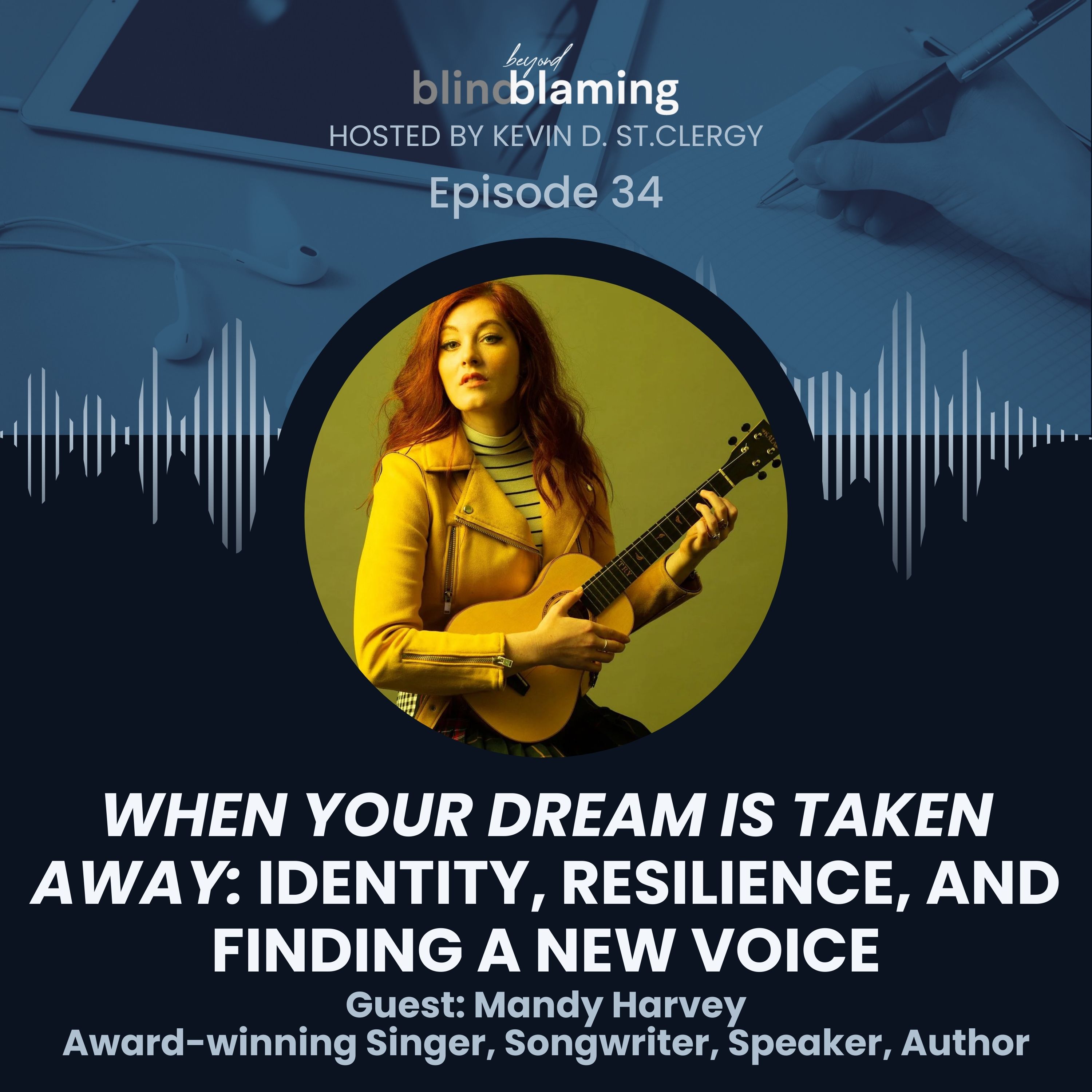
Today I'm joined by Mandy Harvey. Mandy's a singer, songwriter, author, and motivational speaker who captivated the world with her incredible talent. An inspirational story. After losing her hearing at the age of 18 due to a connective tissue disorder, Mandy refused to let her dreams fade. She rediscovered her love for music, using muscle memory, visual tuners, and vibrations to perform extraordinary beauty and precision. She gained national recognition after her golden Buzzer performance on America's Got Talent, moving millions with her song Try, which became an anthem of perseverance.
- [00:51]
A
Because of my stubbornness, I think for me, falling down, all the way down and having to climb back up tiny bits at a time is kind of what I really needed to learn, you know, how to really embrace the fluidity of my life.
- [01:21]
B
Welcome to Beyond Blind Blaming. This is the place where we explore how easily hidden truths can hold us back, trapping us in cycles of frustration and blame, often without even realizing what's truly stopping us. Each week, I'm joined by experts and professionals who share their journey of taking back control of their story, overcoming hidden challenges, and stopping blind blaming from dictating their outcomes. The insights you're about to gain will help you see beyond your current limitations, find the courage to seek new perspectives, and ultimately live a life that's both purposeful and powerful. So if you're ready to break free from blind blaming and discover what's possible, you'll definitely want to listen to my next guest. I'm your host, Kevin Saint Clergy, and today I'm joined by Mandy Harvey. Mandy's a singer, songwriter, author, and motivational speaker who captivated the world with her incredible talent and inspirational story. After losing her hearing at the age of 18 due to a connective tissue disorder, Mandy refused to let her dreams fade. She rediscovered her love for music, using muscle memory, visual tuners and vibrations to perform extraordinary beauty and precision. She gained national recognition after her golden Buzzer performance on America's Got Talent, moving millions with her song Try, which became an anthem of perseverance. Her journey from losing her hearing to becoming an internationally recognized artist shows that limitations exist only if we let them. Her superpower is turning obstacles into opportunities, showing people how to embrace adversity, find their voice, and never, ever give up on their dreams. Mandy, welcome to the show.
- [02:53]
A
Well, thank you so much for having me. It's a. It's a real joy.
- [02:56]
B
Well, I. I read your book to prepare for the call today and the show, and I loved it. And we'll get to that in a minute. But your story is one of incredible resilience. And can you take us back to the moment you realized you were losing your hearing and. And how that impact your identity as a musician and just a more about yourself, if you would too?
- [03:15]
A
Yeah, I mean, I think just to set it up a little bit. When I was growing up, I'd always had issues with my hearing. So it's been something, I think my first surgery, I was about nine months old. So it's been a constant problem. And when I was really young, my mom saw that I was being very withdrawn socially, and so she put me in a choir class at church just to try to get me involved with humans. And it was this kind of moment of realization that the words were there printed in black and white and that I could be a part of a team and actually know what was going to be said instead of having to lip read and guess. And that got me really excited about being a part of community and having that be my dream. So my identity, you know, was always kind of wrapped up in this idea of, I'm a musician, I want to be a music teacher, I want this to be what I am. And I wrapped my dream and my identity together, which I think is a very dangerous thing to do. But you know, you learn from your mistakes. When I went to college, I had my dream and my reality meet, which was amazing. And you feel this like rush of calm at an anxious person. I'm never calm, but I felt like this is what I'm supposed do. And it took about a month in for me to really register that I was having an extreme difficulty understanding my teachers. It was the first time that you're independent. I'm not being monitored by anybody. Ever since I was a young kid, all the way through high school, I was in the spit zone, the first seat right next to the teacher. And now I get to choose my chair. And there's classrooms with 300 people. And I would sit in the middle, not in the back. I'm not crazy, but I'd sit in the middle. And then I had to get closer and closer and closer and closer. And it just didn't help. And that became the oh, this will be okay. I maybe I perforated in your drum. I might be sick, but I went to the audiologist because I don't mess around. And I had lost about 40 decibels of sound in both ears in what felt like over the course of a month. But because as a hard of hearing person who relies on lip reading and stuff like that, it's hard to really say when it started. Their best guess is that it started the end of my high school year and that it was kind of ramping up due to all the surgeries that I was having. Cause I dislocated my leg because I have EDS and so my body started to fight against itself. So it was a very weird and in very intense nine months from going from hard of hearing, slightly hard of hearing, to profoundly deaf in a very foul swoop. And like I said, wrapping your dreams around your entire identity. I didn't just lose my dream. I lost all sense of purpose, all sense of self, and had to find a way to rebuild myself from the ground up. And I wished that I had somebody in my life that would have said, you know, you have a lot more value and a lot more worth than just one dream the way that you thought it was going to go, you know, But.
- [06:43]
B
Well, you talk about it in your book. It's actually one of the questions I had. So I'm glad you brought it up.
- [06:48]
A
Yeah.
- [06:49]
B
Because I loved what you said in the FAQs about not confusing your dream with your identity. And I loved it so much because I see a lot of people who come to me after they read the book and I know you just got through the introduction, but I would welcome any comments from you because I loved your book so much of what you think of what we're doing. Because we try to help people get to the root cause. And we've actually discovered some people that tie their career and their identity together. And when the career is not working out, it's just, it's bone crushing or soul crushing is a better word to use for them.
- [07:19]
A
Well, and I think also that we're kind of lost in this remnants of cancel culture where you have this idea that if you do one thing wrong that your life is over. And that's a very silly thing to say because you can be in the darkest hole of despair and still be a positive light for other people. You know, even if you don't see it for yourself, the things that you can accomplish and the things that you can do in your brokenness is actually quite astonishing. And to say that your value is only one small aspect of who you are, I mean, you know, I. I lost my hearing at 18, at 18 years old, you only barely know who you are at all anyway. You know, like, I talk to my mother and she's in her 60s and she feels like she has an idea of who she is, but she still is learning about herself on a daily basis. My grandfather is 90 years old and he's still discovering things about himself. So it's like you're. You're on this ever look flowing journey of, of learning what you're capable of and pushing those boundaries. And if you handicap yourself into saying that I am limited, that's all you're ever going to be.
- [08:35]
B
Was that what it took? Was that like the turning point for you to pursue music again? I mean, a lot of people might have seen that what happened to you as an ending, but you turned it into a new beginning. Talk us through that or did you?
- [08:46]
A
It's difficult. I think it was kind of a mix, you know, to, to go based off of your book. You know, I had a lot of people blind, blaming me on saying, hey, buck up, you know, like, why can't you do this? You know, you should be over it by now. Why can't you see the happiness? You know, like, you know, it's all in your head, you know, just find a way. And it's really. It's really difficult because nobody really knew why. And there, there is nothing that I could have done differently that would have stopped the progression of my hearing loss. So there wasn't anybody to blame. You know, it wasn't like I got hit in the head with a flying ball and, and it knocked. It knocked me. And now I have something that I can be mad at. It's like the only thing I can be mad at is just me. Like my, my body detached itself. And I think because of my stubbornness, I think for me, falling down all the way down and having to climb back up tiny bits at a time is kind of what I really needed to learn, you know, how to really embrace the fluidity of my life. You know, having eds, I don't know how the day is going to go. I don't know how I'm going to wake up. I don't know what challenges I'm going to face. And as I get older, that's. That's not going to improve. You know, there's so many different challenges that I face and I will face. And having been knocked down the way that I was, I feel like I'm more prepared to kind of go with the flow, you know, and find beauty in what I have at the moment, you know, Like I'm breathing on my own. I woke up this morning, you know, I remember when that was the only thing I could think of that was a positive for my day. But I held on to the small things and then with time, became really infatuated with how beautiful those small things and really realizing how massive they actually are. And I think the biggest thing that helped me to kind of pull myself out of the funk and find a way forward was that I was surrounded by really amazing people who lent me hope when I didn't have any. And even though I wasn't ready to hold on to their hands, they constantly reached out for mine. And I knew that they were there even though I wasn't ready to grab hold. You know, like, I was never really alone. And I think I needed to know that even with my faith, like, I knew that I wasn't alone. And I think that that was the biggest thing for me.
- [11:38]
B
That's great. A lot of people don't have that, too, so it's really good to hear that you had that. Well, you talked about something else I enjoyed. I mean, it's. I will say your book triggered me a few times with some things that happened to me. Sorry, nothing. No, in a good way. Just things that I've gone through. We've all gone through so stuff in our lives. Most human beings, I think we all go through stuff. And you just from grad school, from the deaf community. You know, sometimes audiologists aren't well liked because we're taking away their culture. That's what I meant by triggering just some.
- [12:08]
A
Oh, yeah.
- [12:09]
B
Some previous memories of what I went through in grad school. But I loved your chapter on dream thieves because I see a lot of times where people try to steal people's dreams and knock them down. Any advice you have for the listeners about dream thieves and how to deal.
- [12:25]
A
With them, and, you know, it's a funny thing because you don't think it's going to happen to you until it does. And there's this feeling that you get even when you are actively pursuing your own dream and you're putting in the work and you're moving forward, that you don't always even feel like you're deserving of what's going on. So you almost feel like you're stealing it from somebody else. I think the most important part about pursuing your dreams at all is understanding that it's going to be one small step of failure at a time. You're, you know, you're just going to be bouncing off of barrier Walls that you have to knock down and, and to keep going by tiny little bit at a time. And if it's truly important to you, and if it's something that has deep merit and worth, then all of the rest of that stuff isn't going to matter. You know, people can try to steal your dream, people can put you down, people can shove you over and run over your corpse is what it's going to feel like. But you know, you're the difference of whether or not you stay on the floor or get back up. If you make the decision that they don't know me, the only person who knows what I'm capable of is me and I barely know myself. I'm going to surprise myself on a daily basis, hold on to that and get back off the floor even though you don't know it's going to work out, try again even if you fail and enjoy the process of learning. Because every single person who had become huge barriers to me taught me something and made me a much more vigilant person, much more empathetic person, much more caring and thoughtful person. And I work really hard to not be that person for others. And so, you know, in, in some way send a small thanks to the dream thieves because they're, they're making you stronger if you let them.
- [14:32]
B
I love it. I've just never heard it phrased that way before and I, I loved it. So I might have to ethically swipe and redeploy that one, but I loved it. Well, you also said playing it safe is the biggest risk of all. Talk to us about that.
- [14:46]
A
Well, you only have about, you know, like a limited amount of time. And as, as you get older, you start to understand the frailty of time. And so, you know, allowing yourself to just hold yourself back in. Playing it safe when there is no playing it safe, if you want to accomplish anything, it's a risk. You know, moving out of your parents house and getting your own apartment is a risk. You know, going to the grocery store, that's a risk. You know, like you're making small risks on a daily basis every time you get into your car. You know, like if it's worth it to you to put yourself out there in order to accomplish those things, then going slowly, you know, isn't necessarily the way to go. I'm not saying like, okay, I'm going to sell everything that I have and I'm going to move to Bermuda. You know what, it works for some people at least when you're really in the thick of it and you have no other options. You work really, really hard to protect yourself. Like, you will find ways to scrap it together and make it work. I can't tell you how many times I made promises of things and I had no idea how to do them. And then because I said yes, I had to figure it out. And because I had that pressure, I got it done. You know, it's amazing how you kind of buckle down and go for it when you're. When you're under the gun. Like, sometimes that's what you need. You need that fear, you need that pressure so that you just don't stay complacent and lethargic with your dream.
- [16:22]
B
I love it, but it sounds like. I mean, have you run into people that get too focused on their failures instead of some of the things they've succeeded at?
- [16:29]
A
Of course. I mean, I've done it myself. I think everybody has. You know, it's like I. I've had. I've had my share of pity parties. You know, like, I already. I have like a whole home setup for on. You know, like, oh, this. This is my pity party room and all of my pity party dreams that didn't work out. And here are all the pity party things that I could have accomplished that I ran out of time for. You know, it's all. It's all crap, you know, and it's not beneficial in my viewpoint. I think that there is a lot of benefit of mourning the loss of things that didn't work out. I think that that's very healthy to say this didn't work out, man, that would have been nice, you know, and to allow that to have been something that you had a little moment for. But your moment can only last so long before it becomes detrimental to your health. You gotta let some of that stuff go.
- [17:26]
B
Well, I liked how you said you need to make a decision to get up and move forward again. In the book, we actually call it mfd, Making Effing Decision. Do Something Different. Move forward. So. And in that book, we talk about how often people misidentify the real obstacles in their lives, which you talked a little bit about how people were blaming you for something that was completely out of your control. What are some of the biggest misconceptions that you personally had to overcome, do you think? Mentioned a few.
- [17:54]
A
I feel like I smack into these walls so often they don't feel big anymore. They just feel normal. You know, I think at first, when I was first performing, I think some of the larger barriers that I was hitting was that I was still trying to find ways to learn who I was and love myself, and I was being denied access by a large pool of who I knew in the deaf community at first. You know, it's a large spectrum of people like any other community. And so because I was a person who grew up in the hearing community, I automatically didn't gel with some of the capital D deaf people of that specific community because they said that I'm never going to be deaf enough to ever understand. And I understand that. I'm not trying to absorb and assimilate your full culture that I will never understand fully, you know, however, my barriers are still real, and now I'm on an island by myself. I'm not being accepted by the hearing community because I can't communicate with them. Like, even in this podcast, I have captions that are running across, and I'm trying desperately hard not to, like, let the tail end of your sentences, like, and me start and be like, cut over you. You know, like, I have to work harder just to blend in if I want to blend in and to have access. And at the same time, at that time, I didn't have the deaf community, so I was just kind of on an island alone. And that was very difficult to understand, that I could just be pushed out on all sides and just left to kind of my own devices. With time, I found that so many people in the deaf community felt like they were on an island by themselves. You know, everybody kind of feels that way, and that's a failing of communication, you know, where there is no perfect ideal when it comes to having a difference or a disability, there's not a better version. You know, we're all having a very individualized experience, and that was something that I had to really come to grips with. Say my experience is going to be different than maybe anybody else's. I might meet somebody later who has gone through something that I've gone through, but I might just be. This might just be my experience. And then on the other side of that, when I started to be successful, I started to get people who were trying to dream thief my life. You know, it's like, oh, well, you're too good at what you do, so you must be lying. Or on the other side of it, you're using your disability for pity so that you can make money off of being broken.
- [21:06]
B
Oh, wow.
- [21:07]
A
I mean, I've never pitied myself, you know, as far as, like, that, ever. I have pity parties of the sadness of how my life didn't work out. But I've never looked at myself and said, I'm going to use my brokenness for monetary gain. Like, ugh. Like people can be so harsh when you're doing something that they either don't understand or, and, or they want. It's kind of a weird mix.
- [21:40]
B
Well, and if I remember in your book you did state that you started to recognize when things like that happen that it's normally because that person has something that they need to work on themselves. It has nothing to do with you. And that's their way of dealing with it.
- [21:54]
A
Yeah, it's what I say to when I talk to students. I talk to students in schools all over the world. And a lot of the questions that I get asked is about cyberbullying because, you know, I deal with it a lot. And how do you deal with that? And it's understanding that this person has brokenness that they are struggling to deal with and that's the, the reason why they would put themselves in a position to be this gross. You know, they're hurting and they need to make you hurt or they're going to try to. They don't have the ability to. Only you can allow it to happen. So you can either absorb what they're saying or ignore it. Unfortunately.
- [22:39]
B
That's good though. It's good advice to ignore because if you don't, if you can, it's hard. I mean, I'm starting to get it. The more I get out there with this new book and the self help industry and I'm a little shocked at some of the feedback I get on my YouTube videos and things like that. I'm like, wow, you took time out of your day to say something like that. How about and my mom always taught me to be nice and be kind.
- [23:01]
A
Yeah.
- [23:02]
B
And I don't know where that law. Somewhere I got lost. So I hear you.
- [23:07]
A
Yeah, well. And I know, I know some people who are just like, they had a really bad day and then they yelled at somebody at a grocery store like, oh, I feel better. I was like, that made you feel better? Like there's something wrong with your heart. If hurting somebody else's heart for a moment so that they can come down to your sad level makes you feel better. Like that's, that's silly and crazy to my brain. But you know, it happens more often than we want to admit.
- [23:34]
B
Well, have you ever caught yourself blaming something where you found out it was something completely different or someone?
- [23:40]
A
I mean, I've been mad at things. I don't, I'm a Very like independent person. I've always been very much a look at things on both sides. Like even, you know, even with the brokennesses of my, my ex relationships. Like I can easily say is like, okay, this person did this and this person did this and this person did. But my body and my brain doesn't allow me to do that. It. It's so Spock analytical that I'm just like, yes, but I could have done more of this. I could have done this and I could have done this and I could have done this. You know, like, I've always been very. Even when it comes to trying to understand a person from where they are, to give them some sort of grace in the situation and then getting to a point where I can say, okay, I forgive you, I feel for you and you may be right, but I don't have to accept it. You may be right and walk away. You may be wrong, but I'm not going to say that to your face because it's not going to do anything. Arguing with an argumentative person does nothing. So I just kind of.
- [24:55]
B
Oh, sorry, I thought you were done. I had a peace. I had a guest on the show who did. He does really big fundraising for hungry people all over the world. And he made an interesting comment because he's had some pretty big wig, like presidents, world leaders in rooms who get really angry when somebody else is in the room and they get into an argument. And he said something I'll never forget. See what you think about. He says, do you want to win arguments or do you want to change the world? And I loved it. I was like, oh, that's so good. And that's something that I, I see all the time. People just love to argue and it's like, just stop and be nice.
- [25:33]
A
Yeah, well, and it's hard because a lot of people want to change the world. They just want to do it in only the way that they think is right.
- [25:39]
B
Great point.
- [25:40]
A
You know, compromise tends to be king. You know, it's a little bit you, it's a little bit me, you know.
- [25:47]
B
Well, tell me if I got your song Try right. It became a powerful message about overcoming adversity. And can you share what inspired you to write it and what it means to you today?
- [25:57]
A
Yeah, I actually was inspired to write it based off of a conversation I had with a friend of mine. His name's Eric Weinmeier. He's the first blind man to climb Mount Everest, which is incredible to think about that there's been more than one blind adventurer to summit Everest. But, I mean, I fell over this stool trying to get in this chair, you know. But he and I have been a part of a nonprofit organization called no Barriers. And he asked me one day, just point blank, he's like, why aren't you Write your own music? And I had never even thought about it. You know, I thought that people who write music, they just have this innate sense of self where it's just like, I am a songwriter, you know, and they're just. Just really good at it. And I never put myself in a position to even try that. And I. I said that I was scared. And, you know, in classic Eric form, he said, well, what's the worst that can happen? And I. I didn't have an answer for that because, I mean, in his job, death. Death is the worst that can happen. And it's not even that bad. Like, quick death would be fine. Like, there's a long laundry list of different ways to die that is worse than the other, you know? And so I went home and I sat on the floor, and the mantra of no barriers is, what's within you is stronger than what's in your way. And I was just trying to think to myself what is in my way. And as I was thinking about it, I came to the conclusion that it's me. It's always me. I mean, yeah, I have different disabilities, but they're a part of me that's not holding me back. I'm the one who says what I'm capable of, and I'm holding myself back. It's not the dream thieves. It's not the other people who tell you that you can't do something. They don't get to dictate what I can and cannot do. It's me. It's always been me holding myself back because I'm afraid to fail, so I don't try. And so I sat on the floor. I wrote the song in about 10 minutes. And I was just being honest. I was saying that I don't really know who I am anymore. I don't understand the day anymore. But I do know that I'm tired of letting my life just pass me by while I do nothing because I'm afraid. And if I could just get up and get out of my way, I think I could actually do something. And, yeah, I wrote it, and I never expected ever actually to play it. I was doing a gig, like, the next day at Dazzle in Denver, and I was playing music and in preparation for recording my album, all of Me, which all of those, the first three albums or my jazz albums are all live recorded. So our gig was like our band rehearsal, you know, and so we were towards the end of the night, and I told my saxophonist during our break, I was like, I wrote. I wrote a song. He's like, well, you should play it. And I was like, okay. And so I played it. And then when we got to the studio the next day, he was like, you should record it. It'll take five minutes. I was like, okay. Like, I never. These were never my ideas that were just me saying yes to other people to make them smile and then, you know, getting the opportunity to perform it on something like agt, that was. That was a weird and overwhelming experience and one that I'm very, very thankful for. But it all boiled down to, what's the worst that can happen? You know, even showing up, what's the worst that can happen? What's the worst that can happen? Until finally it hit me in the head. That's really negative. Constantly waiting for the shoe to drop. What's the best that can happen? What's the best that can happen in this moment? What's the best that can happen by putting myself out there? What's the best that can happen by writing a song? Maybe I can give words to not just me, but maybe somebody else's experience. Maybe we can find a way to connect and remind each other that we're not alone.
- [30:20]
B
Oh, I love that so much. My girlfriend, we've had many conversations like this as we debate. She loves horses, wants to do horses. But sometimes we get too focused on how it won't work instead of how it will work, and so love the advice. Well, speaking of that, there's a lot of people that do struggle with self doubt when it comes to pursuing their dreams, that they don't think they're worth it. Do you have any advice for somebody who feels like they've hit a dead end or they're not worth even trying?
- [30:47]
A
Well, I would. I would challenge you to. To maybe look at what your dream is and boil it down to its core. Like, what about your dream is what inspires you? Yes, with my. With my dream. My original dream was I want to be a music teacher. But when I boiled it down, like, what is it about being a music teacher that I really love? It was the community aspect of what I was doing. I wanted to give kids the opportunity to have the tools to express themselves and to not be alone and to be a part of a community. Do I have to do that? Only this Avenue, you know? Cause there's so many different ways to pursue your dream if you know what it is that you're actually inspired by. Even if you're inspired by music, I mean, there's so many different avenues of music, you know, that can cause immense joy. And for you to feel like you've not only accomplished your dream, but you've pushed yourself even further, you know? So I would challenge people to analyze and write out what is it exactly that makes you excited about your dream? What are the elements and the reasons why you're putting yourself in the position to fail over and over and over again, to pursue it and hold on to that, because the path that you're on is going to change. You're going to pivot a lot. It's going to get messy, it's going to get weird, and you're going to probably end up in a place that you never expected to go. But if you hold on to yourself, you know. And I would also say that you should develop a rope team. You know, Eric, he has these people when he's climbing a mountain, he's tethered to. These are your teammates. When you are going through life or going through any sort of dream or business, you should have some people who you can tether yourself to, somebody who's been where you want to go so you can learn from their experiences and to draw inspiration from someone who has skill sets that you struggle with so that you can improve upon yourself and to be inspired and uplifted by somebody who's doing something that you're not fully grasped on. Somebody who knows your core values deeply and will not allow you to falter. Change yourself in the pursuit of what you're trying to do and become somebody that you don't want to be. You know, these people who can celebrate with you as well as cry with you when you fail, and that you can give back to them the same that they're giving so that it's a shared, collective community effort. You think people are the biggest deciding factor between success and failure.
- [33:47]
B
I love it. Great advice. Well, you do motivational speaking too now, right? Do you remember your first time you did that? Because sometimes getting on stage is a little scary. You tell me, how was it and what got you into that?
- [34:00]
A
You know, when I was a kid, I used to vomit on people when I looked at them too directly in the eyes. So when I first started performing.
- [34:11]
B
Sorry.
- [34:12]
A
I'm serious.
- [34:13]
B
I know you are. Just like. I've never heard that one before, but.
- [34:16]
A
Keep going, keep going. No I was known as the puke girl through middle school and high school. Absolutely. Yeah. I would pass out. Yeah, I was a mess. I truly hated performing solo. I hated the attention, and it made me so uncomfortable. But that's why I. Like, in my brain, I was like, I'm never going to perform. I'm only going to teach. The most they'll ever see is my backside while I direct people. Who cares? But after losing my hearing, which was my biggest fear, I kind of fell into this idea of what's the what? What's what? More, more can they take from me? You know, I did. I did do the hard stuff. I did stuff like Toastmasters. I hate talking. And I started doing Toastmasters classes and put myself in a position where I was doing open mic nights and singing in front of strangers multiple days a week, every day, every week, you know, for no money, for the hopes that maybe I would get a $2 tip to be able to have gas money to get home, you know, nothing, nothing expected other than experience gained, you know, and just the abuse of being stressed out over and over and over again. I got to a place where I just stopped being afraid anymore. You know, I'm here and I'm singing, and I'm doing my best, and I work really, really hard, and I do something that I'm not entirely sure anybody else does it this way. So I'm giving you a look into something that I think is really quite amazing. And that's enough for me. If you don't like it, if I sing the wrong note, if I mess up, if I forget some lyrics, if, if, if, if, if. It doesn't matter I showed up. Most people just don't even show up. And I showed up. And for speaking, that never really hurt. For some reason, it just never really made me that afraid after I got to that point where I was okay to open my mouth and share with other people my experience because it's truly mine, and it's not feeling like I'm crafting this, like, crazy, weird TED Talk and. And everything. I'm just being myself and being very honest and having a. A conversation with my friends.
- [36:46]
B
I love it. Well, you've clearly also invested in yourself. What's your favorite way to do that? Is it podcasts? Reading? Do you have coaches, Mastermind groups, if you know what those are? Any advice there? Mastermind groups. Like, we have a mastermind group of medical professionals. We have a couple of different industries that we're at, and we have mastermind groups with leaders. A mastermind group is where you get a group of like minded individuals in a room and you share ideas.
- [37:16]
A
That's cool.
- [37:16]
B
And it's usually a paid room because in my opinion, people who pay pay attention and there's different levels of masterminds. If you get through my book, you'll learn a little bit more about what they are. But it's a great way to learn from other people. Like I could see you in a. It would be really cool to be in a mastermind group with one of my heroes, Dolly Parton. Feel free to make fun of me now because my girlfriend certainly does.
- [37:36]
A
Why? I love Dolly Parton.
- [37:37]
B
I do too. And if she comes anywhere close, we go see her. In fact, she. When you said that you were writing your own music, if I'm not mistaken, she writes every day for a moment.
- [37:47]
A
I write every day.
- [37:48]
B
So yeah, I love her.
- [37:50]
A
I would say that that's probably my jam is writing music and I love co writing. That would be kind of like a mini mastermind because I'm working on a project with other people and bouncing things off of each other. That's like a music mastermind. That's fun but it tends to go really fast and so it's just like, oh, and we're done. But I truly adore being creative and I think that when I'm not creative, I can feel a difference of my personality. I can feel myself degrading in some way, like not being honest to myself when I'm just not allowing some of that stuff to have time. You know, if I'm not writing or if I'm not creating or even, you know, like making up small songs. Like I just need like five minutes to be able to breathe and just to create something. Even just for five minutes. Yeah, I would feel a lot more like myself. And I can't tell you how many times throughout the day that I just randomly write crap. You know, it's just like a constant things. And thankfully I've got kids now. I've got two kids and my daughter is eight months and finally I have somebody in the house who doesn't mind me singing because my kids, my 3 year old son, he, he's like, it's, it's too loud. It's, it's not, it's, it's like I'll be like, it's too loud, it's too loud. I can't even sing around him at all. Like unless it's like the cleanup song. I make up songs for him and he likes those, but he doesn't always. It Depends on his mood.
- [39:40]
B
Well, they are rather blonde. We've got all day, every day. My girlfriend watches her four grandkids, so they're seven months old, one year old, seven month old, one year old, three and four, I think, because the ages. So they are very blunt. They very blunt. Kevin, I don't like you today. Okay, thanks.
- [40:02]
A
Yeah, it's amazing how hard. How hard that hurts, too, because it's like, I don't mind if a stranger is like, I don't like you today. Be like, okay. When it's the person I made, like, I'm like, okay, fine.
- [40:15]
B
I can't have children. So hearing this, I'm learning. I was like, the first time I was around young children, I said, these kids are bipolar. We have a major problem here. And everybody laughs at me. And they're like, kevin, that's just kids.
- [40:28]
A
I'm like, seriously? Inside? You're like, no, for sure.
- [40:31]
B
Like, for real, seriously. I'm absolutely crushed from what this kid said to me. And I get really bad comments online all the time, but this has destroyed me. Yeah, they're funny.
- [40:40]
A
I told my husband the other day, I was like, you realize your son is very, very smart and very charismatic and very, very cheeky. If he was a different lifestyle, he could become a serial killer. Michael. Because we watch a lot of it. Like, he would be like, one of the good ones, you know, like, he's too smart, he's too cheeky, and he's really charismatic. So I was just like, thank goodness. Like, he's in a good, safe environment with no, like, deep traumatic experiences. Because, man, I would be afraid because some of the things that he says, you're just like, no, that's. That's. Yeah, absolutely.
- [41:23]
B
Figured it out. Well, I think we're watching TV shows that we like, so. Good to know.
- [41:28]
A
Yeah.
- [41:30]
B
Well, if people want to get in touch with you about. Wrap it up. Unless you have anything you want to leave the audience with. I'd like to. If they want to hire you for keynote speech or get in touch with you about what you do.
- [41:40]
A
Yeah.
- [41:41]
B
What's the best way for them to get a hold of you?
- [41:43]
A
I would love for them to get a hold of me. I love. I love speaking. It's one of my favorite things to do. So I'm. I am an artist with UTA, so they can always look up with UTA, but they can email me@mandyharvey.mhemail.com I'm on Instagram and Facebook and all of the platforms and stuff like that. You can find me Pretty easily. It's either Mandy Harvey or Mandy Harvey Music, and I'm always working on new music. I'm probably going to put together a new Kickstarter for a new album soon. So what this one I want to do is called for your. For me. And what I want to do is I want to interview people and have their stories or their moments or their emotion be the inspiration for different songs, and to have the whole album be a collection of stories from the community and have it be a gift to you guys. So if you're wanting to back me on that, even if you're not wanting me to interview you, send me a hello, because I'd love help independent artist over here working hard.
- [43:01]
B
Yeah, but you're doing great things and you're helping a lot of people.
- [43:03]
A
I try.
- [43:05]
B
I mean, and I loved your book. So if there's anybody that's having a bad day or a bad week and you don't have the money to buy your book, I will buy it for them.
- [43:12]
A
I will happily find a copy and send it to you. Yeah, great.
- [43:16]
B
Same. So. Well, Mandy, thank you so much for being here. It means a lot as an audiologist just to have somebody that's battled hearing loss, because I know what you're going through. My brother's had hearing loss his whole life. He just got two cochlear implants and he's doing really, really well. So to me, well.
- [43:31]
A
And like I said before, you know, truly am from the bottom of my heart, appreciative of the work that you do with that. Like, for me, you know, like, I always found myself searching for good audiologists because, you know, I've been very blessed recently to have some really good ones. But they saw me at my worst, and it was my worst for many, many years is what it felt like. And so it's, you know, very few people get to see the insides and outs of all of that work and all the fear and all the stress and all the unknown and to be able to hold your hand through that process and say that, I don't know either. Let's figure it out. And to be so patient and so gracious and willing to try and actually decently listen to what you're trying to describe. You know, there's a lot of people who just get you in and out, and then there's the people who actually care. And you can always tell with the people who genuinely, truly do care. And I think every person has the opportunity to inspire and motivate and encourage people, even if it's just holding a door or being quiet and letting somebody talk at you. And so I'm just very thankful for all the things that you're doing.
- [44:55]
B
Oh, great.
- [44:56]
A
Audiology and the podcast and all of that stuff.
- [44:59]
B
Thank you.
- [44:59]
A
Offering people an opportunity for light.
- [45:02]
B
Yeah, I still coach audiologists. I don't do. I don't see patients anymore. But I miss it. Honestly, that's one of the biggest things that I miss because I miss the stories. Young and old people all have stories, but the self help has been pretty gratifying as well. It's just interesting to see how my career path took me down. Self help and coaching instead of actually seeing patients. But it's the same fulfillment to me. If we can help somebody get to the root cause of an unresolved challenge that they have, it makes my day. Just had one this morning. Like, you know, just like you said, you changed. They changed your life. I changed somebody's life this morning and all they did was read the book. So it's very gratifying. Yeah, well.
- [45:38]
A
And you're allowing yourself to open the. The idea that you don't really know where you're gonna go. You're just moving forward. So it's amazing to look back at the path that you've already created and you're like, wow, I made it here. I have no idea where I'm gonna be in 10 years. It's gonna be fun to find out.
- [45:55]
B
You know, same thing. But it is fun as long as you try to make it fun and don't get stuck on the bad things that happen. Cause they always happen. And. And self doubt creeped into me. Jennifer and I were talking about it yesterday. She's like, well, you don't seem. Nothing seems to bother you. I was like, oh my God. I thought my book would be a complete failure. I said, I don't even know if this e course is going to take off. But I'm doing it anyway. And I'm having a blast doing it. And some people like it and some people won't. And I'll still get my feelings hurt because I care very deeply when people don't like something I put out there or for whatever, God forbid they don't like me. And because she's like, well, I thought something was wrong with me. And I'm like, actually, it's just called being normal. We all go through it.
- [46:32]
A
It's beautiful and it's going to be fun to watch.
- [46:36]
B
Yeah. Well, thank you, Mandy, for being here. I know we're top of the hour I don't have too much time for you, but I'll make sure that we put all the links of stuff that you gave so people can find you very easily from the podcast, and we will market it heavily. And then if there's anything I can do to help you with your new stuff that you're doing, let's stay in touch.
- [46:51]
A
Yeah, please do. Please do. And same.
- [46:54]
B
Okay, back at you, Bubba Sam.