← Beyond Blind Blaming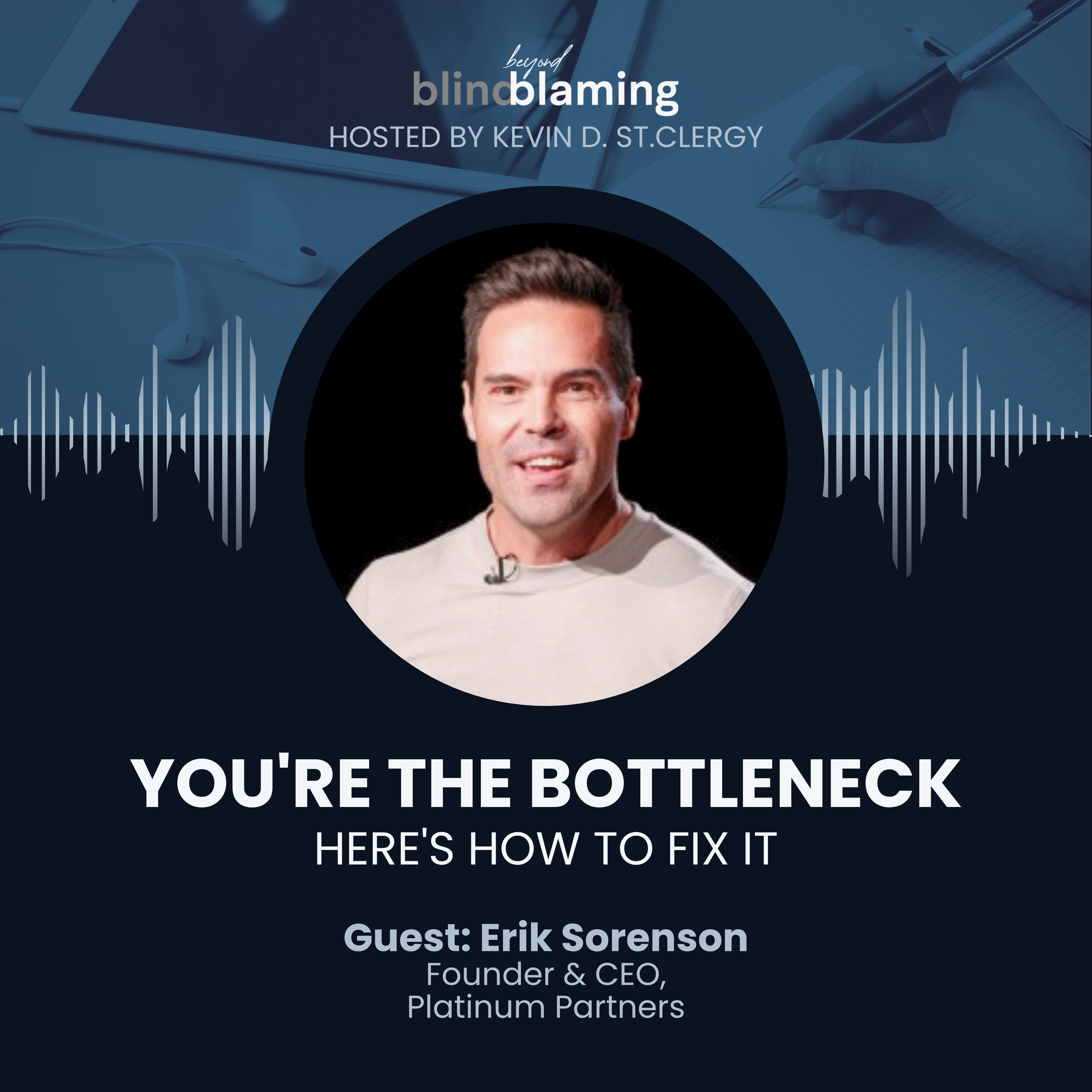
Beyond Blind Blaming
Scaling Smarter, AI Workforces, and Breaking the Hustle Trap | Erik Sorenson
00:33:39
Loading summary
Transcript35 lines
- [00:00]
A
Hustle is great in the beginning, but can curse you down the road because you end up taking on everything yourself and you end up basically being the bottleneck where you're doing everything and you're just going non stop and you get to the end of the day thinking you did things all day long only to find out that you didn't get anything done. There is a path where you can 5x10x your business by doing less, not
- [00:22]
B
more I'm your host Kevin St Clergy and today I'm joined by Eric Sorensen. He's the founder and CEO of Platinum Partners where he helps all types of businesses double their growth and build profitable businesses that run themselves without them having to be there. The average Platinum partner adds over $255,000 in revenue in their first year by doing less, not more. Before founding Platinum Partners, Eric built and led companies of his own, including hereworks and Sorensen Advertising, giving him firsthand experience inside the industry and with the grind of what it's like to own your own business that depends entirely on its owner to keep running. That is what drove him to focus on helping other business owners break that cycle. And today Eric has taken that mission further by building business owners a full suite of AI agents, a complete workforce, 10 AI employees led by an AI Chief of Staff covering everything from finance and operations to marketing, planning and hr, plus a command center dashboard that gives owners complete visibility into their business without having to run every single part of it themselves. He's an international speaker, a two times TEDx presenter, and published author. Through his work with owners, Eric has shown that scaling a business isn't just about working harder and seeing more people. It's about removing the bottlenecks, including the owner that quietly cap growth. His mission is to help business owners move beyond burnout, overwhelm and self blame by building systems and now an entire AI workforce that let their businesses grow without them having to do it all.
- [01:54]
A
You are at the level of your business because of your level of your mindset, the level of your skill set. In other words, your thoughts, your beliefs which lead to actions. That's why you are where you are and the only way to change that is to get beyond it.
- [02:18]
B
Welcome to Beyond Blind Blaming. This is the place where we explore how easily hidden truths can hold us back, trapping us in cycles of frustration and blame, often without even realizing what's truly stopping us. Each week I'm joined by experts and professionals who share their journey of taking back control of their lives, overcoming hidden challenges and discovering how to stop blind Blaming from dictating their outcomes. The insights you're about to gain will help you see beyond your current limitations, find the courage to seek new perspectives, and ultimately live a life that's both purposeful and powerful. So if you're ready to break free from blind blaming and discover what's possible, you'll definitely want to listen to my next guest. Eric, welcome to the show.
- [02:58]
A
Thanks, Kevin. Great to be here.
- [03:00]
B
Well, you've built businesses inside the hearing healthcare space and outside, and you're continuing to do so. Before you even founded Platinum Partners, what first led you to focus specifically on business owners rather than like, corporate or something else? And what made you want to get out of marketing altogether?
- [03:18]
A
Well, it really just came from how painful it is to run a business. If anybody has ever started a business or bought a business, they know how painful business can be. I mean, I once heard, I heard it said that the best personal and professional development system in the world is being a business owner, because it constantly forces you all of the time to get out of your shell, to get uncomfortable, and every day is different. And so it really was me doing business the wrong way that just caused so much pain. And I didn't realize there was another way out. I only knew two major skill sets, and that was I was a hustler and I was hungry. I think hunger is a great driver. I think it's a great skill to have. But hustle is great in the beginning, but can curse you down the road because you end up taking on everything yourself. And you end up basically being the bottleneck where you're doing everything and you're just going nonstop and you get to the end of the day thinking you did things all day long only to find out that you didn't get anything done. And it is painful. Slow growth versus what I didn't know then, what I know now, which is there is a path where you can 5x10x your business by doing less, not more. I mean, it's one of those things that sounds like it's too good to be true. And if it sounds like it's too good to be true, it's probably too good to be true. Until you realize the psychology behind that strategy, and you know, we've proven it in Platinum Partners over and over and over that you can actually grow more by doing less.
- [04:49]
B
Well, it's funny because you must be a mind reader. That was my next question of Platinum Partners tagline is grow by doing less, not more. Why do you think so many owners get stuck growing a business that actually demands more of them and not less.
- [05:01]
A
As it scales, I think they get stuck because they don't know any other way. I mean, there isn't really a playbook for business. It's almost like having a child. All of a sudden, one day you're a parent and. And it's like, how do I handle this? It introduces an entirely new world that no one's really used to unless they've done it before. And business is similar where, you know, it's like, we always think that I got into business to have more time, more freedom, and more money. And I always ask people, well, how's that working out? Because it is kind of like saying, hey, honey, let's have another child so we can have more time, more money, and more freedom. But there is a difference. A child you raise till you're 18 and then they're out of the house. A business you can actually raise and get out of the house, but much sooner, within potentially even a year or two. And I mean by like doing less than you would normally have to do. And so I think most people just don't realize there's another way. And we're taught, like, you have to work hard, and if you work hard, you're going to make high income. And I don't know what world that train of thought came from because I know some super hard workers, workers that are people that are work harder than I do by far and have never really made it that far, never really made that much money. Hard work. There are correlations between hard work and high income. But if you really think about it, it's not the hardest worker in the room that necessarily wins. It's usually the smartest worker. The problem is, is I didn't know how to work smart in business because the only thing I knew was just start a business and just work your tail off. And that's what I did. And I think that's what most business owners do. And I think that's why we fall into that trap, is that's really the only way we know how to do it.
- [06:35]
B
Had a coach tell me one time what got you here. Kevin won't get you there. What does that mean to you?
- [06:40]
A
Well, first off, the second part of that question is, well, then what can get me there? But you're right, what got you here won't get you there. Like, you are at the level of your business because of your level of your mindset, the level of your skill set, in other words, your thoughts, your beliefs, which lead to actions that's why you are where you are. And the only way to change that is to get beyond it. You know, Tony Robbins calls us the tyranny of how anytime you want to have a stretch goal, say you want to double your business this year. Well, first off, that might sound like a painful statement because you're thinking, oh my gosh, in order to double my business, I'm going to have a double my effort. And who has time to double their effort? Well, no one, because that's literally the wrong question. And asking yourself, how can I double my your business if you haven't done that before is like asking somebody who's never climbed Mount Everest, how can I climb Mount Everest? And if you think about it, asking yourself how, you have no idea how. That's why only 8% of people accomplish goals. Because your conscious mind is the goal setter. And it's like, okay, I want to double my business. And that the subconscious mind is the goal goal getter. The problem is, is you're putting on the gas and the brakes at the same time. Your conscious mind says, I'm going to get this goal. And your subconscious mind says, you've never doubled your business. You don't know how. Who do you think you are? I mean, you've tried for years and it's never worked. What makes you think that this is going to be different? And unfortunately, the subconscious mind, which is about 93% of our thinking and our actions and our decisions, is the one in charge. And so how essentially brings in doubt, because we don't know how unless if we have either hired somebody that knows how or have a strategy that we know will work because it's something we've never done before. So what has gotten you here is your level of belief and your skill set. Your level of your skill set. What will get you there is a new belief which will lead to a new skill set. And that belief could be as simple as, you know what? I'm going to stop hustling and I'm going to start buying somebody else's experience. I've sat here for 15 years trying to figure it out myself, and I haven't gotten to where I want to go. Maybe it's time I actually buy somebody else's experience. Somebody that is where I want to be and figure it out in less than a year.
- [08:52]
B
I love that. And the tyranny I wrote down the tyranny of how that was a great quote like that. I've never heard Tony Robbins say that, but I love it because that's where people get stuck. They think that to double my business, I need to double my effort.
- [09:05]
A
By the way, there is a path by doubling your effort to double your business. It can work. The problem is, what are you sacrificing? Because something has to go essentially usually means more time at work, less time at home, more time working on the business, less time doing things that you love, hanging out with friends. You know, I remember starting a business and how tough it was. I remember times where I would go into the office and two and a half days later, without sleeping, went home. Like, literally would work through the night. And it was exhausting. And granted, I had a lot of hunger and a lot of hustle in me to be able to drive me to do that. But eventually I wanted to burn the entire thing down. Have you ever been there where you just want to burn the whole thing down? And in a sense, the very first business I built, I literally did burn it down. I just fire sell that as fast as I could because I was so tired of the grind and so tired of the hustle, I didn't know that there was any other way. I didn't know that there was a path where I could actually do less and potentially double, triple, or quadruple my business. It's wild when, you know, you just simply think that that is the only path. And I thought that way for literally the first 15 years of my business.
- [10:13]
B
Well, beyond blame blaming, I talk about how people often project blame outward instead of looking inward. In your experience working with owners, where does blame usually get pointed first when growth stalls? And where is the real issue usually hiding?
- [10:26]
A
Well, that's a great question, because I think most people, including business owners, will place the blame outside. And the problem with blaming, you're placing the blame on outside is you're blaming something that actually isn't the problem. Think about it. You're placing blame on something if it's external that you can't control, versus if you really dive deep and you realize, what's the bottleneck of my business? Where does the blame actually lie? And it's in you. Now, I get it. You may have team members that are to blame for certain things, but who created that culture? Who didn't train them correctly? Who didn't teach them the right way so they wouldn't make those mistakes, or who didn't correct them when they were needed? Who didn't install transformational leadership inside their business that led to this outcome happening? And I can promise you, like, if you're blaming externally, you're probably blaming Someone or something that isn't actually the problem. And I think, you know, correct me if I'm wrong, Kevin, it's your book. I think that's one of the premises of blind blaming is you're literally blaming things you think are the problem, but they're not. And then you go to try to solve that problem, and how do you say it? You're solving the wrong problem perfectly. I mean, it's beautiful the way you say it.
- [11:33]
B
Yeah, that's exactly right. You got it. And that's the title of the TED Talk, too. You're solving the wrong problem perfectly.
- [11:39]
A
And if you're like me, I solved a lot of wrong problems perfectly. But the challenge is, is I didn't know. Solving the wrong problem perfectly and the right problem perfectly, if you think about it, emotionally, feels exactly the same because it feels like you're actually moving. The difference is one is like moving on a treadmill. The other one is like running on a street. Running on a street, you're actually getting to the destination that you want to go to. Running on a treadmill, you're not moving. You're not getting to any destination. The problem is, is it feels exactly the same. You get the same amount of exercise on a treadmill as you do running out on the street. The difference is you're actually getting somewhere on the other path. So when you're blind blaming something, it feels good. It's like hustle feels good because it feels like you're moving and it feels like you're accomplishing something. But I call it empty activity. Because if you really analyze a lot of your business, you realize that the things you're doing throughout the day, most of them in my experience and coaching over a thousand businesses now to this point in my life, that people are. What they're doing is they're solving problems that actually don't truly matter or that should be solved by somebody else. And so all of a sudden, it feels good to go throughout the day, seeing all these emails come through and answering them, and you're like, I'm working really hard. And you realize you're not actually moving. You're still on the treadmill, but it feels like you're not. So it's really a great liar. It creates a sense of false momentum when the reality is, is what you're doing by blaming the wrong things perfectly and solving the wrong problems perfectly is you're creating false momentum that's actually taking you backwards, not forwards.
- [13:16]
B
I see. Well, can you share an example of that? You have something recent
- [13:21]
A
Boy, wow. Let me pull out the index of 20 years of doing that for, well, at least 15 years of doing that. Yeah, there's been several times in my life and in my business life where that happened over and over again. And I think the biggest example I have that I see happen with most people and that happened with me was that I used to tend to use my email as an inbox. So in other words, instead of me going to the business and living what I call a life by design, in other words, I choose my path, I create my life, I create the business, I choose the direction of the business. What I did was let everyone else's priorities choose the path for me. So it's the reactive side of business. So what I would do is I would go to work and I would open up my email and all of a sudden I get an email, okay, there's to do list number two, one and another email. There's to do list number two and another email, there's to do list number three. And I like how Dan Martel says it says your email inbox is nothing but an inbox full of other people's priorities on you, not yours. And so we end up just being reactive all day long instead of solving the right problems. So that was a big one for me, is when I realized that my email inbox didn't need to be like my priorities. I could have an EA or I could have find someone else to leverage my time that can do that for me. And when you free yourself from the tyranny of the inbox, it's shocking how much like time you can get off of your plate. I don't know what the average is, but I know at least I was probably spending anywhere from two to three hours a day just answering people's emails or solving the problems that came up in the emails versus having somebody else do that for me, which then all of a sudden that they can solve the problem for me and. Or if they need me, they can involved. But very rarely does anything come in your inbox that needs to be at the level of you, the founder, that somebody else can't solve for you, or answer the question or take it to the right team member and coordinate it so that it gets solved.
- [15:20]
B
Well, you've built a full suite for owners of an AI workforce, basically 10 AI employees led by an AI chief of staff, covering everything from finance to HR. What made you decide the next step past coaching and community was to actually build the team for them?
- [15:36]
A
Well, the first thing I really do is I want to say that I think of other people and the problems that they have, and I certainly do. But you know what I think about first I think about my problems as a business owner. And I think if I have these problems as a business owner, how many other business owners have these same problems? And because of those 15 painful years of hustling and grinding at the expense of my family and my future, really because it was so painful, I never want to go back to that again. So I am like constantly looking out for. To me, the most powerful asset that a business owner or entrepreneur can have is the ability to find leverage. You know, and leverage to me means like if you have to plow a mile long road in the jungle, there's several ways you can tackle that. You can use a shovel, which might take you 10 lifetimes, you can use a small tractor which might take you two years, or you can use a bulldozer which might take a day and you could get the same amount of distance. The difference is what's the leverage point? And the biggest thing I think that you have to solve is the challenge of time. Like how can I leverage my time? Because it's funny, there was a study done that for every dollar spent in leverage, it's shocking. Like the return, it was something you get back X amount of thousands of hours per year. So you want to leverage this as much as possible so that you can essentially get this done with a bulldozer in a day versus a shovel for a lifetime. And so for me, I was thinking of what can save me the most time. And there was always this thing out there, like it seemed to me, especially when the LLMs came out. LLMs, if you don't know what those are, you're talking Chatgpt, Grok, Gemini and Claude. Those are large language models, right? They just take language patterns and they spit back information. And most business owners were using them like advanced Google searches or to answer questions. And that's great, but that's the lowest form of AI. And then I started learning about agentic AI and I realized what agentic AI is literally the world's smartest team member if they're trained right, if you think about it. So I thought, well, what if somebody started a business and they were able to hire 10 C level employees for hardly anything, in other words, not to be able to add to payroll. I thought, what if when I started my first business 20 years ago, if I had 10 employees and I didn't have to pay them, like what if that was possible? And I Thought, wow, what if a business owner that is existing that all of a sudden can add ten or a hundred employees to what they're doing, that can do the job better, at least when it comes to the technology side of things, than most of their own employees? What AI agents are is essentially the world's best trained employees in a specific skill set. So think of like an AI CFO or an AI HR director that could be trained on HR standards in all 50 states instantly, or an AI IT guy or an AI attorney or an AI executive assistant or an AI marketing director. Like, imagine like the application for that type of a thing where they literally can work and act like your employees with you, just simply giving them the outcome that you want to have happen within their specific role and they do it every single day. So that's when I had the idea, well, what if we were able to build agentic AI for any industry in healthcare or outside of healthcare, where people could bring on in their business AI employees immediately install them onboard them within 10 minutes, have them automatically be trained on their, their industries, and then all they have to do is upload employee manuals or SOPs for their existing structure, or have the AI agents create their SOPs and deploy them to your teams. And so it was a, it was a interesting thought. Like, if I can do this and solve my biggest problems and add another 10 employees to my team without having to add, well, the equivalent would be about a half a million dollars in payroll a year. Like, wow. Like if I told you you could buy 10 employees for that would normally cost you a half a million dollars. If you could buy them for, you know, four or five hundred dollars a month, I think anybody would jump at the chance to that. And so we started on a journey to create these months and months ago, if not a little over a year ago, when we went two routes. We went voice agents that can do inbound and outbound calls, and then we went with agentic AI that could talk just like us, that you could chat with if you wanted to, like an instant messenger type of thing that you could call them on the phone or you could text them and they would execute tasks for you and create the solution to outcomes where they can convene as a board of directors as well to advise you as the business owner on the biggest decisions in your business, but yet have all the information for everyone in the world. And so that's what we set out to build. And now we have this running in quite a few companies throughout the country. And it's been Kind of a life changing experience to see what they can do and how much time that they can save us all.
- [20:21]
B
So when somebody signs up for this, walk me through what it looks like for an owner in their first 90 days. Going from doing everything themselves to having an AI Chief, Chief of staff and a command center dashboard, giving them visibility into the business instead and having AI agents actually do the work that they're normally having to do themselves.
- [20:39]
A
Well, it's interesting because at first it may sound a little bit overwhelming and one of the tasks that we really have like as a principle that we believe in, and that's Da Vinci's quote, which is the ultimate form of sophistication, is simplicity. And if there's one thing I know about business owners is that when they're experiencing something new, the last thing you want to do is put a bunch of time and obstacles and effort and sacrifice in front of it. So what we set out to do is what if we can. Because AI can train itself on any industry. What if all they had to do was spend five or ten minutes being interviewed by the onboarding agent which would populate the brain of the all the AI agent systems and train them not only on the industry, but on their specific business in about 10 minutes and they're ready to go and up and running in 10 minutes. What if we could do that? And that's what we ended up doing. And we wanted to remove the barriers for a business owner to start using these. And then of course, as time goes on, they can continually update the brain. And it's really cool. You can actually see physically the brain and where it's trained on and all the on the brain and anything that you've uploaded or anything that you've shared or anything, conversations you've had, you can see this brain working and disseminating the information to all the agents. It's kind of wild technology, but we made it simple. So in 10 minutes you're there, you're up and running, and then you can start to use your agents and you can go into your agents and onboard them specifically for their task if you wanted to, or if not, you use the general information. And one thing I love is I am actually using my executive assistant as my personal assistant as well, not just my business. So I literally will say, hey, my wife and I want a dinner reservation at Ruth's Chris Steakhouse at 7 o' clock on Friday night. Can you call them and make that reservation? And if 7 is available anytime, between 7 and 9 is just fine. She'll be like, great, I'll do that. She will call them, say, hey, I'm Eric's personal assistant and he and his wife Renee would like to be able to go to dinner at 7, do you have that available? And they may say, well, no, we have eight. Great, can we book it? And they'll ask, is there any special occasion? And they said, no, they just want a date night. She'll book it, confirm it with them. Then next thing I know, I get an email, I get a text, then I get an invite on my calendar with the address of where it is. And she calls and confirms and makes sure that it's good to go. I mean, imagine that. Application times, dozens of things. And now, Kevin, you may be surprised to know I have my AI connected to my car. So now when I'm driving, I can push a button on my car and I can have that conversation in the car and say, hey, I need this to happen. Can you call this plumber because we had a leak in the house and see if you can get him over here here sometime this week. And, and literally, Emma, my AI executive assistant, will handle all of that, including the follow up, if there is any follow up. So, I mean, with the exception of taking out the trash and cleaning the office, I mean, they can pretty much do anything as long as it's not physical. Except that's coming within a year.
- [23:26]
B
Yep. With the robots, no doubt. Well, for an owner who's feeling buried and just the general operations of their business right now, what's one practical first step to start building freedom into the business without things falling apart, which is always their biggest concern. Because we all know that if you want something done, you have to do it yourself. That was a joke.
- [23:46]
A
You know, there's a lot of these lies that I think as a society we tend to believe, including me. Like I remember starting a business, one of the lies that I was taught was that you don't want to be profitable because then you don't have to pay taxes. So try to eke out all the expenses you possibly can so that you're at a zero profitability by the end of the year, and so you don't pay any taxes. And I'm like, oh yeah, that sounds smart, because then I'm going to save all this money in taxes. But then I just realized, wait a minute, but if I have no profit at the end of the year, I have no income, I have no future. When I realized that that was a lie and the best scenario is to be have your company be as profitable as humanly possible, so that you can have a higher level of customer service or in the healthcare space, a higher level of patient care. Hire better, better people, which essentially leads to better outcomes for your customers. And the tax side of thing after that. If you understand tax strategy, there's things you can do to limit your tax liability as much as possible and depreciate things, and a few other tax strategies you can use. But the one you said, if you want something done right, you have to do it yourself. Wow, that's completely false. I mean, unless if you believe in being imprisoned for the rest of your life, then go for it. That means that if you want something done right, you have to do it yourself. Essentially what you're saying is you have to do everything yourself. And if you want to do everything yourself, you're going to have no freedom, no time. And here's the problem. Wealthy people value time far more than money. People that don't have money generally value money over time. And anytime you're trading time for money, you will always struggle financially because there's only so many hours in a day versus if you value money versus time you'll use, you'll figure out a way to leverage it. And if you want something done right, find someone else to do it. Because most of the things that you want done right, somebody else can probably do better than you, with a few exceptions, most of them. So, you know, I think one of the challenges that we find as, as business owners is we tend to take on so much because we want it done right. And I hear to say that I believe that perfection is the lowest standard you should shoot for. In fact, what we teach our clients is 80% done right is perfect. And the reason why is perfection doesn't exist. You and I have never experienced a perfect person, a perfect product, a perfect service, a perfect sop, a perfect company. It does not exist. The problem with trying to be perfect is you'll never get there for one. And you won't launch the thing, you won't actually finish the thing because you're trying to perfect it so much. So one thing I love to say is that somebody doing something 80% as good as you can do it is better than a hundred percent of you doing it because someone else is doing it 80% as good versus you having to do it and being in prison for the rest of your life. You can't have freedom and you can't want to do everything yourself. At the same time, it doesn't work. Choose one or the other.
- [26:40]
B
Progress over perfection. Or my favorite line is Ready, Fire, Aim. Which was a great book if you haven't read it. So, Ready, Fire, aim. Well, you've worked with business owners all over the country, inside your masterminds and your summits that you do. What's one thing that separates the ones who successfully build freedom into their business and the ones who stay stuck doing it all themselves? And I was totally joking when I said, we all know you can do it better. I knew it set you off.
- [27:08]
A
I could see it in your eyes when you said it. You know, I think the one thing that they do that most others don't is they realize they don't have all the answers, and so they try to find the answers. In other words, I think what I'm about to say I didn't believe 10 or 15 years ago, so it's almost still hard for me to say it, but I believed that I was the one that had to do it all. I, you know, I didn't believe in coaches. I didn't believe in investing in myself. I think the first 15 years of my life, I went to one seminar because the first company I ever worked with required me to do so. And I thought it was the dumbest thing. Like, I go to seminar or hire a coach. It just sounds awful. When I realized that the greatest thing I've ever seen any business owner do is invest in themselves. And I'm not saying hire a coach or join a mastermind. I mean, that's great. How about reading a book? You know, when I, When I was in that tyranny of. I was. Didn't have any freedom. I was doing everything myself. I was working bell to bell every day for years. I got to the point where it just, like I said, I wanted to blow it up. I remember in a very dark day, I made a decision that I hadn't made since college. I picked up a book for the first time. I didn't like reading. I didn't enjoy reading. I just was in so much pain. I didn't. I knew I didn't have the answer, and I had no clue how to get out. So I picked up the. And I read it, and I was actually quite shocked by what I heard. And then I read another one. I started reading a book a week for years after that and just consuming as much information as possible, almost too much, so that I actually kind of got addicted to knowledge and learning and realized, okay, I need to shift this knowledge and turn it into something of action. And when I made that shift, that's when everything really exploded in my life. But I realized that those that invest in themselves and try to find the answers, those are the ones I generally see get the most, have the most success. I think two of the most dangerous words in the English language is I know. Because once you say I know, you're kind of cutting off everything outside of that. You're no longer looking if there's a better way or a different way to do this. Well, I know this is the way to do it. It's funny because, Kevin, you can attest to this, too. You and I are not 20 years old anymore. I don't know about you, but I think very differently. What I knew back then is not even relevant to what I know. What I know today.
- [29:21]
B
Oh, yeah.
- [29:21]
A
And what I know in three or four years is probably not going to be relevant. It's kind of like when you are hiking a mountain. If you've ever hiked a mountain, you know you're at the bottom. When you're in the valley, you can look around and you can't see very far because usually there's hills, you know, obscuring the view. And you get a hundred feet up and all of a sudden, oh, my gosh, I didn't realize there was a peak behind that. And then. And you get up even higher and you're like, oh, my gosh, I never saw this lake that was over here. Then you get up to the top and all of a sudden you see peaks and valleys and lakes and forests that you've in your entire life because all you saw was at the valley floor. And I think that's what happens when you say, I know, it's like stopping the journey on the way to the top. And you get stuck in this, okay, this is the way it is. This is the way it's going to be. And then your brain takes over, an automation, and it no longer looks for the right answers. It just looks to do the same thing you've been doing. So when you start investing in yourself, it's like, oh, my goodness. Now I see this differently. We have this culture, Kevin, in society where change is bad, especially in politics. Like, if you change your position on this or that, it's really, really shunned down. Well, you said this five years ago. Now you're saying this today. If you're not changing your position on things in life, especially in business, you're in trouble because that means you're not growing. I heard one author, I don't remember who it was, who said, if you're not embarrassed by who you were one year ago, you're not growing enough. And I love that because if you're not seeing, if you're not growing, you're no longer seeing what you couldn't see before because your mind was hiding it from you. So that's what I think is the difference between a business owner that can be really successful is one that is constantly opening their eyes to new knowledge, new opportunities, new skill sets, new beliefs, and that empower you. And when you do that, all of a sudden you get rid of the tyranny of I know everything.
- [31:07]
B
I love that quote. If you're not embarrassed who you were a year ago, that was great. Well, you mentioned reading a book. Are there any other ways you like to invest in yourself? Reading podcasts, masterminds, coaching?
- [31:17]
A
Yes. So I, my, what I try to do is one hour every day learning something. So there's a couple of things. One, I have masterminds and I have, so I learned from my own masterminds, of course, but I have three different coaches pretty much always at the same time. Usually a speaking coach, mindset coach, and then like a physical coach or, or at least I'm following a program that is, that is given to me by a coach. I know you do the same thing. So one, I think hiring a coach, that's ahead of you, you can't hire somebody if you wear, you know, trying to grow to $10 million. Don't hire a coach that's never been past a million in their own lives. You know, I don't coach people past a certain amount of revenue. That number for me is $10 million a year because that's my ceiling so far. So anybody up to 10 million, I can bring them on and show them the path to $10 million a year. But I can't get you maybe to 100 million until I've gotten there, which, Kevin, I know you're working on that and I'm working on that as well. So a coach is great and masterminds are incredible for a lot of reasons. One, you basically get coaches, but you also get a community, a community of like minded successful people, some ahead of you, some behind you, so you can pull some up and others can pull you forward. And that's to me, what I found the best environment for learning, because you're learning and usually a energetic situation, you're learning from multiple people, you're getting different perspectives and usually those masterminds are geared towards something that you're struggling with because they should know you well. Enough to know that you're struggling with it. And so they'll bring contributors on and content that can help you solve your biggest problems in your life and in your business. So those are three venues that I think are really powerful ways to do that.
- [32:53]
B
Powerful stuff, man. Well, thank you for being here. I know you and I could talk for several hours. Can you let everybody know if they want to get in touch with you or they want to learn more about your AI agents? Where do they go?
- [33:02]
A
Yeah, go to platinumpartnergroup.com Platinumpartnergroup.com is our coaching platform. We have it in multiple industries, inside and out, outside of the healthcare space, as you mentioned. And then of course, you can simply email me@eric platinumpartnergroup.com Great.
- [33:15]
B
And we'll make sure we put those in the in the show notes for you. But thanks for here again. I know this is your second time getting together with me, so awesome stuff. I love what you're doing. I'm looking forward to hearing more.
- [33:24]
A
Thanks, Kevin.