← Beyond Blind Blaming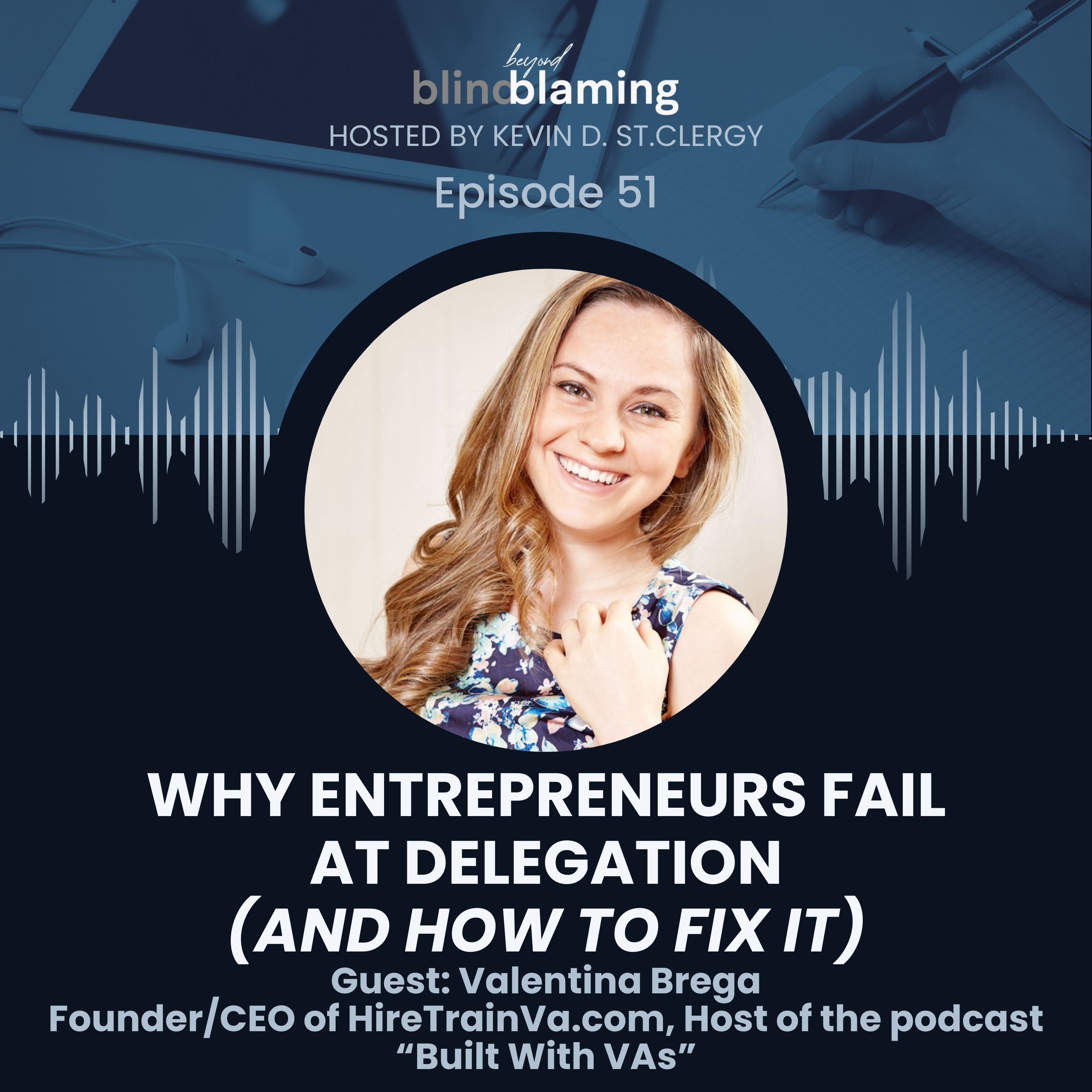
Beyond Blind Blaming
The 7-Figure Business Built by Letting Go and Delegating | Valentina Brega
00:37:57
Loading summary
Transcript43 lines
- [00:00]
A
So of course I was very devastated. I was like, well, this is not fair. What's going on? That was me pointing, you know, blaming everyone else except for looking at myself. And then I said, look, I have two choices. Basically. I can either continue to feel sorry for myself or I can keep a cool head and be like, what is going on? What am I not seeing? What am I missing? And then I analyzed what she was doing and I was like, oh my gosh, this is the secret. This is what she's thinking that I'm not doing. She's not trying to be everything in her business. She found what her genius zone is and she's doing that.
- [00:33]
B
Today I'm joined by Valentina Brega. Valentina is the founder of Hiretrainva.com, a virtual agency on a mission to help entrepreneurs get out of the weeds and back into their zones of genius. She built her company around training purpose driven, strategic virtual assistants who go beyond task completion. They become true business partners. Valentina's own journey from virtual assistant to a seven figure business owner is a powerful example of what can happen when you let go of limiting beliefs, delegate intentionally and build a team you trust.
- [01:03]
A
I really, really had this limiting belief that nobody can do things better than me because nobody has the experience I have. No one can be my clone. And that was the biggest mistake that I did. That was holding me back. And even though I do think I was probably one of the best in the whole country, I didn't have the success I had because my beliefs were holding me back. Don't just throw stuff and hope it lands. Don't just pray that that person will get it. Be intentional. Understand the personality test Personality profile of your employee or virtual assistant. Are they assertive? Do they take initiative? Are they more extroverted or introverted? If they're introverted, I wouldn't put them in a sales position, you know, because that requires people, communication and skill. So all of these little things, it's like understand what needs to be done by whom and let them figure out a lot of a big part of the how.
- [02:04]
B
Welcome to beyond Blind Blaming. This is the place where we explore how easily hidden truths can hold us back, trapping us in cycles of frustration and blame, often without even realizing what's truly stopping us. Each week, I'm joined by experts and professionals who share their journey of taking back control of their story, overcoming hidden challenges, and stopping blind blaming from dictating their outcomes. The insights you're about to gain will help you see beyond your current limitations. Find the Courage to seek new perspectives and ultimately live a life that's both purposeful and powerful. So if you're ready to break free from blind blaming and discover what's possible, you'll definitely want to listen to my next guest. I'm your host, Kevin St. Clergy, and today I'm joined by Valentina Brega. Valentina is the founder of Hiretrainva.com, a virtual agency on a mission to help entrepreneurs get out of the weeds and back into their zones of genius. She built her company around training purpose driven, strategic virtual assistants who go beyond task completion. They become true business partners. Valentina's own journey from virtual assistant to a seven figure business owner is a powerful example of what can happen when you let go of limiting beliefs, delegate intentionally, and build a team you trust. She believes that every entrepreneur deserves time, freedom, and that every leader has a blind spot that's costing them more than just money. It's costing them momentum and peace of mind. Valentina, welcome to the show.
- [03:24]
A
Thank you so much for having me.
- [03:26]
B
Well, you've built an incredible business and we've known each other for a little bit now, and you help entrepreneurs build freedom through delegation, which is hard for some people. Can you walk us through how your journey started? And as you know, I love your story of when you came over to the States, so I'd love for you to go there as well, if you're okay with it.
- [03:42]
A
Yeah, I would love to. And that's actually connected. So I'm originally from Moldova. This is a small country in Eastern Europe. And about 11, 12 years ago, I had another business. I had a school of foreign languages. So I had a school where I taught people how to speak English. And I thought I was the best in the game. I thought I was the best in the country. And I actually really think I was because I previously been to the United States. I was an exchange student in the United States. I lived with an American family who taught me all the slang and, you know, just perfect my pronunciation, all that. I also then came back to the United States and did a four year program. So I studied, I went to university here in the United States. And when I went back home, I knew I wanted to have a business. And I really thought like, no one, no one else has my credentials. No one else is as good as me. And I'm going to be so successful. And this was probably the most struggling thing I've ever done in my life. I've been in that business for three years. We did have a lot of good people Coming in, word of mouth, like the product. The service itself was wonderful. But I did have to shut my business down because we were not making enough money. We were barely keeping our heads above water. And to make matters worse, I had a competitor back then who achieved everything that I had wanted in one year. What I couldn't do in three years, she hasn't been in the States. Her accent was much thicker than mine, but she was like. She was gaining so much popularity, and people were flooding to her and not to me. So, of course, I was very devastated. I was like, well, this is not fair. What's going on? That was me pointing, you know, blaming everyone else except for looking at myself. And then I said, look, I have two choices, basically. I can either continue to feel sorry for myself, or I can keep a cool head and be like, what is going on? What am I not seeing? What am I missing? And then I analyzed what she was doing, and I was like, oh, my gosh, this is the secret. This is what she's doing that I'm not doing. She's not trying to be everything in her business. She found what her genius zone is, and she was doing that. And she's delegating everything else to people. She hired teachers. She hired people. I was the office manager. I was the teacher. I was the salesperson on the phone. I really, really had this limiting belief that nobody can do things better than me because nobody has the experience I have. No one can be my clone. And that was the biggest mistake that I did. That was holding me back. And even though I do think I was probably one of the best in the whole country, I didn't have the success I had because my beliefs were holding me back. So it so happened that life took me again to the United States, and this time as an immigrant. So when my daughter, my first daughter was born, she was two months old, we found out that we won the green card lottery. So I was like, oh, my gosh, what does it mean? Do we stay in Europe? Do we go. Do we go to the United States? Now, it's different when you come to the United States as an immigrant, because I've been to the States before, but I stayed with a family. I went to college here, Right? So there was. There was something. I knew where I was going to live. I knew who was going to take care of me, so to speak. When you come to as an immigrant, you're on your own. And we have no rental history, no credit card history, no nothing. Right. And to make matters worse, we came to The United States, and we find out that we cannot access our funds from back home. And we only had $400 in our pocket. So what do we do if we leave the United States? You can't leave because you lose the green card. It's like we're going to have to make it work with $400 in our pocket. So we didn't have a lot in savings back home, but it would be enough to get us started. So we didn't have a house, we didn't have a car. We didn't have any history of anything. No one could trust us to rent a place. And my daughter was one at the time, by the time we moved to the States. And so, yeah, it was, again, very, very stressful. And then I found this opportunity one day to work from home, and it was for a real estate company. And I said, there's no way they're going to take me. Again, limiting beliefs. There's no way they're going to take me for this job. I know nothing about real estate. Really. I was so green. They're not going to accept me for this job. But I was running out of things to apply. So I said, okay, yeah, I'm just going to go ahead and apply. I had such a good conversation with the COO of the company, and he said, we would like to offer you this position. We think you are the best person for this role. And one thing that actually kind of secure me the job, he said, what books do you like to read or what do you do in your free time? And I said, I actually am reading a book right now called Traction. And he's like, oh, my goodness, that's the book we're basing our whole business on. He didn't know that the reason I was reading Traction is because of my previous failed business. Because I was so determined to figure out what in the world happened and how do I make it work and what can I do? How can I take control of the situation? Yes, I need to delegate, but I also need to learn about business. So because I was reading the book and we got so connected on our vision and our future plans, even though I knew nothing about real estate, I got offered this position. And it's been a game changer. In three months that I was with a company, I was so hungry to prove myself. I was so grateful for the opportunity to have a job and be from home, because again, we didn't have a car. It was just so, so, so bad. And I was so grateful for the opportunity that in three Months, I was promoted to a lead manager, and everybody in that department was fired because my boss at the time, he said, your numbers alone are higher than everyone's combined. Whatever you do, keep doing and find people just like you. Whatever you do, you find your own team. You train them on whatever you're doing. So that's what we did. And we had a lot of success for the real estate company, and more people found out about our success. And I spoke on stages about how to set up the lead system for real estate. And a lot of companies came to me and said, can you train my team? Can you teach my team what you know, or can you find somebody like you? And that's when I had the idea. And I said, I can find people like me. I can find people like me and I can train them. I know what it's like being not American and what kind of hoops you have to jump through to work on the American market. First of all, mindset. And we can definitely talk about that. But it's. I know how to train people and I know what American entrepreneurs are looking for. And so that's kind of how I went back to my boss and I said, I know you're probably not going to like what I say, but I really feel it in my heart. I have a calling that I need to start my own business. And he said, of course, I understand. I completely do. He said, you are overqualified for what you're doing. I believe in you. You have my full support. And to this day, we're very good friends. And I have his full support. And so that's kind of how it started. I built this company and that's why it's called Hire Trained va, because we hire and we train virtual assistants, and we work with a lot of real estate companies. That's what we started with. But because of our success and word of mouth, a lot of companies from other industries reach out to us, and we serve pretty much any industry now. That's kind of the story.
- [10:19]
B
That's a great story. I love it every time.
- [10:22]
A
Thank you.
- [10:23]
B
And I know I've sent you plenty of referrals, so I just enjoy people hearing your story because it's amazing what you've accomplished. You should be very proud of yourself, and I know you are.
- [10:31]
A
Thank you.
- [10:32]
B
Well, and, you know, I. I go back and I always butcher his quote. I think it's Dan Martell says something. The effect of look 80. If somebody does something as 80, as good as you can, it's 100 awesome. It's something like that. And I think we struggle with getting things off our plate. Like you said, I was doing everything myself, and it took me a while to learn how to truly delegate. But how many times do you think people bring on people, but they don't train them appropriately because they don't have the time? Do you run into that a lot too many times?
- [10:59]
A
Absolutely. This is very common. Well, yes, they don't have the time to train them. But also, I think people expect. Again, that was a mistake that I made. People expect to find clones of themselves. And I say, why? I actually have this analogy a lot. It's like, imagine you're playing Tetris, right? Everybody's familiar with this game playing Tetris. It's like, what if you play Tetris with just one piece? You know, that Z piece? What if the whole game, you only had one piece? How many lines do you think you will score? How high do you think your score will be? I mean, yeah, it'll clear some lines. Lions you, you know, but it's not as much. You need a variety of different pieces. So I think what entrepreneurs don't understand is they see themselves as a piece in the game. And instead I tell them, take yourself out of the game. You are the player, not a piece in the game. You have the controller in your hand. You don't need to find another one. Just like you. You don't need to. You're not a piece. You got to shift your identity of who you are. And you find pieces, different shapes, different pieces for different roles. And your job is to stay in a genius zone and to understand what pieces fit together for what role. And how do I make more money? How do I clear more lines? So I think a lot of people, they have the wrong identity about themselves. And when they want to bring virtual assistants or even local employees, they expect them to be well trained. They say, like, I don't want to spend time showing you how to do things because they expect them to know, well, this is not how it works. Develop that relationship. Show them the ropes of how you want things to be done. Yes, definitely. Hire experts. You want to hire somebody who has the skill set of solving the problem that needs to be solved in your company, but show them the ropes of how you want them. Your vision. How does that task fit into your vision? Into the, like, why are you hiring that person? What is the constraint? What is the bottleneck that they're looking to solve? So I think that's a. That's probably the biggest mistake. And that's what I talk about in some of my coaching calls and. Or when I speak on stage is like, are you the player or are you another piece in the game? Because too many people do not see themselves as a business owner, but they see themselves as an operator in their own business.
- [13:04]
B
That also makes it difficult when you're trying to build that. I know one of the things we do in our coaching program is we help people build a freedom fueled empire. And you can't do that if you're working in it as an employee every day. That's what I hear you saying. Is that right?
- [13:18]
A
You're absolutely right. You can't do that because that means you can't take a day off. What happens if you're sick? You are your business and if you stop working, then your business stop existing. That's not the way it should work. That's not the way it should work. Right. You should need to set up a system that works, that allows you to get that freedom. And in fact, what I saw is when you put key people in the right positions, the business works much better than when you are the ones doing everything in your company. And that makes sense. And it's a lot more. I mean, I always ask people, when is the last time you took a week off and like have the phone completely shut off, no Internet access? When was the last time you could do this without worrying about business but actually be present with the family? Can you guess what percentage I'm getting of people?
- [14:05]
B
I would say that they're like, I can't remember the last time that I was able to do that. That's what I usually get. We ask a similar question. Not as detailed as you. I like how detailed you ask that. I might have to. We don't steal stuff. We just ethically swipe and redeploy.
- [14:18]
A
Please. Yeah, but that's exactly the answer I'm hearing. It's like, oh, that was. And then I kept thinking, actually, I don't remember. I don't think I ever had that. What do you mean not worry about my business? What do you mean turn the phone off? Is that possible? Does that happen? So if you're finding yourself asking these questions, that means you are the business. That means the business is running you, not the other way around. You're not running the business.
- [14:43]
B
Cool. Well, on the show, you know as, because you read my book and I appreciate it very much for the positive feedback you gave me. But we explore the idea of misdiagnosed problems. In your experience, what are business Owners often blaming time, team money, when the deeper issue is really about control, trust, or leadership.
- [15:00]
A
Very, very good question. Most people see the success of other companies, but they're not willing to go through the sacrifices of what others did. So they're blaming everything else besides looking at what they can do to change the situation. So if somebody is more successful, well, that's because they. I don't know. And fill in the blank. They got an inheritance. That's because they. They have the right team. That's because they. And they say, okay, what's stopping you from getting the right team? Well, I don't have the money. Well, that's kind of like what comes first, the chicken or the egg, Right? It's like, what comes first? Like, you need the team to make money or do you need the money to make the team? You know, so like, that's, that's the situation. So I feel like a lot of people blame everyone else besides looking at what's in my control. And every business owner, they will hire wrong at some point. That's just inevitable. It happens. But a lot of people get burned by this twice, you know, So I always say, like, don't let a bad experience burn you twice. Like, you got, you hired somebody before and it was the wrong decision. Don't let that bad experience prevent you from making the next grade hire. So I feel like a lot of people blame everything else. In my case, for example, we work with virtual assistants. Well, I hired virtual assistants, and they were not good. I hired virtual assistants, and they don't understand English very well. I don't have time to train them. It'd just be so much easier if I did everything myself. What they don't know is that when we hire virtual assistants, we only look at 1%, the majority of VAs out there. And I'm sorry to say this, but the majority are bad. But the 1% that are really, really good, these are the ones we go after. So the fact that you hired someone who are not good, who is not good, doesn't mean everybody's bad. It just. You have to look at yourself and be like, okay, what did I learn from this? If I were to do this again, if I were to run this job ad again, what would I change about it? What was it in my job ad that attracted this candidate to me? What did I not communicate clearly that made everyone feel okay to apply to this job? You know, so there's so many variables, so many little things that you can tweak to change the output if you don't like the output you're getting, change the input. And I feel like a lot of people are blaming the output and blaming on somebody else rather than looking at themselves for the input. You know, like, what can I do to get a better result?
- [17:10]
B
I agree, but sometimes it's out of their control too, and they don't see it's not necessarily them, but the system or process they've been taught that they think is the only way to do things. They get stuck in their own ways of their past successes sometimes and sometimes their past failures. But. Well, you bring me to another question. So. And you said something like, I don't have time. And I think when I have somebody, I love it when a coaching client or an employee tells me, well, I don't have time. And my answer is always the same when I come back. Well, what I hear you saying is that you didn't make it a priority and that I didn't. I wasn't very clear when I instructed you to take on this task that it absolutely is a priority and I need it done. So that's on me. So I don't have time just means we don't. It's not important. But I think another thing Dan Martel says is that when you do push things off or you don't get it done, it's a gift. It's a signal that you pride each time you're putting off stuff or you're procrastinating, it's probably a sign that you probably shouldn't be doing it anyway.
- [18:08]
A
Interesting.
- [18:09]
B
That's because this doesn't light you up. Because if you think about it, we're going to make time to eat because we like to eat, most of us. But when it comes to riding an sop, I don't have time for that.
- [18:19]
A
But they don't. Yeah. And I see what Dan Martell is saying here, but I also agree. It's like, you don't have to write the sop. Why would you spend your time writing the sop? Again, it goes back to the zone of genius. Right. What is something that you are the captain of the ship. What are you doing to steer the ship? Or if you work in a restaurant, it can be the dishwasher and the waiter and the cook. And you can't do this. You have to. If you're a manager, you manage, you find people. You don't have to write the sop. And so many people don't hire because they say, well, if I hire, I'm going to be buried in all of These admin tasks or I need to give them an sop, if you want to. Let's talk about the sop. You don't have to have a perfect SOP to hire someone. And in fact, the SOP will change as your business grows. I can guarantee you the SOP will change because you will see it from a different, from a higher level. So you don't expect it to be perfect from the start. Instead, what you want to do, even if you're bringing someone on board, you're still going to show them the ropes. You can have a zoom call, right? And just record that zoom call and go in as many details as you can about what you're doing. Like, for example, you say, so first you open this website and you see this red button that says for sale. Click on that. So try to go in as many details as you're recording that session. And then what you can do, you can transcribe that, put it in ChatGPT, and say something like, based on this transcription, give me the sop. You don't have to take time out. Like right now, in the era of AI and everything, it's so easy to save time for things that could be done by someone else or even the sop. The virtual assistant should do it. The virtual assistant can do it. Show them the video, have them watch it again, do the process shadow, give them feedback, see if they understand the process, and when they feel comfortable, ask them to put together the sop. That's what I do with my team. I never put an SOP in my team like my team does the SOPs for the company.
- [20:10]
B
I love it. Great idea. So what's the danger of hiring from a place of desperation versus hiring from clarity and strategy? Because I'm sure you run into that just as much as I do as well.
- [20:20]
A
Right. If you want good people, take time to vet them. And I can talk about this. So my philosophy, my personal philosophy is I usually hire fast and fire fast. The truth is, people can impress you with their resume. People can impress you at the interview. And especially if people are really, really, really good at interviews. A lot of them are good at interviews because they've been doing so much of it because they can't keep a job, you know.
- [20:47]
B
Great point. I'm sorry, I don't mean to interrupt you, but that's hilarious. That's awesome.
- [20:50]
A
So I'm trying to keep that in mind. When someone impresses me at the interview and I'm so ready to offer them the job, I got to keep this in Mind. I'm like, okay, I'm just going to wait and I'm going to follow the protocol, follow the system, follow the process. So part of our process is we put their skills to a test. Always hire after you have tested their knowledge. And I actually have a podcast myself, and it's called built with VAs. And there I talk about different tests you can give for different roles. But one of the tests, for example, let's say a video editor, right? When we look at the profiles or the portfolios they sent us, they are phenomenal. They're amazing portfolios. And then I give them a little reel. I said, hey, look, just edit 10 seconds. You can watermark it. I'm not going to use it, I promise. I don't want to use your work for free. I just want to understand how you would use your tools and your knowledge on my material. Just 10 seconds, 5 seconds, whatever you want to do, like just the intro, that'll be clear. There'll be enough. First of all, a lot of people bail when you give them a test, so that's a good red flag. But second of all, some of the responses that I gotten back, and not even 10% of the portfolio that I saw. So never, ever hire people without testing their knowledge. But even so, when I say I hire fast and I fire fast, the truth is, you never know how good someone is until you actually work with them, because they may be good specialists, but maybe they don't show up. Maybe they're not reliable. Maybe they're coming up with excuses and you can do so much. So, for example, in our agency, we check their Internet speed, we check their computer specs, we make sure they have a power backup, because we don't want people to come up with excuses. My Internet or my Internet or something like, I know, like, we check that to make sure you have all the tech stack all in order. But even so, you don't know how good someone is until you actually work with them. So, yes, I like to give people chances. I like to hire fast. I like to set the expectations. I like to give them a responsibility. I like to show them the why. Why your role is important. And this is what success looks like. If we can accomplish this in the next 30 days, then I know you are on the right track. But I also fire fast. If they don't show up, if they're not reliable, if they're not a culture fit with my team, I don't keep them on the team. So that's my personal philosophy. So kind of to Answer your question. What does it mean to hire out of desperation? It probably means just hire someone who sounds good at the interview or hire someone who has a good resume. Don't do that. At least put them to a test. But also don't take too much time because again, you never really know how good someone is until you actually start working together. And there are so many variables. So take the leap, hire. Keep your options open. I also like, when I hire people, I like to give them a task with minimal instructions and I want to see how they approach that task. So for example, I just tell them to do something that they have to do. Research or if they ask me questions, what kind of questions are they asking? Are they smart questions that they can find on their own online or are they questions that are just a time waster? You know, so these little things that will tell you so much about a candidate, that's something you can do.
- [23:50]
B
I really like the, the task with mental info because we actually do that in a blind blaming seminar. We. There's a, there's an exercise that I do where I grab somebody from the audience and I have them to pretend to be a boss and then I have another volunteer from the audience and I have them pretend to be the new employee. And then I give them a simple six piece puzzle to solve in front of the new, the boss of the new employee. But I take out two pieces and so, you know, they get to the end and they're like, what's going on? And then I pretend to be the boss of the boss and I say, why are you hiring people like this? This is dumb. This person can't even finish a little puzzle. I told you to stop hiring people like this. And the point is, sometimes we don't give them all the tasks once they've started, or we don't give them very good instructions or we don't give them all the information they need. But I love using that approach to see if they're willing to ask for help or they ask for clarity. That's what you're looking for, right?
- [24:42]
A
Exactly. Ask smart questions. What kind of questions do they ask?
- [24:46]
B
That's great because we always knew when we had a new employee coming on board if they start asking questions right away to try to clarify. First of all, we knew they were going through the training. Second thing is we knew that they actually cared about the job and were interested in it. But we also, we started doing paid tests. I don't know. You're doing these tests for free. Is that way I understood it you give them a small task and they do it for free. Just like, hey, I don't want to take up too much of your time, but do this. Or you actually like. We pay anywhere from 50 to $200 for a small test, whether it's giving us a small piece of code or doing a task that we know they're going to have to do on a daily basis, or even shooting a video for us.
- [25:19]
A
That's amazing. If you use that, if you use that material or yeah, definitely pay for that. Pay for labor, because I think that would be fair for us because we're such a. We work with such a big volume of candidates. We have to move fast, but also we have to understand very fast whether this person has potential or not. So our tasks usually involve something much simpler so they wouldn't have to shoot a whole video for us. But like I said, if they edit a video, It'd be like 10 seconds, 5 seconds. Or at least tell me how you would approach it. Or sometimes if I hire social media, the interview, I would open my Instagram, which is, by the way, not great. But, you know, it's like, okay, tell me what you like, what you don't like, and what you would change about this. I just want to see again what questions they're asking. So the type of questions I'm looking for would be like, okay, show me your reels. Okay, go to the real one. Okay, what about stories? Go to archive. Let me see the previous stories you made. What is the engagement? This is the kind of questions that I am. I am looking for when I say I put them to a test, as opposed to somebody saying, like, oh, I'm great with social media because I did this for a previous client. And then when I ask more detailed questions, they don't know how to. They don't know how to support their answer in a strong way. So again, because of our. Because we're a big agency, that's the way we test their knowledge. But if you are a company who's hiring people in I, they would love this. Like, if you actually use their product, if they write a blog post for you, or if they edit a. An ebook or put together lead magnet, whatever it is. Yeah, that's definitely something that should be paid.
- [26:50]
B
Cool. I love it. Well, I mean, you talk a lot about, if I'm not mistaken, I've heard you say something about intentional delegation. What are some practical first steps for an entrepreneur who doesn't know how to delegate or what to delegate or fears letting go.
- [27:03]
A
Oh, Yeah, I have a whole workshop on this. Yeah, smart delegation. Intentional delegation is very important. Don't just. Again, let's go back to the Tetris analogy. You have all these pieces and if you randomly put them, you're gonna end the game very soon. Right? And not with a big score. If you just sort of just push the down button. Down, down, down, without thinking. Let's move this to the left, let's move this to the right. The same thing applies to delegation. You don't just give a task to somebody and hope for the best. You don't abdicate responsibility. You don't be like, okay, you go figure it out. You actually have to be intentional about this. Number one thing you have to do is understand why. Why do you need this to be author plate? Is this an important task for your company? Is this a revenue generating task? So when you delegate something, it either has to bring you more money or it has to bring you more time. And the reason it brings you more time so that you could work on making more money. So at the end of the day, it all goes to how is that impacting our bottom line? If whatever you're delegating doesn't have an impact on the revenue on your time, is just keeping you busy, if it's not important, then why do this at all? So I always say, and I know I talk a lot about delegate tasks, but actually what you want to do is you want to delegate a responsibility, delegate the one thing that they will be responsible for and take ownership for. Because when you delegate tasks per se, you're basically creating another job for yourself. Because that employee or that virtual assistant will come to you and say, okay, boss, I'm done with my task. What's next? So you have to put everything you're doing, you have to put on the side and you have shift gears and think, okay, what else, what else? What else can I do? Can I give you to do Instead of. If you give them responsibility, then, and you tell them why this is important and how it fits into the company's role, then they will figure out what tasks need to be completed to, you know, to accomplish that responsibility. So that's what you want to do. For example, in my company, I have somebody who's in charge of fulfillment. I don't have to tell them, okay, whenever we have a new client, make sure you pair them with the right va. Make sure you assist them. She knows. She knows exactly what needs to be done. I said, you are a customer success. What do you need to have? What you figure out what task I needed here in order to make sure the customer is successful. If it's a replacement, if it's this, check in with them. You know, all of this. I never had to give this to my virtual assistant, but again they've been with me for years. I find very personality traits that I, that I look for. So that's what I mean by being intentional about this. Don't just throw stuff and hope it lands. Don't just pray that that person will get it. Be intentional. Understand the personality test personality profile of your employee or virtual assistant. Are they assertive? Do they take initiative? Are they more extroverted or introverted? If they're introverted, I wouldn't put them in a sales position, you know, because that requires people communication and skills. So all of these little things, it's like understand what needs to be done by whom and let them figure out a lot of a big part of the how.
- [30:02]
B
I love it. Great stuff. Let's keep going. So you believe that hiring a VA isn't just a business move and it's an emotional decision. Can you speak more about what you mean by that?
- [30:11]
A
Oh, I know I might sound not humble when I say this, but I know I've impacted so many lives.
- [30:18]
B
No, I mean I think that's confidence. That's not self adulation, that's confidence. There's difference. And I know you and I know the work you do and I know you're changing lives. So keep going.
- [30:28]
A
Thank you. So when you say emotional, there's two sides, right? Like good emotions and bad emotions. So I'm going to talk about this one. Good. I know I've impacted lives because I get the feedback from both entrepreneurs I've helped, but also from a lot of virtual assistants. Even somebody from my team said I bought my first AC ever. I can finally work in the comfort of my house and I feel comfortable. It's like you cannot imagine what this means to me. And she comes from a climate where it's very, very hot. And she's like, this is such a blessing. And this, these are the things we take for granted, right? And in those moments or when I get messages from virtual assistants, I say because of this job that you provided for me, I am able to do this and that and send my kids to a good school. And it is so important. So it is a good business move, but it's also emotional in sense of when you have the right people, you create good karma, you create good vibes, you create good environment, good emotions for bad Emotions. It's. For example, a lot of people hire well because they, again, maybe it's more like it's not intentional. They hire because of how they feel about that person. They hire because somebody maybe reminded them of something from, you know, the employer's task or personal story that they had to go through, but it doesn't mean they would be good for the job. Maybe they have a sad story and I still like to help those people, but it doesn't mean they would be good for my company. So it's such a fine line between understanding and wanting to help people, but also knowing that you giving them this job, this is exactly what's going to help them succeed as opposed to you giving them this job. You know, they will struggle and they will not only grow your business, but they will also not be happy in the company you're with. So a lot of the times don't hire a person because you're keeping them from finding something they will really, really like. So what I do with VAs, I try to work with the companies we work with, but also I really, really want the virtual assistants from around the world to be successful. And if I see somebody who's very hard working and trying hard, but I just don't see how they would fit with any of the clients we work with. Maybe their English is not strong enough or, you know, for so many reasons, then I try to give them, like, direction of what they could do, what they could improve on to become better or at least become better for our standards. I don't know about the standards of other companies hiring, but I know for our standards, if you want to work with us, I like to give them guidance and directions because as much as I want to help, I know they're not going to be happy. I know they will be struggling. So it's so important to understanding, like, when you offer somebody a job, how is that going to impact their lives? And how is that impacting their happiness? And your business too, of course.
- [33:13]
B
I love it. Well, you've clearly invested in your own leadership journey. Coaches, mentors, masterminds. I know we've been part of similar groups in the same groups. What do you think has been the most transformative investment that you've ever made in yourself? And this is something I ask all guests, and we're putting together a cool video of this. So I'm just curious on what you think the best transformative investment you've ever made in yourself is. Is it coaching? Is it reading? Is it Russell's group?
- [33:36]
A
Everything has been important, but I think probably the main one was this one mindset. Now, I come from a culture that doesn't believe in this mindset. I come from a culture. So my country is a former Soviet Union country. The Soviet Union collapsed when I was very little. Of course, I don't remember anything from it, but my teachers, my educators, all of that were people who grew up in the Soviet Union. So of course my mindset was influenced by their mindset. When I grew up, we were not taught how to dream or that everything is possible. I heard things like, money is the root of all evil. It's just not meant for us to be successful. It's just not meant for us to be happy. Some people are better than us. Keep your head down and do your thing. Don't stand out. All of these little things that shape the way you are and keep you small. Everything is bad. I mean, you know, the Soviet Union collapsed economically. All those countries were struggling. Everything is bad. Keep working. Don't question anything. Like. So the biggest thing for me to believe that I can do it was changing my mindset. And that's why I like the groups, the leaderships, because you see how other people are successful and what they do. And just recently, I was with in one of Russell's groups, and I had a conversation with a business owner, and I don't think he realized how much that conversation meant to me because he said, give me a goal, any goal that you want. And I said, okay, sure. I will make, I don't know, something unrealistic. I hope to make another million dollars in the next three months. And I kind of started laughing off. He's like, okay, what do you need to do for that? Like, come on, that's not possible. He's like, why not? He's like. And he asked me something. Do you know people who make that? I said, yeah, do you know people who make a million dollars in one month? I said, yes. So cool. I was like, okay, well, recently, Alex Hormozy had his book launch. Like, I mean, look, Alex Hormozy made 100 million in one day and a half. I mean, so I know it's possible. It's not unheard of. And he's like, what does Alex have that you don't have? And I'm like, come on. You know, like, that you're not being serious right now. He's like, no, no, I'm being serious. But come on. He has the following. He has the knowledge. He has this. He's like. And he said something like, Alex is just another human being. You are another human being. If he knows how to do it, do you believe there are enough resources in the world, enough knowledge? Do you believe that you can learn how to do this? And I said, I mean, yes. So if he can make 100 million, can you make 1 million in three months? I mean, technically, yes, I get. But it started changing the way I look at things and the way he put things in perspective. This is something I've never, never heard where I'm from. Successful people never share what they do. We always have this idea that rich people are greedy or they did something illegal to become rich. You know, all of these thoughts. It's so against success and being rich and making a name for yourself. So probably the biggest thing for me was changing my mindset, and I'm still going through that. I'm still learning. So being with people, having the right people in your corner is so important. So reading books, attending seminars, attending coaching groups, being with people who are one step ahead of you, this is what's going to make you feel like, if they can do it, I can do it. How can I do it? You ask the right question, how can I do it? And so this was probably the biggest, biggest transformation for me ever.
- [36:52]
B
I love it. That's great. Thank you for sharing. Well, if people want to get a hold of you so that you can help them find and hire and train a VA for them, that's the best way for them to get in touch with you.
- [37:01]
A
Yeah, social media is a good way to reach me. I'm on Instagram. My full name, Valentina Brega. Facebook, LinkedIn. Also our company, HireTrain VA.com. chances are you're going to talk to somebody from my team, not me. But if you need to reach out to me, my team will connect you with me. So I have a great team. I love them.
- [37:20]
B
Well, amazing time together. Thank you, Valentina, for taking the time. So we'll make sure that we put all of this in the resources spot of the podcast so people can get a hold of you. But amazing information. I loved our time together. I know we could go longer, but we're at the top of the hour, so we'll go ahead and say thank you so much for taking the time to be here and. And I look forward to hearing more about your success in the future.
- [37:40]
A
Yes, sir. Thank you so much for having me. It's been such a joy.