← Beyond Blind Blaming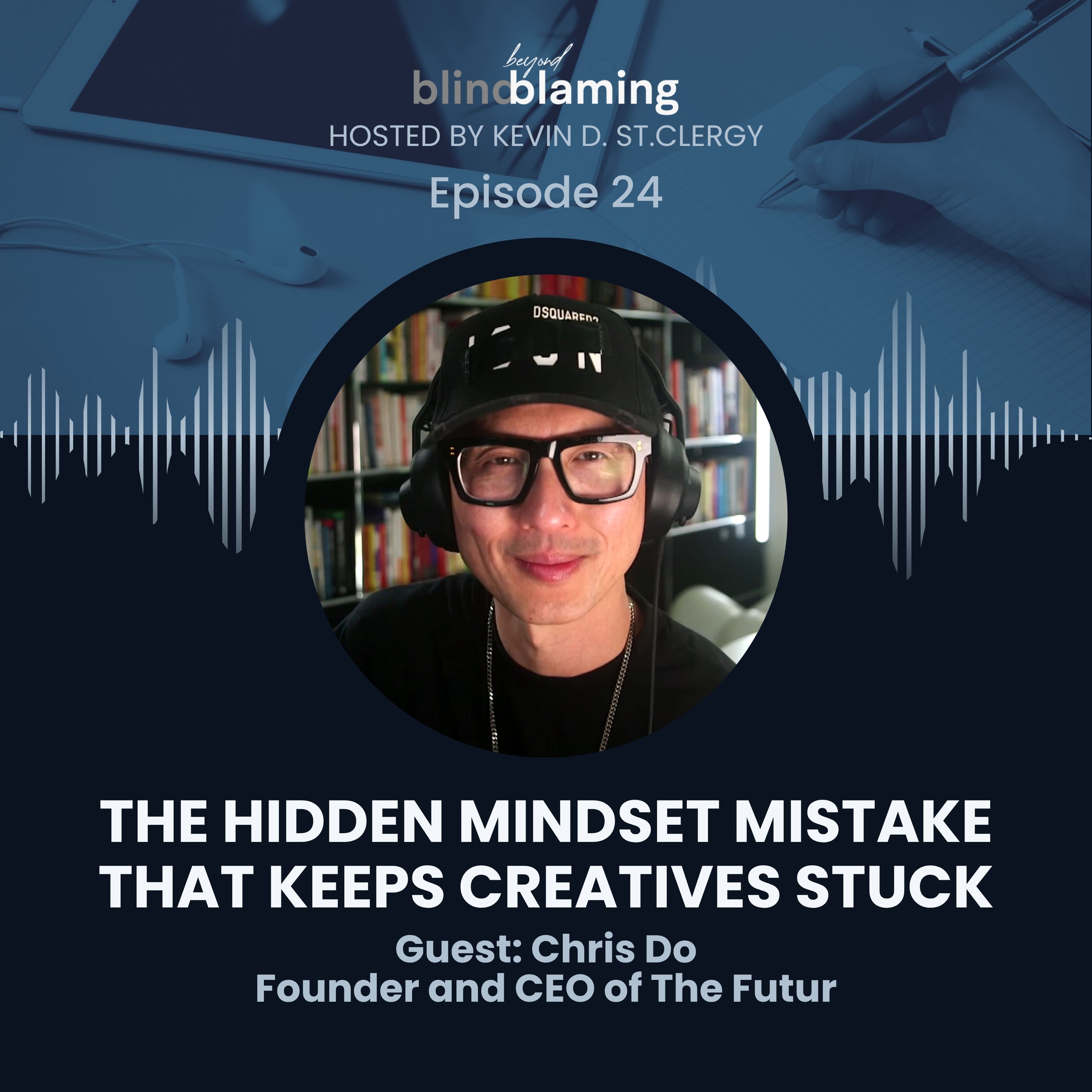
Beyond Blind Blaming
The Psychology of Pricing: Business Secrets Every Creative Should Know | Chris Do
00:45:36
Loading summary
Transcript57 lines
- [00:00]
A
I look at limiting beliefs as we're waiting to get permission from somebody, somewhere to do something that we should have always done. And when we find the right person to say the right thing to us, it's almost as if someone gave us a skeleton key to open all doors. Most people are stuck because they are so familiar with the world in which they've created for themselves, not realizing that everything else is possible.
- [00:21]
B
Today I'm joined by Chris Do. Chris is an award winning designer, entrepreneur, educator and the founder of future, an innovative platform that helps creative professionals thrive in business. Chris has built a global community of creators, teaching them how to bridge the gap between creativity and profitability.
- [00:38]
A
And I had to tell them the truth. And I know in the past if you hem and haw, if you're like beating around the bush, it's a sign that you're not a very trustworthy person and you're probably going to make up something coming out of your mouth. We get the project and it turns out to be the highest amount we've ever been paid to do a logo before. It's a six figure logo assignment and as we're working with them, Ben later on finds out. Why did they hire us? Why did they hire us?
- [01:11]
B
Welcome to Beyond Blind Blaming. This is the place where we explore how easily hidden truths can hold us back, trapping us in cycles of frustration and blame, often without even realizing what's truly stopping us. Each week I'm joined by experts and professionals who share their journey of taking back control of their story and overcoming hidden challenges and discover how to stop blind blaming from dictating their outcomes. The insights you're about to gain will help you see beyond your current limitations, find the courage to seek new perspectives, and ultimately live a life that's both purposeful and powerful. So if you're ready to break free from blind blaming and discover what's possible, you'll definitely want to listen to my next guest. I'm your host, Kevin St. Clergy and today I'm joined by Chris Do. Chris is an award winning designer, entrepreneur, educator and the founder of Future, an innovative platform that helps creative professionals thrive in business. With over two decades of experience in brand strategy and design, Chris has built a global community of creators, teaching them how to bridge the gap between creativity and profitability. His superpower is demystifying the business side of design, helping people build confidence, raise their value, and master the art of selling their creative work. Whether through his online content, public speaking coaching, Chris has impacted millions, empowering them to think differently about business, design and their Own potential. Chris, welcome to the show.
- [02:33]
A
Thanks for having me, Kevin.
- [02:34]
B
Well, let's start with your journey. What inspired you to transition from running a creative agency, which I couldn't wait to talk to you, because I actually owned a digital marketing agency for 20 years, which we had creative people in the group, to becoming an educator and mentor to other creatives and other business owners.
- [02:50]
A
It was by accident that I went on this other journey into creating content and taking my experience in teaching at private school online. It was a buddy of mine, his name is Jose Caballer, and he said one day to me, I know you're interested in passionate about education, and I am too. And I have experience running a YouTube channel and launching digital products. Why don't we just team up and do something together? And the introverted me, the person who was very guarded and socially awkward and a person who was very private, wanted to stay that way. But he made me a very generous offer. He told me for very first episode, he said, all you have to do is sit there. You didn't have to say anything. I'll introduce both of us. I'll run the entire show. And he could do that without me. Saying a single thing allowed me to slowly grow into that role as a host or as a co host, and the rest I was able to learn as I was doing it.
- [03:38]
B
That's cool. I love it. That's a great story because you don't seem like an introvert. Just getting to talk to you briefly before.
- [03:44]
A
Yeah, I'm a recovering, I guess, introvert. Maybe I'm really an ambivert more than an introvert.
- [03:50]
B
Well, your platform, the future, if I'm saying it right, has grown into a massive educational movement for creative entrepreneurs. What was the turning point when you realized this was your true calling?
- [03:59]
A
I think there was a very critical moment in the history or the timeline of us creating content at the very beginning when we started creating content on YouTube to promote and talk about our products. And it felt a little bit off to me, like this feels like some kind of complicated marketing ploy to get people to spend money with us. And we got neither result. We didn't grow our audience very fast, and we weren't selling a lot of products. So one day I said to my business partner at that time, Jose, I said, hey, what if we just showed up and tried to teach something? There's no pitching, no selling, no tie to any products that we make. He goes, okay, I'm game to do that. And by doing so, we would prepare all night. And I literally stayed up to two or three o'clock in the morning. The night before of us going live on YouTube and we recorded this episode and the episode, I think it was either my first portfolio or how I did the branding for a specific project. And that video started to take off and then I knew we're onto something here. This is going to be something that's going to work for both of us. And that's when I started saying, this feels fun. This feels very rewarding, spiritually, emotionally. And I think I could do this for a long time. I need to figure out the business part of it. But on an emotional, artistic, creative sense, I was getting everything I needed.
- [05:09]
B
That's cool. And have you learned that by providing that type of content that people still seek you out and want to work with you?
- [05:14]
A
Yes. At first, there's this long play where you're just creating content and building audience and they become a little bit curious about what else you're doing. It's not directly leading to any real work opportunities. It takes a long time for that to mature. But here's the cool thing. About two and a half years into it, I launched my own first digital product, a course called Typography 101, or Typography 1. Basically teaching the things I learned at private art school and sharing with people. That course did $100,000 in the first week, and now it's done over a million dollars in sales. So it's worked out pretty good.
- [05:45]
B
Well, I'd say so. Congratulations. Yeah, it's hard sometimes to get people to play the long game, though. I'm seeing that with, well, not just the younger generation, but I'm seeing it with everyone. I think we live in a world of immediate gratification, so I'm always trying to teach people to play the long game. And you said two and a half years, which was a little surprising for me. I really thought you would say about a year, but 30 months is a good thing. And which is kind of right in line with another coach that I have who says, look, if you're going to do anything, do it for a thousand days and watch what happens.
- [06:16]
A
That sounds about right to me.
- [06:17]
B
Sounds like you proved that one right. Blind blaming is about blaming the wrong things and sometimes trying to fix the wrong problem perfectly. And I've seen many creators that blame the industry competition, pricing pressures for their struggles. But I've also seen customers who blame creative and marketing for their problems, too. But from your experience, what are the real reasons most creatives struggle with business?
- [06:40]
A
Oh, boy. Let's see how long this episode's going to be. Now I'm speaking to my people and I'm also calling out things that I've done in the past or things I thought about. I'll tell you the first belief that we have, which is if our work is good enough, we don't have to sell. And so we put it all on if the work is good enough. And we don't invest any energy into marketing, into promotion and doing public relations, into networking. And so we just expect work to fall into our lap. And I was the same way. I graduated the top of my class from Art center, very prestigious design school here in Southern California. And thinking to myself, I don't know why I was so deluded that people are just going to know to call me. Outside of a few friends and maybe a couple of teachers at school, no one else even knows that you exist. So it takes a bit of work, a little bit of luck for opportunities to happen. We blame the market, we blame other kinds of things, but we're not taking responsibility for. You got to put yourself out there in every shape, way and form. And it takes a lot of work.
- [07:36]
B
To do that, because if you're not, someone else will. I've seen mediocre creative people or digital marketing agencies or any other company or product that are great marketers, outperform products that are 10 times better over and over and over again. Yeah, and that's kind of part of the blind blaming concept. Once we get to the real root cause, the reason you're not growing is because you're not marketing enough. That's when everything changes. And believe it or not, I'm from the medical field, so I was an audiologist, completely different from what I do now. I consider myself a breakthrough specialist because now we get to the root cause of any issue people have in their lives. But the same thing was applied for doctors. And I think it's just for any professional, not just creatives, but doctors, lawyers, et cetera. They think just because they have this high education that patients or people are going to choose them every time. And it sounds like you learn very quickly. That's not the case.
- [08:26]
A
Yeah, in a lot of instances, especially if you're an independent creative business owner or service professional, there isn't somebody who's going to just anoint you as the one to follow, the one to give all the work to. And so you have to go out there and you have to fight tooth and nail, and you have to develop those skills about copywriting, learning how to do Marketing, building your brand and investing. I would think, on the conservative side, 20% of your energy towards building that. I'll tell you the second thing that I hear a lot about people blaming, which is, sure, what you're doing works in a very specific market in Los Angeles, in America, in a very specific time. So they're adding so many conditions to that. So they would say something like, well, I live here and it's a developing country and this cannot happen. You don't understand the market and the place. My usual response to that is, do you know somebody who's in your market who's done really well, like, really, really well, like, on the global stage? So I was speaking in Cairo, Egypt, and I brought together a slide with me, and it had a picture of a man. His name is Karim Rashid, and he's a very famous industrial designer who is sought after by so many different people. He's Egyptian, so it's like he can compete on the global stage against every other industrial designer out there, and he's doing really well for himself. So you're saying it can't be done, like, well, no, no, it's not. I'm not saying. So what are your excuses now? Well, the people in this market can't accept these terms. They're so backwards in their thinking. Then I asked them, is your market limited to where you live? Then we have this thing, it's called the Internet, and you put out some work. And I'm literally working with someone right now who I've never met. I've spoken to one time on Zoom. The rest is through DMs. And she lives in Italy, whereabouts I don't even know where she lives. She was referred to me by someone else that I trusted. And so now we're working together.
- [10:07]
B
That's really cool. It is interesting how we just default to blame, which is. I've got a new book out called Beyond Blind Blaming, and we talk a lot about cognitive biases and how they can shape how we think. Which brings me to my next topic for you, because as I read about you, you talk a lot about the importance of mindset. Can you share a time when you or someone you coached realized they were stuck because of their own limiting beliefs rather than those external factors that you just talked about? And that's pretty much what you're just talking about. But can you think of another story?
- [10:38]
A
I could tell you about my own personal story. I look at limiting beliefs as we're waiting to get permission from somebody, somewhere to do something that we should have Always done. And when we find the right person to say the right thing to us, it's almost as if someone gave us the skeleton key to open all doors. And I'll give you an example. I used to hate pitching and selling, because I was in that belief, like, God, this is so gross. Why do I have to pitch and sell? Our work is excellent, and we're. I mean, literally at that time, probably one of 20 companies in the world that could do what we do. It's a very unique time. Mid to late 90s, everybody, for context, okay? And so when I met with my business coach, the very first and last business coach I've ever had, he asked me to walk him through how we pitch. And I went through this whole thing quite proud of myself, because at that point, I think we're doing close to $2 million in annual sales. So I was like, we know what we're doing. And then he kind of just nodded patiently. And then he said, how do you know what the clients want? So what do you mean? He's like, well, in your whole process, unless you're forgetting to tell me something, you've never once asked the clients what they want. He goes, kier, that's his name. You don't know how this works. They give us a brief, they tell us the script, and then they're like, what are your ideas? And then we respond, that's how we're supposed to do this. He goes, well, why don't you ask? And I was just thinking to myself, it felt crass. It felt like I didn't know what I was doing to ask what it is that they want. It felt so like. Like I'm at a diner saying, what do you want with your pizza? Do you want drinks with that? Really? But he gave me permission to ask a really direct question. What is it you're hoping to have happen? What have you tried in the past? How far of a deviation do you want to go from where you were in your last campaign? So he just gave me permission, not even the questions to ask. And I tried the first time. It didn't work that well. I came back, and he gave me some more advice. I'm like, oh, let me try it again. I never looked back. After the second coaching session, and after that, we were closing jobs we could not win before. Our ceiling at that point was around $200,000. Once I learned how to ask questions and build rapport with the prospect, I was able to close jobs that were 4, 5, $600,000 in size. And it just Felt easy after that point. So that's the limiting belief. My limiting belief was as the creative auteur, I'm supposed to just know intuitively, emotionally, artistically what they want by just reading things and making a lot of assumptions. So when he gave the permission to ask, I did that. It worked. I tested it by training my team. It worked for them. So I knew this was a real thing.
- [13:03]
B
I think everybody has that fear of being that guy or gal that's just the sleazy salesperson, and it's a big fear. I don't know if you've ever read a book called Selling with Noble Purpose.
- [13:14]
A
No, I haven't.
- [13:15]
B
It's one of my favorite books from last year. I had her on my podcast. Lisa Earl McLeod, fantastic guest. If you ever need somebody to talk. Amazing woman. Incredible book. My favorite part of that book is when she talked about we always look at revenue and sales, and she calls them lagging indicators. I won't ruin it for you. But she basically says, look, if you sell with noble purpose and everybody on your team has a good way of doing things, like you said, a better process in place. But she goes a little deeper than that. I think you'll enjoy it, and I think our listeners will as well.
- [13:47]
A
Sounds good.
- [13:48]
B
Well, in your coaching and teaching, what are some of the most surprising blind spots that hold creative professionals back?
- [13:54]
A
Most people are stuck because they are so familiar with the world in which they've created for themselves, not realizing that everything else is possible. And so it takes a little while to get them out of that space. For example, one belief is, how much is this work worth? They assume there's a maximum, and they found the maximum. And based on whatever dimensions or criteria they're measuring this against, they say, this is it. So somebody who's a friend of mine who now works for me, her name is Carrie. And Carrie told me, you know, for the kind of work that I'm doing with the coaches, I'm building sales funnels. I'm building websites for them. This is all they can pay. And I don't remember the exact number, but let's say it's like 10 or 12 grand. She goes, that's all they're willing to pay, Chris. I'm like, how do you know this? She goes, well, all throughout the Facebook groups that I'm in, all the coaches and all the kinds of people, this is the number that's talked about a lot. Okay. And I asked her, you know, what people say publicly isn't really what happens. You know that, right? And she goes, yeah. So sometimes they withhold things or they exaggerate things and we just don't know. We won't know until we try. One fact, I'm coaching somebody right now who does almost exactly the same thing that you do, but he's charging 30 grand. She goes, there's no way. That's not true. I said, look, I'll send you his website. Why don't you look at it? And it took her a minute. She was going through it. She goes, yeah, it's pretty much the same. So you're telling me it's 30 grand? I'm like, yeah, you could charge 30 grand to do this work. She goes, okay. And so she tries it out on the next couple of calls and she's so excited, she calls me back, says, chris, you won't believe it. I'm like, what? What won't I believe? She goes, it works. There's actually they're willing to pay me not 30 grand, but they're willing to pay me 28 or something like that. I'm like, that's incredible. Congratulations. So she went on this period of like winning so much work that we stopped talking for some time. But I did call her back. I said, you know, you remember when we had that conversation about this other person being able to do it for 30 grand? She goes, yeah. How did you know I was telling you the truth? What if I just made up a number to show you that it's possible? You have no way of verifying that. And she was just like mortified. And she asked me this question. She said, you wouldn't lie to me, would you? I said, I might if I got you a result that I wanted you to get. But I didn't lie to you. But you had no way of verifying. I could have said 100 grand and you would have went for it. So so much of what we believe to be true is just a figment of our imagination with too little proof.
- [16:14]
B
I agree. And a lot of times it's driven by emotion. I think we have negativity bias where we're so scared that we focus on more of the negative things that we can't grow. We have some very high end mastermind groups, 25, 50, a hundred thousand and above, and even some private coaching clients that are paying that. But I can say that five years ago I wasn't comfortable asking for that. But I had a coach who said, what's holding you back? And we kind of really worked through it. So it's. I love the questions. You're asking and how you did that, because you actually answered my next question, which was, pricing is a huge challenge for many creatives. And you just answer the question of what's the big misconception when it comes to charging what's fair for their work and what they're worth.
- [16:53]
A
Yeah, well, I want to speak to creative people specifically. If you go to design school, if you're talking to anybody, they'll say, what are the two most important things you need to have to be a creative person? And it generally boils down to two things. Empathy and imagination. Empathy, because we understand what somebody else is going through. A client, a customer, or their clients or customers. And then we have to imagine some kind of better future. Brian Collins says this brilliantly. He says designers rehearse possible futures and to pick the most optimal one. So they rehearse in their mind different logos or different marketing campaigns or different visual design. And they say, based on all those, I think the one that's going to be the best for you, that's going to have the best results is this one. And they present that. And so when we talk about pricing, we forget imagination and we forget empathy. Because when we say, well, how much should this cost? And it's a trap question because of the way language is structured, right? Cost implies the expense in which you use to make something. So we're already trapped by the clients asking that question, how much does this cost? Which is some variable of materials and labor? And we think to ourselves, okay, what is my time worth? My time is worth $100 an hour. And if this takes a hundred hours, I guess that's $10,000. So we'll charge $10,000. See, the problem with this approach is you've not once spent any time thinking about what is the value or the impact that this is going to have on the buyer. Because not all buyers are the same. Not all buyers want the same things aesthetically or will have the same results. Given the work that you do. This is real interesting. And Gary Vaynerchuk said this years ago. He says, you know what? Basketball sucks. I love basketball, but this basketball, I can't make any money off this basketball. In fact, it's caused me like 2 Achilles heel or 2 ACLs or something like that. He goes, it cost me negative money right now. But if you're saying this basketball is worthless, then you're wrong, because LeBron can make a billion dollars off this basketball. So even though we have the exact same solution, each and every single one of us applied differently. We'll have a totally different result. So it requires some empathy to say client, what is it that you're looking to accomplish if we were to do this and does it really move the needle for you? And if it doesn't, then maybe we shouldn't pursue this thing. And if it does, if it moves in a big way, I'd like to be able to capture some, a fair percentage of the value that was created by what it is that I do. And so we have to switch away. So it's like when I tell people when you price based on your time, you're doing a very selfish thing. You're just thinking about yourself, what you think your time is worth. You've not spent any time empathizing with the other person. Because a small mom and pop is going to have a very different value system than say a Walmart. Very different. But your work could be exactly the same.
- [19:40]
B
I love it. Now when you're talking about those things, I can totally see some creative people or anybody that's kind of a little nervous about selling without feeling salesy. What do you think is the key to selling with confidence while staying true to your values? You've given a couple of them, but I want to take it a step further.
- [19:57]
A
Yes. I think a lot of us have really negative images of what sales is like, mostly because they've been perpetrated by people who don't have the exact best interests in mind. They have an agenda. Their agenda is to hit a quota to close you so it can move on to the next client. We have the image of a used car salesperson or a timeshare person and it's not good. They employ a lot of psychological tricks and manipulation to get you to take an action that's not in your own best interest. So when we have that image of what a salesperson is, none of us are going to want to do that. It's like you're a mercenary for hire and you kill innocent people. Well, no one wants that job. So what we have to do is we have to reframe what sales means. Our center, professor Eric Garrison talks about it this way. He says sales is like I have an excitement for something and I want you to get excited about the same kinds of things. And if you're not, then we shouldn't work together. And if you are, then let's do something beautiful together. That's one way of looking at it. But the way I reframe sales is it's a permission based approach that's handled through conversation to align interests that's it. So your main job in the sales conversation is to understand what the person's going through, where they are in their business, where they'd like to be and what's getting in the way. And if it's something that you can do and help them with, then you should. And if you can't, you should refer them to someone else. Or if they desire a solution coming in pre diagnosed and prescribing a solution that isn't good for them, you have a moral and ethical obligation to tell them. You're free to do whatever you want, but based on the problem that you have, pursuing this solution will not likely lead to that result. I just owe it to tell you this piece of information. You do with it as you wish. Right. And so this is the conversation that we have around sales. So we just need to ask people, where are you now? Where would you like to be and what's getting in your way? And work through the problem with the client by asking really good open ended questions.
- [21:52]
B
That's great. There's a guy named Dwayne Sparks, not to mention another book. But I love to read and you clearly do because I can see behind you. But he wrote a book called Action Selling and he's also wrote a book called the Book of Questions. And I made more money than I ever made back then as an employee when I was in sales by reading that book. It's a fantastic read. They also taught me that training programs are kind of worthless and you have to come up with certifications. So he really changed the way that I train people in the future because we have weekly classes, weekly quizzes, homework assignments, and it's usually around 14 weeks long. That's how we were able to have a transfer of skills and knowledge. And they taught me that from that. But it's called the Sales Board dot com. I think he's on Amazon now. But he talks a lot about asking questions. But going back to what you were saying before, it sounds like you've mentioned, and I loved it, that sometimes clients aren't a good fit. And I think creatives need to be aware of that. And I think it's okay to say no, but talk to us about when you find a client that's not fit or you can tell on the call that they're probably not going to do what you've recommended. And I think it's okay to say, listen, I don't think we're a good fit. But I found that a lot of professionals and I want to know if you've seen that in creatives, too struggle with saying, listen, I don't think this is a good fit. Talk to us about that.
- [23:09]
A
I think to be able to say, this is not a good fit, you must have first clear definition as to what a good fit is. You know, when you're younger, somebody might have asked you, maybe it's your mom or your dad. It's like, you know, if you meet your ideal mate, who are they? What do they look like? And some people have no idea. They're like, I don't know, rich, poor, this or that. They just don't know. And then some of us really sit down and write on a piece of paper exactly who we think we're going to fall in love with and say, I want to spend the rest of my life with that person. So I'm going to give your audience an exercise to do. I want you to think back on the last maybe two years and think about the client experiences that were the most enjoyable for you. The one that beyond money, gave you joy to work with, that, when they called it, put a smile on your face. And when they asked for a little bit more, you were happy to give it to them and to sit down and think of the experiences that you've had. Was there any commonality, Were there any kind of specific traits or things that they did or didn't do that allowed you to feel this way? When I work with a group of people in sales training, I'll ask them that, and inevitably we come back with very similar things. Number one, they trusted me. That's a big thing. And trust means different things to different people. But the umbrella word is trust. The action is, they allowed me to lead the engagement. This is really important. So if you're a creative person, if you do pest control, the client says, what is the best solution for this? What do you recommend? And they go with it. That's really important. Number two is they pay you what you're worth. In fact, they pay not just what you're worth, they pay a premium. And number three is they value their time immensely because clients who have too much free time tend to sit around and ask you too many questions that erode trust, that go against the whole principle of paying you a premium. And I talked to one student or person who attended my workshop. He's like, why do you talk to your clients so much? Let me just make an educated guess. Are they a little bit older? He goes, yeah. Are they of the retiring age? He's like, yes. How did you know? I'm like, well, what do people who retired have a lot of an abundance of? They have a lot of time, they have a lot of curiosity. And if you are selling a lot of time and curiosity, super. But if you're trying to get business done, this is probably not your ideal client. So look, here's the cool part. Everyone who's listening will write a different list and just think about the top three things that you think are common traits of people who are a pleasure to work with. So we figured this out ourselves. We like discerning buyers of creative work. They have very high taste and standards. They know what excellence is, and because of that, they know the premium that it commands. We love discerning buyers. We don't want someone who's like, yeah, red, blue, green, purple, it doesn't matter, it's all good to me. Oh, big, small, doesn't matter. It's all the same to me. Well, that kind of person doesn't care at all. And they're going to probably pay the least amount of money. So we want people who are very discerning to buy our work because we know then that what we charge they'll agree with. We also want people who make really clear decisions, like they're decisive. This is very important to us. Somebody who comes to us and says, ah, let me run this by three, four different people. Let me get their opinion, let me get a third fifth opinion. It's like, you know what? Obviously you don't respect your time, and if you don't respect your time, there's no way you're going to respect my time. So if we walk into the conversation with this in mind, this is an ideal fit for me. The conversation will be structured around what are signs that they're either yes or no. And believe it or not, years ago, when we used to do client work, we literally printed out a decision tree or a map because my salespeople wanted to take every single client who rang. If you had a pulse and you had a dollar, we would take you on as a prospect. I'm like, this is not true. We want to work with very specific individuals. And so we told them to go through this tree and if you can get to the end of it and survive, that means we'll agree to a phone call. If not, say no and refer people away. There's a lot of power in saying no. I read somewhere that saying no gives meaning or power to your yes. If you say yes to everything, then your yeses mean nothing. So the more you exercise your ability to say no. When you say yes, it means a lot.
- [27:18]
B
I think so, too. My business partner tells a story all the time back in his agency days, because he owned a creative agency as well. I say yes to everybody and everything, and I had no time, and we weren't growing, and we were taking on clients that we shouldn't take on at all who were just the time wasters. So great, great talk and great things I want to go back to. Well, first, I want to talk about decisions, because I would love to send you a copy of my book, because there's actually a chapter called Decide, and we call it mfd. Because I had a client one time, and she was kind of hemming and hauling back and forth on a couple of things she was debating whether to do. And she's like, what do you think I should do, Kevin? You're my coach. I was like, well, I think you need to make an effing decision, like, now. And that was all I said. And she left and she came back. I used the F word, but she came back a good client. Been there a couple of years. And I said, well, how are things going? And she's like, man, I'm MFD ing all over the place. I'm like, wait, what? What are you doing? She goes, I'm making effing decisions. I'm deciding now, and I'm making them fast. I mean, I made some mistakes, but I've overcome them. But, yeah, MFD's changed my life, so there's one you can take away. But it got so fun at our mastermind group that a big group of people went back and they came up with MFD and des. If you make effing decisions, you will do epic stuff. Except they didn't use stuff, but it was a lot of fun. But I think you'll like the chapter on Decide, because I'm with you. You want to look for clients who are decisive. But going back to that, I think a lot of creatives get somebody who's lower on the totem pole, tell me if I'm wrong, that are fishing and they're coming to you saying, well, you know, I'm just. I was told to go out and find a solution. How do you get past that? I mean, do you ask them questions? Like, some of the things I used to say were similar to, well, walk me through how decisions are made at your organization, or I'm not specifically attacking that person and taking away their power, but how did you like to do it?
- [29:01]
A
I'd love to hear it, yes. So depending on the size of your business and who you serve, you could be talking to the founder or person many tiers down the chain of command there. And we have to realize that now if you're in the tens of thousands of dollars of engagement, chances are you're talking to somebody very high up in the decision making process. But as you get into the hundreds of thousands, into the millions of dollars, well, that person's time, whoever decides is very valuable. Therefore they have the C suite or VPs or Ps of something presidents and you're not actually there to connect with the decision maker. And a layer below that is a producer or coordinator or somebody who's just looking to get bids. And it's problematic when you work with them because they have a job to do and they want to do their job efficiently, not effectively, just efficient, like get this thing done. And so they're like, okay, I was told to get five bids, I got five bids and then I'll let someone else decide. They're not paid enough to decide, they're not given power to decide. So that's problematic. So if you were to encounter someone who you get a sense and you can usually tell by the title, you can usually tell by the age because there's not going to be a 19 year old founder, not very often, but generally speaking they're a little bit younger and you can just tell because the quality of the questions they ask betray their experience and you can tell. So if you talk to somebody like that, I think your question is excellent. Tell me how decisions are made in your organization. I would also possibly ask who else needs to be in on this to make the decision and what concerns might they have? What has typically happened in the past once we're finished doing what we need to do and is there anything I can do to assist you? So I'm not trying to make them the enemy. I want to be an ally. And this is very important because I don't care what station you are in your Life, if you're 50 years in your business or your first five months, everyone deserves to be treated with respect. Because if you disrespect the gatekeeper, you're basically sabotaging yourself. I know many CEOs who do this trap, right? They have an assistant or a secretary or somebody like that. And depending on how you treat that person, who then gives the boss person the report, you're not good person, you don't treat people with respect and you're going to get eliminated off the list. And I think more people should do that, because how you treat the person that can do nothing for you determines the character of the person of you, basically. And so if you can do that, that'd be great. Oftentimes I think it's called selling the ghost in the room. So there's a ghost, and the ghost is a supervisor, a boss, somebody else who's involved in this and say, if they were here, if the ghost were here, let's put our hands together. If the ghosts were here, what would they say? What kind of questions? Who else did you need to consult? What other questions might they have? And typically, how has this fallen apart in the past? We're trying to avoid all those things. So the more we can engage the prospect at whatever levels they're at and find out useful information, you gain the inside track. It's just a little bit of information goes a long way. Because if you knew, and this has happened to us before, one person said to us, I have discretionary spending power or buying power of $200,000. If it's 201, I got to get approved. I'm like, we'll come in at 199, no problem. They can approve it right away. But if you don't engage in rapport with them, if you don't make them feel respected, you're not going to get them to trust you enough to tell you these kinds of things.
- [32:17]
B
Yeah, I love it. We used to try to get to know those people, too, and ask them other questions, like, what do you like to do when you're not at work? I think a lot of people just go straight into work mode and they forget that people are people. But what I heard you describing is how you do anything is how you do everything and people notice. One of my favorite quest factors. I wish I could turn my camera because I look at it every day to remind me how you do anything is how you do everything. I want to go back to the trust thing a little bit because it's something I feel strongly about. When I had my agency, what I figured out was if I did a good job of building trust by providing good educational information and content, that people would start to trust me before they get on the phone. How do you recommend creatives build that same thing like you've done with your organization that took you two and a half years to get that trust. But how would you recommend that they build that trust before people even get on the phone?
- [33:03]
A
Okay, this is going into a lot of social proof, transparency, and a little bit of vulnerability. I always tell people, beware of perfect people because perfect people are always hiding something. For example, if we look at Amazon reviews and we look at a product we're thinking about buying has nothing but glowing reviews all over the place, I'm a little suspicious. I think they can't have all happy customers. I think there's a study or report about this where they find that the best reviews and the worst reviews give us a better shape of what this product is like. And so when we don't see those negative reviews, we're thinking this feels fake for some reason. And how do we also know this when we look at celebrities who are a little too perfect? They have a statuesque figure, they have perfect glowing skin, they seem ageless and they never say anything wrong. They have perfect teeth and a smile and they're always kind and nice to everybody. We're just waiting for the house of cards to fall apart and eventually it does. Recently, I don't want to pinpoint any one person, but and I think Ellen DeGeneres has been canceled because she comes across as a very likable, personable person who cares about people. In fact, she treats everyone horribly and she's tried to reboot her career twice now and it's not happened because eventually the truth will get out. So I would say for all of you who are creating content out there, go ahead and share your wins, but make sure you share some of your hard earned lessons because I think that'll galvanize people and say, like, you know what, I think I can have a cup of coffee with this person. I'd like to hang out with them. And so it begins there. We also take into consideration social proof as a means to assess if somebody is somebody we should spend time with. And so try to put a spotlight on as much social proof that you have. If you have certain the easy things, degrees, if you've written books, if you've won awards, if you've spoken on stages, if you worked with high end clients and you have great glowing client testimonials, and most importantly, if you have great case studies where you show the before and after and literally talk about the things that you had hand in, not take credit for things you did not, I think that starts to build trust before they get them on the phone.
- [35:05]
B
I agree. I love it. You reminded me of a story when we had a client who came to me and said, hey, look, I got to be honest, I met somebody that really wasn't happy with your service and she mentioned that person's name she said, what happened? I was like, well, we screwed up. Here's what we did, here's what the team did, and here's what we did to make sure that we don't do that again. And there was this long pause where I was waiting for, you know, sorry, we're done. And she said, you know, I'm really surprised, Kevin. I thought you were going to give me some corporate bullshit spend. I really appreciate your honesty, and it sounds like you did the right thing. And by the way, I know my friend, she can be difficult, which was funny. But she said, I'd like to move forward with you because of you being honest with me and telling me what really happened. And I'm like, really? Okay. But I remember because I was fairly young, and I was talking to my coach at the time, and he. He just told me a couple weeks before, just, kevin, if you screw up, be honest with people. Just tell them, hey, this is the mistake we made. Things happen. People make mistakes, and people are human. They know it. If they don't, probably not the best client to work with anyway, because you might make a mistake or you might show them something they don't like, and you'll be able to recover.
- [36:13]
A
I'd love to share a story to kind of reinforce what you're talking about.
- [36:16]
B
Yeah, go.
- [36:17]
A
A couple years ago, there was a client from back east, a large telecom company, and they wanted to rebrand. They wanted to make a new logo. And my chief operating officer was dealing with their second command. And they were just going through a lot of process of vetting us and the whole thing. And finally we're talking CEO to CEO at this point now, when I say larger, they're doing like $400 million a year. That's very large to me. Yeah. Okay. So we got on the phone, and my chief operating officer, his name is Ben. Ben's like, chris, any of the tough questions, you throw it at me. I'm prepared. He has pages of notes. He's been through this. And he's a. He's former military, former police. He's like, so ready. You can't. Believe me. I know a little bit about the project, not much else. And the CEO asked this really direct question. He goes, chris, did you look at our website or something like that? Very basic thing. I said on a cursory level, yes, but not much beyond that. And Ben's face turned white. He was mortified because he was like, chris, you could have just thrown it to me and I would have answered that question. I would have pinpointed everything that we've seen, everything we observed, and we get off the phone, everything's fine, and we always do our postmortem. And I said, how did it go? He goes, yeah, I think we may not get that one. I'm like, no, I thought the call went well. We have a very different interpretation of the call. He goes, man, it just looks like we didn't prepare. You should have thrown it to me. I said, I would have. If he asked, has your team looked at it? But he said, have you looked at it? And I had to tell him the truth. And I know in the past if you hem and haw, if you're like beating around the bush is a sign that you're not a very trustworthy person and you're probably going to make up something coming out of your mouth. And so later on we get the project and it turns out to be the highest amount we've ever been paid to do a logo before. It's a six figure logo assignment. And as we're working with them, Ben later on finds out, why did they hire us? Why did they hire us? And his contact said, because Chris was really direct. He was a straight shooter and we respect that. And I don't care if we win or lose a job. I'm not going to be a person who's going to lie to you. I have to tell you the truth.
- [38:29]
B
And I think it's okay to admit when you make a mistake, but you didn't make a mistake in that point.
- [38:32]
A
I didn't make a mistake.
- [38:33]
B
You didn't make a mistake. You're just being honest with him, which I think is great.
- [38:36]
A
Just being honest. Yeah. I was just telling him I find it dangerous for me to learn so much about you without talking to you.
- [38:41]
B
Yeah, I love it. Absolutely love it. Well, you've clearly learned to invest in yourself over the years. One of my all time favorite questions to ask every podcast guest is, what is your favorite way to learn? How do you develop yourselves? You mentioned having a coach, but you also said I caught it where you said it was your first and last coach you ever had. But how do you like to invest in yourself? What's your favorite thing to do?
- [39:01]
A
My favorite and lowest hanging fruit is to read books. I feel like I learned the most by reading books. And when I say read, I mean literally hold a book in my hand and read it. Not read the digital PDF version, not to listen to it, but really read it. I think I'm a much more visual person and there's Something that's very tactile to me, like, I need to touch it. I want to highlight. I'm right in the margins. That's very helpful to me. The biggest growth I've ever had was to work with a business coach, somebody I worked with for 13 years, whom I met with every single week for 13 years, barring a few holidays, I did that. The reason why I was like, I'm done, is because I think I learned everything I could from another person. And the rest is just me applying that for the rest of my life. But the best bang for the buck, the most value I've ever gotten in my life, was working with a therapist. I think I went to see my therapist. Her name is Joan Lightfoot. I met with her probably less than 10 times. But here's the cool thing about meeting with my therapist. She's a family therapist. So sometimes my wife would go and we would go and talk about things, about raising our children, how to improve our relationship was I got layers of knowledge condensed into an hour that I think I only paid a hundred bucks an hour for. So when we sit down, she would not only give me the tools that. That I needed to solve a specific problem, like my child's acting up. What do I do? She would tell me what to do. But what I got to do was to watch how she asked questions and made certain suggestions that felt like I could do. And her manner of communication, the nonviolent language, just her patience and the way that she did things. I thought I got a masterclass in therapy in coaching and teaching, and I also got the solution to my problem. So it was probably the best thousand dollars I've ever spent in my life, by far.
- [40:42]
B
I love it. I love to read, too. You can't see it because it's cut off, but I have a huge library. You got me beat. So I've got library envy. And just tell. I'm just saying. So I need to get to it. But I love to read every morning. But I'm really shocked at how many people don't read anymore. I. When I launched the new book, I launched it to my huge list, and everybody's like, when's the audiobook coming out? And I've had a couple of young kids say, hey, is it on video? So we're going to make an audio version, and we're actually going to make a YouTube version of the book. The important thing for me is get the knowledge out however anybody likes to. But I still think even my girlfriend's children, who are adult Children, I'm like, look, guys, just start with 10 pages a day. And what's really fun is when they start reading the 10 pages a day because I had them read this one book called the Mountain is you. The first chapter is on self sabotage. And one of her sons keeps doing something over and over again. I'm like, you're self sabotaging yourself, son. And I don't think you see it, but don't take my word for it. Just read these 10 pages for the next week. And he came back and he's like, I figured it out. I'm like, what? He goes, I'm self sabotaging me when it comes to money because we knew some rich people who were complete jerks. And I never wanted to be that guy. And I figured out that I'm starting to do things to make sure that I never get rich because I never wanted to be that guy. And I was like, that's awesome. And he goes, but I never would have figured it out if you wouldn't made me read 10 pages a day. I was like, well, I didn't make you do anything. I just suggested. So it was really cool. So I think more people should read Pass it on. I'm with you there.
- [42:09]
A
When I really think about and zoom out about the process of reading, it kind of trips me out a little bit. There's this thing called ideas. And ideas are codified with words, and words are abstract marks that don't mean anything to anybody unless you understand what those things are. But the thing I was thinking about was, like, say the word esoteric. How did the person who first had that idea translated into a word that was spelled a very specific way that you and I, tens, hundreds of thousands of years later, can use that word and access the same concept? If you really think about it, it trips me out. So when I read a book, I was thinking, this is probably the closest way that two minds can share a single space where the author writes thoughts codified into abstract symbols that you then decode and live in a space in your mind. And I just think that is one of the strangest things ever. That's wild, right? Like, you and I, we're communicating through the Internet right now through something called language and through words. And we have a pretty good approximation of what each other's thinking in this moment through combination of tonality, words, and our body language. But it trips me out. So when I sit there and read a book, I sit there and think, where was this person when they were writing this book? What was going on in their lives and what were they encountering and what was all the stuff that you can't read in the book? I try to imagine, like, what that's like, and it's just if I go too far, I'll probably never find my way back home. But it's just like, wow, it's.
- [43:34]
B
So that's what Saturday mornings are for, right? I mean, I'm with you because I'll sit there and, like, I wonder what this person's really like. And I'll stop reading and I go Google them, or I'll chat CPT and find out, you know, how. What's the original reason they came up with the concept? But I think what you're describing is something a lot of people don't do. Active reading is what I call it. I don't know if there's a formal name for it, but that's when you're have a pen in your hand and you're taking notes in the margins or you're writing. And I have a specific notebook for different subjects that I like, so I have them all together. And my girlfriend the other day was like, do you actually take time to go back and review it? Like, oh, yeah, you can talk to Christina. There's time in my schedule where we. We call it someday maybe time. And that's where I go pull out those journals and just review them. So that's what I like to do. It's worked really well for me, and it's getting even better with my new remarkable pro, which is the digital paper, because I love paper.
- [44:20]
A
Yeah, I've seen those. Those are awesome.
- [44:21]
B
They're really cool. Because I'm starting to travel a little bit more and do some keynotes, and I find that I can still have my notes with me when I travel. So that's my thing. Well, is there anything else you want to leave the audience with? I know we're getting to the top of the hour, and I want to respect your time.
- [44:34]
A
I want to encourage everybody that if you're feeling stuck and that most likely the answer's not from outside, it's from within. And if you start to look inside and hopefully you have a guide to help you navigate this, I don't want you to feel heavy by this conversation, to feel like you got to solve everything because everything's your fault, but to know that because much of what you experience in your life you created that you can then undo if you want to, but only if you want to.
- [44:58]
B
I love it. Great advice. And if they want to get in touch with you. What's the best way to get in touch or follow you?
- [45:02]
A
You can find me everywhere. On almost every social platform. At the Chris Doe and do spelled D O. So at the Cristo.
- [45:10]
B
Great. I love it. Well, Chris, thank you for taking the time out of your busy schedule to be with us today. Amazing conversation. You and I could talk for hours. I know it. But we got to cut it off so you can go do your thing. Thanks again for being here.
- [45:21]
A
Thanks, Kevin. My pleasure.