← Beyond Blind Blaming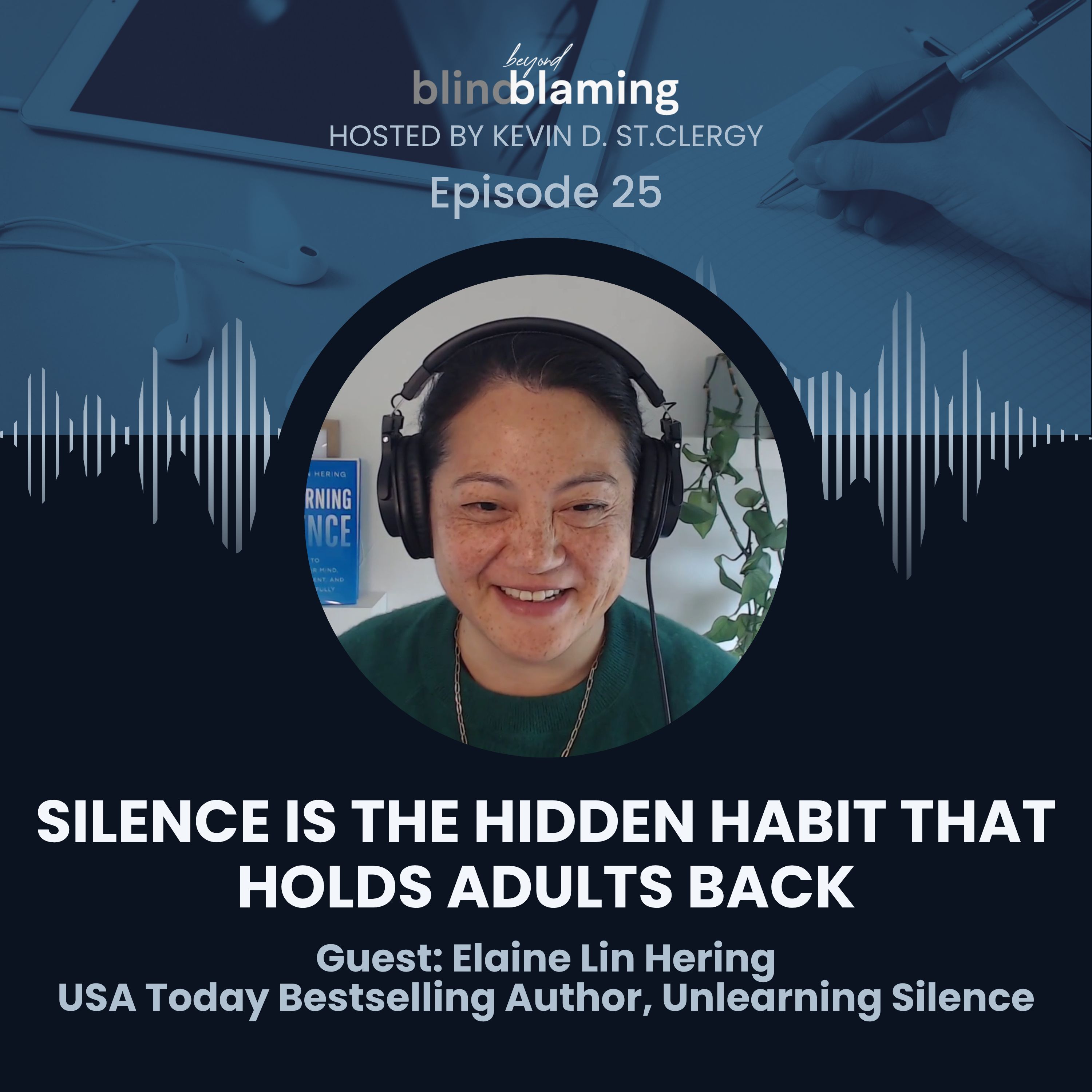
Beyond Blind Blaming
Unlearning Silence: Conversations That Transform Confidence | Elaine Lin Hering
00:49:11
Loading summary
Transcript113 lines
- [00:00]
A
The more that we ingest the wrong question, the more the conclusion can be, I'm the problem of stop telling women they have imposter syndrome. And it is another one of these instances where we take in the dominant narrative that exists in part because it's easy. But what if it's not imposter syndrome? It's imposter treatment.
- [00:21]
B
Today I'm joined by Elaine Lynn Herring. Elaine is a sought after facilitator, coach and authority specializing in communication, leadership and workplace dynamics. As a former lecturer at Harvard Law School and a managing partner at Triad Consulting Group, she helps organizations and leaders navigate tough conversations, build stronger teams, and drive impact and change.
- [00:44]
A
If we're not aware that silence is at play, then we internalize the message that oh, I'm just not good enough or I'm not scared, skilled enough. And of course, there's a whole industry that says you need more confidence, you need more courage. This is what you're doing wrong. And I love this connection to blind claiming of Are we even asking the right question?
- [01:19]
B
Welcome to Beyond Blind Blaming. This is the place where we explore how easily hidden truths can hold us back, trapping us in cycles of frustration and blame, often without even realizing what's truly stopping us. Each week I'm joined by experts and professionals who share their journey of taking back control of their story, overcoming hidden challenges, and discover how to stop blind blaming from dictating their outcomes. The insights you're about to gain will help you see beyond your current limitations and find the courage to seek new perspectives and and ultimately live a life that's both purposeful and powerful. So if you're ready to break free from blind blaming and discover what's possible, you'll definitely want to listen to my next guest. I'm your host, Kevin St. Clergy and today I'm joined by Elaine Lynn Herring. Elaine is a sought after facilitator, coach and author specializing in communication, leadership and workplace dynamics. As a former lecturer at Harvard Law School and a managing partner at Triad Consulting Group, she helps organizations and leaders navigate tough conversations, build stronger teams, and drive impact and change. Elaine's superpower is helping people see what they're missing, especially in high stakes situations where blind spots can lead to conflict or stagnation. Her work empowers individuals and organizations to recognize how they show up, take responsibility for their role and challenges, and move forward with greater clarity and impact. Elaine, welcome to the show.
- [02:44]
A
Thanks so much for having me.
- [02:46]
B
Well, I always start my shows off the same way. What led you to this field and why did you choose to specialize in dispute resolution, mediation and negotiation. What led you here? Because I can tell it's a passion.
- [02:58]
A
Well, I appreciate that because I think as many careers evolve, I feel like I fell into it. I went to Harvard Law School intending to be a litigator. And while I was there, I took the flagship negotiation workshop and realized, oh, we can talk about things and emotions are discussable. What a novel idea. That's certainly not the family or culture I grew up in. And so I threw myself into that world. And it turns out there's a name for that world called leadership development. Did not know that was not on the option set of careers or career goals growing up, but it really was this question of how do we get better at working together, at existing together, because whatever industry we're in, it seems like it's really the people problems rather than the technical problems that hold us back. And so I ran an experiment of can I make a living doing this? Am I actually good at it? I seem to care about it and seem to have some chops. And more than a decade later, the answer is apparently yes.
- [04:05]
B
Well, I can tell by the way you wrote and everything else is definitely successful for you and I'm glad you've been able to monetize it. I think you're right though, because we've done some work in the medical field. We've done a lot of work the last year and a half in just corporate America and small business and medium sized businesses as well. I think you nailed it. The people problem is one of the things that causes burnout and it causes people to not want to go into business or get out of their business sooner than later.
- [04:27]
A
Absolutely. And you could have the best idea, you could have the funding, and so often it is the relationships or having to manage a team that that keeps us up at night and in the end really leads to the failure of all of these ventures. And so for me, the aim really has been, look, let me be realistic. I'm not going to cure cancer, but if I can help that team actually communicate with one another and bring it to market, that's a win. Right? And so finding where is my role in the ecosystem, where might I have impact? And of course, being in leadership development, looking at what is the existing literature, what's being taught, and then in a spirit of continuous learning, what's missing, which is what led me to silence.
- [05:18]
B
I love it. Well, in your experience, what are the biggest mistakes people make when approaching some of those difficult conversations, whether at work or even at home?
- [05:27]
A
Exhaustion, you know, and maybe that's speaking from a point in time, but we as leaders tend to feel like we're supposed to be able to do these things. I'm supposed to be empathetic. I'm supposed to listen to my team. I'm supposed to take the feedback when our internal voices are screaming, ah, I can't. I'm just overloaded, overwhelmed. And so do we have that awareness of when, where, and how can we actually engage with one another in effectively, rather than feeling like these are the things we should do. Therefore, I'm going to go have the difficult conversation, even though I really don't want to, and I'm actually not prepared and the other person isn't either. We're not setting ourselves up for success by taking this just do it approach.
- [06:15]
B
So I like that. Now you're getting into some of the emotional intelligence work that I did years ago. I loved what you said. You're not ready for a conversation. So are you actually saying that people should prepare for difficult conversations before they go into them?
- [06:27]
A
That feels like the rhetorical question of the century. All of the research says that we do exponentially better in negotiations, in feedback, in difficult conversations if we actually prepare. And let's actually be clear about what I mean by preparation. Because writing out a script, I say this, they say that, then choose your own adventure from there. For some reason, the other person doesn't actually follow your script. I wonder why they didn't get the casting memo, whatever it is, versus what might be missing from this conversation. What curiosity might I have genuine curiosity, right? Not a I'm going to ask a question because Leadership 101 said ask questions. So much as we are only human and we approach the world from one vantage point, that could be our role within the organization. That could be my generation that I'm from. Our perspectives are legitimate and limited, just as anyone else's perspective is legitimate and limited. So the question is, how do we, as a team or in a conversation and relationship, put together the pieces? But if we don't realize that we might be missing something not because we're not capable or skilled, but because we're human, there's no room or no need for that curiosity that is so essential to actually cultivating communication.
- [07:48]
B
I love it. So what I hear you saying, if I got it right, is you trying to try to seek to understand and do you have any favorite questions that you recommend for people to ask? Because you did mention I love asking questions too, because it drives me crazy if I have people that I'm training or clients or even team members who are like, well, I told them. I'm like, well, try to get them to say it. What's the question you could have asked to try to understand a little bit more about where they're coming from? Like, my favorite when they're having problems with somebody or somebody's not performing is simply to ask them if they're okay. Mm.
- [08:18]
A
I love that. Are you okay? Actually gets at the emotional aspect of it. And this goes to. Are we talking just about technical things, or are we actually talking about the heart of what it means to be human? The are you okay? Actually leads me to probably the best thing I learned in law school that did not come from curriculum, which is a guy who sat next to me and said, are you okay? And I said, yeah, absolutely. And he could read me well enough to know that that wasn't actually true. And his response was, elaine, you know, it's okay not to be okay. Which my answer was, no, I don't actually know that. Because it has felt like to be professional, to be effective, to be in the running for certain roles and responsibilities and leadership positions, I have to be okay. Right? We look to our leaders to project some sort of competence, and competence we equate with being okay. So that question of, are you okay? And also, as we lead, are we making it okay for people not to be okay? Including us admitting when we're not okay? Which could just be, look, it's a hard day, or that was a rough one. But that emotional honesty means that we don't carry the weight of emotional dishonesty. To answer the question, my favorite question is, what am I missing?
- [09:43]
B
So I can't wait for you to read my book. Yeah, it says, what are we missing? Or is there something else going on here?
- [09:50]
A
Yes. Yes. And the something else, I would imagine, is a what else is going on here? Implication. There is always something else going on.
- [09:59]
B
And that's kind of at the core of blind blaming, which we will get to. But I would love to get into your book because I actually really enjoyed Unlearning Silence. Just a few questions. I do want people to get it. I always offer listeners. If you are having a rough month, this book is so important for you to read. Get the book. I highly recommend it. I loved it. I think it can help you in all areas of your life. If you're having a bad month and you can't afford to get the book, I will buy it for you. Just let me know. But in chapter one, you talk about the silence we learned on several different levels. Talk to us about that.
- [10:31]
A
Yeah, let me back up actually, because I think how I got to silence is important.
- [10:36]
B
Yeah, go for it.
- [10:36]
A
So I spent more than a decade teaching the frameworks out of the Harvard Negotiation Project, getting to yes, difficult conversations through your classic interest based negotiation theory. And despite what is valuable about those tools, some people after training and workshops still wouldn't negotiate, still wouldn't have the difficult conversations, still wouldn't give or receive feedback, no matter how much HR or their manager told them they should. And maybe you start to see the application to home as well. Right? Your spouse is telling you, here's the feedback and you're not ready to take it. Which begs the question why? And that's what landed me on silence, meaning we cannot unlock or unleash the other talent, the other skills and capabilities of communication and conflict management and collaboration if silence is undermining all of those efforts. So by silence I mean you feel like you have to bite your tongue in order to keep the peace, that your ideas, your interests, your needs, goals, hopes, concerns. There's no room in the relationship or on the team or in the ecosystem for them that to stay in the relationship, to stay employed means that you need to bite your tongue. And that causes all sorts of things I know we'll get into. So when I talk in chapter one about the silence we've learned is, in what ways was silence in your life rewarded? I'm the youngest daughter of an immigrant family from Taiwan to the United States. I share all of that because as the youngest daughter, I was expected to smile, keep quiet, and look pretty. Right? Kids are supposed to be seen and not heard. How many of those lines and repetitions are part of our own stories? And in school, of course, you're rewarded for being the good student. Meaning, don't ask questions, respond to the questions with the right answer. And the right answer is predefined. And so all of those habits actually become part of our instincts over time, which is why it's really hard to negotiate. Right. I'm not supposed to ask for things except for ask for permission to go to the bathroom or to take pto. If we're not aware that silence is at play, then we internalize the message that, oh, I'm just not good enough or I'm not skilled enough. And of course, there's a whole industry that says you need more confidence, you need more courage. This is what you're doing wrong. And I love this connection to blind blaming of are we even Asking the right question. Because if the question is, how do we get more confidence and courage, well, there's a whole world and industry that will tell you how to do that and make money off of you. But to me, the real question we have to ask and answer is, what role does silence play in my life and in my leadership?
- [13:24]
B
And it's interesting because I think there's a lot of people in leadership positions who like to surround themselves with people who are silent.
- [13:32]
A
Yes.
- [13:32]
B
And I think it's a mistake. In our first day of employment, we always tell people, look, no sacred cows. If you see something, say something. We want to know. In fact, we rewrote the chapter. There's a couple chapters in there that we actually have people read first now about taking responsibility and stop blaming and complaining and adapt a growth mindset, which I think is what I heard you describing, where you take feedback as not a personal attack, but as a means to an end. We want people to be able to accept that. And I love Carol Dweck's work, by the way.
- [14:01]
A
Absolutely. And if we're going to say, if you see something, say something, then we need to be receptive to it.
- [14:09]
B
Right, Right.
- [14:10]
A
It's not just someone says something. What everyone is worried about and what keeps us silent is, well, what's the retaliation? What's the defensiveness that I have to deal with? So our responsibility and why I'm looking at silence both as what have I learned and how do we do it to each other is because if your response in that moment is defensive when someone does say something, that creates a culture of silence.
- [14:34]
B
And I think what you're describing, as you'll see, not that I want to talk more about yours and mine, but there's something I discovered called the blame loop. And when people are stuck in that blame loop, it's almost impossible for them to see a different way of doing something and making them aware of it. I have things I've called insight and visibility. Sometimes it's physiologically impossible for us to see a solution, especially when it comes from somebody else based on some things I call behavioral bedrock and things like that. So it gets really hard. It's all the cognitive biases that you know about. I just kind of put them in a different format. But it gets hard. But I think you're right. Just like your mission and values can't be just a plaque on the wall, they've got to be something you live every day.
- [15:14]
A
Yes. And that if there is any loop, that also means that there are multiple points where we could break the cycle.
- [15:23]
B
So you talk about how silent leads to other things and a lot of them weren't very good. Like silence leading to self doubt and some other things. Talk to us a little bit about that.
- [15:32]
A
Yeah. The more that we ingest the wrong question, the more the conclusion can be I'm the problem. Right. And one of my favorite articles is the Harvard Business Review article by Ruchika, formerly Tulshan, now Malhotra of stop telling women they have imposter syndrome. And it is another one of these instances where we take in the dominant narrative that exists in part because it's easy. But what if it's not imposter syndrome? It's imposter treatment. Right. What if it is not? We need to speak up more. It is, what role does silence play? Because if we've learned silence, it's not because we made it up, it's because we were rewarded for it. You mentioned it with the leaders who like to surround themselves with yes people or quiet people. It certainly makes life easier in the short term. There's less friction. You can click out of the meeting because no one has questions. But the costs of silence are revealed on a different timescale than the cost of speaking up and talking about multiple leverage points in the loop. We can actually reduce the cost of speaking up if we are willing to listen.
- [16:39]
B
Well, now you're talking about something else I love, which is that's actually a sign of my wall. Deciding to commit yourself to long term results rather than short term fixes is one of the most important decision you can make in your life.
- [16:51]
A
Yeah. And are we playing on that long term timescale? Because present bias is always at play. Right. We as human beings are focused on our survival now versus, you know, two months from now is not guaranteed. But how we lead also incentivizes the people around us to play on a certain timescale.
- [17:10]
B
Well, you do go on in the book to talk about how to use silence in good ways and mention some strategy like releasing guilt, which really hit home for me because I can't tell you how many times in my career I've said, oh, I should have said that a different way, or I shouldn't have spoken up, I shouldn't have said anything because I did get that backlash. I think there's a lot of organizations out there who don't see conflict as a good thing and they squash it, causing more silence.
- [17:36]
A
Silence is at the bedrock of groupthink, or what researchers call organizational silence. Employee silence, the collective phenomenon of saying nothing because it's not worth it. And that to me is the opportunity for how we lead, what we incentivize, what timescale we're playing on and. And really therefore what culture we're creating. Now, if we take your point of values not just being a plaque on a wall, but something that guides us and how we lead every day, that's really the clarity for each of us. How are we leading? How are we living? Which of course becomes your life and your legacy. Right? But do you have that clarity? Because otherwise, the busyness of the day, the overwhelm of the different demands, the volatility of the market, all of that is just pulling us in different directions. And I talk about it in unlearning silences. Everyone else is clamoring for your voice. Everyone else has an opinion about what they want you to do, as they should. And the guard against that is, do you know what you stand for? Do you know what you care about? Are you driving and living your life with the agency of actually being you rather than just being responsive to the demands and that other people might have on you?
- [18:57]
B
That's awesome. And I'm so glad you brought that up, because in our coaching, we actually try to help people when we are digging deep to find out what else is going on, like we talked about in the beginning, we get into their purpose, their values, their principles. And I'm finding that a lot of people, every year for 20 years, I have about a six page document. I take the last week of the year off. I'm really surprised at how many people don't do that. And then I think when they don't do that, then it affects their ability to make or even have a decision making process in their lives.
- [19:27]
A
Yes, yes. And I'm gonna add here and interrupt you because it's so important. One of the biggest pitfalls I've seen is that we conflate corporate values with personal values.
- [19:40]
B
Tell me what conflate means.
- [19:42]
A
Meaning the company I work for right now that I'm employed by, they've comms. Someone came up with a set of values.
- [19:51]
B
Okay, I see.
- [19:52]
A
For the company.
- [19:53]
B
I see. Okay.
- [19:54]
A
And I take as my own values. Oh, versus, what are Kevin's values? Not XYZ corporations values. There may be some overlap, there may be some alignment. And in a place of employment that is sustainable long term, you would imagine that there is good alignment between XYZ corporations values and your own. But do not take them as synonymous, because if you're just ingesting someone else's Values. You're not living from a place of agency yourself. You are forgetting that you actually have a voice, which is one of the really sneaky things about silence. Right. It happens so subtly. And because silence is an absence, you don't even realize it's at play. But in taking on someone else's, whether it's your mother's, whether it is your in laws, whether it is the corporation that you work for, by taking on someone else's values, you are giving up the agency to define and to live out your own.
- [20:57]
B
Oh, I love it. Great stuff.
- [20:59]
A
So watch out.
- [21:00]
B
Yeah. And do your own work and have your own values. I love it.
- [21:04]
A
Yes. And revisit them, as you said, because we as human beings evolve.
- [21:09]
B
Yeah. I was trained by Jack Canfield years ago. Pretty cool. Because he's the second person to read the book. And he gave me an incredible testimonial. It was like, highlight of my year or life. He taught me just every six months, pull that piece of paper out and see if you're living the life that you had planned out.
- [21:24]
A
Otherwise, time passes too quickly.
- [21:26]
B
It does. Which I can't believe. It's almost May already.
- [21:29]
A
Yeah.
- [21:30]
B
Well, you mentioned their voice. How can people find their voice, use their voice for good, and do things like stop silencing others? I know that's a long question. It was about six chapters in your book. But talk to us a little bit about that. What's one thing they can take away today? To use their voice or find their voice for good or stop silencing others? What do you think?
- [21:48]
A
Yeah, Let me back up. And this is. I'm going to put my legal training on full display because we have to define our terms. By voice, I don't mean just the words that you say or don't say in a meeting. Voice is how you move through the world. And I want to offer that really broad definition because often people think, if I'm not extroverted, if I don't speak in three succinct bullet points, do I have a voice? And if voice is how you move through the world, it is all of your actions living out those values that we just talked about. If your voice has been buried or muted because you've been trying to conform to someone else's expectations of your life, or you're thinking, this is how a vice president in an organization should show up, I'd actually invite you to start with the internal work. Remind yourself that you have a voice that can be done with two simple questions that you ask yourself in any Meeting or listening to any podcast like you're listening to right now. Those two questions are what do I think? Not what does my mother think? Not what does my manager think? Not what does my kid think, but what do I as an autonomous individual, uniquely wired with different vantage points of the world, what do I think? And second is what do I need? Because particularly those of us who are servant leading or self sacrificial, we often forget the things that we need, which compromises our ability to show up right, right now, what do you need? A nap? Do you need a pause? Do you need to breathe? Do you need to, you know, what is it that you need? And are you paying attention to it so you can be sufficiently well to continue to show up? So I'd start with that internal work, because that internal awareness, and this is classic behavioral science, internal awareness then drives our actions. If you are aware that you have thoughts and needs of your own, it makes it hard over time not to then choose when, where, and how to share them with other people.
- [23:46]
B
I love it. I want to go back a little bit. I'm hearing imposter syndrome over and over again in different conferences that I go to. I'm reading about it going a little deeper. What you said, you mentioned women are, how did you say it? You said something effective. It's almost like we're telling them imposter syndrome and they're assuming that's what it is.
- [24:05]
A
Yeah, this diagnosis, and I'm quoting Ruchika here, so folks should look up her article. So often we have been diagnosed, whether you are a new manager, whether you are the only woman, only person who did not go to college on your team, whatever it is, we're told, if you have some semblance of self doubt or are not appearing completely confident, then you have this thing called imposter syndrome versus each of us carry a whole bunch of different identities. And anytime you carry a subordinated identity, meaning you're not part of the dominant group, whether that is based on gender, ethnicity, class, education, ability, whatever it is, if you carry a subordinated identity, you're more likely to be doubted, more likely to be othered, and more likely to be left out. So think about that. And that's what I mean by imposter treatment. If you're more likely to be othered, more likely to be left out, less likely to be invited, then is it really that you are deficient or have a deficiency in being an impostor, or is it that you are actually by human nature treated differently because of the things that are visible, the identities that are visible, because people are more comfortable working with people who look and sound like them. Which to me is the invitation for each of us to say, how do I see you, Kevin? As someone who may appear different than me? As someone who is complementary. That because of who you are and the life that you've lived, you have a different vantage point of the problem of the world. And we need those perspectives to actually have accurate data on which to make sound decisions for our businesses and our lives, which means we're not treating each other as other or different or imposters, but really valuing the humanity and the insight and the expertise that we all bring.
- [26:02]
B
I love that you're teaching me all sorts of new phrases. Now walk me through what being othered means. I've never heard that before either.
- [26:08]
A
Yeah, being othered means you're not part of the cool kids club. It's sort of the schoolyard version.
- [26:14]
B
Got it.
- [26:15]
A
And again, I'll go back to my immigrant upbringing. You know, I was the one Asian kid in a primarily white neighborhood, and my mother packed me fried egg sandwiches on wheat bread and wrapped it in Saran Wrap. Now, what happens when you wrap a hot sandwich in Saran Wrap? It gets soggy and it smells. And does anyone want to sit with you at lunch? The answer's no. That's othered.
- [26:42]
B
Got it. Well, the big theme of beyond blind blaming, as we discussed in the beginning before we hit the record button, is recognizing when we misdiagnose problems in your work. How often do you see people blaming others or external factors when the real issue lies within themselves? Or like my story that I shared on the baseball story, how often do you see where it's something that's really out of their control? Do you have any stories you could share?
- [27:06]
A
The premise of unlearning silence is that we've misdiagnosed the situation. It is from my own work of people saying, elaine, you've got to speak up more, or if I'm not getting the results that I want, I'm not getting the promotion, not getting the salary, it's because I've done something wrong in how I negotiate versus actually, it may not be about you, to me, is how do we more accurately diagnose the situation? Meaning silence is at play in three different areas. There's a silence I've learned, right what I may be saying or not saying or in the book, I talk about mitigated speech, how clear I am, and the level of directness I'm using when I'M communicating. It is the ways that we unintentionally silence each other. Like I get defensive when you actually see something and say something because I'm tired and it's not about you. But it sends this chilling effect throughout because my reputation is now Elaine doesn't really want to hear it. And then of course, all of our actions are against the backdrop of the policies and practices that impact us in which silence can also be embedded. So really this question of are we diagnosing the situation accurately? Because if we're not, it's a lot easier for someone else to say, Elaine, you just need to work on your confidence. You need to speak more assertively. And if you can do that, then all your problems will be solved. So essentially, you're the problem. Go fix yourself and then we'll talk. That's the blind blaming right there. Right? Go fix yourself, then we can talk.
- [28:39]
B
Oh yeah, totally.
- [28:39]
A
This is. We each have a contribution in this situation, in this dynamic, which means we also each have an opportunity to do something different. And let's figure out what that is and then choose a different way forward.
- [28:54]
B
What I was saying is you're describing a real problem that I have with the self help industry, if you will.
- [29:01]
A
Yes.
- [29:01]
B
There's just so many people pointing at yourself. Impossible. You've got imposter syndrome. I have it to. You're the problem. You need to take Extreme ownership, which was a great book. And I do think sometimes that we have to stop blaming and complaining and take responsibility. But it's not always us.
- [29:16]
A
It's not always us. And that is part of the work which is figuring out what is mine to own. What is someone else's work to do that Actually a healthy boundary means I'm not trying to do that work for them. And I'm thinking like flashing back to marriages and friendships that I'm aware of right now. You cannot change your spouse. They have to want to change. The door has to unlock from the inside. And meanwhile, as I stay in relationship with them, what are healthy boundaries I have so that I'm not trying to do someone else's work in ways that is depleting me and in the end is really just ineffective?
- [29:55]
B
Well, many people avoid difficult conversations because they fear conflict. But in doing so, I think they often make things worse. How do you help people shift from avoidance to engagement?
- [30:06]
A
That place that we started with curiosity of, here's how I see things. What am I missing? How do you see it differently? And this is Chris Argous's work around the Ladder of inference for those who want to do a Google search or dive deeper. Right. But that this is also where I see people get it wrong, that if I'm going to be curious about someone else, then I'm somehow a blank slate, meaning I don't have anything to offer. And I think it really is that balance of I've got a point of view, I've got a perspective. And it may be a very strong perspective. Right. One I feel really strongly about. How do I both share that and invite your perspective so that you don't feel shut down and I have the opportunity to learn something. And so for people who are looking for phrases of how do you actually get into the conversation? My favorite phrase is from where I sit. So from where I sit, that deadline doesn't seem possible. What does it look like from where you sit? Right. There could be conflict there where I'm thinking, you are totally out of touch with reality. You have no idea about what it really takes to get things done. You know, all these fighting words. And if I just say, tell me what it looks like from where you sit without owning my perspective, it almost feels disingenuous. Right. I've got to deny the things that I believe that I see, the insights that I hold and have to offer in order to be curious. So it really is the both. And of what does it look like from where I sit? And engaging that conversation. Of what does it look like from where you sit? And we're in this joint problem solving mode where we're putting together the different pieces of the puzzle because we each have a different piece of the puzzle.
- [31:49]
B
Well, do you think that advice goes into how leaders can struggle by giving feedback the wrong way?
- [31:55]
A
Which wrong way?
- [31:57]
B
Yeah.
- [31:57]
A
Well, because there's a lot of them.
- [31:59]
B
You were just kind of describing how I think. A lot of people, I think, tell me if I got it wrong. But you know, there's a wrong way and a good way to give a feedback. What do you feel is a better approach? What's the right way? Feedback on, say, performance. Because that seems to be a big one. That comes up a lot with me.
- [32:14]
A
Absolutely. A better way. There's how and then there's when. So let me actually start.
- [32:18]
B
Oh, good. I love that. How and when. Great.
- [32:21]
A
So let's start with when, which is do not let that much time go by. Because if you're offering the feedback three months from now on the performance review cycle or 12 months, the person has no opportunity to learn from it in the meantime. And by the time you have the conversation. They're thinking, why are you dinging me for it now? What? Why didn't you tell me so I could have done something about it? So if you withhold feedback, put it off and we all do it because we get busy and it's not that high on the list and maybe it doesn't matter that much, but you are actually cheating someone else out of the opportunity to learn. So I'd start with that again, starting with mindset which drives behavior and action and results. Right. The mindset is how do I help someone else to learn? Because I actually my observations can unlock that opportunity for growth and and let me do it while it's fresh. Because as much as we want to believe that we remember things well or our AI note takers remember things well, even that proximity to time allows us to have a fresh conversation. So my strong advice is do things in a timely manner. Meaning if the conversation was on Thursday, maybe it's right after the conversation, maybe it's the next day or at least if you're working asynchronously, put a pin in it. Hey, I've got some thoughts about what worked well and what might make it better. In our next one on one, let's make sure that we pick up that conversation so we don't lose the thread. Right? You're at least signposting so that you have accountability for yourself and someone else knows to inquire. We all have so much different baggage around feedback that even just that process piece of we're going to talk about it. Right? And it goes back to vision of how you're leading on a team. But I think the worked well and what would make it better is actually a really useful construct because we can skew it just toward the positive of let me only tell you the good stuff, but the growth and the learning and the opportunity is in what would make it better? And what would make it better isn't constructive criticism or your flaws. It is literally from where I sit, what I think would make it better, which is that coaching is just my opinion. It's my opinion baked into my expertise and my experience that I offer you and that you get to decide what to do with. But I at least my responsibility is to offer it to you and framing it around of what would make it better is in that constructive mode that I think so many of us want to show up in and that helps other people actually hear us.
- [35:01]
B
And I'm loving what you're saying right now because I can also see if we go back in the employee onboarding, I'm real big on when you have new employees coming in. When we're working with small and medium sized businesses, I'm noticing that onboarding is lacking. They're not talking about how we do things here and how we prefer. Just like I said, look, if you see something, say something. But then we go in and say, but here's how you say something. You have been very detailed in the past. But when it comes to giving feedback, like, here's how I like to give feedback and then maybe even ask you, you just gave me a new idea and I'm just, I'm asking you, am I way off? But here's how we've typically given feedback back and forth at the office. And here's some key phrases we've used is how have you done that in the past?
- [35:42]
A
I love that in that it opens up the conversation that we often don't have where, which is both discussing feedback preferences, which implicates our wiring and the way that you phrased it is, here's how we've done it. How do you see it differently? Or what would you add? So you're taking that stance of conversation exercises I've done in the past with clients are a guide to working with me, knowing that we're all wired differently. Do you like the feedback sandwich or do you not like it? I don't think there's a universal answer to it. Some people are saying, I really need it. Like, I need you to butter me up in order for me to hear the coaching. And some people are like, cut the.
- [36:24]
B
Crap, tell me what's going on.
- [36:27]
A
Yes. And people have really strong opinions about this, as I do. But it actually, I've polled enough people, it differs. So can you have that conversation rather than the assumption? The other thing I would do that actually gets back to voice again is we all have different relationships with all the different modes and mediums that we can communicate with. Now, what I mean by that is, are you a texter? Are you a phone person? Are we in person? Are you video on? Are you video off? Are you small group, large group, Are you a morning person, evening person? And in most workplaces, we tend to assume that good leadership or good communication comes in three succinct bullet points in real time. And if that's the bar to being heard, then we're inherently going to miss out on the insights and expertise from people who are wired differently. So that conversation of, hey, Kevin, are you a morning person or a night owl? Because if you're a Night Owl. And all of our key meetings and key decisions happen in the morning. We're not getting the best of you, and I actually want the best of you. And I think you want to bring the best of you too. So those are the unconscious ways that we end up silencing each other that I explore in chapter five of the book of these really are questions for us to discuss and that would be fantastic baked into onboarding. I'll do a bonus one if I may.
- [37:56]
B
Go for it now.
- [37:57]
A
Which is one way that we really don't tend to consider that we differ is in processing speed. And so there are two main profiles. One is a real time processor. So the people who, if we talk things through in real time, the more we talk about it, the more clear the idea gets. And then there are post processors where in a meeting, I can't quite figure out what to say, but 20 minutes after the meeting I'm like, that's what I wanted to say. That's a really painful pairing because the real time processors, if, particularly if you're the manager, you just want to keep talking it through. You're the people who say, let's jump on a call. And the post processors are thinking, will you shut up and let me think? And then I will have some good insight. But I can't do it while you're yammering on. And you could imagine with the power dynamic, the manager and then saying, well, this person doesn't have anything to add. Or the person has the insights afterwards and they're like, well, do I call them back? Do I reply all on the email? It's like, I can't get it right. I'm just not going to say anything. And you get silence versus. All right, Kevin's a post processor. Here's where I think we're headed. Everyone sleep on it. As you post, process, reply all on the email, invite to this call or whatever it is, you've made clear how to re engage the conversation. You've normalized that we're wired differently, that post processing isn't weakness, it's wiring. And you've made it possible to capture those insights from one another.
- [39:21]
B
This is great stuff, by the way, but have you put this in like an assessment that you can take people through?
- [39:26]
A
I haven't, but it sounds like a project we should add to the list.
- [39:31]
B
I like assessments, but especially when you're going in, do you have this? And you have that first? I think it sets you up from a business standpoint as an expert, when we put together assessments in the past, we always had solutions behind them. When we had my marketing agents, do you have a marketing plan? And people would go, what do you mean? I'm like, okay, wrong answer. That's a no. And do you have a process in place for conflict resolution? Do you have a. Do you understand when I talk about silence what that really means? There's different. I'm just spitballing here, but I think what you just described would make a great assessment, but also a great. We used to call them success tools. These are little mini guides we could give clients quickly that would help them through something that they needed to know more about. Well, what are some practical strategies that you have? Because I love the strategy you're giving for disagreeing with somebody without damaging the relationship, whether it be a boss, coworker, friend, spouse, girlfriend, partner.
- [40:22]
A
Yeah, I think we've already offered one, which is this phrase of from where I sit and inquiring, what do things look like from where you sit? Right. It really normalizes that we're going to see things differently. The other strategy I'll offer two, one is just simply I see it differently. So often we get in our heads and we're worried about the conflict and the fallout and all of these things. And so it's really this literal question of what are the words that come out of my mouth in order to put a stake in the ground or stop the conversation long enough that I can gather my thoughts in order to even share that I see it differently. So just having a back pocket phrase of I see it differently. Different isn't bad, different isn't wrong. I'm not telling you you're wrong. I'm not blaming you. It's just different. But that's sort of my yellow flag. I've got more to unpack while I'm figuring out how to actually say it.
- [41:16]
B
I like that because it's not threatening. There's another great book out there called Verbal Judo. Have you ever heard of that?
- [41:21]
A
Yes.
- [41:22]
B
I love that book.
- [41:23]
A
Yeah.
- [41:24]
B
And he has a lot of key phrases like that.
- [41:26]
A
The other one I'd go to is actually not in the moment, but really about how we're working together. So in chapter seven of the book, I talk about three levers for voice. That often when we're thinking about voice, we're just thinking about the what that I say, the substance. But there's two other levers. Relationship, and then process. Process is like the not sexy stepChild of the 3. Process is the how. That's an academic way of saying as we have our conversations? Is disagreement actually baked into how we have the conversations? Do you have standard questions that the team always asks? What are the pros of this idea? What are the cons of this idea? What about this works? What about this doesn't work? What about this resonates? What about this doesn't resonate? Notice that they're all pairs so that you guard against toxic positivity. Because if a manager's asking, you usually are just going to say the good stuff. But if the agenda item, the next agenda item is always what are the cons? What about this doesn't work? Then you are just answering those same old boring agenda questions rather than having to push back against your manager or. Or play devil's advocate, which puts more strain on the relationship. You seem like you had an aha. There are connections.
- [42:42]
B
Toxic positivity. You're giving me so many key phrases that I love. You did say toxic positivity, didn't you?
- [42:49]
A
I did.
- [42:50]
B
Tell us more about that. That was awesome. I love it. I want to hear more.
- [42:53]
A
Everything's great and grand and it's rainbows and butterflies and sparkles. It's also I think the leaders who are so well intentioned who say, yeah, cash flow is really tight but we're going to be okay, it's not a problem. And that cognitive dissonance, meaning what I'm experiencing does not map with what you're saying actually erodes trust versus it's a tough time. We don't have all the answers and we're going to figure it out. Right? That's really different than the sheen or the gloss that well intentioned leaders who want to project that they're in control and things are okay to our earlier conversation often go to. But you don't leave room for the emotional honesty of this is really hard or really confusing. And most damaging, I'd argue is as a leader, you are signaling to people what you really care about and what is acceptable. And if what is acceptable is only the good stuff, then you end up with toxic positivity, meaning a skewed data set that only emphasizes what is good, sending the message you don't want to hear what might be bad or be considered difficult.
- [44:02]
B
That's so good because you know what's going to happen after those toxic positivity meetings as people are walking away going, well, that was a BS or does he not even care about what we're doing? That was really bad and he just didn't acknowledge it. That's what I can hear people saying when they walk away and then they're.
- [44:17]
A
Not having the conversation with the leader and the leader's living an ascute sense of reality. Right. Thinking I did the thing, trying to lead well and they might even know that something's off. But if you don't have that information flow, you don't have a functional team.
- [44:32]
B
I love it. Anyway, that was one of my big takeaways. So thank you for going deeper into that one.
- [44:37]
A
You're welcome. Rainbows, ponies and sunshine.
- [44:40]
B
I could have so much fun with that one. In fact, what you did is you made somebody come into my mind that is in that space right now. She's in complete denial almost about some things that we need to work on.
- [44:51]
A
So, so this is the thing where I think, and I call leaders, well intentioned leaders because I've never met an ill attentioned leader. And the question is, how might the things that we're trying to do that we think are positive or useful or what we're supposed to be doing actually be undercutting our leadership or on the home front, our ability to live fully, live a rich, full, authentic, meaningful life.
- [45:20]
B
Well, as we wrap up, one of my favorite questions to ask. You've clearly invested in yourself. What is your favorite way to invest in yourself? Is it books, masterminds, coaches? What are some ways that you like to invest in yourself to continue your learning?
- [45:34]
A
Yeah, my favorite way is books. And I don't just say that because I'm an author, but I'll quote another author here, Leslie Ford said books are the best self directed deep learning that money can buy. And I love that because as the mother of a seven year old and a business owner and a speaker and you know, all these hats that we carry, the book I can pick up at any time on my own pace. And I'm a hardback, real paper underline, you know, fold over the corners, tactile learner. But books are the access to all these different ideas that I, you know, I couldn't be in an in person mastermind, but I can dive into someone else's thoughts and insights and not necessarily to take the books as gospel, but as inspiration and as catalyst for that active engagement for that thinking of do I agree with this, do I not? What do I think? What do I need really doing that work and getting to do it on my own time.
- [46:36]
B
Well, I've always enjoyed about reading is sometimes I just take away one thing from one chapter that creates that ripple effect across my life. That's why I love to read and I like active Reading. You kind of described it a little bit. I have a journal for different subjects. I'm pretty psycho about it. My girlfriend makes fun of me all the time. She goes, what journal are you on? I was like, oh, this is self help day.
- [46:58]
A
Journal number 27.
- [46:59]
B
Yeah, journal number 27. But it's fun because I can always go back and read them. She caught me. She's like, well, you know, when I've done this in the past, I never go back and look at them. I was like, ah. The only way that I figured out how to do that is to have my assistant schedule time to go through the journals, because I've always flagged some of them to do that, if that gives the listeners any advice. But anyway, enough about me, but if people want to get in touch with you as we wrap up, is there anything else you want to leave the listeners with? Otherwise, I'd like to know how they can get in touch with you if they want to work with you or learn more.
- [47:27]
A
Yeah, absolutely. I'll reiterate. I'm Elaine Lynn Herring. The book is Unlearning Silence, available on Amazon or wherever books are sold. The thought that I would leave us with is that whether or not we're aware of it, silence has some relationship to how we're living and leading right now, and that it doesn't have to be a static relationship. So if you are someone who has been quieter or you are someone who feels like my partner really doesn't get me, I would be curious what role silence is playing in your life and in your relationships. The demographic that has been most surprising to me about my book and my work is actually spouses, particularly of their husbands, saying, hmm, my husband needs this. Not in relation to me, but in relation to his mother.
- [48:20]
B
Oh, interesting, right?
- [48:22]
A
What are we not saying to the people we love as the days go by, that might make a difference in how we get to live more fully for ourselves or in how we get to know one another and in what ideas we might be able to bring to life together. So I encourage that curiosity and of course, would love to be part of your team. LinkedIn. Elaine Lynn Herring is the best way to connect with me.
- [48:48]
B
Well, thank you so much. I learned a lot. I know we could spend a couple hours together, but we're at the top of the hour and I want to respect your time. But thank you for being here. Amazing time.
- [48:57]
A
Absolutely. Thanks, Kevin.