← Beyond Blind Blaming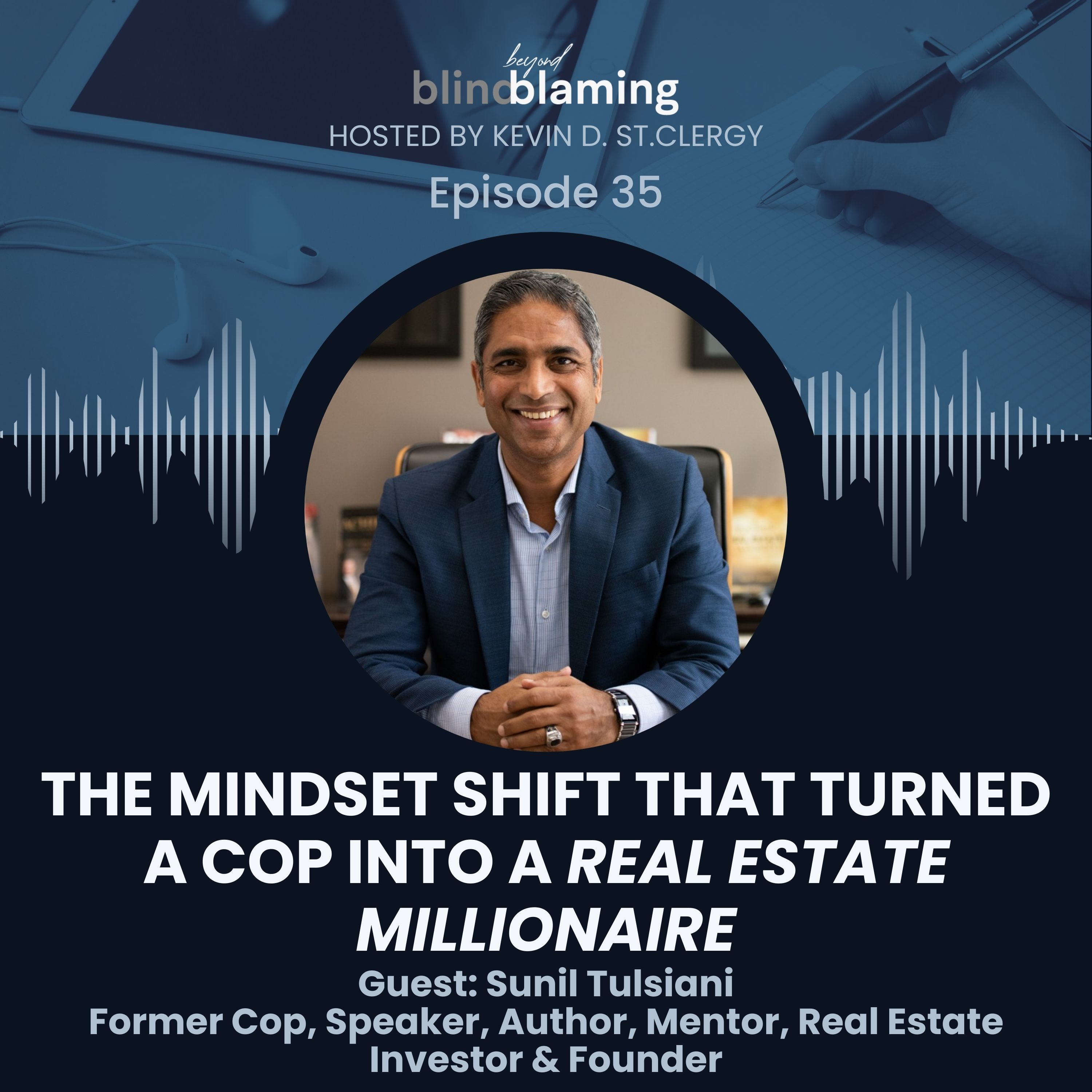
Beyond Blind Blaming
Unlocking Potential From Self-Doubt to 7-Figure Success | Sunil Tulsiani
00:44:46
Loading summary
Transcript47 lines
- [00:00]
A
My teacher told me can't even write a paragraph and now I'm seven times best selling author with some of the legends. So I think the biggest challenge that I would say that I had was believing me, like believing that I deserve or I can do it.
- [00:16]
B
Today I'm joined by Sunil Tulsiani. Sunil is a former police officer turned real estate investor, business mentor and best selling author. He's the founder of the Private Investment Club, Canada's largest real estate investment club where he helps entrepreneurs investors build wealth through strategic property investments. His journey from law enforcement to financial freedom has inspired thousands of people to take control of their futures.
- [00:39]
A
So the way I look at it is very simply if it goes my way, that's awesome. If it doesn't go my way, that's awesomer. Because that means God from above has decided that I was going the wrong way. Foreign.
- [01:01]
B
Welcome to Beyond Blind Blaming. This is the place where we explore how easily hidden truths can hold us back, trapping us in cycles of frustration and blame, often without even realizing what's truly stopping us. Each week I'm joined by experts and professionals who share their journey of taking back control of their story, overcoming hidden challenges, and discover how to stop blind blaming from dictating their outcomes. The insights you're about to gain will help you see beyond your current limitations, find the courage to seek new perspectives and ultimately live a life that's both purposeful and powerful. So if you're ready to break free from blind blaming and discover what's possible, you'll definitely want to listen to my next guest. I'm your host, Kevin Saint Clergy and today I'm joined by Sunil Tulsiani. Sunil is a former police officer turned real estate investor, business mentor and best selling author. He's the founder of the Private Investment Club, Canada's largest real estate investment club where he helps entrepreneurs investors build wealth through strategic property investments. His journey from law enforcement to financial freedom has inspired thousands of people to take control of their futures. Sunil has worked with legends such as Tony Robbins, Robert Kiyosaki and Kevin Harrington and his strategies have been featured in Forbes, the Toronto Star and other major publications. His mission is to help others escape the traditional 9 to 5 mindset, overcome their limiting beliefs and achieve financial independence through smart investing and personal development. Welcome to S.H.I.E.L.D hey, thank you, thank.
- [02:22]
A
You for the intro. I appreciate that.
- [02:24]
B
Welcome. Yeah, I'm getting pretty good at chat GPT, you know, so yeah, great, thank you.
- [02:30]
A
Thank you for having me.
- [02:31]
B
Well, your journey from being a police officer was fascinating. For me to read to becoming a leading real estate investor is remarkable. What sparked that transition and what was the biggest challenge you faced in making the leap?
- [02:43]
A
Well, being an introvert, shy and being told that you're too skinny or too dark, you're too this, you're too that, you're not a good student was what I heard all my life. So going from being a police detective in Toronto into what I have become today, in millions of years, I've never would have known that that's why it would become, for example, public speaking, being international public speaker, a best selling author, my teacher told me can't even write a paragraph. And now I'm seven times best selling author with some of the legends. So I think the biggest challenge that I would say that I had was believing me, like believing that I deserve or I can do it.
- [03:30]
B
Well, that's interesting. So talk to us a little bit about that and what I love about when we were looking at different guests for the show, you and I seem to have the same mentors. Brian Tracy had a big impact on my career early on. And I'm actually interviewing with Jack Canfield here in a couple of weeks in la. So. And I just talked to him last week. The only feedback he gave me was he hated the COVID of my book and so he changed the COVID and now he loves it. So I was super happy. So it was really cool to see you with your picture with Jack when I was getting to know you a little bit better. Cyber stalking you. As I say, how often do you run into that mindset issue where people aren't really sure that they even deserve to be successful? Do you run into that often?
- [04:07]
A
Yeah, see most of my consulting and mentoring is 80%, maybe 90% is all about that, that people say, okay, this is what I want to do. And then like, okay. And then the next thing they're not doing, what would take them to that destination. And it's usually 90% of the time, it's usually all about, you know, their belief system, how they were brought up, their environment and their mindset. Of course, skills, strategies, training is, they're very, very, very important. But then you have, you know, somewhat like 100 people read the same book and then only 2, 2%, maybe 1% will actually do what it is. So I run into this all the time. It's not just. That's called the people who are starting out. I coach CEOs and presidents of the companies that have done well and then now they're stuck. And usually it's Them, they are, in their own ways, interesting.
- [05:05]
B
I love it. Well, that gets me to the investment club. How did you get started with that? You founded it, and you've helped a lot of people, from what I've read, achieve financial success. What made you want to go there and what makes it different from other groups?
- [05:17]
A
That's very nice. Well, what happened was about just over 20 years ago, my wife came to me and said, we're going to have a divorce. Because you're working days, you're working nights, you're working long hours. As a. As a police. Police officer. I was a platoon commander just before I quit my job. And the idea was either I divorced my wife or I divorced my job. And the biggest, the most. The toughest thing was I felt as a man, as a provider for the family with two children, was to quit a secured, you know, trial that paid you every two weeks. And when I left that police force, I said, you know, I have to go into business. No real estate experience. No business experience. Shy person. Like I said, in millions of years, I never thought that I would go on big stadiums. And speaking of 5,000, 6,000 people, alongside of Tony Robbins and Robert Kiyosakis and Grant Cardones of the world. And these were some of the people that I followed. And now they have become some of the. Like Jack Canfield, Brian Tracy, Kevin Arrington. And some of these people, they are actually my friends. Like, they are people that I have their cell phone numbers. They are my business partners. And so when I left the police force, I'm like, what do I do? And then one day, I opened up my newspaper. In those days, newspaper ads were still there. And there's this guy, Robert Allen, he's like, buy properties, no money down. And I was like a former detective. I'm like, what kind of BS is that you can never buy? Long story short, I went to his program, paid five grand for it, and that program changed my life completely, where my mindset changed, but also I got some skills in how to do it. And the first year alone, I did something which Robert Allen told me out of thousands and thousands of students that he taught all his life, had never done, which was I bought and sold 77 properties in one year.
- [07:20]
B
Wow.
- [07:21]
A
And majority of them, no money down. Majority of them. And what happened was the media picks it up. And in those days, and we're not talking about social media, we're talking about, like, news and tv, and they pick it up. And I'm shy guy, like, I don't want to. All I want to do is I want to go out, make some money, bring some money home, take care of my family, do it again. That's it. I don't want to help anybody. I don't want to reveal my sources. I don't want to reveal my stuff. You know. You know how the gurus always used to say those things? I'm going to teach people. I don't want to do any of that stuff. One day a media calls me up and says, hey, you know, we heard about you, and we want. We want to talk to you. I just hung up. Like, I even not talk to them. Like, I'm so scared of that. The long story short, in that one year, when I bought and sold 77 properties, I had partners. I had people who I'd made money for, the investors who made money passively, actively, and all that. And then they kept saying, you should have a real estate club. And I'm like, what the hell is a real estate club? They go, you know, people get together, they network. Did they learn there's somebody who teaches them? I'm like, who? Who's going to teach them? And they go, you. And I looked around, I'm like, are you kidding me? I said, no, no, no, I can never do that. And then second person said. And third person said. And long story short, I just said, okay. One day I got upset. I said, all right, we're going to open up a club. I had no idea what that meant. I actually went to a hotel after somebody told me, just go to the hotel and just book a room. I'm like, okay. So I go to the hotel. I did not know that when you book a room, you actually get chairs. I thought you had to book a room. You have to bring your own chairs. So basically, I opened up a real estate club. And what I did was I said, my club is going to be a doing club rather than learning club. And that became a big differentiator. Because what I did was I said, I want no one just to come in and learn. Because what happened was, and it's the truth, even Today, more than 95% of any trainings that you see from any gurus all over the world, they make their money from selling that course. And they're hoping that you don't do it, because then there's an advanced course and there's another advanced course. There's another advanced course. What I said to myself is, become a member, learn from it, and go do a deal. Go do a deal. And then if you want something advanced, come and talk to me. And then that's how we did it. So the difference has become is like, I then wrote a list of all the mentors that I followed through books in those days and all that stuff. And I said. And I was scared to do that, but I said, I'm going to do business with these guys. So then Robert Allen became who's my mentor. He became a member of my club. Kevin Harrington, Shark Tan became a member. Brian Tracy became a member. Jack Canfield became a member of the. So what I started doing, I started to attract some of the bigger boys, let's call them investors, who were like the elite members. And then people would come in. And this is the interesting part we did. Let's say you became a member and I teach you how to do joint venture partnership. And you have no money, but I teach you how to get a good deal. And now you go get a good deal. I do the business with you, I lend you the money. They're like, holy shit, this is so easy. And that was a turning point of my life. My turning point in my life was when I made money. I'm like, how do I find wholesalers? Well, wholesalers. You become a member of my club. And when you become a member of club, I will teach you how to present your properties to me or somebody like me, okay? I'll teach you what to put in the information package, what is a sole comp, you know, all that kind of stuff, and how to do a proper pro forma to do that. And then when you submit that, we will do the business with you. And then what even became better than that? My millionaire investors said, can we get on on this one where I'm a doctor, I'm a lawyer, I'm an investor, I have lots of money, but don't have the time. So then they're like, we want to become your member. And then the people who had no money, what became members. And I just matched them beautifully.
- [11:41]
B
I love it. It's brilliant. Yeah, and you're right, it's always about that next level for a lot of folks out there. So. Yeah, but I like how you did it.
- [11:50]
A
But, you know, here's the. Here's what it is. A lot of people have heard of nothing down, no money down. The issue is, okay, what do I do now? Well, you go do it yourself. Now, 99% of people, what that means is you gotta go build a brand, you gotta network, you gotta do so many things. You gotta work on your confidence level. You gotta find or attract that millionaire or multi millionaire into your life who can really help you. Let's call it join venture partner. Of course there's other ways of doing. No money down, but. Or assignments or JVs or seller financing. Whatever it is, they win. But what I said was you become a member of my club, you're going to have those people in the room. Okay, but here's what it is. You become a member, you have direct access to me and my millionaires and multimillionaires and where we will make more money from the real estate.
- [12:46]
B
And you're helping them make more money too. So everybody wins.
- [12:49]
A
Yeah. And then as time went on, evolution of my business, of real estate business, I mean real estate club, it's now called professional investors club. And this business idea became more and more, it's like, okay, how do I now become like you, Sunil? How do I build my own real estate club? How do I build my brand? How do I build a business? Real estate is just a product. How do I build a business around that? And so then I started coaching and mentoring people saying okay, I can help you. So now all over the world if somebody says I want to have a, a real estate model, monetization model where I want to train people how and attract the right people, I want them to pay me a monthly or annual fee to do that. How do I attract CEO, center of influences and how do I do that? This is then I went on from there so that now the next level is are these people and then above that would be people like you know, I just want to partner up with you. I want to be, I want to, you know, I'm a builder, I'm a developer. How do I get Sunil and his investors into this project and what do I do with that? So these are the evolution of like how I started to build business. And the interesting part is the media started calling me the wealthy cop and like so I am that person who came from India, lived in, lived in, let's call it slums of New Delhi, India and lived in a one room of a two bedroom apartment. And one room we were as a paying guest with my mother, my father and three brothers and sisters. And we had no kitchen, nothing like that. That room was there and then washroom was shared with the landlord. And then eventually when we did buy our own house in New Delhi, we had no running water, no toilets and no electricity.
- [14:52]
B
So have you noticed your kids that didn't grow up like you did, are they different or have you tried to make sure that they stay Grounded. I know it's hard for my girl. I don't, I can't have children. Like my girlfriend has kids. And we got a big discussion like, what's the poorest country you've ever been to or ever seen? I was like, well, I was in Costa Rica. But they seem really happy and some of these places don't even have running water still today. But they're just extremely happy. They have to go down the street to get water. Any comments there?
- [15:17]
A
Well, I believe that this time that we're living in because the parents, including myself, want to do the best for their children. Now my kids grew up in almost like a mansion and then they. Mercedes is no big deal for them and no running water is like, they can't even imagine how that works. Right. So I don't really blame them to be a little different because. Because they haven't really faced what I faced when I was younger. I mean, I was, when I landed in Toronto, I was in 1981, in 82. I'm working in a gas station at minus 20 degrees at night making, you know, the guys giving me cash overnight and giving me like 20 bucks the whole night, basically. And then I worked in the factories and all that kind of stuff. So they've never got to see that. So I believe they saw the abundant side and which sometimes is we give too much meaning. There's a path that they're walking and I want to kind of clean up their path so then they don't really have any problems or, you know, everything is great. So there is a little bit of idea of the privileged life. My son works with me and obviously it's a lot easier if you have somebody like me to give him a position in the company, for example. You know, it's easier, but they're smart in their own ways. Their own ways. You know, they're smart in their own Ways. He's 30 years old. My son is 30 years old right now. And there's amazing things that he does. But I know when I was 30, definitely, I mean, when I was 13, I couldn't go 20 miles without worrying where I'm going. Yeah, yeah, yeah.
- [17:09]
B
It's different. I know when we, I grew up in a country club lifestyle, then our family lost all of our money. And I remember my dad and I talk about it often. It was probably the best thing that happened for me. I was a little spoiled back then, but when we lost everything and then had to go back to living in an apartment, it was kind of a wake up call. That I need to get to work. So that was me.
- [17:29]
A
Yeah.
- [17:29]
B
But we talked a little bit about blind blaming in the beginning, and many people blame external factors like market conditions, lack of money, or bad luck for their financial struggles. But I think from what I read about you and your experience and in your books, there's a lot of things that you teach about internal barriers that hold people back from success. We talked about one, which was mindset. Anything else you want to talk about there?
- [17:50]
A
I would say that, including myself over the years, working and blaming and being a victim or feeling like a victim, but not even knowing, being aware that we are acting as a victim or gossiping and things like that. In the past, when I was not very successful, that was the normal. I thought that was a normal conversation. What I feel like right now is, of course, the challenges that people get, which I. And you like, you talked about your challenges. When I went through it, 2005 is when I started into this. And imagine, I thought I was going to work all my life. One day I retired as a cop, and then, decent salary. I mean, decent amount of money coming in when I retire. And maybe I'll have a million or so dollars when I'm 65. But the sissy story was I made, you know, so I made millions of dollars. But in 2008, we all know what happened with real estate. You know, I started in 2008. 5. 2008. Imagine you lose everything and you're in bigger debt. That's who I was. So, you know, that's why, you know, when I went to India, somebody says, we're gonna make a movie on you. Because there's a lot of challenges that we went through. And when I was going through those challenges, the security challenges, investors not being happy, wife's gone, where's the money? And I, you know, I hear people going. You know, they were at the point where they go to a gas station and they hope that one of the credit cards work because, you know, not only did I lose all the money, we're in debt. And now you're trying to pay from line of credit credit to his credit card and all that stuff, and you're hoping that credit card will go through. And then. So I went through this, and I blamed everybody. I blamed the markets. I blamed the government. I blamed, you know, their lawyers. I blamed everybody except for me, right? Like, how could they do this to me? And of course, the family blamed me. My father's like, see, I told you, shouldn't have left the police force. And, you know, and all that kind of so blaming was like, norm. But I can tell you that was probably the best thing that happened to me. I didn't feel like it for the two, three years that I was in it because, you know, I had a big house. You still have to pay, and you can't sell the house because the value is less than what I owe. So that can't be done. I have an office with employees can shut that down. If that's shut down, then fine. So now we eat this. But what I found was you become like a genius when you go through these problems. And if you see these problems as problems, then sometimes you're going to sink. But if you see these problems and say, you know, how can I get out of this? What's the challenge here? What. What am I learning here? So the one thing I always did just like in the police force was I always had a mentor that I call up and I say, you know, I'm going through this. Can you just hear me out? And then sometimes a mentor just said to me the same thing that I knew, but it just sounded better. And sometime they did come up with a solution that I couldn't come up at that time, right? And they'd be like, okay, step one, don't worry about the negative comments. Like, how do I do that? Don't go on. Okay, don't go. Don't worry about it. Okay, how do I not work? So they. Okay, they'll do it. Okay, step two, I want you to listen to this audiobook. Okay? You know, I kind of know that, but which one? Okay, listen to Napoleon Air. Okay, good. Okay. All right. So then they took me out. So every day, all they were doing was working on my mindset, So I don't really do that. And then they said something like, sunil, what's the lesson? Write the lessons down. So I wrote some of the lessons that came out of that. And then they say, what do you need to bring it back? And so, you know, do you need to go to more events? Do you need to have more investors? Do you need to do more collaborations? Remember, nobody has taken this away from you. So that is how the challenge of blaming. Where I learned during that time, no university could have taught me, at least at the deep level, that that was the best thing that happened to me. Same thing with the leaving the police forum. I blame my wife for a while, you know, I kept blaming her, saying, hey, you know, because of you, I left something that I loved. And then if she hadn't done that I wouldn't have known that I could be an international public speaker. I didn't know that I could write books all over the. I didn't know that I would inspire millions of people all over the world to become financially successful. So my take on everybody here that I see is that they always try to avoid what ifs. What if I fail, what if this happens, what if that happens? And anything like that. And my suggestion to them is that just of course you don't wanna fail on purpose, but if you do know it's the best thing can happen to you. Because if it goes your way, if you're. I'm religious, I believe in God. So the way I look at it is very simply, if it goes my way, that's awesome. If it doesn't go my way, that's awesomer. Because that means God from above has decided that I was going the wrong way.
- [23:29]
B
I love it. Well, there's a perception that real estate investing is only for the wealthy. How do you respond to people who say they don't have enough money to get started?
- [23:37]
A
This is. I get this all the time that, you know, money makes money, you know, and you need money to be. To make money in real estate. And although all of that is accurate, I think I can change. Money can make money, not money makes money. So then, because in the past, what that meant was if you said money makes money, that means that's the only way you can do it. And then therefore, if you're poor, you're going to stay poor for the rest of your life. And for hundreds and thousands of years, that's what really happened. You know, people who owned the land were rich, people who worked on the land. Well, you have no money, you'll never be rich. Right? So I want to tell you from over 20 years, from my experience, my students experience, my partner's experience, my friends experience, there's thousands and thousands and thousands of people who have become multi, multi, multi millionaires when they had nothing from real estate. And so, so, so first thing to do is, if you don't believe it, just say to yourself, you know what? Is there one person on the planet who has made money from nothing and they became rich in real estate? And the answer is yes, that is 100% proof that's doable. If there's one person, but there's millions of people who have done it, that's definitely a proof that it can be done. So then you go, okay, so then what do I have to do to join that group? And in order to Join that group. Do I need to buy that book? Do I need to subscribe to this audiobook club? Do I need to attend events? Do they need to attend some of the events that you know where they're talking about teaching about some of the cutting edge today's strategies for late 2025 and upcoming 2026? What is happening with them? Like do I need that or not? And the answer is yes, if you haven't done it. And so learn the strategies of no money down. We just talked about three of them. There's lot, many of them with my friend Robert Allen, he had a course that now I'm partners with him and here he talks about 50 examples, 55, zero examples of nothing down. And you don't need to learn 50, just maybe read it all once and then you pick the one or two that you love and that's it. So assignments is very simple. You have no credit, you have no money, you have no friends, you were bankrupt yesterday. You know, you'd go and say, how do I learn to find good deal and then give it to somebody who has money to do that? Where do I find these people? Well, these people, the investors I'm talking about. Well, there's LinkedIn online groups. If somebody goes to LinkedIn and punches my name, he's going to know that we are. I mean I don't monitor my own. I have a team who does that. But I am connected with, I don't know, 20 or 30 different real estate groups on LinkedIn that have 20,000, 30,000, 50,000, 100,000, 500,000 members who only talk about real estate and wholesalers and all that. You can just go in there and start joining them and start that. That's one Number two, join paid online groups, join paid memberships like professional investors club or any club really that allows you to be in, in, in the area or arena where other people are hanging out. This, this is where you go out and say, hey listen, I got this deal, it's worth a hundred thousand dollars, I got it for 60, I'll give it to you for 70. I mean it's just, you know these people, that's what they're looking for. So you take the contract, put it in the contract, learn how to do information package, give it to investor for a fee. Investor is going to say, wait a minute, I'm going to make 30%. And so if it's a million dollars, I'm going to make $300,000. And this guy wants $20,000. Pretty cheap for me. It's better than hiring a real estate agent who wants to sell me at the retail price or wholesale. So I personally, when we look at the wholesale, I look, I love wholesalers because they went out, they negotiated, did all the work, and then they're showing me how good the deal is. And then basically, two things most people want is either they want property below market value or property that produces cash flow, or. And. Or both. So you take the contract, you sell the contract for a fee. You can do that for, you know, let's say you want to make 10,000amonth, $25,000 a month, you go, okay, that's all I'm going to focus on for a while, because that is what I need right now. I have no friends. I'm bankrupted. I have no family. I don't want to get a mortgage. I don't want to deal with hard money lenders, nothing. I just want to do this. That's you. The second is very easy. You get the property deal and say, I don't want to give it away for five or ten thousand dollars. You have the prop money, I have the deal. Let me tell you, when I started, I bought like five condos that were being renovated and the guy wasn't able to sell it. So I went in and I negotiated a good deal, went to an investor, I said, hey, all five of them are only for this price. And I negotiated, I did everything. And I'm going to put the renters in. I'm going to oversee the management company. This is the pro forma. And you're already walking in $200,000 of profits, and that's already in there for us. And then in five years, in five years, we are going to either sell it or we're going to keep it. But up to five years, you're not going to come to me and say, I want my money back. Okay, so he did that. And now I got in with no money down. He put in all the money. It was all fixed up, done up. And was it perfect? Absolutely not. Was there times that, you know, the renters didn't pay? Of course it did. But at the end of the day, five years later, when the money came in and he made his money, he was investors. There are people with money who actually want to do this, but there's only one currency on the planet that works in business, and that currency starts with T. It's trust. That's it. That's all it is. So that's the second one where we go. You get the property, you do A joint venture agreement. And there are different ways of doing JVs, but let's just say where in the beginning, I took out the loan, I took the mortgage. So I'm like, hey, listen, investor, this property is worth, let's make it easy, $100,000. I need 20,000 from you, plus another 5,000 and I'm going to put 70,000 or $80,000 under my name from the bank. You're only putting 20. I'm putting $80,000 and I'm taking the bigger risk. And we split 50, 50. They go, okay. The second, as time went on, I went to them and say, you're going to put the property under your name, you're going to put the down payment and you're going to pay for all the expenses. And I want 50% because I'll manage it. And I find the deal and it's below market value. Let me tell you why, okay? And as I, my credibility went up. People were lining up to with money to do that because they knew. Because you learn how to show the investor that you're putting 20% down. So if a house is $100,000 and they're putting $20,000 down, and house goes up by $20,000 in a year because you bought it below market value or whatever it is, or you improved it 20%, that, that's 100% ROI on his money. Of that money, 50% comes to me. So now he made 50% ROI on his money. So it is incredible where you just focus on the other person's benefit, which is, look, you're going to. You're expected to make 30 to 50% ROI on your money. Are you interested? Let me show it to you. You don't go there and say, listen, I ain't gonna put no money. I'm gonna take no risk. No, you know what I mean? And you're gonna put all the money and you're screwed, right? It's not. Because if you go with the intent of, I gotta make the other person money first. And I tell them, look, before I make a penny, I want all your money to come back to you, and I want your ROI to come back to you, then I want to make money for me. And they're like, oh, that makes sense. And then when you do it once, just once, the same guy will come back and say, let's do two, let's do three. In my case, we had the list of over 10,000 people. And all I used to do was send an email out, hey, I have this property. It's worth this much. I'm getting it for this much Expected roi. This much expected cash flow is this much. First come, first serve is going to 10,000 people go. We had fights. Fights were not that they didn't want to give the money. Fights was, why did you give it to the other guy? So if somebody's listening right now, say, in today's world, it's even easier to have a WhatsApp group or email list or whatever it is than what I did before. And so basically, in this case, you buy a property, you find a good property, make sure it's a good deal and all that stuff. You do a joint venture partnership with somebody else, and now you tend to make more money because now you're actually a partner and you're going to do ongoing. Maybe you have to help oversee the renovation. Maybe you have to put the tenants in and oversee the tenants. The person who's giving the money says, I want to be 100% passive or 90% passive or whatever. That's the second way. First the assignment. And now we talked to JV partner. The third one was, is. Is where somebody bought 25 years ago, 30 years ago, they bought a property. They've been renting it out. They became older now, and they're like, you know what? I hate my renters. My renters not paying me. They damage my property. Property's 100% paid for. I want to try to sell. Nobody wants to buy it because property's damaged and the renters don't want to move. You walk in, go, guess what? I'll buy you a property at the price that you want without paying the real estate agent. But you become my bank. That's it. So sometimes I say, no. Why do you want to sell it? Well, you know, why did you buy the property in first place? Well, I like passive income. Great. Every month I'll give you passive income without dealing with the renovation, without dealing with the tenants, without dealing with anything. I'm going to take care of it. So right now, just even if nobody read books or they didn't do anything, they go, okay, these three concepts, let me go on YouTube and just punch it in and then just listen to a few people to do that. If you have no money, I'm saying, If you have $20, go buy a book. If you have $500, go buy a course. If you have $10,000, then, you know, join a elite club. If you have $25,000, join a real estate mastermind. The reason why I joined masterminds in the Past is it's not to really learn. It's actually to find the other 20 people who paid $25,000 as well, who are millionaires, multimillionaires, investors, buyers that do business with you.
- [34:50]
B
I love it.
- [34:51]
A
Thank you.
- [34:51]
B
One of the best things I ever learned was working with wholesalers. I wish I'd learned that the first time, but everybody's got a mistake to learn, right? It's nice to be able to walk into properties where you got some good wholesalers. I have three that I work with and have a high level of trust for them. And they're very upfront, like you said. They'll come to me and say, kev, do you mind if I make $10,000 on this? You're going to make X. Yeah. And it's a great relationship. So clear. And I remember Robert Allen. I remember his commercials like they were yesterday because I was a kid with very ambitious, but I remember him. But I'm 53, so I'm a little older than some of the other folks. But. Well, it's very clear to me with the big names that you know, and a lot of my mentors, we have the same folks that we like. I don't know a lot of them personally. I've really gotten to know Jack and I love him. Sweet man. Very difficult and tough coach, though. He will tell you how. How he really feels, which I love, too. But you've clearly learned to invest in yourself. What's your favorite way to invest in yourself? You mentioned a few today.
- [35:44]
A
Having a coach or a mentor has to be like, if you go back 10,000 years, doesn't matter what century you're talking about. Probably most people, most gurus and most successful people have different strategies, and sometimes they don't agree with each other on certain strategies. But I have yet to meet a very successful person, guru, teacher, mentor, whatever, who says, you know what? You don't need a mentor. Just do it on your own. Don't worry about it. I have no men. Nobody says that you, you know, so this is basically, I would say 99.9999% of the people who are successful are going to say, do what they taught you not to do in school. In school, I was very bad. And what I used to do is I. During the exam, I used to write some formulas, let's say, for mathematical exam, I can't remember the formula. I would write it. So then I remember it. Or if somebody sitting right beside me who was a smart person and they would, you know, we would have A deal. They would show it and I would just, you know, do something for them or buy them lunch or whatever. So basically, I'm copying them in the real world. That's what you do. You find somebody who's successful and copy them.
- [36:56]
B
So call it ethically, swipe and redeploy. Yeah.
- [36:59]
A
And it's the way to do it. In school, they say, hey, stop looking through out the window. Stop thinking. Just do what we tell you to do. In the real business, that's what you do. You think they say, don't collaborate. Well, that's what you do. You collaborate. They say, don't talk to strangers. That's what you do. You talk to strangers.
- [37:18]
B
All these things we have to unlearn. I mean, we. Oh, God, we're speaking the same language. Because I always ask people, how many Olympic athletes do you know that won a gold medal that didn't have a coach and weren't part of a team? So you've got your coach, you've got your mastermind. Those are my two favorite ways. In fact, they're in my newest book. We have this thing called the RCD Method, where you reflect to try to get to the root cause and connect is where you have to have a coach and a mastermind group of some sort to be able to get the most out of what you want. Because they're going to notice things you can't. Because they're not in that same sphere of influence that you are. They're not tied down to the same thing. And they can look at you objectively and say, listen, this is what you really should do. I love it. It's great advice.
- [37:55]
A
And the idea of books I used to. I don't believe before I got into this business that I don't remember if I read any book that I did not have to read it. Meaning if it was a police detective book because I had to read it, I'll read it. If it was a school that told me that I had to read it. And even then I found a ways to find summaries of those books. So then I can just barely pass. But as time went on into the business, the books started to read the books. I started liking it because I became that first and because it's something I want to do. And the better thing that I did that I felt was great was audiobooks. I'm like, I love audiobooks. I'm driving around listening to it, you know, all that stuff. I go for a walk. Even today, I go for a walk, I'm listening To something that is going to build me or build a skill for me. And that's basically it. Even though, you know, I've been successful, I have to maintain that or grow if I want to continue to grow. And now it becomes an obsession. Obsession. You like it, you enjoy it, you want to hang out with the same type of people and then you go into the environment. That's why. So the books. So. So of course, coaching is the top level. Joining a group, whatever highest level that you can join. You know, there's. There are groups that you can join for 500 bucks or, you know, half a million dollars. You know, that is the proximity that we're talking about, the power that it is for the group itself. You become who you hang out, as we've heard this before. And so the idea is first is to get a coach. If you can get a coach or get a coach that you think you can afford, maybe one step above what you think you can afford. Okay, so if you think you can afford $500 coach, then maybe go to $1,000 one if you could do you know what? You get the point. And read books, highlight them, study them, Get a notebook and put down book's name and say chapter one, what were the main thing you learned? Highlight it, do it again. And what I used to do is I used to listen to an audiobook every time, twice in a row.
- [40:13]
B
Oh, twice. Interesting. Okay, I like that.
- [40:16]
A
Yeah, you start and you finish and immediately you start again and finish the book. There's a book from Wallace D. Waddle, original book was called the Science of Getting Rich. Okay. I rewrote that book in simple format.
- [40:30]
B
Oh, really?
- [40:31]
A
How to become Rich. Okay. It is the book if people want to learn how to become rich. Now, a lot of people, when they say rich, they talk about relationships. I'm talking about money. I'm just focusing on money. And so does Wallace D. Wall. But when he wrote it, it was in a 1906 or when he probably wrote it towards the end of 18 something. It's hard to read a book. That book, I simplified it and it became the top bestseller. Because this book talks about from start to finish, how it works on mindset. Then he talks about the what do you have to become and the skillset to become rich. And so what I did was I took that and I put it in today's environment. What do you do today to become rich? Not only in real estate, but any type of business you have. So I said to myself, in order for me to write a book and Think on it and extract, what do you call it, lessons from it. I read this book more than 50 times. 55. 0. Then from audiobook point of view, I must have taken courses, listen to it another hundred times. So now I'm living and breathing this book and like, I gotta. And I'm getting all these ideas. I'm like, I gotta put this into a book. And so that's an example of studying a book rather than just learning a book. If you like, you know, we all heard of, you know, my good friend Robert Kiyosaki, Rich Dad, Poor Dad. You know, that book was instrumental for me. And his other book, Cash Flow Quadrant, was instrumental. Another great one, Think and Grow Rich, was instrumental for me as well. If you have, you just go to YouTube and punch in that book and say audiobook and you can get them for free and listen to it as many times as you can. There's a speech from, I believe, Earl Nightingale. It's called the Strangest Secret. I have heard that more than 100 times. Hundred times. And you know what? Every time I hear, something pops up, just like when you watch a movie. Second time, third time. Like, you catch me things. So if you do this. And the word really is repetition, I love it.
- [42:52]
B
And the Stranger's Secret, interestingly enough, my buddy Russell Brunson, he was my coach 20 years ago when I first started my business. He was also the first gentleman I called when I sold my business. But he's actually taken the strangest secretary and kind of done a whiteboard to it and he uses it in his presentations. It's so good. It's so good the way he did it. So well. Sunil, thank you. We're getting top of the hour and I don't want to take up too much of your time, even though you and I could talk for hours. Wish we had more time. But if people want to get a hold of you, what's the best way for them to get in touch?
- [43:18]
A
Our website is professionalinvestorsclub.com I'm on all social media. Just say that if somebody's sending us a message, please put in the fact that they saw us on your show. And that way my. I have a team. Let's say if somebody sends a LinkedIn message or something, they do select the people to connect. But the best way to do that is website social media. Come and connect with me and I would love to gift them a book, if that's okay with you.
- [43:46]
B
Absolutely. I love freebies. So.
- [43:48]
A
Okay. So anybody that maybe in your. I don't know if there's this show notes or something like that.
- [43:54]
B
We put it, we put them all there because we'll go over how we market it but we'll definitely put it in there. We put it on our website too with the notes as well.
- [44:00]
A
Okay, sounds good. So I'll have my team send you the link and they can have access to the digital copy of this book. And also if you send us your physical address I will autograph this book and I will send this mail this book to you as a gift.
- [44:19]
B
Great, I'd love to have it. I love to read so I usually go through a book or two every other week so yeah, I'd love to see it. Well Sunil, thank you so much for being here. This was amazing. I learned a lot just from being here and I'm sure everybody else did too. Hopefully we'll have you on the show again.
- [44:32]
A
Thank you.