← B&H Photography Podcast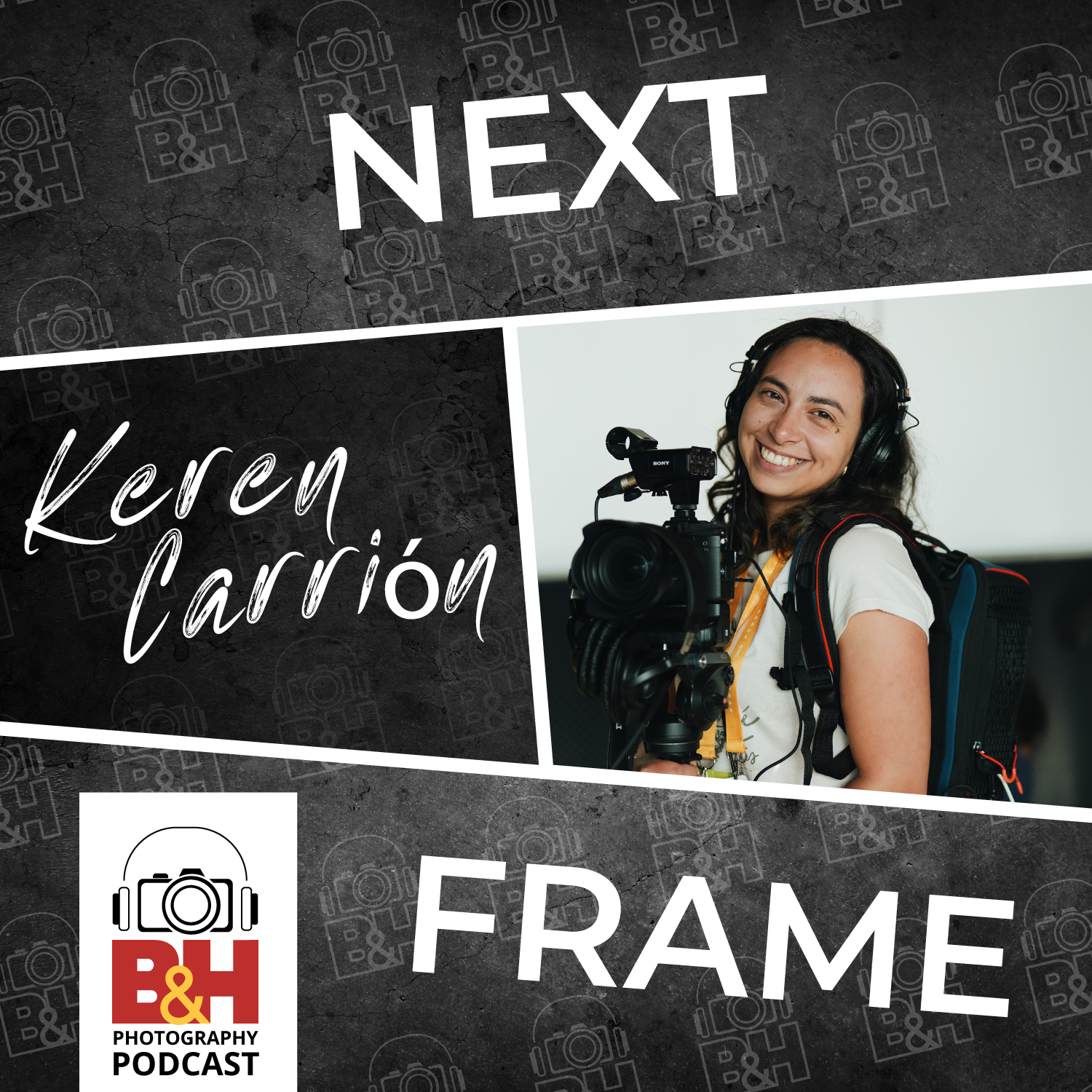
B&H Photography Podcast
Next Frame: Reporting the News & Finding Your Visual Voice, with Keren Carrión
00:44:05
Loading summary
Transcript142 lines
- [00:01]
A
You're listening to the B and H photography podcast. For 50 years, B& H has been the professional source for photography, video, audio and more. For your favorite gear, news and reviews, Visit us at b&h.com or download the BH app to your iPhone or Android device. Now here's your host, Derek Fazbender.
- [00:22]
B
Welcome listeners. I'm Derek Fassmeder, host of the BH Photography Podcast. I'm also host of our new monthly series Next Frame, in collaboration with creative producer Jill Waterman and audio engineer Mike Weinstein. News reporting has got to be one of the toughest markets to crack for a visual journalist. But the whirlwind of 247 news cycles and the pressures of telling human stories in rural news deserts has not deterred today's guest, Karen Carrion, a photojournalist and short form video producer currently working on the NPR Visuals team. Originally from Puerto Rico, Karen graduated from George Washington University in 2019 with a BFA in photojournalism. Prior to her current role, she spent two years as a photojournalist for KERA News, NPR's affiliate station in Dallas through Report for America. She has also worked with CNN as a video editor in Atlanta and interned with Univision, USA Today, the Hill, and the New York Times Student Journalism Institute. Additionally, Karen is an alumna of the Eddie Adams Workshop and Momenta Photo Workshops Project Puerto Rico. When Karen isn't working, she's probably sitting in the window seat of an airplane heading to a new destination. If not, you can always find her with a camera in her hand or petting the nearest dog. Karen Carrion, welcome to the show.
- [01:46]
C
Thank you for having me.
- [01:48]
D
It's great to have you on. Now we got to get to the most important thing first. Window seat over aisle. I feel like as I've traveled more, I've moved to an aisle seat person. So window seat still does it for you?
- [01:59]
C
Window seat still does it for me. I can't give up the cloud views.
- [02:03]
D
I know. And you don't want to be that person that's like, I want to take a picture but there's a strange in the middle seat and I can't reach over totally.
- [02:10]
C
Although I do get the aisle seat.
- [02:12]
D
Yeah, see, the aisle seat for me is like if I'm in the window seat, I'm at the mercy of the middle seat and the aisle seat to go to the bathroom if I need to. And it's like I'm taking cross country flights. So I'm like, you know what, I'm just gonna Sit in the aisle. I get the extra leg room. So we got the important stuff out of the way, but now to photography. Obviously you work in video now, but I want to start with still photography. Cause that's where you started out, as a lot of us did. But where did you first get your interest in photography?
- [02:39]
C
Yeah, so I gotta credit my mom. She was born one day and she was like, I'm gonna take up photography as a hobby. I'm like, sounds great. We got a Nikon DSLR kit from Cost, and literally the first weekend she had the camera, I was like, well, I'm going to take the camera on a spin. And I ended up falling in love with how crisp the images were. It was just like my first experience with like a real camera. And I would take it with me everywhere. Like anytime I was leaving my house, I'm like, I have to take a picture of this leaf, of this rock. You know, just like the most random pictures. But I became obsessed with cameras. And I was taking a journalism class in high school, and my journalism teacher was asking for people to submit their applications for a photo editor role at my high school paper. And I was like, well, you know, I have these pictures of a lizard and, you know, and I sunset. And he's like, great, you're hired. And so I became the photo editor slash photographer for my high school paper. And I realized how much I really loved pairing my camera with telling stories. And because I expressed interest in that, my parents enrolled me in this program called National Geographic Student Expeditions. And I was able to go with Nat Geo for two weeks to London in high school, which was an insane experience and really solidified that I wanted to be a photojournalist, traveling the world with my camera.
- [04:25]
D
Props to your parents for that. I think it's so great when parents give kids the opportunity. It's like too many times we don't realize it until we get older and we realize like, wow, we're really at the mercy of what our parents sign us up for or give us an opportunity to experience. So that's awesome that they are open that door for you to then take it and run with it.
- [04:45]
C
100%. Yeah. I'm very grateful for their support. And I think they saw the vision before I did.
- [04:51]
D
And sometimes that's necessary, you know, to really believe in ourselves or think that there's something there. You need a fan. You need somebody who believes in you. So it is always great to see parents helping their kids get out there and explore and find what their interests are. Now as far as video's concerned, when did that come on the scene? Was it something that you had always been interested in, or was that something that came a little later down in your photo career?
- [05:14]
C
Yeah, so like you said, I got my bachelor's in fine arts in photojournalism, so it was still photography. But during my time in college, I joined the video team at my college newspaper, the GW Hatchet. And I kind of fell in love with, like, going out and. And grabbing different elements. That's video, audio, you know, B roll, a roll. Like interviews and kind of setting everything out on a timeline and getting to craft a whole piece together. I thought it was so much more involved and so much more interesting, I think, than just going out and shooting stills, which, again, is my first love. But I think after that experience, I started producing all of my school assignments in video instead of still photography. And I think it really separated my work.
- [06:08]
D
Was it more about the ability? I mean, when you tell a story with one image, there's maybe less work, but more responsibility because you have one frame and you have to tell it all with video.
- [06:18]
C
Totally.
- [06:18]
D
It's not like you're dropping a point on the map and you're like, all right, you gotta figure out the rest. Choose your own adventure. With the video, it's frame by frame. You're guiding someone through that story. Does that make it more intriguing to you? Or was it something that grasped you that, hey, I could really tell the story I want to tell instead of, hey, I'm just going to sprinkle out a picture here, and you have to figure out the rest.
- [06:39]
C
Totally. Yeah. I think video, for me, it made me feel so much more of a reporter in a way. Like, I was really able to craft a story from start to finish. And I like to take, like, a cinematic, slash documentarian approach to my work. So I think video really helped me kind of see also, like, all the wide variety of shots that I need for one story. I think it's always more interesting when a photographer turns to video afterwards because you have the still photography background to understand composition and mood and moment and then take that into your video.
- [07:21]
D
I couldn't agree more. It's like the person who's like, hey, we gave them a bunch of toothpicks and Elmer's glue, and they built this big dollhouse rather than the person that had all the tools to begin with. And it's like, if you can build that with minimal tools, you can go and take all the tools and have more at your disposal and create Something even greater.
- [07:44]
C
Totally, yeah.
- [07:45]
D
It's always an interesting dynamic. I love to see when people are in video, it's like, how early into their career? Because some people, it's like, I'm the MTV generation. So we grew up with music videos, and so there was always this tie between music and, and visuals. And then obviously anyone who's a film buff, the music, the sound design, the foley, the score, it all plays into the visuals. I'm interested about the educational side of things because I think it's always we have people who are self taught, and then we have people who went to school for journalism, for media, for photography. What kind of role did your formal education play in your whole creative vision and how you progressed in your journalism career? What did you take from your formal education? How did that change you as an artist or as a creative?
- [08:36]
C
Yeah, so I got an art degree, which was very interesting for me because I had never really considered myself an artist. And I remember one of my classes, freshman year was just like a basic studio class that they have you take, and it's like a rotation. So you do photography, but you also do like ceramics and painting and like other mediums. And I went to my professor one day and I was like, I'm not an artist. Like, I don't know why I'm in this class. And he wrote down on a piece of paper, he handed it to me and it said, congrats, you're an artist. Make whatever you want. And I was like, okay, so now I'm an artist. And so I think getting an art degree really opened up my vision of what photography can be. It doesn't have to be. I think the way that photojournalism can be, which is like kind of gritty, matter of fact, you know, it can have emotion, you know, with the way that you play with the light and the way that you play with your shutter speed. You know, like anything, you can make it an art and a craft. But I will say I feel like my studies is not what got me to where I am now. I will say, like where I studied in Washington, D.C. i was afforded a lot of opportunities. You know, I was like 18, 19, doing an unpaid internship at the Hill as a photo intern. And I was covering Nancy Pelosi and Paul Ryan. And, you know, I was super young to be in those environments, but I got all of that experience. I was there for eight months, day in and day out after my classes.
- [10:26]
D
School can't teach you that.
- [10:28]
C
School cannot teach you that. So, yeah, I will say being in D.C. really helped me skyrocket my career.
- [10:39]
D
So would you say, does that kind of lean into a piece of advice for your peers or for somebody who is in high school looking to follow a similar path? Do you recommend putting yourself in the right place, doing an internship, going out there and getting the work experience and not just the formal education behind it?
- [10:58]
C
Yes, 100%. I think that's my biggest advice to college students. Find the internship opportunities in your area. Find any networking opportunities, portfolio reviews. If not, travel to them. We'll get into this a little bit more, but I remember the first one that I had heard of was the Atlanta Photojournalism Seminar. And me and my friend got $60 spirit flights from D.C. to Atlanta and went to this photojournalism seminar and met a ton of big hitters in the industry. And it was like my first experience kind of meeting also other college students who were studying photojournalism. And I think it really helped me figure out where I fit in this industry and who else was up and coming with me. And so my advice is to find those opportunities and go to them.
- [11:51]
D
You got to be a go getter. And that's what I'm gathering from everything you've done, you're putting yourself out there. You're going and finding it. You got to find whatever means you can to put yourself in the right arenas, to talk to the right people, to rub elbows with the people that you want to potentially replace or work with one day. You have to get out there and do it. You can't say on your butt and just wait for the opportunities to come to you.
- [12:13]
C
Exactly.
- [12:15]
D
Yeah. So in talking about that, you have worked with momenta workshops, their 2019 program in Puerto Rico. And I gotta shout out all these programs across the country because this is sourcing the talent for this series that we're doing next frame. And there's so many great programs out there, a ton of nonprofits, people who are just pouring blood, sweat, tears, time into building up the next generation. And there's mentors and volunteers who really just. It's passion that they pour into this. So I want to talk about your experience getting the full scholarship to Momenta Workshops 2019 program in Puerto Rico. How did these programs shape you and your vision, your skill set?
- [12:59]
C
I don't exactly know how I found out about Momenta Workshops, but I think somebody sent me the their Project Puerto Rico website and I was like, oh, my God, like, so I'm Puerto Rican. And at the time, I had just finished making a mini documentary about A Puerto Rican family who was displaced after Hurricane Maria and ended up having to live in D.C. first with FEMA, and then, you know, they ended up getting their own place, and then they decided to move back to Puerto Rico. Anyways, Puerto Rico, to me, is a passion project, and I said that in my application. At the time, I was applying for the West Award, which is a full scholarship for Momento Workshops. And what Momento Workshops does is they shine a light on nonprofits through photography. So I ended up finding this nonprofit called Pro Cafe, and they were providing 750,000 coffee tree ceilings to about 500 small coffee farm families in Puerto Rico. And the project was started because when Hurricane Maria hit Puerto Rico, 85% of these crops were wiped out completely. And what I found out was it takes up to four years for a coffee plant to bear fruit. And so at this point, when I went to Momento Workshops, it had been maybe two and a half years after Hurricane Maria, and so basically entire coffee farms had been completely wiped out. So I was awarded the West Award for Momenta, which meant I got a full ride to be a part of the project. And I got mentored by Jamie Rose and her husband Chris, who started this workshop. And they really pushed me to follow the story. Like, they helped me develop my sources. They made sure that I had multiple coffee farmers that I was meeting with. And I was getting up at the crack of dawn to go meet up with coffee farmers in the mountains of Puerto Rico, which was just an incredible experience to be able to follow their entire day and also, like, find that light.
- [15:09]
D
As a photographer, you're pouring your passion in while documenting what their passion is. I think for a lot of these people, it's not just their livelihood, it's their passion. Many times it's something that is in their family and has been passed down. So what was it like for you? I mean, the tough part about journalism, I think, for a lot of people, is you have to balance emotion and storytelling and facts, and you can't get overly emotional as far as what you share or report. How do you draw that line? How do you dial back that emotion when it's something that, especially as you're getting to know these people and you're coming across some stories that just have to tug at your heartstrings. Right.
- [15:51]
C
I think it's hard. I think as a journalist, you are also feeling all of these emotions with them, and I think it is hard to separate. I think by you doing the story, you are also validating their experience and what they're going through. And so I feel like journalism is, like, a way to help, but it is hard. I personally don't take out the emotion as a journalist, I think it's important to be there with your sources and also, like, respect what they're going through. You know, I was taught, like, oh, if they're crying, like, even better, like, get that picture. And it's like, sometimes I need to put the camera down and, like, respect what they're going through.
- [16:34]
D
Interesting. It's like being a human first and a journalist second sometimes.
- [16:39]
C
Yes, yes. And I do live by that, which is not what I was initially taught to do, but I think it is important to be a human first.
- [16:49]
D
That's actually really refreshing to hear, especially where we've become a society of immediacy. And who breaks the story first? Not who breaks the story. Correct. Or who really empathizes and sympathizes with these people. In certain cases where you are at that time, you're the closest outside source to that person. And a lot of journalists have the responsibility of being the only source or the person that I control. What narrative gets out about something that you're incredibly passionate about or heartbroken about? You know, a lot of these stories, if there wasn't deep emotions and importance tied to them, we wouldn't be telling the story. Right. So now it's your responsibility to put that out there. And it's like, well, am I going to put it out there for a headline, or am I sitting here with this person as another person really wanting to do them a service by telling their story the right way?
- [17:47]
C
Totally. Karen, quick question. I'm wondering, have you kept in touch with the people at this coffee plantation? I have, actually. How are they doing now that they're
- [17:58]
A
bearing fruit and coffee prices are sort of going through the roof?
- [18:02]
C
I'm wondering if it puts them in a good position. Yeah, it's really interesting. So I follow some of them on Instagram, and I've met some coffee farmers who actually never had a coffee farm and lived in the San Juan metro area and ended up moving into the mountains to start their own coffee shops and coffee farms. And it's really interesting because now there's like, a return to the land, if that makes sense. And people who really believe in the coffee industry in Puerto Rico and want to see it thrive. And so it's been really beautiful to see one of them won a national award for their coffee the other day. So it's really beautiful to see them still thrive within an industry that is, quote, Unquote, dying in Puerto Rico. And I will also say, I don't know if you guys listen to Bad Bunny, but he has a song called Cafe Conron. And during his residency in Puerto Rico, where tourists from all over the world were visiting for over three months in the summer, they created, like, this coffee farm for tourists. And so tourists were actually able to visit a couple of coffee farms in Puerto Rico, which is really beautiful to see because, again, like, at the time that I was reporting on this, there wasn't much, and now we're seeing a bit of popularity with that. So it's exciting to see.
- [19:37]
D
That's awesome. I always love. I mean, just for those that don't know, I mean, they should look into what Bad Bunny has done in basically for you got to come down here to see me, and I'm going to give all this money back to my people. I'm going to. That's what I think is real activism is doing something and really pushing the issue and saying, we're going to do it on my terms. And what he brought back to Puerto Rico, I think is so great. I didn't know about that whole coffee tour thing, but that kind of just takes it to another level where I'm going to use my platform for good, and I'm going to do everything within my power to educate people.
- [20:14]
C
Totally.
- [20:15]
D
I want to pivot to Report for America because I think a lot of our listeners might not know what Report for America is. So I want to talk about your experience with Report for America, but can you first give us a little bit of information on what Report for America exactly is?
- [20:31]
C
Yeah. So Report for America is a national service program that places emerging journalists into local newsrooms across the country to report on undercovered issues. So I was part of Report for America for two years. Basically, what they do is they pay half of your salary in collaboration with a local newsroom. And the way that you apply is they kind of accept you, but then they have to pair you with three to four newsrooms, and it's up to the newsroom to interview and hire you. So they had actually paired me with four different newsrooms, and actually they all fell through until kera, the NPR affiliate station in Dallas, joined Report for America pretty much at the last second. And they interviewed me and gave me the job as a staff photo and video journalist working in Dallas and rural Texas. And also within Report for America, you are required to do a service component. So, for example, I would help teach a high school journalism class in Dallas, and I would be Like a guest speaker every other week and help them craft stories and create fun pictures with your iPhone and stuff like that and connect with the kids in my community. And they also provide you with mentorship opportunities. So they pair you with a mentor in the industry and then you get like portfolio reviews or you can like go through a story and they would help you craft and refine what that looks like.
- [22:07]
D
And how did that inspire and shape what you do? I know obviously you're doing service for the service of others, but that has to change you in a way, especially being a younger creative and just kind of getting your feet wet in your career. That has to have some kind of bounce back on you.
- [22:24]
C
Yeah, I think during my time as a Report for America corps member, I was doing a lot of stories about under reported areas, specifically in south Dallas. So I was covering environmental racism stories like this woman had a mountain of shingles in her backyard and she had been fighting with the city for years to remove it, but it was like producing this toxic waste and it was right behind her house. And so covering stuff like that or how there are certain neighborhoods that are food deserts in Dallas and why people don't have access to grocery stores and, you know, how does that affect people's day to day life? I think I was able to really connect with the community in a way that is pretty much impossible otherwise. Yeah, like, I would have never talked to any of those people if it weren't for the work that I was doing. So, yeah, very grateful for that.
- [23:24]
D
How was the location? Because We've already heard D.C. atlanta, Dallas. We already know New York. You've worked all over the place. You've seen different environments, and these are just vastly different cities. It's easy to be like, all right, which city was your favorite? Which one was the best? I want to know which city provided the most meaningful opportunity for you? Which city did you feel most deeply rooted in that you were affecting change or really making a difference there or connecting to?
- [23:53]
C
Yeah, I would have to say rural Texas was the place that I felt like I had the most impact because it was a news desert. Like it was severely underreported. I was going to all over the state pretty much, and the state is a very big state. Sometimes I was the only or one of two reporters working on a story about a specific county or town. I remember I went to this rural town called Bowie, Texas, and it's the hometown of the Bowie Knife. And it was literally like one stretch of road. And I was working on a story there about how the only hospital closed and so the closest hospital to them was like an hour and a half away. When you start thinking about, you know, how far they are to be able to access a hospital, it also makes you think, like, how far are they from, like a local newspaper? Like, who is covering the stories that are happening in their communities? And also how does that connect to the policies that are being made in D.C. and how are they being affected by these national policies? So I felt like in Texas I was able to really connect with rural communities in a way that I was also able to tie it back to, like, national issues. So I don't know, I did feel like I was able to make a big impact there as one of the only visual journalists in that area.
- [25:21]
D
Yeah, it's such a great term, underreported. And I think people who grew up in big metro areas, especially we New Yorkers, we have grown up with pretty much access to things that a lot of people, even in our own country don't have access to. You know, we have cable news here, we have network news. It's like from the moment you can turn on the tv, you're being inundated with news from every direction. And now with the Internet and social media, you have 24 hour news. So it's interesting to hear about places in this country that have underreporting and where they don't have access to information like we do. So it kind of makes sense that even just sending one person down there can amplify whatever they're going through and kind of give them more of a voice.
- [26:09]
C
Yeah, yeah. It's pretty insane to think about.
- [26:14]
D
It's an understatement of the century. Now, your work with NPR, you started working there in 2022, right?
- [26:21]
C
Yes, correct. All right.
- [26:23]
D
As videographer, producer. And I think even since then, I mean, that's only three short years. But it seems like how we report news and how we get our news as consumers of news is constantly changing and evolving with social media. And I think it's funny, everybody used to take their cues from cable TV and cable news and cable television and all that, and now it's kind of no. Social media is setting the tone and cable news is now like, well, what are they doing on social media? We got to kind of get some of that there. So it's just this interesting evolution of news media. How has this affected what you're doing on a day to day basis with npr?
- [27:05]
C
So I joined the visuals team at NPR and I was tasked with crafting and pitching and scripting short form video for our Instagram and TikTok audiences. And. And it's been really fascinating. You know, I feel like my work has evolved again from like still photography to documentary video to now, like, how to think about crafting a story in two minutes or less in a vertical format. And so it's really kind of changed the way that I approach storytelling now. It's like, okay, what is being shown and said in the first three seconds and is that going to make somebody stay or scroll away? And so I'm constantly thinking about how to format it for the audience that we're sharing it with. And so, you know, a lot of times reporters come in with like their, you know, very well researched, well reported piece. And I'm like, okay, this sounds great, except people are not going to understand what you're saying because it needs to be, you know, informal. It needs to be like you're talking to a friend. Because we're trying to reach younger audiences on these platforms and sometimes reading them jargon is not gonna work. So, yeah, it's been a lot of
- [28:26]
D
like, you're like a liaison.
- [28:28]
C
Yes.
- [28:28]
D
The go between taking the older generation. Yeah, right. And like, hey, we gotta translate for younger.
- [28:35]
A
I didn't even know NPR had a TikTok.
- [28:38]
C
Oh, yes, we do now.
- [28:39]
D
You know, Mike.
- [28:40]
A
I know, but it's almost oxymoronic in my old man brain. It doesn't make any sense.
- [28:47]
D
No, but you know what? This is where it makes sense. All right, quick analogy here. It's like a content creator versus a creative who creates content. You have a body of work. Say I'm a journalist and I have a body of work. Or I educate people. I have to create content because that's what gets views, that's what gets my name, my brand out there, and I get recognition to get people back to my actual work. Right now a content creator is just creating content for the sake of views. And people are gonna have their opinions on this. Yeah, you have your information, I have my opinion. Exactly. I'm talking about the people who are just creating stuff. Like, I just want to be known online and get my following, get clicks and all this. So I think, yeah, NPR Having a TikTok, how else are you going to reach. You can't reach a younger new audience on archaic and outdated platforms. You have to find them on their own turf.
- [29:42]
A
It's more the aesthetics, what you said, Karen, you know, like the style guide. Like, how do you transmute the sober minded NPR down to a TikTok? I'm gonna go check it out.
- [29:56]
D
Come on. Boom.
- [29:57]
A
Cause I'm really curious.
- [29:59]
C
I know. Please do.
- [30:01]
D
Yeah, I wanna stay on the fun stuff, you know, we don't wanna go back to Stuffy. We wanna stay on the fun stuff. The Tiny Desk concerts.
- [30:08]
C
Let's do it.
- [30:09]
D
Is that the coolest part of the job?
- [30:12]
C
Has to be one of the best perks of npr. Yes, for sure.
- [30:17]
D
I was gonna say there's no way, like, that's the kind of thing that gets you up in the morning. Like, hey, the day you're going to work on that, it's got to be like, I'm ready.
- [30:26]
C
Yeah. It's like, you cannot get anything else done during the day because it's like, no, I'm gonna see this artist and I'm gonna be part of the production, and then I'm gonna talk about it for three hours afterwards. So, yeah, there's no work done on Tiny Dusties.
- [30:41]
D
I mean, that's to be expected. And then you got to tell everyone, you know, like, oh, my God, you'll never believe who we recorded with today. Or you guys got to just wait and see. I'm sure is a lot of it, like, NDA'd, or.
- [30:51]
C
I want to say NDA'd, but we definitely do like to keep it a secret from the public, especially for the bigger ones.
- [30:58]
D
You gotta keep the hype.
- [31:00]
C
Yeah.
- [31:01]
D
Totally contained. Yeah, I totally get that.
- [31:04]
A
Karen, I'm interested in the gear that you use. I'm staying with the TikToks.
- [31:08]
C
Okay.
- [31:10]
A
Are you using a phone?
- [31:11]
C
Yeah, we started out with just iPhones sometimes. We were shooting in 4K, but then we realized it would lag a lot on Premiere and we wanted to be able to edit a little faster. However, we just ended up transitioning to using Sony's to shoot them now. And that has really.
- [31:29]
A
Sony mirrorless cameras.
- [31:30]
C
Yeah, Sony mirrorless cameras. The A7Rs.
- [31:33]
D
Oh, nice.
- [31:34]
C
Yeah. And so I feel like that has really, like, up dark cinematic game.
- [31:39]
A
Do you have, like, guidelines to do the vertical format in the electronic viewfinder?
- [31:46]
C
You know, not necessarily, but I will say I use this rig that just, like, switches your camera to vertical. So I'll sometimes take my monopod or tripod and just set it on my little vertical rig. And that has been so helpful because it's kind of hard to switch your brain from shooting horizontal to vertical. And so being able to just see it.
- [32:09]
A
Yeah.
- [32:09]
D
Oh, my God. Yeah.
- [32:11]
A
Yeah.
- [32:12]
D
It even throws us off in, like, our personal. Like, someone handed me their phone the other day to take a can you take some videos with a, like, a photo shoot going on, and I forgot to ask her before they started, and I'm freaking out, panicking. Like, does she want vertical or horizontal? If I shoot this, like, the filmmaker and photographer in me is telling me, shoot it horizontal. And then I'm like, is she going to kill me because I shot it all horizontal and now she can't post it on her story or TikTok.
- [32:38]
C
Yeah, it's crazy. Yeah.
- [32:40]
D
We're in a scary place right now.
- [32:41]
A
Yeah.
- [32:42]
D
These are the issues that are just unhinging us. Oh, man. So is the NPR gig, has that been your favorite job, or is there any gig work that you've done? What stands out as the most memorable job you've had?
- [32:56]
C
Oh, my gosh. I mean, definitely I've gotten the most opportunity with npr. You know, I've done everything under the sun from, like, I was the elections video producer for the last year and a half, and so I went to all of the conventions. I was part of, like, a live video team. I was, like, doing my own photo essays and pitching to go cover swing states with big hosts like Ari Shapiro. And, you know, I was traveling everywhere. Like, I was in Arizona and Milwaukee and North Carolina. And, yeah, I think that was, like, a really exciting time to be part of an NPR reporting team. And I was, like, kind of the sole video producer working on that specific beat. Yeah, it was an exciting time, for sure.
- [33:49]
A
Hmm. It is an exciting time to be alive and especially if you're covering the news. What's the morale like at NPR nowadays, just in terms of, you know, what's happened vis a vis the administration and are people optimistic or is it just business as usual? Put your nose to the grindstone and get the job done?
- [34:14]
C
Yeah. I will say it's a mix of both, I think us as reporters, us producers work with on as usual. We still produce great work every single day. But I think having the national spotlight on NPR has been a lot on the employees. And, you know, we lost 1% of our funding, but a lot of local rural radio stations lost up to 90% of their funding. And so it's really, how can we support the rural stations who will probably cease to exist without this money? Wow. So that's really, I guess, where they will be feeling it the most.
- [35:02]
D
That's powerful. The journalism community coming together. I like to see when people and even whole industries can look out for their own.
- [35:13]
C
Yeah, it's been really beautiful to see how other newsrooms and just the public in general has rallied behind public radio stations.
- [35:23]
D
I'm kind of interested because we are in an interesting place, society wise, now that we're talking about it in terms of people aren't necessarily getting their news from traditional news sources 100% of the time anymore. You used to have no choice. So it used to be just like, open your mouth, we got the spoon. Now there's a lot more boots on the ground in all different kinds of environments. All places around the world where you're seeing actual citizens who have a phone, have the Internet and they can document from behind the lines, or they have this outside window to the world that we don't have to go through a filter. How is that discussed for larger news organizations? Is that something that the higher ups are aware of and is that something that is addressed down through the ranks? Does this change the way that these organizations are reporting, knowing that everybody essentially is a journalist now with their phone?
- [36:21]
C
Yeah, it's actually really interesting because we have this video series which is, it's not really serious, but it's like news of the day kind of video that we produce every day. And it's all user generated content. Like you just said, like people, boots on the ground, like they're seeing this and we are seeing it also as, as the public, as the audience. And then we are taking it and publishing it on our own platforms. And I will say, like, those videos do the best on our Instagram accounts. They sometimes get millions of views, whereas sometimes like the video that we worked really hard on and it was super over reported gets like 300,000 views. And so I think as newsrooms we do have to be open to sharing those kinds of videos. You know, not everything has to be over reported. Sometimes like a video speaks for itself. And so being able to be open to sharing that on our platforms as well has kind of been a game changer for our Instagram. Does that make sense?
- [37:32]
D
Yeah, yeah, totally.
- [37:33]
A
I've been seeing that trend for a decade now.
- [37:36]
D
I mean, I think in a sense too, we've become jaded by the media. And when you're seeing videos from just random people, I think there's this sense of authenticity where this is real, this person doesn't have a horse in the race other than what they're seeing or what they're experiencing. And it's a different voice and it's not under the umbrella of a corporation or an organ or a newsroom as a whole. I think there's power in that and people want to start seeing various voices. They want to have access to as much information as possible so that they can make up their own mind.
- [38:13]
A
Oh, this whole anti establishment bond.
- [38:16]
D
Totally tracks. Totally tracks. I was just going to ask you, where do you see yourself in five years? What kind of aspirations do you have? Have you considered branching out? Do you have any directions that you've pondered?
- [38:27]
C
Very good question. I like to say that I evolve with the industry. So, you know, I went from stills to video to short form to now we're doing like a lot of video podcast interviews. You know, I always like to evolve with the industry and learn new skills as the audience changes and as platforms change. So I think it's hard to tell where I'll be in five years. I still really love long form video and I think I would love to produce more like mini documentaries and stuff like that. And for sure, I think Puerto Rico will, like I said, be a passion project for me always. And so I'm always looking to see how I can get back there. But I guess I'll see where the industry takes me.
- [39:17]
D
I love that answer and I love the long form.
- [39:20]
C
Yes.
- [39:20]
D
Can we not let long form die?
- [39:22]
C
Never.
- [39:23]
D
Everything doesn't have to be 30 seconds. I feel like we're back in the vine days. It's like, why do we want six, seven seconds? No, give me long form. Especially for the artists. That's like, cap, cut. We do everything on our phones now. It's like, no. Sometimes I just want to go on to Adobe Premiere and spend six hours editing.
- [39:39]
C
Yes.
- [39:40]
D
I don't know. It's therapeutic. I'm not going to rant about it, but I totally get. I feel the same way on the long form vibes now. What advice do you have for either your peers or people who are coming up behind you? Is there one standout piece of advice that you feel has helped you and could help others?
- [40:01]
C
I would say, like, if you're starting out, you should take your camera everywhere. So my first job was at CNN in Atlanta. And you know, I would go out with like my intern group and we would like go out to the club and I had my camera with me and I was taking pictures of everyone and finding the light and finding the cool strobes and finding the moment. And like, I would just try to find the photography and everything. And I would say, like, I think it's really important to have the visual voice and the only way to find that is to keep shooting. Yeah. And I will also say meet with as many people as possible, be mentored, go to portfolio reviews, figure out how to elevate that voice.
- [40:47]
D
Portfolio reviews. Yes. Throw yourself out there. Don't be afraid of hearing the truth about yourself. We all have to become comfortable with that reality that you can improve on something. We all have been through it. I know I have.
- [41:02]
C
Definitely. I'll never forget my first portfolio review. It was pretty brutal.
- [41:06]
D
Like, we all have, like, some embedded trauma, some of it justified, and some of it was like, no, I really like that. Who are you?
- [41:15]
C
Yes. And there is a balance between, like, fighting for your work and valid criticisms.
- [41:19]
D
Totally. And that's stuff I think you figure out as you go along. And sometimes you look back five later and you're like, yeah, they were right. I know I was mad for the past five years, but they were right.
- [41:32]
C
Totally. That happened too.
- [41:34]
D
Well, Karen, this is great. Do you have any upcoming exhibits, projects, anything you're working on?
- [41:40]
C
Yeah, I. Super randomly. I'm going to go talk to people about why they still go to fast food restaurants, why fast food restaurants are still thriving in this country. And I'm excited to talk to some people in the Midwest, in Pennsylvania. So that is an upcoming visual project that I'm working on.
- [42:05]
A
Do you have any theories?
- [42:07]
C
I really don't know. It might be the breadsticks at olive Garden or McDonald's fries.
- [42:16]
A
McDonald's fries.
- [42:18]
D
I just had the best truffle fries, by the way. New York City.
- [42:22]
A
That's not fast food, though.
- [42:24]
D
No, but it's not fast food. But it was like, come on. It was basically like McDonald's fries infused with truffle oil. So, you know, maybe I'm not a fast food person, you know, I get it. But I'm interested in this project. We might just have to start a whole nother interview.
- [42:39]
B
Over.
- [42:40]
C
Okay, I'll have to let you know.
- [42:41]
D
Yeah, definitely keep us posted. Yeah, now you're gonna have to keep us posted. And where do you post? Are you Instagram? TikTok?
- [42:47]
C
Where?
- [42:47]
D
Where?
- [42:48]
C
Yeah, I'm on Instagram at Karen Carryonphoto, and you can find some of my work there.
- [42:55]
D
Wonderful. Well, Karen, this was great talking to you. I definitely, as if I wasn't interested before to see what you have going on now, I really. The fast food thing, this is like super size me. 2025 and beyond.
- [43:07]
C
That's right.
- [43:09]
A
Yeah.
- [43:09]
C
2025. What's. What's going on?
- [43:11]
D
Yeah. Where are we at? Like, where are we at now?
- [43:13]
A
No one knows.
- [43:14]
D
Well, Karen, thank you so much for the wonderful conversation today. It was a pleasure having you on.
- [43:19]
C
Thank you. Appreciate it.
- [43:21]
D
Of course. And to all of our listeners out there. Thank you so much for joining us today. If you are a fan of the show but are not yet a subscriber, head on over to Apple Podcasts, Spotify, B&H's YouTube channel, or wherever you get your podcasts and and click subscribe. You can also find us on the Explora blog where we post photos from our guests along with our show notes. And don't forget to please join us on Facebook at the B H Photography Podcast Group where you can share your favorite photos and comment about the show. I'm your host, Derek Fosbender. Jill Waterman is our Creative Producer. Episodes are recorded, mixed and edited by technical producer Mike Weinstein, and our Executive producer is Richard Style Stevens. On behalf of us all, thank you so much for tuning in today.