← B&H Photography Podcast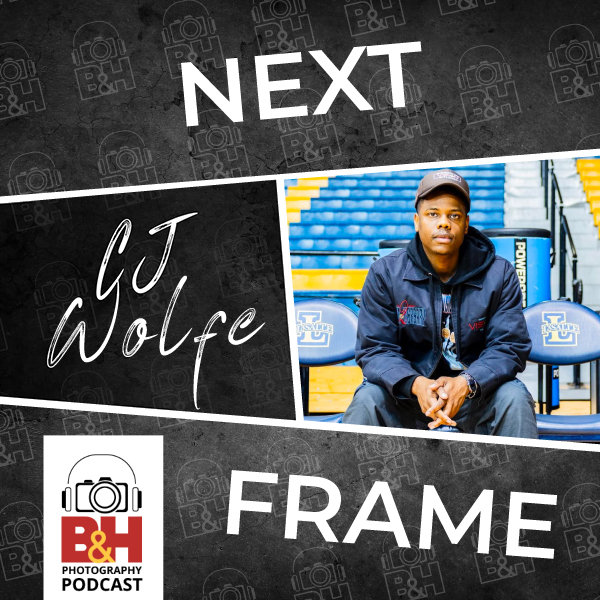
B&H Photography Podcast
Next Frame: Trailblazing a Philadelphia Photo Community, with CJ Wolfe
00:40:09
Loading summary
Transcript45 lines
- [00:01]
A
You're listening to the B and H photography podcast. For 50 years, B& H has been the professional source for photography, video, audio and more. For your favorite gear, news and reviews, Visit us at b&h.com or download the B and H app to your iPhone or Android device. Now here's your host, Derek Fassbender.
- [00:22]
B
You're listening to the BH Photography Podcast. I'm your host Derek Fassbender. I'm also host of our new monthly series Next Frame, and in collaboration with creative producer Jill Waterman and audio engineer Mike Weinstein. Picking up a camera is often the start of a life changing journey, and when it's combined with a focus on community building, the determination to lead by example and shrewd entrepreneurial skills, this basic action can have a ripple effect with the potential to change countless lives. In today's show, we're speaking with a young photographer who has built a passion for pictures and infectious team spirit into a multifaceted brand that encompasses rental studios, a creative agency, and a nonprofit organization with a mission to educate and inspire disenfranchised youth. Our guest is CJ Wolf, who regular podcast listeners might remember from an interview segment we recorded at B H's Build Expo in June 2025. CJ first picked up a camera in 2018 while pursuing college studies as a student athlete, and since that time he's become a staple within Philadelphia's creative community, influencing sports, media, music and lifestyle through his creativity behind the scenes and more importantly, behind the camera. Early on, CJ recognized a major gap in his hometown, a lack of safe, inspiring spaces for photographers to refine their craft, showcase their talents, and build professional networks. Responding to that need, in 2020, he founded Immortal Vision Studio, which quickly grew into a trusted rental powerhouse for photo and video production. Now operating two boutique studios totaling 6,000 square feet and booking over 2,000 appointments per year, this homegrown business has become a cornerstone of the city's creative community. Additionally, in 2023, CJ founded Immortal Vision Agency as a creative firm producing high impact content for brands and businesses while simultaneously elevating local talent to the world stage. Working together with his team, CJ has produced work for Red Bull, Foot Locker, Ethica, and asap, Ferg, Lil Baby, Meek Mill, and Allen Iverson, to name just a few. C.J. wolf, welcome back to the show.
- [02:35]
C
Glad to be here. Thank you for having me.
- [02:38]
B
It's good to get you in. Now for an official sit down. Of course, we covered a lot of your backstory when we talked to you at Build. And that was kind of just a happenstance meeting where we had a table there. You came by, conversations started, and we kind of just freestyled it. So I want to jump in with you taking it back to the first camera you had in College, Canon 5D Mark III. And at that point, it was mostly just taking pictures of fellow student athletes, right?
- [03:06]
C
Yes.
- [03:07]
B
And free. As we all start out, it's like you're taking pictures of anybody who can get in front of your camera. I want to talk about the transition from doing the free work, building the confidence as a creative, to taking that into paid work. What was it like for you?
- [03:23]
C
Yeah, it was awesome, man. Like, I look back when I had so much energy, I could do about like eight shoots in one day and not be tired and edit, you know, it was an amazing time. As you stated, when I use my Best Buy credit card to get this 5D Mark 3, I'm looking at the camera coming from like a T6 that my friend let me borrow, and I'm like, oh, my God, the menu settings and the settings on this camera is so much different. But that same day that I purchased it, I had an opportunity to shoot Lil Uzi that same night. Wow. And it just was like, wow, I'm gonna figure this out. And it was like building a puzzle. I'm learning on the fly, trying to put all the pieces together. Learning how to do my exposure triangle in one night and not getting it and felling and not liking this photo. And at that time, didn't know how to denoise these images. But it was all part of the process, and the process allowed me to continue to go forward.
- [04:23]
B
I love hearing that. I feel like it's so a lot of people, because we have the avenue now to skip the formal education part of it. A lot of people do. So hearing you talk about learning the exposure triangle and actually wanting to learn about how to take a proper image, that touches my heart, man. I gotta admit, the educator in me is like, you know, there's a lot of people who are out there just like, I'm just gonna create, and I'm not gonna try to get better, and I'm not gonna try to learn. The. That resonates with me. Because you clearly, from the beginning, you wanted to be good at the craft. And as we see now, looking back over these past five years, that's something that you clearly have built upon, is becoming an inspiration and wanting others to be inspired and learn and not just be out there like, all right, we're just putting work out and we're not going to try to get better or learn.
- [05:09]
C
Yeah. Because I mean, if you look at it right, I have a duty to build a creative agency and give clients great work. Right. But I also have a duty when individuals come through our studio space, whether you're a contractor, an intern, or part time or full time staff member. In order to continue to grow the ladder within our agency. And there's so many dope agencies out there doing amazing things. You have to know how to tell a story, tell it quick, tell it fast, and tell it in an efficient way. And I always say there's no better way to do that than like crisp, clean photos straight out of the camera, knowing your settings. Because we live in time of 20, 26 is upon us and no one wants to wait super long for the edits. Right. They want to hire you, shoot the content, get it done onto the next. And it's not like a microwave effect, but it's also just keeping up with not the trends but just the speed of the industry of getting content out quickly. So like those small parts help you turn from a freelancer to. You can charge $5,000, $7,000, $10,000 for these assignments.
- [06:26]
B
Now you being a student athlete now. I was an athlete, I now coach and I talk all the time about sports. Are a big, big producer of leaders. You know, growing up playing sports, you're on a team. You're part of something bigger than just you is being coached and is working at things you need to work on. And that builds leaders, it builds camaraderie. Can you talk about what skills and assets you developed through being a student have helped you not just in being a successful creative, but in building your business?
- [07:04]
C
Yeah, the first thing is determination. You know, when we look at sports, it is a team thing, of course. Right? Team together, each achieve more. However, you have personal goals for yourself and you have personal accolades that you want to hit for yourself. Whether that's making the team, whether that's six man, whether that's starting guard, once you get that position, how much do I want to average? Right. We all look at those things. The coaches probably hate that we look at that stuff, but we always look at that and then we kind of look at, okay, how do I help us get there? Maybe my goal Is to average 20. And then you look at it like, okay, what's the best way for my team to succeed and win a championship? So the great thing is we all have different goals and aspirations. Mine was always this determination on how can I win how can I win together, each achieve more. And whether that was playing defense one night, whether that's, you know, me having to shoot the ball a little bit more, whether that's, you know, me staying in the film room a little bit more to go over it with my college teammates on the defense that they run or, you know, the different offenses that they run, I just was determined to win. So, like, that determination, that ambitious to, you know, wanting to do more, that first one in the gym, last one to leave, getting up extra reps, it still correlates to photography, right? You can have a shoot, do some free work, and, okay, I'm practicing on my craft. But YouTube is free, right? Podcasts like this are free that you can listen to and learn from, and you can study from people that are doing what you want to do, and you can learn from their stories and learn from their mistakes and, you know, try your best ways to not do it. So determination. And what really helped me was like, just studying. And that correlates to the photography side as well. I'm a big advocate of that. Like, 10,000 hours, right? You put those 10,000 hours in and you can start to master or get extremely good at whatever you're trying to get good at. And it said day by day thing. And, you know, determination, that's what really instilled, you know, a grit inside of me to continue to pursue, you know, my goals and aspirations. And then I would say leadership. It's funny because I'm naturally a shy person. Like, I'm laid back, I'm quiet, I'm chill. Don't say too much. You may see me in a room, may not know that I'm there, right? I'm always that guy. But I was always talented in basketball and. And from little League to college, my coaches always made me a captain, but they didn't like the fact that I didn't talk that much. So I used to ask them, like, why did you make me a captain? I didn't ask for this role, but I realized I'm a great person at leading by the example. And I think that led to me as well, when I have other creators using our space. Yes, we have some good equipment in our space. We have some amazing things inside our space that you can use for your project. But a lot of these creators in Philadelphia and the surrounding areas come to Immortal Vision Studio because they know my story and they know the exact groundwork that I put in, day in, day out, to perfect my photography skills. And then also that correlate to the Actual business to help give people opportunities. So, yeah, determination and leadership, man, it played a vital role. And playing collegiate sports for me.
- [10:30]
B
Now can you talk about the rental business? A lot of people, you pick up a camera, you're not focused beyond yourself. I mean, you're really like, I'm gonna build up my own craft. I'm gonna go out there and I'm gonna shoot everything and everybody that I wanna shoot. And you work towards that route. You fairly early on in your career, it was towards the community. It was towards, I'm gonna help others. Opening studio is one thing. The rental business, that's what like, really grabs me as, like, I know people that have opened studios and okay, that's kind of like you're a photographer, you want a place to shoot and create. It's a natural second step to open a studio. But a rental house, how did that come about?
- [11:08]
C
Yeah, and if I told you, if I sat up here right now and say, I knew from day one, I want a rental house and photographers who use our space for rentals, I'll be lying, right? I was the same guy running around with hip hop artists, young in their career, NFL players and everything. I started out as, hey, I'm going to bring them here now. I didn't realize in my process that the location that I picked in Philadelphia is the number one drug open area market in the U.S. kensington. If you look up Kensington, Philadelphia, you'll realize like, wow, K and A, K and A. Hey, I do not want to go near there. Now. I didn't know. I graduated college in 2019 and I opened my studio in 2020. So I'm far away from what's happening in the city. I'm still a city guy, but for the last five, six years was all basketball, right? But the great thing about that is it's always beauty in that struggle. Even though I didn't pick the ideal location that made these NFL guys want to come through and I didn't fully earn their trust, I just was the guy holding the camera or what typically they call the cameraman. Let me call my cameraman. As I had the space, I didn't know what C stands were, right? I didn't know there were like different numbers and sizes of backdrops. I didn't know what a sandbag was. I didn't know any of this, but I had a vision of like, hey, I can bring these guys here and we can shoot. That really didn't work. When I posted on social media, other photographers like, hey, my aunt is pregnant and she Wants a maternity shoot. Hey, my friend just started up a fashion brand. Can we shoot hair? Hey, my guy makes music. Can we shoot a music video? Hair? I'm like, sure you can. And then that started to build the business. At first, if you remember, in 2020, a lot of places were shut down due to L and I, right? A lot of these event spots couldn't be open. So we was really within like the first four or five months producing a lot of events inside of our space. I spent mostly all of my savings for my first last in security and just hustling, bustling, going from month to month and picking up some, you know, gigs that I can work as a freelancer to get me through and to paint a picture. We are in a 600 square foot space. So as we continue to build, I'm like, okay, we have something. And let me always put the community first because the community helped me shape this vision and gave me this grand idea of things I can add within our studio space. So what I do, I start going to other studios. I would just show up, hey, I want to take a tour. Hey, what is this silver stand called? I kept seeing a lot of silver stand. I said, what is that called? That look like something? Oh, it's a C stand. You put your lights on there. I said, oh. I said, well, I don't like how the backdrops look on the wall. You know how you bring them down from the wall and you put the paper up there like that takes too long to change it. You can only have four options up there. But we can use that C stand as an option to put our backdrops on there and roll them out. Hey, I like that we have boutique studio space. Let's build it up on to show a different way of how our studio can be used and reimagined to the creative world here in Philadelphia. So that's how that really came about within our studio space and our rental space. And then as we started getting a lot of bookings of people using our space for photo and video projects, people needed equipment. Hey, I left my SD card. Hey, my camera has this black spot every time I take a photo. Do you know where that's from? Well, maybe you should clean your sensor and clean your lens. Oh, what is that? Oh, hey, let's go back to the team. These individuals, these creators don't have that because a lot of our creators are amateurs, right? And this was the first stuff that they knew. Immortal Vision Studio. And this would gave them their start. And now it's amazing. Celebrating Five years where these creators, just like myself, I didn't know what this equipment was and didn't know the difference from AD200 versus another Godox. And oh, we have Westcott. Okay, I like Westcott. Right. We don't have to plug stuff in Bluetooth. So please just start learning and learning and learning and investing in ourselves and learning with the community and staying determined, showing that leadership.
- [15:46]
B
Man, I love the term boutique. And it sounds like you're paying attention to what is going to set you apart. I've rented a lot of studios, I've done a lot of shoots in a lot of different studios and 98% of them are the same. It's literally like someone has the blueprint and they put the same stuff in there, the same gear, it's the same setup, it's the same color, seamless paper on the wall and everything's the same. And I love hearing that there's a studio out there that is actually paying attention to what is gonna set them apart. What is gonna really make an experience where the client uses that studio and is like, you know what, this is the place we wanna come back to. And even from the first conversation with you, it was apparent that you cared about community over just putting a business out there to serve a need. It was about what is going to make this a space that people feel comfortable in and people want to come back and create, work in. But obviously there's a business aspect to everything. So can you take us through this whole process of building up gear and how are you acquiring gear? How are you deciding? You know, obviously when you're first starting out, you can't just go for the high end stuff. Maybe you gotta put some stuff in there that isn't as high end and kind of work your way up. Can you talk about that process?
- [17:05]
C
Yeah, sure. It's like anything else. For the way that I seen it was okay, this is where we start while we're using it. If we can master, you know, using the AD200 and you got the Bowens mount on there and all these different attachments that we need to use, we can be good when we step our game up with the Westcott's and the other pieces as well. So it's like what I would tell individuals is, okay, you are where you are, trust that process. In the meantime, while you're there, start thinking about what do you want next? And study that. I sound repetitive, but it's all about studying and looking ahead. We can't change of where we at now. We can't change that. Okay? I started with no money as a creator. We can't change that, okay? I can't go in the bank and get $70,000 loan or funding to help me with my equipment. Some people can't change that. That's not their reality. But what the reality is, you can have something to start at. You can study it, you can embrace it. And then as you continue to save your money, as you continue to build your portfolio, as you continue to build your network, when you start to get the more expensive equipment and the equipment that's more accessible to use for other individuals, you'll be good. So for us, like I said, we was using notebooks as our sandbags. We're using book bags as our sandbags. Part of I couldn't afford it, but I didn't know what it was. I would see. I would look up. I would look up studios. I'm like, what is that? You know how you try to reverse search something on Amazon or online? Like, what is that that sits on a photography? Like, I just couldn't find it for a while. So what I had to do was I had to go find it. I had to go inside camera stores and ask these questions. And then it got me to my answer. And it didn't happen overnight, Right. But I would tell individuals, like, just study and be aware of what's out there. I think a lot of times where I see individuals, no matter what type business it is, it's like staying ahead of, like, what's next and understanding your industry and understanding what your competitors are using. And then a lot of that stuff comes with collaboration. I would be wrong if I didn't, you know, give respect to older photographers, a little bit older than me that had their studio for 10 years, seven years when I was in the game. And, you know, they gave me advice on what I can do and how I should handle things and what equipment I should get. So there's a lot of, like, ways that individuals can learning about this equipment. I mean, when I met you guys at the Build Conference, Ruad had a nice setup there for a podcast. And it's like, you can learn about the mixers, you can learn about the microphones, you can learn about everything. They have reps there. You can ask questions. Got to put yourself out there and find the information. Yeah, definitely.
- [20:02]
B
I mean, I feel like there's a lot of people, they want what comes from the hard work, but they don't want to do the hard work. They don't want to take the long arduous route of asking these questions. I mean, not many people will go into a studio space to ask them questions about gear and to gain that knowledge. So respect to you for really doing the work and doing everything that it takes to make yourself successful from the ground up and not just expect to be handed things like, a lot of people really just, you know, I want to get sponsored. I want to do this. And they think that it comes from just waking up one day and being viral. And there's a lot of hard work that goes into it. Now, in addition to the studio, the rental house, you have a nonprofit foundation. So can you talk a little bit about the nonprofit and how are you surrounding yourselves with the right people? What's the process like for bringing people in? Because the more you expand, the more you need to rely on other people and the less power and control that you have and that you have to delegate to others, it can cause things to go awry sometimes. So how do you make sure that the people you are bringing on board have your vision, from interns to anybody else that you're working with in your organization?
- [21:15]
C
Yeah. The biggest thing I had to learn through my journey is trust. And as I'm scaling vertically, that's what our mission is within our team. Someone asks a question or. Or someone says an idea, we access that scaling vertically. And when it comes to trust and when you building a brand, that's a hard thing to do. I struggled with this for a long time because, like, this is my baby. This is what I build. I want to be so close to it. I don't want to let someone else take it away. They won't do it. How I do it, but I had to learn early on is like, yes, I'm cj. Yes, I had the vision. Yes, there may be some ways that I will do a photo shoot or if I send a contractor out, there were maybe some things I do different. But I had to embrace. First, I had to set up the systems to show them how we do it. Then I had to embrace how they would do it themselves. And I had to trust that. And it took me a while to do that. But when it comes to our team, man, like, I was blessed to come across some super talented, hungry individuals. When it comes to Carissa Augustine, she runs our nonprofit, the C.J. wood Foundation. And that's where we expose black boys and girls here in Philadelphia to photography. Those young people are exposed to gun violence. Right. And our goal, My goal when I first started was I just was putting things together. Like, okay, Everyone meet me at the studio. We're going to celebrate this weekend. We're going to do free youth classes. I'm going to bring in my banker friends, and they're going to talk about how to get good credit. I'm going bring other people in. We're just going to celebrate this weekend. It's called Community Weekend. We're just going to do something small and shout out to Carissa, because she was like, cj, you're doing this. This is great stuff, but there's no structure to it. You're just doing it out of kindness of your heart. And I love that. But you need to structure this because there are people as far as, like, donors, there are organizations, and there are other people that can help us take our impact to another level. But we have to fix some things up and structure this thing. So she took that initiative to get our 501C3, get all of our paperwork in order, run our programming. And we did a lot of great partnerships within that. And one thing that I learned from that conversation is that you can do a lot alone. I shouldn't go way farther with someone. And that's what she did. And she brought me on that ride and brought me on that journey. And I always wanted our space to double down as a space where individuals can rent, a space where individuals can get some education, have some community, and a community is helping others. That's what I strongly believe, what a community is. So we'd like to bring some of those young people through our programs, get them some work opportunities and expose them to photography. Because if we don't invest in the young people take that initiative, like, who will? And since I knew a camera really changed my life, I knew it can change other people's lives as well. So we just want to give that exposure to them. So our foundation, you know, our other leg of the studio, of our philanthropy work, has been amazing. We were able to help individuals, and we're looking to continue to have a huge impact to help more individuals here in Philadelphia and help more young people that can be impacted by gun violence here in the city.
- [24:38]
A
Cj, quick question about the neighborhood your studio's in. Early on, you mentioned that when you first rented out the space, you wanted some of your NFL guys that you were photographing to come by, and they were reticent because of the reputation of the neighborhood for drugs and such. Has that changed in the time that you've been there, or is it more accessible to people these days, or are you just working with the local community? Who's already in the neighborhood and feels comfortable there.
- [25:12]
C
And that's a great question. I'm sorry I didn't hit on that. But that changed. We earned their trust, right? And that's why it doesn't matter. Like, I wallow. He says, when you're hot, they're going to confine you. And what he's pretty much meaning is, no matter what your situation is, no matter how many followers you have, how long you've been in business, no matter what, if you're hot and you're doing something great and it's undeniable, people are going to come find you and they going to rock with you. And we've been blessed for those individuals to say, wow, cj, like, you changed what I thought about Kissington. We had individuals coming from the suburbs, coming from Delaware, New Jersey was like, they would email us sometimes, like, hey, we see your reviews online. They are great, but would I be okay in safe parking? It's like, yes, you will. And then when they come in, they're like, oh, this is awesome. Like, inside looks way different than I would ever imagine. Like, kudos to you. And that's really a thing once you experience it. And once enough people experience becomes gold. In the trenches is what we call it. And it's safe. We never had any issues, you know, by the grace of God, it's just tough in the city of Philadelphia where we are, but we try to keep that light shining, showing young people that it's possible and giving a space to creators. The great thing is our first location is in Kensington. Then our second location is in Germantown. And that's a shared space called Braid Mill. It's a co working space and we have a partnership with Braid Mill. With us doing Kensington for four years, Brad Mill was like, hey, come over to our space and create another satellite location. And that's what we did. So I'm always grateful of where we started. And like Wallo said, when you hot, they're going to come find you. And we had opportunities to open up another boutique space and activate it on the other side of the city of Philadelphia due to the great work that we did at Kensington.
- [27:15]
B
That's so great. I mean, and branching out within your city, you also have goals to create a franchise out in different cities. Right. You want to take this idea and bring it around the country.
- [27:27]
C
Correct, Correct. Correct. That's exactly what we're looking forward to.
- [27:32]
B
Is there anything on the map right now as far as. If you could say this is the first city? I want to go to and what criteria are you looking at? Are you looking at cities that are similar to Philadelphia, where there might be a need, but somebody needs to be the person that's going to go in there and just break ground and do something about.
- [27:50]
C
About it? Yeah, absolutely. Right now. It's funny as you say that, like, actually I'm traveling to a lot of cities getting acquainted with individuals. I just was at Miami Art Basel a few weeks ago and, you know, getting introduced in Miami by people from all over. So, yeah, man, we've been looking in Chicago. We've been traveling there a lot. You know, Baltimore is right down the street from us. We do a lot of community work there with some organizations that we work with. Charlotte is hot. I'm hearing that there is some need for photography out there. Of course. New York City, right, Like, that's the mecca.
- [28:29]
B
You're welcome whenever, man.
- [28:31]
C
I've been hearing some great stuff about Brooklyn over there. So, yeah, like, I'm taking it slow. I'm seeing what's out there. I think we still have some more work to do here in Philadelphia a bit respectfully, to help others and to just get our space to where we comfortably want wanted. Our flagship location, if you will, something that becomes an icon here in the city of Philadelphia and a staple even more of opening it up to like 8 to 10,000 square feet of production and for corporate events as well. So once we get some more work done here in the city of Philadelphia, I think we'll be ready to, you know, branch out once more. So we just celebrated five years. We're calling it Chasing 10. And hopefully within these next five, we have another location that we open up in another state.
- [29:22]
B
That's awesome. Well, congrats on the five years. I mean, it is incredibly hard to start a business, even just a single track business, when you're talking a multifaceted organization, nonprofit. The more moving parts that are involved, the harder it is to run. So we wish you the best of luck on that.
- [29:41]
C
Yeah, I wish I knew that when I first started, man.
- [29:44]
A
Yeah.
- [29:45]
B
I mean, maybe that's what keeps some people from doing it.
- [29:48]
C
Yeah.
- [29:49]
B
And the fact that you just jumped in and it's kind of like you're passionate about it and now you're gonna figure it out.
- [29:55]
C
Yes.
- [29:55]
B
And you're already pot committed on it. And the great thing about, you know, New York is so saturated. New York has been done time and time and time again. I think what makes it so great about a market like Philly is I feel like there's cities like that that are due for an artistic renaissance, they have the talent now. We have the means of connectivity via social media, the Internet. You know, a lot of people are trying to get out of bigger cities like New York and go and reinvent themselves in smaller cities. And when you get in on something early on, you know, like, it's like the music photography game, it means something different. When you were there before, the artist was big, and then the artist gets big and you're like, you know what? I've been riding with you since day one. And that's kind of where I see you and what you're creating in Philly, where it's like, yes, people are out there doing their thing, but I feel like you're taking things to another level and you have that aspirational power to just keep going and going and going. And I even love what you said about not wanting to branch out into another city until you really build up and create this flagship in your own city. So that being said, what does five years from now look like? I mean, you're just celebrating five years. Where do you see yourself in another five years?
- [31:09]
C
Years. One word. Well, two words, I guess. More impact. One of my guys say impact equals more income. And we're not worrying about the income, though. But the more individuals that we can impact, the more photographers we can just let them come in and give them a one service of our space, the more clients we can get on our agency and be able to wrap up projects for them. Impacting others is just what it is. I'm just keeping it simple and just keeping the main thing. The main thing within that. Yeah, yeah, it's just. It's just more impact, man.
- [31:42]
B
What about you as an individual artist? Do you have a desire sometimes to just get back to creating yourself? Are you totally consumed with this and making it happen? How do you disconnect? Are you still creating work for yourself?
- [31:56]
C
Yeah, man, that's a great question. And I'm actually working on a sabbatical within the next two months to figure that out and to figure out what study I want to do for photography and what project I want to take on next. Personally, it been a good five years since I really worked on something that I wanted to work on and I'm getting back to that. And for some reason I don't want to give too much, but I'm flirting with, like, the game of basketball around the world or like how music is seen around the world and things like that. So I'm still trying to find my assignment on what I want to focus on for a personal project of mine. But. But I do want to showcase my work and behind my lens and what I see and dive into that. And I want to create something that brings dialogue and conversation together and bring people together off of my photography work. So for a while I've been not being able to create because I've been doing a business, but I'm grateful to say I had the opportunity to do so now and that's what I'm looking forward to in 2026 and I'll plan it out now.
- [33:08]
B
I love that. Look, I'll tell you, as somebody who's already over the hill, you're already way ahead of the curve. You have all the time in the world to focus on you and let things come, and you have time to focus on the business and on the brand and still create for yourself when that comes. And I think you're doing great things. You're already way ahead of where a lot of people are 15, 20 years into their career. So there's something to be said for that. If you could look back at your process over the last five, seven years and give advice to somebody who is just starting out, somebody who's just getting their own first camera, is there one thing that sticks out to you as the best piece of advice to give somebody who's just starting out?
- [33:55]
C
Yeah, I would say my friend used to tell me, always have your camera ready to shoot because you never know what you need capture that day. But I think he more so stating that always be ready and open to learn and to see new things and see new perspectives. So I would say like this, like we see social media changed in so many different ways. Right. Like, I could be on here for a long time talking about, you know, when social media started, how Instagram was in 2017 to how it is in 2026. Right? From the algorithm to creators and everything. Right? We know that, right? But I think just being open and having, you know, open eye, a third eye, if you will, of what's going on in the game of like storytelling and marketing, because that's what's really going to drive you to success. We see how everything is changing. We see with AI, we see what storytelling, we see what, like they say it all the time. A few years ago it was be an architect or be a doctor and things of that. So, like, individuals are making a lot of money being creators now, right? No matter if they shooting the content, whether in front of it, whether they have a podcast, whether, you know, they are acting, whatever it looks like. But I would just say, like, always be open and have your third eye open to like, what's going on around you and how you can fit that into your story, into your art, into your creativity within your camera. Because nowadays photographers, you're just not a photographer. Like, there's so much more to that now and you have to be able to be open up, knowing what marketing look like. Okay. I may not be a great videographer, but I know there's about 10 people in my city that I can get in contact with that's doing lectures or talks and they need to put it out there. They may not need Sizzle Rules, but they need a live recorded. You can pick up extra money by just doing that, having audio, clean lens, clean shots and being able to do that. So having that third eye open of like, and I hope people following what I'm saying here is like, always keep that perspective and always knowing what's going on around you so you can contribute to other people's success and adding value to others.
- [36:16]
B
Adding value to others. Contributing to other people's success is such a good mantra, not just for business, but for. For life and looking outside yourself. And really, that's what this whole idea of community is about. Wonderful, wonderful words of advice. Now, cj, what do you have that you're working on? Is there any upcoming projects? Anything in the immediate pipeline?
- [36:38]
C
Yeah, yeah. So we more so focusing on, like I talked about that flagship location. Right now we are activating two locations and there are two warehouse locations. So there's other businesses inside of our buildings and that's great. Give us a chance to network and connect and all that stuff. Right. But we're looking at a standalone boutique square footage space, about 6 to 10,000 square footage, where we can open up our space more and allow more resources and opportunities for creators and peoples and brands here in Philadelphia. So with 2026 coming up, we have about five major events from FIFA to the 250th anniversary to MLB All Star to March Mad. There's a lot going on in Philadelphia and me being in Philadelphia and I'm proud of that. And for us it's like, okay, how do we capitalize of the good stuff that's going on in our city and putting our photographers first and giving them opportunity and resources to thrive and continue to build our brand. So focusing on that location and also really taking advantage of what's going on in our city in 2026 and then, you know, also traveling out and producing work for other clients in other wow.
- [37:58]
B
And I'm over here and I haven't even bought all my Christmas gifts and you just laid all that out there like, man, wow, you're really doing it. Again, a huge congratulations on the five years. I mean, you clearly you have not just the ability to do all this, but you have more importantly, the vision. And you're a forward thinker and you're not the type to sit there and wait until you have all the pieces and aligned. You're the type to get out there and do it. And look, I've always said there's two types of people in the world, the ones that do it and the ones that don't. And the ones that sit around and wait for everything to be aligned usually don't end up doing it. And the ones that just get out there and do it, they find their way. And I think that's what you're doing. You're finding your way. And the world needs trailblazers and we need more trailblazers like you. So I want to send a huge congratulations and best wishes to you over the next five years and the five years after that and the five years to come. Where can we hear more about your work? Where can we track what you have going on?
- [38:58]
C
Yeah, man, I really appreciate those words and I really appreciate being on here. Thank you for that. Immortal Vision Studio, I'm on all platforms immortalvisionstudio.com Immortal Vision Studio on social platforms and CJ Wolf, CJX Wolf on all social platforms as well. And that's woof with the E and Studio S T U D I O no S just yet.
- [39:27]
B
Perfect. CJ Huge. Thank you to you again for joining us.
- [39:30]
C
Yes, thank you.
- [39:32]
B
And to all of our listeners out there, thank you for joining us as well. If you are a fan of the show but are not yet a subscriber, head on over to Apple Podcasts, Spotify, B&H's YouTube channel or wherever you get your podcasts and click subscribe. You can also find us on the Explorer blog where we post photos from our guests along with our show notes. I'm your host, Derek Fosbender. Jill Waterman is our creative producer. Episodes are recorded, mixed and edited by technical producer Mike Weinstein and our executive producer is Richard Stevens. On behalf of us all, thank you so much for tuning in today.