← Big Ideas Lab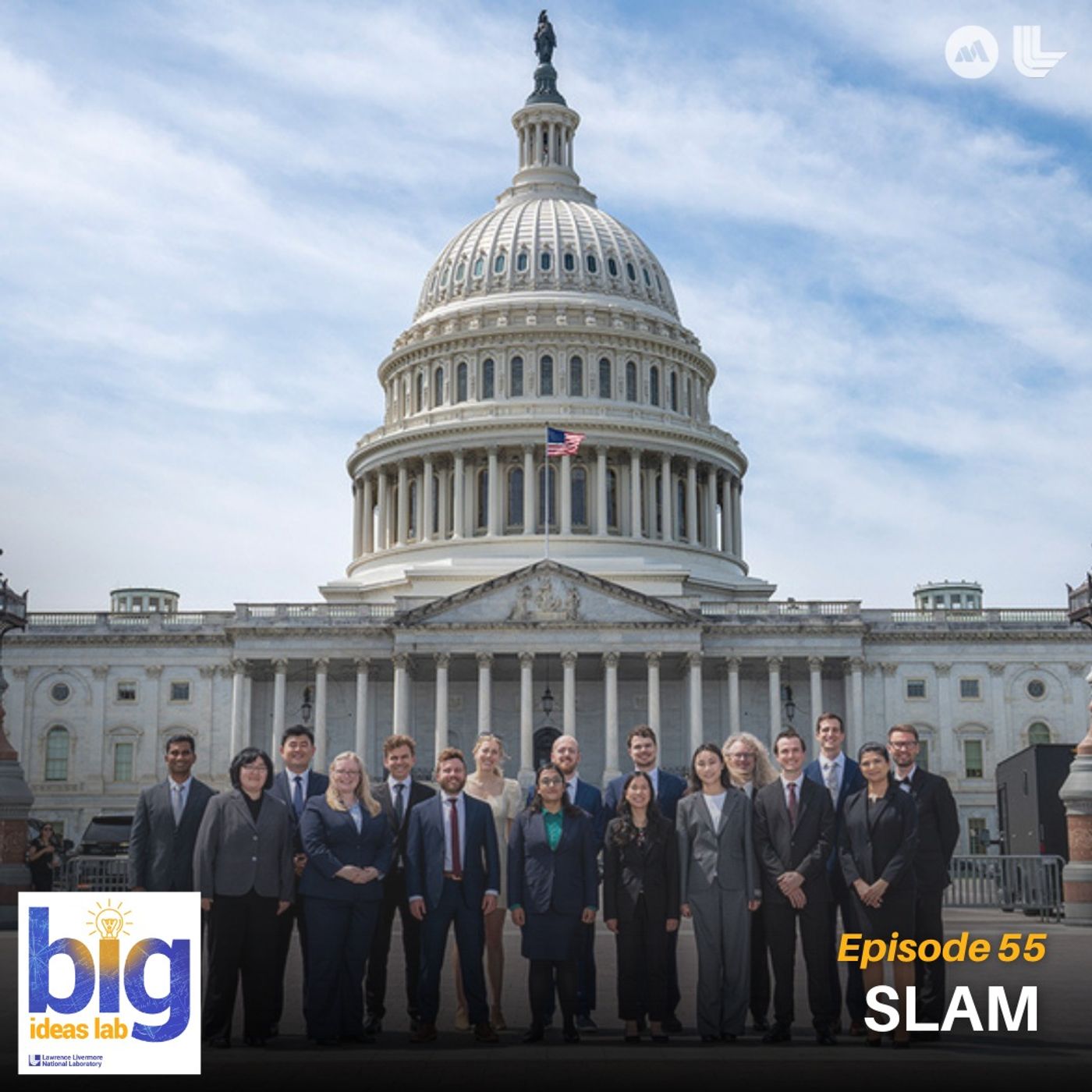
Big Ideas Lab
SLAM
00:21:49
Scientists from all 17 national laboratories get three minutes to explain years of complex research.
Loading summary
Transcript101 lines
- [00:05]
Narrator
It's 2am and you're opening the freezer door. You know it's probably not the best idea, but you find yourself grabbing that tub of ice cream, calling your name, knowing it's rock hard. You're gentle with it as you place it on the counter, careful not to alert anyone of the personal choice you just made. You reach into the drawer and grab a spoon, but not the plastic one. You don't even think about it. You just know you don't put a
- [00:37]
Brandon Zimmerman
plastic spoon in there because intuitively you know that would just snap off.
- [00:41]
Narrator
You've never taken a material science class in your life and you just made a material science decision. That example is how Brandon Zimmerman, a scientist at Lawrence Livermore National Laboratory, explained millions of dollars worth of national security material science to a room full of Congressional staffers on Capitol H in three minutes.
- [01:06]
Brandon Zimmerman
It's not the right material for the role it has to play. And so we're just doing the same thing at the lab.
- [01:11]
Narrator
A scientist can spend years on a discovery that could change the world and still lose the room in 30 seconds if no one understands why it matters. So Lawrence Livermore built something to fix that. A program designed to take the hardest science in the country and make it land for someone who's never set foot in a lab. From local competitions to a showdown between 17 national labs in Washington D.C. this is the research slang. Welcome to the Big Ideas Lab. Your exploration inside Lawrence Livermore National Laboratory. Hear untold stories, meet boundary pushing pioneers and and get unparalleled access inside the gates. From national security challenges to computing revolutions. Discover the innovations that are shaping tomorrow. Today. Join a team where expertise makes a difference. Lawrence Livermore National Laboratory is hiring for a nurse practitioner, physician assistant, a senior health physicist and a laser modeling physicist. And the list of open positions doesn't end there. There are more than 100 job openings across science, engineering, IT, HR and the skilled trades. This is more than a job. It's an opportunity to help shape the future. Explore all open positions and start your next career adventure today@llnl.gov that's llnl.gov careers before he was a staff scientist at Lawrence Livermore, Brandon Zimmerman was a postdoc. And there was one event that every early career researcher passing through the lab was encouraged to consider the research Islam.
- [03:19]
Brandon Zimmerman
You have three minutes to explain why your work matters and what you do to broadly a non technical audience. You're not talking down to them. It's just people who are not scientists in your field doing the stuff you do every day.
- [03:32]
Narrator
Brandon has a better way to picture it.
- [03:34]
Brandon Zimmerman
If you're talking to a friend of your parents that you bump into at a party and they ask, what do you do? You don't immediately tell them, I'm solving differential equations. You go, higher level. I'm working on how do we make materials that are really strong and light at the same time.
- [03:47]
Narrator
You know exactly the moment he's describing. You have about one sentence before their eyes drift toward the snacks. Only at the Research Slam, it's in front of a panel of judges. The Research Slam is more than a contest for the scientists who go through it. It's a skill that follows them everywhere. Funding pitches, policy conversations, grant writing, and the simple moment of explaining your work to someone else.
- [04:14]
Christine Zacko
The slam is really about science communication.
- [04:18]
Narrator
Christine Zacko is the operations manager in the Academic Engagement office at Lawrence Livermore National Laboratory.
- [04:25]
Christine Zacko
How to communicate really complex science to a non specialist audience.
- [04:30]
Narrator
Christine is one of the two people who founded the national Lab Slam.
- [04:34]
Christine Zacko
Them being able to tell me creates some trust there and that helps bridge that gap between science policymakers, society in general. It's good for us to fully understand what they do.
- [04:49]
Narrator
Christine knows this because her first thoughts about Lawrence Livermore were from the outside.
- [04:55]
Christine Zacko
I'm two miles down the road. Before I got my job at the lab, it was a mysterious place. What goes on there, I didn't know
- [05:02]
Narrator
that kind of mystery creates distance. The way across that distance is communication. Clear, relatable communication.
- [05:11]
Christine Zacko
These scientists are so smart and if they can't tell me what they do, I'm not going to get it.
- [05:20]
Narrator
From her very first day, Christine's job was the postdocs, the early career scientists passing through the lab, learning how to build a life in research. About 10 years in, she was invited to watch the University of California's Grad Slam in San Francisco, a competition where graduate students had to make complicated research understandable to people outside their field.
- [05:44]
Christine Zacko
We saw the great talks that were given. We could identify that these were skills that were so important for young researchers to have to be able to communicate their science.
- [05:56]
Narrator
Christine and her boss had some time together after the event as they took the train back that day, we got
- [06:02]
Christine Zacko
on the BART train and went, we have to do this. We have to do this for our postdocs.
- [06:06]
Narrator
So they did one local slam at Lawrence Livermore National Laboratory. But the excitement could not be contained.
- [06:13]
Christine Zacko
I have a really close working relationship with my counterpart at Lawrence Berkeley Lab. I said, hey, you gotta come see what we're doing. She saw it, she loved it. Thought it was great. So she took it back to Lawrence Berkeley and did one for their postdocs the following year.
- [06:29]
Narrator
As years passed, a regional level was created with more research powerhouses joining in. Slac, the Linear Accelerator center at Stanford, and Sandia, the national lab next door in California. Naturally, this led to one final, final question.
- [06:46]
Christine Zacko
Man, wouldn't this be great if we could do this on a national scale?
- [06:51]
Narrator
What if all 17 national labs did this together? They took it to lab leadership and
- [06:57]
Christine Zacko
leadership said yes, it very quickly progressed to all 17 labs. We had commitment from every single DOE laboratory across the nation that they would train a finalist, prepare them, sleep and send them to Washington D.C. for this event.
- [07:15]
Narrator
What had started as an energetic train ride home was now a national stage. Every lab in the system sending a single champion to Capitol Hill.
- [07:25]
Brandon Zimmerman
Ladies and gentlemen, welcome to the first
- [07:29]
Narrator
ever National Lab research slam. All 17 national laboratories of the US
- [07:38]
Brandon Zimmerman
Department of Energy have each sent one champion.
- [07:44]
Narrator
The crowd cheers in the Congressional Auditorium tucked beneath the east front plaza of the Capitol building itself.
- [07:51]
Brandon Zimmerman
Large auditorium, red velvet seats sweeping up. And then there's box seats up top. It's almost like you're going to see a mid tier play.
- [07:59]
Narrator
But Brandon is not in the theater yet.
- [08:02]
Christine Zacko
Give me a Test. Test.
- [08:04]
Narrator
All 17 scientists are getting wireless microphones clipped to their lapels by the production crew. On one wall, a six inch monitor plays a silent feed of the stage. Brandon can see the person on screen, but he can't hear them talk or tell if the audience is locked in. So mostly he waits. And what almost no one in that room knows is that the talk Brandon is waiting to give is is not the one he spent months practicing.
- [08:34]
Brandon Zimmerman
He had thrown it out one week before the National Slam. I threw out my entire script and I rewrote it from scratch. So the presentation I gave at the National Slam was completely new.
- [08:44]
Narrator
And that change would define his early career. Lawrence Livermore National Laboratory is hiring. If you're passionate about tackling real world challenges in science, engineering, business or skilled trades, there's a place for you at the lab. Right now, positions are open for a senior research scientist, a power grid engineer and a space hardware postdoctoral researcher. These are just a few of the more than 100 exciting roles available at Lawrence Livermore. You'll work on projects that matter, from national security to cutting edge scientific advancements. Join a team that values innovation, collaboration and professional growth. Explore opportunities@llnl.gov careers where your next career move could make history.
- [09:55]
Brandon Zimmerman
Ladies and gentlemen, from Lawrence Livermore National Lab, Dr. Brandon Zimmerman.
- [10:01]
Narrator
Brandon Zimmerman would represent Lawrence Livermore at the inaugural National Lab Research Slam. But at first, he was not exactly looking for a spotlight.
- [10:11]
Brandon Zimmerman
This might take away time for my research. I don't really want to get up and talk in front of a bunch of people.
- [10:16]
Narrator
At the time, Brandon was a postdoc. And at Lawrence Livermore, the postdoc years are not just a holding pattern. They're a proving ground. The lab is watching for people who can grow into staff roles, people who can contribute not only to the research, but to the culture around the research.
- [10:34]
Brandon Zimmerman
But I did really want to be converted, and I did want to show that while I'm willing to stretch and try these things.
- [10:40]
Narrator
So he entered and set forth solving the puzzle of explaining what he does. Brandon's real work is in solid mechanics. He studies materials that are 3D printed, built up layer by layer into shapes that couldn't exist any other way.
- [10:55]
Brandon Zimmerman
We have this great additive manufacturing thrust at the lab that's been working on different types of materials that weren't able to be created before you could do additive manufacturing. But when you print it from the ground up, you can now make these things that didn't exist before.
- [11:09]
Narrator
Lattices flow full of tiny holes, structures that interact with shock waves in ways nature never made. These descriptions alone could lose a room. So Brandon went looking for the version of his work that everyone already understands. And that ice cream image became the spine of his talk.
- [11:29]
Brandon Zimmerman
We have a specific thing we need to do, and we want to know, can I grab this material? Will it do the right thing?
- [11:35]
Narrator
The plastic spoon snaps, the metal one works. You match the material to the job. That's all his research is finding which new printed material is right for which extreme job. At the lab, he didn't dumb the work down. He found the version that was true and gripping at the same time. But knowing the analogy isn't the same as landing it. Three minutes is not a lecture.
- [12:02]
Brandon Zimmerman
You're not just saying what you do. You're. You are giving a performance. So you have to tell a story.
- [12:07]
Narrator
And a story has a shape. It has a hook in the first sentence, or you've already lost.
- [12:13]
Brandon Zimmerman
If you don't catch the person's interest and get them to buy into what you're saying right away, then they're already gone.
- [12:19]
Narrator
So Brandon built his three minutes like a story with a turn in the middle. He'd pose a problem, hit a dead end, and then pivot the very first sentence.
- [12:28]
Brandon Zimmerman
I wanted to kind of establish, why is this person talking like this? That's an Odd thing to say, talking about ice cream and plastic spoons. I'll listen a little bit longer to see what it is. And then the way to get the buy in is explain why do we need to do this? Material science research at Lawrence Livermore involves extreme high pressure loading conditions. To survive these loads, I needed to develop an entirely new type of material. The problem is this testing is wildly expensive.
- [12:53]
Narrator
The computing power available at Lawrence Livermore National Laboratory changed that.
- [12:57]
Brandon Zimmerman
I can't just play with the laser all day, but I can use my computer and our world class codes to simulate this testing. Running all these simulations saved a lot of taxpayer money because now I only have to test my final designs.
- [13:10]
Narrator
Once he had that structure, Brandon practiced until the talk stopped feeling like a paper and started feeling like a performance.
- [13:17]
Brandon Zimmerman
It was really exciting though, because I probably practiced that speech 500 times.
- [13:21]
Narrator
He gave it at Lawrence Livermore's local Style Slam. He carried it into the regional competition and each time the talk got him one step closer to Washington. But one week before the National Slam, Brandon faced a question he couldn't shake. Was the talk that had gotten him this far actually the one he should take to Capitol Hill? The last performance Brandon gave felt flat. He couldn't figure out why until he met the national coach, John John Luke, a scientific communication expert who worked with the finalists on their presentations.
- [13:55]
Brandon Zimmerman
He gave us a 30 minute presentation just on like here's the elements of what makes a good slam, a good non technical talk. And listening to him, I realized I'm violating that.
- [14:04]
Narrator
Brandon sat there realizing he was breaking every rule.
- [14:08]
Brandon Zimmerman
That's what the issue is. The reason I felt something was off is I'm not doing those things right and I think I know exactly what I have to do to flip it.
- [14:17]
Narrator
So he made the call. One week out, he threw the entire script away. Four months of practice gone and seven days to write a brand new speech and memorize it. Before the biggest stage of his career, he tested the new version on the toughest crowd he had. His in laws, both engineers.
- [14:40]
Brandon Zimmerman
Both of them immediately were like, no, that one's not good. It's way too confusing. You should go back to your old one, don't use this one. And I remember thinking, I just have to do it like this. I'm just going to ignore your advice.
- [14:50]
Narrator
He trusted what John Luke had said about the narrative. He believed the structure made sense and took the new version to the finals. The evening before the National Slam, the finalists ran through their talks one last time in front of each other. And the Coach Brandon stood up, opened his mouth, and nothing came out.
- [15:13]
Brandon Zimmerman
So I stood up there for probably 30 seconds, knowing I had to talk tomorrow morning. And I just could not remember any lines at all. Absolutely nothing. Like, when you see somebody up there who forgets, you think that they must be thinking, I can't believe this is happening. What are my next lines? I just could not think of a single thing at all.
- [15:30]
Narrator
So that night, he sent an email. He asked the people from Lawrence Livermore who'd traveled with him to meet him the next morning. And there in the hotel lobby, he ran it one more time in front of the people who would sharpen him the most. His peers.
- [15:45]
Brandon Zimmerman
I think we had 10 people from the lab show up just to let me give a quick presentation in a hotel lobby. So just even that support was incredible because I just needed to know, okay, with people watching me and being stressed, I still do have a clean one in me.
- [15:58]
Narrator
Just a few hours later, Brandon was sitting in that room with the small screen of the stage waiting to be called.
- [16:06]
Brandon Zimmerman
There were several hundred people, and it
- [16:08]
Narrator
wasn't just the room. Back home, every national lab was streaming it live. Next thing he knew, he was on stage.
- [16:16]
Brandon Zimmerman
When I was out there and got started, it just felt like, yeah, I've done this before. The words were coming a little slower than I wanted, but they kept coming in at the right time. So it felt like, yeah, I've done this before. It's just kind of a practice I'm running through. I can tell that I'm doing a nice job. The audience seems into it. That kind of carried me through.
- [16:33]
Narrator
The finalists waited while the judges made their final decisions. Brandon had done the only part he could control. Now all he could do was listen for the name.
- [16:44]
Brandon Zimmerman
Afterwards, I don't think I really remembered much of the other people. I was just kind of sitting wiped out.
- [16:49]
Narrator
And then it happened.
- [16:50]
Brandon Zimmerman
I got first place in national security, which I was really excited about. I got a big crystal trophy. I got to take pictures with the other people from the lab team.
- [16:58]
Narrator
Brandon didn't just win, he won twice.
- [17:02]
Brandon Zimmerman
Then at the end, they called us all back and they said, now it's time for the People's Choice Award. And to be honest, I was actually kind of hoping they would drop the four winners from that because I thought you put all that work and you travel the whole way out to go to D.C. it would be terrible if somebody doubled up, and then it was me. I got People's Choice as well.
- [17:19]
Narrator
A few months later, he finally brought it up with his in laws, to their credit.
- [17:23]
Brandon Zimmerman
They were like, yeah, I'm so glad you didn't listen to us. It actually sounded so much better in the real thing.
- [17:28]
Narrator
What the experience gave him went beyond the trophies. He left Capitol Hill knowing he could walk into any room, a congressional hearing, a funding pitch, a conversation at a party, and make the work land. These skills aren't just for the public. They're for other scientists. Brandon came to Lawrence Livermore thinking science communication was something you did for high school outreach talks until he sat in his first internal funding pitch.
- [17:56]
Brandon Zimmerman
So if you're doing an LDRD pitch, the people you're talking to are Also scientists with PhDs who work at the same lab you do. And they could be in a field that's so different that they can't really communicate if you just directly explain what you're doing on the day to day.
- [18:12]
Narrator
It also changed what Brandon noticed in the scientists leading projects around him. Specifically, the skill of knowing when to leave the details behind.
- [18:21]
Brandon Zimmerman
I have PIs that I work with who. We have very technical meetings, and then I sit in on where they're giving a proposal, and the entire way that they'll talk about the topic switches. I could get you here, or I could save you money and all of the details on how we do that. But what gets you in the door is not your incredible detailed research plan. It's, are you interested enough in what I'm buying to even get down to that research plan?
- [18:45]
Narrator
Christine believes that's the real win. The moment scientists realize how skills from the slam transfer outside the composition. One of the contestants she thinks of most is a finalist on that same stage from a different year. A scientist who'd been flawless in every practice, who also walked out, opened his mouth, and nothing came out. But this time it wasn't. During the rehearsal, he froze.
- [19:12]
Christine Zacko
He tried to restart, and it just wasn't happening. He tried to restart three, four, five times.
- [19:19]
Brandon Zimmerman
And.
- [19:19]
Christine Zacko
And I'm sitting there thinking, oh, how do we get him off the stage and just end this misery?
- [19:24]
Brandon Zimmerman
It's delivering reliable power where and when it's needed, but.
- [19:37]
Narrator
And then from the wings, the people he'd spent the whole week with refused to let him go down.
- [19:43]
Christine Zacko
One of his cohort members yelled, you got this. The audience all started clapping. And then he did. He got through. I was so proud that he didn't give up.
- [19:55]
Narrator
It's the part of the slam that doesn't fit on a trophy. The finalists arrive as strangers from 17 different labs, but they leave as a confident cohort Brandon's Cohort from the first National Lab Research Slam in 2023 never stopped talking.
- [20:11]
Brandon Zimmerman
So it gives you a better understanding of what all of these labs are, how all of their missions differ, what the working environments are like at those labs. Coming directly out of grad school and knowing nothing about this environment, it just really helps you fit in better.
- [20:24]
Christine Zacko
I think they still keep in contact. They wish each other happy holidays. They invite and attend each other's conference talks. They report on life events. Ooh, I just bought a house. Ooh, I just got another job. Wow, we're having a baby. It's so validating to see that they have such a close connection all these years. Years later, it makes me incredibly proud to have been part of making this event happen.
- [20:50]
Narrator
Science doesn't end at discovery. It's why a national lab built for fusion, supercomputers, and national security. Science will spend valuable time teaching researchers how to use something ordinary, like a late night trip to the freezer, to explain something extraordinary.
- [21:07]
Christine Zacko
I often hear these fun talk about going to their families and saying, my mom doesn't understand what I do. And we put them through this training and they'll come back and they'll say, my mom understands what I do. It's about that.
- [21:20]
Narrator
At Lawrence Livermore, the slam is a reflection of what a scientist should be. Not just someone who can do the work, but someone who can carry it outward to colleagues in other divisions, to policymakers, to the public.
- [21:35]
Christine Zacko
It's about getting that message across. It's about talking to sponsors and policymakers and writing grants for funding. It helps them put their research out there in a way that they can get back. It's meaningful because it shows that at Livermore, at the other national labs, it's not just about doing great science by itself. These researchers are expected to communicate clearly, support each other, and then grow into leaders where their work has broader impact across the nation.
- [22:16]
Narrator
For Brandon, the proof came quietly. Months after Capitol Hill, he gave a routine update to a group at the lab who had no natural reason to care about his corner of the work.
- [22:26]
Brandon Zimmerman
The one person who was leading it was like, that was actually very nice. I felt like I fully followed everything you were saying. That was very cool to learn, and that felt like winning it all over again. That's amazing.
- [22:36]
Narrator
Somewhere out there is a person two miles down the road from a lab, driving past the fence, wondering what happens inside. And in three minutes, a scientist can explain it. Thank you for tuning in to Big Ideas Lab. If you loved what you heard, please let us know by leaving a rating and review. And if you haven't already, don't forget to hit the Follow or Subscribe button in your podcast app to keep up with our latest episode. Thanks for listening. Looking for a career that challenges and inspires? Lawrence Livermore National Laboratory is hiring for a nuclear facility engineer, systems design and testing engineer, and a senior scientific Technologist, along with many other roles in science, technology, engineering and beyond. At the lab, every role contributes to groundbreaking projects in national security, advanced computing and scientific research, all within a collaborative, mission driven environment. Discover Open positions@llnl.gov careers where big ideas come to life.