← Big Ideas Lab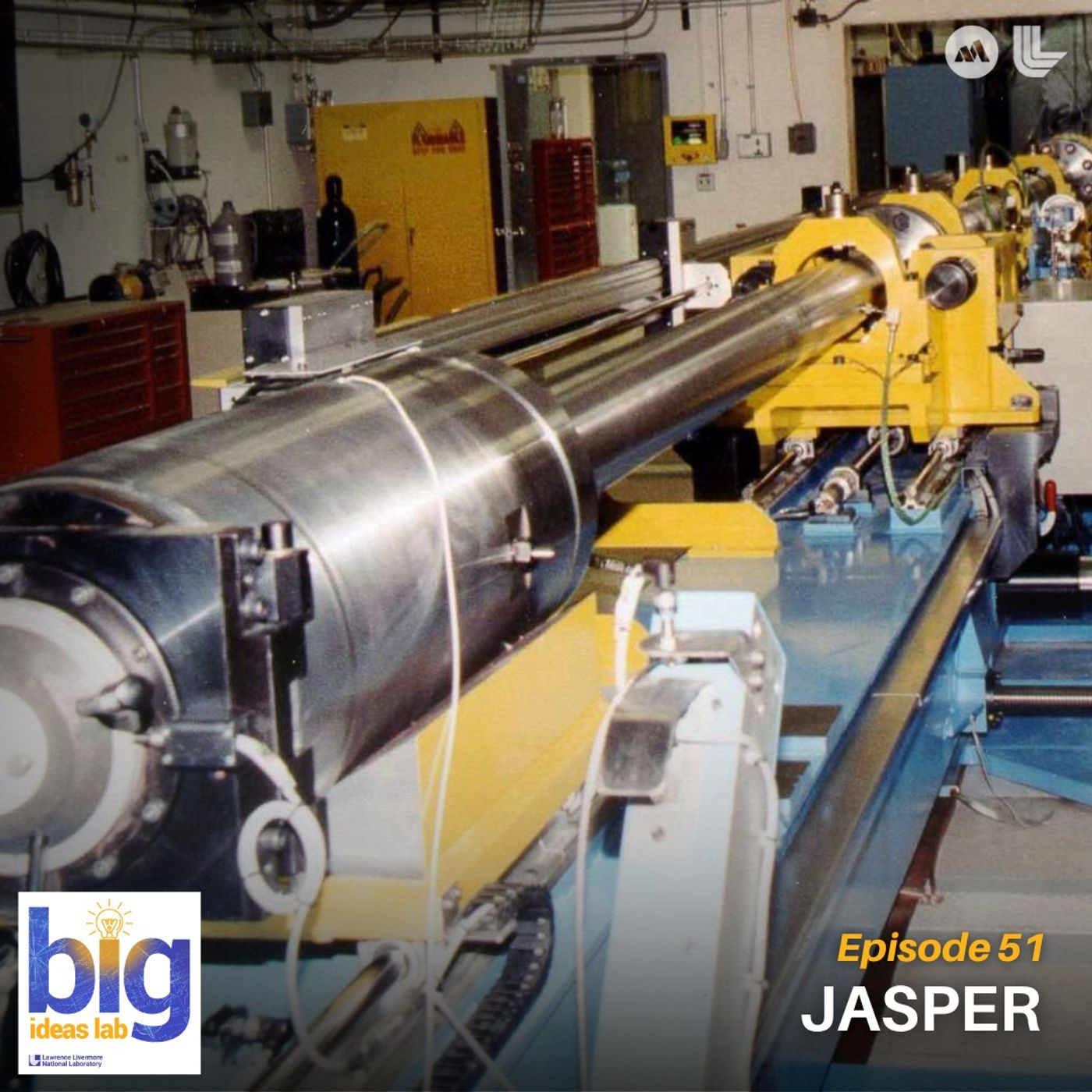
Big Ideas Lab
JASPER
00:16:30
Scientists at JASPER study one of the most consequential materials on Earth: plutonium.
Loading summary
Transcript56 lines
- [00:07]
Narrator
As the car door slams shut, dust scatters 90 miles one way deep into the Nevada desert has coated everything in a fine layer of grit. It's 7:06am A scientist from Lawrence Livermore National Laboratory has just arrived at a remote facility built for for a single purpose. To measure an event that no human can fully witness. A dry wind gusts across his face one last time before he steps inside the doors of the concrete building. He runs through his checklist. Materials shaped and delivered, systems aligned and diagnostics tuned to capture a moment too fast for human senses to register. The data collected will ripple far beyond the harsh Nevada desert and directly influence national security. He's made this trek many times before, but today is different. Today is the day that three years of preparation culminate in less than a microsecondition. Today is the day a two stage gas gun drives a radioactive hazardous material into conditions too extreme to observe directly. Today is the day they measure plutonium. Today is shot day at Jasper. Welcome to the Big Ideas Lab. Your exploration inside Lawrence Livermore National Laboratory. Hear untold stories, meet boundary pushing pioneers and get unparalleled access inside the gates. From national security challenges to computing revolutions, discover the innovations that are shaping tomorrow. Today, Looking for a career that challenges and inspires, Lawrence Livermore National Laboratory is hiring for a nuclear facility engineer, systems design and testing engineer and a senior scientific technologist along with many other roles in science, technology, engineering and beyond. At the lab, every role contributes to groundbreaking projects in national security, advanced computing and scientific research, all within a collaborative mission driven environment. Discover Open positions@llnl.gov careers where big ideas come to life. An unmanned test vehicle tears out of the atmosphere. In the vacuum of space. It's silent as it makes its way back to Earth. Then it hits reentry. The air doesn't part, it compresses. Temperature spikes. The surface begins to burn. The vehicle and whatever it could have told us, gone.
- [03:53]
Ricky Chow
Back in the 60s, the space race people wanted ways to test re entry nose cones.
- [03:59]
Narrator
As missile programs and early spaceflight pushed beyond the atmosphere, reentry became one of the hardest problems to solve.
- [04:07]
Ricky Chow
Typically, if you have something from space falling back to Earth, it might be 11 kilometers per second.
- [04:12]
Narrator
The US government turned to General Motors looking for another way not to chase a moment in the sky, but to recreate it on the ground. Using the same principle as a cannon, they compressed gas to launch a projectile at extreme speeds fast enough to mimic the shock of reentry gas guns. Eventually making their way to Lawrence Livermore National Laboratory where the Technology was expanded, refined and adapted for entirely new kinds of experiments.
- [04:43]
Ricky Chow
That gun should have a Chevrolet stamp on it because it was made by General Motors.
- [04:47]
Narrator
Ricky Chow is the execution lead at Jasper General Motors.
- [04:51]
Ricky Chow
What they've done with these test guns, they donated them to the Department of Energy. So the guns that we have here were prototypes of the launcher.
- [04:59]
Narrator
But what they were built for then isn't what they're used for now. For more than 20 years, far removed from city lights and ordinary laboratories, the Joint Actinide Shock Physics Experimental Research facility or Jasper has done something no other place on earth can study plutonium with extraordinary precision. In complete containment without nuclear testing.
- [05:27]
Ricky Chow
In the old days you could use rough guesses for the data because well if you're not sure we're going to blow one of them up and then we'll just verify our models against the test. Once you stop being able to do that and the further you go away from that, then your models have to get better.
- [05:46]
Narrator
Few materials arrive with as much baggage as plutonium.
- [05:50]
Ricky Chow
You are the target.
- [05:52]
Narrator
You will be prepared. Mushroom clouds, fallout shelters waiting out decay, yellow and black radiation signs and the long after image of the atomic age atomic bombs. It's a highly radioactive heavy metal. Plutonium.
- [06:07]
David Bober
Are you telling me that this sucker is nuclear?
- [06:10]
Narrator
It's handled under some of the strictest protections the US government can impose. And it's toxic. At Jasper, every step must be controlled.
- [06:24]
David Bober
Jasper is the only gun in the United States that can hit this broad a range of velocities and be used on plutonium.
- [06:33]
Narrator
Meet David Bober, the team lead for Jasper.
- [06:36]
David Bober
A Jasper target typically starts its life cycle as some source of plutonium. Could be a casting that we've made specifically for these sorts of science experiments and that will then be brought into a glove box. The image in the public mind is the intro to Homer Simpson.
- [06:50]
Ricky Chow
All I need is some plutonium.
- [06:52]
David Bober
He's got his hands and the gloves and the big window. It's that, but done by professionals.
- [06:57]
Narrator
Once it's prepared, the experiment begins.
- [07:00]
David Bober
Jasper is an impact driven launcher. Impact driven experiments. So we throw a projectile at up to 8 kilometers per second at the
- [07:06]
Narrator
target, 18,000 miles per hour ejected by a two stage gas gun.
- [07:13]
Ricky Chow
You hit a fire button, it sends a fire pulse through the electronics and in Jasper's case it sets off a debt commercial detonator. The first stage is like a large cannon, like a howitzer or a battleship gun. It works the same way. You have a propellant charge. We wrap it up, it looks like a giant burrito. We fill it with priming powder. We use commercial sporting goods like hunter powder. And then we fill a.30 06 cartridge with the same powder and stick it in the back. And all we do is we have a solenoid that acts like a hammer of a gun that hits the back of the.30 06. And that's what fires a gun. The primer on the cartridge, it lights the primer powder. The primer powder burns, the flames go out the holes, and then lights the main charge.
- [07:52]
Narrator
The fire command starts the first stage. The second stage comes only milliseconds later. Once the piston has compressed the hydrogen
- [08:00]
Ricky Chow
gas, the propeller starts to burn. And it's in a breach, which is in a sealed volume. So as you create more burn gases, pressure builds up. Then the pressure is going to push on a piston. And then so this piston starts traveling due to the burning gases. At some point, you increase the pressure so high, and then the gases escape into a tapered section and it acts just like a perfume nozzle, so that you have gases going through and accelerates the gas. And that accelerated gas then pushes on a little inch in diameter projectile.
- [08:30]
Narrator
The pressure going through is so high that it ruptures a pedal valve that launches the projectile.
- [08:36]
Ricky Chow
And that's what gets launched at 800 per second. And then it goes down to a barrel, comes out of the gun, and it smacks the target. And then it flies through. Some X ray and laser diagnostics just to measure the velocity, you know, like basically like two I beams. You break one beam, get a counter break another beam that gives you your velocity.
- [08:52]
Narrator
The whole sequence is designed to do one thing relentlessly well, turn stored energy into extreme speed.
- [09:00]
David Bober
The old magic trick where the magician pretends to catch a bullet in their teeth, we're really doing that. But this bullet is traveling 10 times faster than a rifle bullet. The portion of time where we are collecting useful data is less than a microsecond or one millionth of a second. And that's actually maybe for our slower experiments. Some of the more typical experiments, it's more like 100 nanoseconds. So a typical experiment for us would be we may be measuring the speed of a shock wave. It transits through a sample. So we'll measure very precisely the moment of impact, and then we'll measure how long it takes for that shock wave that's generated to transit across the sample. And that tells us something important about the thermodynamic state.
- [09:40]
Narrator
In a fraction of a microsecond, Plutonium is pushed into extremes too fast. To see and too important to guess at.
- [09:48]
David Bober
You can imagine a shockwave like imagine a snowplow driving down the street. The snow has fallen overnight. The road is covered in a nice even layer of it. As the snow plow goes, the snowplow blade moves with a certain velocity and the snow piles up in front of it and it compacts. And as it compacts, you can imagine that wave starts to move forward, away from the plow. So the farther the plow moves, now there's this wave traveling forward of compacted snow. That disturbance is what we're looking at where you go from unmoved snow to compacted slab.
- [10:18]
Narrator
The shot only matters if the diagnostics can capture it clearly enough to make the result repeatable, credible and useful.
- [10:26]
David Bober
And when you do that, it makes an astounding mess. When a projectile hits something going 8 kilometers per second, people sometimes ask me what's left? Afterwards, what's left is almost nothing. The target's essentially exploded. So you've taken your target, you've in some cases vaporized it, you've mixed it with soot. Everything else is more or less burned and it's embedded as tiny particles around whatever it was in when you shot it.
- [10:48]
Narrator
Which is why creating the shot is only half the challenge. Containing it is the other half.
- [10:57]
David Bober
What makes Jasper really audacious was that the people who conceived of this knew that they had experience with those sorts of gun experiments and they imagined a way in which they could do it on plutonium and capture every last tiny speck of that material and prevent it escaping into the environment.
- [11:13]
Narrator
At Jasper, containment is not just part of the design, it is the thing the entire experiment does depends on. The diagnostics matter, the timing matters, the data matters, but none of it matters unless the material stays contained. Join a team where expertise makes a difference. Lawrence Livermore National Laboratory is hiring for a nurse practitioner, physician assistant, a a senior health physicist and a laser modeling physicist. And the list of open positions doesn't end there. There are more than 100 job openings across science, engineering, IT, HR and the skilled trades. This is more than a job. It's an opportunity to help shape the future. Explore all open positions and start your next career adventure today at llnl.govforward/careers, that's llnl.govcareers. At Jasper, containment is non negotiable.
- [12:33]
David Bober
If you want to reuse your gun, your containment strategy has to somehow cope with that. You have to admit the projectile but not emit the contamination.
- [12:41]
Narrator
The shot has to get in, but nothing can come out. Something that at One point sounded impossible.
- [12:50]
David Bober
Sometimes when I drive to work I try and imagine how was that meeting when this was proposed? And I think what I come back to over and over again is that when you want to know how important this is, it's important enough that someone was able to propose that idea. And the answer was, yeah, let's think about that. And then it got done.
- [13:05]
Narrator
The team at Jasper has not only made met the goals of their original mission, they've gone far beyond its original expectations, cutting uncertainty by more than 50% from its initial targets.
- [13:18]
Ricky Chow
I can smack plutonium all you want if I don't have diagnostics. All I've done is create nuclear waste.
- [13:23]
Narrator
Trust is not a feeling. It is built, shot by shot through repeatability, transparency and uncertainty small enough that other programs can confidently build on the result.
- [13:37]
David Bober
We're using really well proven tools, so the science behind this dates back decades. So we try to be very open about how big our error bars are and we try to be really transparent in everything that goes into that uncertainty. I can tell you a thing is an inch long, but if it's an inch plus or minus a mile, that's not that useful. Historically, the shock physics community has not maybe done as good a job about that as we should. I think that has changed and I think Jasper was one of the ways that helped that change.
- [14:05]
Narrator
Jasper's mission is to generate data precise enough to reduce uncertainty and strong enough to anchor decisions across the stockpile, stewardship and modernization community.
- [14:16]
David Bober
By the time we actually produce the data, there's a lot of evidence to show that what we claim to be measuring really is what we're measuring.
- [14:23]
Ricky Chow
I make an effort of going out there periodically giving these briefings to people so that they understand how their work impacted the overall program. And I will show them the data and show them the impact. This is data we took, this is how headquarters received it. This is the result of this measurement. And when you tell those guys that your measurements prove that the PU behaved properly, you see it in their eyes.
- [14:47]
Narrator
The success also depends on a close partnership with the Nevada National Security sites or the nnss, whose operational expertise and support help make these complex experiments possible.
- [14:59]
David Bober
In practice, that relationship works better than you might think because while we have separate budgets coming from the federal government, I think both sides of that relationship realize that you can't row with one oar. We do a good job cooperating.
- [15:12]
Narrator
As diagnostics improved, the picture sharpened, as priorities shifted, the questions expanded, and as the data became more precise and repeatable, Jasper's role grew.
- [15:24]
Ricky Chow
With it, other questions like temperature. That's a much harder question. That's been a holy grail for the shock physics community. Not even just plutonium. It's almost anything. Shocking anything. And trying to measure accurate temperature. We've had to develop new street cameras that are coupled with spectrometers, infrared detectors for lower temperatures. So the needs of the experiment drive the development of diagnostics.
- [15:45]
Narrator
What started as a way to answer a narrow set of questions questions became a facility capable of answering many more about aging, manufacturing, material strength and the future needs of the stockpile.
- [15:58]
Ricky Chow
It came online in the early 2000s. We were in the middle of obtaining the data on the various materials. How Jasper fits in now versus then is that once you've created the capability, other problems pop up. And then Jasper was the right facility to answer these questions. So the first one that was outside the original Jasper was an idea that's still with us today is the idea of what happens when your plutonium gets old. Does it behave the same? And Neal Holmes says, well, we have this Jasper facility that we're getting very high accuracy. We can do an experiment that we can compare new and old plutonium. And that was the first branching off point.
- [16:34]
Narrator
The future of Jasper is not only new questions, but new ways of measuring them.
- [16:39]
David Bober
There are changes afoot in the nuclear weapons complex. We're building, building new pits, for example. Many of the existing weapons are quite old. The questions that are being asked related to things like new manufacturing and aging. Those have influenced the sorts of science that Jasper and facilities with similar missions are doing.
- [16:56]
Narrator
What began as a way to answer shock physics questions has transformed into one of the nation's most trusted tools for understanding plutonium. The event at its center unfolds in less than a microsecond. And yet that moment begins becomes data scientists can trust. What leaves Jasper isn't the shot itself. It's the understanding that remains after it. Thank you for tuning in to Big Ideas Lab. If you loved what you heard, please let us know by leaving a rating and review. And if you haven't already, don't forget to hit the follow or subscribe button in your podcast app to keep up with our latest episode. Thanks for listening. Looking for a career that challenges and inspires, Lawrence Livermore National Laboratory is hiring for a nuclear facility engineer, systems design and testing engineer, and a senior scientific technologist along with many other roles in science, technology, engineering and beyond. At the lab, every role contributes to groundbreaking projects in national security, advanced computing and scientific research, all within a collaborative mission driven environment. Discover Open positions@llnl.gov careers where big ideas come to life.