← Big Ideas Lab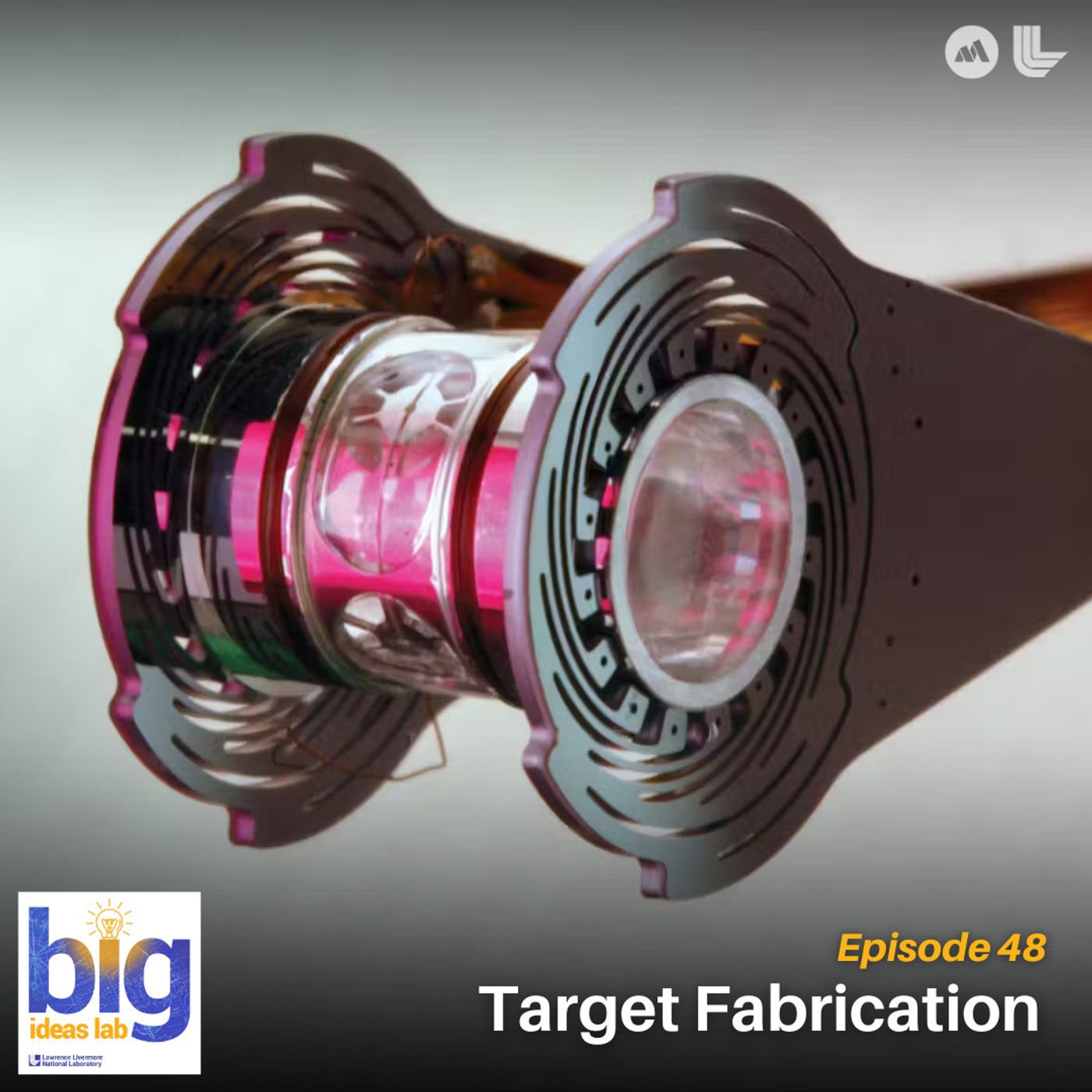
Big Ideas Lab
Target Fabrication
00:14:06
A tiny, precisely engineered object built to withstand the intensity of the world’s highest energy laser system.
Loading summary
Transcript35 lines
- [00:02]
A
Every bump in the road sounds louder than it should. In the back seat, a scientist keeps one hand pressed flat against a small metal case. The other grips the handle above the door. He's made this trip before, hundreds of times. Still, his heart pounds. Not because what he's carrying is dangerous, but because it's fragile. Inside the case is an object smaller than a pen, pencil, eraser, built for science and delicate enough that months of work could be undone by a single vibration in the wrong direction. The next step of the journey is the airport. A few people glance at the singular case carried flat in the scientist's arms, unaware of the significant breakthroughs possible from what's inside. It leaves his hands given carefully to security. For a moment, there's nothing to do but wait, because what's inside can't be rushed, can't be jostled, and can't be easily replaced. This tiny object has already crossed continents. Soon it will reach its final destination, Lawrence Livermore National Laboratory. It's a capsule filled tube assembly, the most fragile and essential component of a fusion target. Engineered to sit at the exact center of the most energetic laser system ever built. Designed to experience temperatures hotter than the core of the sun and fabricated with tolerances so precise that a floss smaller than a bacterium could change the outcome of an experiment before the lasers fire, before ignition is even possible. Everything depends on this one small capsule. Welcome to the Big Ideas Lab. Your exploration inside Lawrence Livermore National Laboratory Hear untold stories, meet boundary pushing pioneers years and get unparalleled access inside the gates. From national security challenges to computing revolutions, discover the innovations that are shaping tomorrow. Today, Looking for a career that challenges and inspires, Lawrence Livermore National Laboratory is hiring for a nuclear facility engineer, systems design and testing engineer and a senior scientific technologist, along with many other roles in science, technology, engineering and beyond. At the lab, every role contributes to groundbreaking projects in national security, advanced computing and scientific research all within a collaborative mission driven environment. Discover Open positions@llnl.gov careers where big ideas come to life the National Ignition Facility at Lawrence Livermore is the most energetic laser system on the planet. It generates temperatures of up to 100 million degrees and pressures more than 100 billion times Earth's atmosphere, mimicking the extreme conditions required for nuclear fusion, the process that powers the stars and sun.
- [03:51]
B
We don't really run a sun which does a lot of energy and fusion reactions all the time. It's on non stop 24 hours a day.
- [03:59]
A
Michael Staderman is the program manager for target fabrication at Lawrence Livermore.
- [04:07]
B
Here we're able to, for a nanosecond, deliver the amount of power that it takes to drive these fusion reactions. And so we very briefly create this flash of light, the mini sun, and then it's gone.
- [04:23]
A
The precision and energy of NIF's lasers allow scientists to explore nuclear fusion in a controlled environment, work that is vital to ensure the safety, security, and effectiveness of our nation's nuclear deterrent. The Synchronization of these 192 beams is critical. Each one must travel over a half mile, amplified along the way, before converging on a tiny, perfect target that makes it all possible. Target fabrication is the precise and methodical process of creating that target.
- [05:00]
B
It has to be as perfect as possible.
- [05:04]
A
Creating nuclear fusion, or as Michael put it, a mini sun, requires flawless design, fabrication, assembly, and materials. Many NIF experiments use inertial confinement fusion targets, or ICF targets, engineered to withstand intense conditions and deliver energy with extraordinary precision. At the center is the capsule, which holds the fusion fuel. The capsule is suspended inside a small metal cylinder called a hall room. When the lasers enter the haulroom, their energy is converted into X rays that compress the capsule evenly from all sides. All of that complexity inside a single target, measured in millimeters, a fusion ignition
- [05:52]
B
target is as big as an eraser head. So they're very, very small. And that's the largest part that we handle. Everything else that goes inside is smaller.
- [06:00]
A
Why so small? Because NIF has a finite amount of energy, so a bigger target capsule would require a bigger laser. NIF is already three football fields long, with 192 laser beams building up immense energy throughout the facility to converge on a single point. Small but mighty, an ICF target is designed to be used only once before it's vaporized by a laser.
- [06:29]
B
The thing that's most famous that we make are the ignition targets. And that's where we have the deuterium tritium filled fuel capsules that we're trying to compress to really high temperatures and densities so that we get a fusion reaction that releases more energy than we put in.
- [06:44]
A
But before the fuel can reach those extreme temperatures, it has to start incredibly cold. Inside the capsule is fusion fuel made from two isotopes of hydrogen, deuterium and tritium. When cooled to nearly 437 degrees below zero, just a few degrees above absolute zero, the fuel becomes dense and uniform, forming a smooth layer ready for even compression. But the outer shell that holds that mixture must be strong, uniform, and predictable under pressure. A material 100 times smoother than a mirror lab Grown diamond.
- [07:27]
B
Diamond is the material that we use for ignition experiments because we know it works.
- [07:33]
A
Smoothness is critical. Tiny imperfections can impact the experiment, throw the implosion off balance, and make fusion unlikely. One common imperfection is a pit.
- [07:45]
B
A pit is a bit of missing mass on the surface. Imagine the perfectly round sphere. And now there is a hole. It's usually just on the surface.
- [07:54]
A
And identifying those pits isn't always straightforward.
- [07:58]
C
I believe that's really a divot on the surface. That's a pit versus, hey, there's some doubt as far as this may be a piece of dust or something. We should take a look at that and then potentially reclaim the capsule and make sure that we don't have that feature there.
- [08:13]
A
Jared Hund is the Lawrence Livermore contract manager at General Atomics, a company which makes key components of the target and performs detailed inspections of the fuel capsules. Before a capsule can be approved, every surface has to be understood.
- [08:29]
C
We basically create a Google Earth of the entire capsule so that we've got a representation. You can zoom in on any little square patch and see where any kind of defect or any kind of feature is and provide a histogram to physics and counts of what these features are. And every year, we seem to be able to drive those down fewer and fewer.
- [08:49]
B
We're working right now on understanding systematically what gives rise to the evolution of pits, voids, and inclusions. So hopefully, as the request comes in to make bigger shells, we're well prepared for it and can adopt quickly. And then figuring out maybe in the next step, how do we make bigger hull ROMs? What kind of hull roms should we be making for those larger energy drives? To support those experiments adequately, scientists create
- [09:13]
A
roughly 1500 capsules each year, but only half are perfect enough to use. Each one is built by hand over months and used for a single experiment. The smallest human mistake can end a capsule's journey.
- [09:29]
C
When I first started, I measured some capsules by hand, and one day I dropped one. And so I was on my hands and knees with a piece of paper, sweeping the floor. I found it, but it was trash at that point. As far as it had been exposed to the dust and stuff on the floor. That's the level of fine motor control and carefulness you've got to have, because if you bump something wrong and it goes flying, you, it's over. It's a really touchy process.
- [09:57]
B
Everything is perfect, and the more imperfection you introduce, the harder these become to model. The experiment will tell us if the imperfections are a problem or not. And so we can look at output from the data that tells us do we need to work on removing more of the pits or are we at a level that is acceptable?
- [10:17]
A
While the inspection is microscopic, the journey of the material is global. Long before it reaches Lawrence Livermore, target fabrication begins halfway across the world. Lawrence Livermore National Laboratory is hiring. If you're passionate about tackling real world challenges in science, engineering, business or skilled trades, there's a place for you at the lab. Right now, positions are open for a senior Labor Relations Advocate, Operations Cybersecurity Manager, and a senior Database Administrator. These are just a few of the more than 100 exciting roles available at Lawrence Livermore. You'll work on projects that matter, from national security to cutting edge scientific advancements. Join a team that values innovation, collaboration and professional growth. Explore opportunities@llnl.gov careers where your next career move could make history. For Lawrence Livermore. Target fabrication for ignition experiments begins with diamond materials in southwestern Germany. Engineers at diamond materials grow thus thin diamond shells that form the outer layer of the fuel capsule. Each shell is made to exact specifications with careful control over thickness, shape and surface quality. From Germany, the shells travel to the US where they arrive at General Atomics in San Diego to be measured and inspected. A lengthy process.
- [12:05]
B
We want the definition how thick they are, how big they are. We want that eight months in advance. And so those will be processed, starting with the coating and manufacturing. Then they go to General Atomics where they get post processed, characterized and turned into capsule fill tube assemblies. Those then come to Livermore and we assemble them into the targets.
- [12:25]
A
Transporting capsules comes with its own engineering challenges, mostly around how much vibration the capsules experience.
- [12:33]
B
We hand carry all of these capsule filled tube assemblies from La Jolla to Livermore.
- [12:38]
A
Transportation is also part of the experiment. Even the movement of human hands becomes data.
- [12:45]
B
When the capsules get packed up, the accelerometer gets turned on. You can see exactly how steady someone's hands are as they're walking to the car or from the airport. And you can see how rough the car rides are. And you can see how rough the plane ride is. And usually the plane ride, there's a good amount of underlying vibration because of the engines that are turning all the time. You can see exactly when the plane starts taking off. But the car rides from Oakland to Livermore are actually the worst.
- [13:09]
A
While ignition draws the most public attention, NIF targets are used for a wide range of national security applications, including ones that draw insights for basic science. Each target is designed to meet the goals of the experiment, which drives the choices in materials, size and shape.
- [13:27]
C
Besides the ignition experiments, there's a wide range of experiments for national security applications, such as the stockpile stewardship. And then there's a lot of basic science experiments that go on as well. There is a set aside of what they call discovery science shots. They're looking at things that may be some kind of astrophysical phenomenon, or it's some kind of measurement that will help them understand the model of the sun.
- [13:56]
A
And experiments require trial and error, especially when so many variables can affect the outcome.
- [14:03]
B
The capsule or the target is only one variable of many as you do an experiment. So, for example, the laser performs ever so slightly different between different shots as well. And there might be other external circumstances, fuel age, or other things like that that affect the result. And so we really only can learn if we have a good picture of the conditions going in. Because then when something goes wrong, you can try to compare that and contrast it with prior experiments and see what did I do different this time than last time? Why is this one worse, and why is the other one better? And that's ultimately how we're able to make improvements.
- [14:40]
A
Experiments at NIF last only fractions of a second, but the targets they depend on take months to create before fusion can happen, before ignition is even possible. Success begins in perfected diamond shells carried by steady human hands. This is where every beam meets at the center of the National Ignition Facility.
- [15:14]
B
Foreign.
- [15:19]
A
Join a team where expertise makes a difference. Lawrence Livermore National Laboratory is hiring for a nurse practitioner, physician assistant, a senior health physicist, and a laser modeling physicist. And the list of open positions doesn't end there. There are more than 100 job openings across science, engineering, IT, HR, and the skilled trades. This is more than a job. It's an opportunity to help shape the future. Explore all open positions and start your next career adventure today@llnl.govcareers. that's llnl.govcareers. Thank you for tuning in to Big Ideas Lab. If you loved what you heard, please let us know by leaving a rating and review. And if you haven't already, don't forget to hit the Follow or subscribe button in your podcast app to keep up with our latest episode. Thanks for listening.