← Big Ideas Lab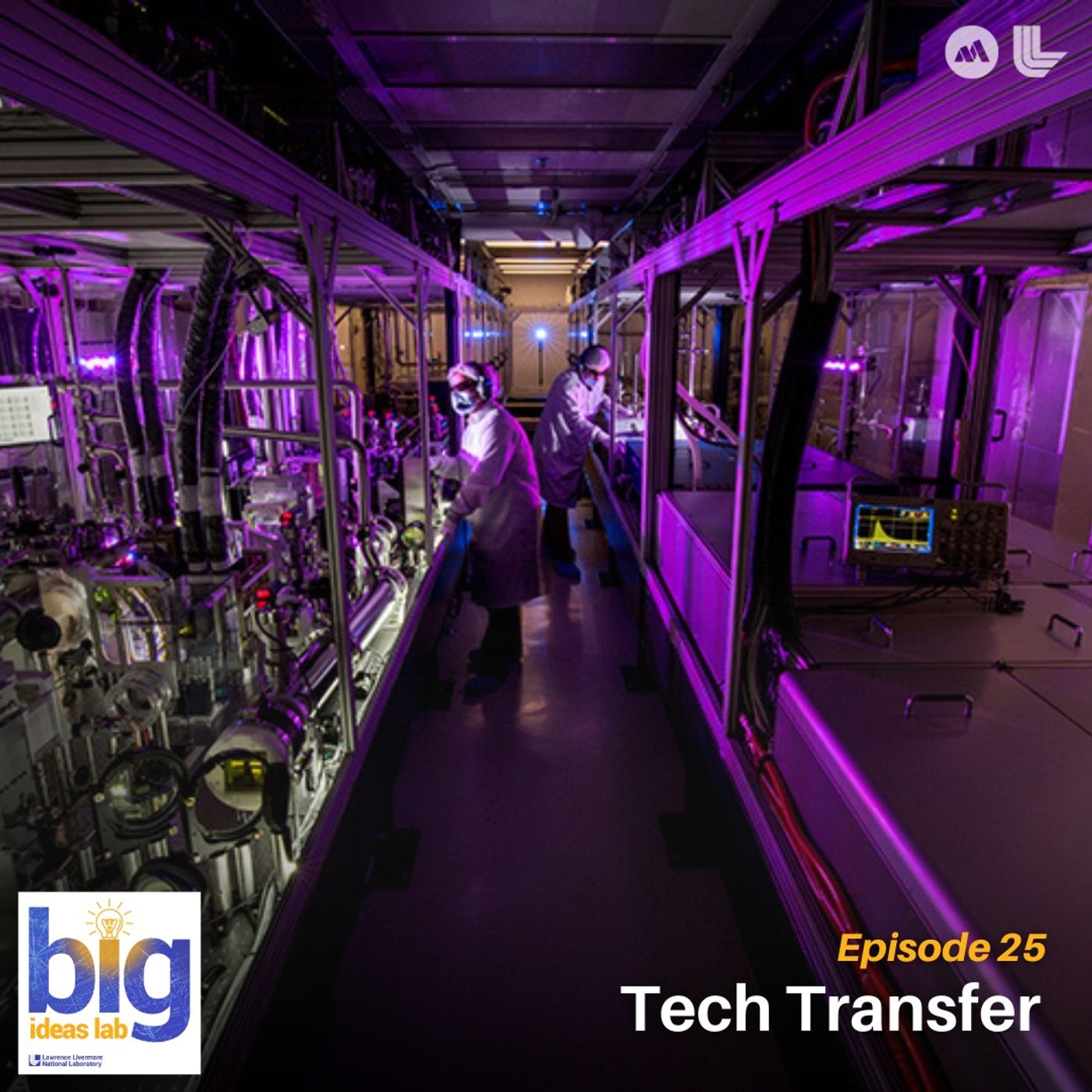
Big Ideas Lab
Tech Transfer
00:17:45
Today we’ll explore how technologies developed at Lawrence Livermore National Laboratory make their way from the Lab into industry — impacting lives every day, in ways that might surprise you. We’ll explore how scientific breakthroughs like high-peak-power laser peening, 3D metal printing, and more spotlight LLNL’s Innovation and Partnerships Office - and how this vital connection between groundbreaking research and industry creates far-reaching impact through technology transfer and entrepreneurship.
Loading summary
Transcript45 lines
- [00:02]
Narrator
In 1989, United Airlines Flight 232, carrying 296 people from Denver to Chicago, experienced a catastrophic failure that would forever change aviation safety. A microscopic crack in a titanium fan disk, an invisible weakness caused by metal fatigue, grew silently over time. As the disk spun at high speeds, the crack expanded until it finally reached its breaking point. The disk fractured violently, sending shrapnel through the plane's hydraulic lines, draining the hydraulic fluid. Critical flight controls were useless, and at 37,000ft, the aircraft's tail mounted engine exploded. With remarkable skill, the crew used only differential engine thrust to steer the damaged jet towards Sioux city, Iowa. After 45 tense minutes, they managed to bring the plane down, saving 184 lives. Despite their heroic efforts, 112 lives were lost. The tragedy exposed a fatal flaw in aviation safety microscopic weaknesses in materials that could remain hidden until it is too late. The aviation industry needed a solution, something that could strengthen vital components and prevent such failures before they occurred. That solution came from a public private partnership between Lawrence Livermore National Laboratory and Curtis Wright's Metal Improvement Company. Together, this partnership developed a new high peak power commercial manufacturing application for a technique called laser peening, a process that can strengthen metal components at the microscopic level, preventing cracks before they form. Over the past 20 plus years, countless jet engine fan blades have been reinforced as a result of this technology, now making air travel safer for millions. This was made possible because of the lab's Innovation and Partnerships Office, or ipo, a critical link between groundbreaking research and industries looking for innovative solutions. High peak power Laser peening is just one example of how this office brings pioneering science beyond the lab to solve global challenges. Today, we'll explore the journey through from innovation to Partnership to impact.
- [02:52]
Lawrence Livermore National Laboratory Announcer
Lawrence Livermore National Laboratory is opening its doors to a new wave of talent. If you're driven by curiosity and a desire to solve complex challenges, the Lab has a job opening for you. Currently, there are 139 open positions. These include opportunities in science, engineering, business administration and the skilled trades. From enhancing national security to pioneering new energy sources and advancing scientific frontiers, Lawrence Livermore National Laboratory is where you can make your mark on the world. Today's open roles include lead power grid engineer, laser modeling physicist, postdoctoral researcher, OCECLO program leader and chief data architect. But the list doesn't end there. Explore all available positions@llnl.gov careers. Each opportunity comes with a comprehensive benefits package tailored to your lifestyle and future. Join a workplace that champions professional growth, fosters collaboration, inspires innovation and and drives the pursuit of excellence if you are ready to contribute to work that matters, visit llnl.govcareers to explore all the current job listings. That's llnl.govcareers. your expertise could very well be the highlight of our next podcast interview. Don't wait welcome to the Big Ideas Lab. Your weekly exploration inside Lawrence Livermore National Laboratory. Hear untold stories, meet boundary pushing pioneers and get unparalleled access inside the gates. From national security challenges to computing revolutions, discover the innovations that are shaping tomorrow.
- [04:58]
Narrator
Today.
- [05:07]
Matthew Garrett
Our role is what's called the technology transformation at the lab and that encompasses a number of activities which essentially facilitate the capturing of innovations and facilitating partnerships with outside entities to allow that innovation go from the laboratory to a company or outside entity such that it can be then either produced or commercially make an impact on the United States economy.
- [05:33]
Narrator
That was Matthew Garrett. He is the Director of the Innovation and Partnerships Office at Lawrence Livermore and he's describing the role of IPO and its technology transfer function.
- [05:44]
Matthew Garrett
How do we commercialize and take technologies from the lab, engage with the private sector and transition them so that they can make impact outside the lab? There's a lot of challenges and a lot of technologies that are emerging out of the lab that could make a real impact and we're trying to facilitate that to happen.
- [06:00]
Narrator
IPO protects intellectual property by securing patents for the lab's innovations, safeguarding scientists work while making these technologies accessible to external partners. The way these partnerships transpire can differ based on the tech transfer mechanisms at play, which can range from a company licensing lab owned technology to partnering to access the lab's unique facilities for testing or technology maturation to a multi party research collaboration project. Whether the partnership is with a startup, large enterprise university, other national lab, or a government agency, tech transfer aims to support national security and US Economic competitiveness. And while the ways in which outside organizations partner with the lab are diverse, impact is always the goal.
- [06:53]
Matthew Garrett
We work with our scientists and engineers to essentially capture ideas through intellectual property and that could be in the forms of a patent or if it's software or a design of an idea, we capture it through a copyright and we essentially capture those working with our legal department and folks and are able to then work with companies to create those partnerships that allow us to transfer that technology where they can actually take the idea and make a product out of it.
- [07:26]
Narrator
One of the most impactful examples of tech transfer over the decades at Lawrence Livermore is a technology known as Micropower Impulse Radar or mir. MIR is a high resolution radar technology that uses ultra wideband pulses to detect Objects with incredible speed and precision while using very little power. In the mid-1990s, this technology became a life saving tool in disaster zones and revolutionized GPS and defense systems. But it didn't start out that way. Scientists at Lawrence Livermore needed to measure events happening in billionths of a second during fusion experiments on the nova laser, One of the most powerful lasers of its time. Traditional radar systems weren't fast, precise, or small enough to capture events occurring that quickly. This is how micropower impulse radar was born. Mir's compact size, low cost and low power requirements revolutionized radar. It brought this advanced technology to places where it simply wasn't possible. Before, traditional radar systems were bulky, expensive and power hungry, Limited to military or large scale industrial use. But MIR made high resolution radar affordable and portable. And this versatility allowed for life saving applications in disaster response. Mir can detect the faintest heartbeat or breath, Guiding search and rescue teams to survivors trapped under rubble in cars. It powers collision avoidance systems. It also boosts GPS accuracy and strengthens defense systems by precisely measuring distances and detecting objects in complex environments. Lawrence Livermore's IPO and Mir's entrepreneurially minded inventor, Thomas McEwen, a Lawrence Livermore scientist at the time, Worked together to facilitate the partnerships responsible for its many applications beyond the lab. Ultimately, MIR was commercialized by 42 different companies.
- [09:51]
Matthew Garrett
You have something, you have an idea, or you have an innovation. How do you get it to reality? How do we teach scientists and engineers the thought process and the mindset of being an entrepreneur? It comes down to a certain type of person in the end, Somebody that can see at low earth orbit, way up in the sky of a large ecosystem or a problem or some sort of thing of how it impacts society, but also can get down to the details of how something works at the fundamental levels.
- [10:19]
Narrator
As part of its tech transfer mission, IPO is also dedicated to helping scientists think like entrepreneurs.
- [10:27]
Matthew Garrett
There's this piece where you want to talk to someone that may not have the scientific or engineering expertise of a particular subject matter area that you want to try to persuade or convince to work with you or to even invest in your idea. So how do you go about doing that? And so we have had this national laboratory entrepreneurship academy going for the last decade now, which teaches people the language and the skills of how to think entrepreneurially. And that could be how do you communicate what we call the value proposition of your idea?
- [11:01]
Lawrence Livermore National Laboratory Announcer
Lawrence Livermore National Laboratory invites you to join a diverse team of professionals the lab is currently hiring for a lead power grid engineer, A laser modeling physicist, postdoctoral researcher, an OCEC program leader, a chief data architect and 139 other positions for scientists, engineers, IT experts, administrative and business professionals, welders and more at Lawrence Livermore National Laboratory. Your contributions are not just jobs, they're a chance to make an impact. From strengthening US Security to leading the charge in revolutionary energy solutions and expanding the boundaries of scientific knowledge, the lab values collaboration, innovation and excellence, offering a supportive workspace and comprehensive benefits to ensure your well being and secure your future. Seize the opportunity to help solve something monumental. Dive into the wide variety of job openings@llnl.gov this is your chance to join a team dedicated to a mission that matters. That's llnl.govcareers. your expertise might just be the spotlight in our next podcast interview. Don't delay.
- [12:33]
Narrator
Another historical success story is chromosome painting a new horizon in biotechnology in the mid-1980s, chromosome painting allows researchers to tag individual chromosomes with fluorescent dyes to study genetic material like Mir. It's been one of Lawrence Livermore's most successful tech transfer stories, highlighting the wide range of industries impacted by this office. Before chromosome painting, scientists struggled to study chromosomes in detail. Traditional staining methods made it hard to tell individual chromosomes apart or to spot tiny genetic changes. This limited their ability to detect abnormalities or diagnose genetic diseases accurately. With chromosome painting, scientists were able to use fluorescent dyes to color code each chromosome, see them clearly under a microscope and tell them apart instantly. Then they could detect even the smallest abnormalities, like pieces of chromosomes breaking off and reattaching incorrectly, which are often linked to cancer. This new level of detail also made it possible to compare chromosomes across species, helping researchers understand evolutionary relationships. And in medicine, it transformed genetic diagnosis, making it faster and more accurate. Once again, Lawrence Livermore's scientists, this time Joe Gray and Don Pinkel and IPO recognized how valuable chromosome painting could be for genetic research and medicine. They worked with researchers worldwide to broaden its use for cancer research and the study of genetic damage over ultimately commercializing it with vicis, a subsidiary of Abbott Pharmaceuticals and becoming a key enabling technology in the genetic revolution, where there's a.
- [14:31]
Matthew Garrett
Challenge of major national interest. We have the tools and the folks to think about it, solve it, come up with a pathway to success, and then our job at IPO is to facilitate that and engage with companies so that they can then run with it on the outside.
- [14:47]
Narrator
IPO helps channel the culture of innovation at Lawrence Livermore to bridge scientific discoveries.
- [14:54]
Lawrence Livermore National Laboratory Announcer
With real world applications.
- [14:56]
Narrator
And it's paid off. Tech transfer has a long history of success at Lawrence Livermore. And each success is a testament to the lab's commitment to driving progress forward. A more recent notable success story is the work of former lab scientist turned entrepreneur James DeMuth, who, along with several co inventors at Lawrence Livermore's national ignition Facility, or nif, helped the lab understand the fundamental barrier that previously prevented additive manufacturing from being scaled.
- [15:29]
James DeMuth
One of the big issues we found was how do you make a chamber that can withstand the brutal environment of the fusion reactions, not melt, crack, or die through whatever processes that's happening in there. We actually found an alloy that gave us incredibly high temperature fatigue properties, met all of our requirements. And we found that while you couldn't weld it or cast it, you could 3D print it. 3D printing can do all these crazy geometries, all these, you know, very intricate cooling channels and so forth, but it's going to take 200 years to use 3D printing to make one of these things, and I'm not going to live that long. So we need a faster way of doing things. So we architected a system to figure out how to do that in 70.
- [16:07]
Narrator
As time went on and innovation continued, James saw the market potential in this research, eventually co founding Seurat Technologies, which specializes in high volume 3D metal printing. Seurat then licensed Lawrence Livermore's additive manufacturing technology as a partner and secured significant investment as a startup. James DeMuth's journey from scientist to entrepreneur highlights the impact that Lawrence Livermore's support can have for researchers taking bold steps into the business world.
- [16:40]
James DeMuth
The lab was able to provide effectively a safety net on entrepreneurial leave of absence. It made it a lot more palatable for myself, my family to do this. The lab helped, and the IPO helped really make an environment where I felt I could go out on a limb and do something risky that otherwise might have been more challenging to do and, and that was a huge enabler to make this technology be able to be birthed, so to speak.
- [17:11]
Narrator
Additive manufacturing, or 3D printing, is an area where the lab's technology transfer program has made a significant impact. As covered in our full episode of additive manufacturing, Lawrence Livermore researchers developed techniques to build complex metal components layer by layer. Innovations that have shaped industries like aerospace, defense, and energy. James vision for faster, more efficient 3D printing stemmed from a clear challenge. While traditional 3D printing could produce intricate geometries and complex cooling channels, the process was painfully slow. Today, Seurat is tackling complex manufacturing and thermal management challenges in industries like aerospace, automotive, and electronics.
- [18:02]
James DeMuth
We're Changing the world of manufacturing. How do we reinvent how we do things such that we can do them faster, more effectively, shorten supply chains, give freedom of design, and ultimately democratize manufacturing in a green and sustainable way?
- [18:14]
Narrator
James Journey is one example of how tech transfer can distribute the benefits of groundbreaking research by empowering scientists to turn their innovations into thriving companies that shape entire industries. The next chapter of Lawrence Livermore's tech transfer success stories is already taking shape with breakthroughs on the horizon in areas like fusion energy, AI driven biotechnology and quantum computing.
- [18:42]
Matthew Garrett
I'm excited for what's next. That's another part of being in this particular role. You get to have a front seat as to what's next with all the things that we're working on in AI, machine learning, life sciences, manufacturing. I'm excited for what the future holds and some of the things we're working on.
- [18:58]
James DeMuth
My experience was exciting. Everything I felt like I came into contact with was just opening new doors and seeing new things and helping put the pieces together in different ways. What's that next thing right There was so much that's either being discovered or on the cusp of discovery. It just was at the forefront of all this really, really cool stuff. I had a blast there.
- [19:23]
Narrator
With each new partnership and patent, the Innovation and Partnerships Office continues to connect brilliant minds with industry leaders, driving innovation forward and ensuring the US remains a global leader in science and technology.
- [19:41]
Matthew Garrett
It's all about impact. And I use that word all the time with my team, is that we are trying to create impact. It's not about the numbers. A lot of times, it's not about volume. It's about individual narratives of stories, of technologies where you can connect our activities to something that people see and touch every day. That is priceless. You can't put a dollar amount on that.
- [20:04]
Narrator
And that's the power of technology transfer. Turning groundbreaking science into innovations that shape our world.
- [20:25]
Lawrence Livermore National Laboratory Announcer
Lawrence Livermore National Laboratory is opening its doors to a new wave of talent.
- [20:30]
Narrator
Whether you're a scientist, an IT professional.
- [20:33]
Lawrence Livermore National Laboratory Announcer
A welder, an administrative or business professional, or an engineer, Lawrence Livermore National Laboratory.
- [20:40]
Narrator
Has an opportunity for you.
- [20:42]
Lawrence Livermore National Laboratory Announcer
From enhancing national security to pioneering new.
- [20:45]
Narrator
Energy sources and advancing scientific frontiers, Lawrence.
- [20:49]
Lawrence Livermore National Laboratory Announcer
Livermore National Laboratory is where you can make your mark on the world. Lawrence Livermore National Laboratory's culture is rooted in collaboration, innovation and the pursuit of excellence.
- [21:00]
Narrator
We offer a work environment that that.
- [21:02]
Lawrence Livermore National Laboratory Announcer
Supports your professional growth and a benefits package that looks after your well being and future.
- [21:07]
Narrator
Are you ready to contribute to work that matters?
- [21:10]
Lawrence Livermore National Laboratory Announcer
Visit llnl.govcareers to explore current job openings and learn more about the application process. Don't miss the chance to be a part of a mission driven team working on projects that make the impossible possible. Visit LLNL to view the current job listings.
- [21:32]
Narrator
Remember, that's LLNL.gov careers. Your expertise could be the highlight of.
- [21:39]
Lawrence Livermore National Laboratory Announcer
Our next podcast interview.
- [21:41]
Narrator
Don't wait.
- [21:43]
Lawrence Livermore National Laboratory Announcer
Explore the possibilities today. Thank you for tuning in to Big Ideas Lab. If you loved what you heard, please let us know by leaving a rating and review. And if you haven't already, don't forget to hit the Follow or Subscribe button.
- [22:08]
Narrator
In your podcast app to keep up with our latest episode. Thanks for listening.