
Podcast
Books Brothers
Hosted by booksbrothers · EN
Two brothers talk through the BEST non-fiction books about science, evolution, culture, history, complexity science, nature, cognitive neuroscience, artificial intelligence.
18episodes
Episodes
Newest firstAll episodes
Guns Germs & Steel - Episode 14
Oct 600:34:11Tap to summarizeWhy did Europeans conquer the Americas instead of the other way around? In this episode, we dig into Jared Diamond’s Pulitzer Prize–winning classic Guns, Germs, and Steel. Diamond sets out to answer Yali’s famous question: why do some societies have so much “cargo” while others don’t? His answer boils down to one word: geography. We trace the story from the collision at Cajamarca, 168 Spaniards defeating tens of thousands of Inca warriors — back through the domestication of wheat, barley, and horses, the east–west axis of Eurasia, and the germs bred in crowded farming societies. Along the way, we wrestle with Diamond’s strengths, poke holes in some of his oversimplifications, and connect the dots to later works like Sapiens, Against the Grain, and The Secret of Our Success. If you’ve ever wanted the big-picture story of how environment, food, animals, and disease shaped human history — this is it.
Transcribe →Against the Grain: How States Went Wrong | Ep. 13
Sep 100:57:49Tap to summarizeYo! Let’s go. JD and Andrew are back in the Fertile Crescent, baby—where civilization supposedly “leveled up” but maybe just took a massive L. In this episode, the bros break down James C. Scott’s Against the Grain: A Deep History of the Earliest States, a book that argues farming, governments, and the rise of states weren’t exactly the glow-up history books made them out to be. We’re talking fire hacks, Homo erectus barbecue parties, stationary bandits (aka ancient mob bosses), marshland living, and why grain might be the world’s first “Big Tech monopoly.” JD digs into archaeology and science, Andrew keeps us grounded with the big cultural picture, and together they wrestle with whether civilization was really worth all the taxes, laws, and SWAT teams. As always, it’s educational, a little ridiculous, and super accessible. Hit play, grab a snack (non-taxable please), and find out what life was really like before the IRS showed up. Timestamps (Chapters): 00:00:00 – Intro hype + “barbecued cat bones & Homo erectus poop” 00:01:00 – What is this book? Scott vs. the State 00:03:10 – Bandit theory vs. coordination theory (why states even exist) 00:04:50 – Stationary bandits = ancient mob bosses 00:07:00 – Domestication of fire (and how it domesticated us) 00:10:30 – Fire as predator deterrent + the ultimate gang hangout tool 00:13:00 – Niche construction: ancient humans as ecosystem engineers 00:17:30 – Marshlands, mobility, and why early states hated swamps 00:22:00 – Grain: the world’s first surveillance + tax technology 00:28:40 – Bureaucracy, walls, and why early states kinda sucked 00:35:00 – Rebellion, resistance, and the “dark side” of civilization 00:42:00 – Closing thoughts: was the state really progress… or a trap? Listen if you’ve ever wondered: Was grain basically the original Facebook? Why did marshes make governments sweat harder than the IRS in April? Would you rather hang with Homo erectus around a fire… or Mesopotamian tax collectors? Stay tuned, stay curious, and remember—sometimes going “against the grain” is the smartest move.
Transcribe →
The Secret of Our Success - Episode 12
Aug 4, 202501:06:10Tap to summarizeIn this episode, we dive deep into Joseph Henrich's groundbreaking book "The Secret of Our Success: How Culture is Driving Human Evolution, Domesticating Our Species and Making Us Smarter." Discover why humans are the only species to dominate every continent with just ONE species (while ants needed 10,000+ species to do the same). We explore how cultural evolution became the primary driver of our genetic evolution, making us the ultimate "copycats" of the animal kingdom. Key Topics Covered: Why toddlers crush chimps and orangutans at social learning How lost European explorers with 5 years of food died while locals thrived The shocking study comparing human children, chimps, and orangutans Why we evolved menopause (spoiler: it's about preserving cultural knowledge) How cooking food literally changed our biology The incredible story of persistence hunting and why we're the sweatiest species Why blue eyes evolved in the Baltic Sea region Cultural customs that save lives (even when people don't know why) How arrow-making requires 14 steps, 7 tools, and 6 materials From cassava processing in the Amazon to elephant grandmas remembering 60-year-old water sources, this episode reveals how culture - not individual intelligence - made humans masters of Earth. Subscribe for more deep dives into the books that explain our world! 📚 Other Books in Our Series: Sapiens, Behave, The Righteous Mind, Guns Germs & Steel, The WEIRDest People in the World, and many more!
Transcribe →
The Ancient City - Episode 11
Jul 14, 202501:51:41Tap to summarize🏛️ THE ANCIENT CITY: How Religion Built Civilization (Books Brothers Podcast) The oldest book we've ever covered reveals the SHOCKING truth about how cities actually formed! Forget everything you think you know about ancient Greece and Rome. French scholar Numa Denis Fustel de Coulanges drops a bombshell in this 1854 masterpiece: RELIGION wasn't just important to ancient people—it WAS their reality. Every law, every custom, every political structure came from one source: worshipping your dead ancestors. From sacred fires that could NEVER go out to marriage ceremonies that were basically religious conversions, this book explains how ancestor worship created the foundation of Western civilization. Plus: Why exile was worse than death, how Rome's secret sauce conquered the world, and the moment Christianity changed everything forever. Books mentioned: Sapiens, Behave, Righteous Mind, Origins of Political Order, and more from our reading list! 📚 CHAPTER MARKERS 00:00 - Intro: The Oldest Book We've Done 02:42 - Ancient Beliefs: Souls, Death & the Afterlife 07:15 - Worship of the Dead: Pour One Out for Grandpa 13:00 - Sacred Fires: Rule #1 - Never Let It Die 17:00 - Marriage = Religious Conversion (Wild Ancient Wedding Rituals) 22:00 - Family Continuity: Why Having Sons Was EVERYTHING 25:00 - Property Rights: How Sacred Land Created Modern Law 29:00 - The Gens: When Families Become Tribes 37:00 - BOOK 3: THE CITY - How Cities Were Actually Born 42:00 - City Founding Rituals: The Badass Story of Rome's Birth 48:00 - Gods of the City: Stealing Enemy Bones for Power 52:00 - Religion = Government (No Separation of Church & State) 58:00 - Citizens vs. Strangers: You're In or You're Out 1:02:00 - THE REVOLUTIONS BEGIN - When the System Breaks Down 1:15:00 - Rise of the Plebs: The First Labor Strike in History 1:20:00 - Tribune of the Plebs: The Untouchable Power Move 1:25:00 - Laws Written in Bronze: The 12 Tables Revolution 1:30:00 - Solon vs. Draco: Democracy's Poet vs. The Harsh Tyrant 1:35:00 - Athenian Democracy: When 5,000 People Actually Talked 1:40:00 - Alexander's Death & Rome's Rise: "To the Strongest!" 1:45:00 - Christianity Changes Everything: The End of Ancient Society Subscribe for more mind-bending books that explain how the world really works! 🧠⚡ #BooksBrothers #AncientHistory #Rome #Greece #Christianity #Philosophy #History #Podcast
Transcribe →The Molecule of More - Episode 10
Jun 16, 202501:02:54Tap to summarizeJoin JD and Andrew as they dive deep into "The Molecule of More" by Daniel Lieberman and Michael Long - exploring how dopamine drives human behavior, relationships, creativity, and our never-ending pursuit of "more." 🧠 What You'll Learn: The difference between "wanting" and "liking" - and why dopamine controls wanting, not pleasure How dopamine creates two distinct brain circuits: desire vs. control Why the honeymoon phase in relationships only lasts about a year The surprising connection between dopamine and political ideology How immigrants and entrepreneurs share similar dopaminergic traits Why creative people are 25x more likely to have bipolar disorder The neuroscience behind addiction, love, and achievement 🎯 Key Takeaways: Dopamine is the "molecule of more" - it never says "enough" There are two types: desire dopamine (limbic) and control dopamine (prefrontal cortex) Balancing future-focused dopamine with "here and now" chemicals leads to greater happiness Mastery combines both systems for optimal satisfaction 📚 About Books Brothers: We read the big ideas books so you don't have to! Subscribe for summaries of books like Sapiens, Righteous Mind, Behave, and more. 🔔 Subscribe for more book breakdowns and hit the bell for notifications! 💭 What's your dopamine weakness? Let us know in the comments! Chapter Markers 0:00 - Introduction & Book Overview 1:30 - What is Dopamine? The Molecule of More 2:45 - Here and Now vs. Future Molecules 8:15 - Chapter 1: Love - Dopamine in Relationships 16:00 - From Passionate to Companionate Love 19:30 - Sex and the Dopamine Switch 23:00 - Chapter 2: Drugs - Desire vs. Control Circuits 28:45 - Why Adderall Helps ADHD vs. Cocaine Addiction 35:00 - Chapter 3: Domination - Control Dopamine in Action 42:00 - The Buzz Aldrin Effect: Achievement Addiction 45:30 - Willpower as a Limited Resource 48:00 - Chapter 4: Creativity and Madness 52:15 - Why Artists Are 25x More Likely to Have Bipolar 55:45 - John Nash and the Beautiful Mind Connection 58:30 - Isaac Newton: Genius and Virgin 60:00 - Chapter 5: Politics - Liberal vs. Conservative Brains 65:30 - Dopamine and Political Ideology 68:45 - Charitable Giving: Here and Now vs. Abstract Policy 72:00 - Chapter 6: Progress - How Dopamine Got Us Out of Africa 75:30 - The DRD4 Gene and Human Migration 78:15 - Polynesians and Extreme Exploration 80:45 - America as the "Dopamine Nation" 83:30 - Immigration and Entrepreneurship Statistics 86:00 - De Tocqueville's Observations on Restless Americans 88:30 - The Fertility Crisis and Safety Nets 90:45 - Final Thoughts: Balancing Dopamine and Here-and-Now 93:00 - The Avatar Metaphor for Perfect Balance 95:30 - Mastery: When Dopamine and Present Merge 98:15 - Construction Workers and Optimal Happiness 60:00 - Conclusion: A More Balanced Way of Being Human
Transcribe →I Came to Cast Fire - Episode 9
Jun 2, 202501:25:19Tap to summarizeIn this episode, the hosts explore René Girard's mimetic theory through Friar Elias Carr's 2024 book "I Came to Cast Fire: An Introduction to René Girard." The conversation examines how human desires aren't entirely our own but are shaped by imitating others, creating cycles of rivalry and conflict that have defined human societies throughout history. The hosts discuss Girard's insight that humans are the "culture-making animal" whose social structures evolved from the "scapegoat mechanism" - a process where communities channel violence toward a single victim to restore peace. They look at how this pattern created religious rituals, myths, and prohibitions that formed the foundation of ancient civilizations. The discussion moves from ancient ancestor worship to biblical interpretations, examining how Jesus's crucifixion and resurrection uniquely exposed this scapegoat mechanism from the victim's perspective, offering humanity a path beyond mimetic violence. The hosts work through these dense philosophical concepts while questioning evidence for some of Girard's more controversial claims. Connecting cultural evolution, religious worship, and human conflict, this episode presents the hidden mimetic patterns Girard identified in human societies. The conversation covers anthropology, religious studies, and theories about how imitation shapes both our individual desires and our collective institutions.
Transcribe →Wanting - The Hidden Forces Behind Your Desires - Episode 8
May 1, 202500:57:06Tap to summarizeIn this mind-bending episode, Andrew and JD explore René Girard's revolutionary mimetic theory through Luke Burgis's accessible book "Wanting." Discover why your deepest desires might not actually be your own! We dive into: Why we mimic the desires of our "models" (from celebrities to rivals) How mimetic rivalries escalate into violence and conflict The surprising connection between scapegoating and civilization Why René Girard became Christian after developing his theory Practical ways to escape mimetic desire and find authentic purpose From Peter Thiel's investment philosophy to why hipsters all look alike while no one identifies as one, this episode will transform how you understand human motivation, marketing, social media, and even ancient religious practices. NEW: We're releasing TWO episodes monthly in April and May! Watch on YouTube! Our amazing video editor and graphics team illustrates all the key ideas and quotes throughout the episode, creating a visually stunning experience that brings these concepts to life. Trust us - this one is worth watching! #MimeticDesire #BooksBrothers #PersonalDevelopment
Transcribe →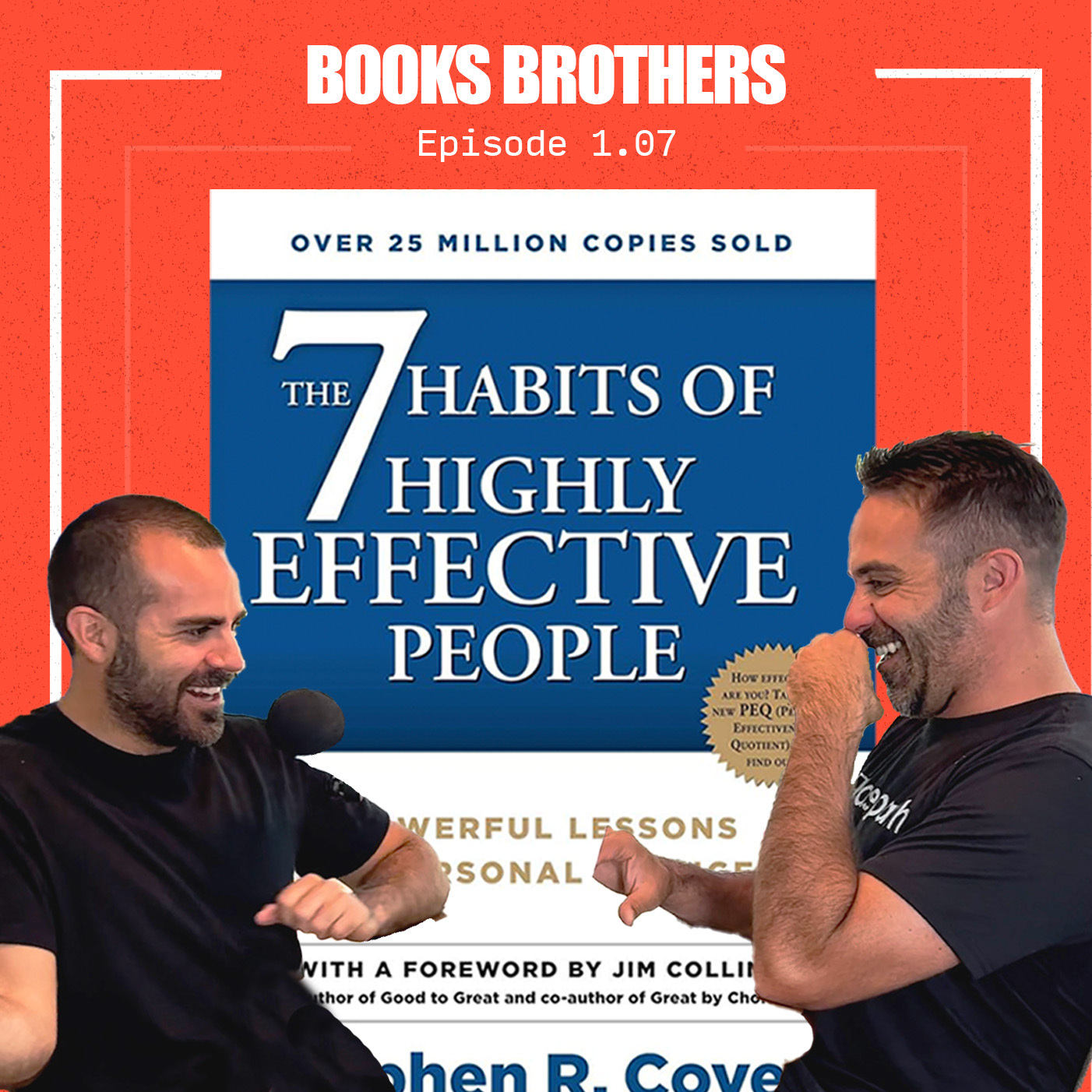
The 7 Habits of Highly Effective People - Episode 7
Apr 15, 202500:53:51Tap to summarizeIn this episode of Books Brothers, JD and Andrew break down Stephen Covey's seminal work "The 7 Habits of Highly Effective People." Published in over 50 languages and named the most influential business book of the 20th century, Covey's framework distills centuries of self-improvement literature into actionable habits for personal growth. The brothers discuss how Covey spent years studying success literature since 1776 to create principles for living your best life aligned with timeless values. From taking control of your life to building meaningful relationships, this episode unpacks how to move from dependence to independence to interdependence through Covey's transformative seven habits. Chapter Markers 00:00:00 - Introduction to the book's influence and reach 00:02:00 - Covey's research process and the book's core message 00:04:20 - The Character Ethic vs. Personality Ethic 00:08:10 - Principle-Centered Paradigm and taking responsibility 00:10:57 - Habit 1: Be Proactive 00:13:25 - Viktor Frankl and choosing your response 00:17:15 - The mindset of reactive vs. proactive people 00:19:13 - Habit 2: Begin With the End in Mind 00:21:08 - Leadership vs. Management 00:22:00 - Creating a personal mission statement 00:24:03 - Center of your life: principles vs. other centers 00:26:56 - Habit 3: Put First Things First 00:28:34 - The Four Quadrants of Time Management 00:31:00 - Stewardship vs. Go-for Delegation 00:33:54 - Trust Banks and relationship building 00:36:10 - Habit 4: Think Win-Win 00:38:25 - Problems with competition in society 00:41:51 - Habit 5: Seek First to Understand, Then to Be Understood 00:43:35 - Empathic listening and its power 00:45:44 - Ethos, Pathos, Logos and communication 00:46:13 - Habit 6: Synergize 00:47:52 - Habit 7: Sharpen the Saw 00:49:02 - The Eighth Habit and final thoughts 00:52:09 - Summary of all seven habits References Books: "The 7 Habits of Highly Effective People" by Stephen Covey (00:01:06) "The 8th Habit" by Stephen Covey (00:49:06) "The Speed of Trust" by Stephen M.R. Covey (00:50:18) "Man's Search for Meaning" by Viktor Frankl (00:13:44) "How to Win Friends and Influence People" by Dale Carnegie (mentioned at 00:06:38) People: Viktor Frankl (00:13:44, "friend of the show") Benjamin Franklin (00:02:30) Dale Carnegie (00:02:30) Tony Robbins (00:02:30) Johann Wolfgang von Goethe (00:18:32) Warren Buffett (00:50:18) Peter Thiel (00:38:56, reference to "Zero to One") Jocko Willink (implied at 00:28:23 as "our guy Jocko, a friend of the program") Jonathan Haidt (00:42:50, reference to elephant and rider metaphor) Concepts: Character Ethic vs. Personality Ethic (00:04:48) Principle-centered paradigm (00:08:11) Production vs. Production Capability (P/PC Balance) (00:10:25) Stimulus and Response model (00:14:29) Trust Banks (00:33:55) Four Quadrants of Time Management (00:28:34) Scarcity vs. Abundance Mentality (00:41:06) Ethos, Pathos, Logos (00:45:07) Other Podcast References: "Righteous Mind" (00:51:40, reference to another Books Brothers episode) "General Theory of Love" (00:44:26, reference to another Books Brothers episode)
Transcribe →