Podcast
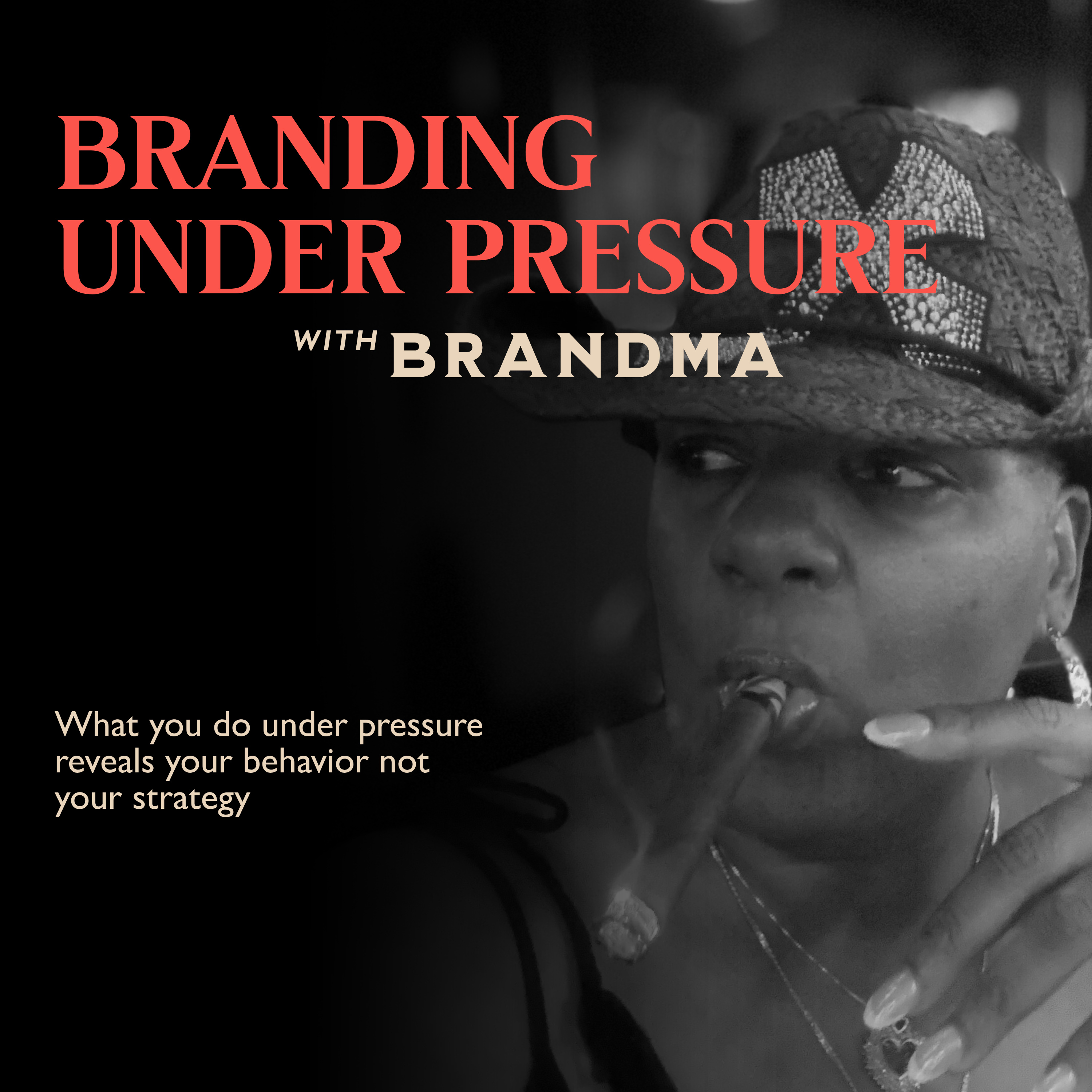
Branding Under Pressure
Hosted by Brandma's House · EN
Branding Under Pressure is not another sideways branding or business podcast. It’s where brand behavior shows up long before strategy can show off.
Endorsed by Brandma’s House, this brand behavior commentary examines how Founders actually lead when shit gets real. Specifically, around money, visibility, authority, and identity.
Hosted by The Ghetto Country Brandmother®, this show strips branding down to its behavioral draws. No trends. No tactics-first bullshit. Just hard truths about pricing, boundaries, over-giving, people-pleasing, and leadership under pressure.
15episodes
Episodes
Newest firstAll episodes
Once Upon a Brand… Everybody Could Sound Like
4w ago00:38:28Tap to summarizeAva Sinclair wanted her work to reach a larger audience. She didn’t expect the audience to start crediting somebody else for it.When Ava’s team notices Sloane repeating her language, cadence, and teaching patterns, Ava refuses to look threatened. She calls it shared language. She calls the extra workload expansion. She calls the relationship aligned because admitting otherwise would mean facing what she handed over before anybody signed a damn thing.Then a former client praises Sloane for an idea Ava has taught for years and invites Ava to moderate.Adjacent to her own work.Ava returns to Brandma’s Bar furious, orders her Wild Turkey 101 on the rocks, and keeps adding ice until the bourbon is as diluted as the explanation she’s been giving herself.In this episode of Branding Under Pressure™, imitation stops feeling flattering, audience size becomes emotional leverage, and a repeatable brand voice starts looking like a costume somebody else can wear more easily than the Founder who created it.Sloane’s behavior was shady. Ava’s behavior still matters.Another person can exploit your pattern without creating it. And being wronged doesn’t erase your responsibility for the access, silence, assumptions, and missing structure that allowed the consequence to grow.Through B.E.D.S., Ava’s problem becomes bigger than stolen language:Her behavior contradicts what she says she values.Her energy, and her team’s, is carrying the collaboration.Her desire for recognition has been bent around borrowed reach.The structure exists in a beautiful deck, but not where it counts.The Founder Brand Fit™ examines where behavior, energy, desire, or structure has stopped fitting—even when the brand still looks successful from the outside.Because reach is not proof of authorship.And recognition gets expensive when you don’t know what it’s buying.
Transcribe →Once Upon A Brand... That Finally Found A Peer
Jul 1100:28:13Tap to summarizeAva walks into Brandma’s Bar celebrating what looks like the right kind of expansion.A sophisticated influencer has recognized her work, remembered the ideas most folx overlook, and invited her to build something as a peer. The proposal comes with reach, production support, polished plans, and both of their names printed at the same size.For the first time in a long time, Ava feels like she won’t have to carry the whole conversation by herself.Then Sloane repeats one of Ava’s signature ideas publicly and receives more attention for it than Ava did. Instead of marking the source, Ava calls it proof that the message is bigger than her.That explanation lasts until Sloane asks for Ava’s complete workshop notes, including the unfinished material, so her team can make everything feel cohesive.In the Season 2 premiere of Branding Under Pressure™, Brandma watches peer validation turn into collaboration flattery, intellectual access move faster than the agreement, and a successful Founder rename extraction because recognition feels too good to question.Sloane doesn’t have to be a villain for Ava to be responsible for what she hands over. The opportunity doesn’t have to be fake for its cost to be real. And the brand doesn’t have to be failing for carrying its visible persona to start feeling like an obligation.The question sitting at the bar is simple:💋 Is success expanding your possibilities—or increasing the role you must perform to keep access to what you’ve built?When your brand still works but no longer fits how you want to lead, the Founder Brand Fit Forecast™ examines where the misfit may be forming beneath the success.For more language around refusing to fold yourself into an impressive structure that demands self-abandonment, read You Don’t Fit, Fake, or Give a Fuck.Pull up a chair. Ava’s tab is open, and her thumb is still hovering over Send.
Transcribe →Pressure Doesn't Get The Final Say
May 2900:24:39Tap to summarizeThis episode was supposed to be released on Brandma’s birthday.It wasn’t.There’s no apology tour, divine-timing story, or retroactive attempt to make the delay sound noble. The episode didn’t get recorded. The date passed. Now Brandma is making a different choice.In the Season One finale of Branding Under Pressure, Brandma examines how a missed deadline can climb out of the calendar and start acting like it owns the work. What began as something you chose to create becomes a chore you owe your past—and suddenly, you’re carrying the original task plus the emotional labor of judging yourself for not already finishing it.The argument is what exhaust you.Brandma breaks down the difference between a chore performed under borrowed authority and a choice made through self-governance. She also confronts the responsibilities Founders keep renewing while talking about them like somebody else assigned the work.Choice doesn’t make the task easy, enjoyable, or consequence-free. It reconnects the work to your agency. It lets you decide whether to complete it, change it, or close it instead of allowing an old plan, expired deadline, or former version of you to keep running the room.Plans should serve leadership. Leadership shouldn’t become obedient to a plan after the plan stops serving reality.The episode was late. It wasn’t lost. The deadline passed. Brandma’s authority didn’t expire with it.
Transcribe →Decide What You're Called
May 2200:30:50Tap to summarizeYou can survive something and still refuse to make it your name.In this episode, Brandma pulls from her memoir, That Damn Girl Stuff, to unpack a question most founders never think to ask:Who the fuck gave them naming rights?Long before there was a business, a brand, a title, or an audience, many of us inherited labels. Too loud. Too emotional. Too much. Too ambitious. Too difficult. Too sensitive. Too whatever made somebody else comfortable.The problem is those labels don't stay in childhood.They show up in pricing.They show up in leadership.They show up in visibility.They show up in the decisions founders make under pressure.This episode explores what happens when old family rankings, inherited authority, and outdated opinions continue influencing grown-ass adults who should be leading their own lives and businesses.Inside this conversation:Why labels travel faster than truthHow pressure resurrects old identitiesThe difference between what happened to you and who you areWhy some founders are still negotiating with ghostsHow inherited authority leaks into business decisionsThe hidden cost of remaining loyal to outdated versions of yourselfWhat it means to reclaim naming rights as an adultThis isn't a conversation about victimhood. It's a conversation about authority. Because events deserve context. They don't automatically deserve naming rights.Pull up a chair. Bring your boundaries.And ask yourself one uncomfortable question: Who still gets final say in your head?
Transcribe →Confused Audience Is Reading Your Behavior
May 1500:34:35Tap to summarizeYou keep calling it audience confusion.Your audience is calling it mixed signals.Most founders assume hesitation comes from bad messaging, weak positioning, or a lack of clarity. But what if the problem isn't what you're saying?What if it's what you're repeatedly doing?In this episode of Branding Under Pressure, Brandma breaks down the uncomfortable truth about founder-led brands: people trust patterns more than promises.You say premium but move like you're desperate.You say boundaries but stay available on demand.You say leadership but keep asking the room for permission.That's not confusion. That's contradiction.Through stories from entrepreneurship, observations about founder behavior, and lessons pulled from Say What You Mean, Brand What You Say, this episode explores why audiences read behavior long before they believe messaging.Inside this episode:• Why hesitation is often feedback, not rejection• How mixed signals quietly erode trust• The difference between saying who you are and acting like it• Why repetition matters more than perfection• How founder behavior creates clarity or confusion• The hidden relationship between standards, trust, and authorityBecause at the end of the day, your audience doesn't experience your intentions. They experience your behavior.And if your words and actions keep telling different stories, they'll believe the one they can see.Words introduce you.Behavior decides whether anybody stays.
Transcribe →Folx With Money Behave Different
May 800:28:21Tap to summarizeYou keep saying you want better clients, better budgets, and better behavior……but you keep building a brand for folx who don’t have the capacity for any of it.In this episode of Branding Under Pressure, Brandma breaks down the uncomfortable truth behind pricing problems, weak boundaries, and overgiving disguised as generosity. Because some of y’all are not dealing with “bad clients.” You’re dealing with audience training.From restaurant regulars with entitlement energy to Founders overexplaining their value just to avoid discomfort, this episode digs into:why overgiving is a pressure responsehow weak boundaries create behavioral driftthe difference between appreciation and entitlementwhy folx with money behave differentlyhow self-selection shapes brand authority long before pricing doesThis ain’t a “raise your prices” conversation.It’s a behavior conversation.Because if your brand keeps attracting folx who negotiate, drain, and overconsume your energy… you may need to look at what your behavior has been teaching them all along.Pull up a chair, Brandbaby.We’re talking about the cost of training your audience to expect access they never earned.
Transcribe →Boundaries Don't Feel Good
May 100:22:36Tap to summarizeBoundaries weaken because you needed the room to feel good about them before you could stand on them.In this episode of Branding Under Pressure, Brandma breaks down why boundaries don’t feel empowering in real time. And for founders conditioned to manage perception, soften tension, and negotiate approval, that quiet can feel unbearable.Inside this episode:• Why silence feels like rejection instead of authority• The behavioral patterns behind over-explaining• How omission bias, impact bias, and status quo bias keep rewriting your boundaries• The difference between presence and performance• The classroom reset story• Black culture, barbecue culture, and “pitmaster energy”• Why checking the lid too often ruins both the meat and your leadershipThis isn’t about saying “no” louder.It’s about holding the room without performing for it.🎧 Because boundaries don’t clap.They settle.
Transcribe →Consistent Bullsh*t vs. Unregulated Reality
Apr 2400:24:45Tap to summarizeWhen nothing’s on the line… you sound like the leader you know you are. But when pressure hits?Money. Visibility. Authority. Proximity.That’s when your behavior starts negotiating in real time.This episode breaks down the difference between consistent bullshit and unregulated reality. Not to shame you… but to show you exactly what’s running your brand when things get uncomfortable.Because it’s not your strategy.It’s not your messaging.And it damn sure ain't your audience.It’s your behavior under pressure. Inside this episode:• Why inconsistency is just a pattern you haven’t owned yet• How pressure exposes what you default to—not what you believe• The real reason your tone shifts when the room changes• What happens when you soften, over-explain, or delay decisions in real time• Why discipline won’t fix what regulation hasn’t addressedMost founders think brand problems live in messaging, positioning, or consistency.They don’t.They live in behavior, specifically how that behavior shifts when things get uncomfortable And until you see that? You’ll keep fixing symptoms while the pattern keeps running the show.🎧 Book Tag: Say What You Mean, Brand What You Say
Transcribe →When The Brand Grows Faster Than The Founder
Apr 1700:20:15Tap to summarizeYour brand didn’t outgrow you. You just didn’t keep up with it.This episode is about identity lag. The gap between who you’ve been and who your brand now requires.This is branding under pressure.Because when growth is staring you in the face… old roles don’t stay quiet. They linger. They vote. They negotiate.And before you know it, you’re leading a brand with a version of yourself that should’ve been released two levels ago.Inside this episode:• Why your authority feels off (even when everything looks right) • The roles you’re still emotionally loyal to • How identity clinging shows up in your decisions • Why evolving your brand without evolving yourself creates frictionThis isn’t about reinvention.It’s about release.If your brand feels ahead of you… this is where you catch up.🎧 Book Tag: You Don’t Fit, Fake, or Give a Fuck
Transcribe →You Don't Have A Messaging Problem
Apr 1000:27:39Tap to summarizeThis episode is about visibility pressure. The moment your nervous system steps in before your brand ever gets a chance to speak.Not a content issue.Not a clarity gap.Not bad strategy.A regulation problem.Because when being seen feels risky…👉🏾 your tone softens.👉🏾 your truth gets edited.👉🏾 your best ideas stay in draft.Inside this episode:Why smart founders freeze when it’s time to postHow fawning sounds like politenessWhy overexplaining erodes authorityWhat your body does before your brand hesitatesWhy your next level requires more than confidenceThis isn’t about better messaging.It’s about becoming steady enough to be fully seen.If your voice gets smaller under pressure… this is where that changes.🎧 Book Tag: I’m Not Here To Fix My FaceThis is Branding Under Pressure, where behavior shows up long before strategy has a chance to speak.
Transcribe →