← Breaking Beauty Podcast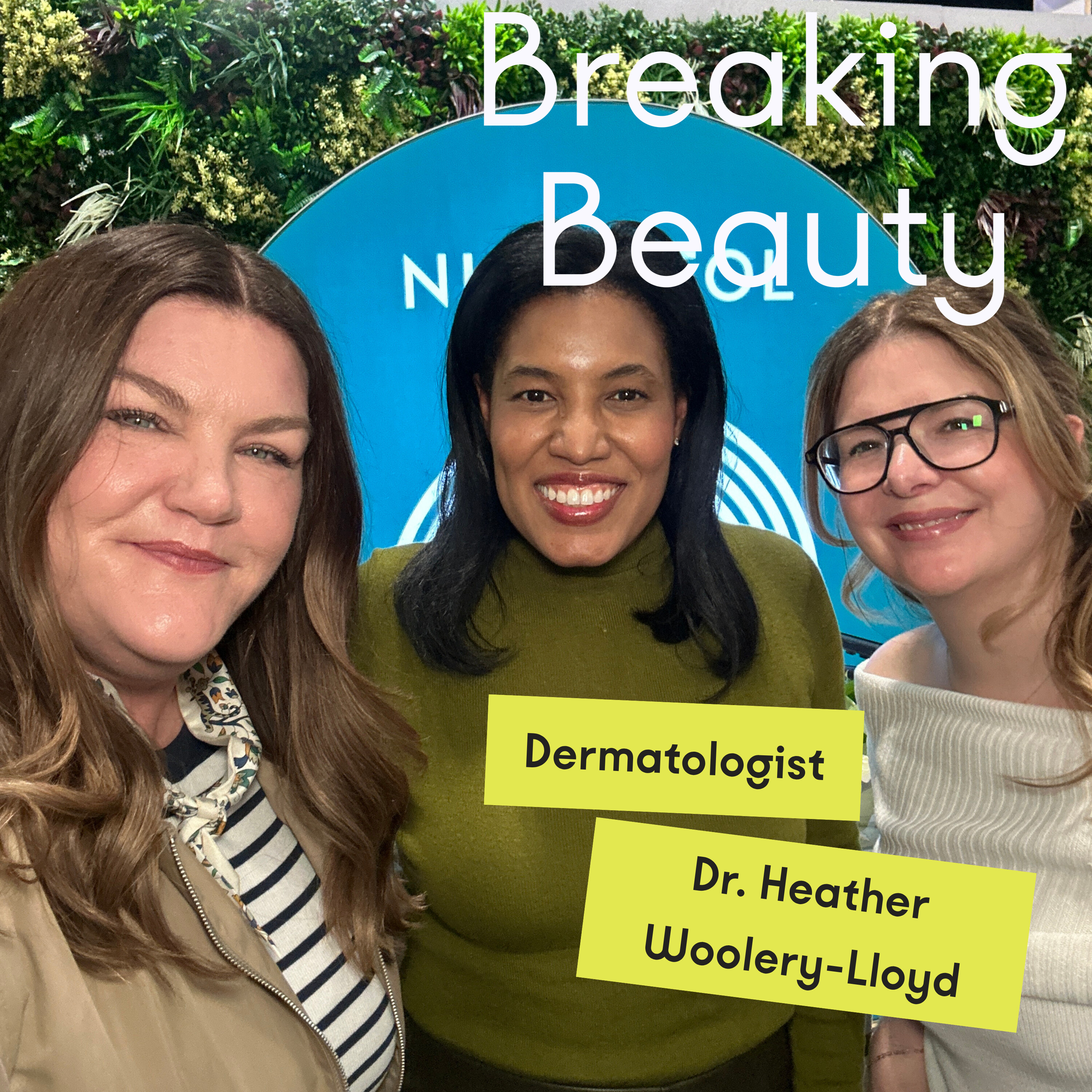
Breaking Beauty Podcast
BONUS! What’s next in skin, scalp, hair: reporting live from the biggest dermatology meeting in the world
00:37:03
Loading summary
Transcript187 lines
- [00:01]
A
The following podcast is a dear media production.
- [00:08]
B
Welcome to Breaking Beauty the podcast. All about the breakthrough people, products and moments in beauty. We're your hosts, Jill Dunn and Carlene Higgins. Hello everyone and welcome to Breaking Beauty Podcast. We are back with a very special live episode today. Carlene. I'm here with my lovely co host Jill. Done. And we're all about the breakthrough people, products and moments in beauty.
- [00:36]
A
Hey, Carlene. And hello to our listeners at home, of course. We are two longtime magazine beauty editors turned beauty podcasters. We've had our show for nine years and we are coming at you today with a very special bonus episode in partnership with our friends at Nutrafall who have invited us on a field trip of sorts.
- [00:54]
B
Yes. So you might hear the buzzing, the background noise. That's because we are live here on the floor at the American Academy of Dermatology. That's AAD for short, their annual meeting here in Denver, Colorado. This is the premier meeting to be at for all dermatologists. For anyone who's a real skincare nerd like we are, this is where everybody goes to find out what the trends truly are. What's coming next? Not just trends, but in research, in data, what are the, what are the actual facts that we're going to eventually see in our bathroom cupboards at home?
- [01:30]
A
Yeah. And it's skin care, it's aesthetic treatments, it's hair health, and much, much more. And Carlene, I was surprised to learn that there's over 350 vendors here. Like it's our first time, everybody. And my mind is blown at the scale of this event. So we are kind of drilling everything down for you today and talking about the trends.
- [01:48]
B
That's right.
- [01:49]
A
Yeah.
- [01:49]
B
And to help us do the crystal ball decode, what is new, what is worth knowing. At the meeting, we are welcoming our esteemed guest, Dr. Heather. Woolery Lloyd is with us. She is a board certified dermatologist. She's also board certified in lifestyle medicine and she is one of the most in demand speakers here at AAD this year. Dr. Heather just mentioned to us off mic that she's been doing like nine or ten different educational sessions. And Dr. Willery Lloyd is an active member of the Skin of Color Society and the American Academy of Dermatology. And, and she's the author of more than 90 peer reviewed publications. All of that. And she serves as the chief medical advisor at Nutrafol. Welcome, Dr. Woolery Lloyd.
- [02:39]
C
Thank you so much. Thanks for being with us. Welcome to the ad.
- [02:44]
B
It's our first time.
- [02:45]
A
Yeah, it's honestly amazing. Everyone that's listening at home, they have a place where you can pet puppies. Like, I don't think you understand.
- [02:52]
C
I haven't made it there yet.
- [02:53]
A
Yeah, I haven't made it there yet. I want to set the scene a little bit. We need to. It's everyone walking around with giant bags of skin care, hair samples. Yes, it is.
- [03:01]
C
People petting puppies.
- [03:02]
A
It is incredible. Dermatologists like yourself delivering cutting edge research. There is a lot of innovation. We are honored to be podcasting live here. And curious, Dr. Woolery Lloyd, if you were to share an overarching theme or idea that you're seeing emerging here that just simply cannot be ignored, that we need to be talking about, what would you say our listeners need to know that's coming out of this conference?
- [03:23]
C
I definitely think one of the huge undercurrents or overcurrents, I don't know what the word is, is longevity. Longevity and cellular health. So in the past, when it comes to skin health, people were more concerned about the visual signs of aging and more what was on top of the surface. And now I think there's a trend to dive a little bit deeper, look at root causes and look at cellular health. So longevity is a hot topic. And this concept of having the healthiest skin and hair for the longest amount of time, and this is something that I've seen in a meeting actually this morning I was in a session, the cosmeceutical section, and there was a whole lecture on longevity in dermatology. And there were other sessions in that session, other speakers spoke on longevity. And it was just something that I think is a trend, but not a trend in a way that it's going to go away. It's something that's here to stay, right?
- [04:20]
A
Yeah, it's emerging.
- [04:21]
B
It seems to me it's almost like cell care, like your skin cells. Cell care is the new skin care. And I think a lot of brands, and we are seeing a lot of consumer brands here at the show, much more than I anticipated. It does seem like it's hard to kind of separate the marketing from what is evidence based when it comes to cell care and longevity. So as a dermatologist, how is this meaningful to you? This kind of like shift in mindset?
- [04:53]
C
I think it's very meaningful. First of all, we need more research. We will always need more research. And so I think, as you mentioned, it's emerging. It's something that's new. So more research is to come. I give a lot of lectures and I prepare Lectures. And I'm always scanning through all of the literature, the peer reviewed literature, and there is great data, but of course, we could always use more. So I think it's something that's important. It's going to continue to grow, but we, of course need more research.
- [05:21]
B
Yeah, yeah.
- [05:22]
A
Okay. And just being on the floor over the last couple of days, we've been hearing a lot about the word senescence. Am I saying that correctly?
- [05:29]
C
First of all, senescence.
- [05:30]
A
Senescence. I knew I was going to get it wrong. Everyone. And how it really is the key to understanding the concept of aging or our aging skin. So can we have a refresher on this and how does it factor into this longevity conversation?
- [05:43]
C
So senescent cells are cells that are alive, but they're not very functional. So they're kind of the bad guys.
- [05:51]
A
Chaos agents is what I'm hearing.
- [05:54]
C
I'm trying to be nice about snes and cells. Don't ask me why I'm trying to be nice. But they're not nice, you know, so they're cells that are alive but not functional, not doing their job, and also releasing all of these inflammatory chemicals. So they make the surrounding cells not work as well because there's a lot of inflammation. So sometimes they call them zombie cells.
- [06:13]
A
Right.
- [06:14]
C
So cellular senescence increases with age. And this is something that in the longevity space, people are trying to address.
- [06:21]
A
Okay, that's fascinating.
- [06:23]
C
Go ahead.
- [06:23]
B
How does this concept of cell care relate to scalp care? Because there's a whole conversation around scalp health as well. I've seen so many booths, including Neutrophil, as I've been walking the show over the past couple of days. So does that apply to the. To what's happening with hair thinning and the way that it's being approached with either at home products or in clinic treatments?
- [06:46]
C
So definitely the scalp influences our hair. And scalp health is extremely important. So think about our skin. We all know that our skin ages as we get older. And our scalp is skin. It's the skin on top of our head. So our scalp also has aging. There's a decrease in collagen, it gets thinner. And when you think about your hair, the scalp. Scalp is the foundation. It's almost like the scaffold that a healthy hair grows from. So as the scalp thins with age and goes through all of those other cellular changes with age, you have less of a good foundation to grow a healthy hair. And that's one of the reasons why people experience thinning with age.
- [07:23]
A
Okay, okay. And another huge topic this year at AAD seems to be around the skin and scalp microbiome, and I feel like that has also been emerging for a couple of years. So what is the latest thinking that's caught your own interest when it comes to the microbiome that you could see becoming relevant to our audience that's listening?
- [07:42]
C
So the microbiome, you're right, it's been around for a little more time than longevity. So we do have actually more research on the microbiome, which is always a good thing. And products that are microbiome friendly are extremely important when it comes to hair health. And that's because the microbiome is important and it has all of these different microbes, so bacteria, bacteria and fungus on our scalp, but they're supposed to be there and they help to maintain the health of the skin. So one of the things that the microbiome does is they release antimicrobial peptides. So they keep our scalp healthy. And it's very important to use products that are microbiome friendly. So you're probably thinking, what does that mean? So microbiome friendly means that it doesn't disrupt the skin's microbiome. So it's really important when it first skin health and for scalp health that you focus on microbiome friendly products.
- [08:33]
A
So if you disrupt the microbiome, like maybe you're using something that's too stripping or harsh or something, is that one of the reasons why?
- [08:41]
B
Yes.
- [08:41]
C
So when the microbiome is disrupted, the skin barrier is disrupted, you can get redness scaling and so forth. And they've done studies that actually have shown that. So it is really important for your microbiome to be healthy and that you use products that are microbiome friendly.
- [08:56]
B
Yeah.
- [08:56]
A
Okay.
- [08:57]
B
So. So again, your scalp has its own skin barrier, just like your face, right?
- [09:01]
C
Exactly.
- [09:02]
B
Yeah. And in terms of a skincare ingredient, I think that's always. We are always seeing something that just kind of blows up and then we see it across so many brands. Is there a buzzy skincare ingredient that's emerging out of this year's show? Maybe even that your fellow dermatologists tend to be really interested in right now? Like, is it still exosomes or is there something new?
- [09:26]
C
There's always something new.
- [09:28]
B
Yeah.
- [09:28]
C
I would say that the ingredients that are trending or that are emerging are ingredients that are focused on this longevity space. So exosomes are one of them. PDRN is another one. So these are ingredients that have been studied in this space and something that has continued to. Because exosomes and PDRN were around last year. Yes. But I think, again, we need more research so people are still speaking about it, because when a new study comes out, people start talking more.
- [09:56]
A
Right. What's your best analogy for exosomes? We ask every dermatologist what their analogy is because it is a very challenging concept to understand. Do you have one that resonates with your patients?
- [10:08]
C
So, you know, if you remember from biology, right. Our cells have a cell membrane, and a vesicle can come off of that cell membrane, and it contain things like lipids and rna and it can contain all different types of things.
- [10:21]
B
Right. Now, you mentioned a third ingredient that I actually hadn't heard of. Spermidine. Was that it?
- [10:26]
C
Yes, Spermidine.
- [10:27]
B
What is that?
- [10:28]
C
Okay, so spermidine is a really interesting ingredient. It is. And it's well known in the longevity space. So basically, have you heard of autophagy?
- [10:37]
A
Yes.
- [10:37]
B
Okay, I've heard of it.
- [10:38]
C
I'll tell you about it.
- [10:39]
B
I don't know that I can explain it.
- [10:41]
C
So autophagy is cellular housekeeping. So basically, I describe autophagy as when you're cleaning out your closet. So you find a pair of jeans that the zipper is broken, you find a shirt that has a stain on it, and you get rid of it. Well, our cells do the exact same thing. And basically, cellular housekeeping is what autophagy is. It's keeping the cell healthy, getting rid of things it doesn't need, keeping things that it does need. So spermidine is an ingredient that has been shown to improve or help with autophagy. And of course, as we age, like everything else, autophagy becomes less efficient. So spermidine is an ingredient that I heard about actually this morning in my session that can be helpful to address that specific issue of autophagy.
- [11:21]
B
Okay, so that could be the next.
- [11:22]
A
Yeah, it's like kick starting. Kickstarting. Yes. Okay, very cool. We're learning. We're learning. And our audience is obsessed with sunscreens. I'm obsessed with sunscreens. And there's always news around sunscreen. So I'm curious what's coming out of AAD that is, you know, in the realm of studies or filters, any innovations? What do our listeners need to know about?
- [11:45]
C
So there is news in the US There is a new sunscreen that is supposed to be approved hopefully in the summer. Okay. And so that's a new filter. A new sunscreen ingredient which is a filter. So it's called bimitrizinol. It has a few other names. Tinosorb S, parsol, shield. Those are all the same things. If you hear that those three words, they're all the same thing. So what is Bemitrizinol? Bemotrizenol is a sunscreen filter that has broad spectrum of coverage. So it covers both UVA and uvb. It covers most of UVB and most of uva. Not all of uva, but most of uva. Why is it so interesting? It's because we haven't had a new sunscreen filter in the US in over 20 years. So this is a huge breakthrough for us in the United States. And the other really great thing about it is that it's going to be under the category called generally recognized as safe. Right. So the only other sunscreen filters that are under that category are zinc and titanium.
- [12:45]
A
So would you categorize it with those mineral filters alongside that are also grass or.
- [12:51]
B
Yes.
- [12:52]
C
Okay. So it's very similar. There's lots of data, because it hasn't been in the U.S. there's 20 years of data that was submitted to the FDA to show safety. So it really is in that same type of category. The only difference is that you notice that zinc or titanium dioxide can be used alone. So you might find a sunscreen that has just that one ingredient. So Bametricenol will not be used alone. It still will have to have other ingredients with it, but it offers alternatives and allows people to formulate and not use certain sunscreen filters that are less desirable for formulas.
- [13:26]
A
So maybe textures will be a little more elegant or less white cast, that kind of idea.
- [13:31]
C
No, it's a clear sunscreen. So it doesn't have a white, white cast. And absolutely the texture is key.
- [13:37]
B
So just looking at all the sessions, because of course we have the floor where we walk around and it's almost like a marketplace, but there's sessions going on. This is where I feel like the big conversations presentations happen and people like you are in the room. So tell us what is happening, because I feel like there's a lot of innovations in hair and scalp. Surely you're talking about AI so what do we need to know in the way of. I think hair transplants has been a topic of conversation. Tell us about that.
- [14:07]
C
So definitely the AAD is about the education because we have continuing medical education here and in Canada, where we have to keep up to date with what's new. So the whole focus of the AAD is actually those other sessions. It's not where we are right now.
- [14:21]
B
The serious people are not even to be seen.
- [14:24]
A
I haven't I haven't seen it. I haven't seen a session hall. Yeah, yeah, yeah.
- [14:30]
C
So. So that is really the reason for the aed, to learn about the new research, to learn about cutting edge things. It's where companies might present new findings or introduce new technologies. In the sessions, there's been a lot of talk, like we said, about longevity, about hair health. Hair health has become more and more important because as we live longer, we want to have healthier skin and hair. We want to have the best hair that we can possibly have. So you're right, there are lots of sessions going on. Not where we are right now, but that is the focus of the whole meeting.
- [15:04]
B
Yeah.
- [15:04]
A
Did you see anything in one of any of those sessions about AI or what. What can you share?
- [15:09]
C
So I did see it in one of my sessions. I did see something on AI. There was a session on AI and digital skin health, basically. So. So it talked about that session, talked about many different things, but one of the things it talked about is how AI and imagery may be affecting our self perception.
- [15:30]
A
Yes.
- [15:30]
C
And you know, we are of the age that we weren't always exposed to this, so we might not be as susceptible, but for younger people, they may be more susceptible to be thinking that what you see online is real. And this concept of coming into the dermatologist with a picture of what you want and not realizing that what you see in that picture, that doesn't even exist in real life. So there was a huge discussion on that. That was a definitely a hot topic.
- [15:56]
A
That's fascinating. I'm glad that's part of the conversations because skin, hair, confidence, it really all is so integral to how we feel about ourselves. Right. And in you're coming up, you are flooded with all these images and having that. We used to call it like media literacy. I don't know, would it be like AI literacy in place or like skin literacy?
- [16:16]
C
Yeah.
- [16:17]
A
I think that's really important that you guys are on the front lines and you can like let them know that's not real.
- [16:22]
C
And the other thing in that session that was interesting were the devices or the apps that kind of grade skincare based on how that app thinks the ingredients are.
- [16:32]
A
Oh, I know what you're talking about. Yeah.
- [16:34]
C
And so that can also be an issue because patients might not know the nuance of how the app decides that something is good or bad.
- [16:44]
A
Right.
- [16:44]
C
So. So those. That's another thing where AI is maybe playing a role that might not be beneficial in some ways.
- [16:50]
A
Yeah. And I know a lot of my girlfriends they. That's what they do. They get a product, they plug it into the app, and I'm like, it's not a derm, you know? So I'm glad that those conversations are happening as well. And I think for a lot of our listeners at home, when they think about hair thinning, they may not think about speaking to a dermatologist at first. They probably would text their girlfriend or maybe they'd bring it up with their hairstylist. So what have you noticed about how people are thinking about scalp health and hair thinning, hair shedding in 20, 26 and beyond?
- [17:17]
C
So I think hair thinning is something that is becoming more recognized. I think the good news is that we need to communicate to people that they need to see their dermatologist, because the dermatologist can evaluate the hair thinning and come up with a plan that could include a hair growth Nutraceutical like Nutrafol, to help address hair thinning. So my big take home is see a dermatologist if you're experiencing hair thinning.
- [17:41]
A
Right, right.
- [17:41]
B
So my niece, actually, she goes to university and she messaged me. I don't know if she's really stressed out or what. And she said, I feel like my hair is really thinning. Do you know of a supplement that I can take? And I was so surprised because she's so young. And so, first of all, that just goes to show that hair shedding is an issue regardless of age. Like, not just with something that happens as you age, but also because when I was her age, I would have maybe immediately said, okay, what shampoo should I use or what shampoo should I not use? I don't know that my head would have gone straight to supplements. So I think that's such a sign of the times. And of course, I did say Nutrafol, because that is the first. That's the one that's been recommended the most on our show. So on that note, I do want to ask you, because as a dermatologist, when it comes to supplements for skin and scalp, you know, sometimes it can be a challenge to figure out, like, is it really working as it metabolizes, as your body is digesting it? How much of that is actually going to be useful afterwards? And how much of that is actually going to go to your scalp, of all places in your body? Those are the types of criticisms that I've seen from medical professionals about supplements. You are so accredited, and you are also a medical advisor for Nutrafol. So how do you weigh in? Because I know that you are recommending it?
- [19:09]
A
Yes.
- [19:10]
B
So how do you know that it works?
- [19:13]
C
Well, I love this question because I do clinical research. That's a huge part of what I do. And there are so many studies that support the role of Nutrafol in hair thinning. So there's over 25 studies published that includes three randomized controlled trials. So that is the most rigorous type of clinical trial where you compare that product to someone not taking the product. And so it's so important that when people are unsure, look at the research and look at what the research shows. And clearly there's a lot of data and a lot of research to support neutral falls used for hair thinning. On top of that though, I think just as important as effectiveness and efficacy is safety. And safety is something that I am very, very passionate about. And of course Nutrafol is the number one dermatologist recommended hair supplement. And one of the reasons why is this commitment to safety. And it is the only hair growth Nutraceutical that's NSF certified for sport.
- [20:13]
B
Yeah.
- [20:14]
C
So are you familiar with that certification?
- [20:16]
B
This is what I want to hear more about because I have been asked before, like, is this supplement, what is the certification? So what does that look like? And I have been starting to hear with Nutrafol about this NSF sport and not just Nutrafol, other brands as well.
- [20:32]
C
Right.
- [20:32]
B
So what does that mean?
- [20:33]
C
So NSF is an independent third party organization that basically makes sure that what's on the label is what's in the bottle. So it's a trusted source that actually tests the product. The product is sent into their laboratories and they test. And there are different levels of NSF certification, but NSF certified for sport is the most rigorous level of certification. So not only does it test for what's on the labels, what's in the bottle, but it makes sure that there are no unsafe levels of contaminants. And it's the type of certification that allows, for example, an athlete to be able to take neutrophil because athletes whole career are based on making sure that they're not taking anything that they're not supposed to be taking.
- [21:15]
B
Right.
- [21:16]
C
So NSF certified for sport is very important because as a dermatologist for me, it makes me very confident in the safety of the product. And the fact that Nutrafol is NSF certified for sport just shows me as the ethos of the brand is really committed to safety, while everybody who listens
- [21:34]
A
to the show knows that I'm obsessed with sports. And Nutrafol partners with the mlb, Major League Baseball. And they have this whole like really amazing hats off thing that they do at the ball games where it's like people on kiss cams, but it's usually guys. And the idea is instead of kissing, you take your hat off. And I'm obsessed with it.
- [21:49]
B
Yeah.
- [21:50]
A
I think it's so fun.
- [21:50]
C
I love it.
- [21:51]
A
I love the tie into the sports.
- [21:52]
B
I've seen the giant neutrophil logo at baseball games, at MLB games of like. So cool.
- [21:59]
A
Yeah.
- [21:59]
B
I want to ask you on that note, and I think it's perfect that you're involved with that. You have this great understanding of supplements because you are more than a dermatologist. We mentioned mention this off the top. In addition to being a board certified dermatologist, you're also board certified in lifestyle medicine. So tell us what that is and how that might differ from say a functional doctor.
- [22:23]
C
So lifestyle medicine is a specialty that focuses on evidence based lifestyle interventions for our overall health and wellness. So there are two things that I said, they're evidence based, so that's really important. And then lifestyle intervention. So things like diet. And mainly we focus on a plant predominant diet that's free of processed foods and things like that. Exercise. So around 30 minutes of exercise five times a week or 150 minutes of moderate exercise. And moderate exercise means that you can talk but not sing. So that level of exercise, it focuses on sleep. That's the one that I'm not good at. But your goal is to get seven to nine hours of healthy sleep. Stress management, avoiding risky substances, and of course social connectedness, which is a huge predictor of longevity. So those are the six pillars of lifestyle medicine and that is what lifestyle medicine is all about. Evidence based lifestyle interventions to help our overall health and wellness.
- [23:23]
A
I'm so curious where the dermatology and lifestyle medicine intersect though. Are you prescribing sunscreen and exercise or.
- [23:31]
C
Well, one of the things. The only place actually where the lifestyle medicine literature mentions dermatology is under stress. Oh, interesting. So stress really can aggravate skin conditions. So it makes eczema worse, it can make psoriasis worse, it can make hair thinning worse. That's a very common one. And so when someone comes into me with hair thinning, one of the first questions I ask is, did you have a major stressful event in the last six months? So a car accident, a childbirth actually
- [24:00]
A
is one of the big ones. It's stressful.
- [24:02]
C
Yeah, it's pretty stressful. Hospitalization and major flu, all of those
- [24:07]
B
things are major starting University.
- [24:09]
C
Yes. Yeah, exactly. Right, yeah. And that can influence your hair health. And so I do actually bring it into my practice. And I will sometimes if someone, I think they can benefit from it, I'll recommend meditation apps. Even five minutes of meditation a day, walking outside. Those are the types of lifestyle interventions that can help manage good for overall health, but also great for stress management.
- [24:34]
A
If our listeners are hearing this for the first time, this area of expertise, what's the one takeaway that you think makes the biggest difference in lifestyle?
- [24:43]
C
Well, you know, lifestyle medicine has six pillars, so they're all important. I will tell you two answers based on the studies. Social connectedness is the biggest predictor of longevity. That is the biggest predictor of longevity. So maintain strong, positive, healthy relationships. But when it comes to brain health and aging, exercise is a big one too.
- [25:06]
A
Yeah.
- [25:07]
B
Yes.
- [25:07]
C
Strength training.
- [25:08]
A
Do you do strength training?
- [25:10]
C
I do, I do. I was a cardio person. I loved cardio. I loved like dance fitness. But I realized as I got older I really needed to do strength training. So now I'm in it.
- [25:23]
B
Same. I've swapped out, swapped out cardio for sure.
- [25:26]
A
We gotta do those glutes, ladies.
- [25:27]
C
Squat, squat, squat, squat, squat, squat.
- [25:29]
B
A perimenopausal woman's credo these days. I want to talk to you about your, one of your sessions because you've done a few while you've been here and one of them was called Late Breaking Skin of Color cosmeceuticals. Is that right?
- [25:42]
C
Yes. Yes.
- [25:43]
B
Okay, so we have a two part question. One is maybe if you could define cosmeceuticals. Yes. And two is what is the biggest takeaway in that realm in 2026? Because I know we were kind of wandering around yesterday talking about some big breakthroughs. So let's share with the class.
- [26:02]
C
So I first of all, what is cosmeceuticals? So it's a term that was invented over 20 years ago and it combined the word cosmetics with pharmaceuticals. So combined it together and became cosmeceuticals. And in general, even though it doesn't have an official definition, generally cosmeceuticals are products that have studies to back up their claims, so they tend to have more rigorous testing. So that's a general description of what they are.
- [26:28]
A
Right.
- [26:29]
C
In my session, I talked about a lot of the new treatments for hyperpigmentation and uneven skin tone. So there's ingredients like Malice Season, which is an ingredient that now has been shown to be very helpful for pigmentation. I also talked about a new Study that showed this ingredient called aflornithine, which had been used actually to reduce hair growth in the past, but now has been shown to help with pigmentation. I talked about sunscreens and sun protection. And one of the key things when it comes to pigmentation is visible light. So, you know, when we think about sunscreens, they have UVA and UVB coverage, but there's also visible light. Visible light is the light we actually see that comes down. And visible light drives pigmentation. It turns on our melanocytes and makes us create more pigment. So when you're using a regular sunscreen, you're not protecting against visible light. You're only protecting against UVA and uvb. So to get that visible light protection, you have to add in iron oxides, which are pigments that block visible light.
- [27:30]
A
Right.
- [27:31]
C
So tinted sunscreens block visible light. And I talked a lot about that today also.
- [27:35]
A
Oh, that's really interesting. I really feel like what I've seen here at aad, there's so much talk about pigmentation.
- [27:41]
C
Yes.
- [27:42]
A
Melasma, hyperpigmentation, because it is, like, such a huge area where people are really getting to a certain age, and then they have a spot or pigmentation, and it's like, what do I do?
- [27:51]
C
You know?
- [27:52]
A
So I think that these are all very topical, obvious, and very exciting. What was the response to your presentation today? It was great.
- [28:00]
C
I got a nice applause. That was fun.
- [28:02]
A
Love it.
- [28:03]
C
I'm always surprised. Like, everyone started clapping, and I was
- [28:05]
B
like, oh, everybody loves you here. When we were walking around yesterday, it truly was like walking around with a celebrity because everybody was running up to you and, hi. Oh, my gosh. Hi. Hi. You know, everybody. Everybody knows you.
- [28:19]
A
And you also presented on the topic of rosacea and inflammatory conditions in skin of color. So what were some of the takeaway tips that our listeners can learn about on this topic that maybe they haven't heard of before?
- [28:32]
C
Okay, so I spoke a lot about acne and rosacea. Those are the two concepts. So for acne, people with darker skin tend to have dark marks, which is the biggest problem for that person. So they actually don't care as much about the acne. They care more about the dark marks. And dark marks can last a long time. So I presented some studies I've done all over the world. And in these studies, they found that the people reported that the dark spots lasted a year or more, and some of the studies, five years. So imagine getting a pimple and having a dark spot for five years. So in that talk, I focused a lot on explaining to the audience. It's so important to treat the pigmentation because that's what really bothers that patient. And then for rosacea, when it comes to darker skin types, it can sometimes be masked by the pigment in the skin so you don't see the redness. So I just gave little tips. And this applies to all skin types where patients with rosacea are very sensitive to skin care. So that's a little tip. As dermatologists, we have been trained for years basically to recognize redness in every skin type. So you just have to look for the nuance, and it's something that you develop with years of training.
- [29:42]
A
Honestly, what's the best way bang for your buck? If you have an acne scar that's been kicking around forever and really want to get rid of it, you have
- [29:52]
C
a dark spot from your acne. I would say the most important thing for us is to start wearing sunscreen every day. Because if you're not wearing sunscreen, I would say it's like pushing a rock uphill. So that's the most important thing. And then there's some new ingredients that are being used, thiamidol, 2 MNG, that are very helpful and have been studied. Four dark spots, and I have talked about those in my talk. But the key is to get on a consistent skincare routine and to see a dermatologist.
- [30:19]
B
Yeah, hydroquinone. Is that just done now? Nobody uses that.
- [30:23]
A
It's not done.
- [30:24]
C
I did have it in my talk. I use it a lot less frequently, but it's not done. I actually presented a really interesting paper that looked at a very low dose of hydroquinone, and it was conjugated with zinc, and it had really great efficacy. This is the only paper. So, you know, I'm waiting for more research, but it was lovely to see it. So I still think it plays a role, and dermatologists still use it, but now we do have very good alternatives, so we use it a little bit less. But I still think it's a very important part of a dermatologist. A dermatologist's armamentarium.
- [30:58]
B
Yeah. Is there something else that our listeners might be able to look for on a label? Because we talked yesterday about some competing ingredients that, with the evidence, has showed are at least as effective as hydroquinone.
- [31:11]
C
So there have been studies on thiamidol, studies on an ingredient called 2MNG, studies on malaccin that I mentioned. Tranexamic acid is another one. So we really have quite a list. I have been giving this Lecture on hyperpigmentation for a very long time. And the list used to be three or four things long and now my list is, you know, 20 has 20 different agents. So it's a very exciting time and there are a lot of really effective alternatives. Okay.
- [31:41]
B
Amazing.
- [31:41]
C
That's great.
- [31:42]
B
I think GLP1 has been the topic on everyone's mind for the past year. Lots of big boots here on the topic. Yes, there certainly is. I'm curious if you can help us understand how GLPs impact hair and skin.
- [31:58]
C
So GLP1 skin are something that I think have impacted hair and skin specifically. Hair thinning is a common thing that we see in people who are using GLP1s. So I see it very often in my practice and for me as a dermatologist, a part of my plan includes a Nutraceutical like Nutrafol. It's very helpful. And Nutrafol can be used alongside GLP1. So I really love using it in my practice for my patients with hair thinning from GLP1, I've seen great success and I think that what I want to emphasize, anyone who's on a GLP1 see a dermatologist if you're experiencing hair thinning, because the dermatologist can look for root causes and also come up with a plan.
- [32:41]
B
Yeah.
- [32:42]
A
Right.
- [32:42]
B
So what else has blown your mind here at AAD that we need to know about?
- [32:47]
C
Well, I think one of the things that I find very, very interesting is the skinification of hair. So, you know, our scalp health is something that we have been talking about and how important your scalp is for healthy hair. I think another thing that's very interesting is this shift from trend to evidence based. I think that people in general want to know the evidence. And although trends are fun and interesting and, you know, they keep you excited, really, I think there will be a huge shift where people are focused on evidence based approaches. And this is something that is important to me because I do clinical trials. So I think it's extremely important. But I love that everyone else is really focusing on this.
- [33:34]
A
Yeah, yeah. And I think without question, what I'm walking away thinking about is how integral dermatologists are and how consumer brands that you may not think about are here.
- [33:44]
B
Yeah.
- [33:44]
A
Trying to get the attention. And it's not just, here, try my cream. It's, here's our data. Here is where we are impressing you.
- [33:53]
C
Right.
- [33:54]
A
This is new. You're hearing about it first.
- [33:56]
C
Right.
- [33:57]
A
And there literally you'll go up to a booth of like a skincare brand. And it will have a peer reviewed paper studying an ingredient and it's meant to, you know, blow your mind.
- [34:07]
B
It's the idea of influencing the influencers, but like the dermatologists who are the most critical.
- [34:14]
C
Yeah, right.
- [34:15]
B
You know, that's kind of what it's.
- [34:17]
C
Because that's all we focus on. We focus on the data.
- [34:20]
B
Yeah.
- [34:20]
C
It's wonderful to have a grading new ingredient, but if you don't have any studies to support the claims, it doesn't mean anything.
- [34:26]
B
Yeah.
- [34:27]
A
And I just think hair health, like, Carlene, you and I have talked about this. Like, we never really talked about scalp health ever in our careers as journalists. And all of a sudden it's just like everybody wants to know more. Everybody wants to know how they can improve their hair health. Because I for one will admit that I never thought about the skin on my head.
- [34:44]
C
Yeah.
- [34:45]
A
Like, I really didn't. I was like, it's here and down, you know. Exactly.
- [34:49]
B
I completely agree.
- [34:50]
A
That's so great. Well, thank you so much.
- [34:52]
C
Thank you for joining us today. We know how busy you are and
- [34:55]
A
it's just been a joy to learn all about AAD from you. You're a veteran, we're newbies, so we really appreciate it.
- [35:03]
B
And thank you to our friends at Nutrafol, the number one dermatologist recommended hair growth supplement brand, for inviting us here to be part of this conversation.
- [35:10]
A
And happy 10th anniversary neutrophil. And that's so exciting, by the way. The booth here is amazing, everyone. There's like sports lockers and it's just so fun. I got a baseball card made of me saying I'm a beauty editor. Like, I'm so excited. For a limited time, Nutrafol is offering our listeners $10 off your first month subscription and free shipping when you visit nutrafol.com that's spelled n u t r a f o l dot com and enter promo code breaking. And if you'd like to watch this episode on our YouTube channel, you can see exactly where we're podcasting from. Hit like subscribe, share and we will see you next Wednesday.
- [35:49]
B
Thanks for listening. You can find details on every product mentioned in today's episode along with our exclusive promo codes on our blog @breaking beauty podcast.com.
- [35:58]
A
while you're there, be sure to sign up for our newsletter. Every episode will be delivered directly to your inbox, so you won't miss a
- [36:05]
B
single thing and get social with us. Let us know what you think of the episode. You can follow us on Instagram at Breaking Beauty Podcast and Did you know
- [36:12]
A
we also have a private Facebook group? Just search Breaking Beauty Podcast Chat Room.
- [36:17]
B
You can even leave us a voicemail at any time with questions or feedback at 1-844-227-0302. And don't forget to subscribe to us
- [36:26]
A
wherever you get your podcast fix. Spotify, Stitcher, Google Podcasts and Apple Podcasts where you can show us some love by writing a review.
- [36:35]
B
See you next Wednesday. Please note that this episode may contain paid endorsements and advertisements for products and services. Individuals on the show may have a direct or indirect financial interest in products or services referred to in this episode, day or night.
- [37:07]
D
VRBoCare is here 24? 7 to help make every part of your stay seamless. If anything comes up or you simply need a little guidance, support is ready whenever you reach out. From the moment you book to the moment you head home. We're here here to help things run smoothly because a great trip starts with the right support. And hey, a good playlist doesn't hurt either.