
Podcast
Breaking News To Trading Moves
Hosted by Shirish Agarwal · EN
Breaking News to Trading Moves delivers fast, actionable trading ideas straight from the headlines. Each episode cuts through the noise of daily news and translates it into clear short- and long-term trade setups you can actually use. Whether it’s earnings surprises, policy shifts, or market-moving events, you’ll get sharp insights on which stocks, sectors, and themes to watch.
Perfect for traders who want to stay ahead of the market without wasting time, this podcast gives you the edge to turn breaking news into smart trading moves.
150episodes
Episodes
Newest firstAll episodes

Moderna’s mRNA flu vaccine gets FDA adviser backing
Jun 2000:17:25Tap to summarizeFDA advisers backed Moderna’s mRNA flu vaccine, mFlusiva, for adults aged 50 and older. This is an important healthcare headline because it tests whether mRNA can move beyond COVID and become part of the regular seasonal vaccine market.For Moderna, the catalyst matters because the company needs new revenue streams after COVID vaccine demand slowed. The FDA decision is expected by 5 August 2026. If approved, the vaccine would support the idea that Moderna’s platform can create repeatable revenue outside pandemic products.WinnersmRNA platform winnersThis is the clearest winning group. FDA adviser support improves confidence that mFlusiva can reach the market and gives investors another reason to believe mRNA can work in large, recurring vaccine categories. The impact is not just about one flu shot. It is about whether the market starts valuing mRNA platforms as long-term seasonal vaccine businesses.Names: $MRNA (Moderna), $BNTX (BioNTech)Pharmacy and healthcare access winnersIf Moderna’s flu shot is approved and adopted, pharmacies and healthcare distribution channels could benefit from another seasonal vaccine moving through the system. More vaccine options can support patient visits, pharmacy traffic, appointment activity and inventory movement during flu season. This impact would depend on adoption, pricing and how quickly healthcare providers add the product to their vaccine programmes.Names: $CVS (CVS Health), $WBA (Walgreens Boots Alliance)Healthcare distribution winnersVaccines do not just need approval. They need ordering, storage, shipping and national distribution. If mFlusiva becomes part of the US seasonal flu market, large healthcare distributors could benefit from the extra product flow. These companies may not get the same headline reaction as Moderna, but they can still be part of the second-order trading impact.Names: $MCK (McKesson), $COR (Cencora)LosersTraditional flu vaccine incumbentsIf Moderna’s mRNA flu vaccine is approved and gains traction, traditional flu vaccine makers could face a new competitive threat. These companies already have established flu vaccine businesses, but a successful mRNA product could raise questions about future market share, pricing power and whether older vaccine platforms look less attractive to investors.Names: $SNY (Sanofi), $GSK (GSK), $AZN (AstraZeneca)Non-mRNA vaccine technology namesThis group could be pressured if investors decide mRNA has a stronger long-term position in respiratory vaccines. The market may become more selective and reward companies with faster, more adaptable vaccine platforms. That can make alternative vaccine technologies face tougher comparisons, especially if mRNA products keep gaining regulatory support.Names: $NVAX (Novavax), $DVAX (Dynavax)Large pharma vaccine competitorsBig pharma companies with vaccine exposure may not lose immediately, but they could face a tougher narrative if Moderna proves that mRNA can compete in seasonal flu. Investors may ask whether larger, diversified healthcare companies can defend their vaccine franchises against faster-moving biotech platforms. The impact is likely more about sentiment and future competition than immediate revenue loss.Names: $PFE (Pfizer), $JNJ (Johnson & Johnson)#StockMarket #Trading #Investing #DayTrading #SwingTrading #Moderna #BiotechStocks #HealthcareStocks #VaccineStocks #PharmaStocks #FDA #MRNA #BioNTech #FluVaccine #PharmaNews #HealthcareInvesting #StockMarketNews #TradingIdeas
Transcribe →
The risk-reward ratio is useless without probability
Jun 1900:17:45Tap to summarizeA 3:1 risk-reward ratio sounds attractive. Risk £100 to make £300, and the trade looks sensible on paper. But that number means very little if you do not understand the probability behind the setup. A trade can offer a huge reward compared with the risk, yet still be a poor decision if it almost never works.Why risk-reward can be misleadingMany traders are taught to look for trades where the potential upside is larger than the downside. That is useful, but it can also become dangerous when it is used in isolation.A trade with a 5:1 reward-to-risk ratio might sound better than a trade with a 1.5:1 ratio. But what if the 5:1 trade only works 15% of the time, while the 1.5:1 trade works 60% of the time? The second setup may be far more profitable, even though it looks less exciting.The problem is simple. Risk-reward shows the size of the win, not the likelihood of the win.The missing piece is expectancyThe real question is not, “How much can I make if this trade works?” The better question is, “What happens if I take this trade 100 times?”Expectancy combines your average win, average loss and win rate. It tells you whether your trading system has a positive edge over a large sample of trades. A high reward target with a very low win rate can still lose money, while smaller winners with stronger probability may build steadily.Key points covered in this episode• Why a big target does not automatically make a trade good • Why a 2:1 or 3:1 setup can still have negative expectancy • How probability changes the value of every risk-reward ratio • Why traders often overestimate how often their setups work • Why backtesting and trade journaling matter more than theory • How to think in sample sizes instead of single outcomes • Why consistency comes from repeatable setups, not attractive screenshotsThe trap of chasing perfect ratiosSome traders reject trades simply because the risk-reward ratio is not high enough. Others force unrealistic targets because they want the chart to show 3:1 or 4:1. Both habits can damage performance.A realistic 1.8:1 trade with strong probability can be better than a forced 4:1 trade with weak odds.Probability comes from evidenceProbability is not a feeling. It comes from data, repetition and review. You need to know how a setup has behaved before you risk real money on it.That means tracking entries, exits, market conditions, time of day, trend direction, volume behaviour and whether your target was reached. Over time, this shows whether the setup has an edge or only looks good after the fact.Trading is not about being right onceOne winning trade proves very little. One losing trade also proves very little. The edge appears only across a series of trades. Traders can make the right decision and still lose on one trade. They can also make a bad trade and win by luck.The goal is not to judge yourself by one outcome. The goal is to build a process that produces positive results over many repetitions.The practical takeawayBefore taking a trade, do not only ask what the reward is. Ask how often this setup works, whether the target is realistic, whether the stop is logical, and whether the same idea has shown positive expectancy in your journal.Risk-reward is useful, but only when it is connected to probability. Without probability, it is just a number on the chart.#StockMarket #Trading #Investing #DayTrading #SwingTrading #RiskReward #TradingProbability #TradingPsychology #RiskManagement #TradeExpectancy
Transcribe →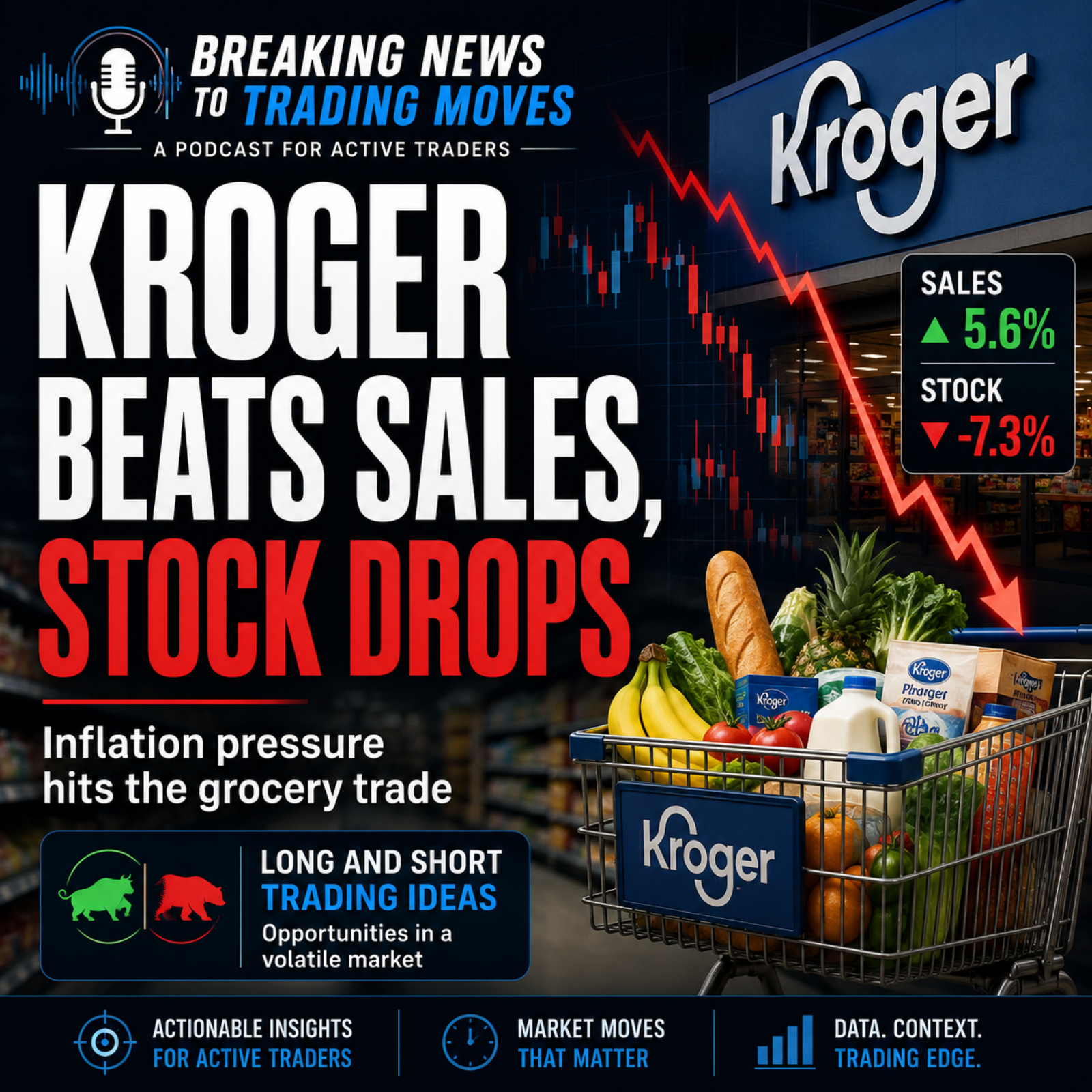
Kroger beats sales, but inflation worries send the stock lower
Jun 1900:17:13Tap to summarizeKroger beats sales estimates, but the stock drops as inflation pressure and cautious shoppers hit the grocery tradeKroger gave investors a mixed update. Sales were better than expected, but the market focused on the warning underneath the numbers. Management pointed to inflation pressure, price-sensitive shoppers, and more promotional trips instead of full-basket grocery trips.That matters because grocery is usually defensive. People still need food, but steady sales do not always mean steady profits. If customers chase deals and buy more private-label products, grocers may need deeper discounts to protect share. That can hurt margins even when revenue holds up.WinnersValue retail and warehouse clubsIf households are stretching budgets, value retailers can keep winning traffic. Walmart and Costco have scale, strong price perception, and larger baskets when shoppers want savings. BJ’s may also benefit as consumers look for bulk value.Names: $WMT (Walmart), $COST (Costco), $BJ (BJ’s Wholesale Club)Discount retail and trade-down storesReason: When grocery inflation rises, some shoppers move part of their basket to cheaper stores. Dollar General and Dollar Tree may benefit from smaller trips for snacks, pantry goods, household items, and essentials.Names: $DG (Dollar General), $DLTR (Dollar Tree)Digital grocery and retail technologyReason: Kroger is investing in technology and digital capabilities to support traffic and loyalty. That keeps attention on online grocery, delivery, retail media, and price comparison. Instacart may benefit if grocers push harder into digital shopping, while Amazon can benefit through Amazon Fresh and Whole Foods.Names: $CART (Instacart), $AMZN (Amazon)LosersTraditional grocers facing margin pressureReason: Kroger’s report highlights the problem for traditional grocers. Sales can improve, but margins can weaken if promotions and price cuts are needed to defend share. Albertsons and Sprouts may face similar questions around basket size, traffic, and pricing power.Names: $KR (Kroger), $ACI (Albertsons), $SFM (Sprouts Farmers Market)Branded packaged food companiesReason: If shoppers become more price sensitive, branded food companies may lose share to private-label alternatives. Kroger has been investing in store brands, which can pressure national brands when consumers want cheaper choices.Names: $GIS (General Mills), $KHC (Kraft Heinz), $CPB (Campbell’s), $KLG (WK Kellogg)Restaurants and discretionary food spendingReason: Higher grocery bills can reduce spending power elsewhere. If consumers are careful in supermarkets, that caution can spill over into restaurants, coffee, fast food, and fast casual dining.Names: $MCD (McDonald’s), $SBUX (Starbucks), $YUM (Yum Brands), $CMG (Chipotle)Podcast angleThis is not just about one grocery stock falling after earnings. It is a read on the US consumer.Shoppers are still spending, but they are spending more carefully. If consumers are buying promotions, splitting baskets across retailers, and choosing cheaper alternatives, companies may need to fight harder for every dollar of revenue.For traders, the setup is value versus margin pressure. Value retailers like $WMT and $COST may look stronger if they keep taking traffic. Traditional grocers like $KR and $ACI may struggle if they need discounts to defend share. Packaged food names like $GIS and $KHC may face pressure if private label keeps gaining.#StockMarket #Trading #Investing #DayTrading #SwingTrading #Kroger #RetailStocks #ConsumerStocks #ConsumerStaples #Inflation
Transcribe →
Taking partial profits may be quietly killing your biggest winners
Jun 1800:20:40Tap to summarizeTaking partial profits feels responsible. You lock in gains, reduce risk and avoid watching a winning trade reverse. But what if this habit is also cutting off the trades that are supposed to pay for everything else?In this episode of Breaking News to Trading Moves, we explore why taking profits too early can quietly damage the expectancy of a good strategy. Partial profits are not always wrong. The problem begins when traders use them automatically, without checking whether the numbers support the decision.A trader may enter with a clear target, but once profit appears, fear takes over. Half the trade is closed, the stop is moved too quickly and the remaining position becomes too small to matter. The result may be smaller winners with the same full-sized losses.Why partial profits feel so attractiveTaking something off the table creates emotional relief. It reduces the fear of a reversal. However, the trader may stop managing the position according to market structure and start managing it according to discomfort.This is dangerous when a strategy depends on a small number of large winners. Trend-following, breakout and momentum systems often experience several small losses before catching one major move. If size is reduced during the early stages of those winners, the strategy may lose the payoff that makes it profitable.The hidden maths behind scaling outImagine risking 1R on each trade. Several trades lose 1R, some make 1R and a few produce 4R or 5R. Those larger winners may carry the entire system.Now imagine closing half the position at 1R. Even if the trade eventually reaches 5R, the combined result is only 3R before costs. Across dozens of trades, the difference can become significant.Partial exits can improve the win rate while reducing the average winner. A higher win rate may feel better, but it does not automatically mean a more profitable strategy. What matters is the relationship between win rate, average winner, average loser and trading costs.Questions to ask before taking partial profits• Does testing show that scaling out improves expectancy?• Is the exit based on a meaningful price level or simply the presence of profit?• How often does price continue to the original target after the partial exit?• Is the remaining position large enough to benefit from an exceptional move?• Does reducing size improve execution, or hide a fear of holding winners?• Would a trailing stop or full target produce better results?Without clear answers, taking partial profits may be an emotional habit disguised as risk management.When scaling out can make sensePartial exits can be useful when they are part of a tested plan. They may suit volatile positions, trades approaching resistance or situations where reducing exposure helps the trader follow the remaining setup.A planned exit at a defined level is different from selling because unrealised profit feels uncomfortable.Traders can compare different approaches: taking 25% off at 1R, closing half at 2R, holding the full position to target or using a structured trailing stop. The answer should come from data, not from whichever method feels safest during one trade.The objective is not to hold every trade forever. It is to make sure the exit process supports the strategy rather than quietly weakening it.#StockMarket #Trading #Investing #DayTrading #SwingTrading #TradingPsychology #RiskManagement #ProfitTaking #TradeManagement #PositionSizing #TradingStrategy #TraderMindset #TradingDiscipline
Transcribe →
Google loses Gemini co-lead Noam Shazeer to OpenAI
Jun 1800:16:31Tap to summarizeNoam Shazeer, one of the leaders behind Google’s Gemini models, is leaving Alphabet to join OpenAI. Shazeer is a respected AI researcher, a co-author of the transformer research behind modern generative AI and a key figure in Google’s effort to compete with ChatGPT.Because OpenAI is privately held, the tradable effects fall mainly on its partners, suppliers and competitors.WinnersOpenAI cloud partnersA stronger OpenAI could increase demand for cloud computing, model training and enterprise AI services. Microsoft remains one of OpenAI’s most important partners, while Amazon and Oracle are also exposed to its infrastructure needs. If Shazeer helps improve OpenAI’s models or increase ChatGPT usage, these companies could benefit from higher demand for computing capacity.Names: $MSFT (Microsoft), $AMZN (Amazon), $ORCL (Oracle)AI chip and networking suppliersCompetition between OpenAI, Google, Meta and other developers requires enormous computing power. Nvidia leads in AI accelerators, AMD is trying to capture more demand with competing chips, and Broadcom could benefit from custom AI silicon and high-speed networking.Names: $NVDA (Nvidia), $AMD (Advanced Micro Devices), $AVGO (Broadcom)Data-centre infrastructure companiesAdvanced AI models require larger data centres, greater power density, faster networks and better cooling. Vertiv supplies power and cooling equipment, Arista provides networking and Eaton is exposed to electrical infrastructure investment.Shazeer’s move will not change earnings by itself, but stronger competition between OpenAI and Google could encourage more AI data-centre spending.Names: $VRT (Vertiv), $ANET (Arista Networks), $ETN (Eaton)LosersLarge competing AI platformsAlphabet is the clearest potential loser because it is losing a senior leader who helped guide Gemini. The departure may raise questions about research continuity and Google’s ability to retain elite AI talent.Meta is not directly involved, but the move highlights how expensive the AI talent market has become. Meta may need to increase compensation and infrastructure spending to retain leading researchers.Names: $GOOGL (Alphabet), $META (Meta Platforms)Enterprise AI software companiesA more capable OpenAI could make it harder for enterprise software companies to differentiate their AI assistants. Salesforce, IBM and Adobe may have to invest more, deepen model partnerships or reduce prices to remain competitive.These companies can still benefit from wider AI adoption. The risk is that more value shifts towards businesses controlling the strongest models and the infrastructure needed to run them.Names: $CRM (Salesforce), $IBM (IBM), $ADBE (Adobe)Smaller standalone AI companiesSmaller AI companies may face greater scrutiny as OpenAI adds technical talent. Better general-purpose models can make some AI features easier and cheaper to reproduce, increasing competition and potentially pressuring valuations.Names: $AI (C3.ai), $SOUN (SoundHound AI), $BBAI (BigBear.ai)#StockMarket #Trading #Investing #DayTrading #SwingTrading #AIStocks #ArtificialIntelligence #OpenAI #Google #Gemini #ChatGPT #Alphabet #Microsoft #Nvidia #AMD #Oracle #Amazon #CloudComputing #Semiconductors #DataCenters #TechStocks
Transcribe →
Why your best setup might deserve more risk than your normal setup
Jun 1700:20:02Tap to summarizeMost traders are taught to risk the same amount on every trade. That protects capital, reduces emotion and prevents one bad decision from causing serious damage. But it also assumes every valid setup has the same quality. Some opportunities are stronger than others.Your normal setup may meet the minimum entry criteria. Your best setup may also have cleaner structure, stronger confirmation, better timing, supportive volume and a more attractive risk-to-reward ratio. When several factors align, that trade may justify slightly more risk.Not every valid trade has the same edgeA pattern may win 55% of the time overall, but one version may perform better when the higher-timeframe trend agrees, price reacts from a major level and volume expands. If your journal shows those conditions improve expectancy, treating that trade like an average setup may be too conservative.What should qualify as an A+ setup?More risk should only be considered when the trade meets objective conditions:• A meaningful historical sample, not a few recent winners.• Higher-timeframe structure supporting the direction.• A clear reaction from an important price level.• Volume, momentum or market breadth confirming the move.• A logical stop-loss and attractive potential reward.• A written A+ checklist completed before entry.The distinction must come from tested rules, not excitement.Confidence is not probabilityA trader can feel extremely confident and still have no additional edge. Fast price movement, bullish commentary or 2 recent winners can create conviction, but they do not automatically improve the probability of success.Real confidence should come from repeatable conditions and recorded results. Your best setup is not the trade you want to win most. It is the trade your data suggests offers the strongest balance of probability, reward and controlled downside.How much more risk is reasonable?Increasing risk does not mean doubling your size. A structured model could be:• Standard setup: 0.50% account risk.• Strong setup: 0.65% account risk.• A+ setup: 0.75% account risk.These are examples. Your limits should reflect your strategy, account size and drawdown tolerance. Any increase should be gradual and capped.Even the best setup can fail. Higher probability never means certainty. A loss on an A+ trade should remain manageable.The danger of making every trade specialOnce traders allow more risk on their best setups, many begin labelling every attractive chart as A+. This destroys the system.The highest-risk category should be rare. You should be able to explain why the trade meets every condition before entering. If you increase size because you are bored, chasing a loss or trying to hit a daily target, the decision is emotional rather than strategic.You could limit A+ trades each week or require a completed checklist before using the higher risk tier.Prove the category deserves more riskRecord standard and A+ setups separately. Compare win rate, average reward-to-risk, profit factor and results in different market conditions. If the A+ category does not consistently outperform, it does not deserve extra risk.The real lessonRisk should not increase because you feel certain. It may increase when a clearly defined, repeatable setup has demonstrated superior expectancy.Your best setup might deserve more risk than your normal setup, but only within strict limits. The goal is not to gamble more. It is to direct slightly more capital towards your strongest opportunities while ensuring every possible loss remains controlled.#StockMarket #Trading #Investing #DayTrading
Transcribe →
SpaceX buys Cursor for $60 billion
Jun 1700:19:52Tap to summarizeSpaceX has agreed to acquire Anysphere, the company behind the Cursor AI coding platform, for $60 billion in an all-stock deal. The transaction follows SpaceX’s Nasdaq debut and strengthens its position in enterprise artificial intelligence through xAI integration.Cursor has reached roughly $2.6 billion in annualised business-to-business revenue. SpaceX plans to integrate an xAI model into Cursor while developing Grok Build, its coding agent. The deal is expected to close in the third quarter of 2026.AI coding is now becoming a core battleground for developers, cloud providers and enterprise software platforms.WinnersSpaceX and AI infrastructure expansionSpaceX is the most direct winner because it gains a leading AI coding platform, developer data and enterprise distribution without building from scratch. Using stock instead of cash also allows it to leverage its high valuation after its recent market debut.Nvidia benefits from increased demand for AI compute infrastructure as Cursor scales. Alphabet also benefits through prior investment exposure and rising demand for cloud compute and AI tooling.Names: $SPCX (SpaceX), $NVDA (Nvidia), $GOOGL (Alphabet)Chips and data centre networkingCursor’s growth depends heavily on compute availability. Scaling AI coding agents requires GPUs, high-speed networking and distributed data centre infrastructure.AMD could benefit from enterprises diversifying away from Nvidia. Broadcom and Arista Networks gain from increased demand for networking hardware inside large AI clusters as training and inference workloads expand.Names: $AMD (Advanced Micro Devices), $AVGO (Broadcom), $ANET (Arista Networks)Power, cooling and infrastructure buildoutAI expansion is increasingly constrained by power and cooling capacity rather than software capability. Data centres require advanced cooling systems, electrical distribution and grid-level construction.Vertiv and Eaton supply critical infrastructure for AI facilities, while Quanta Services benefits from large-scale energy and grid expansion tied to hyperscale computing growth.Names: $VRT (Vertiv Holdings), $ETN (Eaton Corporation), $PWR (Quanta Services)LosersRival AI coding platformsMicrosoft’s GitHub Copilot, Amazon Q Developer and Oracle’s enterprise coding tools now face a heavily capitalised competitor backed by SpaceX and xAI.The risk is increased pricing pressure, faster product cycles and stronger competition for enterprise developer workflows as Cursor integrates deeper into AI-driven development.Names: $MSFT (Microsoft), $AMZN (Amazon), $ORCL (Oracle)Developer platforms and collaboration toolsGitLab and Atlassian face long-term pressure if AI agents increasingly handle coding, debugging and deployment workflows.DigitalOcean could also see pressure if AI-native platforms bundle development tools directly with cloud infrastructure, reducing demand for standalone developer environments.Names: $GTLB (GitLab), $TEAM (Atlassian), $DOCN (DigitalOcean)IT consulting and outsourced developmentConsulting firms could face structural pressure if AI coding agents reduce the number of human hours required for software development and testing.While AI deployment services may create new revenue streams, the long-term risk is margin compression in traditional outsourcing and development contracts.Names: $ACN (Accenture), $CTSH (Cognizant Technology Solutions), $EPAM (EPAM Systems)#StockMarket #Trading #Investing #DayTrading #SwingTrading #SpaceX #Cursor #ArtificialIntelligence #AIStocks #TechStocks #SoftwareStocks #Semiconductors #DataCenters #CloudComputing #EnterpriseAI #AICoding #MergersAndAcquisitions
Transcribe →
Most traders confuse low risk with low volatility
Jun 1600:19:44Tap to summarizeA quiet chart can look safe. Small daily candles can make danger feel distant. But low volatility and low risk are not the same thing. Confusing the 2 can leave traders exposed to losses they never properly planned for.Why low volatility feels safeWhen price moves slowly, traders often assume the trade is easier to manage. Daily losses appear smaller and stops seem less likely to be hit. This can lead to larger positions and more confidence than the setup deserves.Low volatility can also change behaviour. Instead of reducing risk, it can tempt you to increase exposure. A stock moving only 0.5% per day may appear safer than one moving 5%, but it becomes dangerous when you use too much size, ignore liquidity or hold it through a major catalyst.Volatility measures movement, not total dangerA low-volatility trade may still carry:• Gap risk: Earnings, economic data or unexpected news can push price beyond your stop.• Liquidity risk: Thin order books and wide spreads can make exits much worse than expected.• Concentration risk: A calm position becomes dangerous when it represents too much of your account.• Leverage risk: Small price moves can create large account losses when leverage is excessive.• Correlation risk: Several “safe” positions may depend on the same market factor and fall together.Risk is not simply how much a market normally moves. It is also what happens when normal conditions disappear.The position-sizing trapMany traders increase size when volatility falls because the chart looks stable. This may work for weeks, reinforcing the belief that the strategy is safe. Then one sharp move wipes out many small gains.Historical volatility can fall just before a major expansion. Calm conditions do not guarantee that calm conditions will continue. Position size, stop placement, liquidity, leverage and event exposure all matter more than whether recent candles look quiet.A trader buying 1 volatile share may be taking less real risk than a trader buying 1,000 slow-moving shares. The instrument does not define the risk by itself. Your exposure does.Questions to ask before entering• How much could I lose if my stop is filled badly?• What happens if the market gaps beyond my exit?• Is there an earnings report or major announcement ahead?• Can I exit easily during stressed conditions?• Am I increasing size only because recent candles are small?• Would this trade still be acceptable if volatility doubled tomorrow?These questions shift your attention away from how calm the chart looks and towards how the trade could damage your account.The key lessonDisciplined traders do not automatically avoid volatility. They price it into the trade. They use smaller size when movement is larger, but remain cautious when movement is unusually low.They also separate probability from consequence. A sudden move may be unlikely, but if the consequence is catastrophic, the position is still poorly designed. Good risk management is not about predicting every shock. It is about making sure no single shock can remove you from the game.Low volatility can make a trade easier to hold, but it does not automatically make it safer. True risk depends on exposure, leverage, liquidity, concentration, catalysts and the size of the loss when your assumptions fail.Do not ask only, “How much does this asset normally move?” Ask, “What can happen when normal conditions stop?”#StockMarket #Trading #Investing #DayTrading #SwingTrading #RiskManagement #Volatility #TradingPsychology #PositionSizing #MarketRisk #TraderMindset
Transcribe →
OpenAI’s $34 billion spending surge
Jun 1600:19:58Tap to summarizeOpenAI reportedly spent $34 billion in 2025 as it expanded computing capacity, developed new models and prepared for a possible IPO. Figures reported by the Financial Times and covered by Reuters suggest around $19 billion went towards research and development, while nearly $6 billion was spent on sales and marketing.For investors, the main question is where that money is going. The spending could support chips, cloud computing and data-centre infrastructure, while increasing pressure on smaller AI companies and software businesses.WinnersAI chips and custom siliconAdvanced AI models require enormous processing power. Nvidia remains the leading supplier of AI accelerators, while AMD could benefit as customers seek alternatives.Broadcom may gain from demand for custom AI chips and networking technology. Larger computing clusters require more processors.Names: $NVDA (Nvidia), $AMD (Advanced Micro Devices), $AVGO (Broadcom)Cloud and AI infrastructureOpenAI needs more computing capacity than it can build alone, creating opportunities for cloud providers and specialist GPU infrastructure companies.Oracle could benefit from major AI contracts and the Stargate build-out. Amazon may gain through Amazon Web Services. CoreWeave offers a concentrated way to trade rising GPU demand.Names: $ORCL (Oracle), $AMZN (Amazon), $CRWV (CoreWeave)Data-centre networking, cooling and powerArista supplies high-speed networking, Vertiv provides cooling and power management, and Eaton supplies electrical distribution equipment.AI servers use more electricity and produce more heat than conventional servers. As cloud companies expand capacity, demand for these systems may rise.Names: $ANET (Arista Networks), $VRT (Vertiv), $ETN (Eaton)LosersSmaller AI software companiesOpenAI’s $19 billion research budget shows the challenge facing smaller AI companies. OpenAI can improve models, lower prices, enter new markets and spend heavily to win customers.Smaller companies may still succeed in specialist areas, but investors will demand stronger recurring revenue, improving margins and defensible technology.Names: $AI (C3.ai), $SOUN (SoundHound AI), $BBAI (BigBear.ai)Established software providersOpenAI’s expanding capabilities could pressure software companies selling specialised tools at premium prices.Salesforce must show that AI agents create new revenue. Adobe faces competition from generative image and video tools, while Intuit could see more bookkeeping and tax work automated.These companies have valuable data and customer relationships, but AI may make some features less distinctive and pressure pricing.Names: $CRM (Salesforce), $ADBE (Adobe), $INTU (Intuit)Technology consulting and outsourced digital workCoding agents and automated workflows could reduce the billable hours needed for development, testing and support.Accenture, EPAM and Globant may benefit from helping clients adopt AI, but they must move towards higher-value consulting. Businesses relying on large technical teams could face pressure on utilisation, pricing and hiring.Names: $ACN (Accenture), $EPAM (EPAM Systems), $GLOB (Globant)#StockMarket #Trading #Investing #DayTrading #SwingTrading #OpenAI #AIStocks #TechStocks #Nvidia #Oracle #Amazon #DataCenters #CloudComputing #Semiconductors #SoftwareStocks #IPO #WallStreet
Transcribe →
Why a “safe” trade can be the most dangerous trade
Jun 1500:16:27Tap to summarizeMost traders think danger comes from volatility or aggressive setups. But sometimes the trade that feels safest is the one most likely to cause damage.A “safe” trade usually has a reassuring story. The company looks strong. The chart appears obvious. Analysts agree. The market has moved in the same direction for days. The trader feels there is almost no chance of being wrong.That feeling is where the danger begins.The illusion of certaintyNo trade is safe. Every position is an exposure to uncertainty, and the market does not care how convincing the setup looks.When traders label a position as safe, they often stop managing it with the same discipline they would apply to a more uncertain trade. They may increase their size, widen the stop, ignore warning signs or hold through news because they believe the outcome is obvious.Why “obvious” setups create bigger lossesA trade that looks uncertain usually creates caution. A trader may use a smaller position, demand a clear entry and respect the stop.A trade that appears obvious often produces the opposite behaviour:• The position size becomes larger than normal • The trader enters late through fear of missing out • The stop is widened or removed • Contrary evidence is dismissed • The trader averages down because the idea still feels correctThe danger is losing far more than the plan allowed because the trade appeared safer than it really was.Crowded trades can unwind quicklyThe safest-looking trade is often the most crowded. When everyone sees the same bullish narrative, much of the expected good news may already be reflected in the price.When a crowded position reverses, many traders try to exit at once. Liquidity can disappear and a normal pullback can become a violent sell-off. A strong company can still be a poor trade when too many people are positioned for perfection.Familiarity is not protectionA stock you know well can still become a bad trade. Previous wins may encourage a larger position, but valuation, sentiment and market conditions can change. Familiarity can improve understanding, yet it never guarantees that the next entry is safe.A safe story can hide bad risk-to-rewardMany dangerous trades begin with a good story but a poor price.A stock may have strong earnings and excellent growth. However, if the price has already risen sharply, the remaining upside may be limited while the downside is substantial.Before entering, ask:• How much upside remains? • How far could the price fall? • Is the entry based on evidence or comfort? • Am I risking more because I feel certain? • Would I still take the trade at half the size?Confidence must not replace risk managementA high-conviction trade can still fail. The purpose of a stop-loss is to control the damage when the market proves the idea wrong.The more obvious a trade feels, the more important it becomes to check position size, entry quality and exit rules. Confidence should never be mistaken for protection.What a safer trade really looks likeA safer trade is one where the risk is clearly defined and small enough to survive.It has:• A planned entry rather than an emotional chase • A position size based on account risk • A clear invalidation level • A realistic target • A willingness to exit when the evidence changesThe best traders do not ask, “How safe does this trade feel?” They ask, “How much damage can it cause if I am wrong?”#StockMarket #Trading #Investing #DayTrading #SwingTrading #TradingPsychology #RiskManagement #PositionSizing #TraderMindset #TradingDiscipline #MarketPsychology #RiskReward #StopLoss #Overconfidence #TradingRules
Transcribe →