Podcast
Breaking News To Trading Moves
Hosted by Shirish Agarwal · EN
Breaking News to Trading Moves delivers fast, actionable trading ideas straight from the headlines. Each episode cuts through the noise of daily news and translates it into clear short- and long-term trade setups you can actually use. Whether it’s earnings surprises, policy shifts, or market-moving events, you’ll get sharp insights on which stocks, sectors, and themes to watch.
Perfect for traders who want to stay ahead of the market without wasting time, this podcast gives you the edge to turn breaking news into smart trading moves.
150episodes
Episodes
Newest firstAll episodes

Oil drops after the US and Iran reach an initial peace agreement
Jun 1500:19:55Tap to summarizeOil prices fell sharply after the United States and Iran announced an initial peace agreement intended to end the conflict and reopen the Strait of Hormuz. Brent crude dropped by more than 4%, while West Texas Intermediate fell by around 5%.The Strait of Hormuz handles roughly one-fifth of global oil and liquefied natural gas supplies. Traders are removing part of the geopolitical risk premium built into crude prices.If oil remains lower, airlines, cruise companies and transport businesses may benefit, while oil producers and oilfield service companies could face weaker earnings expectations.WinnersAirlinesAirlines are among the clearest potential winners because jet fuel is one of their largest operating expenses. A sustained fall in fuel prices could reduce costs, protect margins and improve earnings forecasts.Names: $DAL (Delta Air Lines), $UAL (United Airlines), $AAL (American Airlines)Cruise operatorsCruise companies consume large quantities of fuel, so lower oil prices could improve voyage margins and free cash flow.Names: $CCL (Carnival), $RCL (Royal Caribbean), $NCLH (Norwegian Cruise Line)Delivery and logisticsFedEx, UPS and J.B. Hunt face substantial fuel costs across aircraft, trucks and distribution networks. Lower diesel and aviation fuel prices could support margins, although fuel surcharges mean the benefit will not flow directly into profit in every case.Names: $FDX (FedEx), $UPS (United Parcel Service), $JBHT (J.B. Hunt Transport Services)LosersIntegrated oil producersLarge oil producers are the most obvious potential losers when crude prices fall. Lower realised prices can reduce upstream revenue, cash flow and the value of future production.Names: $XOM (Exxon Mobil), $CVX (Chevron), $COP (ConocoPhillips)Shale producersIndependent producers usually have greater sensitivity to WTI prices than diversified energy companies. When crude falls, operating leverage works against them.Devon, Diamondback and EOG could face lower revenue expectations if WTI keeps declining. Investors may also question whether producers can maintain drilling, dividends and share repurchases.Names: $DVN (Devon Energy), $FANG (Diamondback Energy), $EOG (EOG Resources)Oilfield servicesOilfield service companies do not sell crude directly, but their customers base drilling budgets on expected oil prices.If producers expect prices to remain lower, they may delay projects, reduce drilling or negotiate harder on service costs. Halliburton has meaningful exposure to North American shale, while SLB and Baker Hughes have broader international operations.Names: $SLB (SLB), $HAL (Halliburton), $BKR (Baker Hughes)What Traders Should WatchWatch whether the Strait of Hormuz reopens on schedule. An agreement does not instantly restore normal shipping conditions.Also watch how quickly oil exports return. If flows approach pre-conflict levels, the market could shift from shortage concerns towards oversupply fears.Sanctions matter as well. More Iranian oil entering the market could add further downward pressure and deepen the sector rotation.#StockMarket #Trading #Investing #DayTrading #SwingTrading #OilPrices #CrudeOil #EnergyStocks #AirlineStocks #TravelStocks #TransportStocks #OilAndGas #WTI #BrentCrude #Geopolitics #StraitOfHormuz #MarketNews #SectorRotation #RiskManagement
Transcribe →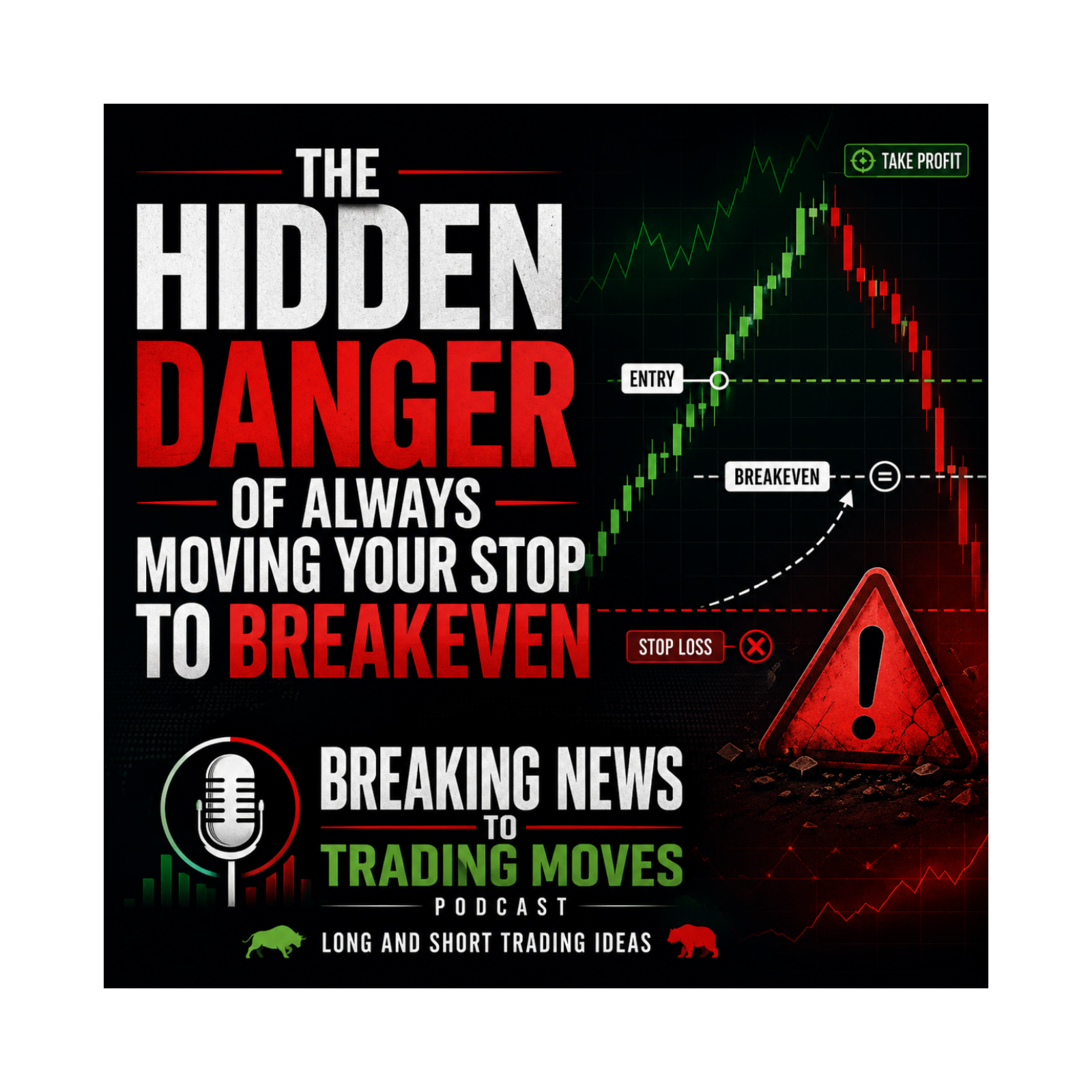
The hidden danger of always moving your stop to breakeven
Jun 1300:21:12Tap to summarizeMoving a stop to breakeven feels responsible. Once a trade moves in your favour, protecting the original capital can seem like the obvious decision. You remove the risk and tell yourself the trade can no longer hurt you. But doing this automatically can quietly damage a profitable strategy.A breakeven stop is not always risk management. Sometimes it is fear disguised as discipline.Why breakeven feels so safeMost traders hate turning a winning trade into a losing one. The moment price moves into profit, the mind treats that unrealised gain as if it already belongs to the account. A normal pullback then feels like money is being taken away.Moving the stop to the entry price provides emotional relief. However, the market does not care where you entered. Your entry price matters to you, but it may have no technical importance.The hidden cost of protecting too earlyMany good trades do not move directly towards the target. They break out, pull back, retest a level or react to short-term volatility before continuing. A stop placed at breakeven can sit inside normal market noise.The pattern is familiar:• The trade moves into profit • The stop is moved to breakeven • Price pulls back and closes the position • The setup remains valid • Price then reaches the target without youRepeating this habit can reduce average profit, lower the realised win rate and weaken the reward-to-risk profile that made the strategy attractive.Breakeven is still an exitTraders often record breakeven trades as harmless because no money was lost. That ignores opportunity cost. You analysed the setup, waited for the entry and accepted initial risk, yet captured nothing from a move that later worked.Spreads, commissions and slippage can also turn a breakeven trade into a small loss. Repeated exits may encourage overtrading because the trader keeps being right about direction but fails to stay in the position.When moving the stop may make senseA breakeven adjustment may be reasonable when:• Price reaches a predefined reward-to-risk level • Major resistance or support has been cleared • New market structure protects the entry • Part of the position has been closed for profit • An event introduces fresh risk • A tested plan includes a clear breakeven ruleThe decision should be based on structure, volatility and tested rules, not discomfort caused by open profit fluctuating.Give the trade room to workA stop should sit where the trade idea is invalidated. If that level has not changed, moving it because price is slightly profitable may make little strategic sense.Alternatives include trailing behind confirmed swing points, reducing position size, taking partial profits or using volatility-based stops.Test the rule, not the feelingReview your trading journal. What happens when the original stop remains untouched? What happens when it moves to breakeven after 0.5R, 1R or a confirmed structural break? Track how often price returns to entry before reaching the target.The answer should come from data. A rule that improves one strategy may damage another. Different setups behave differently.The real lessonGood risk management is not about avoiding every loss. It is about accepting planned losses while giving profitable trades enough space to deliver their expected return.Moving every stop to breakeven can create the illusion of safety while slowly removing your edge. Sometimes discipline means protecting the position. At other times, it means allowing a normal pullback and following the original plan.#StockMarket #Trading #Investing #DayTrading #SwingTrading #RiskManagement #StopLoss #BreakevenStop #TradingPsychology #TraderMindset #PositionSizing #TradingDiscipline
Transcribe →
SpaceX surges past $2 trillion: the winners and losers from the biggest IPO in history
Jun 1300:18:46Tap to summarizeSpaceX has completed a stock market debut unlike anything Wall Street has seen before. The company priced its record $75 billion initial public offering at $135 per share, opened at $150 and finished its first Nasdaq session at $160.95. That was a gain of roughly 19% and gave SpaceX a market value of about $2.1 trillion.More than 510 million shares changed hands, showing the scale of demand from institutions and retail traders. However, this is not a conventional value story. SpaceX remains unprofitable, generated $18.7 billion in revenue and is trading at roughly 112 times revenue. Investors are paying for the future of reusable rockets, Starlink, direct-to-cell communications, government contracts and possible orbital computing.WinnersSpaceX and the Starlink commercial ecosystemSpaceX is the clearest winner. The IPO gives the company enormous financial resources for Starship, Starlink and other capital-intensive projects.Names: $SPCX (SpaceX), $TMUS (T-Mobile US)IPO banks and capital-markets firmsThe record offering validates Wall Street’s ability to execute extremely large technology listings. The banks involved can benefit from underwriting fees, client relationships and a stronger pipeline of future IPOs.Names: $MS (Morgan Stanley), $GS (Goldman Sachs), $BAC (Bank of America), $JPM (JPMorgan Chase), $C (Citigroup)Exchanges and retail trading platformsNasdaq gains prestige, listing revenue and trading activity from hosting one of the world’s largest public companies.Retail-focused brokers may benefit from elevated account engagement and trading volume. Around 20% of the IPO allocation reportedly went to retail investors, making this debut especially relevant for platforms serving individual traders.Names: $NDAQ (Nasdaq), $HOOD (Robinhood), $IBKR (Interactive Brokers)LosersSatellite communications competitorsThese companies face a newly public competitor with vast funding, a large installed satellite network and strong brand recognition. EchoStar fell around 11% on the day of the debut.Investors may now compare every satellite communications company against Starlink’s scale, launch access and ability to fund expansion. AST SpaceMobile and Globalstar may still succeed, but their valuations could face tougher scrutiny.Names: $SATS (EchoStar), $ASTS (AST SpaceMobile), $GSAT (Globalstar)Launch and national-security space competitorsSpaceX’s access to public capital could strengthen its advantage in reusable launch systems, government missions and national-security contracts.Rocket Lab is the closest listed pure-play comparison, while Boeing, Lockheed Martin and Northrop Grumman have exposure to competing launch and space programmes. These companies are diversified, but SpaceX’s scale may increase pricing and innovation pressure.Names: $RKLB (Rocket Lab), $BA (Boeing), $LMT (Lockheed Martin), $NOC (Northrop Grumman)Smaller space stocks competing for investor attentionPlanet Labs dropped around 9% as investors rotated towards SpaceX. Smaller space companies could struggle when one dominant name absorbs sector capital and becomes the default institutional holding.Intuitive Machines and BlackSky operate in different niches, but both may face higher expectations around revenue growth, cash use and profitability.Names: $PL (Planet Labs), $LUNR (Intuitive Machines), $BKSY (BlackSky Technology)#StockMarket #Trading #Investing #DayTrading #SwingTrading #SpaceX #SPCX #SpaceStocks #Starlink #IPO #Nasdaq #SatelliteStocks #Aerospace #DefenseStocks #RocketLab #ASTSpaceMobile #MarketNews #TechStocks #ElonMusk
Transcribe →
Why protecting capital can become an excuse for never taking risk
Jun 1200:16:55Tap to summarizeProtecting capital is one of the most important principles in trading. Every trader hears that survival comes first, losses must be controlled and risk defined before entering a position. That is true. But sensible caution can turn into avoidance, with “protecting capital” becoming an excuse for never putting money to work.In this episode of Breaking News to Trading Moves, we explore the difference between disciplined risk management and fear disguised as discipline. A trader can wait for perfect confirmation, reduce position size repeatedly and reject every setup, yet still believe they are behaving professionally. In reality, they may simply be avoiding uncertainty.The market never offers certaintyNo setup is guaranteed. Even your strongest pattern can fail, a good entry can move against you and a weak-looking trade can become a winner. If you demand complete confidence before taking risk, you will remain on the sidelines because certainty does not exist in trading.Professional trading is about accepting uncertainty while limiting the damage when you are wrong. You need a reason to enter, a defined exit and a position size that allows you to think rationally.When caution becomes avoidanceCapital protection may have become an excuse when you:• Keep reducing your size until the possible reward feels meaningless. • Wait for extra confirmation after your signal has appeared. • Reject valid trades because the previous trade lost. • Spend more time refining rules than testing them live. • Feel relieved when a setup disappears because you no longer have to decide.Risk is the cost of participationTrading requires capital to be exposed before it can produce a return. Your risk is not a mistake simply because a trade loses. A properly sized loss taken according to a tested plan is part of the strategy’s cost.The real danger is unmanaged risk, oversizing, breaking your rules or trying to recover losses emotionally. Avoiding every trade protects your account from short-term losses, but it also guarantees that your strategy cannot produce returns.A useful question to askBefore skipping a valid setup, ask yourself:“Am I avoiding this trade because it violates my rules, or because I do not want to experience another loss?”That question separates process from emotion. If the setup does not meet your criteria, avoiding it is discipline. If it meets your criteria and you still cannot act, the problem may be fear.How to rebuild trust in taking riskStart with a position size small enough to follow your plan without panic, but large enough for the outcome to matter. Judge yourself on execution rather than one result. Review a series of trades, not a single winner or loser.Create a minimum participation rule. If a setup meets every condition in your plan, take it at a predetermined reduced size. This prevents fear from rewriting your strategy in real time.The goal is controlled exposureGood risk management should help you participate consistently, not keep you permanently safe on the sidelines. Your capital should be protected from reckless decisions, but also deployed when your edge appears.Strong traders are not fearless. They understand that uncertainty, drawdowns and losing trades are unavoidable. Their advantage comes from taking calculated risk repeatedly.Protecting capital matters. But when protection becomes the main objective, growth becomes impossible. The challenge is to take enough intelligent risk for your edge to have a chance to work.#StockMarket #Trading #Investing #DayTrading #SwingTrading #RiskManagement #TradingPsychology #CapitalProtection #TraderMindset #TradingDiscipline #PositionSizing
Transcribe →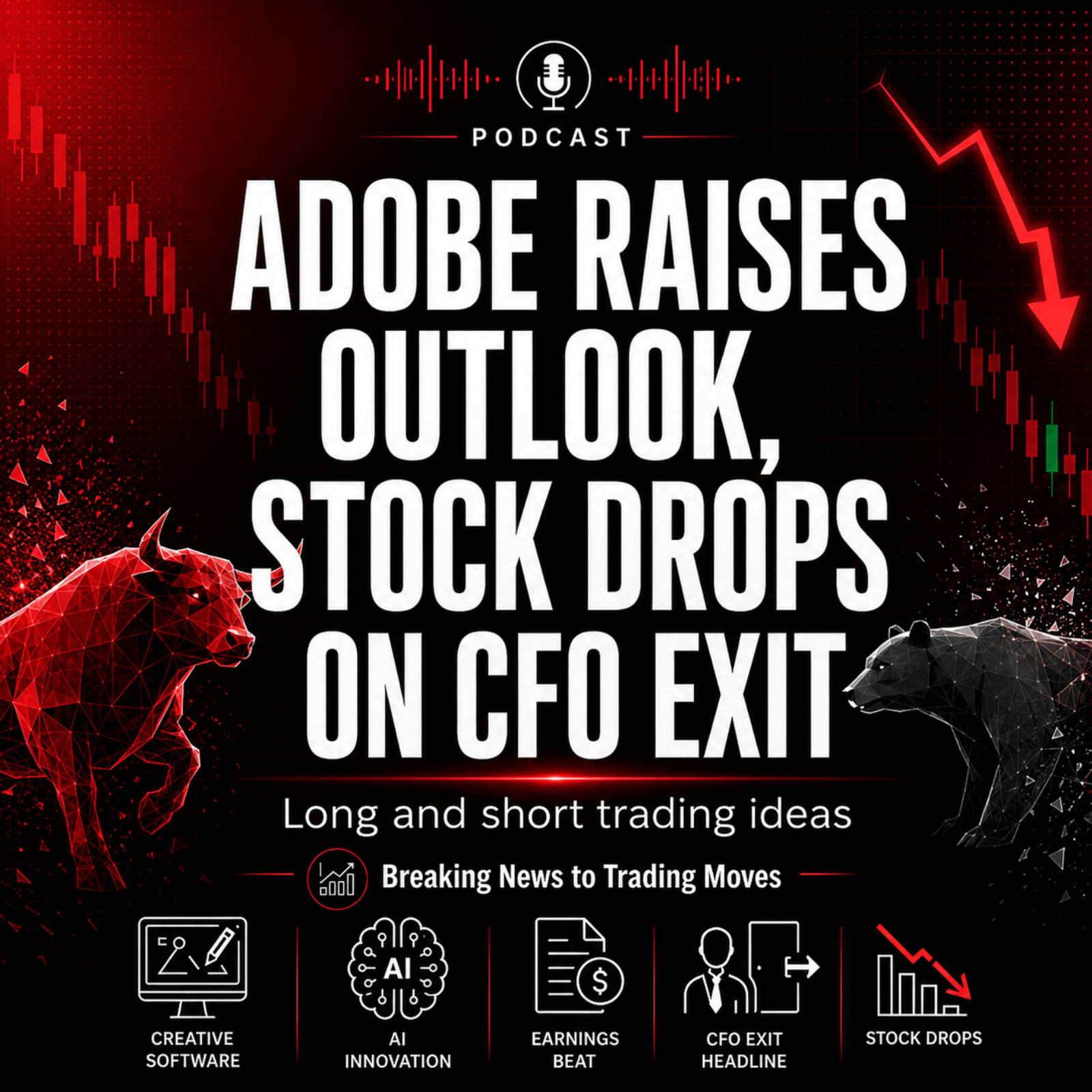
Adobe raises outlook, but CFO exit deepens AI strategy concerns
Jun 1200:18:41Tap to summarizeAdobe delivered stronger numbers, but investors focused on a growing leadership problem. The company raised its fiscal 2026 revenue forecast to between $26.5 billion and $26.6 billion and increased its adjusted earnings guidance to between $24.35 and $24.45 per share.Despite that progress, $ADBE fell about 5% in extended trading after CFO Dan Durn announced his departure. Durn is moving to Marvell Technology, while Steve Day will become Adobe’s interim CFO from June 15. WinnersAI-native design and productivity challengersAdobe’s leadership uncertainty may create an opening for companies offering simpler, collaborative or heavily integrated AI tools. Figma is the clearest direct beneficiary because it competes for professional designers and product teams.Microsoft and Alphabet can place AI-assisted image, presentation and content tools inside productivity platforms that businesses already use.Names: $FIG (Figma), $MSFT (Microsoft), $GOOGL (Alphabet)AI infrastructure and custom-chip companiesMarvell is the most direct winner because it is hiring Dan Durn as CFO while expanding its position in custom AI silicon and data-center infrastructure.The wider read-through is that Adobe’s rapidly growing AI revenue confirms that software companies are still investing heavily in generative AI products.Names: $MRVL (Marvell Technology), $AVGO (Broadcom), $NVDA (Nvidia)Digital advertising platformsAI tools are reducing the cost and time required to create multiple versions of advertisements, images and videos. That can encourage brands to test more campaigns and personalize content for different audiences.Meta, The Trade Desk and Pinterest could benefit if lower creative-production costs lead to greater advertising volume.Names: $META (Meta Platforms), $TTD (The Trade Desk), $PINS (Pinterest)LosersAdobe and traditional design-software companiesAdobe is the direct loser because raising its outlook was not enough to offset concerns about the departure of two senior executives.The reaction may also weigh on other highly valued subscription-based design software companies. Names: $ADBE (Adobe), $ADSK (Autodesk), $PTC (PTC)High-valuation application softwareAdobe’s decline shows that beating expectations and raising guidance may not protect a software stock when investors are worried about strategy, succession or AI disruption.Salesforce, ServiceNow and Intuit are not direct Adobe competitors, but all must prove that AI investment will create durable revenue rather than simply increase development costs. Names: $CRM (Salesforce), $NOW (ServiceNow), $INTU (Intuit)Standalone website and marketing softwareThe more capable AI becomes at producing websites, images, copy and campaign materials inside large platforms, the harder it may be for standalone providers to defend premium pricing.Wix, GoDaddy and HubSpot are developing their own AI tools, but they face the risk that creative and marketing functions become bundled into broader ecosystems from Adobe, Microsoft, Alphabet and Meta.Names: $WIX (Wix.com), $GDDY (GoDaddy), $HUBS (HubSpot)What traders should watchThe first signal is whether $ADBE can recover from the initial sell-off. A rebound would suggest investors are focusing on the higher forecast and AI revenue growth. Continued weakness would imply that leadership uncertainty and competitive pressure matter more than the quarterly numbers.#StockMarket #Trading #Investing #DayTrading #SwingTrading #Adobe #ADBE #ArtificialIntelligence #AIStocks #SoftwareStocks #TechStocks #Figma #Marvell #Semiconductors #Earnings #StockNews #MarketAnalysis #TradingIdeas
Transcribe →
Position sizing matters more than entries, but nobody wants to hear it
Jun 1100:18:49Tap to summarizeMost traders love talking about entries. They want the perfect breakout, the clean pullback, the best indicator setting or the exact moment to press buy or sell. But the uncomfortable truth is this: your entry is not what protects your account. Your position size does.In this episode of Breaking News to Trading Moves, we look at why position sizing is one of the most ignored parts of trading, even though it often decides whether a trader survives long enough to improve. You can have a decent setup and still lose money if the size is wrong. You can also have an imperfect entry and stay in control if your size is sensible.Why entries get too much attentionEntries feel exciting because they make trading look precise. They give you something to focus on, backtest and talk about. But an entry only tells you where the trade starts. It does not tell you how much damage the trade can do if it goes against you.A trader can be right on direction and still lose if the position is too large, the stop is too tight or the risk is emotionally uncomfortable.The real job of position sizingPosition sizing is not just about protecting capital. It is about protecting decision-making. When the trade size is too big, every tick feels personal. You stop reading price action clearly. You move stops, cut winners too early, add to losers or revenge trade after a normal loss.Good position sizing gives you room to think. It allows you to follow your plan without turning every trade into a test of your ego.Why small accounts struggle with thisTraders with smaller accounts often feel pressure to size up because the profit from proper risk feels too small. A 1% gain might not feel exciting. A sensible trade might not feel worth the effort. That is where the danger begins.When a trader starts sizing based on what they want to make instead of what they can afford to lose, the account becomes fragile. One bad trade can erase days or weeks of progress. Worse, the emotional damage can lead to rushed decisions after the first mistake.What traders should focus on insteadInstead of asking, “Where is the perfect entry?”, ask better questions:How much can I lose if this trade fails? Is this position size small enough for me to follow my plan? Will I still think clearly if price moves against me? Does this trade fit my account size, or am I forcing it? Am I sizing based on risk, or based on hope?These questions are not as exciting as chasing entries, but they are far more useful. They shift your focus from prediction to control.The hidden benefit of sizing correctlyCorrect position sizing makes losses easier to accept. That does not mean losses feel good, but they become part of the process rather than a personal attack. When the loss is planned and affordable, you can review it objectively.This is where progress starts. You can study whether the setup was poor, whether the market changed, whether your stop placement made sense or whether you followed your rules. But if the size was too large, the lesson often gets buried under frustration.Trading is not about looking smartMany traders want to be known for great entries. They want to catch the bottom, short the top or post the perfect chart. But long-term trading is not about looking smart. It is about staying solvent, consistent and emotionally stable.Main takeawayYour entry decides where the trade begins. Your position size decides how much the trade can hurt you. If you get the size wrong, even a good setup can become dangerous. If you get the size right, you give yourself the chance to stay calm, protect your capital and improve.#StockMarket #Trading #Investing #DayTrading #SwingTrading #TradingPsychology #RiskManagement #PositionSizing #TraderMindset #TradingDiscipline #RetailTrading
Transcribe →
The AI Capital Paradox: Financing Growth and Market Ripples
Jun 1100:14:19Tap to summarizeThis story matters because it gives the market 2 very different signals at the same time. On one hand, Supermicro is saying AI demand is real and large, with roughly $39 billion in recent AI server orders. On the other hand, the company needs a major financing package to buy components and fulfil that demand, which raises concerns about dilution, margin pressure and whether the AI buildout is becoming too capital intensive.WinnersAI chip suppliersIf Supermicro is seeing a fresh wave of AI server orders, that is a positive read-through for the companies supplying the compute inside those systems. NVIDIA is the clearest winner because AI server demand usually means more GPU demand. AMD can also benefit as customers look for alternative AI accelerators and broader supply options. This group wins if Supermicro’s order book reflects real industry demand and not just short-term enthusiasm.Names: $NVDA (NVIDIA), $AMD (Advanced Micro Devices)Data centre power and cooling infrastructureMore AI servers do not just mean more chips. They also mean more power distribution, cooling, electrical equipment and infrastructure inside data centres. Vertiv and Eaton are both tied to the physical buildout that supports AI deployments. If Supermicro and similar vendors are preparing for a much larger delivery cycle, these infrastructure players can benefit as customers expand or upgrade data centre capacity.Names: $VRT (Vertiv), $ETN (Eaton)Memory and connectivity suppliersAI servers need high-performance memory and fast connectivity. Micron benefits from rising demand for memory used in AI systems, while Broadcom benefits from networking and connectivity exposure tied to large-scale AI clusters. If Supermicro is aggressively sourcing components to fulfil orders, the demand should flow through to companies that help power the full AI server stack.Names: $MU (Micron), $AVGO (Broadcom)LosersAI server makers facing pricing pressure and financing scrutinySupermicro is the direct loser in the short term because a large equity and equity-linked financing package can dilute shareholders. But the read-through may also pressure Dell and HPE if investors start to believe the AI server market will become more competitive, lower margin and more working-capital heavy. If the market shifts from excitement about demand to worry about who can monetise that demand efficiently, this group can come under pressure.Names: $SMCI (Super Micro Computer), $DELL (Dell Technologies), $HPE (Hewlett Packard Enterprise)Traditional enterprise hardware and storage namesA stronger AI infrastructure cycle can pull spending away from more traditional enterprise IT budgets. If companies and cloud customers keep prioritising AI compute and accelerated infrastructure, storage and legacy hardware spending may face tougher competition for capital. That does not mean these names are broken businesses, but it can make them relative losers if AI capex keeps crowding out other categories.Names: $NTAP (NetApp), $PSTG (Pure Storage)High-multiple AI infrastructure names vulnerable to sentiment resetsThis news is a reminder that AI growth is expensive. When investors see big fundraising, heavy capex and dilution risk, they sometimes start questioning the valuation of other AI-linked hardware names. Arista and Marvell still have strong AI exposure, but in a market pullback they can trade lower simply because sentiment shifts from growth excitement to discipline, returns and balance sheet quality.Names: $ANET (Arista Networks), $MRVL (Marvell Technology)#StockMarket #Trading #Investing #DayTrading #SwingTrading #AIStocks #Supermicro #SMCI #NVIDIA #AMD #DataCenter #Semiconductors #TechStocks #WallStreet #StockMarketNews
Transcribe →
Why your need to be “right” in stock trading is more expensive than your losses.
Jun 800:20:25Tap to summarizeIn trading, the most expensive mistake is not always the losing trade. Sometimes it is the need to prove that your original idea was right. This episode looks at why ego, loss aversion, regret and revenge trading can cost traders more than the loss itself.Why being right gets expensiveEvery trader wants confidence, but confidence becomes dangerous when it becomes attachment. Once you see a trade as a test of your intelligence, discipline or identity, the loss is no longer just financial. It feels personal.You move your stop loss because you do not want to admit the trade failed. You hold a loser because closing it would make the loss feel real. You size up because you want the money back quickly. You ignore your own rules because the market has triggered your ego.The psychology behind lossesThis episode explores the psychological traps behind costly losses:Loss aversionThe pain of losing money usually feels stronger than the pleasure of making the same amount. That is why traders cut winners early and hold losers too long.Mental accountingA paper loss can feel easier to tolerate than a realised loss. But the money is still gone if the position is down. Refusing to close it delays reality.Get-even thinkingMany traders do not want a great setup. They just want their money back. That mindset can push them into poor trades and oversized positions.Revenge tradingAfter a stop loss, frustration can take over. The trader stops thinking in probabilities and starts trying to erase pain. One controlled loss can become several uncontrolled losses.Ego attachmentWhen being wrong feels like failure, traders protect opinions instead of capital.Why rules matterThe episode also looks at strict trading systems. Pre-trade checklists, fixed risk limits, stop losses, cooldowns and daily loss limits can reduce emotional decisions.A good system gives the trader structure before emotions take over. It can force a pause, limit risk and stop one bad decision becoming account damage.But rules only work if the trader does not override them. The strongest approach combines discipline and psychological awareness.The key lesson for tradersA losing trade does not make you a bad trader. Ignoring your plan after the loss causes the real damage.The best traders do not need to win every argument with the market. They know each trade is one event in a long series of probabilities. Their goal is not to be right every time. Their goal is to keep making good decisions.If your stop loss hits, that is not humiliation. That is risk management doing its job.What this episode coversWhy traders hold losing positions too longWhy the need to be right damages risk controlHow ego turns small losses into bigger lossesWhy revenge trading is pain avoidance, not strategyHow stop losses and cooldowns protect capitalWhy discipline matters as much as technical analysisHow to separate self-worth from trade outcomesWhy process matters more than predictionFinal thoughtThe market is not interested in your opinion, your confidence or how badly you want a trade to work. It responds to supply, demand, liquidity, momentum and risk.Your job is not to prove yourself right. Your job is to protect your capital, follow your rules and survive long enough for your edge to play out.#StockMarket #Trading #Investing #DayTrading #SwingTrading #TradingPsychology #RiskManagement #TraderMindset #TradingDiscipline #RetailTrading #RevengeTrading #LossAversion #EgoTrading
Transcribe →
The Siri Evolution: Apple’s Shift to Edge AI Dominance
Jun 800:17:51Tap to summarizeToday’s main story is Apple, and the question is simple: can Siri finally become a serious AI product?Apple is heading into its developer conference with investors and developers watching for a long-awaited Siri overhaul. The market is not only looking for a smarter voice assistant. It is looking for proof that Apple can turn its massive device base, private user data, app ecosystem and custom chips into a real AI advantage.This matters because Apple is not trying to win AI in the same way as Nvidia, Microsoft or Google. Apple’s edge is distribution. Siri already sits across iPhones, iPads, Macs, Watches and other devices. If Apple can make Siri useful with chat features, personal context and deeper app integration, it could shift the AI trade from cloud models alone to AI built directly into consumer devices.WinnersApple ecosystem and iPhone upgrade cycleApple is the direct name in focus. If Siri becomes more useful, the market may start giving Apple more credit as an AI platform rather than just a hardware company. A better Siri could help iPhone retention, services usage and future upgrade cycles, especially if the best features require newer chips or newer devices.Names: $AAPL (Apple), $QCOM (Qualcomm), $AVGO (Broadcom)AI model and cloud distribution partnersApple may not need to build the most powerful model by itself. The Reuters article mentions the possibility that developers could choose from models such as OpenAI, Anthropic and Google Gemini inside their apps. That matters because Apple could become a distribution layer for outside AI models.Names: $GOOGL (Alphabet), $MSFT (Microsoft), $AMZN (Amazon)Edge AI chips, memory and device processingMost AI trading has focused on data centres, but Apple’s Siri story also supports the idea of edge AI, where more intelligence happens on the device. That still requires better chips, faster memory and more efficient processing.Names: $NVDA (Nvidia), $AMD (Advanced Micro Devices), $MU (Micron)LosersSearch and app discovery platforms under pressureThis is where the story gets more complicated. Alphabet can be a winner if Gemini gains distribution, but it can also face pressure if Siri becomes a stronger front door for search-like queries. If users ask Siri for answers, recommendations, bookings and summaries, some traffic may shift away from traditional search.Names: $GOOGL (Alphabet), $META (Meta Platforms), $RDDT (Reddit)Standalone productivity and task appsIf Siri becomes more deeply integrated with apps and personal context, some standalone productivity tools may face more pressure. Apple’s advantage is that it can build helpful features directly into the operating system.Names: $DOCU (DocuSign), $BOX (Box), $DBX (Dropbox), $ZM (Zoom)Android and Windows ecosystem sentiment if Apple catches upGoogle and Microsoft have been seen as stronger AI leaders than Apple over the last two years. But if Apple delivers a practical Siri upgrade, the market may reassess that gap.Names: $GOOGL (Alphabet), $MSFT (Microsoft), $HPQ (HP), $DELL (Dell Technologies)#StockMarket #Trading #Investing #DayTrading #SwingTrading #Apple #AAPL #AIStocks #ArtificialIntelligence #Siri #WWDC #BigTech #TechStocks #Semiconductors #NVDA #MSFT #GOOGL #AMZN #OptionsTrading #MarketNews
Transcribe →
Revenge stock trading is not always anger, sometimes it is ego protection
Jun 600:17:22Tap to summarizeIn this episode of Breaking News to Trading Moves, we look at a dangerous trading behaviour that many investors do not recognise until the damage is already done. Revenge trading is usually described as anger after a loss, but the deeper problem is often ego protection. The trader is not only trying to win back money. They are trying to win back the feeling that they were right.That is where the real risk begins. A bad trade creates more than a financial loss. It creates a psychological conflict. You believed a stock, ETF, fund or setup would work. The market then gives you a different answer. Instead of accepting the new information, the mind starts defending the old story. It searches for reasons to hold, add, blame the market, blame a fund manager or blame manipulation. The trade becomes personal.Why losses feel so hard to acceptWhen a position moves against you, the numbers are clear, but the ego is not. Selling a losing position can feel like admitting failure. That is why many traders hold losers for too long and sell winners too quickly. The winner gives instant validation. The loser threatens the identity of being smart, disciplined and in control.This episode explores cognitive dissonance, motivated reasoning and the disposition effect, showing how traders protect their self-image even when it hurts performance. The danger is not just taking a loss. The danger is refusing to learn from it.Key points covered in this episode• Why revenge trading is often about protecting pride, not just reacting emotionally• How traders turn losing positions into proof of identity instead of risk decisions• Why the brain looks for excuses when the market contradicts your original thesis• How holding losers and selling winners can become an ego-driven habit• Why delegating money to professional managers does not remove psychological bias• How fund manager overconfidence, high turnover and transaction costs can damage returns• Why blaming someone else can feel satisfying but still prevent real learningThe role of blame in tradingOne of the most interesting ideas in this episode is that delegation does not always solve the emotional problem. When investors hand money to a fund manager, they may believe they are removing their own bias from the process. But if the fund performs badly, the investor can simply fire the manager and feel clean again. That may look rational, but it can also be a way to protect the ego.Instead of saying, I made a poor allocation decision, the investor says, the manager failed me. That emotional release can feel like control, but it does not guarantee better decision-making. It may move the blame somewhere else.What traders should take from thisThe market does not care about your original thesis, your confidence or your need to feel right. It only gives feedback. The challenge is whether you can receive that feedback without turning it into a personal attack.Strong traders are not people who never feel frustration. They build systems that stop frustration from becoming execution. They use rules, position sizing, journaling, stop-loss planning and review processes to separate decisions from ego protection.Your biggest trading risk may not be volatility, news, earnings, algorithms or even the fund manager you hire. The biggest risk may be the emotional story you tell yourself after the market proves you wrong.#StockMarket #Trading #Investing #DayTrading #SwingTrading #TradingPsychology #RevengeTrading #RiskManagement #TraderMindset #TradingDiscipline #MarketPsychology #BehavioralFinance
Transcribe →