← Broad History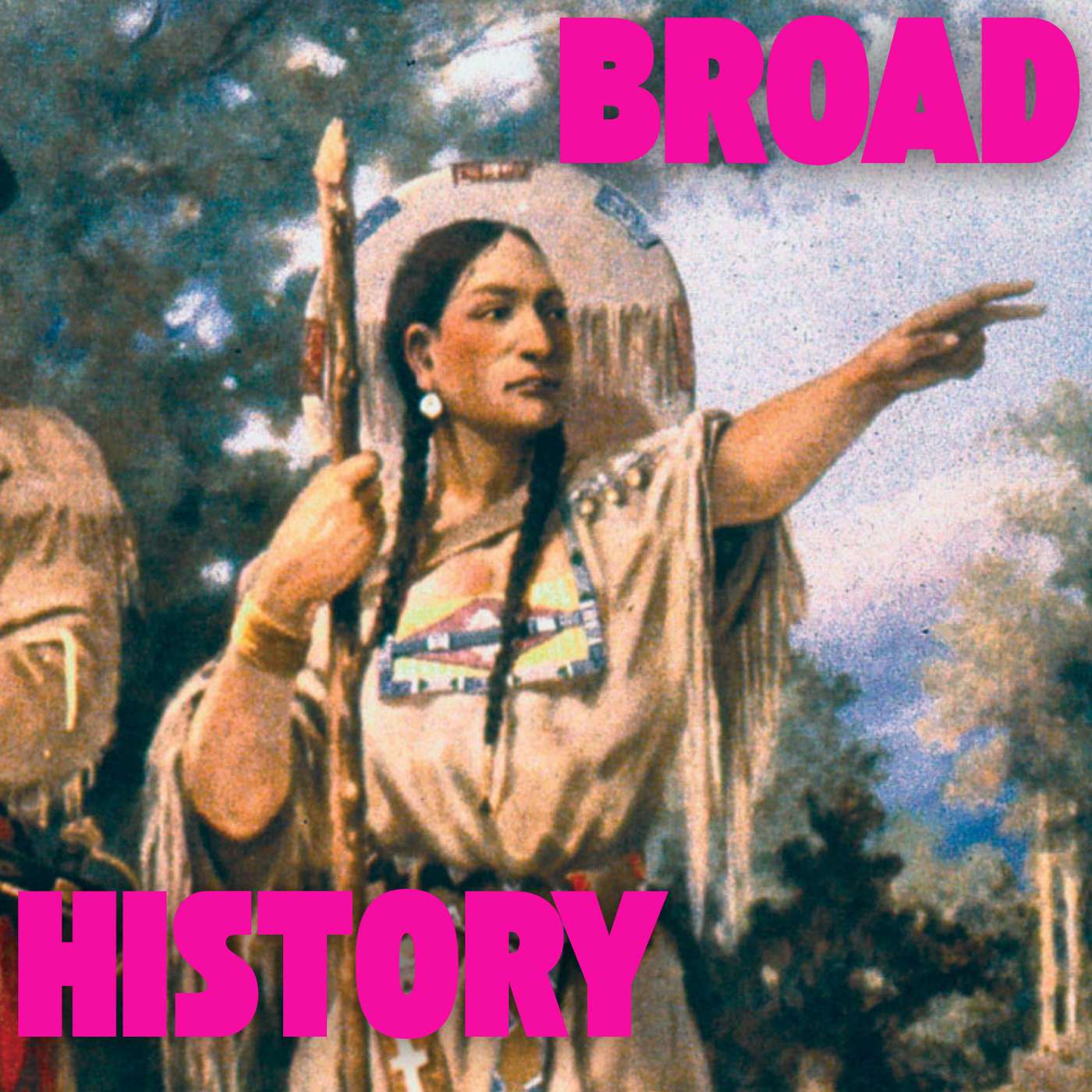
Loading summary
Transcript96 lines
- [00:01]
A
Hello and welcome to Broad History, a podcast about the history you think you know with women in it. This time I'm your host, Isabelle Rogol. When you think about the American west, what images come to mind? Probably a cowboy, maybe a family in a covered wagon moving west. Maybe a railroad baron, or a Native American man on a horse. A little girl in braids running down a hill covered in wildflowers. The imaginary of the American west is so powerful and my guest today is here to tell a different story. Megan Kate Nelson is a historian of the American west and the US Civil War.
- [00:37]
B
She taught at many prestigious universities, has
- [00:40]
A
written wonderful books, was a finalist for the Pulitzer Prize, and her latest work, the Westerners, looks at myth making and belonging in the American west through the lives of seven people who did not at all fit the mold of who you might think of when you think of an American pioneer. Of course, you know how the show works by now.
- [01:00]
B
In our case that means looking at the life of full, complex, messy, interesting, fascinating women. Our conversation was so fascinating I could not end it and actually went on much longer than a typical episode. So I decided to break it up into two parts. Conveniently for our purposes, if not for the American people. The Civil War is kind of a natural historical break between the two parts of the American 19th century.
- [01:25]
A
So today we will look at the
- [01:27]
B
first half, 2/3 pre civil War.
- [01:30]
A
On the next episode we will look
- [01:32]
B
at post Civil War Reconstruction.
- [01:34]
A
And those are two quite different American Wests. If you are a member of Broad History, you can binge both episodes right away in your members feed. If you are not a member of Broad History, well this is your cue. Join today@broadhistory.com membership and you will get immediate access to both parts of the episode. And you will also, on an ongoing basis, get early and ad free access to every episode of the podcast. Podcast including multi part series which I will start releasing this summer, as well as more benefits as we grow and I'm able to provide more. And more importantly, you will get that fuzzy warm feeling inside that you are supporting independent publishing and podcasting. I cannot do it without you and I am so grateful to the members who have already joined this week. In particular, thank you and welcome to louise. Go to broadhistory.com membership to sign up right now and then you can feast on Megan Kate Nelson's wonderful stories of the American West. Here she is.
- [02:34]
B
Megan Kate Nelson, welcome. Thank you so much for joining me.
- [02:38]
C
Thank you so much for inviting me to be on.
- [02:40]
B
I'm very excited to have this Conversation, because I'm actually. I love the American West. I mean, American history in general, a bit of a soft spot for me. Before we spend the next hour debunking the myth, we should probably define it first, especially for a lot of listeners who are not American. What is the frontier? What does that mean?
- [03:00]
C
Okay, yes. So the frontier is generally kind of accepted to mean in this context of American history, this sort of place where civilization is kind of pushing up against wilderness, wild animals, wild people, and there's a real struggle there to survive and to persevere. And in some accounts, including the very famous 1893 Frontier Thesis, which was proposed by a historian at the University of Wisconsin, the frontier is a bit of a moving target in the United States. So the frontier, early in, you know, U.S. history is the Appalachians, and then it moves progressively west as Americans move progressively west. And they keep pushing the frontier and pushing it and pushing it until they get to the Pacific. And this is a process that Frederick Jackson Turner, this historian, identified as a fundamentally American process, that this is how American institutions came to be. This is the heart of America. We did not get all of our institutions and our kind of democratic mode from Europe, but instead got it in this experience of Americans fighting both nature and then indigenous peoples ultimately succeeding and establishing themselves along this frontier line. So that's one of the major elements of it. And then the whole idea of the frontier will probably be familiar to your listeners, even if they're not familiar so much with the United States, just because the images are so resonant and so sticky. The frontier image usually involves a white frontier family that has come from the east in a covered wagon. They're moving progressively westward, establishing themselves and settling in the west, persevering, overcoming all the challenges in their path, and creating basically Western culture and American culture. So it brings together all of these major ideas in American history, major narratives, Manifest destiny, the American Dream, rugged individualism. It's extremely important to this notion of the frontier that the white Americans there do it all by themselves. They have no help from anyone. This is embodied in the American cowboy who enters the kind of frontier myth a little bit later in the 19th century and becomes this major icon. So those. Yeah, those are the fundamentals. And I think we see them everywhere in all kinds of imagery and advertising and film and tv, all kinds of different elements of American then. And then also global culture.
- [05:57]
B
Yeah, I mean, it's an incredibly powerful image.
- [06:00]
C
Right.
- [06:00]
B
I was a little girl growing up in France, and I devoured every single volume of, I think there's eight of Little House in the Prairie that I
- [06:08]
C
borrowed from my local library.
- [06:10]
B
It's just the. The imaginary of the American west is just so powerful to everyone around the
- [06:17]
C
world that I think, absolutely, yes. And, you know, I too, went through my Little House phase. I have some delightful class photos of me with my braids. I have my braids and my prairie dress, of course, because, you know, that story hooked young girls because it did have a young girl as a protagonist. And that kind of drew you into this space. But still, all of the frontier imagery was there and promoted. And this vision of white American culture moving progressively western in a kind of conquest of space and people is enduring.
- [06:57]
B
Yeah, and you. You dropped a phrase there that we should probably explain as well. Manifest Destiny. What does that mean?
- [07:05]
C
This is the conviction that many white Americans had that it was the United States destiny to overtake the continent, to take up all of those lands and make them productive and sett all of these growing numbers of people on them. And officially, that term came into being in 1845 in an edit a newspaper editorial. But the idea had been in place even at the founding of the country. Thomas Jefferson was a huge proponent of Manifest Destiny. This is part of the reason that he was eager to acquire first New Orleans and then all of Louisiana territory, because he also believed the US population was growing by leaps and bounds. And he and most Americans were convinced that population needed to spread out. And given that they were all established on the Atlantic coast, the only way to spread was westward. So they would make it over that first mountain chain of the Appalachians, and then they would move into the Ohio Valley and then the Mississippi river and then further on into the west. And that this was ordained by God.
- [08:16]
B
And very much that east to west travel right single direction, right of the picture to left of the picture, even in the paintings that you see of the time. Right. Sticking to that east to west vision, which also presupposes or requires that all of that land to the west is virgin territory, is free of people and of anyone that matters or anyone at all.
- [08:41]
C
Right, exactly. And if they do exist, then the conviction was that it would be quite easy to get rid of them, that either they would just take up indigenous lands by force, or that indigenous peoples would just kind of naturally vanish from the landscape and keep moving westward in front of that compelling, insistent, propulsive movement of white Americans in that one linear direction.
- [09:12]
B
And so, contrary to that mental image that Americans in the east at the time, you depict a West that looks quite different from that imagination that's what we're gonna be looking at. And we're gonna travel sort of the wide 19th century in America, Right? And so what does the west look like at the start of the 19th century? We're about a generation after the American Revolution.
- [09:40]
C
This is what's interesting. It makes it a little tricky to write about because the American west was not really the American west in this moment. It was indigenous territory. It was northern Spain. In some places, it was still French or Spanish, and it did not belong to the United States at all. And to say the American west, of course, suggests that there is an east, that this space is west of an American kind of central polity. And so early in the late 18th century, early 19th century, the west did not yet exist as we know it today. But its components existed, its fascinating elements, especially what I'm most fascinated by, and one of the major arguments in the book is that there's constant movement throughout the American west in all different directions. And people are moving from north to south, from west to east, from south to north, in addition to from east to west. And they had been doing so for hundreds, if not thousands of years. And there were already trails and roads that were connecting people together. People had very far flung networks of trade, of kinship, and of warfare. Also, that this was a space that had its own history. This was a kind of vast, indigenous. And then a little bit later in the 17th century, a kind of Spanish world. And so Americans were really late arrivals. They didn't really enter the scene until the early years of the 19th century. And the American west, as a whole concept, in and of itself as we think of it today, did not exist until the mid 19th century, but it still retained that kind of dynamism and that movement. And people did not settle in the way that we think of them settling during this period. In fact, the entire region was unsettled, really, until the late 19th century, for a number of reasons.
- [11:55]
B
And two men who are very famous in American history for opening up that space to the United States. Again, not discovering it, it was plenty discovered by other people, but opening it up to United States, the government and the culture of the United States were Lewis and Clark.
- [12:12]
C
Right?
- [12:13]
B
And they were guided, helmed, directed almost by a woman who knew very much what she was doing and very much knew the land. Sacagawea, I'm hoping to pronounce correctly. And her life starts. It's like a superhero origin story, the way that her life begins. Can you talk us through that a bit?
- [12:32]
C
Yes, absolutely. I wanted to start the book with an Indigenous voice and a woman's voice, because this rarely happens in large, sweeping popular histories of the American West. Women are almost always just erased or marginalized or not even present in a lot of those accounts. And so I felt really strongly I wanted to do that. And Sacagawea was, you know, instantly came to mind as someone to start this book. And it was a little intimidating to write about her because she is so mythologized. She's probably the most famous person in the book and the one person people may know when they start to read it. And it was really interesting because when I went into the research, I didn't know much more about her than that mythic history either, that I had learned in school way back in the day, that her life is most important when she meets Lewis and Clark and she goes with them on this journey to the Pacific and back from the Missouri River. But she had a whole life before that, and she had a whole life after that. She's born in the northern Rocky Mountains to what is now known as the Lemhi Shoshone Band, which is a northern Shoshone band. And pretty early on in her life, she is stolen from her people in a raid by the Hidatsa, who are a tribal nation who live along the upper Missouri River Valley. So she had been living with her family. They had traveled around. The Shoshone were a mobile band. So her first movement through the west was eastward. So she is a. She's a war captive. And this was very common. The Indigenous world was full of warfare and raiding, and the captive trade was part of that whole process and that whole tradition. So she moves eastward first and lives with her captors initially, and then is married off to a French trader named Toussaint Charbonneau when she's still a teenager. And it's important to think about her as a woman in an Indigenous world who's having experiences that many women had. She's an exceptional person, and we think of her as exceptional. But she also was in many ways a kind of ordinary woman living in this particular life. She learned to farm. She learned to process buffalo hides. She learned all of these skills from other women in the Knife river villages in the upper Missouri Valley. And by the time Lewis and Clark got there, she was a married woman, she was pregnant, and she was, if not fully integrated into Hidatsa society. She had learned the language, and she had established connection there on her own. But what Lewis and Clark really wanted her for is that she still had command of the Shoshone language. And Lewis and Clark didn't know very much about what they were going to encounter on this journey, but they did know that at some point they were going to have to stop traveling by boat and start traveling on horseback. And they knew that the Shoshone were big horse traders in the Northern Rockies. This was a very important logistical element of the core of discovery. And this is why initially, she was valuable. Although I. Upon reading the Lewis and Clark diaries, it's really remarkable. They talk about her more than 150 times. They call her by a number of names and sometimes just describe her as a wife or give her new names entirely. But when they describe her, she is always doing something or saying something. And this is what we don't get from traditional accounts. She is even more than a translator. She is a guide. She's a topographer. She helps them to map this whole area of the west, from the upper Missouri Valley to the Pacific. And she is a botanist. She is constantly pulling roots and plants from the soil, not only to eat, but also to show Lewis and Clark. She understands that they are on a botanical exploration as well. And she contributes several specimens to the Lewis and Clark Expeditions collections. She saves their lives multiple times, I think, because. I think she saves them from scurvy, for sure, because of her knowledge of the landscape. She successfully translates and helps to negotiate with the Shoshone with her people when they get there. And then ultimately, I really do think she becomes an explorer in her own right. There's a remarkable moment in the Pacific where they left her behind.
- [17:21]
B
Yeah, I love that scene. I was gonna bring it up.
- [17:24]
C
Please share it. I know. Oh, it's so good. She, you know, they know they're gonna have to stay in this area over the winter. And so they leave her behind in camp, which is a couple miles away from the ocean. And they go to the ocean. Louis and Clark and Toussaint Charbonneau and a couple other members of the corps. And they come back with stories of the Pacific Ocean and the beach. And there had been a huge whale that had been beached, and the local indigenous band was breaking it up. They were taking it apart and using the blubber and the bones. And everyone writes about this in their journals. She goes to Clark and she says, you're gonna take me to the Pacific because I did not come all this way not to see it. I want to see the ocean, and I want to see the big fish, you know, that they had been talking about. Because, I mean, it's hard for us. I Think to access this today because, you know, we know what a whale looks like, even if we've never seen a live whale. But they did not. They had no idea what this looked like. This seemed just unbelievably remarkable. And then to also see the ocean for the first time. So she demands this for herself, and Clark agrees, and he takes her. And I just. I love this moment because I think it's really where you see her taking something for herself and valuing this experience for herself in a way that we never see her. We never see her that way. In other accounts, she's usually just helping Lewis and Clark and pointing the way. Being a mother to Jean Baptiste, who she had given birth to just a couple months before they left, I feel
- [19:15]
B
like we have to say she takes on this entire journey as a postpartum teenage mom breastfeeding an infant the entire time. That is pretty impressive as well.
- [19:24]
C
Yes. And they both are. They both become very ill also at separate times during the expedition. And of course, Lewis and Clark have all these outmoded notions of medicine. It's remarkable they didn't kill her, actually, you know, they were trying to bleed her. They were probably giving her something like mercury. I mean, it was just, you know, just terrible. And she. She managed to survive. And what I think is really interesting about that, every single visual depiction that we have of Sacagawea and we. No one sketched her or made any kind of visual representation of her during her lifetime. So we only have guesses as to what she actually looked like. But all of the images we have of her now depict her with Jean Baptiste, with him on her back and either walking or on horseback. And I think today we think of that as just incredibly remarkable. And I think it is, given the distance that she traveled. But also, indigenous women carried their kids around all the time, and they were in constant movement. They were always moving between camps for hundreds of miles according to the seasons and what they were going to hunt. And so in many ways, I think it would have struck Sacagawea as totally bizarre not to do that. Right. And she would not have left him behind. That would not have entered her mind. She would not have abandoned him.
- [20:48]
B
Yeah. And in fact, at one point after the expedition, Clark, who's taken a liking to the kid, suggests adopting him, essentially, and taking him to school. And she's like, mm, mm, that's my kid. She does later on leave him to go to school in this is a few years later and live with the Clark family. And I'm gonna fast Forward a bit here. But unfortunately, she dies quite young. She dies around 25, I think. And Clark has her boy, and she has just given birth to a daughter who also ends up living with Clark. I find that quite moving. Right. That Clark ended up raising both her children after she passed.
- [21:29]
C
Yes. And that. And we're not really sure what happened to Lisette. I think we. There is some contention that she died quite young, which would have been, again, consonant with the time infant mortality was quite high. And if she did not have her mother and she was not able to breastfeed, this was gonna be very difficult. But, yes, and this. But this also. I mean, part of the reason that Sacagawea left him with Clark a little later on is that he was older. And there were these practices among many Trib nations that you could be adopted into other families, or you. You kind of sent one of the children to go live with a relative, usually an uncle, for boys to learn all sorts of skills, to learn to be a warrior. So she definitely felt more comfortable because Jean Baptiste was older and earlier, she didn't feel comfortable because he wasn't done yet. She hadn't weaned him yet. So he was. She was like, he's way too young to go and be on his own. But she felt more comfortable with it later. And that, too, was an indigenous tradition.
- [22:35]
B
Yeah. And there's quite a few stories of children, actually, with the next woman we're gonna be talking about of children sort of being raised quite communally or like, between different families and not just by birth parents, which I think is also interesting to that sense of community, that. And rather than that rugged individualism that is the image of the west that we see.
- [22:59]
C
Yes, absolutely.
- [23:02]
B
And just to finish on Sacagawea, she was ignored. Right. For most of the 19th century. Her story was resurrected somewhat later, which I find interesting, because it seems like Lois and Clark did appreciate her and did appreciate her contribution and helped her family settle and get some land after that. Right. Like, they recognized her contributions and her expertise.
- [23:23]
A
Right.
- [23:24]
C
They did indeed. And they, again, they all wrote about it. And Lewis and Clark and then other members of the expedition who kept diaries. They're remarkably consistent, actually, in their accounts of her and everything that she did. But it took a new edition of the Lewis and Clark journals that was published in the 1890s to really emphasize her and what she had done. And one of the other scenes along the Pacific coast where she quite literally makes her voice heard, she is the one who chooses the winter campsite. And again, that is indigenous tradition. Women always did that. She argued for it, she lobbied for it. And then the whole Corps of Discovery voted on the location of the campsite. So she voted. And then also York, who was a black man who was enslaved by William Clark, he also voted. So there's this kind of extraordinary moment. And that moment is emphasized in these 1890s journal, that addition in the 1890s in a way that it hadn't been before. And it's important that at this moment, American suffragists are gaining in power and really starting a campaign to get the women's vote. So they take up Sacagawea as the first woman to vote in the United States of America, which is, you know, strikes us as kind of funny, obviously, but that is one of the major reasons that she bursts into the American imagination. Suffragists take her up, they commission a statue of her, a sculpture of her for the 1904St. Louis Exposition, which is the first visual image we have of her. And then attention to her just takes off. And she has become one of the most recognizable and also the most depicted women in American history. And along with Pocahontas, Pohantas is probably one of the two indigenous women that most school children can name.
- [25:30]
B
Yeah, I certainly heard about her. I was an exchange student in American High school in New Jersey 25 years ago. And yes, I did. I took my AP US history, and I learned about Manifest Destiny and I learned about Lewis and Clark and Sacajawea.
- [25:46]
A
Absolutely.
- [25:48]
B
She really is a figure. But again, and I think we see that with a lot of the people you talk about in the book who all have some level of fame in the story of the American West. They end up mythologized, or you don't get the full person.
- [26:03]
A
Right.
- [26:03]
B
You get the cliche, the caricature of the person that you can depict and just have that exceptional individual that does not contradict the sort of white pioneer men myth of the frontier.
- [26:19]
C
Right, exactly. They become either supportive of it as a kind of wife and mother, or they become a sort of saucily depicted antagonist, usually in the form of a madam of a brothel or a sex worker in her employ. And this happened to Sacagawea, too. There were a lot of depictions of her and Clark as possibly having had an affair and all of these things. But, yeah, most. Most white Americans could not conceive of a successful woman in the American west if she was a prostitute, which is just insane.
- [27:02]
B
Insane. And so they're not going to like our next character
- [27:07]
C
who.
- [27:08]
B
Whose Name is going to be even harder for me to pronounce, but I'll try it. Her trudus, Her Trudis. Barcelona.
- [27:15]
C
Barcelo. Yeah.
- [27:16]
B
So Spanish. Spanish woman or New Spain.
- [27:20]
C
Yes.
- [27:20]
B
To become Mexican. To become, I think maybe American at
- [27:24]
C
the end of the day, ultimately American.
- [27:26]
B
Yeah. She goes through all of the different evolution of the nationalities of the land that she's on. Who is she?
- [27:34]
C
What is her story? Yeah. You know, I really love her. She may be my favorite protagonist. I know we're not supposed to have favorites. It's okay. It's okay. But she is my favorite. And I had actually learned her story when I was researching a previous book, the Three Cornered War. But she died in 1852, and so she predated the American Civil War, which is what I was writing about in that moment. But I always had remembered her story, and I kind of kept it in my pocket and hoped that I could write about her one day. And so when I conceived of this book project, I was like, okay, we're writing about Barcelo because, yes, she is born in Sonora. As a new Spanish citizen, she moves with her family northward during the Mexican Revolution against New Spain, where they secure their independence in the early 19th century. And she's living in Albuquerque and Santa fe by the 1820s and 1830s. And she's a Mexican citizen at that point. And one of the important things to remember is that Spanish law and Mexican law gave a lot more rights and freedoms to women than the US Did. And I'm not sure about France, actually, I haven't studied that specifically, but. But yeah, the. They could own land.
- [28:52]
B
Well, this was Napoleon era, so France was horrible. Napoleon was a terrible misogynist.
- [28:58]
C
Oh, there we go. There we go.
- [29:00]
B
You would have been better off being Spanish, I think, at that point.
- [29:04]
C
Yes. So women could own land, they could inherit it. They could own it in their own names. They could get divorced, although divorce was rare, and they could keep their own names. They could sue and be sued in court. So Barcelo grew up without the kind of restrictions on her ambition that I think a lot of white American women in this moment may have had. And she got married in. In the 1820s, and her husband taught her to play this card game called Spanish Monte, which is a. It's a betting game on suits, and it's from a. You play it with a 40 card Spanish deck. And it. She was just really good at it. She had a mathematical mind, she had a quick mind, she had a really good memory. And so she started to Play. And she won some money and then she started to deal Spanish Monte. And it was a very. It's one of these games that you can just set up a table in an alley and people will come and bet and you can make a lot of money. Because what I discovered, I was trying to figure out how she could have made so much money in her life. And so I learned to play. I learned to play and to deal Spanish Monty. I got a 40 card deck and I learned to do it. And I gave my husband 20 poker chips. And I was like, all right, let's play. And I took all of his money in six hands.
- [30:29]
B
Well, you've got an alternative career.
- [30:31]
C
Like, that's open to you, a side hustle. I know. I'm trying to figure out how to work this into my book tour. Can I sell them a book and then take more of their money at the gambling table? But yes. So she. She started off just with a table of her own, and then she made so much money that she ultimately moved to Santa Fe and opened a gambling saloon and was the wealthiest woman in New Mexico territory when the Americans arrived in 1846. And she had so much money, in fact, that she invested in currency, she invested in mules. She sent really huge wagon trains along both the Chihuahua Trail south to Mexico City and then also on the Santa Fe Trail, which had opened in 1821, to the United States. And she was famous. She had the kind of opposite trajectory of Sacajawea. She was very famous in her lifetime. And many American travelers knew about her and sought out her saloon so they could go see this bizarre phenomenon of this woman dealing Monty in a saloon and making so much money. She was pretty amazing. When people maligned her, she took them to court. When she loaned money to Anglo businessmen and they didn't pay her back, she took them to court. And this is part of the reason we know about her, is that those court records generated documents.
- [32:00]
B
Historians love. Love courts.
- [32:03]
C
They're so precious. Yes. God bless the courts.
- [32:07]
B
A court and a bureaucrat is what you need for history to be written. And she's wonderful because she is, again, like all of your characters, really. She is like this broker between the different cultures of the South. Right. The Spanish and Mexican and indigenous, and then the United States coming in. I always hesitate to say Americans because I know in that.
- [32:29]
C
Right, right.
- [32:30]
B
It's contentious reading about her and about Sagatjwaya and sort of all of that, that first half of the 19th century, because this really feels like. Well, technically, it's more like 2/3, 1/3. But it really feels like the 19th century is split with the Civil War in the middle. And that first half of that first two thirds, you almost. You get an image of what other America could have been, what America could have looked like if that. That west is the one that prevailed.
- [33:05]
C
Yes. Or even if that west were one that white Americans even respected and remembered. Yes. And thought about in a different way, you know, that they would see indigenous peoples as polities in their own right to be established in the country and find a way to survive together instead of this relentless violent campaign against them, not instituting racist and misogynist laws that took power away from someone like Barcelo. She did not live very long after she became an American in 1848, in the wake of the Mexican American War. She died in 1852. But I think she would have seen her empire fall. I think that U.S. officials, as much as they appreciated her salon and they went there and they gambled and they lost a lot of money to her, but the restrictions on her and her property would have been such that I think she would have lost a lot of her land and a lot of her property in the end.
- [34:11]
B
And ironically, I mean, she is probably the character that most represents the pioneer, the iconoclast, the person that you imagine as plucky, perseverant, savvy, smart, no nonsense, entrepreneurial. But she's a woman and she's Hispanic. And those are the only two ways in which she doesn't fit the mold. Because the exact same story of a white man is exactly the image of the west that you have.
- [34:38]
C
Right, exactly, exactly. And this is what I found through most of my research is that all seven people in the Westerners, the women and the men, exemplified a lot of what we have come to think of as that pioneer spirit. Right. But they undermined it in other ways. And for the women in particular, they were either marginalized and then erased completely. Barslow, in the years after her life, no one marked the site of her gambling saloon as a historic space. No one really wrote about her until women's historians recovered her in the 1970s and 80s. And even now today, there, there is. I have heard that there is now a tour you can take. Oh, yeah, I know. And Borough Alley still exists, the place where she had her saloon. And I think that whoever is leading that tour must have looked into the land records to find where her house was and then where her saloon was, and you can take a tour of those sites. But this is a very recent phenomenon. And she is not lauded or emphasized in the greater tourist infrastructure of Santa Fe. And often when people speak about her or write about her, again, she is depicted as possibly maybe a prostitute. This is a commonality that women can't possibly have power unless it is in this one very narrow profession. And that is the vision of a woman that persists in the pioneer myth today. Because otherwise you would have to make room for the possibility that women, and in this region in particular, Mexican women, were badasses and.
- [36:28]
B
And were more than their relationship to. To the men and to their sexuality.
- [36:34]
C
Exactly, yes. And that they were canny business women and they knew their rights and they asserted themselves and they built lives for themselves without men almost entirely. So, yeah. And that has seemed impossible for white American men to really embrace.
- [36:55]
B
And so as we jump into the second part of the 19th century, so we have have the Civil War for gen Fu non American, that's 1861 to 65 or 60 to 64. One of those. Yep. 61 to 65. Okay. And so after the Civil War, the thing that I think is maddening when you look at the Civil War is that it feels like it should be a victory for a freer, more liberal, more progressive America, because after all, it is the defeat of slavery. And yet everything that comes after feels more segregationist, more racist, more of all the things that we don't like about American history during the Reconstruction era.
- [37:42]
A
And this is the terrible cliffhanger I leave you on. Join me and Megan Kate Nelson on the next episode to talk about this
- [37:49]
B
post Civil War, Reconstruction era, American west
- [37:52]
A
and even into the early 20th century and see if it delivered on that
- [37:55]
B
promise of a free, more liberal, more progressive America.
- [37:59]
A
I'm afraid I kind of spoiled that already, didn't I?
- [38:01]
B
Remember, if you are a member of
- [38:03]
A
Broad History, you can binge that second part of the conversation right away. Sign up@broadhistory.com membership again broadhistory.com membership. And you can listen to the rest of my conversation with Meg and Kate Nelson. If not, it will be on the feed in two weeks. We're going fortnightly. Several of you have told me you couldn't keep up with weekly releases. And you know what?
- [38:26]
B
Neither can I.
- [38:28]
A
And to entice you into that membership, which is the only way that this work is possible, here is a little bit of a taster of what you're missing.
- [38:36]
B
Five women in town.
- [38:37]
C
This is crazy.
- [38:38]
B
I don't know how many men, but like hundreds and five women.
- [38:41]
C
Yeah, hundreds. This is how powerful the frontier myth is it has always been used as a way to marginalize and erase people from a national story. It makes it much easier to take their land, to take their dignity, and to take their civil rights.
- [39:00]
B
There are still women being sold and traded after abolition.
- [39:05]
C
My mother texted me and said, you, father has just finished that chapter and you have broken his heart.
- [39:11]
B
I'm. I'm with your dad. I. My heart was broken too.
- [39:13]
C
I know a journalist is totally shocked to find this older Chinese woman living in the middle of Idaho. Chinese people have been erased by that point from all of Western history.
- [39:27]
B
Made me think of the Yellowstone show quite a bit.
- [39:30]
A
If people watch this, it looks pretty,
- [39:32]
B
but it's really a mafia.
- [39:33]
C
This push among far right conservatives that women don't need to vote, they just need to stay home and have babies. They are using the pioneer women to bolster that policy.
- [39:45]
B
Every time that you complicate that story, it messes with their plans.
- [39:49]
A
If that sounds like something you want to hear now, go to broadhistory.com membership this has been broad a one lane bridge production research, produced, edited and hosted by me, Isabelle Rogol. Talk to you next time.