Loading summary
Transcript2 lines
- [00:02]
A
Pros save more on the materials you need to get the job done inside and out at Lowe's right now, get 10% off in stock Trex Naturals decking now available in more styles. Plus get 15% off select custom entry, interior and storm doors. Then we'll deliver it all straight to your job site. To help keep your jobs moving, get the brand's pros trust priced right and ready when you need them. Our best lineup is here at Lowe's, valid through 527, while supplies last selection varies by location.
- [00:40]
B
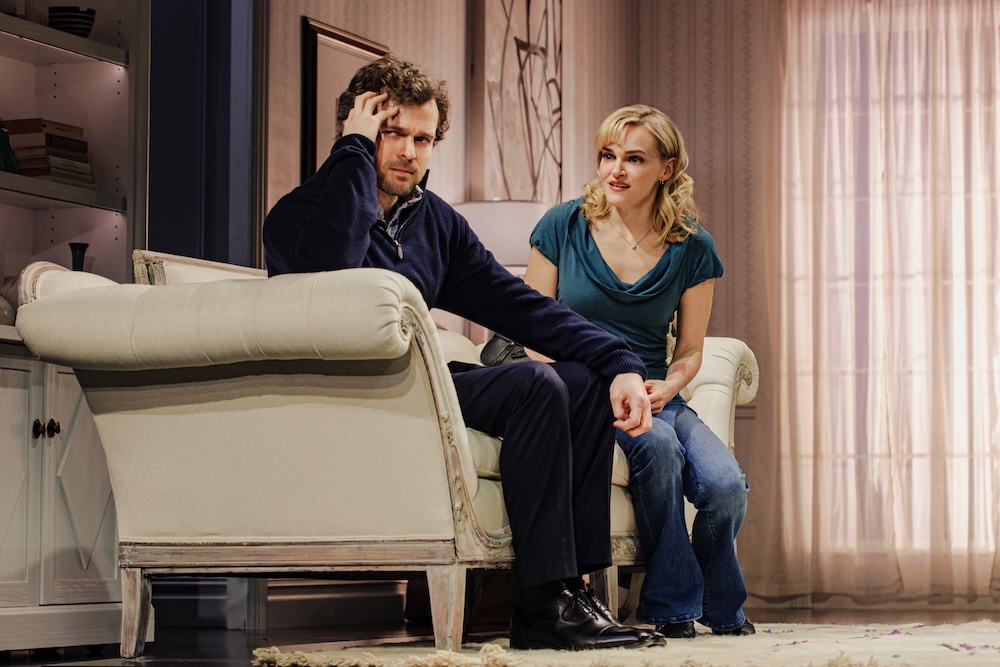
I have never believed that you have to like a character to find something meaningful in their story. In fact, theater is full of morally compromised, deeply unpleasant people who make for fascinating drama precisely because they are not asking for our approval. The problem with Becky Shaw, now open at Second Stage's Helen Hayes Theater on Broadway, is not that I disliked the protagonist. It's that I vehemently disliked everyone in the show. And while I think that is largely the point of the play, I'm not sure the production ever gave me a reason to care about the damage they were doing to each other. Welcome to Broadway Radio. My name is Matt Tamnini, and today I will be reviewing the original Broadway production of Becky Shaw. Playwright Gina Gianfredo's ultra dark comedy Becky Shaw originally premiered off Broadway in 2008 and was a finalist for the following year's Pulitzer Prize. In many ways, the play was ahead of its time, shining a terrifying light on toxic masculinity, performative empathy, gaslighting, narcissism, codependency and the ways people turn therapy speak into a weapon. The play is at its best, a sharp examination of moral justifications. Everyone in Becky Shaw thinks they are in the right. Gianfredo understands that cruelty rarely announces itself as such. More often it comes dressed up as truth telling kids, caretaking, self preservation or righteous indignation. With every character there is another undiagnosed psychological issue or four preventing them from being anything resembling a happy, fully functioning member of society. But we've seen plays about broken, messy and generally bad people before. From the Greeks to Eugene o' Neill to Tracy Letts, the history of theater is built on morally bankrupt characters. But the key in many of those examples is that there is usually at least one character, flawed as they might be, who who doesn't deserve to be suffering through the pain that the more vile characters are inflicting upon them. From Ophelia to Laura Wingfield to Edmund Tyrone to Ivy Weston, there is always someone who can be an emotional anchor so that we can empathize with and process the depravity being unleashed by the terrible people around them. Without that, it just feels like another day in the hellscape that is 2026, with no hope for dramatic catharsis. Unfortunately, in Becky Shaw and everyone is awful in such mutually reinforcing ways that after a while the escalation stops feeling tragic and you become numb to the damage being done. The play centers on a setup that sounds almost sitcom simple. A blind date goes terribly wrong. But instead of veering into the silly and slapstick, Becky Shaw spirals into something far more cynical, destructive and acidic. Susanna, played by Lauren Patton, sets up her pseudo brother Max, played by Alden Ironreich, on a date. The pair have their own fraught and mutually destructive relationship. So when Susanna's new husband, Andrew, played by Patrick Ball, introduces his co worker Becky, played by Madeline Brewer, there is already a combustible tension at play. For any number of reasons, the date does not go well, and the ripples of that night gradually turn into waves, hitting everyone until they are drowned by a tsunami of emotional blackmail and score settling. By the time any of the characters finally make anything resembling a healthy decision, I had long since stopped having any emotional reaction, undoubtedly as a defense mechanism to their callousness. That, to me, is the problem. If you're going to populate a play with excessively caustic characters, you have to give the audience a reason to care either about the source of their cruelty or about the people left injured by it. In this case, every character is just as responsible for the emotional violence as the next. That leaves Becky Shaw in a strange middle ground, because the cruelty is cyclical, passing from one damaged person to the next. It becomes the theatrical equivalent of a snake eating its own tail. The issue is not that the characters are all aggressively unpleasant. The issue is that their unpleasantness becomes dramatically stifling. The cruelty doesn't deepen the message or impact of the play. Instead, it traps the action in a state of corrosive stasis. And to me, that's disappointing because I appreciated the precision with which Gianfredo drew her characters and the specificity with which her dialogue cuts. Coupled with Trip Coleman's always sharp and incisive direction. There is expert craft at the heart of the piece. But nonetheless, I remained at a distance from the action. I never felt enough for the characters to fully invest in the wreckage they were making of their own and each other's lives. And yet, ironically, the two characters who most clearly embody the play's cruelty. Max and Becky, who are, by my reading at least, the worst of the lot, are also the ones who worked best for me. Max is arrogant, elitist, emotionally brutal and uninterested in participating in societal norms, like being nice to the people he cares most about. But he knows that while he justifies his narcissism in the cloak of intelligence and doing what needs to be done, he refuses to apologize for his abrasive methods, thinking that sympathy is a sign of weakness. Becky, meanwhile, is manipulative, unstable and exasperating in a way that feels both pathetic and predatory. Unlike Max, she hides behind her doe eyes and weaponizes playing the damsel in distress. But it only takes one flash of Brewer's sadistically satisfied smile to know that she is well versed at playing games to get what she wants. Unlike Patton's Susanna, who lives on grief and indecision, and Ball's Andrew, who performs goodness almost exclusively for the pats on the back it brings him, Max and Becky know who they are. Susanna and Andrew, along with her mother, played by the always wonderful Linda Ahmond, are all blinded by their belief that they are good people doing the difficult but ultimately right thing. Max and Becky do not suffer such delusions, and therefore you can at least give them a grudging respect for their self awareness. As Max Aynreich is giving one of the best performances of the season, even if it is an unsettling one, leaning into the character's cruelty without sanding off his charisma, which is honestly the only way that a performance of this character doesn't completely topple into a sea of sociopathy, which, considering the material he was given, is a testament to Iron Reich's talent. If Max were merely another horrible rich white guy, then whatever tolerance you might have for his abrasive antics would would disappear completely long before the first scene ends. Brewer brings a chaotic energy to Becky that rounds her out more than she likely is on the page. Her raw weirdness is so jarring that it takes a while to orient yourself around just how exploitative she is. Becky Shaw is clearly constructed to leave you uncomfortable, but there is a difference between being challenged by cantankerous characters and feeling overwhelmed by them. Eighteen years ago, when the show premiered at the dawn of the Obama era, perhaps there was more discomforting humor to be found in the awful actions of awful people. But nearly two decades later, after years of public life being shaped by grievances, bad faith arguments, victim blaming and gleeful cruelty, the play's emotional ecosystem feels less like an outrageous distortion for comedic effect and more like our everyday lives. There is perhaps an ironic credit to be given to Gianfrito that what she wrote in 2008 as extreme dark comedy now feels prescient. But I just could not find either the humor nor the pathos in people weaponizing the vulnerabilities of others. In the end, Becky Shaw is a play about terrible people doing terrible things to each other while insisting that they are the injured party. As we know all too well, there is both truth and comedy in that. But while I can admire the intelligence of Gianfredo's writing, the sharpness of Coleman's direction, and especially the performances from Ironreich and Breweries, I just could never fully invest in a play populated entirely by emotional terrorists and pretty clothes. I didn't need to like these people. I just needed to care what happened to at least one of them. And with Becky Shaw, both the play and the character, I just never quite did the Second Stage Theater's original Broadway production of Becky Shaw is running at the Helen Hayes Theater through June 14th. We appreciate your support of Broadway radio. If you want more Broadway radio, head over to patreon.com broadwayradio thank you so much for listening. This has been Matt Tamanini and I'll talk to you.