← BroadwayRadio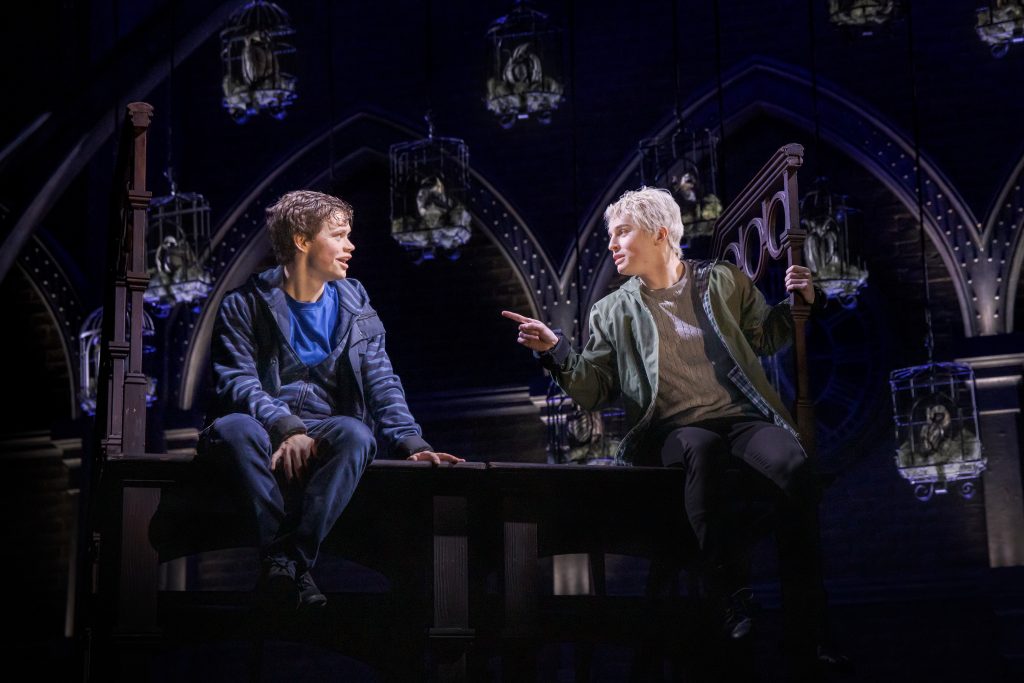
BroadwayRadio
In Review: ‘Harry Potter and the Cursed Child’ National Tour at the Dr. Phillips Center in Orlando
00:10:00
Loading summary
Transcript1 lines
- [00:10]
A
One of the great truisms of the creative world is that all art is inherently political, regardless of message or medium. The simple act of creation flies in the face of those who would prefer that those who see the world for what it could be remained silent. For some artists, their work itself speaks to overtly political topics, while others use the guise of musical theater, painting, literature, sci fi and fantasy to Trojan Horse beliefs that they think the world needs to see into something that might be perceived as more palatable. That is what is so frustrating about Harry Potter and the Cursed Child, whose first national tour is currently playing at the Dr. Phillips center for the Performing Arts in Orlando, Florida through Sunday, February 15th. Welcome to a review episode of Broadway Radio. My name is Matt Tamminini. While the creator of this particular wizarding world, J.K. rowling, is credited with contributing to the story alongside director John Tiff Symphony and playwright Jack Thorne, she did not pin this continuation of the books and films that made the Boy who Lived an enduring global phenomenon. Instead, that was Thorne, and as he had in films like Wonder, TV shows like Adolescence and plays like Let the Right One in and Stranger Things the First Shadow, he is preternaturally able to excavate the anxiety and confusion and emotions of being a child, to expose universal truths that often exceed the traditional confines of their respective genres. When you combine that with Tiffany's expert Tony winning direction, incredible stage magic by Jamie Harrison, movement and choreography by Stephen Hoggett, powerful music by Imogen Heap, and uncanny lighting design by Tony winner Neil Austin, you have the makings of what should be an across the board crowd pleaser, even if this now even more so shortened version does too far cross the line into fan service for my particular liking. Unfortunately, however, the specter of Rowling and her bigoted attacks on the trans community are impossible to avoid when consuming any pieces of Harry Potter media, but especially with Cursed Child, as this play explicitly delves into the impacts of bullying, public smear campaigns, and even, dare I say, queer awakening. Not satisfied with unfathomable wealth and worldwide acclaim, Rowling has positioned herself at the center of the international terf, or Trans Exclusionary radical feminist movement, going out of her way to use her billions to attack an already vulnerable population under the bad faith pretext that simply allowing trans people to exist and attempt to live happy lives somehow harms women. This is wholly and always unacceptable, but especially so at a time when fascist and narcissistic politicians the world over are demonizing innocent trans people specifically to incite their already angry bases for the sole purpose of consolidating power and wealth. So it is incredibly difficult to enjoy anything about Cursed Child for what it is without being weighed down by the knowledge that the financial support of any rolling property directly and unambiguously goes to harming trans people around the world. That being said, I truly sympathize with the fans who grew up with Harry Potter as an on ramp to reading and imagination and empathy. Because now that you're being forced to choose between the nostalgia of a formative literary world, which admittedly is a bit racist and problematic in retrospect, with living up to the ideals they believe the stories stood for. Personally, I cannot in good conscience recommend ever contributing monetarily to anything associated with J.K. rowling. If you want to reread or rewatch your physical books or DVDs, that is the only way that I think it is possible to separate the art from the artists when the artist no longer benefits financially from your enjoyment of the material. Now I will never push that to the side, but on the topic of Harry Potter and the Cursed Child specifically, this show is a visual feast for lovers of the franchise and those of theatrical and technical magic alike. While no one will ever confuse the script with one of the great works of dramatic literature, at least some of that has to do with the fact that the version now touring the country is the third incarnation in Cursed Child's evolution. It originated in London and then subsequently on Broadway as a two part event that consisted of a total of roughly 45 hours and 15 minutes of stage time. After the pandemic, the Broadway version was shortened to around 3 hours and 40 minutes, which is also what the West End production is currently running at. But then last year the New York staging was trimmed again to 2 hours and 55 minutes, which is also how long the touring version currently is. No doubt with an eye on keeping the runtime under the three hour cap before certain union members hit overtime. Due to this aggressive shortening, the show now feels less like a continuation of the beloved characters stories and and more like a highlight package of the best bits of installments gone by. And since not everyone who comes and sees Cursed Child will have an intimate knowledge or recollection of the books and films, characters are forced to rattle off tedious exposition to ensure that everyone is up to speed on what is going on. Even with little to no Harry Potter knowledge, I found parts of the dialogue to be very similar to that of my much beloved soap operas, which consistently have to make sure the audience is up to speed in case they missed yesterday's episode were on a vacation for a week or have been in a coma since the Clinton administration. Nonetheless, this story centers on the son of Harry Potter and Jenny Weasley Potter. He is named for two of the iconic characters from previous incarnations, Albus Severus Potter, and he's beginning his wizarding journey at Hogwarts alongside his cousin Rose Granger Weasley. Despite his famous father, Albus does not take well to life at Hogwarts, being sorted into Slytherin and managing to make only a single friend, Scorpius Malfoy, the son of his parents rival Draco Malfoy and Astoria Greengrass Malfoy. In order to remove himself from his father's shadow, Albus hooks Scorpius, who is fighting widespread damning rumors about himself, into a complicated, semi nonsensical plan to make up for certain mistakes of the past. However, as is often the case, the road to a dementor filled world is paved with good intentions. Now, longtime listeners know I go out of my way not to spoil anything, so I will not not reveal too too much about the plot of the show or the characters who do appear. But needless to say, there is a healthy dose of familial drama, coming of age and unintended magical consequences at play with some colorful characters new and old. One of the highlights of the show is hearing the audience giggle and gasp when a familiar character appears or a canonically important name is mentioned. While you don't need to be well versed in Harry Potter lore to appreciate Cursed Child, if you are, it undoubtedly will enhance your appreciation of the at times flimsy material. Playing Albus Potter is Adam Grant Morrison, and even though he often sounds like Ethan Slater's spongebob squarepants came down with the case of the Keala Settles. He is a grounded central character with muggle world problems living amidst the craziness of the wizarding world. David Fine's Scorpius Malfoy provides a more hysterical Muppet esque performance that balances out the drama of this central pairing. Due to the streamlining of the plot, there isn't much room for nuance and characterization in Cursed Child. However, there are two moments that would resonate in any show regardless of context, and both come from Malfoys. The first comes when Draco, played by Ryan Halahan, gives his bitter rival Harry, played by Nick Dillonburg, some hard learned parenting advice about the difficulty of growing up. The other comes when Draco's son unloads on Albus, reminding him that some people have actual problems that are far worse than simply being the son of the famous Harry Potter. In a show that is far more about shock and awe, these are the most emotionally powerful parts of the play. Despite these resonant moments. Make no mistake about it, the star of the show is the ingenious illusions by Jamie Harrison. Employing tactics as simple as misdirection and as complicated as projection mapping, Cursed Child will at times leave you amusingly bewildered and at others completely dumbfounded. Again, I make efforts to avoid spoiling and anything but the seamless integration of centuries old stage effects alongside cutting edge technology and Tony nominated choreography does bring an air of magic to this show that I have never witnessed in any other theatrical production. Admittedly, the tour staging is slightly different than the Broadway version, likely to account for technological differences that can't be recreated on the road like they are at the Lyric Theater, but overall the majority of the magic is maintained. Though Harry Potter and the Cursed Child won six Tony Awards in 2018, including Best Play, and was nominated for four more, it is not a stellar work of literature. Instead, it is an expertly crafted piece of nostalgia bait that mostly delivers on what it promises to provide a nearly non stop succession of dopamine blasts from the past. And while the story contains tender and nuanced moments, the continual downsizing of the production has mostly rendered them toothless and little more than speed bumps on a journey through well worn events, locations and character relationships. Now don't get me wrong, for many people who see this show that will be more than enough. And for them I suppose I'm happy. But again, no matter the sentimentality that comes with this show, I do hope that you will think about the impact of paying to see it, to listen to the new star studded audiobooks, to watch the forthcoming television adaptations, or to visit the wizarding world at Universal Universal and how it will unequivocally contribute to the ongoing persecution of a group of people who are being attacked simply for wanting to live their lives the best ways they know how. Harry Potter and the Cursed Child will play at the Dr. Phillips center for the Performing Arts through Sunday, February 15th. I will have ticket information including a discount code in the show notes if you feel you must go thank you for listening to this episode of Broadway Radio. If you want more Broadway Radio, head over to patreon.com broadwayradio thanks again for your time and your support. My name is Matt Timminini and I will talk to you.