Loading summary
Transcript3 lines
- [00:02]
A
Pros save more on the materials you need to get the job done inside and out at Lowe's right now, get 10% off in stock Trex Naturals decking now available in more styles. Plus get 15% off select custom entry, interior and storm doors. Then we'll deliver it all straight to your job site. To help keep your jobs moving, get the brand's pros trust priced right and ready when you need them. Our best lineup is here at Lowe's, valid through 527, while supplies last selection varies by location.
- [00:40]
B
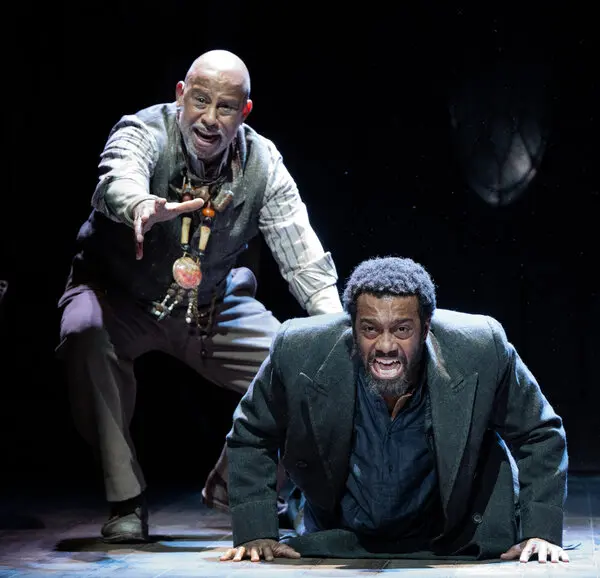
Having the opportunity to see an August Wilson play performed anywhere, especially on Broadway, is never short of thrilling. In the ideal circumstances, the show will fundamentally change your life and rewrite every fiber of your being. But even in the least inspired production, you are still graced by some of the finest words, ideas and characters in the American theatrical canon. Unfortunately, the current revival of Wilson's Joe Turner's Come and Gone has settled somewhere in between those extremes. It never fully unlocks the ritual force of Wilson's vision, but it also isn't completely devoid of the magic that makes the playwright's works sing. This is by no means a bad production of a great show, nor is it an unsuccessful one. Wilson's play is too rich, too haunted, too spiritually exacting to ever be anything short of revelatory. But Joe Turner's Come and Gone is not a play that should merely be presented. It is a story that calls to be conjured and mirroring many of the characters in the play. That is something that this production is still searching for. Welcome to Broadway Radio. My name is Matt Tamaneni, and today I will be reviewing the current Broadway revival of Joe Turner's Come and Gone, currently running at the Ethel Barrymore theater. Set in 1911 in a Pittsburgh boarding house run by Seth and Bertha Holly, played by Cedric the Entertainer and Taraji P. Henson, respectively. Jo Turner's Come and Gone is, on the Surface, about a group of black travelers moving through the aftershocks of slavery, displacement and the Great Migration. But as is almost always the case with Wilson, the Surface is only the entryway to a much more mystical and psychologically expansive story. The arrival of the mysterious Harold Loomis, played by Tony nominee Joshua Boone, has caused concern for some living in the Holly's home with his young daughter in tow, Loomis has come looking for the wife he lost after being forced into seven years of illegal bondage by a man named Joe Turner. His quiet intensity and unnerving presence immediately make Seth suspicious of him, and the landlord eventually gives him one week before he must clear out. But as that final week progresses, it becomes clear that Harold Loomis search for his wife is about far more than just reuniting with the mother of his child. Loomis, a former church deacon, is trying to recover the self that Joe Turner stole from him. The faith, family, freedom and spiritual certainty stripped away by a well connected white man powerful enough to turn racist cruelty into lawless captivity. Another of the boarding house's tenants, Bynum Walker, played by Tony Winner and one of the theater's great August Wilson interpreters, Reuben Santiago Hudson, insists that Harold Loomis is looking for his song. The literal and figurative music that makes life worth living by connecting you to your ancestors and your purpose. Having been stripped of nearly everything that once gave his life shape, Loomis attempt to recover his song becomes one of the most compelling threads in all of Wilson's work. And while this production certainly has moments of impact, almost all focused on Boone and or Santiago Hudson, overall it feels far too stagnant for a play with so much internal combustion and spiritual unrest. All too often, Debbie Allen's direction is oddly inert. She frequently allows the action to settle into fixed pockets on the stage, the kitchen, the living room or the space in between, limiting the actor's physical movement for no obvious reason. For play that feels pressurized to the point of an explosion of mystery, ritual, visions and spiritual and emotional tumult, this production remains far too dramatically static. David Gallo's set, by contrast, seems more attuned to the play's mythic architecture than the direction around it. The long looming staircase stretching upward as though towards some unreachable spectral destination becomes an apt metaphor for the entire production. Visually suggestive, spiritually charged, and yet not always fully activated by the action beneath it. Now, I would understand if the rationale behind that is that Alan wanted to allow Wilson's words to do the heavy lifting. And I honestly couldn't disagree with that in theory. But when the driving forces of your show are two extraordinary actors like Boone and Santiago Hudson, it seems like a missed opportunity to not let them use their entire repertoire of talents to tell what should be a full bodied story. As should not be a surprise to anyone who has ever seen him on stage before, Santiago Hudson brings with him the kind of theatrical gravity that cannot be manufactured. His character, Bynum is a conjure man, a spiritual guide who is able to access unseen forces while fully rooted in the everyday rhythms of the Hollies house. Santiago Hudson occasionally opens a door into a stranger more numinous version of Bynum, one who seems to dwell slightly outside our ordinary concept of time and plane of existence. As arresting as Santiago Hudson is, it is Boone who delivers the most powerful performance. His herald, Loomis is equal parts wounded and angry, suspicious and mysterious, broken and dangerous. It would be easy to play the character coming out of seven years of forced enslavement as all fury or all suffering. But Boone finds a way to give both in service of something altogether different. At the heart of his herald Loomis, he is confused. He is a man of God, stolen from his life while preaching, severed from his wife, his child and his certainty. The things that once gave him structure and confidence have crumbled over the past seven years, and he is struggling to figure out who he now is and what, if anything, he believes in. When Boone is on stage, the production has a consistent electricity that only seldom crackles without him. The ghosts that seemingly follow him wherever he goes eventually haunt everyone around him until all of the pressure, distrust and unease come to a head. Alan's direction rarely leans far enough into those dangerous, eerie elements of Wilson's script, but when it does, Santiago Hudson and Boone deliver chilling and breathtaking performances as Seth and Bertha Holly. Cedric the Entertainer and Taraji P. Henson are both solid and unshowy turns that provide the story with a sturdy domestic backbone, while the more volatile characters ignite around them. Nimony Sierra Ware and Maya Boyd also make strong impressions as Matty Campbell and Molly Cunningham, two women searching for wholeness in very different ways. Ware gives Maddie a tender, exposed ache, making clear that her search for the man who left her is less man himself than about recovering the self worth his abandonment has shaken. Boyd's Molly, by contrast, is more guarded and self possessed, someone who has decided that freedom, not attachment, may be the only safe thing worth pursuing. Despite a strong cast and a design that often understands the play's fractured mythology better than the staging does, Joe Turner's Come and Gone never feels fully realized. The show is not meant to function merely as a domestic drama with supernatural flourishes. The mystery and spirituality are not there purely as decoration or to provide a few moments of bone chilling excitement. The other worldliness of Wilson's story is central to how the play understands trauma, yearning, regret and salvation. When the production treats these elements too cautiously, leaning too far into the naturalistic trappings of the setting, its mythic power remains present in the text, but not always fully embodied on stage. Fortunately, again, the words are August Wilson's, which means that there is only so much that directorial restraint can diminish. The playwright's language is muscular and musical, plain spoken and prophetic, capable of turning a boarding house kitchen into a crossroads between this world and somewhere else entirely. Wilson's writing operates on a level few American playwrights have or likely ever will reach, but this revival feels like an exquisitely written ghost story told by people who don't fully believe in ghosts. And yet it still provides an invaluable opportunity to sit with Wilson's words, wrestle with his questions, and watch Joshua Boone deliver an unforgettable performance as a man attempting to claw his way back to his own humanity. I just wish the production around him had been as willing to get lost in the mystery as he is. August Wilson's Joe Turner's Come and Gone is playing the Ethel Barrymore Theatre on Broadway through July 26th. As always, we appreciate all of your support for Broadway radio. If you want more Broadway radio, head over to patreon.com broadwayradio thank you so much for spending your time with us and listening. This has been Matt Tamineni and I'll talk to you.
- [09:36]
C
Hey there. It's Wayfair here, where delivery and setup are as easy as a few taps on your phone. You're relaxing in an old hammock, scrolling Wayfair's app when you spot it. A brand new patio set. Next thing you know, Wayfair delivers it right to your patio and sets it up. Oh, you need a new grill too. All right, Wayfair's got you covered. With Wayfair's room of choice delivery and fast expert setup on qualifying orders, life gets a little easier. Visit Wayfair.com or the Wayfair app. Wayfair Every style, every home.