Loading summary
Transcript1 lines
- [00:02]
A
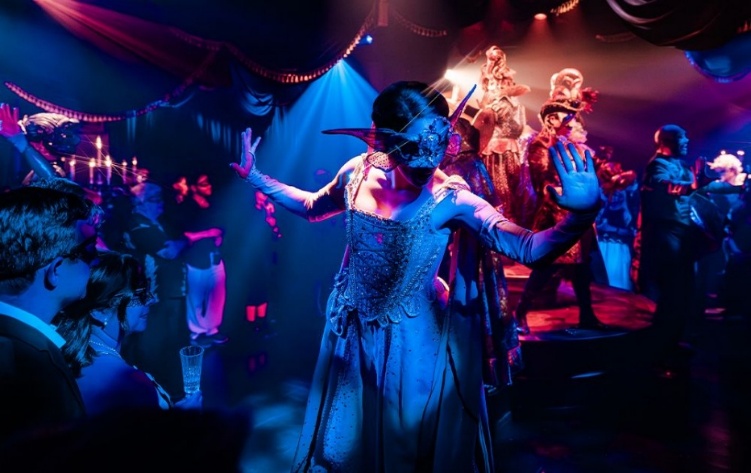
Dondes a que vayas ganas puntos como un pro la nueva Target American Express My Los Pro Rewards. In the interest of full disclosure, I knew going in that Masquerade would not be a show tailored to my specific theatrical preferences. I saw Phantom of the Opera during my first trip to New York in the spring of 1998 and declared it then to be the worst show I had ever seen. With my opinion only moderating slightly over the years, I am also not naturally inclined to enjoy immersive theater. The willful dissolution of the actor audience contract makes me inherently uncomfortable. However, what director Diane Paulus and her team have created in their multi floor warehouse playground is nothing short of staggering. From all imaginable artistic and logistical perspectives, what they have done with this reinvention of Phantom of the Opera is one of the most sumptuously satisfying theatrical experiences of my life. Welcome to Broadway Radio. My name is Matt Tamnini and today I will be reviewing the immersive Phantom of the Opera Off Broadway production known as Masquerade. Whether Hal Prince's record breaking original, Lawrence Connor's redesigned tour, the disastrous movie adaptation, the ill fated sequel, or any of the countless anniversary concerts, Phantom has always felt far more like a museum piece to me than something that inspired immediate excitement, emotion or enthusiasm. But after leaving Lee's Art Shop, the former West 57th street art store between Central park and Hell's Kitchen where the show plays, I was honestly aghast by the production's beauty, intricacy and attention to detail, and I found myself far more captivated by the music and story than I ever had been before. Much of that sense of astonishment comes from the preposterous levels of audacity that drive Masquerade's concept. This is not simply Phantom performed in smaller rooms in front of audiences of roughly two dozen people who follow characters around a dimly lit building. It is essentially six productions happening simultaneously, with the audience divided into separate pulses that move through the playing spaces, catching different angles, rooms, encounters and emotional pressure points of the story. And nary the groups shall meet. It's not really until you are debriefing over a drink in the lake bar after your performance that you even realize that there were other people having a parallel, slightly staggered experience alongside you. That alone would be a logistical high wire act worthy of praise. But what makes Masquerade so astonishing is that it never feels like logistics. It never feels like you are being hurried or corralled from point A to point B. It feels like two hours of well choreographed seduction. You are ushered from dressing rooms to salons to corridors to performance spaces, with an elegance that disguises the production's absurd levels of precision, timing and coordination. Aside from each pulse's Phantom, the performers are bouncing between the pulses, performing in multiple versions essentially at the same time. That is where the achievement begins to feel less like staging and more like sorcery. But the miracle of Masquerade is not merely that this theatrical machine works. It is that the machine finally created the conditions for the story itself to work. For me, the night I attended my Phantom was Shawn Seamus Thompson, one of the production's swings, which only makes his incredibly haunting and haunted performance even more impressive. Knowing that he had countless other tracks running through his head at the same time. In traditional versions of the show, I had never truly felt the horror and terror that the story should carry. Yes, the vibes were always at appropriate gothic and macabre levels, but the productions seem caught in a limbo between a story of star crossed lovers and a thriller about a mentally unstable stalker. Under Paulus direction and with Thompson's menacing performance, Masquerade was the first time that I actually felt that a production fully understood and articulated the material's unsettling levels of both supernatural and real world abuse. All too often, I feel that Phantom can be so overwhelmed by its own iconography that the actual people at the center of the narrative and their real human emotions are completely swallowed up by the chandeliers, staircases, boats and masks. In Masquerade, those images still obviously exist, often in glorious form. But the intimacy of this space changes the scale of your attention. You are close enough to see even the tiniest moments of fear, rage and love. And for me, that made all the difference. This proximity put into sharp relief just how evil and coercive Thompson's Phantom was and how inescapable his spell over Riley Nolan's Christine came to be. She was not a lovelorn girl torn between Raul and her angel of Music. She was a young woman fighting to reclaim herself from manipulation both earthly and mystical. Because she is literally walking amongst you, I was able to witness Nolan processing and fighting against the phantoms pull on her up close, not as melodrama, but in a way that finally made Christine's plight feel urgent and contemporary. While the trappings might look different, it now feels like a story all too familiar to women today. In addition to being able to pick up on all of these acting nuances, being in such close quarters with the performers also brings a new level of appreciation for what they are able to do with their voices. Hearing singers of this caliber perform anywhere is a joy, but their impact is so much more tangible and visceral when it is in a room smaller than a studio apartment. While the performers are mic'd, the amplification is so unobtrusive that the voices feel startlingly pure and immediate, resonating in more than just your ears. You feel him in every part of your body and soul. And because the production is so intimate, Andrew Lloyd Webber's score lands differently than it ever has for me. I heard more emotional texture in the music than I usually do. Because I was so close to the singers. The score stopped being merely about vocal virtuosity. It became about how they used those iconic melodies to reveal their characters deepest, darkest and most dangerous emotions. While again, I am not normally a fan of immersive theater, Masquerade worked for me because while there is some interaction, the corps de ballet dancing with people from the audience, Mary Johnson's Madame Giry leading guests by the hand to the next room, or Carlotta Satomi Hoffman giving me a big bright red lipstick kiss on the cheek, it is fairly minimal and it is probably more appropriately defined as intimate theater rather than immersive. But what helped soothe any of my lingering reservations about the immersive nature of the Creation production was that every single person there was in costume. The production requires black tie attire, including a mask. If you do not bring one yourself, they do have non obtrusive lace ones that they will provide. While I certainly don't normally attend shows in formal wear, not only did it make the experience feel even more special than it already did, but it helped me feel more at home in this version of the Paris Opera House, not only did I feel more connected to the cast and the action because I was in, honestly the fanciest suit I had ever worn, but with audience members on all sides of the action, the dress code helped maintain the illusion of the show in nearly every circumstance. I believe wholeheartedly that audience members should be allowed to wear whatever they want to the theater within the boundaries of normal decency and decorum, of course. But when a production is built around the audience being part of the show, I am able to excuse some expected level of elegance from even before you enter the building. Masquerade is gorgeous, decadent and lush. Paulus and her army of designers have created such a sensually arresting production that it is practically impossible not to be swept up in the awe and spectacle of the evening. And that 360 degree immersion only helps to accentuate all of the wonderful work done across the rest of the experience. That, of course, does not mean that every element of Phantom never works. But by making clear how vile and powerful the Phantom is not because of some strange charisma or musical mastery, but because of his otherworldly hold on Christine, Masquerade takes the story from a problematic artifact of the mega musical era and returns it to its horror roots with very modern, real world implications. I went into Masquerade expecting to admire the mechanics and simply endure the material it. Instead, I found myself genuinely moved by the fusion of craft, ambition and proximity and dazzled by the talent, power and immediacy of the performances. The reframing of Phantom of the Opera into Masquerade, like cats into the Jellicle Ball, is not a gimmick. It is a vital recontextualization of a story that had grown stale in its previous incarnation. What remains is a gorgeous, seductive immersion that eases audiences into and guides them through an emotionally fraught journey of obsession and resistance. While I might never be Phantom's biggest fan, for the first time I understood why so many people over the past 40 years have been willing to surrender to the music of the night. Thank you as always for all of your support of Broadway radio. If you want more Broadway radio, head over to patreon.com broadwayradio thank you so much for giving up your time and listening. This has been Matt Tamanini and I'll talk to you soon. Sam.