Loading summary
Transcript3 lines
- [00:01]
A
Everyone talks about summer like it's supposed to be carefree. But if this season brings up money, stress, body stress, family stress or social stress, that's real too. Grow Therapy can help with that. Whether it's your first time in therapy or your 50th, grow makes it easier to find a therapist who fits you, not the other way around. They connect you with thousands of independent, licensed therapists across the US Offering both virtual and in person visits nights and weekends. You can search by what matters like insurance, specialty, identity or availability and get started in as little as two days. And if something comes up, you can Cancel up to 24 hours in advance at no cost. There are no subscriptions, no long term commitments. You just pay per session. GROW helps you find therapy on your time. Whatever challenges you're facing. Grow Therapy is here to help. Grow accepts over 100 insurance plans, including Medicaid in some states. Sessions average about $21 with insurance and some pay as little as $0 depending on their plan. Visit growththerapy.com booknow to get started. That's growththerapy.com booknow growththerapy.com booknow availability and coverage by state and insurance plan.
- [01:33]
B
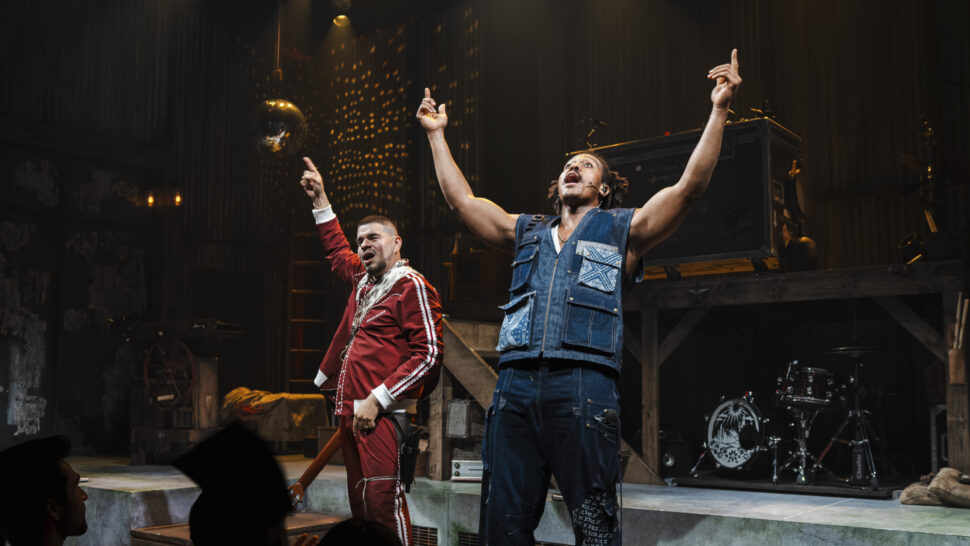
Some pieces of theater aspire to do nothing more than to entertain, to deliver an enjoyable experience to their audience. Others seek to stand on their own as examples of what the art form can be in the hands of extraordinarily talented and visionary artists. Others still are singularly focused on telling urgent, vital stories that speak directly to the world for which they were created. All three of these goals are equally valid, and succeeding at any is an extremely high bar to clear, so much so that most shows never even really attempt to achieve all three, comfortable with delivering on one or perhaps even two of these ideals. But of the ones that do strive for entertainment, artistry and social resonance, most are lucky to clear only one bar. A select few past two only shows of staggering craft and profound feeling clear all three, and the new musical Mexodus does so with room to spare. Welcome to Broadway Radio. My name is Matt Tamnini. Today I am reviewing the Off Broadway return engagement of Mexodus. Mexodus is one of those rare shows that demands you sit up straighter because it reveals to you in real time a level of artistic vis, vision, technical precision and theatrical imagination that feels both refreshingly original and somehow as if it has been part of our shared theatrical heritage for generations. Created and performed by Brian Quijada and Nigel D. Robinson, the two hander off Broadway musical is hands down, without question the best new musical I have seen this year, and quite possibly the best new musical I have seen in the last five years, perhaps even since Hadestown in 2018 following its initial Off Broadway run. Had the show's next stop been Broadway rather than the larger Off Broadway Daryl Roth Theater, I have a very hard time imagining a world in which it would not now be seen as the runaway favorite for best Musical at the Tonys. Mexicus tells a fictionalized story inspired by a very real but far less frequently discussed piece of American history, the Underground Railroad that did not run from the southern states into the north but instead traveled south with enslaved people crossing the Rio Grande into Mexico in search of freedom. At the center of the show is Henry, one of those freedom seekers fleeing bondage in Texas, and Carlos, the Mexican farmer who becomes his unlikely ally. What begins as a story of survival becomes one of solidarity, identity, friendship, and the complicated, combustible ways that borders geographic, political, racial, linguistic, emotional shape the people forced to live on both sides of them. While the story of Mexico vibrates with painful contemporary relevance, that is only part of what makes the show so special. The score of this musical is built entirely through live looping, a process in which a performer records a sound, a beat, a line, a guitar riff, a stomp, a breath, a drum pattern, and then that sound immediately plays back on repeat, the allowing the performer to layer new sounds on top of it. Over time, this series of small musical phrases builds into a fully formed song, complete with percussion, harmony, melody, atmosphere, eventually creating the feeling of a full band, even though it has been built live in the moment by, in this case, just two people in Mexico. Kihara and Robinson use looping stations, instruments, microphones, pedals and what must be one of the most complex audio systems off Broadway to create their show's music. Both performers play multiple instruments, from strings to percussion to piano to found objects, while also recording themselves and sometimes the audience to add to the mix. They sing into one microphone, move to another, trigger a loop, cut it off, layer a harmony, build the beat, step into a scene, and somehow continue telling the story without ever making you feel as if this incredibly complicated process is anything other than normal. It is not just impressive because it is difficult, though it is very clearly that it is impressive because the difficulty disappears into the storytelling. The musical and artistic vision required to build and craft this show stretches far beyond the normal scope of musical theater. Now. This is far from the first time that looping has been used in theater. Grace maclean's solo musical in the Green is one prominent Off Broadway example, having run at LCT3 a few years ago. But in these types of shows, every sound has to be made at exactly the right moment. Every layer has to be recorded cleanly, every dramatic beat has to land. While both performers are also functioning as actors, singers, musicians, technicians, conductors and composers, the margin for error seems impossibly thin. And yet this production has the confidence and fluency of something that feels alive with abandonment. Rather than being precarious, the show clearly benefits from the fact that Kihata and Robinson are both the creators and the performers. Their years of first hand knowledge that come from crafting the piece have made its intricate technological choreography second nature to them by now. But even knowing that, the virtuosity with which they make it all look so easy remains astonishing. Especially because the technology never comes at the expense of nuanced, powerful and thoroughly captivating performances. In that way, and really only in that way. After I saw the show, I found myself thinking about Masquerade, which I had seen just a few days prior. These are completely different shows with completely different goals, aesthetics and vocabularies, but they share a certain strand of theatrical DNA, the sense that what you are watching could only happen because of almost unfathomable planning, precision and attention to detail. With both productions, part of the thrill comes from the story being told and. And part of it comes from the mind boggling realization of how many things had to go exactly right for that story to reach you with such force. Now, while the connection to Masquerade is more architectural than literal, the show shares more obvious connections with another beloved musical theater institution, Hamilton. There are certain songs in the Mexican score that sound as if they might have been lifted whole cloth from between two cabinet battles. The blend of modern musical theater, historical narrative, dense lyrical storytelling and contemporary musical influences work here with a similar kind of pace and propulsion as Lin Manuel Miranda's masterpiece. But it never feels like Mexican is simply chasing Hamilton, or even worse, trying to be the next Hamilton. Instead, it feels as if Hamilton gave Quijada and Robinson proof of concept that a musical could tell a weighty story from the past using the music of now, that hip hop could carry exposition, emotion, mythology, and that the lessons of history could feel relevant to modern audiences by reframing them in the musical language of today. Mexicus takes the proof that Miranda provided and runs with it, forging something entirely its own and pushing the art form somewhere thrillingly new. But Mexicus is not great merely because it is audacious. The technical achievement would be enough to make it memorable. The musical accomplishment would be enough to make it remarkable. But what makes it genuinely extraordinary is that all of that craft is in service of something much deeper, and that the two artists doing the musical and technological heavy lifting are also giving stunningly powerful performances. Because both performers are doing so much at all times, it feels a bit counterproductive to separate their responsibilities too cleanly. But they do have slightly different lifts. They are both actors, musicians, storytellers and engines of the show's story. But Kihara often seems to be the one keeping the machine in motion, while Robinson reaches inside to its center and makes you feel. Kihara takes on the slightly less featured role dramatically, but in many ways he shoulders even more of the musical architecture of the evening. He is funny without ever undermining the stakes, loose without ever losing control, and emotionally raw in ways that sneak up on you. While he handles slightly more of the musical side, Robinson carries an enormous dramatic weight while singing at an almost impossibly expressive level. If you were not playing everything from piano to trumpet while singing these songs, you could almost be forgiven for imagining that he was not actually acting, but instead channeling the accumulated weight of a human life through through music. That balance of the creative and technical and the personal is what makes Mexic so overwhelming. It is virtuosic, but never showy. It is politically resonant without being didactic. It understands that the story of people crossing borders in search of safety, dignity and self determination is not some sealed off chapter of the 19th century. Instead, it has been one of the defining stories of this country since long before it even was a country. And that, ultimately is the miracle of Mexodus. It uses technology to make something deeply human, not as many billionaires want you to believe is best the other way around. It uses history to speak directly to the present. It uses two performers to conjure an entire world. And it uses music looped, layered, fractured, rebuilt as both form and metaphor. A sound is made, then repeated, then transformed, ultimately becoming something better and stronger because of the process in what it was. Woven together with. America at its best is not one thing. It is beautiful and brutal, harmonious and incongruous, fractured and rebuilt. And it becomes something extraordinary only when people are allowed to exist outside of the boxes that others are so determined to keep them in. Mexico is not just one of the most impressive theatrical achievements currently on a New York stage. It is also one of the most complete. It is the kind of show that, for all of its modern innovations, reminds you of the power that theater's most ancient building blocks can still provide people gathering in a room, making sound, telling stories, and turning the art of creation into something sacred. Mexodus is currently running off Broadway downtown of the Daryl roth Theater through June 14th. As always, we greatly appreciate your support of Broadway Radio. If you want more Broadway radio, head over to patreon.com broadwayradio thank you for giving us of your time and listening. This has been Matt Tammanini and I'll talk to you soon.
- [12:10]
C
You may think you know McDonald's drinks, but you don't know them like this. From fruity refreshers like the Strawberry Watermelon Refresher and the Mango Pineapple Refresher with Popping Boba to crafted sodas like the Sprite Berry Blast with Berry Flavored Sprite topped with cold foam. Who knew ice cold drinks could be so fire six? All new drinks are here. Try them all now at McDonald's. Refreshers contain caffeine.