Loading summary
Transcript44 lines
- [00:01]
A
This is not one of those businesses that you get to learn along the way.
- [00:06]
B
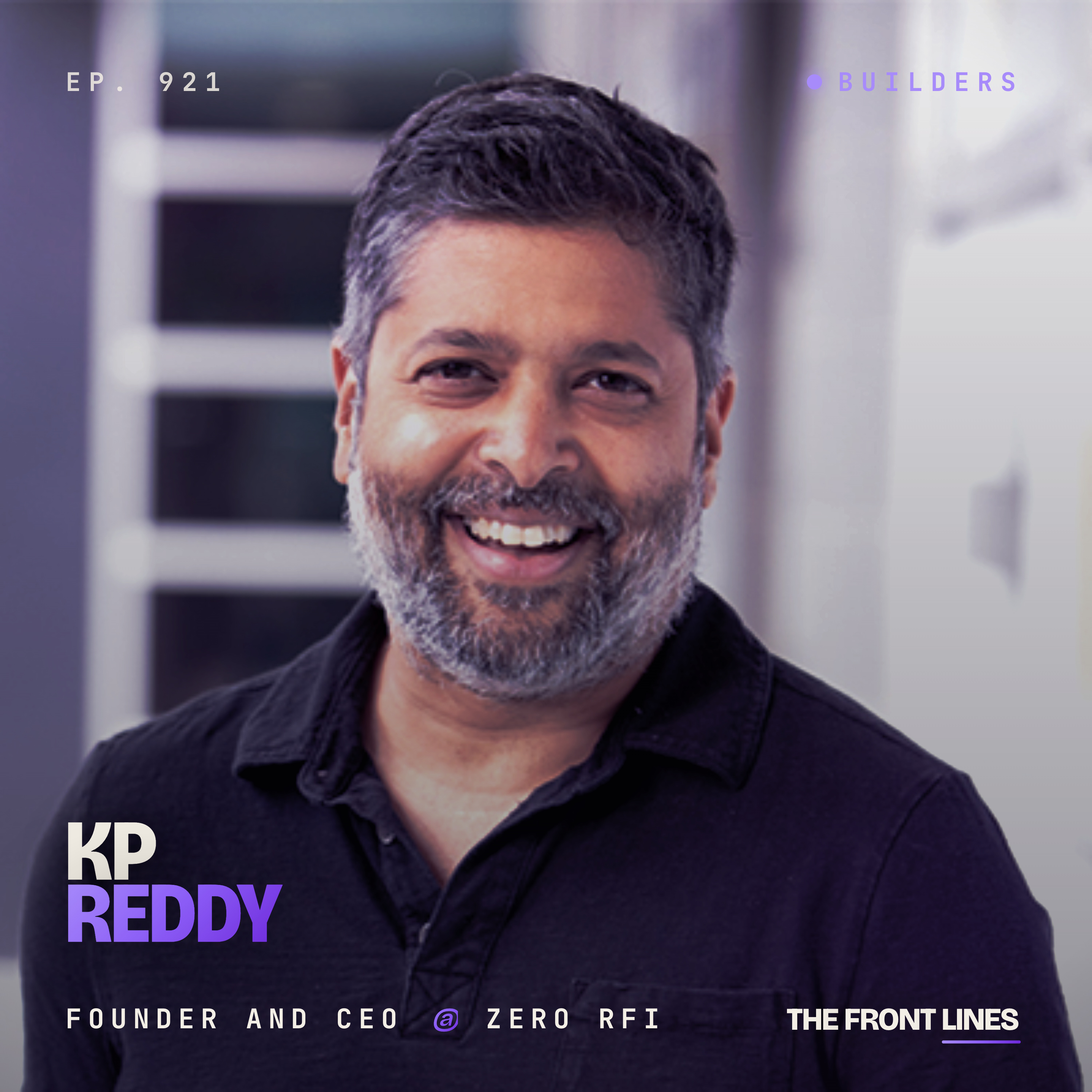
Welcome back to another episode of Builders. As always, this show is brought to you by Frontlines IO, Silicon Valley's leading B2B podcast production studio. If you're bringing technology to market and want to learn from your peers, we have a library of more than 1200 interviews with Venture backed founders and marketers. Where they talk, all things go to market. Of course, if you want to launch your own podcast, we offer podcasts as a service to more than 80 tech startups. The idea there is very simple. You show up and host and we do everything else. Now with all that said, let's jump into today's episode. Our guest today is KP Reddy, founder and CEO of Xero rfi. Kp, welcome to the show.
- [00:45]
A
Hey, how are you?
- [00:46]
B
I'm doing great. Looking forward to this conversation. So you're a founder turned investor now you're back to founding again. Talk to us about what you're founding.
- [00:53]
A
Yeah, so we're doing a AI roll up of construction services businesses. So we started it with, in partnership with General Catalyst. So they're kind of my primary backer to date. Obviously, as we continue to raise money, there'll be other people around the hoop, hopefully. So we're already experiencing tremendous growth and we'll continue to grow.
- [01:15]
B
So amazing. And I feel like everyone right now is talking about AI rollups. That seems to be the buzz word or like the buzz thing all over on my Twitter at least I recognize I'm probably in a bubble. What's the key to really getting that right and nailing that? Whenever I see people talk about it in the comments, people say like, it's very hard to actually pull off.
- [01:32]
A
It is very hard. I would say you actually have to have been in the shoes of the founder that you're buying. Right? This is where like PE experience doesn't really help you that much because a lot of times what you're doing is buying companies that you're sitting across from the founder and they're like, look, how are you going to make my life better post acquisition? And I think these require a transfer of knowledge and all of that. So I think, think it's really important to understand like their business and have been there, done that, then you get really far. I think you have to have a technology team that's world class. If it's like, oh, we've coded some stuff or we're, you know, that's a big. So what, what's interesting with a lot of the Firms, it's not like they've never heard of AI, right? They're trying different things. So we find that you have to have a great tech stack and then honestly, you've had to have been an operator. I took one of my companies public, I took another one of my companies and sold it to a large public company. So I know what zero to 1500 feels like. And I think it's very hard because the pace at which you acquire companies, I mean by the end of the year we might be a 5,000 person company. Like who knows, right. It's really how many deals can you get done? And it's not one of these things that the speed, it does not allow you to grow into the role. But most tech founders, they have the benefit of growing into the role, right? They control the pace, they get to learn along the way. This is not one of those businesses that you get to learn along the way.
- [03:00]
B
And what would you say is the average profile of the type of company that you're having conversations with that you want to acquire?
- [03:06]
A
Yeah, most of the ones we talk to are 50 to 100 people. We've done three deals so far. Those were under 50. I would say those are kind of our experiment acquisitions to see what works, what doesn't work within a very controlled environment, so to speak. But 50 to 100 for us right now is a good spot. And then probably next year we can start doing the 500 and up type acquisitions as well. So there's a little bit of you have to continue to build your team and your technology. I mean, you are building product along the way. Right. And it's important to pattern recognize what are you building, what's the benefit? Everything from the technical deployment models to the cultural deployment models becomes really massive. So it's all the above. Right. So once again, experience rules.
- [03:54]
B
And what's that integration look like? Is it being merged under one brand? Do you keep it separate? What does that look like?
- [04:00]
A
Yeah, for us, we operate as a house of brands. To me it's like counterintuitive. We're a new brand at 0RFI. So for us to go in and buy a brand that's been around for 20 years and rebrand them, like, I don't get it. So I'd rather leave their brand alone and help them grow their business under their brand. You have to think about it. You're acquiring a business, but you're really acquiring customers. And I don't know the customers, they probably went with a boutique brand in the first place. None of Us want to really be reminded that our Porsche is actually owned by Volkswagen. Right. Like, so there's a little bit like you bought the brand for a reason. So to come in and change what it is is not really that helpful.
- [04:45]
B
And talk to us about the manifesto. I was reading through the manifesto earlier. Talk to us about that.
- [04:48]
A
Yeah. So I think what's really different with what we're doing as a roll up is we acquire companies that are aligned with our mission. Right. So which is very different than like, I don't think you see a lot about, oh, we do these markets and here's the sizing, like it's a lot less spreadsheet y. It's much more aligned with a mission and ambition. Right. Those are the two things I'm looking for. So 0RFI means the ability to basically build buildings without change orders, without any questions. Right. All the information is provided up front. So there's never a pending question along the way. Right. That's the mission. And we think AI is the perfect way to be able to do this is to run the simulations, run the traps up front so that you answer all the questions before a shovel hits the dirt. Right. If you can do that, the build, the construction goes really well. So we're really focused on that. So we acquire buildings that are aligned with that and that founders that buy into the mission and have the ambition to execute on the mission.
- [05:54]
B
And was that clear? Day one. That was going to be the path to bringing this technology to market.
- [05:58]
A
Day one, meaning 30 years of my life. Yes. I mean, I'm second generation in the business, so my first company in the 90s was Construction Management on the Web. Right. Circa 1994. Right. So early to market. But my feeling was if you could get all the information, democratize information. Right. Which was what we said back then and put it all on the Internet and provide transparency, there would be no questions on how you build a building. Well, that didn't quite work out. Then another technology came along called Building Information modeling, which was 3D simulation software that came in the early 2000s that was going to fix everything. I wrote a textbook on it. That was my first book around how do you use this technology to execute on this mission? Right. Same mission I've had for 30 years. That didn't quite work out. It didn't get implemented that way. And so when I saw AI coming along, I'm like, okay, third time's a charm. Still have the same mission. Right. Deliver predictability to owners and developers when they're building something. But I thought AI was going to really be the platform for that. So we think of that as AI being a catalyst for the theory of change of how buildings are built.
- [07:10]
B
This show is brought to you by Frontlines Media, a podcast production studio that helps B2B founders launch, manage and grow their own podcast. Now, if you're a founder, you may be thinking, I don't have time to host a podcast. I've got a company to build. Well, that's exactly what we built our service to do. You show up and host, and we handle literally everything else. To set up a call to discuss launching your own podcast, visit Frontlines I.O. podcast. Now back to today's episode. And you're kind of where I was coming at with that is I don't want to ever pick like a favorite episode, but I do have an episode that was very special and it was with a company called Metropolis. So they're like a parking technology company. They probably kill me for like saying that, but they built parking technology. They were trying to sell it to commercial landlords. And landlords basically said, like, come back to us in 50 years. Like when you're growing up in your big. They did that two years, they struggled. Then they said, you know what, maybe there's a different path. Let's go out and acquire everyone. And they've raised a few billion dollars. They bought a big company to get private. And like, now that's their plan, their go to market is that basically they're calling it a growth by buyout, which I think Slow Ventures is kind of behind and supporting a lot. Like, is that how you're thinking about go to market is like you're acquiring customers and then you're plugging your technology in 100%.
- [08:19]
A
So I think like, in their case, their go to market, you need to own the asset to capture the value. Right. It's as much of if I sell you a CRM and I charge you X dollars per month, that means you're really not that confident, right? If I'm going to take a percentage of sales I drive in my CRM, that's a different story, right? Like, then I'm confident in my product and I'm not going to charge you a dime. I don't get paid unless you get paid. Right. And so when you think about value capture in these business models and when people talk about SaaS is dead and this and that, I think there's only a couple things, right? Can you capture enough value as a SaaS company to stay in business? Right. That's step one, step, two, do the users love the product? Right? So good luck taking slack away from me. Good luck taking notion away from me. Good luck taking Excel away from me, like over my dead body. But I think like, Salesforce is a good example, right? Who loves Salesforce? Management loves Salesforce. The users hate Salesforce. To me, that's problematic, right? That's the problem of like, is SaaS dead? SaaS will never be dead as long as the company can survive. They're capturing enough value to have a real business, right? And then two, that the users can't do without it if it's a user, if it's obstacles, right? So I think when you look at Metropolis that go to market strategy is like, hey, could they continue have continued as a software company? Maybe, but they may not have survived because they're not capturing enough value in the business model. So the way to capture the most value is to buy the asset, right? So I think that's a great move, right? But I think that's what you're really looking for is can I capture enough value?
- [10:09]
B
And for you, what's the big plan? You mentioned that you went through three so far. Are you doing a few test ones before you go after a big whale? Is that the thinking?
- [10:18]
A
Yeah, we'll grow into it. The way I look at this, I'm a technologist at heart. Been coding since I was 13, right? And when you're a technologist, you get that weird frustration of like, but my product is better. What's wrong with this dumb user, right? Like, you get in that mindset, I used to be that way. I'm a little bit more balanced these days around it. And I think the reason you need to move up, I say in many ways we're like a virus. And the larger the company, the greater the antibodies, right? So I have to build up enough concentration to really make effect change because I might have the right technical solution. But it's a people business, so you have to get good at demonstrating and having a good rollout plan. And one of the best ways to have a great rollout plan is to insert people that have already been through the process and believe in the process. In other words, I'm a big fan of like, show me, don't tell me. And I think in these businesses you got to show people, not tell them. So I want to build up to that so that I have enough people that have been AI pilled bias that they show up to the next acquisition, go, oh my God. Let me tell you, six months ago, before these Guys came along, my life sucked. But now it's amazing. Right. It's not about me saying it, it's about other people saying so I think it just takes time to build it out.
- [11:40]
B
And how many targets are there for you in the US that are of this scale that you want to try to buy?
- [11:45]
A
So we think for us to have enough of a market share, a controlled market share, we have to deploy about 5 billion and most of it's been identified.
- [11:57]
B
Wow. And what's your timeline for that?
- [11:59]
A
Three years.
- [12:00]
B
That's amazing.
- [12:01]
A
Yeah. So this year we'll continue to build like the experiments. Right. And then next year we'll start doing the 200 and 500 person type acquisitions. And then year three, we start doing the bigger ones and bigger ones. And we're being very strategic. We know in some markets where there's other players, we know where we can go get share pretty easily with a lot less friction. And then at some point we don't have to buy the competition. We'll just be that much better.
- [12:26]
B
What are the conversations like with investors? And I'm sure that they go smooth given that you've a very successful founder and B, that you have been an investor yourself. How are you messaging this and what do those conversations look like with investors then? What's the profile of an investor that you're working with? You mentioned general catalyst, but maybe just expand on that a bit more.
- [12:43]
A
Yeah. So I think generally, you know, when we came out of stealth, I got a ton of inbound. Right. And it's inbound from who's who. Every first meeting was with a partner. And so I think what I'm mostly asking of them, like, how will they be a good partner to me? Right. And there's a couple things to being a good partner to the business. Right. Is one, have you ever done an AI roll up? And if the answer is no, I get a few points taken off. Right. Because I don't want to teach you. This stuff is pretty complicated. I'm a big fan of like, I don't make me convince you. I don't have that. It's either it works or it doesn't. I don't have that gene in me that I can convince Eskimos to drink ice water type of stomach. I don't have that gene. It's like either you're already convinced or you're not. So that's usually step one is like for fit, and then step two is like fund structures, do they support a long game? That is, are they evergreen funds? You Know if I'm talking to someone and this is where my being from the venture background is helpful. Hey, this will be the last investment out of your fund. Great. You're five years in. It's a ten year fund. I'm not going to be that helpful to your fund, to your DPI if I'm the last investment. You're not getting your cash back in five years. That's not happening. Right. So it's really important that their fund structure and where they are in their fund journey is super important. And that's usually the second thing I talk about. The third thing is really what does their portfolio look like? What's been super interesting. I look at our business and if I was like a next generation CRM, right? I like to pick on CRMs because they're just all spreadsheets. But if I was the next generation CRM and I was talking to a vc, I would ask them like, hey, who in your portfolio can be a customer for me? Right? And that's pretty normal, right? To get those introductions to the portfolio. In my world, I didn't think that was a thing. Right. It's like how much construction are their portfolio going to be doing? It turns out it's massive, right. If you look at General Catalyst, they have a massive defense portfolio. Anduril Saronic, Helsing, Pacific Fusion, I mean they have. It's amazing. What's happened is now as software has gone out of favor and Capital Light has gone out of favor, we've now moved into Capex extreme. People are building factories. There's a re industrialization of America happening. We're building data centers, we're building electric cars, GC, they're building I think a million square feet in Fort Wayne, Indiana, right? So turns out these VCs portfolios are actually doing a lot of construction. So that's why I've been really optimizing it. Once the first two gates are passed, then it's like, hey, tell me about your portfolio and how much construction do they have going on? If their portfolio is a bunch of like, hey, they all work virtually hybrid and weworks, there's no business there for me. If it's oh no, we just funded a company to build whatever, sure, I want to talk to them about how they're going to construct their buildings. This show is brought to you by the Global Talent Company, a marketing leader's best friend. In these times of budget cuts and efficient growth, we help marketing leaders find, hire, vet and manage amazing marketing talent for 50 to 70% less than their US and European counterparts. To book a free consultation, visit globaltalent.co.
- [16:05]
B
that first point there you mentioned, asking them if they have experience with AI rollups may be a dumb question, but are there a lot of investors that have experience in AI rollups at this point?
- [16:14]
A
I mean, I think if you look at broadly what VC has decided in this wave we're in or whatever this phase we're in, is that you have to either be an investor in the labs business, that is Anthropic OpenAI World Labs, there's a few, or the inference services business somewhere in that area, or you have to be in the applied AI business. And that's where we kind of sit. As in this applied AI business. I think it's very hard to raise money right now if you're building a CRM company. I think it's very hard if you're building some kind of social media software business. What VCs will tell you is those aren't venture fundable. In fact, why would you want to venture? Why would you want a VC involved? Go build it yourself and if you have the market for distribution, go sell it. Like, why would you want anyone on your cap table? Go build, you know, would you rather have a $10 million, your EBITDA business that you own 100% of or a percentage of a business that you have to wait for liquidity to get a check? And so I think what's happening, it doesn't mean that SaaS is dead, it just means that especially vertical SaaS, I think there's still a lot of great opportunities in vertical SaaS, especially with small business, that they're just not venture fundable, which is fine. I mean, to me it's like entrepreneurs say, oh, it's not venture fundable. Why are you being so negative? I'm telling you, it's a positive. You have free will and independence to go build a company without any dependency on anyone else. That should be thrilling.
- [17:45]
B
All I know is after this talk, I've never wanted to build a CRM. But in case that ever comes to my mind, first of all, I'm not going to build a CRM. What are the examples would you say of AI roll ups that have gone well or that, you know, maybe you haven't been involved in like, that you've watched, you've thought like, okay, that was well executed.
- [18:01]
A
Yeah. So our friend Alex Taubman at Long Lake just has been doing a lot. He just bought American Express Business Travel on a take Private deal. I think he paid like 6.2 billion for it. So he's taking them private and he's gonna apply. I mean, look, it's American express Business Travel, 100-year-old brand. A lot of people don't realize, like, American Express kind of started in the travel business, right? That was the business they were in. And so for him to take an iconic brand like that and then apply his AI SWAT team to start creating a different experience, you might actually attract a new kind of customer to America. I mean, think about, like, do you use American Business Travel? I don't think you probably know anyone that uses an American Express Business Travel, right? But who knows? Like, they create this amazing feature that might attract you because honestly, no one else has done a great job. Even some of these other firms, like, we use Navin and Avan. We use that. I thought it was going to be amazing. It's not. It's okay. Right now we use Ramp. I think Ramp is amazing. I think Ramp is fantastic. Makes my life easy. My controllers 100% right. I don't know that you can improve Ramp per se. But travel, nobody's really figured out. So they're doing well. There's another company called Udia E U D I A. They're a law firm roll up. They're doing extremely well. They have figured out that in large companies. So if you think about a large company, general counsel, they don't really do lawyering. They actually look at projects, come in, they decide, can I get it knocked out in house? Buy an, you know, an associate. They maybe have one person or who do I need to send it to? So this allows them to understand, like, what can they do in house? And maybe they can do more in house. But it also helps them optimize when they need to send it out, packaging it up and sending it out to an outside firm. Things like litigation, you're probably. You're not going to let AI do litigation for you yet. But, you know, I just read that,
- [20:04]
B
I think there was an article yesterday in Bloomberg perhaps that PE is coming for personal injury law firms right now. And, like, there's a bunch of action happening there.
- [20:11]
A
So I think Arizona passed a law that you don't have to be a lawyer to own a law firm. And so what they're doing with personal injury, they're using AI, right? So you get into a little Fender vendor, you're probably going to get a text from a lawyer based off traffic cam data before you even step out of your vehicle.
- [20:29]
B
It's crazy to think about, which is
- [20:31]
A
like, I don't Love that,
- [20:34]
B
like, lawyers were already a bit annoying. They're the first ones. I don't know if they could. Getting more annoying.
- [20:40]
A
Right. The technical aspect is kind of cool. Right? But just because it's kind of cool doesn't mean we like it.
- [20:47]
B
No, I want to be respectful of your time. I'm seeing that we're up on time right now, so I just want to ask you one final question. If I look back, I've done 1500 interviews now, and if I were to put on a chart, there were very few construction tech companies five years ago when I started. Now there's more and more. I feel like construction technology is hot. There's a lot of action there. There's a lot of founders that want to build their. Given your history, what advice would you have to a founder that wants to go and build construction tech?
- [21:11]
A
Think bigger and don't get the so under 5 million in ARR. Sometimes it's a big head fake because the market is so big, there's so many problems. It's actually not hard to get to 5 million in ARR, but it doesn't mean you're going to get to 10, 20, 30, 40, 50. And so what happens is you see like the classic S curve. When founders think too small, they hit the top of that S curve so soon and they don't have a plan to extend that vertical. Right. And I think it's really important that you're constantly thinking about, like, it's funny that top of the S curve happens so much faster if you're not paying attention in construction tech than in any other industry.
- [21:58]
B
Last one. What markets are you excited about within
- [22:00]
A
construction, robotics and material sciences? I'm not excited about software. I think the challenge with software in our industry, people do not like black boxes. Right. Number one, software being used in construction companies excel. Right. So they don't even like using the data that's in a system. If you ask them what's their single source of truth, it's the spreadsheet on their laptop. Right. And that's the nature of the industry. Right. It's a. Art is an industry at scale. And so I think when it comes to software and AI in construction specifically, I think you'll get some early adopters. But at some point I need to know what's in the black box, like, precisely. I also need to understand am I violating any data issues, governance issues with my clients. If you're using AI and you're working on an airport, you are probably out of compliance.
- [22:55]
B
All right, we're going to end here. Kp, this has been super fun. Thank you so much for taking the time.
- [22:58]
A
Absolutely.
- [23:02]
B
Well, that's all for today's episode of Builders, brought to you by the Frontlines. If you want more amazing content like this, visit Frontlines IO, where you'll find the library of more than 1500 interviews with founders, marketers and other GTM leaders, where we unpack the tactical lessons from their journey. And of course, as always, if you do want to launch your own players podcast, we'd love to have a conversation with you. Visit Frontlines IO Podcast as a service. Mention that you listen, mention you love the show, and we'll give you a 10% discount. Thanks for listening. We'll catch you on the next episode.