Loading summary
Transcript28 lines
- [00:01]
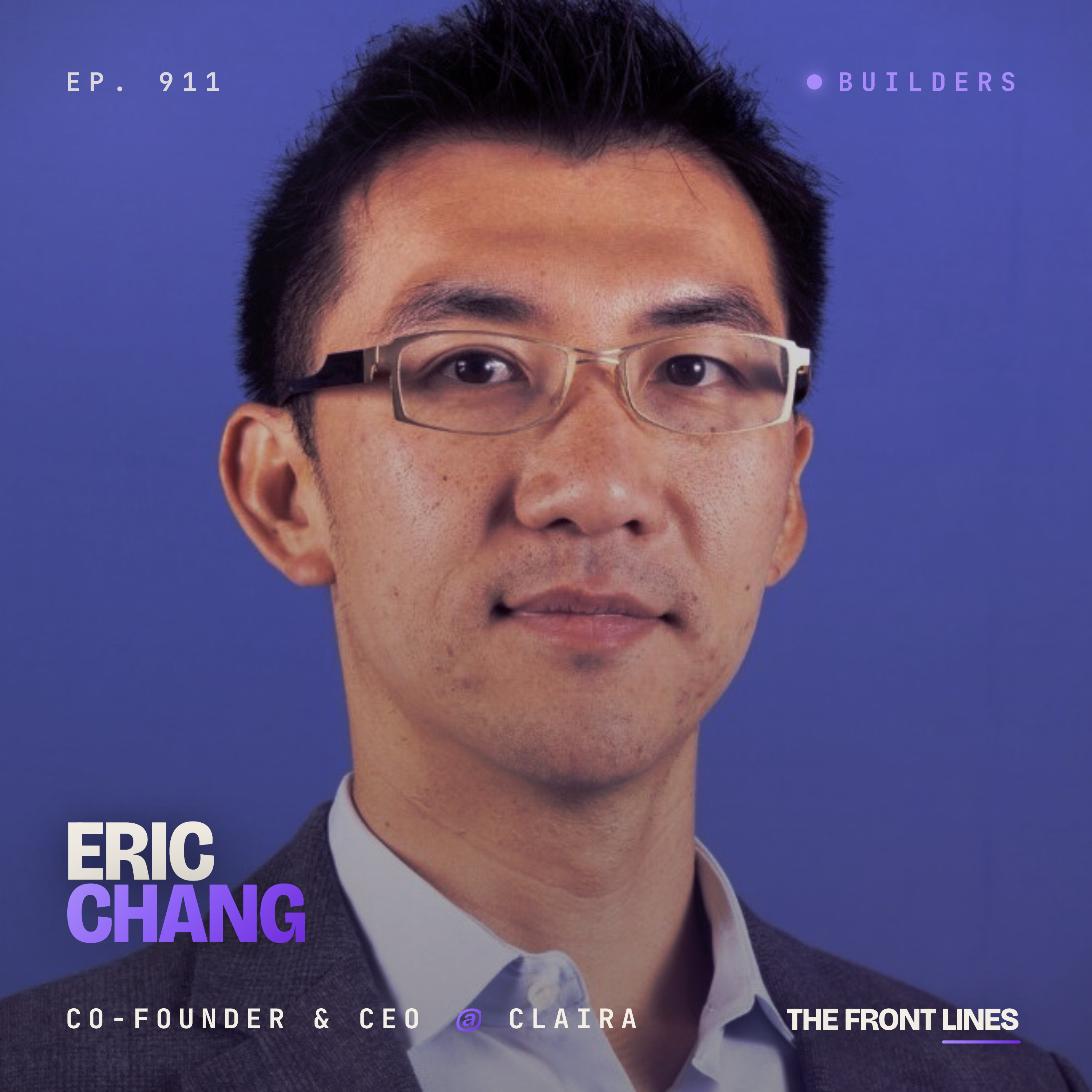
Eric Chang
It's not going to come up with a growth assumption. It's not going to come up with an ROI return on the company. Right.
- [00:10]
Frontlines IO Host
Welcome back to another episode of Builders. As always, this show is brought to you by Frontlines IO, Silicon Valley's leading B2B podcast production studio. If you're bringing technology to market and want to learn from your peers, we have a library of more than 1200 interviews with Venture backed founders and marketers. Where they talk, all things go to market. Of course, if you want to launch your own podcast, we offer podcasts as a service to more than 80 tech startups. The idea there is very simple. You show up and host and we do everything else. Now with all that said, let's jump into today's episode.
- [00:43]
Brett
Today our guest is Eric Chang, CEO and co founder of Clara. Eric, thanks for being here.
- [00:49]
Eric Chang
Thanks so much. Really appreciate you having me.
- [00:51]
Brett
Yeah, excited to jump in. So I understand that you are creating a category and that's awesome. That's cool, I love it. But it's also very, very hard to do. So before we jump into the category that you're creating, tell us a bit more about the company.
- [01:03]
Eric Chang
Yeah, thanks for that. So I'm Eric Chang, co founder and CEO of Clara Clarity with AI and what we're trying to do is to transform the investment process for private market investors. That includes private credit, private equity, venture capital, people investing in private companies. And what we're trying to do is the private company investment process, if I were to be honest, is still pretty tribunal. It's not very different than, I don't know, a thousand years ago when people gathered in a room, someone presented their case, a level of research has changed, but you still present a case and then people sit in a room and you know, say yes or no based off some deliberation. Right. That's not how I think a really effective investor of the future should be. Human memory is not perfect. Humans are subject to biases and so on. So how do we actually create a process that allows investors not just to be faster, which is a lot of I think AI is doing, but much more effective. And so that's what we're doing at Clare. We think about as a agentic deal management platform where we facilitate the tracking, helping the analysis, but most important, the capture and recall of every transaction that a deal team's looked across. And that really allows investment team to take a step back and look at each investment, not just a standalone, but relative to everything that they've seen. Look at their own investment history with more objective eyes and really become much more of a forward thinking investor masters going forward.
- [02:35]
Brett
And if they aren't using you, what's the status quo? Just what you describe sitting around a boardroom talking.
- [02:40]
Eric Chang
Yeah, I think and that's to your point on category defining or redefining and like the struggle that we have is a lot of people are using AI to help specific tasks be a little bit faster and with the hope and maybe true that they will become more faster investor, they'll go through deals faster. But that in of itself doesn't make you a better investor. And I think a lot of our investors are interested in that. But when it becomes a really unlock is if they can find a way to look at alpha and alpha or find signals that they currently don't have. And so the way to think about Clare is actually really at the core really a intelligence data layer where we're stitching together all the information that as a private investor you have about your deal. So taking the venture capital world as an example, you've got data rooms, you got your CRM with who you contact with, you've got maybe granola or various AI tools that are taking notes for you, you've got your email that's got back and forth, you've got conversations, all of that's actually information, a deal. And they're not connected, they're not automatically tied to a specific opportunity and transaction and you might remember it on each basis, but six months later, a year later, that's gone. And so what we really do is by connecting and creating that data layer and then the agents on top is then allowing you to have that data layer fully up to date and fully up to speed just by your normal day of work. So you can think of Clara as a new team member, you include it on your conversations, you email copy it on the email back and forth, you include it in your Slack or teams chat and just by nature doing so, it's capturing, logging everything about the transaction and tying around the deal and then allowing you to retrieve that and pull that to be able to, you know, basic questions of like hey, let's look at all the companies looked at this sector in the last six months. Has any of them noted each other as competitors? And what they say to then taking really a holistic view of your investment to say, okay, let's look at all the deals we looked at last six months. What's the conversion? What's, what's the status of each of those? What are the factors and attributes that are common across the Deal and does that align with how I think about myself as an investor and my investment philosophy? Right. And really being able to allow firms to look at themselves in the mirror of what, how they are investing. This is done. If you're a long, short equity trader, you do this. If you're a investment grade bond and you're investing in etf like you're constantly looking for signals and what you're doing in the market, in the private market, that isn't really done. So we're trying to bring that concept here. But this is something very, very new for a lot of our investors. And so a big part of our challenge is kind of telling them that they need to do this or convincing them that they should do this and then helping them on their journey of how do they go from what they're doing today, which is a lot of discussions and one off deals and thinking about transaction by transaction to think about their investment strategy and process on a whole and be ready to change it.
- [05:48]
Brett
Everyone talks about this idea that category creation is very hard. And I hear that from people who've done it and built billion dollar plus companies. But I think to make it tangible, like one of the reasons why it's so hard is that there is no established line item. If you are a CRM, then the organization's there saying, okay, we need a CRM, you go find a CRM. But in your case it sounds like you have to go out and convince them to be in the market, to be hunting for a solution in the first place and then you can capture the demand. So you have to create demand and then capture it. Most people are just fighting for demand. So what are you doing to create that demand? What's moving the needle?
- [06:21]
Eric Chang
Creating demand actually really starts first with education and informing clients of what the future looks like. And so a lot of it's joining Brett like yourselves to inform people what the future should look like. A lot of it's also built on trust. And that trust really starts with having a personal connection or an established connection with our clients on a personal level. There's a lot of hype in AI. We're a little bit anti that or not sort of that much. And that's part of like deliberate in the sense of building trusted clients, like being real in terms of what you promise the clients, not just showing them something that you vibe coded and something that you actually built. And then with each promise of what they want, being able to deliver that and that then builds a trust to say, hey, we really understand what you're doing, we know not just like what is possible, but also what is the limitation of the technology today and having that type of conversation with clients and then saying, but this is what is feasible in terms of being this data centric investment process. And this is the way to get there without having to expect or hope that technology achieves X, Y and Z, or hope that the AI models get to this. It's already there, it's achievable, and this is a path to get there. So it's a lot of. Not just to point, like getting our story out there and creating a little bit of that demand, but as you have those conversations, maybe it's a little bit different than your normal selling, but it's almost more about first building that trust of like, we know what we're talking about, we can deliver, we know where the limitations of AI are. We're not here to help sell you a hype story. And then this is the path of what we think the future could look like. You know, here are the benefits and let's go on this journey together because we can. And not selling something that's just like, hopeful in the future.
- [08:16]
Brett
This show is brought to you by Frontlines Media, a podcast production studio that helps B2B founders launch, manage and grow their own podcast. Now, if you're a founder, you may be thinking, I don't have time to host a podcast. I've got a company to build.
- [08:28]
Frontlines IO Host
Well, that's exactly what we built our service to do.
- [08:30]
Brett
You show up and host and we handle literally everything else. To set up a call to discuss launching your own podcast, visit Frontlines I.O. podcast. Now back to today's episode. I think what must be so unique about this period of history is I'm making it up, but I have to assume that it's like a more straightforward path than ever before to create a category. If you just think about three, four or five years ago, kind of before this AI revolution, I feel like organizations were very boxed into, like the standard thinking of, you know, you go to Gartner and you evaluate options. Like, there is, like clear way that people bought software and they thought about it in these limitations. But I think right now, like everyone I know, whether that's a startup or an enterprise, like, everyone's mind is just broken right now and mind is just blown of like, whoa. Like, things are possible today that were not possible, like, not even a year ago, like a week ago or a month ago. So it's like the market is just primed right now to buy new categories So I think you're in a very fortunate position compared to someone maybe five years ago trying to create a category.
- [09:29]
Eric Chang
Absolutely. I think people are much more open to the art of the possible and open to change. I would say the challenge that's come with what's happened and like kind of going back to that trust is really important is like there is also a lot of noise and then it's almost for us that live in the AI world we stay on top of things. There's updates and changes. But you got to think about like our clients are investors of Deal team. Their main job is to invest and stay on top of the news of their companies or their sectors that they're keeping on top of their investments. And the AI stuff is like something that they check once in a while. And so it becomes like a challenge for them is that the almost the development process is faster than their decision making process. Every time they look back, oh my God, it's like everything's changed. It's like what did I. And so like it kind of goes back to like where we've really been able to get our traction clients. It goes back to like really selling like that trust and like this. Comments like, sure, this is our vision today. We're taking you to that today. If AI updates and there's a huge step change in the capability, we're just going to move the needle where we take you on that journey as a company in terms of how we can change your investment process. You as a client don't have to worry about it. Which is the latest model, which is the latest tool. Outsource that to us. We're here to take you on a journey of transforming your investment process from manual note taking and room discussions to a data centric view of how you can do that all while not disrupting your process. That then becomes like a thing that you can really stay on with your clients to continue to build and build that relationship.
- [11:13]
Brett
I mean that's such an important note to hit I think with messaging. Right. Because what was like the famous thing people would say like everyone's competing with a spreadsheet or an intern now everyone's competing with Claude or ChatGPT or AI just in general, the general purpose tooling. So I think for the message to be received by the market that you are going to be evolving with them, that you're the partner to evolve with them as all of these new things come out. I think that's yeah, it's very critical to communicate that because I think every buyer is Just evaluating. Oh, do I go with Eric or do I just wait a year and see what Claude comes out with?
- [11:45]
Eric Chang
Absolutely. Definitely have heard that as well. And that's part of like, what we've really been very deliberate about the platform as well is there's this phrase, like, how do we bring AI to the team rather than the team coming to AI, which I think we're not only unique to that, I think many places are trying to think about that. And so for us it's like as an investor and like, where are you working today? Obviously spreadsheets, PowerPoint, Word and we'll have AI there. But also like a lot of it's the inter communication that happens amongst the deal team and that's happening on teams, on Slack, on email, going back and forth. And so that's why like been very critical for us from Clara's side of thinking Clara as like a teammate that you can just include on all this stuff. And then by nature that data layer is getting created without you thinking about it. Because what that happens is then it creates this environment where as an investment team, I'm not actually having to do anything different. I'm still just talking about the transaction, I'm emailing the team about my latest thoughts or after a call, but just by simply copying Clara or just including Clara on the distributing channel, like it's now this data layer is being captured and it's truly like having another teammate that doesn't eat, doesn't quit and has a perfect memory of everything that everyone's ever talked about. Right. Like that in itself, it's like extremely valuable that you can then query and ask and pull on. And it's done in a way where its thinking is very much like deal centric, like how deal teams like think this is the opportunity and this is the company and so on. And so that's this journey. But also that transition for investment teams, to your point. Oh, I can wait a clock was like, well actually you don't just like, you can just get started today with no change in what you're doing and you reap the benefits three months later with all the data that you've captured. Right? And then it makes it a very easy or easier transition and change for firms and then it becomes less of like, oh, do I have to adopt this? Do I have to learn another thing? Right? It's just, oh, great, hire Claire to my team and let's see what happens. So that's kind of how we've really thought about that mindset of like, should I Wait or not.
- [14:00]
Global Talent Company Announcer
This show is brought to you by the global talent company, a marketing leader's best friend. In these times of budget cuts and efficient growth, we help marketing leaders find, hire, vet and manage amazing marketing talent for 50 to 70% less than their US and European counterparts. To book a free consultation, visit globaltalent.co.
- [14:21]
Brett
how do you balance the messaging where, you know, I think they're in New York, but in, in San Francisco, all over the place, there's an AI SDR company that has put these very aggressive billboards of like, fire your humans, hire an AI. And like, I get it. I think it was controversial and I don't think it was an accident. And I think that all of the rage is like, on purpose. And I think they're going to do great and I think they're okay with the controversy. But you have that kind of style of like, very aggressive, like, AI is coming for jobs. That's like one style of marketing AI, and then the other style is more like, this is meant to augment you and support you and it's a tool. How do you think about finding that line between, like, those two very different messages?
- [14:58]
Eric Chang
It really depends on where the value play is, right? And I can't speak for the other areas, but for our space, the value as an investor and you think about, if you're venture capitalist or private equity, your value as an investor is really to think about what does all the data mean for the future, Right? And AI is great, but it's all built off the past. So AI can help you capture the data and capture your own thinking, such that you don't forget anything can help you source and pull more data than you've ever had before. But none of that is predictive, Right. And so in some ways for our clients, it's actually really attractive because it's about, in your natural day of work, you now have someone that just logs every activity for you and creates this, like, really complete history of your own deal investment history, such that you have all of that to think about what that means for the future. It's not going to come up with a growth assumption. It's not going to come up with an ROI return on the company. Right. It'll give you all the data for it, but you still have to think about that. And so it allows firms to really free themselves to not be like, oh, I've got this question. It'll be great if we, like, what have we thought about growth assumptions for the last six months and should that change that? Currently a lot of that question work is then even figuring out what have we looked about in history? And then you get to think about the future. Now you just like accelerate that and you can think about your history, your future and you can run all sorts of scenarios, you can run all sorts of different type of styles that because you now have more time to really think about the prediction side and AI is never going to take that away. So I think for us it's truly an augmentation of the team and really a mechanism to improve. It's even as an individual, if you want to get better, what do you have to do? You have to look at yourself, look in the mirror, look at where your fault, where have things worked whereas things not worked. That should be the same when it's an investment team of like we should look at our deal history. What has worked, what's not worked? Does that match your philosophy? Does that match how our LPs want us to invest? And with Claire you now actually have the data to answer and look into that in a lot more detail than ever before.
- [17:18]
Brett
Is there anything that you've tried from a marketing perspective, from a growth perspective that just didn't work, that turned out to be a waste of either time, money, resources or all of those?
- [17:27]
Eric Chang
I would say part of an evolution of to your point, as the anthropic openais of the world have gotten better and it kind of makes sense from an economic standpoint, right? Like their business model is usually on a per seat basis, so they want as many users as possible. They're on a token basis, so they want you to do as many tasks on the platform as possible. And so they're very much optimizing for individual task ownership and that's great. And if you're thinking about an investment team that means doing more and more of the an analyst task or maybe even some of the seniors, but that's still doing tasks. What it doesn't really do and what we do is more organizational benefit. So we kind of think about Clara as like the Claude for the deal team versus cloud for an analyst. And when you kind of get to the team level it's most about the coordination the collective data, the collective institutional intelligence and knowledge that's creating and how do we capture that and log that in a way that is usable prior to OpenAI anthropic really advancing. We really focus on. Well to be able to capture on the institutional level we need a helping analyst capture their activity so we get the data what the analyst is doing in some way that didn't work and or both from a marketplace that's kind of been solved by the anthropic and OpenAI as the world. So now we're just leveraging everything that they have and build on top of it and really focusing on our value add as this like context, data, intelligence data layer and how do we control that. And so we benefit from all the improvements that they're able to make. We're able to then provide more value for our clients for that. But to your point, on something that's like we started as like, oh, like we'll help you run the DDQ process better or help you like write a memo better. That didn't really work. That's people are using ChatGPT or Claude to do that now. So that's something that we've had to have to change.
- [19:20]
Brett
And final question, I'm seeing that we're over on time. We're almost over on time here. The big picture vision. So we can go out three years, five years, 10 years. What's the big picture vision for everything that you and the team are hard at work building?
- [19:30]
Eric Chang
So if you can kind of think of we're able to capture this perfect memory of each investment firm. Like in some ways it's like building the true investment memory or DNA of an investment firm. And so the Clara that is working for each client actually becomes very different in terms of its recommendation, its suggestion, and that becomes information that we have along each firm. And then that actually can be very, I think, sort of transformative from not just an augmentation of the deal team today, but really taking that maybe to the next level of being a sounding board for the investment team or actually helping the investment team go find deals that really match their investment DNA and becoming more that connector of opportunities that are out there to the people that have capital and helping facilitate that coordination where, hey, I know you like these type of deals, you like these type of founders, or you like these type of businesses. Let me help you go search for businesses that match that based off of your own tracker record. And you can have really custom suggestions, really almost like marketing segmentation at its extreme based off of your own investment history. Kind of like how people are tracking everything that you click on and talk about, but at a different level. So then that enables us to really add value to our clients in a whole different way.
- [20:58]
Frontlines IO Host
Love it.
- [20:59]
Brett
Love what you're building and love how you're building it. This has been awesome. Well, we'll be doing what, five more of these to help me convince my wife to let me move to New York. So stay tuned. More coming. Eric, you are awesome. This is an awesome episode. Thanks so much for taking the time.
- [21:11]
Eric Chang
Thanks so much, Brett. Really appreciate you having me.
- [21:16]
Frontlines IO Host
Well, that's all for today's episode of Builders, brought to you by the Frontlines. If you want more amazing content like this, visit Frontlines IO, where you'll find the library of more than 1500 interviews with founders, marketers, and other GTM leaders, where we unpack the tactical lessons from their journey. And of course, as always, if you do want to launch your own podcast, we'd love to have a conversation with you. Visit Frontlines IO Podcast as a service. Mention that you listen, mention you love the show, and we'll give you a 10% discount.
- [21:44]
Brett
Thanks for listening. We'll catch you on the next episode.