Loading summary
Transcript45 lines
- [00:01]
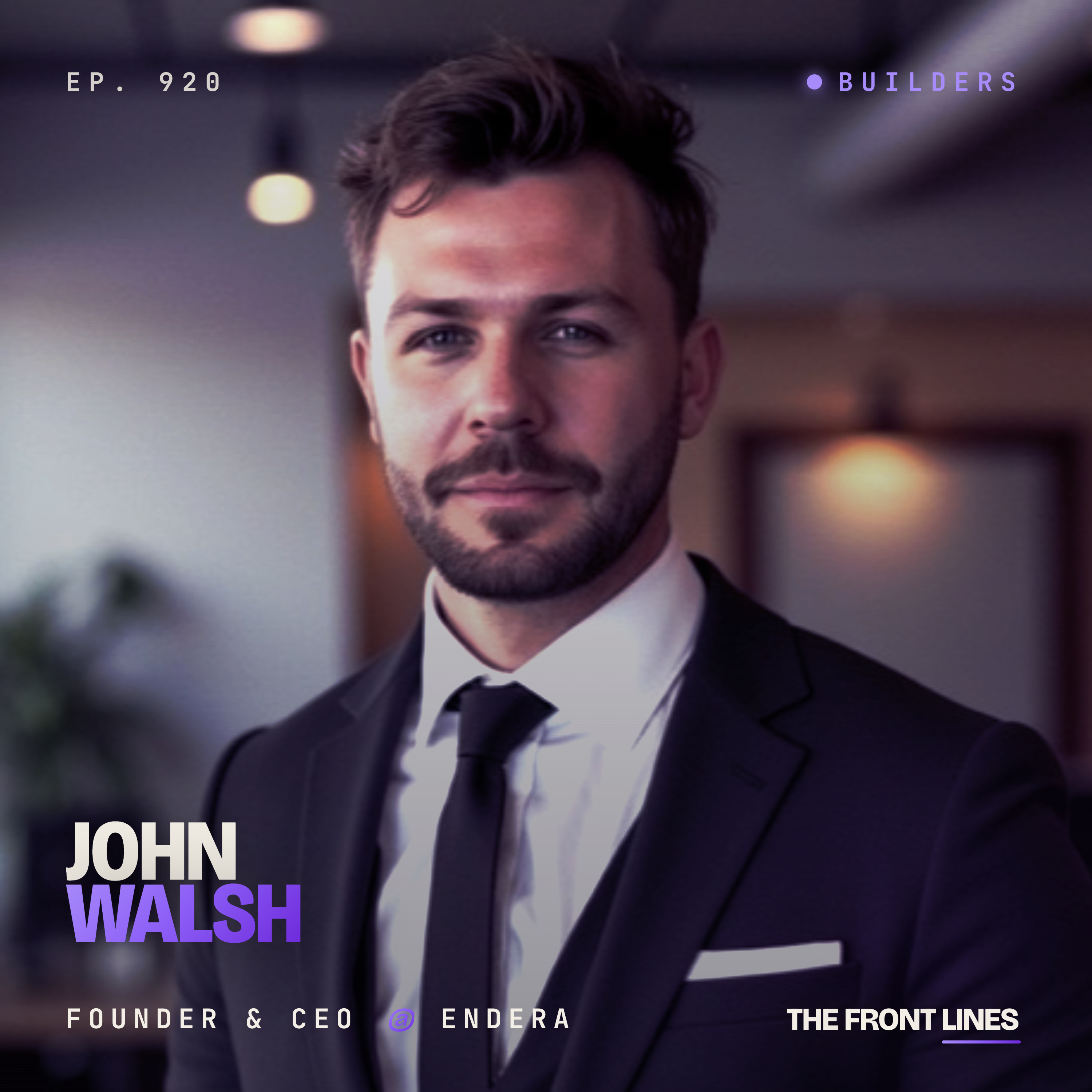
John Walsh
It was a seven figure deposit and then they said build it and I didn't even have a bus.
- [00:08]
Frontlines IO Host
Welcome back to another episode of Builders. As always, this show is brought to you by Frontlines IO, Silicon Valley's leading B2B podcast production studio. If you're bringing technology to market and want to learn from your peers, we have a library of more than 1200 interviews with Venture backed founders and marketers. Where they talk, all things go to market. Of course, if you want to launch your own podcast, we offer podcasts as a service to more than 80 tech startups. The idea there is very simple. You show up and host than we do everything else. Now with all that said, let's jump into today's episode.
- [00:41]
Brett
Our guest today is John Walsh, founder and CEO of Indera. John, thanks for being here.
- [00:45]
John Walsh
Thank you for having me, Brett.
- [00:47]
Brett
Let's imagine that you're on a flight and you have a chatty person next to you and they ask you, what do you do? How do you respond to that question?
- [00:55]
John Walsh
Well, I'm the founder and CEO of an auto company and we build specialty buses for the government. But more than just being an entrepreneur, you really have to be a good manager of people and learn how to really make everybody run the same boat, go in the same direction, which is easier said than done.
- [01:17]
Brett
I have a two year old and one of her favorite things to do is say bus, bus, bus. Every time we go by and she sees a bus, she gets so excited. Was that you as a 2 year old or you're just dreaming of buses from the early days? No.
- [01:27]
John Walsh
If I had a conversation with my 18 year old self and said that you'd be a bus manufacturer, I'd say you're crazy.
- [01:36]
Brett
What's it like being a bus manufacturer? I would imagine it's hard. Doesn't sound like one of those things where, you know, you meet a founder and they tell you what they do. I'm like, I don't want to say anything's easy, but like, that sounds pretty easy. Bus manufacturer sounds like the scale of hard pretty high.
- [01:49]
John Walsh
Yeah. And they're like, wow, I wouldn't have guessed that. Like, what do you, what do you think I am, like a, you know, software guy or.
- [02:00]
Brett
What does that take then to manufacture buses? Maybe take us inside of the manufacturing plants.
- [02:04]
John Walsh
It takes a high pain tolerance. You have to seem to like pain and suffering. But yeah, I mean, you know, there's just a lot of moving parts physically and metaphorically and you know, there's a thousand things that can and will go wrong. And a lot of coordination, a lot of people that you have to manage and you have one part that doesn't arrive on time and you can't deliver the product. And I remember a couple times I had like $10 million worth of buses that I couldn't deliver because I had a windshield wiper that, you know, didn't arrive on time and I was just like sweating. But you know, you flush it out. But we're in the middle of Ohio, which is manufacturing headquarters, kind of the country, or at least it used to be. It's considered part of the Rust belt.
- [02:53]
Brett
I grew up in Kalamazoo, Michigan. So not, not too far from you. And what is the origin story? You know, to go back a little bit there, like how did you end up the space? You didn't grow up thinking about buses. We covered that. When did you actually start to think about this?
- [03:05]
John Walsh
So I left college and I knew I wanted to start a company. I had started a couple startups when I was in college and I got farther with each of them than I did, you know, the one before, but it failed by all intensive purposes. And part of it was just not doing things in the proper order. But I got a job in private equity and I was on auto teams that were messed up, something was wrong with it. And I was on the diligence teams at first and then I joined the operations team and got to learn the ins and outs of auto manufacturing, industrial manufacturing, and then I was assigned an electric bus company and got to learn the ins and outs of ev. And I just saw transportation be really fascinating. It's like every deal was the price of a Malibu home, but there was very little regulation from the sales side. But you know, it's super old school, a lot of handshake deals, but saw an opportunity on EV and that's how we originally started. And after about a year being the side of that company, I left. And then I started Indera. And really it was a consultative approach. I went to a pilot customer and I said, I'm not going to tell you what you need. Why don't you tell me what you need and let's build this together. And flew that operator to Canada, China, the Midwest. And I wrote on a spec sheet what they said they wanted. And then they cut me a deposit. It was a seven figure deposit. And then they said build it. And I didn't even have a bus. I just wrote what they said they wanted and then they cut me deposit. And I was just sweating and I was like, oh my God, like what I just do. And because I actually now had to deliver it, you know. But the good thing was is that I knew exactly what to build, right? Like I knew exactly the blueprint. So it's like every problem became a good problem to have. Whereas like my first company, I tried to design something and I had no validation that someone would buy it. And so, you know, you can really catalyze a company with that type of methodology. But Yeah, I was 25, had a lot of confidence and not a lot of experience.
- [05:16]
Brett
And why'd you decide in the first place to sell to government? Was that the plan from day one or when did that begin?
- [05:22]
John Walsh
The government historically is really stable source of business. You are inflation proof, you're tariff proof, you're international threat proof. Because all these vehicles had to be made in America. And back in 2019, EV was just starting to get interesting. And it's interesting because now it's still increasingly popular every year. But we're selling to state agencies, we're selling to school districts, we're selling airports, and they all have these multi year mandates to reduce their carbon emissions. And 50% of our market are in these blue states that really have accelerated that plan. Now one thing government business is not, is government shutdown proof. Which I learned recently. Painfully new historic shutdowns. The good thing is that it was like in that situation, it was not lost demand, but deferred demand. We saw a snapback. But yeah, I mean historically the government's, it's a good customer to sell to.
- [06:40]
Brett
What's the procurement cycle like? Is that brutal or is that quick in the market that you're in?
- [06:44]
John Walsh
So you get on state contracts, they're five year contracts. And so there's an upfront bid work that you have to do. And then every school district in that state or every transit agency in that state can buy off of that state contract. And it's designed to accelerate the procurement or to simplify the procurement for, you know, think about like some small foothill transit district that's buying six buses. They don't want to go through this RFP process. So they buy off a state contract and then you're a vendor on this exclusive pool of vendors and then they start printing positive, at least on the gas side. On the EV side, you know, we scale the legacy gas business too, which has really made our EV more compelling from a profit equation just because you can get overhead and labor efficiencies. But with the EV side, they want more demos, right? They want to see, feel and touch it they will start with a couple units for EV and then make sure that those EVs can serve their route. They can actually, like, perform their duties because there's a lot of range anxiety. There's been a lot of horror stories from early days, but what we've seen is that once you give them the product, they realize it's a better product and then they start laying larger orders.
- [08:00]
Brett
This show is brought to you by Frontlines Media podcast production studio that helps B2B founders launch, manage and grow their own podcast. Now, if you're a founder, you may be thinking, I don't have time to host a podcast. I've got a company to build. Well, that's exactly what we built our service to do. You show up and host and we handle literally everything else. To set up a call to discuss launching your own podcast, visit Frontlines I.O. podcast. Now back to today's episode. Different industry, but we've had a lot of founders on from defense. And I always ask them, what's your number one? Go to market advice? And I wouldn't say all of them, but, you know, a good chunk of them say, hire a lobbyist. Some of the best spend that you can ever have when it comes to spending money and you're getting, getting something out of it. Is it similar for you? Like, do you spend a lot of money on lobbyists?
- [08:45]
John Walsh
I have spent money on lobbyists. The thing about lobbyists that you got to be careful of is that they're like, kind of like lawyers, right? Like, they just rack up the fees and the hours. If you just let them run and you don't have a pointed objective with them, then they go into like, Wandersville. And then like, you don't have an exact scope. The most effective use of lobbyists is when I already have a deal that we're involved with that we understand and we're going through the proper channels to procure that or to pursue that opportunity. And then for some reason, you need to open some doors and get access. Then you have a specific defined objective for that lobbyist. And you bring someone that really understands or has contacts in that realm. And then you can use that to sort of top down whatever you're trying to do or get some sort of influence, you know, and that can even start at the bid level. Right? You know, a lot of these government agencies, they regurgitate bids or contracts from their predecessors and they put requirements in these contracts that you're just like, why is that in there? Like, it's so stupid. Or it just makes no sense. And you know, or it's just like costly or time consuming. Right. But they're just. Once you get requirements in, it's very difficult to take requirements out. It's kind of like, you know, laws, right. You know, it's really hard to remove laws once they're put in place. Same thing worked for government procurement. And so sometimes you need to have someone in their ear that goes through their, you know, normal process or know someone who used to work there to let them know why this is better. And at that point, you know, I've seen it be more effective and less costly.
- [10:38]
Brett
Sounds like you had good learnings there with lobbyist equals lawyers or how lawyers at least go about billing. What have been some of the other painful lessons that you've learned as you've brought this to market?
- [10:46]
John Walsh
Oh man, a lot of painful ones.
- [10:49]
Brett
Trauma dump me. What are the. What are the worst.
- [10:52]
John Walsh
Getting your supply chain down is really important. Vertically integrating in areas that you're able to do with your circle of competence. It's typically the effective solution around supply chain. But we grew up in Covid, right? I mean, you know, we, we're the fastest growing specialty bus company in the country right now. It's because we got a quality product, take care of our customers, we vertically integrated EV to where it helps provide a cheaper product with better service and higher quality. But the road to get here was brutal. Like, you know, we had times where like in 2022, inflation was going up so high every month that our vendors were just giving us new prices. And normally you have, it's an inflation proof industry. But hyperinflation, there's a lagging indicator or it's a laggard effect because you get this annual PPI in your contracts, right? So you get to actually absorb that ppi, but you only get it at an annual renewal. So for like 11 months into a contract, I was just getting escalators by our suppliers and I couldn't absorb it with the customers. So I was getting POS printed that, you know, towards the end I was like, I was making no money on it. It was driving me crazy. And then the computer chip shortage in 2022 ended up like chassis were in really short supply. That's brutal. The wrong hire is also really brutal and really key roles. If you're looking at your C suite, it's almost like not filling the role is better than filling the wrong role or filling the role with the wrong person because they end up being a net negative and do more damage than good. And we've had times where we've had a role that was just the wrong role and then it becomes brutal to remove them, but massive working capital management to do auto. And so you have to have a lot of ingredients that go. Right. You also have to, you also have to make sure you fundraise. I mean, you got to know how to fundraise, right? Fundraising is definitely an art, not a science.
- [12:53]
Brett
What have you learned about fundraising so far? What's the art?
- [12:56]
John Walsh
The art is that it's a bunch of people, right? And you know, you've got to sell a vision, you have to concrete it in reality and you have to also execute on that. Right. A lot of people spend too much time fundraising and not enough time actually executing and focusing on the business. You have to make sure that you lean into the right investors that lean back early on. I spent too much time on the wrong type of investor. I was chasing a project equity fund that had some relatable deals, but it was not relevant. Right. And you got to look at what effective sector you're in and then make sure you have investors that match that. But yeah, too much time on the wrong investors was an early mistake for you.
- [13:44]
Brett
What is that ideal profile of investor?
- [13:46]
John Walsh
Well, it's depending on the stage, right? Like family office was great in the beginning and venture and then growth equity is where we really graduated to. We fell through the cracks early on with it. Different investors because we weren't fully climate tech, although we had this vision of accelerating the transition to clean mobility. The way we did it was scaling this legacy bus body manufacturing business so that we could drive the price of EVs down and then also have a financially healthy company, which, looking back, we looked early on, it was not sexy. But we look like geniuses later because all these EV companies, they, a lot of them went under, right? And they were EV only. And our belief was that EV was a transition. And so you know that you had the climate tech people that were like, oh, we don't like the legacy business. Right. And this was early on, but then all of a sudden everybody started liking it when people realized that EV was not going to happen overnight and that you needed to have some form of, you know, profitable business model. And, you know, so our belief is just reinvesting those dollars into driving that price down is more effective. And you know, and then we've got like debt providers for working capital. But yeah, those are our profiles. But making sure that you really understand where you're at and what stage you're at. Like if you're an early stage venture group. Don't be talking to hedge fund.
- [15:14]
Global Talent Company Announcer
This show is brought to you by the global Talent company, a marketing leader's best friend in these times of budget cuts and efficient growth. We help marketing leaders find, hire, vet and manage amazing marketing talent for 50 to 70% less than their US and European counterparts. To book a free consultation, visit GlobalTalent
- [15:33]
Brett
co. Did you have to go through any painful repositioning? Like a lot of the companies that I've talked to that were in climate or you know, selling climate as, you know, positioning, so to say they had to almost scrub it from their existence, you know, remove it from the website, change the value prop because they said like the value prop that resonated, let's say like before 2025 was no longer resonating now or whatever the timelines were. Did you have something similar happen?
- [15:57]
John Walsh
Yeah, I mean we were really an EV maker early on and we deemphasized the legacy business and when we bought that legacy business we had assume manufacturing operations and then we started selling gas buses. And so it was somewhat of a de emphasis. Right now we're a specialty, you know, we're specialty automaker, right. And you know, we provide school buses and shuttle buses. We have EV as a product. It's still a, you know, lesser part of our business, but every year it becomes larger and larger as a percent of revenue and a percent of unit sales. And we have CNG as well. We think EV is a fundamentally better technology for buses. It's fixed routes. You have slow charging overnight and you have industrial bus depots where you can lay the infrastructure, the cost per mile with fuel and maintenance is up to 75% less. But again we, you know, it's one product, right, of what we offer. And so yeah, I think that, you know, in general there's a repositioning and
- [17:07]
Brett
when you think about the product lines that are going to be the most successful, just dominate the business. Like what is the product line five years from today that's going to make up most of the revenue, would you say?
- [17:16]
John Walsh
I think that EV will be over 50% of our unit sales. We will have larger class vehicles in our portfolio and we're continuing to develop new products every year. And you know, we think that EV will be probably over 50% but on its own merits, right. The price will be cheaper, the operating cost is cheaper and the infrastructure will already be laid. A lot of these customers that we're starting to see is like their second. It's somewhat of a brownfield project. Right. Like they're replacing their existing fleet with a new fleet of EVs. So they've already got the infrastructure. Right. It's much easier. We are looking at other energy infrastructure opportunities as well that we see compelling from a commercial level. But yeah, I mean I see us growing our product portfolio and I see EV being an increasingly larger share of that over time.
- [18:10]
Brett
What about autonomous? Is that something that's on the roadmap?
- [18:13]
John Walsh
We have had some early partnership discussions on autonomy and we will be looking at doing something from a partnership level. The interesting thing about autonomy is that the insurance premiums are still so high it's the cost of a six figure driver. Right. So, so the risk models really have to come down. But they're going to come down, you know, and then they'll come down in a big way. But it's a lot more expensive to insure 20 or 30 human lives than it is to ensure one human life, like a logistics provider or even a cab. Right. So you know, right now that it's like the insurance companies value human life, I think it's like $15 million human life. Right. So it's like you have to have like a $200 million insurance policy, which is expensive. But it is coming. I mean, it's coming. I don't know if you've driven a Tesla, but I mean I've got Tesla drives that I don't drive. I mean it's crazy.
- [19:14]
Brett
Yeah, I have a Tesla and I do the drive from San Francisco to L. A all the time and I don't drive most of that time and I'm still like a little kid. Same thing. Like when I'm in a Waymo, my mind is just blown that like this is happening. It's like what we dreamed of as little kids is happening now, which is pretty cool.
- [19:29]
John Walsh
Yeah.
- [19:30]
Brett
Final question for you. When you think about the future, I know you just touched on it a little bit, but paint us a picture, the big picture vision. Let's go out maybe 10 years. What does this company look like 10 years from today?
- [19:39]
John Walsh
I think 10 years from today. I'd like to think that we are more of a mobility services company or a critical infrastructure provider that has mobility services as our predominant play where we are vertically integrated in the manufacturing, but we're also providing software and technology solutions which we currently do, but we don't control the end to end customer experience. I think that if you look at UberPool and what you can do with adopting those same types of technologies to transit operations, that 10 years from now it's going to be autonomous vehicles and asset sharing. Still think the most efficient way to move people is in buses, right versus cars. So having autonomous buses operating in a network that are leveraging an Uber like technology without fixed routes and the ability to deploy those assets in areas where they have demand prediction and they understand where there's people that want to get picked up and dropped off, it will drive the cost of transportation down dramatically. And so EV buses with autonomous technology combined with Uber like ride sharing is where I see the future of public transportation.
- [21:05]
Brett
All right. That's where we're going to end things. Where should we send people if they just want to follow along with you and your journey?
- [21:10]
John Walsh
Sure, you can go to www.enderaendera c o r p.com Amazing.
- [21:19]
Brett
John, thanks so much for taking the time.
- [21:20]
John Walsh
Take care, Brett.
- [21:24]
Frontlines IO Host
Well, that's all for today's episode of Builders, brought to you by the Frontlines. If you want more amazing content like this, visit Frontlines IO, where you'll find the library of more than 1500 interviews with founders, marketers, and other GTM leaders, where we unpack the tactical lessons from their journey. And of course, as always, you if you do want to launch your own podcast, we'd love to have a conversation with you. Visit Frontlines IO Podcast as a service. Mention that you listen, mention you love
- [21:49]
Brett
the show, and we'll give you a 10% discount. Thanks for listening. We'll catch you on the next episode.