Loading summary
Transcript32 lines
- [00:00]
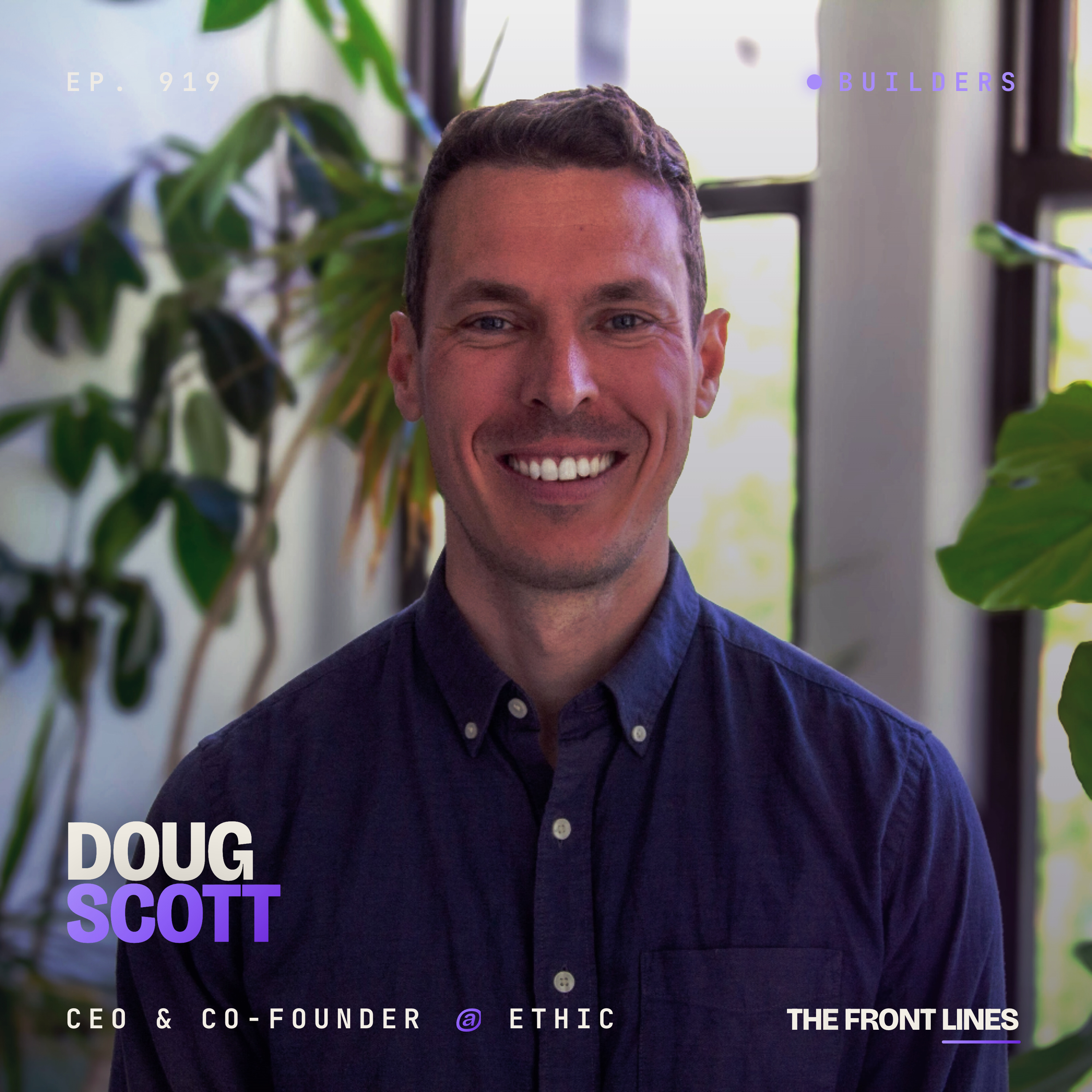
Doug Scott
We had zero followers on YouTube and we're over 200,000 views. And you gotta lead with a good product. In this case, it's the content itself.
- [00:11]
Brett
Welcome back to another episode of Builders. As always, this show is brought to you by Frontlines IO, Silicon Valley's leading B2B podcast production studio. If you're bringing technology to market and want to learn from your peers, we have a library of more than 1200 interviews with Venture backed founders and marketers. Where they talk, all things go to market. Of course, if you want to launch your own podcast, we offer podcasts as a service to more than 80 tech startups. The idea there is very simple. You show up and host and we do everything else. Now with all that said, let's jump into today's episode. Today we're speaking with Doug Scott, CEO and co founder of Ethic. Doug, thanks for being here. Pleasure to be here, fellow podcaster. Always fun talking with another podcaster.
- [00:54]
Doug Scott
Yeah, it's fun to be on this side of the mock refine.
- [00:57]
Brett
We're going to be going deep on podcasting and what you're doing with your podcast, but maybe let's take a step back. Let's talk about your company. Tell us a bit more about what you do.
- [01:04]
Doug Scott
So I'm founder and CEO of Ethic and we build customized tax smart and values aligned investing for advisors and institutions. So you can think of this as delivering a platform that allows an investment advisor to personalize across their entire book of business based on the objectives of their client base, all of the issues that they care about, and all of the underlying considerations, whether those are financial considerations, values considerations, tax considerations, and then we are managing that portfolios across all of those different households and accounts. So today we manage over 9 billion in assets across about 300 different investment advisory businesses. Everything from a small wealth management business up to some of the largest platforms, endowments, foundations, those kind of things.
- [01:53]
Brett
And I know you're what, 11 years into the journey so far. Maybe talk us through the different chapters of the company, if it can be
- [01:59]
Doug Scott
broken up that way for sure. So I mean the earliest chapter, as everyone who's ever founded a company, it's chewing glass and staring into the abyss type chapter. You know, we picked, let's call it the path of maximum resistance in a go to market. I would say most in the investment world and in starting a business in financial technology tend to go consumer route. And mainly that's because it's able to acquire customers quicker, get out from zero to one quicker. We decided to go a Different route. And that first phase, we said, look, our experience and what we believe the problem statement is, is centered on this sort of more sophisticated financial professional who is managing portfolios across individuals, families, endowments, foundations. But the trade off with that is while these are big pools of capital, it's typically a very trust based environment. And it's typically very sort of risk averse. And so going from $0 under management to any dollars under management is challenging. And so that first phase, getting the first few accounts really and then getting ourselves to these sort of psychological threshold. So the first big psychological threshold for our business was getting up to 100 million. But in the early days, even well before all of that, you know, we spent years building technology and proving that we can deliver something that we believe that would be 10x better than anything out there to give you flavor for, like our product, if you like. It's basically the simplest version of it. If you take an index like investment, you unwrap it and you customize it across all of the different considerations that you care about. And then we manage that at scale. And so when we go in, we were pitching against some of the largest institutions and asset managers in the world and we came in with just a very technology first, deep customization, seamless client experience like that was very differentiated to what was available. But even with all of those advantages on the product side, it was still very hard. And so that phase was like that kind of getting from, let's call it like the, you know, earliest phase, the founding of the business up until really just kind of that touching product market fit. So series A ish timeframe. And then there was sort of taking that spark of product market fit and then sort of getting to building culture and teams. And then after that it becomes team of teams and it becomes very different problems. And you know, you hit these different milestones with 100 million, 250 million billion, et cetera, et cetera. And you know, as I said, we're on the path towards, you know, above 9 billion now and knock on wood, hopefully 10 billion pretty soon. So, you know, business has really, you know, grown considerably since then. But you know, the earliest days are definitely some of the more challenging.
- [04:27]
Brett
And you, when you reflect on all of that growth, what would you say were some of the growth levers and the marketing levers that you put in place that just really worked?
- [04:35]
Doug Scott
Okay, so coming up between CNA is when typically you're going out to hire your first salesperson, proper salesperson.
- [04:41]
Brett
Right.
- [04:41]
Doug Scott
And I think, you know, some of the bigger Lessons was moving from founder led sales to the first, you know, growth leader who's actually still with us today. Incredible growth leader. The challenge I think you have there is really disseminating the value prop, you know, because the builder, if you are the builder and you're then also the distributor of the product, and I like to use that word distributor, if you're one person, you can very easily go back and forward as soon as you start to move into, hey, I'm bringing someone else in to lead the go to market initiative that you then immediately have a translation issue. So I think one of the biggest issues is obviously like be good at hiring, which is hard to do in the best of times, but even more so once you find the right person, making sure that loop between what you're hearing from clients into the actual building experience is really tight. Once you're getting past the Series A's, you've hit some sort of product market fit. Our business is a little different perhaps to most software businesses because, you know, the actual, you know, solution itself is investment portfolios. Like we are managing money, we are registered. And so because of that, it's like the marketing models you have are a little different than you would have. Like we found that paid advertising was not a fit for us. We've done very little of that in the history of the company. What we found was distribution partnerships were really effective. And so finding a great distribution partners where you have very naturally complementary solutions where we can provide what we believe to be, As I said, a 10x better solution. And that partner then brings say distribution into a wider audience. We found that to be really effective. And then as we kind of scaled further, it became more about the culture of that grow to market team. And there's a whole bunch of learnings that I could go into around how to build culture and especially in sales teams. But I'd say those are key ones, right? Getting that product feedback loop really tight in that first hire and then also finding the right go to market motion and being comfortable, experimenting, right? Because if your business is different as you think it may be, you've got to test things and you've got to have an experimental mindset not dissimilar to the way you build solutions.
- [06:34]
Brett
This show is brought to you by Frontlines Media, a podcast production studio that helps B2B founders launch, manage and grow their own podcast. Now, if you're a founder, you may be thinking, I don't have time to host a podcast, I've got a company to build. Well, that's exactly what we built our service to do. You show up and host and we handle literally everything else. To set up a call to discuss launching your own podcast, visit Frontlines I.O. podcast. Now back to today's episode. Can you think back to a specific experiment that you ran? And I'm especially interested in the ones that you maybe thought weren't going to work that well, and they did work. I don't know about your experience, but normally it's opposite for me. The things that I think are going to work very well don't. And then. Yeah. Versus true.
- [07:12]
Doug Scott
Yeah, that's a good question. I mean we tried quite a lot of things. Well, I'll give you one of the ones that the direction is right, but the execution was really hard to get right, let's say that. Right. So the theory of it, especially on the distribution partnerships, it makes a lot of sense what I said, you know, you have a big and typically there's a big asymmetry between the size of distribution partner you're working with, like big financial custodians, those kind of folks, and then your business. Right. There's usually a big difference because they're looking for innovation. You're looking for a distribution partner that has reach. I would say getting that right is really hard. And we tested lots of different ways to actually execute there. What we found is when there was a big disconnect between, let's call it the people leading the partnership discussions and alignment and negotiations and the people on the ground who are actually responsible for distribution. If you don't have a line between there, you're toast. Like there's no way you can have all of the buy in from the top you want. But if the people on the ground aren't incentivized, aren't understanding, aren't educated, aren't actually motivated and capable of pushing out solutions, you're never going to get the reach you want. And so we learned that lesson a little bit the hard way. We tested and tried and really tried to incentivize and try to get everything all kind of aligned in terms of incentives, but that was quite complicated. And as I said, I don't think that any one large organization is identical, but there are definitely patterns. And we tried a bunch of them that were somewhere significantly more effective than others. So that's definitely one big learning. I think, as I said before, one of the other ones I think is if you know venture capitalists in particular, they'll give you patents, they'll like, oh, this works for this company and this works for that company. And on many different occasions I had discussions with investors that were saying this, you know, this really works for this go to Market Motion and this type of client, like let's say enterprise software, right? Here's what works in enterprise software. If you take that playbook verbatim and just try and implement it without being idiosyncratic on the kind of business you're running and the motion and the clients and the client's problems, it's unlikely going to, it's highly likely you're going to run into problems, I'll put it that way. And we saw that, right? We had folks saying, oh well, you should create minimum dollar amounts in terms of providing software solutions to clients and things like that. And I said no, it's not going to work. It's two different for the type of client that we work with, they're just not going to accept that. And so you have to back yourself in understanding the client problem better. And so I guess that's another one that we sort of tested in some ways, but really never really implemented because I knew it would be such an anathema to our client base. If you understand the client well, you should then tailor your go to Market Motion around that not, hey, this is what worked for these five companies and we should just go and try all those five things. That would be one of my other big learnings, I would say, especially early days.
- [09:56]
Brett
Yeah, I would say I deeply do not believe in this idea of playbooks. I've seen it even where someone could be coming from, let's say it's a cybersecurity company and they have a proven playbook from another cybersecurity company. They come in, they try to run that same Playbook and it doesn't work because that other cybersecurity company was series D. This startup is series A and just a completely different scenario. Or this startup had a very famous founder, this had a first time founder and it's a totally different motion. Like I think that idea of just a Playbook, it's a nice fantasy. Like I think there's like for sure things to learn. But I know a lot of founders where they kind of seem to like float around with this idea that they just need to find the right person to come in with the right playbook, install it and boom. And sounds great on paper, but I don't know if that's ever worked out that great.
- [10:38]
Doug Scott
Yeah, I completely agree. A mentor of mine once said to me, what is the opposite of an enduring truth? I was like Ah, he said, another enduring truth. And it's sort of this example where you can give case studies on companies that look almost identical, that use entirely different strategies and are successful or not successful for it. It is very hard to give a playbook a set of generalized this is always going to work advice. And that's true of go to market. It's also true product. That's also true of almost any part of building companies, I would say.
- [11:10]
Brett
Yeah, I mean it's kind of like a get rich quick thing, right? It sounds too good to be true. Like, oh, you just come install a playbook for any part of the business and it works. Now I want to take time to talk about you one specific thing. I alluded to that at the start, but it's your podcast. So prior to this starting, you know, we go through our process of doing research for guests. I went through, saw that you had a podcast. I immediately took a screenshot of your YouTube channel, sent it to my team and said, guys, this is an example of just amazing work, perfectly executed. So you and your team are just doing an amazing job. Maybe just talk to us a little bit about the genesis of why you decided to launch the podcast in the first place.
- [11:43]
Doug Scott
Well, thank you. Firstly, that's very kind of you. And you know, we've invested a lot in terms of the thinking here, but I can. The genesis is really was born with this concept of how do we help elevate our ecosystem and get the leaders in our ecosystem to tell the kind of stories that I hear every day. And exactly in the same way that kind of we're doing here is like you learn from that experience. And what we found in the advisory space, specifically in wealth management, there was a big gap for high quality content that was talking about almost like the how I built this type thinking in the wealth and asset management ecosystem. And so we had this idea, it was about a year ago now and we said, okay, well you know, let's invest. And we'd invested in video because we think that video content is the future for a lot of content creation. And so we actually turned an old space that we had into a whole virtual production studio. We've got an amazing team here that focuses on building and we were able to create this incredible content and it's been a real joy. You know, as I said, I'm usually more recently now because of Work Ethic is the name of the podcast and the interview series. But because of Work Ethic, I'm unusually on your side. So it's nice to Be back on the other side, because prior to that, it was very much on the other side of the microphone, so to speak. But it's been really inspiring because it allows our sort of ecosystem to share the stories, what they. The lessons that they've gone through, you know, the arc of their careers and how they've faced, you know, some adversity and overcome adversity and built businesses and all of the challenges and leadership lessons, what they look for in talent. It's been a really great investment and it's got a lot. You know, we're over 200,000 views, even though we're only a couple episodes in, which is really remarkable. It's definitely exceeded everyone's expectations for sure, even though we had high expectations that have exceeded them. So, yeah, I'm a big fan of this style, so kudos for you also. Similarly, for building out a great interview series and podcast series as well.
- [13:34]
Brett
Have you followed TVPN at all?
- [13:36]
Doug Scott
A little bit. I do definitely follow some of the more popular shows. Are you a fan? This show is brought to you by the global talent company, A marketing leader's best friend. In these times of budget cuts and efficient growth, we help marketing leaders find, hire, vet and manage amazing marketing talent for 50 to 70% less than their US and European counterparts. To book a free consultation, visit globaltalent.co.
- [14:01]
Brett
yeah, I think, you know, the. Or you know why I'm mentioning it. You know, they had this pretty much, like, incredible outcome would be. I think that's underselling it. You know, they started this podcast. Eighteen months later, they sold it for what people say was 200 million to OpenAI. And just like, the rise and like, the velocity, like, the pace, like, how they pulled that off in 18 months was just insane. Like, they captured all of, like, the attention of Silicon Valley, you know, in a very, very short period of time. And one of the kind of, like, legends that they've talked about is early on they were chatting with David Senra, the guy who hosts that other podcast called Founders, and he told them, like, you guys should take this, like, very, very seriously and, like, take it more seriously than, like, you're even thinking about it right now. And they did. And I think that's why it was so successful. Like, they went and booked a. Or rented out a, you know, l A studio space. Like, their production quality, like, everything was just like, level 10. And I think that you've done that too. Like, you didn't do this as, like, oh, this side thing. We're going to have kind of a Zoom podcast, it looks like you went very much all in. Like, if we're going to do this, like we're going to do it right. What gave you the confidence to do that? Because, like, that sounds cool to me, but also probably sounds expensive to your CFO or whoever's kind of looking at the numbers in the map.
- [15:09]
Doug Scott
It is. And it goes to the go to market motion and the go to market strategy, you know, we built it and said, what is the way to best engage with our ecosystem in a way that we can elevate their stories? It's not about me talking, it's about us elevating their stories. And so we were very clear. And this is what the sort of the go to market strategy. I think Content Driven Inbound has been a great channel for us over the years. And so it was a natural evolution because we'd already invested in video content because we have even in our user experience, in our platform for our clients, a lot of our service content, we do video content and a lot of our product releases, we do video content. So we'd invested in some of the infrastructure to be able to scale that. And we experimented, you know, in the early days, we experimented trying to use others and it didn't quite fit. It was always. There was always a bit of a lag and the quality and the cost and everything we said, you know what, let's just bring it in house. And I think it's also a. We have a sort of default build mindset, I think, as a company. And so. But yeah, it was, you know, you got to invest, like you said, you can't sort of do it on the side gig and not really pay full attention to it. You got to invest properly. You got to have the creative talent to be able to pull it off and you gotta have the quality of guests and the narratives that are really interesting to a wide audience. And I think, you know, at least so far it's been really the sort of across all of those different areas, it's really worked quite well.
- [16:28]
Brett
And you don't have to share the exact number if you don't want to. But like, what would you say you invested to even like the studio space to get that built out? Like a high level? Like, what are you looking at for like year one of this?
- [16:38]
Doug Scott
I probably can't quote the specifics, but it's an investment, you know. You know, think of it as, again, going back to the cost of acquisition. If your business is a paid acquisition business, which ours is not, you know, that's an expensive go to market motion. You've got to have your unit economics. This is the same, like in the same way, you've got to have unit economics attached to it. You've got to understand, you know, this is what we're building out and this is the ROI we're looking on and this is what we're trying to deliver out of it. And you want to create, you know, quality content that's going to achieve the kind of outcomes you're trying to get in terms of reach. And also it's really beneficial for partners. You know, it's beneficial all around. It's a classic win win scenario where, you know, partners that we work with are trying to grow their businesses. And you know, if they're trying to grow their businesses, then like having sort of an amplification tool with high quality content is really beneficial for them as well. And so that's been a really, really
- [17:27]
Brett
powerful, you know, one insight that we've had and it sounds like may have been similar for you. You know, like on our side we spent so much money on like LinkedIn ads and Google Ads and I would overall say we got, you know, nothing out of that. Like it didn't work for our business. And now what we've done is we went all in on this podcast network. We have about 20 different shows, all for founders, for marketers, and the audience of those shows are those exact people. Those are the exact people that we're trying to sell to. So for us we just have ads for our own services within our network. We now spend $0 on LinkedIn ads, on Google Ads. We just put all of that money into content and our own audience. And unlike LinkedIn ads where I sit there, I'm like, we spent this much money and got nothing out of it. At least the podcast that compounds over time the audience grows and like, I feel comfortable making that bet of what let's just do more. Like, I don't know what it means, but like full throttle, more episodes, let's grow the audience and like, I think good things will come if you just obsess over the audience and build that audience out.
- [18:22]
Doug Scott
Yeah, absolutely. And you've got to have the data and systems to be able to then follow on. Right. Like once you have, you know, intense signals and all these different things that help you then create world class content, distribute it really well and then be able to follow up where it makes a lot of sense. You want to get that flywheel and you know, it sounds like you guys have definitely done a great job on this because it's not easy to build really high quality content, especially with a lot of like, low quality content, let's say, is flooding the markets. You know, you've got to put something out there that people want to listen to and people want to watch.
- [18:54]
Brett
I think that's the nice thing. And yeah, we talk about that a lot. It's like, oh, there's a lot of podcasts. Like, true, there are a lot of podcasts, but are there a lot of like super, super premium podcasts? Especially if you look at like the B2B world, like, is there stuff that looks like Theo Vaughn or like Joe Rogan level, like, production quality in these, like, niche B2B markets? Like, absolutely not. Like, there's a long way to go before that gets saturated.
- [19:13]
Doug Scott
Yeah, it's usually like two people on Zoom and it's like, you know, with virtual backgrounds or something, you know, and I mean, definitely our first episode was in late February, so like a couple months ago. And you know, we had zero followers on YouTube and like, you know, as I said, we're over 200,000 views and you know, it's like, it's really impressive and but again, it goes to the test. You got to lead with a good product. In this case, it's the content itself. So, yeah, I completely agree on that front.
- [19:40]
Brett
Yeah, content. Content is the product. Doug, we're up on time, so unfortunately we have to wrap. I would love to have you come back on and do another episode every couple of months.
- [19:46]
Doug Scott
Yeah, let's do it. Let's do it. Maybe you can come into New York and we'll do an in person one at some point.
- [19:51]
Brett
Amazing, man. I love that. Thanks so much for taking the time.
- [19:53]
Doug Scott
Thanks, Brett. Cheers, mate.
- [19:58]
Brett
Well, that's all for today's episode of Builders, brought to you by the Frontlines. If you want more amazing content like this, visit Frontlines IE where you'll find a lot library of more than 1500 interviews with founders, marketers and other GTM leaders where we unpack the tactical lessons from their journey. And of course, as always, if you do want to launch your own podcast, we'd love to have a conversation with you. Visit Frontlines IO podcast as a service. Mention that you listen, mention you love the show, and we'll give you a 10% discount. Thanks for listening. We'll catch you on the next episode.