Loading summary
Transcript42 lines
- [00:00]
A
If I had to pick the most important one that we have today, I would say is the one around basically activating our partners. Yeah, I think this is the one that is the most fundamental for us.
- [00:15]
B
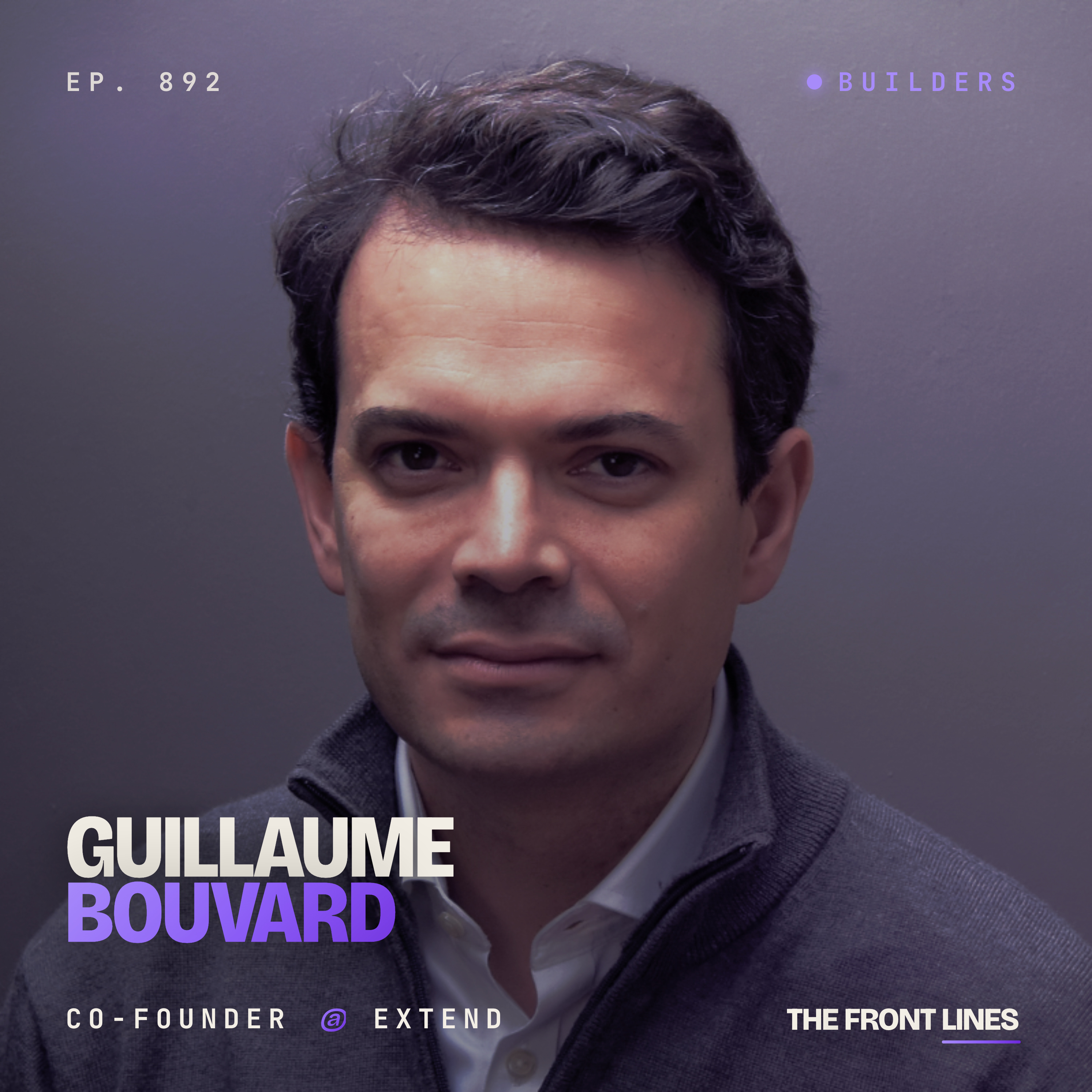
Welcome back to another episode of Builders. As always, this show is brought to you by Frontlines IO, Silicon Valley's leading B2B podcast production studio. If you're bringing technology to market and want to learn from your peers, we have a library of more than 1200 interviews with Venture backed founders and marketers. Where they talk, all things go to market. Of course, if you want to launch your own podcast, we offer podcasts as a service to more than 80 tech startups. The idea there is very simple. You show up and host and we do everything else. Now with all that said, let's jump into today's episode. Today we're speaking with Guillaume, co founder, COO and CMO of Xtend Enterprises. Guillaume, welcome to the show.
- [00:55]
A
Welcome. Very happy to be here. Thank you Brett for having me.
- [00:58]
B
Really looking forward to this conversation. Let's go ahead and jump right in. So let's imagine that you're taking a flight from Paris to New York City. Someone next to you is very chatty, they like to talk and they ask you that question, what do you do for work? How do you answer that question? How do you describe what you do?
- [01:13]
A
Question in a couple words I would basically say that I'm the co founder, CMO and CEO of a company that is based in New York City. It's a company called xcend that operates at the intersection of two different markets. One, the financial infrastructure. We were basically selling to banks and really get them to distribute a solution that we have built for their clients. And we are also on the business plan and expense management side where we're basically offering these businesses a solution to manage the way they make payments for their business. And so at the end of the day, what's our business? Truly what we're trying to do is we're trying to be the default if you want spending and expense management layer that the bank offers to their business clients. So that's my job, basically bring this to market and make it as successful as possible.
- [02:05]
B
Today in day one, did you have the title COO and cmo? That seemed like to me at least a very unique combination.
- [02:13]
A
I guess so. You know, there's a little bit of a story behind that and I may not be the best at both, but I certainly feeling that the old hat. You know, when we co founded the company we were three people. We still are the three co founders, one of them, Andrew, he and I were basically from American Express and worked together there. And he's truly very good in everything related to partner management, business development, et cetera. And he has some product expertise also. And so when we started the company, he took that on. That felt like the right place for him. The third co founder, his name is Danny, was a developer, a designer, very smart too. And so obviously he took on the CTO role at the time and took on the product role. Although that's a role that we, at the beginning, at the beginning, at least we shared. And then the other function, you know, were more of my area. I had some marketing experience and expertise from my time at Capital One and American Express. Really love the topic, talk about it at length. And I also run some businesses at American Express and so had the operational experience too. So in some ways that's the way we built the company and that remains today.
- [03:23]
B
What did you learn from your time at Amex? So you were there for 12 years, so decent amount of time of your big chunk of your career spent there. What are some of the learnings from just how that organization works and what you took with you in terms of ideas and insights when you founded the company?
- [03:38]
A
Oh my goodness, that took so much. I mean, amex is an incredible company to stay and you know, one of the key reason I think we were able to be successful when we launched XTND was everything I brought, Andrew. We brought with us in particular the strong network of individual that we created over the years. XTEND is a solution that we sell to the banks and the financial institution. And what you see in the industry, for anyone who knows the industry, is that there's a lot of Amex people who have gone into other players over the years. And so that has been extremely helpful and very, very helpful for the years to be able to pick up the phone and talk to an executive at Bank A or other financial institution, because we knew them before. In particular, when I was at American Express, I was in the strategic planning group when I started my career there. And it was a very small group that actually worked with the CEO and all this speed. And so when I left, I basically had this incredible network that I could basically contact and tell them, like, here's what I'm doing, would you be interested for your portfolio of customers? And that actually, you know, the ability to open the doors was absolutely fundamental, I think, and still is today, by the way, to our success. But that's not the only thing. Obviously I took from My time at American Express. Going back to your question, again, as I said, great people, really great learning environment, everything from financial, business run marketing. I mean they have a unique value proposition. They have been doing an incredible job over the years at positioning themselves and driving value to their clients. And so can I. Took a lot.
- [05:14]
B
And if we look at, you know, founding the company 2016, at what point in the founding history did you really turn on marketing? And I talked to some founders where they say we didn't have to turn on marketing for like three years because we were just so focused on selling to our existing relationships, you know, like nothing mattered. Basically. From a marketing perspective for you, were you turning on marketing day one or when did you really start to turn on the marketing machine?
- [05:36]
A
Yeah, we did turn it on fairly early on is I have a. I don't very much believe in, you know, build a product and things will happen. I've never really bought that story. I've seen too many great products where, you know, no one is aware of them and therefore no one buy them and they have not been able to tell their story, tell their value, et cetera. So I think marketing plays a role from day one. I think it's a question of how you define marketing, obviously. But the first document you put together that actually start to talk about your value proposition is a marketing collateral piece that it's nothing more than that. And the first time you put your website together, it is a marketing piece. And so I think again we started really early on having maybe day one as you said, you know, having thought about how do we position our product, what is a value proposition and know what's our vision, mission like, how do we integrate all of these into our messaging, et cetera. So yeah, I would say very, very early on.
- [06:32]
B
And what does the marketing program look like today? Maybe paint us a picture of what it looks like and then any of the key evolutions along the way to get to the point that you're at today.
- [06:40]
A
Yeah, and maybe I'll just talk about where we are today. I will give you the big picture. So the way I look at marketing is I first look at what is the growth motion of our company and then I try to map activities if you want, or group of activities. The gross motion of our business. And so the gross motion of our business, there is really four of them. What do we do? We basically sell our solution to banks. That's the first thing first gross motion. And we do that directly of two partners is very important. Two, we actually partner with these partners we acquire customers through them. So there's a sig on growth motion. The third one is we do, and it's a very tiny one, but it still exists. We do acquire customers ourselves. And the third one is we enable and more customers. If you want to retain and grow customers, that's truly the form of growth motion. And so then you think about, okay, well how do I actually support these growth motion with marketing activities? Yeah. And so the first one that we have about acquiring banks, how do I do that and how do I also acquire businesses through partners? Well, a lot of it is about sales enablement. So my first marketing at pillar, if you want, is about market is about basically sales enablement and truly enabling our partner and activating our partners and our sales team also. But to acquire banks and users, that's the first marketing pillar. The second one has to do with capturing the demand at the end of the day, all these customers and prospect, if you want, wherever they come from, whether they come from our partners or they found us by searching on the web, they need to find us. And when they found us, they need to actually learn about us and they need to be able to be acquired by us. So it's almost like think about middle of the funnel all the way to the bottom of the funnel. We need to be able to nurture these relationships before the customers are signed. They need to be able to learn about our product, our value proposition, et cetera. So I have a marketing pillar which is about capturing that demand along the funnel. And that's a very important one. Then my third pillar is obviously everything about attending this and onboarding these customers and educating them, our product once they have signed so that they actually want to grow and really use the product to the maximum of the value it can actually generate for them. And then along the way we can and et cetera, et cetera. And it's wonderful to do that. So that's my third marketing pillar and I have one that kind of like feed into all of the other ones, or maybe I should say all the other ones. And that's the one that is around truly establishing ourselves in the marketplace to drive awareness, credibility, trust, because especially when it comes to financial services, that element of trust, so fundamental and obviously awareness I talked a little bit about earlier, you know, if you have a product no one hears about it, knows about it, then it is great. So this last pillar, you could argue is at the very top of the marketing funnel, actually supports every single other piece of the growth motion of the company.
- [09:44]
B
This show is brought to you by Frontlines Media, a podcast production studio that helps B2B founders launch, manage and grow their own podcast. Now, if you're a founder, you may be thinking, I don't have time to host a podcast. I've got a company to build. Well, that's exactly what we built our service to do. You show up and host, and we handle literally everything else. To set up a call to discuss launching your own podcast, visit Frontlines I.O. podcast. Now back to today's episode. If we look at the first part there, that, that funnel, what's the demand that you're trying to capture in terms of line item, in terms of category? Like, what are people searching for in the first place?
- [10:17]
A
Yeah, so first of all, we have multiple audiences that we're trying to target here. Yeah, we have the magic. They are, they're usually product people at the banks, product leaders and executives at financial institutions that actually are trying to offer a new and better solution to their business clients. So that's one group of one audience. The second one is truly the buyers of these solutions. So think about CFOs, head of procurement, head of product, potentially head of HR, you know, financial director, et cetera, et cetera. This kind of the operations of a business that actually to enhance their internal operations with a product that actually give them more control, more visibility, a lot of automation and efficiencies, because that's so important nowadays. And so this is our 1 group. It's usually companies that are between 20 and 500 people, but we have customers are way bigger. Like we have a couple portion, 500 to even 40, 50, and then we have a lot of to our customers too. But the ideal profile for our customers, usually between. Yeah, think about it. Or head of business between 20 and 500 people. It's probably the main focus of our customers.
- [11:28]
B
And you think through those different pillars that you just walked us through, is there one in particular that right now you're really spending a lot of time on and trying to optimize and put energy into all of them?
- [11:38]
A
We have a great marketing team that actually is really decked against these four pillars. And, you know, they are heads down in trying to deliver against the goals for each of these. I would say if I had to pick the most important one that we have today, I would say is the one around basically activating our partners. I think this is the one that is the most fundamental for us. You know, it's working with our partner so that their sales team can actually distribute our product. And for that, the way I Look at it is the sales team of our partners needs to be educated. They need to understand our product. They need to be equipped. If I talk to a customer, I need to have something to tell them about, but also maybe a piece of collateral or you know, demo or something. And then they need to have some incentive to actually do it. Yeah. So they need to understand the value proposition that their company is going to get out of these sales, but also potentially what they will get out of these sales. And so if I do these three things the right way and consistently, then I actually think I have a successful activation. If you want, with my, with the salespeople. And then we also work with partners to go beyond B2B sales. We also go into digital channels. So that's the another part of that pillar.
- [12:56]
B
Is there anything that you spent time, money, energy, resources on to activate partners that just didn't really work? You reflect back, you're like, all right, that was a waste of money or we probably could have spent a little
- [13:07]
A
bit less on that with partners. Yeah, I mean we're in the world of B2B2B and so what you realize is a lot of our partners are financial institutions. And it's very different than a B2B2B model where for instance, in the, in the model of Bloomberg. Sorry, I'm going to take a little bit of step back. In the model of Bloomberg, you know, they would have salespeople would go on the training floor and go from one desk to another desk to another desk and sell the Bloomberg solution. That worked really well because they were all in one place. Wonderful. It's really hard for me to send salespeople or sell enablement people if you want and find all the salespeople one of our financial institutions because they are distributed people. And so we need to have someone on the road and knocking on doors of homes is the home of ourselves, the salespeople of our partners basically everywhere in the US and that's not working. It's not possible. And so, you know, trying to distribute, you know, having our team everywhere and knocking on doors everywhere, it's not happening. And so we are always looking for ways to actually connect with our partners in places where they actually gather their sales team because we can't do the one to one unfortunately in person. The post Covid has enabled us to make that in a digital way, the remote way, but it's never as good as, you know, in person.
- [14:28]
B
That seems to be a big shift anyways, right now, at least from what I'm seeing is like the shift from digital to analog. In this like Covid era, everything was online. But it seems like people crave in person experiences and people want to be offline more and more.
- [14:42]
A
Yeah, certainly. I think, you know, the way I talk to my team about it sometimes I say, you know, especially in the world of AI, one day, Brett, you may actually be an avatar of yourself. In fact, you may actually be giving about 3, 4, 10 interviews at the same time because you will be a brat. Avatar one, Brett. Avatar one, Brett. Avatar two. And I on the other end, all the other interviewees that you may have may actually not even realize that. And that's made possible not just because of AI, but because of these remote conversations. It's not as easy as to do that in person. And I think as you said, people create more the moment where they can actually, you know, shake hand and have a glass and laugh in three dimension, not two dimension. And I'm one of them for sure.
- [15:27]
B
And it seems like that's only going to dial up right as this technology evolves as like we start to have those valid questions like am I actually talking to Gilmore? Is this like an avatar? Like as that becomes like today, you know, the technology is not quite there, it's close but like as that becomes a reality, I think it's going to aggressively lean more and more towards like in person, human experiences. Like I think that's the trend.
- [15:48]
A
A hundred percent agree with that. And I actually think the technology is actually here. I have used just for the fun of it a year ago already. So a platform where you can create your own avatar of yourself. And so it's not like a, it's not a drawing, it's actually based on a small recording of myself. Then that platform allows me to then basically inject any text I want. And then the person on the screen is me speaking that the language I picked and basically everything on my face and my arms move based on the text that I give it. And that text can be completely generated by AI, which is actually a little scary. In fact, I'll tell you a little bit of a fun story. Fun and scary for me. I was preparing an interview because one day I was also on Pioneer Shoes. And so it was actually about AI and the person that was supposed to interview and that 250 people are going to listen to that webinar. He and I could not get in. So I prepared question and what I do, of course I use AI to create a question. Yeah, to think about what I want to talk to him about. I sent that to him. And again, as I said, we could not meet and discuss them. So we prepared the answer on his end, which I have no doubt we're using AI. Yeah. And so then we went into that conversation in front of everyone and it felt really weird. I felt that I was a form factor of AI and that he was a form factor of AI. We probably use the same AI engine, by the way. So it was almost like AI speaking to AI through two humans. This is really scary. Where are we going? It's basically, where is our brain? We have two AI speaking to one another. It just happened to do that through humans. So, anyway, a quick story that, you know, telling for me.
- [17:33]
B
This show is brought to you by the global talent company, a marketing leader's best friend.
- [17:37]
A
In these times of budget cuts and efficient growth, we help marketing leaders find,
- [17:41]
B
hire, vet and manage amazing marketing talent
- [17:44]
A
for 50 to 70% less than their
- [17:47]
B
US and European counterparts. To book a free consultation, visit globaltalent.co. we had an interesting moment the other day. We're building some internal tooling and we hired a dev shop to do it. And they sent us this, you know, very aggressive, long questionnaire. And, like, just from how the words were written, like, it was very clear, you know, that it was like AI generated. I was answering that and then I got like the fourth question. I'm like, this is just AI. I'm just going to put it into AI. So then, like, I go and fill out their questionnaire with AI, send it back to them, we do a strategy call, and very clearly they just fed that into AI. I'm like, what are we doing here, guys? Like, we're just all working on the AI right now.
- [18:21]
A
I tell you, the human is becoming the form factor. It's a portal.
- [18:26]
B
That's a problem that's crazy to think about. I think in general with AI, you know, like, my brain is split between like, oh, my God, this is amazing and oh, my God, this is scary. And, like, those are two consistent beliefs at all times. I don't know about you, but, like, I'm at the state of my AI journey now where, like, I'm losing sleep because I'm so excited about, like, what's possible and, like, what can be built and what can be done. But also it's driven somewhat by, like, fear because it's like, if we don't do this now, like, we're going to fall behind. Like, this is here. It's now, like 10 years from now, it's going to be doing this. It's like one month from now it could be doing this stuff and like we need to all start planning for that.
- [19:01]
A
Let me remind you for you and like me, what's the matrix? Yeah. Do you remember the name of the bad people? They're called the agents. You know, agents, myths. That's the.
- [19:12]
B
That's true. That guy. I need to rewatch that one. And you know, I see that we're over on time now. So I'll just end with one question here. What advice would you have to other leaders of marketing right now? You know, navigating this world that they're in. Like what's your number one piece of advice that you'd share with them?
- [19:28]
A
Someone who is new to the role, you mean or new to startup world.
- [19:32]
B
I'll give some quantifiers. It's a post product market fit company. They've just hired their first cmo. They're coming in but there's a blank canvas. They've done very little marketing. What should they do? What should be top of mind?
- [19:44]
A
Oh, you said they have done very little marketing. And at the end of the day the role of marketing for me is about creating value for customers. That's truly what it is. You create value for customers because you're going to create awareness about your products and the customers are going to be able to buy it or educate your customers about what the product can do so that they can make a informed decision. Or you're going to educate customers about the new feature you're launching, they can actually decide to adopt it. And so it's all about the customer. And so if I had one advice before they do anything is spend a lot of time with customers or prospect but customers to understand like how they see your product, what problem did they have before they started to use your product, how do they like your product today, et cetera. I think it is so important and I see too many times people jump into their role thinking they understand the product, thinking they understand the customer when they actually don't. And it creates so much problem down the road that I certainly would encourage anyone goes into any company for that matter. But really as a marketer, to start with understanding the customer that the company is supposed to serve, that would be my one piece of advice.
- [20:54]
B
I told you one more question, but there's one more that I want to ask because I think you're just in a unique seat, right? As a co founder, of course a CEO and cmo, what advice would you have to founders as they go out and look for a CMO or look for a marketing leader. All of the founders I know that's one of the rules that they really struggle with. I think the tenure of CMOs at startups is very, very low. Like what should founders be thinking about as they go out and look for their first marketing leader?
- [21:21]
A
I mean it's like for any job. Yeah. At the end of the day you're looking for skill and I think and fit. The skill is really hard to assess through introduced, really difficult. So I would do really a strong due diligence on making sure the person that you are hiring is, has the right skill. I think that's really important and I know we do. You know, it's like in every company you do case studies that people take home and, and you do like background checks and calling former leaders etc. But yeah, I think it's really hard to do that because obviously everything is biased. You know, of course if I ask someone, can you give me a reference that I can talk to? You're not going to give me a reference. That is a bad one. So for that I think to ask the skills piece, if I talk to a founder, I would say don't start by interviewing people. I would actually do the other way around. I would actually pick your network, ping your network, really ask them for recommendation. So I would actually go the other way around. I would start with recommendation instead of any type of hosting or whatsoever because everything is going to be biased after. That's for the skill piece. And I think you come up with a list of good people that people are willing to put their name first on that people that you trust. And then the feed I think is also fundamental. You know, we see it in small companies especially like having the right person leading a department because they have a conflicting culture, I think is a real problem. And so, you know, for the leader of a department, regardless of the department, but again for marketing as an example, I think spending the right amount of time to actually assess how much of a good fit that person is going to be with the team, with the culture of the company you're trying to build is really fundamental. You don't want to change leader every three weeks. It creates too much distraction. And by the time you realize that, it's usually that damage has been done. And so how do you actually make sure that you have the right fit from absolutely fundamental? We're a little bit long winded on that one. But it's difficult to get the right people. It's true at every level, but you're at the top. It's so difficult to get the right people.
- [23:24]
B
Totally agree and appreciate the insight. Like I said, you have a unique seat, I think, to give that insight to founders and I think they'll listen to that advice. Now we are going to wrap. Before we do wrap, where should we send people if they want to just follow along with more of you and the company journey?
- [23:38]
A
If they want to learn more about extend, the best way is Obviously our website, paywithextend.com P A Y W I V H E X T e n d com I think you know you can find us on LinkedIn, obviously. And then if someone wants to contact me directly, I'm happy to be contacted. So do that on LinkedIn. Easy.
- [23:56]
B
Amazing. All right, my French friend, thank you very much. Enjoy the conversation a lot.
- [24:00]
A
Thank you again, Brett. Really nice speaking with you.
- [24:05]
B
Well, that's all for today's episode of Builders, brought to you by the Frontlines. If you want more amazing content like this, visit Frontlines IO, where you'll find the library of more than 1500 interviews with founders, marketers and other GTM leaders, where we unpack the tactical lessons from their journey. And of course, as always, if you do want to launch your own podcast, we'd love to have a conversation with you. Visit Frontlines IO Podcasts as a service. Mention that you listen, mention you love the show, and we'll give you a 10% discount. Thanks for listening. We'll catch you on the next episode.