Loading summary
Transcript32 lines
- [00:01]
A
If you are not there or not on the path to there, there's nothing I can tell you about enterprise sales systems that's going to be useful because you're going to be selling something that probably shouldn't be sold.
- [00:14]
B
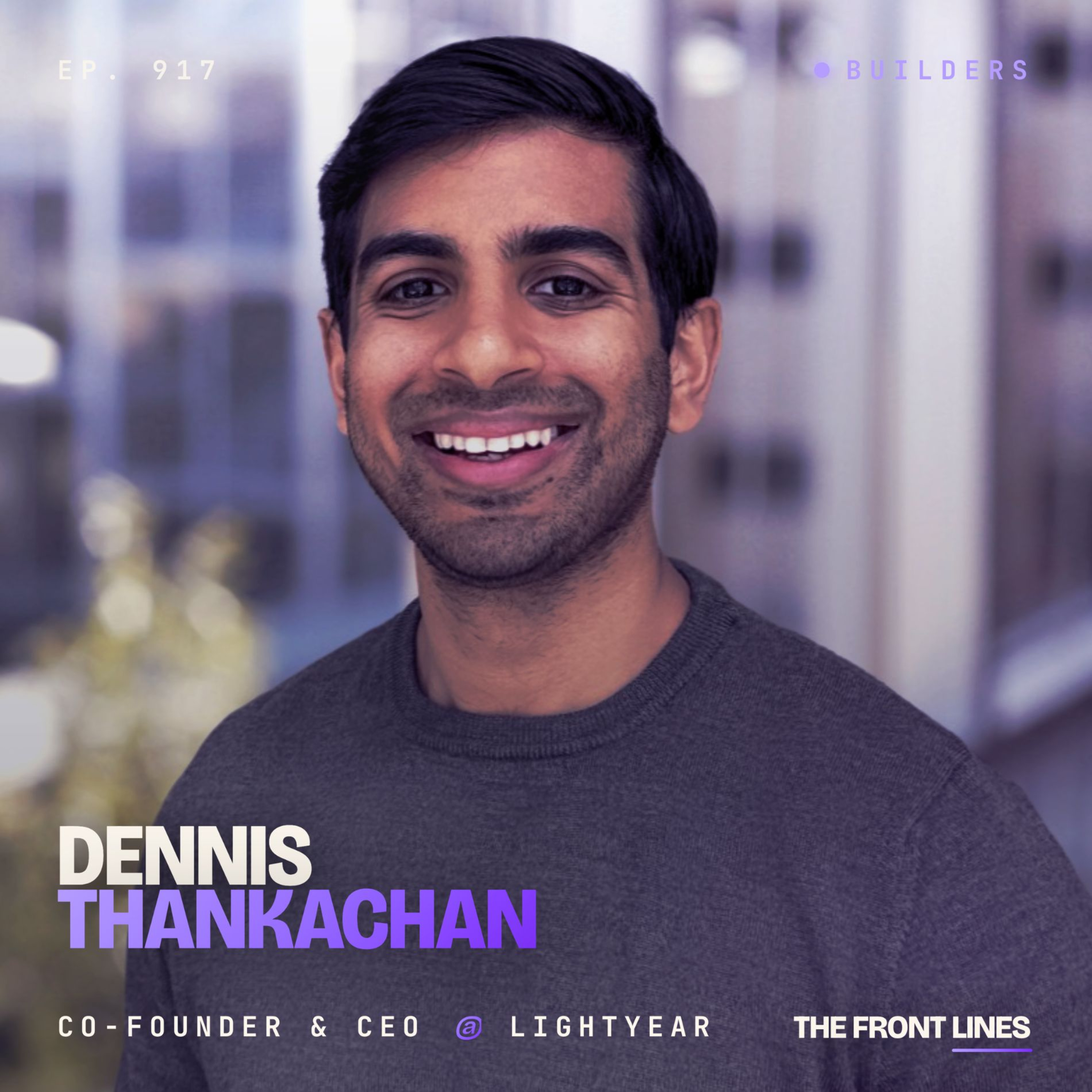
Welcome back to another episode of Builders. As always, this show is brought to you by Frontlines IO, Silicon Valley's leading B2B podcast production studio. If you're bringing technology to market and want to learn from your peers, we have a library of more than 1200 interviews with Venture backed founders and marketers. Where they talk, all things go to market. Of course, if you want to launch your own podc, we offer podcasts as a service to more than 80 tech startups. The idea there is very simple. You show up and host and we do everything else. Now with all that said, let's jump in today's episode. Today we're speaking with Dennis, co founder and CEO of Lightyear. Dennis, thanks for being here.
- [00:53]
A
Thank you for having me on, Brett, of course.
- [00:55]
B
I'm glad to have you back. It's been three or four years since the first time, so always fun to reconnect. Talk to us about Lightyear. What does Lightyear do?
- [01:02]
A
So Lightyear is the AI native platform that automates how enterprises manage their telecom. So things like an enterprise Internet connection, data center space, dark fiber phone systems, things of that nature that are mission critical to how enterprises operate. You as an enterprise network operator can use Lightyear to buy services, buy, track inventory, manage installs, pay bills, manage expenses, deal with tickets, all of the various things that go into a telecom operation. It's a lot of very technical, very boring, infrastructural type of stuff that is extremely important to how enterprises operate.
- [01:44]
B
And what's the origin story here? How'd you end up in this space? I don't want to say it seems like a random space, but it is a different type of space than the thousand other companies or founders that I've had on. I don't think I've talked with anyone that's operating in this space.
- [01:56]
A
Yeah, it's interesting. Telecom is a multi trillion dollar market where literally every human being is a telecom customer unless you're truly off the grid. But it feels like a random space because it feels like a small world. I worked at a large hedge fund where I led their investing activities in telecom for a period and developed a strong interest in the space. I quit to start a company in the space that was different than what Lightyear ended up becoming. But in the context of starting that company, I Started learning about how businesses buy telecom services and realize that there's a massive information asymmetry problem. And businesses are either managing this stuff manually out of spreadsheets or using hordes of consultants or what you call telecom brokers or agents that cause a lot of problems, like principal agent type problems in the context of how businesses buy. And it's just a lot of manual grunt work managing this stuff. And if you could enable businesses with software to manage this stuff better, they could save a lot of money, operate more efficiently and just get to significantly better outcomes. And you know, I think I've chipped away a bit at proving that's true.
- [03:04]
B
If we zoom out, maybe let's talk about the scale just to give the audience some context of the scale that you're operating at today, the growth that you're seeing.
- [03:11]
A
Sure. Today we have raised over 65 million in capital. I can share. We have over 400 enterprise customers, including a number of the Fortune 50 and a few in the Fortune 10 that are really large names that utilize lightyear to manage their networks. And today, you know, with ISPs in particular, you know, the vendors like the AT&TS, Lumen, Zayos, etc. Of the world, we're on the advisory boards or the number one channel partner for I think four out of the top 10 US ISPs, meaning we're driving so much volume for them in the context of business activity that places us either at the top channel partner or the advisor type level.
- [03:56]
B
Talk to us about it doesn't have to be the first, but maybe an early enterprise logo that you're able to land. You don't have to tell us who it was, but tell us the story about how you landed that. Because I know getting the first few enterprise logos is never easy.
- [04:08]
A
Sure. The earliest enterprise that we worked with was a company called Roadrunner Transportation. And this was prompted really in the heat of COVID We were initially going to be a platform that helped SMBs identify Internet connectivity for office spaces primarily. And then Covid happened and you know, for one SMBs were going bankrupt and then people were at the time saying that no one will ever work in an office again. So that business idea didn't seem particularly fruitful. However, the thing that changed in Covid was enterprises were all across the globe basically figuring out how to cut cost because economic activity went to zero and also looking at re architecting their network for what was going to be a shift from office based activity to hybrid or in some cases not office based activity. So There were many enterprises that were willing to entertain startups in ways that they previously were not able to. And that was an opportunity because ultimately the vision was to go enterprise. And it's just we knew that there was quite a bit of product we had to build before we add something that was enterprise passable. So we ended up being able to get embedded within a number of enterprises in the logistics space via connections that we had, you know, one in particular I'll name as Roadrunner that became a longtime customer of ours. And we were able to identify significant cost savings opportunities just by rationalizing some of their telecom rates to what was current market. And the interesting thing that we determined was, you know, for one, how would an enterprise know that your telecom rates are market or not? Because there is no public facing gauge of what market actually is. And two, the circumstances of what enterprises were paying, how out of date their rates were, their technologies were, was just far worse than I would have thought as an outsider. And you know, that really showed that even as like a new entrant without a real product, there were significant opportunities to help enterprises cut costs. So you know, we worked with a number of enterprises on what was admittedly like an extremely manual basis, mapping out all of the different workflows on what we needed to build from a software product around what would go into basically creating RFPs, installing and managing inventory for telecom services. And we're able to drive a number of savings for a few different enterprises around, call it like mid to late 2020 with what was more of a consultative approach than a product. But we were able to land some customers, prove out the revenue model, validate the TAM, and really over the course of 2020, 2021, 2022, we were able to, you know, be fortunate to land some venture capital and really turn that into a product and very early go to market motion. And then really, you know, when we met 2023, that's when we were at the earliest innings of sniffing product market fit. And really from then to today, we've turned the business into more of like a machine. And I would firmly say we have true enterprise product markets fit with a real product that does the things that we say, rather than just a pure sort of like consultant approach.
- [07:26]
B
What were those early conversations like with investors and did investors understand right away that the telecom space were able to find VCs that had invested in this space? What did that look like early on?
- [07:38]
A
So early on we were talking to seed stage investors where I think I count I had something like 30 rejections for my early pitch, and it felt so arbitrary why investors would say yes or no. The most frequent reason I got, I remember because I got this like 20 times, was, oh, you know, we don't feel the market is big enough, which is insane because telecom's a multi trillion dollar market. And now one of the most exciting points for investors who've invested in light years, oh, the market is so large, that's never going to be a problem. Where I think the reality was, looking back, is that I sucked at pitching and I've gotten better at pitching over time because everyone said no. And then eventually one person said yes. That was really taking a bet on me rather than understanding of the market. And after that one person said yes, that happened to be sort of a pretty well respected institutional investor. A lot of other people said yes. And everyone wanted to get in our round and that made things easy. We raised a seed round and then in 2021, we raised a Series A very quickly, but admittedly not on any traction or momentum. Purely market hype. We raised a Series A that valued us well above where we should have been, which is, you know, oddly reminiscent of the times we're in now in terms of, you know, what's going on in the market and how companies get valued. But that was something that we eventually had to claw past because we were not worth what the market deemed we were worth. And then, you know, 2022 was a tougher period for startups.
- [09:03]
B
This show is brought to you by Frontlines Media, a podcast production studio that helps B2B founders launch, manage and grow their own podcast. Now, if you're a founder, you may be thinking, I don't have time to host a podcast. I've got a company to build. Well, that's exactly what we built our service to do. You show up and host, and we handle literally everything else. To set up a call to discuss launching your own podcast, visit Frontlines IO Podcast. Now, back to today's episode. How did you hone your ability to pitch and sell and weave a story? Like, are there any specific iterations that come to mind? Where, like, okay, like, I've been told, no a bunch of times, like, I'm going to try this and, like, see if it works yet.
- [09:39]
A
The number one bit of advice that I would give is to ensure that you are doing something for the true conviction and belief that thing is right in your bones rather than to satisfy an investor. The more you care what an investor thinks, the less they will have interest in you. It's gating, in a sense, I knew for sure telecom is a huge market. The business we were building was absolutely viable. The demand and interest was there. I also knew that it's a boring market that without particular prior knowledge is not going to be exciting to you. But that doesn't mean you can't build a really phenomenal business. A lot of the most exciting business ever built are in markets that appear optically boring. And my early pitching, I cared so much what investors thought, I would be answering their questions to try to satisfy them rather than to give them the true and honest answer. I would be at their whim for every bit of feedback. I would adjust my pitch based on what an investor told me rather than what was actually best for the business. And people could really sniff that. I think in retrospect, the less and less I cared what investors thought, the more success I had with investors.
- [10:55]
B
Sounds just like dating now. What about the narrative and the pitching on the sales side? When did you start to really feel like, okay, like we've got a pitch here, it's resonating, it's something that we can replicate, we can scale and you know, get outside of founder led sales?
- [11:10]
A
Yeah. So, you know, early pitching in venture capital is a lot like dating because it's very emotional. You don't have numbers, you don't have proof points. They have to get excited about you and that you're going to see something through to the finish line. And that's inherently subjective and emotional. Enterprise sales is hyper rational, hyperlogical. So you know that mode matters a lot less for enterprise sales. I think early enterprise sales can be very feel oriented. You want to identify early adopters, but eventually it is about becoming a machine. Once you have a product that passes muster in a market and has competitive differentiation, that is the first point you want to get to. If you are not there or not on the path to there. There's nothing I can tell you about enterprise sales systems that's going to be useful because you're going to be selling something that probably shouldn't be sold. But once you are there or close to there, there is the science of marketing, how you bring in leads, and then there is the science of selling, how you close those leads. And both of those really can be boiled down to a science. Basically there is some subset of people, like if you have a product that's competitively differentiated for the enterprise, that can help the enterprise do something better. Enterprises are hyper rational profit oriented buyers that want to buy your thing. So you need to get in front of the people that are the Right people to buy your thing, explain why your thing is better and some subset of those people should buy. And if you can get that down to a science where you're getting in front of them, you're pitching properly, and you're managing the sales process to close properly, you should be making money. And, you know, you'd basically want to isolate each of the points in that funnel where something can go wrong and optimize each point until it basically becomes like a machine that gets better and better.
- [13:06]
B
At what stage of the funnel did you find yourself spending the most time tweaking and optimizing?
- [13:12]
A
You know, I can go sort of from top to bottom of the funnel, and I wish I could tell you, oh, you know, I did this one cool thing. And after that, everything just imploded. There was just a wave of demand. I feel like I listen to podcasts and I hear people talk about that, and I wish that was the case for me.
- [13:31]
B
We want to get rich quick. Go make it work for it.
- [13:34]
A
That's right. It's really been really just like brick by brick building a machine. Early on, we were small enough to where one enterprise could be really valuable in the context of our total business. You know, today we have, you know, a small number of customers that continuously expand that for a variety of reasons basically make up a large percentage of our revenue. Like individual customers that we have high fit with can be super valuable. So marketing, you know, basically bringing in those leads was more of a game of getting in front of via connection as many people as I could via very intense ground game like referrals, talking to people, this, that and the other, trying to just get in front of the right person at companies that could make for very valuable leads rather than building a machine. And selling started off as a learning process of trial and error with me and our early VP of sales like, or who became our VP of sales over time, effectively just manually selling every single lead until we could turn that into a system. Eventually we were able to identify the common threads of how people bought what they wanted to see in an early meeting. You know, we need to conduct discovery. What do we need to discover about the enterprise that validates optimism? An optimal opportunity to sell? How do we demo properly? How do we convey roi? Who do we need to get in front of properly? Who are the different stakeholders that buy and how should we run each meeting to identify how things go well? What are the common objections we get and how should we frame an early sale so that we're well set up for expansion? We were able to turn that into a bit of a science and then hire an early rep that we were able to also build a compensation system around. And eventually we were able to hire a few reps until that marketing piece of it wasn't enough to feed the quantity of reps that we had. You know, when you're doing $0 of revenue, every lead that you bring in basically represents infinite growth. And you know, if you get to 20k of ARR, you can bring in a lead at 50k of ARR and then you're, you know, tripling the business. However, once you get big enough and you have mouths to feed, like, basically these reps have to be hitting quota of, call it like 500k, 750k, a million dollars a year, you have to bring in enough leads to feed the reps, assuming some loss rate. And then demand gen becomes the part of the funnel that you need to focus on. So, you know, after that sort of like ground game of talking to as many people as I could stopped working, meaning it wasn't bringing enough leads, I knew we had to build up demand generation. So there are a number of channels we've built up over time and each of these channels independently has had a different build process. You know, first we started writing content that would basically rank for long tail keywords that are highly unique and tied to our specific buyer. Things like dedicated Internet access, pricing. You know, that's quite a long tail keyword. There's only a few hundred clicks of traffic per month that go to that. But every single one is eligible for us and we want to rank number one for that term. There's a whole slew of terms like that. We'd write content for it, show up in organic search, and then we'd also run paid ads against that. That's a whole science of inbound. And you know, we're now redoing that for LLMs. There's events identifying the conferences where your buyer is likely to show, showing up at those conferences in the best possible way, being convincing, identifying leads and then following up on those leads. That's a whole science that we've had to build out. There's outbound, identifying the prospects that are ideal for us. Going after them via cold call, cold email and a strong pitch and building data as a science and hiring an SDR team. And then there's analyst relations and pr. These are more long, brand oriented, game type things. And we've over time basically with each of these channels identified which channels have scalability potential, which channels don't and have been able to just slowly build brand alongside a demand gen mechanism on the sales end. You know we've turned what started off as just founder led selling to founder plus sales rep selling to now primarily like reps plus manager either creating their own demand and closing deals and now really the whole motion is around recruiting, training and compensation to make the sort of widgets in that machine or add more widgets to the machine to make it more productive. If that makes sense. This show is brought to you by the Global Talent company, a marketing leader's best friend. In these times of budget cuts and efficient growth. We help marketing leaders find, hire, vet and manage amazing marketing talent for 50 to 70% less than their US and European counterparts. To book a free consultation, visit GlobalTalent
- [18:34]
B
co. What on the demand gen side did you try that turned out just to be a waste of money or a waste of time?
- [18:43]
A
I've tried a variety of things that are get rich quick schemes and I found that get rich quick schemes haven't worked. Or at least they just never work for me. Things that sound too good to be true often are, I have found. So examples oh, why hire and train an SDR team on how to call when you can pay our outbound lead generation service? We will book you five meetings a day for $100ameeting and you won't even have to hire an fte. I've tried multiple of those services. They haven't worked for us. Maybe that's a failure of us. But building an outbound function with SDRS takes time. It's very difficult. But that's been extremely productive and high payoff. Once we've put in that work, we've paid for things where oh, pay for X service and we'll put you in front of 15 qualified buyers with intent about your thing with a guarantee of minimum 15 meetings or bus. That has not worked. Every single thing we've done that's worked well has been sort of like a brick by brick, detail oriented, highly nuanced, thoughtful build out that has generated over time a machine or a gift that keeps on giving, if you will.
- [19:56]
B
That's been my experience with marketing. I was describing to someone a while back and it's like I used to have this fantasy that I would have a good idea for, you know, a marketing hack or a marketing channel and I would test it and it would work and I'd be like oh my God, I'm a genius. Like the reality is like I test something and like what I get back is not the whole Cookie, I get like a little crumb and like all I need is that little crumb to keep going. And then you just keep going and going and eventually you build it into a channel that works. But I've yet to see like the get rich quick stuff that everyone tries to sell. I'm always like, I don't know, excited about it, but I've just never ever seen that work. And I don't know anyone that's really seen that type of stuff work.
- [20:29]
A
Yeah, exactly. The marketing equivalent of you two can have ABS in five days.
- [20:35]
B
What about when you've approached building the team? How important has it been for you and you know, focusing on the go to market team that they have experience in telecom.
- [20:43]
A
Once you shift from founder led selling to rep selling those early reps, you're putting them in a situation that's difficult, like an early sales function. Your quota model might be off, you may not have enough leads to feed them. They may need to opt for demand gen help. You may not have the process, training or structure to enable them effectively. And all of those things were true for us. There was a whole host of flaws where we needed reps in the funnel, on the ground doing work for me to identify all of the problems with that rep program. Because when we first started we really were throwing darts at quota model, demand gen structure, all of that around reps. So, you know, the two things that were very important for early reps was one subject matter expertise that allowed you to navigate sales cycles successfully at lightyear when we couldn't give you the structure to do so. So yes, we found that early enterprise telecom reps were more capable for us in particular than elsewhere. So you know, for other people you may want to think about what would apply for you in that context. Second, we were screening for people that showcased risk tolerance and the ability to navigate ambiguous situations. If you need a, you know, ABCD type exact telegraphed process system, we're just not going to be able to give that to you. Now we're getting closer to that because over time what I described about our early reps, there are not that many people you can find that want that and can succeed in that environment. And eventually you want to have an org that can have many sales reps. If you want to have many sales reps, you need to be able to expand your tam. That means process training systems and the ability to recruit all types of people into your sales org to become successful. So you know, one of the newer things that we've rolled out is an SDR to AE transition program. Earlier on, we just weren't equipped to bring in an sdr, train them on the market and have them succeed as an ae because we don't want to promote someone if they're not going to succeed. Now, you know, we're really confident in our ability to do that, which is great and really expands the tam of reps that we can bring into the org.
- [22:53]
B
And the final question, I'm seeing that we're almost up on time, so only two minutes left. What's your big bet in terms of growth for 2026?
- [23:01]
A
I'll state something that I think is going to be the most uncontroversial big bet, but it's exciting and unique in the context of what we do. And that's agentic AI. So about it. Yes, people in Silicon Valley may or may not have brought this to your attention, but the models have gotten so good that you can now shift from model augmenting workflow to model handling workflow. And that's great. And that's occurring in every space in B2B as we speak. However, the key input that's required for model success is proprietary data that can allow those models to have the context to make decisions and knowledge of how all of these nuanced workflows can work well. So for us, we spent years and years putting together the most detailed data set on enterprise telecom outcomes. Every little nitty gritty detail in all of the nuanced workflows, vendor to vendor. You know, AT&T, Verizon, Lumen, take your pick across hundreds of vendors, how an order works, how an implementation works, how to onboard inventory properly. And a lot of this was done by hand. And we can now have agents do for us what previously could only be doable by human. And so think of like an agentic workforce that that is effectively your enterprise telecom team working on your behalf 24 7. And that's something that we're uniquely positioned to bring to the market. We've already launched one product that is basically a taste of capability there. That's our expense management offering. And we have a lot more exciting stuff to come in the coming months.
- [24:40]
B
Amazing. I love it. Dennis, so good to catch up with you. Let's do this more than like once every three or four years. So you have to come back on again and keep us updated. Thanks so much for taking the time. Where should we send people if they want to follow along with you?
- [24:51]
A
Lightyear I check out our website and Find us on LinkedIn. We also post tons of content.
- [24:57]
B
Love it. All right. That was fun, man. Really enjoyed it. Good catching up to you. Well, that's all for today's episode of Builders, brought to you by the Frontlines. If you want more amazing content like this, visit Frontlines IO, where you'll find a library of more than 1500 interviews with founders, marketers, and other GTM leaders, where we unpack the tactical lessons from their journey. And of course, as always, if you do want to launch your own podcast, we'd love to have a conversation with you. Visit Frontlines IO Podcasts as a service. Mention that you listen, mention you love the show, and we'll give you a 10% discount. Thanks for listening. We'll catch you on the next episode.