Loading summary
Transcript43 lines
- [00:01]
A
We're competing not on the software budget, we're competing on the labor budget.
- [00:08]
B
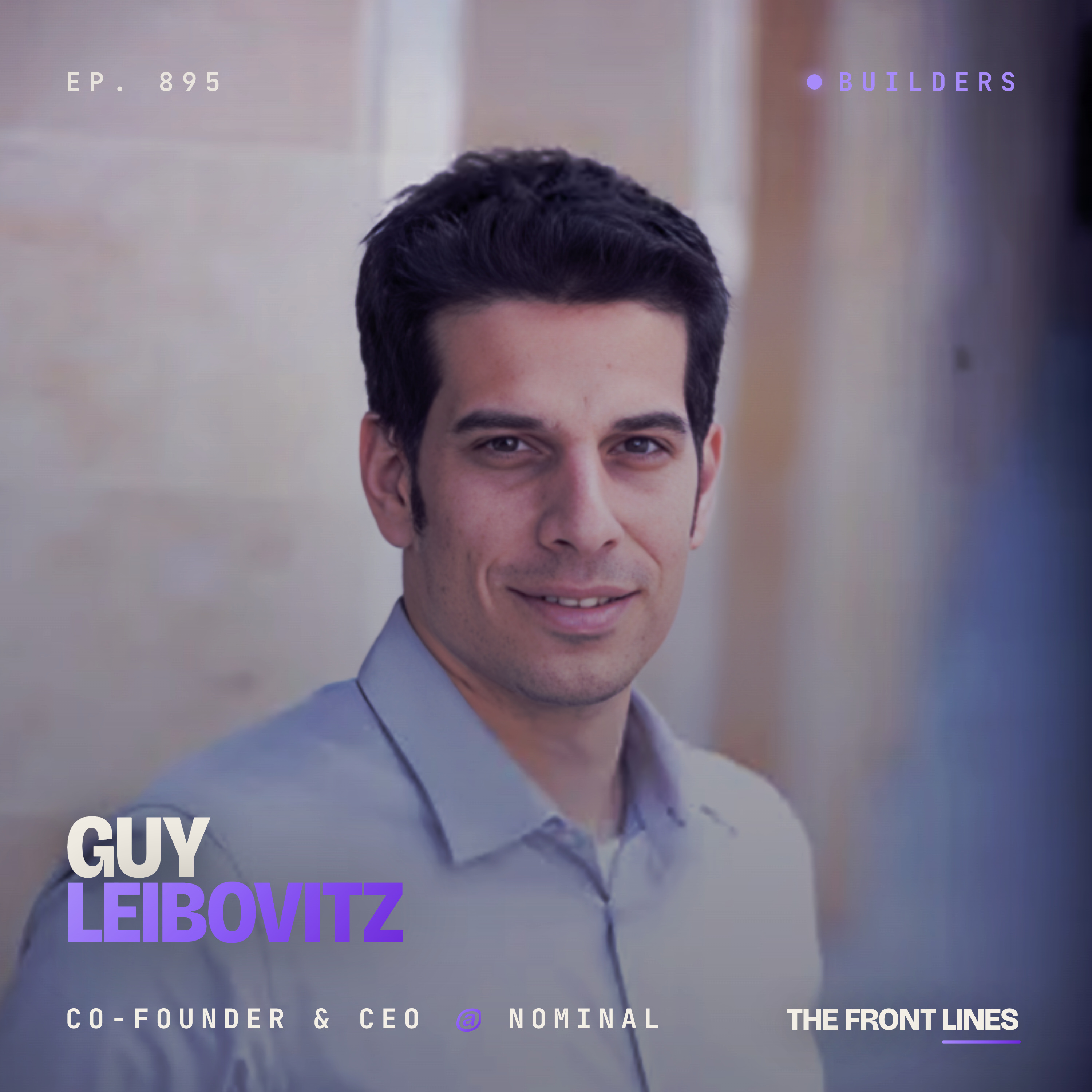
Welcome back to another episode of Builders. As always, this show is brought to you by Frontlines IO, Silicon Valley's leading B2B podcast production studio. If you're bringing technology to market and want to learn from your peers, we have a library of more than 1200 interviews with Venture backed founders and marketers. Where they talk, all things go to market. Of course, if you want to launch your own podcast, we offer podcasts as a service to more than 80 tech startups. The idea there is very simple. You show up and host and we do everything else. Now, with all that said, let's jump into today's episode. Today our guest is Guy Leibowitz, co founder and CEO of Nominal. Guy, thanks for being here.
- [00:47]
A
Thank you so much for having me. Brett.
- [00:50]
B
Let's imagine you're on a flight, someone who sits down next to you, they're chatty and they ask, what do you do? How do you answer that question?
- [00:55]
A
I sell dreams usually, but actually we're selling the future. So, yeah, in one sentence, you know, Guy, I'm an entrepreneur. I built three companies, two of them exited, and now we're working on Nominal. That the concept behind or the premise behind Nominal is to take all the legwork and manual work, a controller and accountant, and basically replace it with AI agents.
- [01:22]
B
I'm sure when you or I'm sure that you've spent a lot of time reflecting, is there anything as you were going in here to build your third company that you said, based on my experience with the previous two, I am not going to do this no matter what? Yes.
- [01:34]
A
And I think compromise on the quality or the fit of people that I work with. So I think I realized, you know, this, you know, startup number three that I can choose with who I want to work with. And yeah, we have a really uncompromising bar of finding their best people to work with.
- [01:57]
B
And if you just kind of zoom out, looking at the market that you're into today, what's the state of AI in the industry? What are the customers, the prospects, the conversations that you are having? How are they generally thinking about AI?
- [02:10]
A
Yeah, so there's a lot of sizzle, but not enough stake, I think. And you know, if you look at the office of the cfo, obviously there are places that make basically that, you know, make a lot of sense to tech. I think AP right is probably kind of the first thing, like accounts payable. So for your audience who are, who is familiar with racks and ramp Those are accounting scale ups and I think kind of invoice processing was very obvious. But accounts payable is one account out of dozens of accounts in a chart of accounts of a company. And you know, we see companies tackling one by one and that's what we try to do at Nominal. But we also see other companies that, you know, try to apply agentic workflows to revenue and others. But there's a lot of noise and it's interesting time to work in this space because the next ramp, the next Brex is now emerging. So it's been an awesome ride.
- [03:06]
B
When you think about your competitive landscape, what are the buckets of competitors that you have?
- [03:12]
A
So it's a great question. Our competition is usually humans with Excel saying, I can just do it in Excel, or alternatively I can work with a bpo, basically cheap workforce in, you know, the Philippines, India, et cetera, that can do the work instead of the agents. So when we think about competition, we're competing not on the software budget, we're competing on the labor budget. So it's a bit different. And I think this is kind of our number one competition today because we kind of operate in an interesting space where one thing that we did with Nominal is we were really kind of targeted on very specific icp, which is more or less the blue ocean. We started mid market and enterprise instead of SMBs. Usually a lot of companies starts with kind of the SMBs and go up market. We actually looking at companies from 50 to 60 million all the way to Fortune 50 and there's not much going on there and I hope it stays that way.
- [04:09]
B
And was that clear day one that that was going to be the ICP focus or what was the journey like to get to exactly where you are to know who that ICP was?
- [04:18]
A
That's a great question. When we started Journey, we thought building a next gen ERP for startups and that didn't work because, you know something about startups is they shut down and churn or getting acquired. And I remember we had a company called Commit and we had the contract out in Legal and then the CEO calls me, we just got acquired, like there's no way we're going to make this deal. I was like, okay. And you know, then we decided and then, you know, I was like really bummed. And I went to this kind of event with a friend of mine, works, you know, at the large energy company and she told me, well, the energy space really needs what you guys are doing. And I was like, oh really? And I called Everyone I knew, and I met another founder, a good friend of mine, that connected me to another founder and he said, well, my neighbor works at this company and his neighbor was a CFO of Green Street Power Partners, and they are our first customers. And you know, three years later or two and a half years later, they're still a customer. So it's kind of a very, very interesting story about how we got. We thought about selling to startups and now we're selling to Fortune 50s.
- [05:20]
B
What did you have to change? Or how much did you have to change is maybe a better question there. I've been a part of a few companies that have made that shift and the pitch that really resonates with startups, with founders is obviously very different from what resonates with mid market enterprise, at least from what I've seen. Did you have to dramatically change the messaging and the value prop?
- [05:39]
A
Oh, yeah, 100%. At the end of the day, our customers buy from their ebitda, from their cash flow, and they don't buy from VC money. So it's a different ballgame and you need to prove that there is roi. And you know, our customers can attest and their annuals can attest that there is a lot of ROIs. And also we see expansion as well. So we had completely different process, completely different compliance needs. Like we had to go through SOC1 and SOC2 obviously, but SOC1 is a kind of complicated security thing that we had to get through and completely different story, different go to market, different people. Yeah, it's a different channel, so it's completely different.
- [06:15]
B
Anything that comes to mind. That was a valuable lesson for other founders that find themselves in a similar position going from startups to mid market or enterprise.
- [06:24]
A
I think like my previous company that I tried to kind of do it all, serve all the market, and I thought we decided here that we're going to say no more. So we are saying no to smaller tickets and we actually refer to people what I guess VCs would consider as competition. But like they're targeting the SMB market and I think they're saying no more to companies that don't fit our icp. Look, at the end of the day, you know, if we cannot really serve our customers well, like why even engage? So if they're a better solution than nominal to a customer, they should just go and work with the best solution they can find. So in our SAP, I think we've proven that we are the best solution.
- [07:11]
B
This show is brought to you by Frontlines Media, a podcast production studio that helps B2B founders launch, manage and grow their own podcast. Now, if you're a founder, you may be thinking, I don't have time to host a podcast. I've got a company to build. Well, that's exactly what we built our service to do. You show up and host, and we handle literally everything else. To set up a call to discuss launching your own podcast, visit Frontlines I.O. podcast. Now back to today's episode. What were the signals that you were seeing to know that that made sense, to make that change and to shift the focus on ic? Was it like glaringly obvious or was that a decision that was heavily debated internally?
- [07:45]
A
Yeah, well, that's a great question. I think that at the end of the day, you know, a company of our scale had to erase a Series A and like building a system of intelligence as a system of actions. Building agency frameworks at scale, you know, in the office of the CFO requires a lot of capital to do that. But we still wanted to kind of raise an A with revenue and traction, and we did so for us, we looked at it from like a position of, okay, where can we serve the market fast? Where can we grow the fastest and focus there? But it wasn't easy because we had kind of a long tail of customers that we said no. We had customers that we decided to kind of break up with them. And, you know, that really hurt one quarter. Like we said, go, you know, to hundreds of thousands of dollars. And you know, as a seed stage company, you're like, you know, that could kill the company. But in hindsight, you know, Obviously hindsight is 20 20. But let's say that we hadn't taken that decision. We were being a very, very different situation.
- [08:46]
B
Now let's talk a little bit about the go to market engine. Maybe let's skip the early go to market engine and talk about the current modern state of the GTM function.
- [08:55]
A
I'll tell you all the secrets. So we have basically three ways of going to market. One is outbound. Actually, we started Outbound since we changed the go to market, right? So we had that team and now we have a new team. Outbound works like cold calling works, gotta say, so that's something that really works. We use power dialers, but it's well researched and every BDR has its own kind of cloud coworker that does the research, blah, blah, blah. We also, I want to give a shout out to a company called Alta HQ that helps us with everything that is not fun, that automates the research and the reach out to our icp. Then we have growth go to market engineers basically that use clay and other tools to do a reach out with a signal, well research using AI at scale. What we found out that if you combine field marketing with go to market engineering, this is a combo that is unstoppable. Right. Let's say that I have a dinner. Let's say I'm reaching out to someone and just saying okay, you know, you're growing, your peers are using nominal. Do you want to demo? That's one thing. But if we're saying hey, I'm going to bring a CFO from a public company that is going to explain the journey of them growing, you know, 25x year over year or the AI transformation that he led, et cetera, et cetera. And we're only having 10 people, we have only 10 spots. And you know, we created this thing called Nobu series. So we go to each Nobu basically worldwide, which is pretty cool and bring like you know, 10 CFOs or finance leaders. And that worked really well, you know, combined with go to market engineering. And lastly we have inbound. Inbound is. It's a big part of our go to market motion. And what we found out that 4 hour SAP actually meta performance really nicely. So these are all the secrets more or less. But yeah, so we have this kind of three headed approach. Outbound, GTME and Performance for the go to market engineers.
- [10:48]
B
That's one of those emerging job titles that I see a lot on LinkedIn. I see a lot of companies that are hiring for. What I found from the conversations that I've had is there's no like set mold even for like. I mean first off there's no real clear definition from what I've seen of like what exactly a go to market engineer does. It's different things at different companies and, and then also backgrounds. Like I've seen some that come from engineering and I've seen others that are marketers who are just hackers basically and have just gone in and gotten their hands dirty and played around with things. What are you seeing? Like what's the normal profile for you for go to market engineers?
- [11:20]
A
Yeah, and we are in New York by the way right now, the second person. So we had a couple of GTMEs and we like to see exactly what you said. Kind of the hacky mindset. I think that's more important than everything usually you know, if you think about it like you know, people who entered the job market in, in the recent five years, they are hacky and probably they know AI and they use AI, et cetera. So what worked for us is really people who understand humans. And we had people were BDRs and SDRs before, but with a very, very, very hacky mindset. And that worked for us really well. We're now hiring people from a different cohort that are more kind of techy. Like people who worked at BI work, you know, did bi, did some business analytics, et cetera. So we see kind of these two roles for us. What worked thus far is actually people who did reach out, let's say anymore, kind of they were snipers and now they want to cast a big net. So that's kind of what worked for us.
- [12:20]
B
Is there anything from a go to market perspective that you just wasted a bunch of time, money and resources on that you've since either eliminated completely or stuck, scaled back dramatically?
- [12:29]
A
Yeah, again for our market specifically and probably people would disagree with me completely, But I think LinkedIn posting organic on LinkedIn, it was okay. I think what really works is like sharing, you know, like building the public. I think that works really well. However, you know, we are cutting down on events in our industry a little bit because what we've seen is we've seen a lot of people are coming for those events, fly them out to the four season in Miami, whatever. And you know, they have the event but they're not really looking to buy anything. They're just looking to kind of. That's something that we've seen kind of. You know, we are very picky with our events. We used to be okay, we have one shot, you know, let's do every event under the sun. And you know, we built our own kind of system of tracking the ROI from every event, every marketing activity. And the ROI wasn't there. Like yeah, sometimes we had events that we were, you know, great branding experience. But at the end of the day we're more picky but we'll go bigger. Right. So we have an important event with Gartner this month or next month and we're spending like a seed round basically on that event because we really believe in the event. So it really depends.
- [13:36]
B
And the Nobu series, is that still ongoing or are you shutting that down?
- [13:40]
A
No, no, it's ongoing. This is great because as I said, it's a field marketing that is in a multi touch. Right. So you need to touch someone eight times until they say yes, I will agree, you know, to a demo. But, but what we found out and you know, sometimes you have to say, well, GTME doesn't work, but it should work. And then you find a combo of like, yeah, GTME and field marketing in our event. And now we're doing an event with another company called Nylos and they bring door gtmes. And the thing is, if you can do that, you know, if you try to pull value from a customer, from prospect, it's not going to work. You have to push something. And actually we don't try to sell. We try to be stewards of the industry. And they come back to us and say, well, we want a demo. And I was like, okay, sure. But like, you know, I'm not going to pitch you while I'm eating the sushi, Right. And people like, really? I was like, no, like, let's set the time. Like, you know, and it's really cool. Also, I love working with the office of the cfo. You meet so many cool people in so many industries. It's like an MBA monster. It's like you'll hear all this kind of business models. So I think people also enjoyed and something a request that we've seen that really come often from those events is everybody like calls me and say, hey, can you share the list of the people I really want to collaborate with this other guy, all this other cfo, she's been amazing, et cetera, et cetera.
- [14:52]
B
Yeah.
- [14:52]
A
So it's been cool.
- [14:54]
B
This show is brought to you by the global talent company, a marketing leader's best friend in these times of budget cuts and efficient growth. We help marketing leaders find, hire, vet and manage amazing marketing talent for 50 to 70% less than their US and European counterparts. To book a free consultation, visit globaltalent.co. have there been major iterations to get to this point for that no Boost series? Like, what were some of the changes that you made to get to what you just described? Sounds epic. What happened behind the scenes? Be able to describe it that way.
- [15:24]
A
Oh, my God, no, it just didn't work. It just like it was spam at the beginning. I was like, I was looking at the message and I think something that I'm asking. There are two tricks that I ask. One is there is a great book. There is the guy David Cancel, who was the CEO of Drift. Yeah. And now I think Ray and he has this book anyhow that he recommends about another book that is called Dini 7 the principles of persuasion. It's called Persuasion. But so we put that in ChatGPT and I was like, okay, every message that you do as ChatGPT, make sure that you use like, you know, those principles of persuasion. And the second thing is a mindset change. I was like, are you going to respond to this message? And that kind of. We saw some uptick when we kind of incorporate like, more personalized message, more human, like, message, et cetera. But what really worked is really the combo of like dinners or as I said, like, you know, pushing value, not pulling value. We're lucky to be in a field when there is not a lot of like, you know, I used to work. My last company that we sold was in cybersecurity. And the average, you know, cybersecurity officer gets like, gazillion calls, gazillion emails, gazillion LinkedIn messages, et cetera. But, like, what we did was a bit different. And, you know, we are trying to come with value to the customers, whether it's biased or not, whether he wants to engage or not. You know, that's something changed dramatically since we kind of created this kind of field marketing plus growth combo.
- [16:46]
B
Funny you mentioned that about cybersecurity, because that makes more sense. Because when I saw the prep for the interview, I just thought, why is this not a cybersecurity guy? Like, Israeli founders are always cybersecurity founders.
- [16:55]
A
It's really now. Yeah. I think that right now the motion with cybersecurity is very risky. And there is no founder market fit. For me, at least. I'm not saying no. You never say never. But right now I think you cannot. Like IRA is 2.5 million. It's a seed round for Cybersecurity Company 2016 now a seed round. I invest in rounds of 25 mil seed. So I think the MO is take bigger risks. And at the end of the day it makes sense. But for me, one of my fiduciary duties is to return value to our shareholders. And I think it's a very, very risky game. And if you think about it, like, I don't know, two, three billion dollars or whatever, a billion dollar invested in cybersecurity every year you need to return 10x on that, you know, and there's no 10x exits. There are, but not a lot. So it's a game of outliers. But I think if you had to be like top 10%, now you need to be top 0.1%. And at the end of the day, I have to say another thing about my fit to cybersecurity is that, and I think kind of this is the essence, you know, what we sold at Cognigo, my previous company, and many cybersecurity is like selling Insurance in a way, right? Cause nobody calls you like if your cyber security works, like nobody uses the platform. If you think about it for a second, right? I have like my, you know, defense system, my endpoint defense system, like nobody is going to call it right. And I think we're not doing it from a place of, you know, it's not from the place of like my co founder or myself, financial outcome. It's really from the place of creating impact to where it's needed the most. And I think, you know, if you look at controllers and accountants and what they do on the day to day, there's so much room for improvement, so much Excel sprawl, so much, you know, manual work, so much legwork that I think the, if we can create the impact. For me, it was a great mission to pursue.
- [18:41]
B
I'm sure that you're navigating the conversation that every AI company is navigating. You know, the people that you're selling to. I'm sure there's some fear that it's going to replace them or eliminate jobs or maybe not their job, but the people that they care about, the people that work for them. How do you navigate that conversation?
- [18:58]
A
I think first of all, it's about the kind of fear right of the day. You know, things can change. It's like Uber. And I think you can think about Uber for a second, right? Like, you know, taxi drivers were like, oh my God, it's going to take our job. But many Uber drivers were former taxi drivers. And I think that's the case with AI and AI native employees, right? It's not that you're going to be replaced by AI, you're going to be replaced by professionals who know AI or AI native professionals.
- [19:26]
B
And final question for you. When you think about 2026, what is your just top burning priority objective as a company? What are you guys locked in focused on?
- [19:36]
A
Our number one priority is customer love and focusing on the customer love and adoption of the product. We have early signs of getting into this kind of flywheel of adoption and our number one goal is to create this customer love for the product that will create another go to market channel so people can recommend and we're already seeing referrals as one of our kind of go to market engineers. So if you can build a great product, really and people talk about the product and you know, love the product, then they will go and they will take pride in telling everybody that they know about this product. So that's our focus for 2026.
- [20:17]
B
Amazing. I love it. And before we wrap, for those listening in that want to follow along, where should we send them? Where should they go?
- [20:22]
A
LinkedIn X Guy Leibovitz or Guy Bovovitz on LinkedIn. Yeah, come around.
- [20:29]
B
Thanks so much, Guy. Appreciate it.
- [20:31]
A
Thank you.
- [20:34]
B
Well, that's all for today's episode of Builders, brought to by the Frontlines. If you want more amazing content like this, visit Frontlines IO where you'll find a library of more than 1500 interviews with founders, marketers and other GTM leaders, where we unpack the tactical lessons from their journey. And of course, as always, if you do want to launch your own podcast, we'd love to have a conversation with you. Visit Frontlines IO Podcasts as a service. Mention that you listen, mention you love the show, and we'll give you a 10% discount. Thanks for listening. We'll catch you on the next episode.
- [21:05]
A
Sam.