Loading summary
Transcript42 lines
- [00:01]
A
Attention is now the critical factor because software is increasingly commoditized. Anybody can create an app. Anyone can create a really great app. And so now it's about distribution and who has those customer relationships and who has those eyeballs.
- [00:18]
B
Welcome back to another episode of Builders. As always, this show is brought to you by Frontlines IO, Silicon Valley's leading B2B podcast production studio. If you're bringing technology to market and want to learn from your peers, we have a library of more than 1200 interviews with Venture backed founders and marketers. Where they talk, all things go to market. Of course, if you want to launch your own podcast, we offer podcasts as a service to more than 80 tech startups. The idea there is very simple. You show up and host and we do everything else. Now with all that said, let's jump in today's episode.
- [00:51]
C
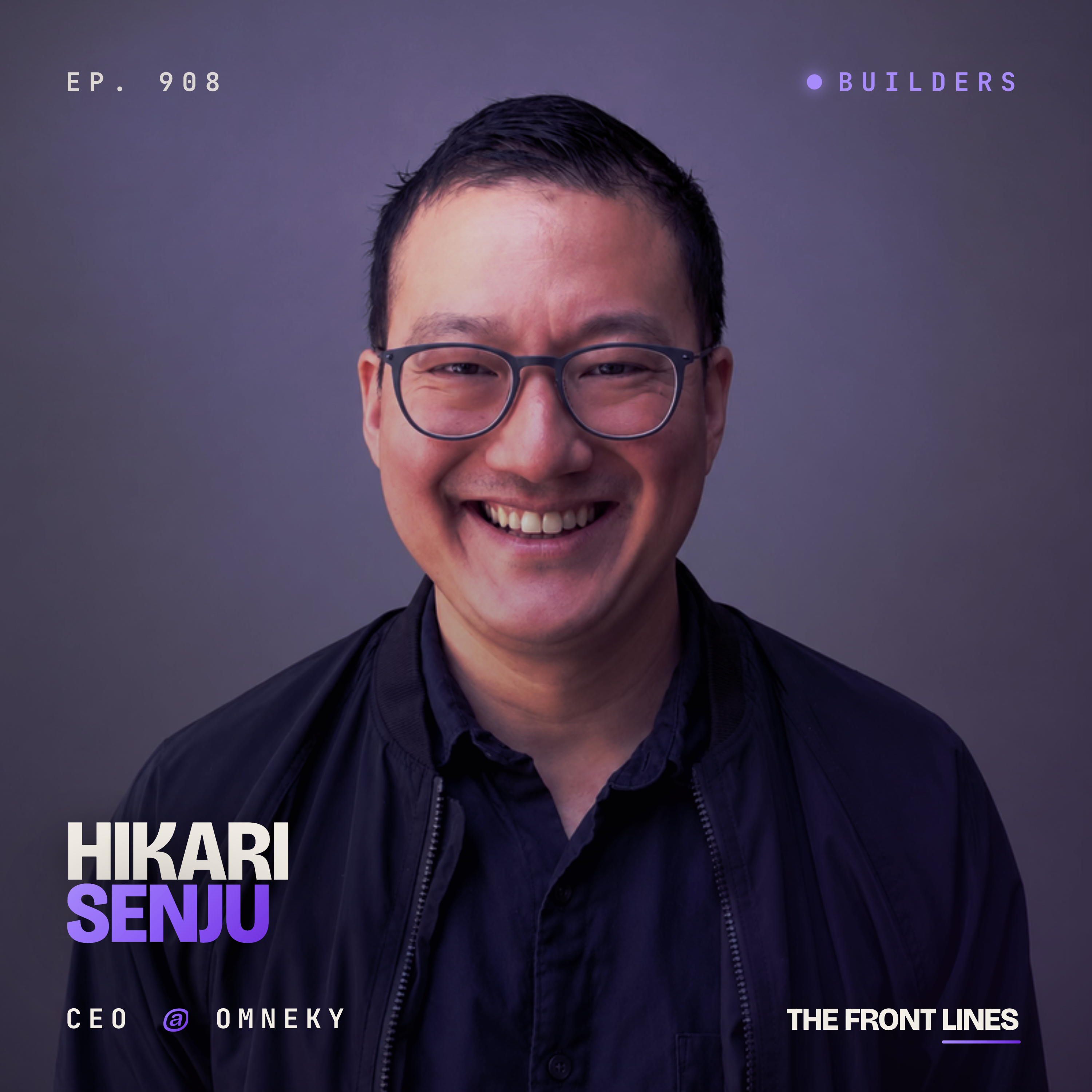
Today we're back with another two time guest. Today we're speaking with Hikari, CEO of Omni Key. Hikari, welcome back to the show.
- [00:58]
A
Thanks for having me, Brett. Really excited to be back.
- [01:00]
C
Of course. Yeah, I should say welcome back to the show. We were just talking pre interview three years ago. You were on here three years ago. So I know a lot's changed in the world. I'm sure a lot's changed at your company, but at a high level, what's been going on the last three years?
- [01:12]
A
Gosh. So you know, I want to even start eight years ago we set a vision, right, which is that agentic AI and generative AI is going to automate creative work. You know, basically automate advertising agencies. The work that advertising agencies do when it comes to generating and managing campaigns. And that's partly why we called Omnikey Omnikey because the largest player in the ad ecosystem is Omnicom and then the second largest player is Publicis. And our logo, our Omnikey logo is the exact same gold color as the Publicis line. So back when I'm ideating this in 2017 and then starting in 2018, the North Star is automating advertising agencies. And what we've seen over the past three years, but as an acceleration of this, but being the first mover in the space, executing against that vision and being one of the leading advertising generation and optimization platforms has been just a steady drumbeat of execution on our end. Just continue to ride this wave.
- [02:06]
C
How have you seen the conversation around AI and advertising just evolve since we last spoke three years ago?
- [02:12]
A
I think three years ago we were just getting started with, you know, well, that was the chatgpt moment. So LLMs were very big and continue to be very big, but generating copy was the big rage back in 2023. And then since then, you just had a exponential rate of improvement in terms of image and video generation models. And so now AI is better than the average human designer at image creation and graphic design. I think that's pretty clear. And then video generation as well, I think we're really almost. I think earlier this year we might have passed the uncanny valley there as well, where AI can generate video that's almost indistinguishable from human generated video content, which again, makes it easier for businesses to create, scale these advertising campaigns in a much more personalized way, so that the creative really is ultimately at the end of one where, you know, you're generating a piece of content in a kind of idealistic sense for that moment in time, for that individual based on their interests and, you know, their particular thing that they're interested in at that moment. And so that was the vision and now it's much more implementable because of the advancements in these image and video generation models. And then the third component, I think, and this is the most exciting part, is the complete agentic strategy and planning component as well. So we just announced the release of Omnikey Agent, which is a completely autonomous system that generates campaigns for you, launches those creatives for you, and then optimizes it every week for you completely autonomously with no human input. And that wasn't really doable until really this year where AI became very agentic and their agentic capabilities really kind of finally met the expectation. And that's only going to continue to become bigger as well in the coming year. The agentic opportunity, I mean, even when
- [03:53]
C
I just think back to three years ago, you know, it was very obvious if it was AI, if it was not AI. Three years ago. But a few weeks ago, I had the first moment where I was unsure and I'm still unsure. I don't know if you are like myself, but I wasted way too much of my life on Twitter on X. And there's that, the meme account, or I thought it was a meme account. Hendrik Johansson, the compliant vc. Have you seen any of this guy's stuff?
- [04:14]
A
I think so. I think I see his stuff kind of surfacing on my feed.
- [04:18]
C
He just, yeah, posts kind of like these sarcastic things, you know, kind of like mocking like European innovation about compliance, all this stuff. But then he drops a podcast with like Martin Shkreli and I'm watching it and I'm reading the comments and everyone's like, wait, I thought this was a fake account. It's real. I'm like, I'm looking at it and I still don't know the answer. Like, I don't know if it's real or fake. And for me, that's just like kind of this like critical moment that I'll probably remember for the rest of my life. It's like the exact moment where I no longer can tell what's real, what's not. And I think everyone is having their own kind of critical moments like that. But it's fascinating times and kind of scary times when you realize that, like, you can no longer trust your eyes.
- [04:53]
A
Absolutely. And I kind of want to also use this moment to plug that omnique. Also, you can generate videos with two avatars in one scene. So like, to your point of a podcast, again, it wasn't until fairly recently where you could have two different characters in one scene talking to each other in a coherent way in one kind of frame. And yeah, and so just even the example you gave wouldn't have been possible earlier this year. And so, yeah, like, I would have to see the video for myself. I haven't seen it, seen that video with Monsquarely, but it is possible that it's AI generated.
- [05:20]
C
And for you, when you think about how you describe the category that you're in, is it agentic ad management? What does that look like in terms of.
- [05:28]
A
Yeah, I mean this, it's agentic advertising. So it's the full workflow, end to end the generation, the launching, the media management, the optimization, the media buying, managing budgets across channels. Advertisers today, and small business in particular are struggling with the really high CPMs of Google and Meta. They keep ratcheting up the cost per impressions for their platforms. And so small businesses are now looking to diversify and looking well, is there a more affordable way of growing where I'm not competing with the biggest budgets on the planet for the same audiences? And that's where platforms like us, where we will measure the return on ads, will help businesses launch. First of all, a business doesn't even need to have an ad account to use us. We will create the ad accounts for them. So if they've never advertised in Meta or Google before, we will programmatically create ad accounts for them where they can run their ads. But separately. Once they've tested Meta and Google, they can also expand to Reddit and LinkedIn and TikTok as well to see maybe there are cheaper CPMs there. And then we will measure the return on ad spend across all those channels and optimize the budgets as well across those channels. And so it is that full end to end media management that we deliver. And the other thing to note is it's kind of ironic that the seminal paper in AI is the Transformer paper, and it's called attention is all you need. And that, you know, who would imagine that almost a decade after the release of this paper, attention is, you know, there's now this meme, right, which is like, you know, and I'm spending a lot of time on X as well, which is distribution is the moat that like, attention is now the critical factor because software is, you know, increasingly commoditized. Anybody can create an app. Anyone can create a really great app. And so now it's about distribution and who has those customer relationships and who has those eyeballs. And that competition for attention is only going to get fiercer as AI makes it easier to create digital experiences. And that's really what we're delivering for these businesses is ability for them to better compete for that attention, for the limited number of eyeballs there are on the planet.
- [07:20]
C
And when you say SMBs, how are we talking about? I think I was reading the legal definitions of it and I think they said a small business is anything less than a thousand employees, which feels like a pretty big business to me. How small is the smaller end of the segment that you're after?
- [07:34]
A
We have customers that could literally be one dude in their basement with their candle business that they like. You know, they're making candles in the basement and they're selling that D2C. You know, it could be they don't even have a website, they just have an Instagram page. And so like, there are all types of small businesses and entrepreneurs are looking to get started and those, you know, again, we democratize growth. We enable any business to connect with their customers and start connecting with their customers without having a million dollar marketing budget or an advertising budget to find those customers. On the flip side, we have great big enterprise customers as well. Mitsubishi is one of our largest customers. They're a big enterprise and they're like one of the hundred largest companies on the planet. And so, you know, from the smallest business to the largest enterprise, we serve them.
- [08:15]
B
This show is brought to you by
- [08:17]
C
Frontlines Media podcast production studio that helps B2B founders launch, manage and grow their own podcast. Now, if you're a founder, you may be thinking, I don't have time to host a podcast. I've Got a company to build. Well, that's exactly what we built our service to do. You show up and host and we handle literally everything else. To set up a call to discuss launching your own podcast, visit Frontlines I.O. podcast. Now back to today's episode. I mean, is that hard having two totally different segments to go after? Like, do you ever feel tempted to say, you know, we're not going to
- [08:45]
B
focus on enterprise, we're going to be
- [08:46]
C
all focused on SMBs or the other side of you. No SMBs, we're going to go focus on enterprise.
- [08:51]
A
Well, honestly, I think they feed into each other so well. SMB, you know, they're very critical on the product, right? There's no more critical product person than a small business that's spending their meager capital on your product. I mean, they really need your product to work and they need your product to work perfectly because for them cash is really scarce and very important. And so they're going to provide the most direct feedback and the most real feedback and the most helpful feedback in terms of improving the product. And so that speeds up our product development cycles because we're competing in this Darwinian world of SMB apps, where there are apps being, as you noted, there's a lot of competitors and new competitors popping up and these SMBs are comparing us with those new players as well. And so they're not holding anything back when it comes to feedback, which is great for us. That then improves the product experience for enterprise. On the flip side, also, the SMB product is lead gen for enterprise as well. Enterprise can use our tool for free initially for seven days and kick the tires and then learn more about our product before committing to a larger enterprise deal. And then there's also marketing as well. Having a great SMB product helps with brand awareness and increasing brand awareness so that the larger enterprise has more conviction when making that enterprise purchasing decision. So I think these go hand in hand. They really feed into each other. This is kind of how we've been thinking about it.
- [10:08]
C
And do you see that the feedback that a small business owner has and, you know, the complaints or the issues or the request are similar to the needs and the pain points of an enterprise? Let's say a paid performance marketer manager at, yeah, Mitsubishi. Like, are they having the same types of like, thoughts and desires and pain points and needs from the platform?
- [10:27]
A
Well, yeah, I mean, there's overlaps and there's distinctions. Right. But the core use case, right, of generating high quality creative, launching those creatives, having good analytics to optimize that creative again, that automating that workflow. Whether you're a small business or a big enterprise, oftentimes the media buyer is still an end of one. You know, it's oftentimes the CEO at a small business and it's oftentimes, you know, usually just have one person kind of ultimately, you know, managing that budget. Even at a large enterprise, even most large enterprise teams have very lean marketing teams and creative teams. The biggest brands may have maybe a dozen people actually doing performance marketing. So even the big enterprises actually have fairly small teams. And so it's not like, you know, a big enterprise has. When it comes to media buying and performance marketing in particular, it's like a humongous difference in terms of the number of seats in particular. And so I think there is, there is overlap, obviously for the enterprise. There's a distinct set of needs like data security, you know, IP whitelisting and copyright and like brand safety and brand kind of guardrails and things along those lines are more important for big business, related predominantly to copyright, brand and data. But the core need of having more higher effective creative is universal across small businesses and big enterprises.
- [11:35]
C
And for the small businesses that you're serving, is it convincing them that they need to be doing paid ads in the first place, or is it convincing them that it's time to fire their agency or stop wasting their time doing it themselves? Like, where do they typically sit?
- [11:51]
A
I think more and more people are starting to realize the value of advertising, even the SMB, precisely because attention has gotten so scarce and so competitive. And so, you know, people now talk about the growth engineer. Right now that's like, now the new lingo is it's no longer marketer. You're a growth engineer. And I think that is the trend. I mean, in theory, advertising should be a much larger market in some ways than it even is today. Right. Historically, advertising has been a cost center where, you know, you have a brand budget and you don't really see the roi. And it's really difficult to measure the ROI in advertising unless you're at a particular segment of direct response performance marketing. Now the attribution has gotten better, and so now you can actually see kind of a larger ROI for all kinds of marketing from television. Advertising is now done more on an ROI basis than historically programmatic. Television used to be more brand, but now it's more programmatic. That's a humongous area of growth in advertising. And so as more and more forms of adherence become measurable, there's now more and More of an ROI calculation. And it actually makes more sense to spend more money earlier on these channels because the ROI is more clear. And I can ultimately see, for example, and this is kind of what we've been saying ourselves for some time, maybe this might have been mentioned. The previous podcast was even like sales teams, right? I mean everyone, you know, you can only have so many people cold emailing and cold, you know, cold calling people. People just don't read cold email emails anymore. Or it's all kind of AI now. It's like all AI can stop. And so the traditional methods of sales don't really work anymore. Right. What does work though is a personalized creative, you know, a video, a highly engaged 30 second explainer video directed just towards you that explains the value props of that product. And in fact, every day you're seeing a different episode in some ways, if you will, of this sales pitch where it's walking you through the value props of that company, you know, that product in a very personalized way that is effective sales and that's advertising. And so I can see advertising taking more and more of sales budgets to get leads and generate leads. I actually think that digital advertising, yeah, more and more people will start advertising sooner and it will actually take a larger percentage of gdp.
- [13:58]
D
This show is brought to you by the global talent company, a marketing leader's best friend in these times of budget cuts and efficient growth. We help marketing leaders find, hire, vet and manage amazing marketing talent for 50 to 70% less than their US and European counterparts. To book a free consultation, visit GlobalTalent
- [14:17]
C
co. And if you look at your own growth, is it 100% or 99% fueled by paid ads?
- [14:24]
A
No. No. So like I think we're a product led growth company and so the first and foremost is having a great product that customers share and a word of mouth element to it. And ultimately, like paid ads, you know, you need to have the beef, right? And paid ads only helps you to the extent that it can get the customer the door. But you have to have a great product to retain the customer, to upsell the customer and then to have them refer new customers. And so our biggest lever of growth continues to be investments in the product and product led flywheels, whether that is kind of how we use the network effect of existing customers to provide insights for net new customers regarding what types of creatives are working or suggestions for new creative formats and designs, new campaign strategies. And that product led growth is the main engine. We then augment that with targeted ads and that has the scale in which we've depended on that has varied over the years, but it is not purely based on paid performance marketing.
- [15:19]
C
What do you put in place to make sure that the design doesn't start to look like you kind of design slop. And I don't mean that in a bad way, but more that it just like looks like everything else. I had this experience probably like a month ago. I was playing with Claude Cowork a bunch and I was doing a bunch of designs and it was creating epic stuff. And then immediately after everything that I started to see on LinkedIn, I could tell that it was AI generated. And it's kind of like the EM Dash and the word delve. And it's not this, it's that with written content, I feel like visual content is kind of going down that path. How do you ensure that it doesn't feel that way or does it not matter? Because the markets that you're serving, they're serving customer bases where they're not seeing that type of stuff over and over again.
- [15:59]
A
Well, okay, so a couple of things to know here. First of all, that the underlying technology is getting better. So this, the EM dash and these kind of weird verbal ticks that these certain LLMs have are only going to get resolved, you know, as GPT, you know, the next GPT or the next models come out with more compute. Right? And so, like, there is a certain thing to know to frame there first. But the second thing is, yes, you do see these weird ticks. But at the same time, think of all the bad content you saw previous to architecture where AI humans weren't relying on these tools and they were literally like, gosh, I've seen some terrible ads in my life, you know, like, truly like weird clickbaity things. That is just complete garbage. And it hurts my soul and my eyes to like, go through and read a great blog post and then be attacked with this, like, terrible design that someone's, you know, like, slopped together without using AI. And it was like, built with some random, you know, it looks like it was made on paint or something. Like. So, yes, it's not perfect, but also it's a lot better than what came previously. You can't compare every AI generated ad to the Mona Lisa. Those campaigns continue to happen. Those campaigns exist. But what that AI is replacing is much shittier content that preceded it. Those people who are operating at similar kinds of budgets. And I think it is a vast improvement in terms of the types of content that historically used to run during those particular placements. Or selling those kinds of businesses.
- [17:19]
C
Kind of makes me think of a conversation I was having the other day with a friend who lives in Michigan, and I was telling them about Waymo and how, like, my default is Waymo. And he's like, but isn't that, like, scary, like, being in with a robot? Like, you know, what's scary is like being with an Uber driver who. Who knows what's happening? Maybe he just got divorced. Maybe he had like a, you know, a fight with his kid. Like, whatever it is, like, you know, it's a human being. Like, I am way more scared, honestly, of driving with a random human being than I am with, like, a robot or an autonomous, you know, vehicle with a. With a Waymo. And I think that people have this, like, I don't know, kind of view that, like, the human is perfect and they forget how flawed humans are. And kind of, to your point of like, how flawed all the other designs and the written content and all of the shit that we're used to seeing out there.
- [17:58]
A
Yeah, I mean, for example, in the Waymo example, I mean, like, I think, for example, like, if you're a woman, like, you're actually very scared of driving Ubers, right? Like, you actually, it's not even like, as a man, like, you don't. You don't like it. It's actually could be very scary. And so Waymo's actually unlock a whole series of mobility and freedom for large parts of the population. The historically, maybe not, may have been more concerned about using Uber. So, like, there is a certain, again, democratization of freedom and enablement of freedom and empowerment of people through AI. And I think that's the larger narrative that gets forgotten with the current doomerism around AI, that, oh, AI is going to replace jobs or AI is going to, like, yes, there will be disruptions. Like there are just like there were disruptions with the Internet, or just like there were disruptions with mobile or just like there were disruptions with previous innovations. But ultimately, the arc of technology is democratization. The arc of technology is more empowerment, and it's going to enable more freedoms and newer freedoms and newer types of jobs than historical. Imagine even this, you know, the job, you know, even podcasting wasn't really a thing, you know, 30 years ago. And so to imagine that, like, you know, there will be a whole new class of jobs created due to AI, you know, that just, you know, we can't imagine because those entrepreneurs haven't started those companies yet. But, you know, if there's a human need Some crafty entrepreneur will come up with a good product and offering to meet that need. And so I think the empowerment that AI enables and the democratization that AI enables is oftentimes kind of drowned out in the larger chorus of doomerism sometimes that I think is unfortunate.
- [19:27]
C
And final question for you. I know that the future can be hard to predict. Where do you see this all going when we talk again in three years, or I hope I talk with you more than once every three years, but let's just assume I don't talk to you for three years. What do you think is going to happen? Like, what's the world going to look like three years from now from the lens of advertising?
- [19:45]
A
Sure. So one thing is to take a step back again from three years prior. Right. And again, the thesis we laid out was that this technology was going to arrive and when this technology arrived, which is AI generated content and agentic AI, that it was going to create a flood of new competitors and that this is why it was important to be the first mover in this space and be in the pole position in this race when this technology finally arrived. We've executed that flawlessly. We set the first move in this space. We're in the pole position now when it comes to agentic advertising. So now the goal is to scale and because this is a trillion dollar industry, if not multi trillion dollar industry, based on the growth of the advertising itself. And so hopefully three years from now we're operating a much larger scale than we are today per kind of the initial game strategy we laid out back in 2017, 2018, again embedded in the very name of the company, automating a large part of the advertising work that historically, you know, again was barred to certain SMBs just because of how expensive it was.
- [20:43]
C
Amazing. All right, my friend, that's where we're going to leave it. We got to talk before three years from now, but thank you so much. Great catching up. Great seeing you again. Where should we send people if they just want to follow along with more of you?
- [20:52]
A
Well, yeah, so you can follow me on X. I'm at hikarisenju on X. You can definitely sign up for a free trial@omnikey.com you can follow omnikey on Twitter, on X, on LinkedIn, on Instagram, and then you can follow me on LinkedIn and X as well.
- [21:06]
C
Amazing.
- [21:07]
A
And then feel free to email me as well@hikarimnikey.com Amazing.
- [21:11]
C
Thanks so much, my friend. Great seeing you.
- [21:12]
A
Thank you, Brett.
- [21:16]
B
Well, that's all for today's episode of Builders, brought to you by the Frontlines. If you want more amazing content like this, visit Frontlines IO, where you'll find a library of more than 50, 1400 interviews with founders, marketers and other GTM leaders, where we unpack the tactical lessons from their journey. And of course, as always, if you do want to launch your own podcast, we'd love to have a conversation with you. Visit Frontlines IO Podcast as a service. Mention that you listen, mention you love the show, and we'll give you a 10% discount.
- [21:44]
C
Thanks for listening. We'll catch you on the next episode.