Loading summary
Transcript99 lines
- [00:00]
A
I sat down with a gentleman that ran a $300 million ARR business and you just literally couldn't imagine how he could make the rep experience any better.
- [00:09]
B
Sellers are only spending 30% of the time selling and 70% of the time not selling, wrangling tools and stuff. It's like, that kind of sucks, right?
- [00:17]
A
It's really easy to look like a hero. You can look like the genius for a couple hours, but then you've got to integrate it into your go to market stack. You've got to make it flow, you've got to make it all work, which is an oxymoron.
- [00:28]
B
Which is oxymoron itself. I was like, okay, well, by definition you're not really personalized, nor are you at scale. So you came the gates with a founding team of 14, which is very different. It's built different. Most companies don't do that.
- [00:37]
A
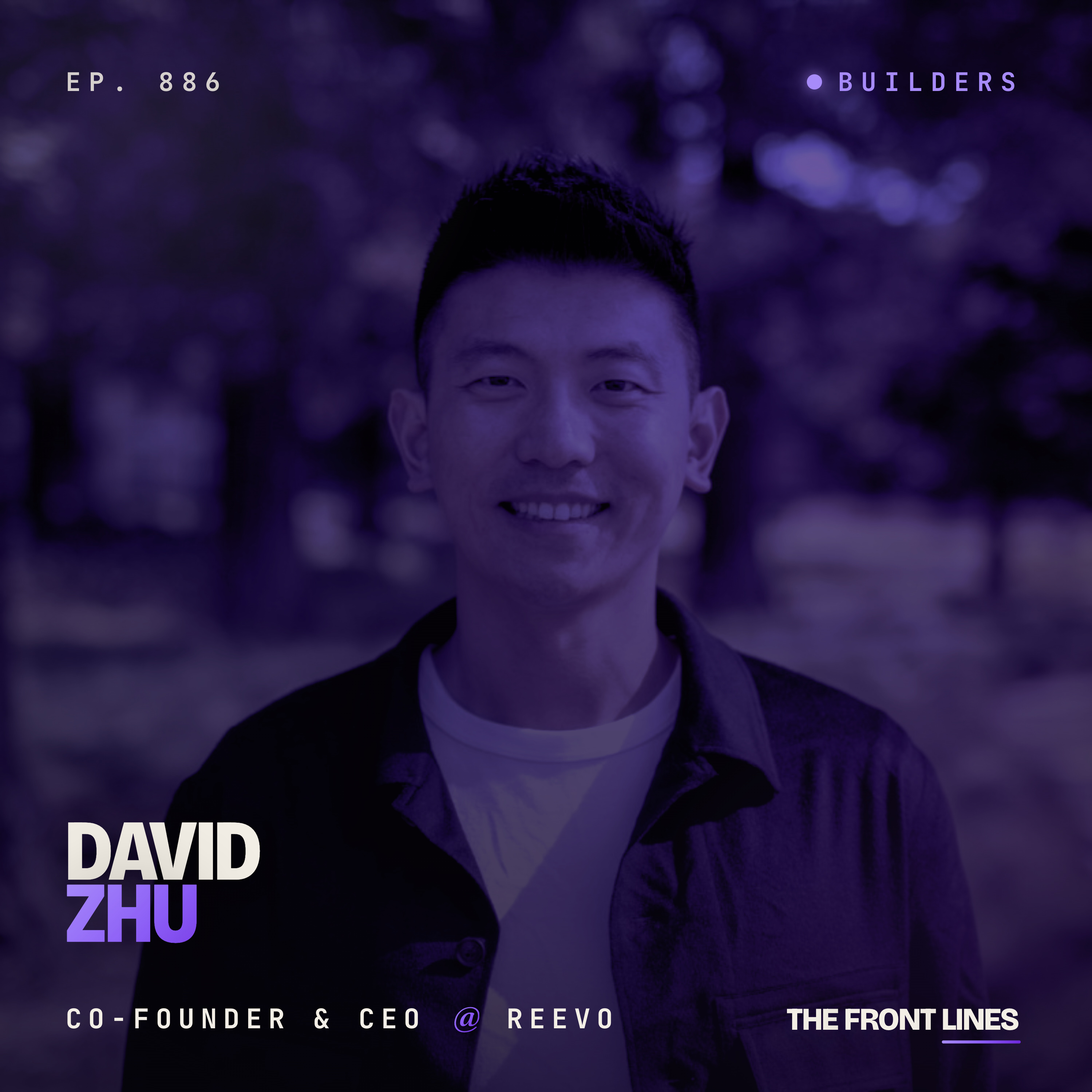
That is something that I wish most CEOs could articulate. Welcome to the Builder podcast. I've got David Zhu, founder of Revo. I'm excited to do this podcast. I've spent my entire career around CRM and you're coming in to try to reinvent it, which I've wanted people to do for a long time. So welcome. It's great to have you.
- [00:59]
B
Thanks for having me.
- [01:00]
A
Yeah, I always love to ask founders not first what they do, but if you're wildly successful, what does the company, what does the world look like? How does it look different if Revo does what you set out to do?
- [01:14]
B
Yeah, that's a great question. I think success is like really interesting because you got to sort of like add a variable of time horizon. And so if we snap, let's say for the sake of argument, like the time horizon of 10 year, I think what success could look like is I imagine this world where within the space of revenue, you know, Revo becomes the only platform that powers the entirety of a go to market team's motion from, you know, marketing, sales, success, support from inception of a company to scale. And so inception is like regardless if you're just a YC founder testing a concept market fit through scale, which is hopefully a Fortune X bracket company that have reached significant product market fit and is trying to retain that market position. Revo is that single unified platform that powers the entirety of that go to market motion. So then the question is like, okay, cool, what's the. So what, what's the impact? And you know, one of the things that we believe in at Revo is that we're all feeling animals that Think, not think, animals that feel. And so part of that aspiration of success is how do we create this world where humans who are in this go to market space are happier at the end of the day, like genuine happiness, genuinely happier at the end of the day going back to those who matter outside of work. And so they're more energized, they're more engaged, they're able to go back to their friends, family, passion, interest on the weekends and not have to sleep in and recharge because they had an exhausting five day weekday because of manual entry or prospecting fatigue or forecasting nightmare because of computer fields and rural fields that don't really work out. Um, and so if Reva can offer a new way of working that helps facilitate outcomes, I think it's really, really powerful and it's a really exciting and inspiring future for everyone in this space to trek towards together. Now, obviously we're not there. Right. And obviously today, sort of with a legacy, sort of last generation tech shift, it saddles revenue teams with a lot of tech bloat.
- [03:49]
A
Yes.
- [03:50]
B
Stack bloat. And that's okay. That's okay. We're here to innovate and we're here to do it together.
- [03:57]
A
I spoke at a conference yesterday on. I think everyone in my world, you come from the engineering world. I think it'll be fun to talk about how you view it differently. Everyone in my world, which is rev ops practitioners, we all see that we're living in a world where clunky salesforce, clunky objects. I sat down with a gentleman that ran a $300 million ARR business and you just literally couldn't imagine how he could make the rep experience any better. And so I think everybody living in the rev Ops and the GTM world wants what you, what you're building. I think we'll dive into kind of the, the wedge. The other thing that you didn't touch on which I don't know if you know the company, DevRev, I'm guessing. Have you seen. Seen them yet? Yeah. So DevRev had the vision that there is product data like support. So and then there you see, have the support GTM data and the GTM data, but then you have like the tickets and if you think about it, those two data streams don't talk together at all. And so by bringing them all onto one platform, you can start to do that. I think what you have right now is you have a product engineering silo which enough you come from, you have the GTM silo. And then you have kind of a finance silo. And I think the first people to really bring those together is interesting.
- [05:10]
B
Yeah, well, it's really interesting that you touched upon that point. Like even within the sort of silos of go to market, there's micro silos within marketing success, sales, et cetera. So take one practical customer journey that is very real, which is upon a close one of a certain account. How do you decompose that account's characteristics into a set of facets that you can feed into top of the funnel to find more lookalikes and route those lookalike accounts, but more importantly, the contacts, the decision makers, the economic buyers through your highest performing campaigns to have that revenue flywheel and to do so in a manner that doesn't require expensive GTM engineers or human labor that needs a PhD to stitch together a dozen different tools, I think that's very liberating.
- [06:07]
A
So what you're fighting against is best of breed. It's the hey, I have to run an ABM campaign. I have this tool tooling that will integrate into Salesforce. And even though I know it's all clunky, I'm still able to have my marketer execute their best of breed and I'm still able to have my sales team do that. How do you attack this market? I think a lot of people, I think we all see where the world's going and where you're going to make sense to me. And I'm excited for you and the seven or eight other people that are all chasing it different ways. What's the market wedge that you kind of see that you're attacking first?
- [06:40]
B
Yeah. So to talk about a wedge, we sort of think first principles and we start with understand this sort of a little broader framework we use. We're very heavy on frameworks here at Revo. It's like a simple framework of learn love before advising. And so in order to innovate in any space, we believe that we have to learn the space first and we have to like, once you learn the thing, then you have to love the rationale for why we are here today. And then you can start applying first principle thinking. Decompose the ration of what got us here today to inform a potential better future via vise or a product wedge for that matter, to use this nomenclature. So how we thought about it is like, okay, well how do we learn a space? Well, you got to have product founder fit and you have to feel the pain. And so this is to your earlier point, being a technologist by training over 13 years prior to starting Revo or prior to the N1 endeavor before Revo, where I was running go to market for two years and feeling the pang of having to procure a dozen different tools. And as a technologist, like, oh my God, am I dumb for not being able to figure out how to procure prospecting tools, conversation, intel tools, outbound campaign tools, delivery, you know, deliverability enhancement capabilities. So then my emails actually land in the mailbox. There's a slew of things that are just like in saying that doesn't actually contribute to our ability to reach out to customers and serve them.
- [08:07]
A
Yeah.
- [08:08]
B
And, and so we were like, okay, cool, let's, let's learn all the customer journeys, all the workflows, all the jobs to be done that Personas in this space have to execute. So you know, SDRs, AES, Rev Ops, marketers, success, et cetera. And so we just basically created this like graph view of nodes and edges. And so we think of the Personas like the nodes and then there's no to no interactions in terms of jobs to be done. And a jobs to be done just for example is like engaging with a customer or prospecting or generating reports, forecasting insights, stuff like that. And so once you map that full mece set of a graph, then you can look at that graph in a complete sense and say, hmm, are there sub sets of that graph that can be rerouted edges to nodes rerouting that can make this entire system more efficient?
- [09:06]
A
Yeah. What are the sacred cows that you can kill?
- [09:08]
B
Exactly, exactly, exactly. And so that's sort of the approach we took. And what we know, what we sort of, you know, we're only year and eight months in, but what we learned early on with our customers is that there is a huge appetite on this sort of co building together for this future world. Because to your exact point, everybody knows that with AI as the latest technology shift, there is a new way of working. Nobody sort of oscillated on exactly what that is yet. And that's okay. We can talk about different modalities and sort of channels of whatever ways of working, but ultimately there's going to be a new future. And so one can say, well, we're going to sit back and just wait for others to discover this new world together, you know, and then we'll adopt. But there's actually a larger cohort who says we're going to be the pioneers and co create that future together with companies like Revo.
- [10:05]
A
There are companies out there experimenting with this right now and super large company. It's interesting. I think this innovation is going to come from both below of the people that are going after like the hubspots of the SMB, the YC companies. And I also am seeing a lot of innovation at the gigantic enterprise level where they say, hey, I know I need something better. The challenge there is you're going to have a thousand integrations that are all going to be plugged in. What are some of the sacred cows that you've found in studying the graph so far?
- [10:34]
B
Yeah, well, it's really interesting. So it's different by segment and so there's actually a between enterprise and sort of, let's call it mid market SMB. There's quite different learnings. So let's say enterprise, for example, integrations is literally like the first thing that every decision maker asks is like, oh, who do you integrate with? Right. Do you integrate with legacy systems that we already currently have? We have a sort of certain workflows that's tied to Finance, NetSuite, ERP Systems, whatever, YADA yada yada. There's. So that's one challenge where that's sort of the status quo and then on the down segment sort of the SMB and mid market that they're not really quite saddled with that as sort of the first classes and pain point. They're just like, look, we're screaming for leads we can close and we're screaming for help closing them.
- [11:23]
A
Yeah.
- [11:24]
B
And so it's like I don't really care about the integrations, like I just care about getting jobs or like getting the outcome. And so early on and this, you know, to sort of like the sacred cow thing. My opinion. And so everyone's entitled to opinion, not their own facts. My opinion is that I think with AI advancing, especially on the cogen side, it reduces the time to innovate. And so innovation by definition goes hand in hand in failure. If you know something's going to work, it's not innovation, it's repetition. And a lot of companies are now starting to embrace the fact. It's like, okay, cool, we just need to innovate internally. And so enterprise companies, I believe in the next, you know, year or so definitely is, are going to start building a lot of these things in house.
- [12:08]
A
I agree, they already are. I mean you're seeing people. I'd say there's maybe a 10 contingent. That's data warehouse first.
- [12:14]
B
Yeah.
- [12:14]
A
CRM and map second.
- [12:16]
B
Sure.
- [12:16]
A
And when you get to that point.
- [12:17]
B
Yeah.
- [12:18]
A
Then you can start to play with like headless UX there's so many different
- [12:22]
B
ways to penetrate to sort of like. And there's different schools of thought. There's, you know, they all have their own great, you know, rationale for it. But I think enterprise is one sort of space that is like, it's really hard for an entrepreneur or for a newcomer to try to penetrate really hard. And so then we sort of just like leave that space for the time being and we apply a framework of okay, well trust equals consistency over time. And in order for companies, enterprise companies to really sort of trust you, you have to consistently do what you say you'll do over time, which you can't compress, right? But you can't be consistent in the things you, you say you'll market, right? And so we thought it's like, okay, well let's grow together, right? Let's find the next rocket ship sets of companies and like really, really, really keep up with their growth arc such that by the time they are scaled, right, they scaled on Revo.
- [13:14]
A
So it's like Checker taking Uber. Find those, find those breakout companies.
- [13:18]
B
Exactly, exactly, exactly. And so it's also very organic because then it allows us to build the foundational pillars where in Revtech it's not just the tip of the iceberg that's exposed, but it's really the body of the systems that even power it to begin with. And so for Riva, how we thought about is like, okay, we kind of have to bridge the both of the best of both worlds and understand that we're not just like pure AI native. We're also combining the sort of system architecture that power the last cloud era and compose it together with AI. And so how we thought about is like, okay, you know, we have an objective to be a daily habit, right, which is sort of a consumer esque thing. We want to be a daily habit such that all revenue leaders and all revenue, you know, participants are view Revo as a daily necessity regardless of device type, regardless of modality type. And then we also believe that in order for us to be trusted as a daily can see layer A, we have to have the highest precision insight derived based on the highest recall set of ground truth data. And so with this sort of what we call Frankenstack architecture that got us here today, we won't be able to have the highest recall set of ground truth data. And so our approach that really resonates with our customers is they love that we're both building this surface area, product surface area of where all the jobs are to be done. We're capturing the high resolution data and we're storing it first party in a very tentative and protected manner because data matters to our customers such that when we do generate insights and action that they know it's based on the highest resolution, full recall set of data that maps and represents them and that they're not having to deal with integration tags and like API fidelity loss or, or you know there's a lot of players nowadays or just sort of this wrapper layer, agentic wrapper layer that has their webs into different data sources and sort of they consume the stream, they process and feed into frontier labs to sort of distill like we know that doesn't work. Yeah, it'll get you enterprise pilots.
- [15:30]
A
It's really easy to look like a hero. Yeah. Like if you take Clay, which is a very impressive tool and you play with it, you can look like the genius for a couple hours but then you've got to integrate it into your go to market stack. You've got to make it flow, you've got to make it all work. And so I think it's the, the ability to really succeed at GTM is. It's complicated and people don't get that. So what would be the ideal just for the, the audience here, what would be the ideal customer for you guys today? Is that going to be. It sounds. Because I think most of the breakout companies right now, we were talking before we hit record, you guys are. You don't have the product stream yet but that'll come. But a lot of these breakout companies are like a gamma or. I was just talking to my friend who's running GTM at OpenArt the other day. Like these things are growing really fast, but they're more PLG type companies. Like what would be the sweet spot company for you guys today?
- [16:21]
B
Yeah, I think for this year we're really focused on making sure that we are able to serve maniacally well. Companies are AI forward thinkers, adopters, innovators, embracers who exemplify a sales led growth motion. Right. So if you're a company that's like serving B2C we're probably not the best fit for you. Right. But if you're a B2B or if you're, if you have a sales led growth motion or you have an engagement motion that requires to engage with others, we could be a potentially great fit. And so today our customer segments, we're not vertical agnostic, we support hardware, software services, consult, you know, and so there's like, there's a breadth that we can serve and over time we'll sort of go deep and focus, but we're not quite there yet.
- [17:12]
A
Today the breadth actually makes sense. I was talking to Matt Curl, CEO at Apollo, and he said, you know, there's only 6,000 B2B Rev Ops functions out there, but there's 300,000 companies that need their data. And so the ability to go beyond what we're all sitting in the valley looking at and look at all these different types of target companies and help them is, is powerful.
- [17:33]
B
Yeah.
- [17:35]
A
What do you think about. So I'm starting to see some companies innovate around AI. There's obviously AI outbound. There's also now people are starting to innovate on the SMB AI closing as well too. I think support's a really good use case where people started at kind of the 30 to 40% ticket resolution and then they had the mechanics and the feedback loops to get up to. I think what are you hearing now like 80, 90 in some cases. And so how do we do start doing that for other functions in gtm?
- [18:03]
B
Yeah, so one concept that we work backwards from that our CTO has sort of like coined is this concept of verifiability. Right. And so I guess some people call it like hallucinations or whatever, but it's really, the concept is like, okay, cool, what are the customer journey that needs to be the most verifiable and how do we increase over time? Right. So to use customer support, example, customer support, there could be application players, there's several big ones, very well funded that get to 80, 90, 95%. But depending on the use case, certain institutions cannot tolerate a 95% correctness or verifiability. Right. And so in financial services, for example, you can't really like screw that up. And so I think the cost of verifiability is like the sort of first order bit to focus on and iterate on within the other functions of a go to market outside of support, which is pretty well studied at this point. I think with a couple, like I said, there's multiple approaches. There's the application layer approach of leveraging Frontier Labs, which has its own sort of downside because hallucination is predicated on the Frontiers Labs capability. But there's also other approaches of like, okay, well maybe you can just create foundational models that actually eliminate hallucinations. Right. So there's that approach as well. So there's like multiple approaches or models
- [19:30]
A
checking models which is.
- [19:32]
B
Yeah, so you can like have like adversarial agents that fact check, the sort of zero shot, few shot, whatever, chain prompt responses that gets back, but whatever. Maybe there's different approaches, but it ultimately comes down to verifiability. And so within sales, marketing and success, each one of these functions have different bar of verifiability. And so our approach is like, okay, well let's understand the nuances of the different types of verifiability thresholds that we have to meet for our customers who are doing that set of jobs to be done to trust us. And so the investment there from our perspective is like, okay, well what are all the building blocks that feed into it? Right, on the data side, on the data lake side, on the graph side, vector store side evals, for instance. So there's a bunch of things that ladder into it such that when we think about, okay, if a rev ops leader is looking to generate, I don't know, like a forecasting report for their qbr, that it is, you know, exceeding the threshold of verifiability that they need for their CRO to go to their board and present. Right? So that's very important. And then if you're, you know, conversely, to take, you know, another example that might have a lower threshold of verifiability, it's like, okay, cool. You know, there's a lot of, to your point, like a lot of sort of interest on how do you generate personalized messages at scale, which is an oxymoron, which is oxymoron stuff. It's like, okay, well by definition you're not really personalized nor are you at scale. And so it's like, okay, well maybe there's higher tolerance there depending on which lever of the volume you want to toggle. If you want to toggle insanely high volume on the outreach side, then you're going to be a little bit more, you know, you're going to have lower fidelity on the personalization. And if you want to highly personalize, then maybe the volume goes down.
- [21:22]
A
It's funny because you bring an engineering fidelity exactness approach to things. I think in the go to market world you're living in a funnel approach, right? Which is I'm okay with mistakes and actually mistakes in some cases, like outbound. If you take AI outbound, it may be very generic and it may be the same every time. And if you send the same one every time, eventually we all got used to the hey, I, are you the right person? Or I have one question. Can I ask a quick question? And so I feel like innovation and pushing mistakes are okay in a Lot of go to market. Clearly when you get down to the finance and the revreck and all that stuff, it becomes much more important than it's exact. Yeah, but it's interesting to see how you're bringing that like data driven approach.
- [22:08]
B
Mistakes helps us grow, which we shouldn't embrace because it's a growth mindset. But when applied in revenue bearing and profit center functions that can't tolerate that level of mistake, then we just have to be aware of it and just sort of, once again using that principle or framework of learn, love, advise, just have to learn and understand which sets of jobs to be done, has close to zero percent tolerance of, you know, verifiability loss and just go do that. And even on that prior point of personalization and outreach at scale, you know, it's really interesting because it's not just the volume play or nor personalization play. There's so many different facets that feed into it like deliverability. Right. There's the levers on the mailbox side, domain side, IP side and it's sort of a black box today. How do you make sure that your mailbox is warmed up? How do you make sure your domain is in a healthy state? Continuously in a healthy state? How do you make sure the IPs that are powering the domains, whether it's static or shared IPs are maintained in a very nice manner. And so these are the sort of foundational infrastructure utilities sort of like things that we take for granted. A lot of users, you know, revenue leaders and users take for granted that when they are hampered they sort of blame, you know, a sequence company. You're like, well we procure this seat on the sequence or campaign app and I'm getting certain spam rate or whatever bounce rate. It's like it's your problem. It's like, well, it's actually not quite true because there's different levels of fidelity that we have to get into that power into it. So our approach is like let's understand once again first principle, what are all the different input levers that feed into the jobs to be done, to be achieved and see if we can rethink a lot of these input variables.
- [23:53]
A
There'll be some that'll be hard. Like I spent two and a half years in email, I was filtering billions of emails. There'll be some that are, that you may not want to attack. Right. Like deliverability is a really interesting one because yes, there are deliverability experts that can get all the spif and skim and all those different Things and that's a, it's a, it's a, yeah, it's a dkim. It's a, it's a random, it's a crazy language. But you still have to fight against Google and Microsoft on those things. And Google, I tried to meet those guys, the long haired dudes that were, that, that were watching and owning the spam filters. I at upwork, I think I sent a million email to people like you, to engineers. Did not go well. We were, we, we watched the cascading spam and so yeah, I think you can help. But there's also like, you have to draw the boundaries at some point with like. Because the neat thing is you guys have raised enough to be able to have the time to really do this and figure it out. But there's also like even to your point on outreach, there's deliverability, there's message which is all there. But there's also like what's your brand? Do people know about you? What are the assets? What are the Personas? Like if you're, if you're sending just a message versus like I got sent to the warrior game last night, somebody sent me a note, I'm like, yes, I'll reply to you and engage.
- [25:03]
B
Yeah.
- [25:03]
A
And so I feel like there's almost with go to market market there's no end to where these things go. And so have you with the company drawn those lines around? Like no, we need to focus and we're not going to go outside of this box to be successful or you like explore in any direction right now?
- [25:20]
B
Yeah, that's a great question. Well, we dream big, bus starts small. And this is sort of a thing we learn from doordash and you know, our dream big big is to ultimately serve the full breadth of go to market. Right. But the reality is like focus does matter.
- [25:35]
A
It does.
- [25:36]
B
And so our focus is start with sales and then within sales. Like okay, there's slew of opportunities that we can tackle and some opportunities are more urgent and important, others are important but not urgent and others are urgent but not important. So we just sort of like categorize sort of methodically. It's like, okay, cool, if we solve this for our customer, it would be the most compelling. It might not be the most differentiated but it'll be the most compelling and it'll elevate them their happiness. We'll get time back. Forget the OPEX savings and all that, that's like sort of a rounding area in the future. But the labor savings in terms of the time and the energy that us humans are putting in. If we can elevate, you know, one stat that we learned from our customers, like sellers are only spending 30% of their time selling and 70% of the time not selling, wrangling tools and stuff. It's like that kind of sucks, right? And so if we can like flip that variable to be 70% selling, 30% not selling, like, that'll be amazing. So then they can do more with less time energy and so they can go back to those that matter outside of work, to their loved ones, to their interests. And I think just that creates a happier employee base, a more effective and efficient employee base, but more tactical. Coming back to your point of like, where do you focus and how do we think about it? We sort of like think of these like golden workflows is sort of this nomenclature we have. And these golden workflows represent a sort of thread of view across different modules, right? Or different applications or different stacks that you previously had to procure. And we offer that magical experience that you don't have to manually go and boom, boom, boom. Do things from top of the funnel to middle to bottom to the CRM. We just sort of thread it all together in this like one super workflow for you and it's just magical.
- [27:36]
A
I think that's maybe the most exciting and we, we touched on it before we hit record of you're coming outside of the space. Like, I think we've all been look used to looking at forecasts in a certain way, funnels in a certain way, but you could imagine a TikTok experience for evaluating. I don't know what it is, but it's not just innovating on the data side, but it's also interviewing how you work. It's the ux, right? I was an early investor in, I don't know if you remember it, Scratchpad. Oh yeah, yeah, Scratchpad was let's create
- [28:04]
B
a daily habit Scratchpad dually.
- [28:05]
A
Yeah, yeah, Scratchpad dually. Like let's create a daily habit to do that stuff. They did a great job engaging people on the user level. It took em some time to figure out how to engage and charge for it. But I think I kept having my reps come to me and say, hey, we're using this free tool, we love it. And then I was like, oh, but I'm in my world and I don't. It's like, I don't. I think the challenge I ran into was we know we're delivering a subpar UX to people, rev ops people, but we have a ux, but we have these other problems that we haven't dealt with. And so no one's willing to pay more to improve the rep UX when they really should, because that's at the core. So I think I get excited by what companies like Revo can deliver and build.
- [28:48]
B
Yeah, we're very excited about the sort of UI UX of the future. And we strongly believe that, you know, today we're sort of operating this like mouse and keyboard click imperative state. And we look forward to a world where in the coming quarters or years where we get to elevate the how we work to be natural language outcome declarative, not input declarative, but output declarative. And I think that'll be very, very powerful. And the different modality types, whether it's like or device types that will manifest, will change. Right. It might not just be primarily desktop or laptop.
- [29:28]
A
Yeah.
- [29:28]
B
It could be apps on wearables. And we are very excited to be able to explore those ideas with our customers, ideate with them, hear their thoughts, see their reactions when we talk about these two year out sort of things and it's just so fun. What a pleasure.
- [29:48]
A
I'm excited to see where it goes. Okay, so you guys have raised I think 80 million if I'm right.
- [29:52]
B
Correct.
- [29:52]
A
I've raised nothing. And so I think it's this really interesting debate that's going on. Right. And you probably can't bootstrap a enterprise company. I think for me I've, I've been going much more the not raising at all. But I do think AI opens up a lot of that stuff. Right. The ability to ship something really fast. And so before you started this, how did you think about fundraising? Because I think that could be, I mean an impressive, insanely impressive round, seed round. A round. What was the.
- [30:21]
B
Yeah, we just announced that it was around
- [30:25]
A
and so like how did you as a second time founder think about that? Or first time founder, but super senior engineer, multi time entrepreneur? Yeah, yeah, yeah, multi time entrepreneur. Like how did you go through the fundraising journey? I think that'd be fascinating for people because there are not a lot of people that raise an 80 million round out of the gate.
- [30:41]
B
Well, so we thought about the opportunity space and we were very excited to partner with amazing long term, I would say venture assistance as Vinod likes to call himself. He doesn't actually call himself a venture capitalist, but venture assistant. And so we thought about like, okay, well what are the spaces that are workflow driven enterprise SaaS, companies of the last two decades that are right for innovation. Right. And it's not just in go to market, there's actually multiple other sectors that are very ripe for innovation. And so, but obviously product founder fit has to matter as well. And so we said okay, cool, if we were to swing for the fences, like what do we have to believe to be be true such that in 5, 10 year horizon we would be living in a fundamentally different world. And so we just sort of worked backwards from that and we incubated with Vinod at Khosla, at Revo, out of the gates and that was really fun. And so once we sort of had that vision, then we thought about okay, what are the different win conditions that has to be true, right. Team composition is one of them, arguably the most important because the team you build is a company you build. That's another vodism. But and so we thought about like okay, cool, if we're building compound thesis where the action actually has to match the intent, right. There are a lot of companies that talk about compound startups, yada yada yada, but then their action doesn't actually reflect it. They'll start with this slight thing. And so for us it's like, okay, well we don't want to, we, we don't want to do one thing or say one thing and do another. And so if we're going to be this all in, one out the gates, we're going to act like it. And our action has to reflect it, our product investment, engineering investment has to showcase it. And so the talent density has to then follow it.
- [32:21]
A
Yes.
- [32:22]
B
So that's why we came out the gates with a founding team of 14 which is very different, it's built different. Most companies don't do that, right? Most companies don't come out the gates with 14 members. And so then it's like, well the reason why is because it's such a bread breadth of a surface area. And so then it's like, okay, cool. In order to have that, what do you need? Well, you need to have clarity of several things, clarity of your company values, your company principles. What are the non negotiable frameworks that everyone can have clarity and rally around. Right. And so for us there are simple, there are a couple frameworks that we sort of at inception we stood up with the founders and founding team. All of us fortunately have had multiple journeys together in the past. So there's a lot of relationship capital to fall back on. But one sort of simple framework that I forgot who talked about it. Maybe it's Simon Sinek talked about is like this Navy SEAL 2 by 2. Y axis is performance, high performance, low performance. X axis is like trust, low trust, high trust. And there's multiple ways to slice it by what are the non negotiables. And so one way is like some founders and some teams will slice it horizontally. It's like as long as you're a high performer, regardless of whether you lose the trust of the team or not, like we'll tolerate you. That's not us. We drew the line vertically down the middle of trust. Right. Obviously if you're a high performer, you're a high trust. Like you're a keeper or you get
- [33:46]
A
the default to be high trust, but you still gotta earn that.
- [33:49]
B
Exactly. But we optimize for making sure that there's team cohesion, there's a strong collaboration. And so even in the cases where you're high performing but you lost trust of the team because of a certain way you act and you, you know, we don't tolerate that and we make it very, very, very clear. And that clarity of sort of like our value system allows us to easily move through a day to day minutia as we continue to sell or replicate, which is another sort of concept that we like to sort of think about. First, 10, 15 employees is basically the DNA of the company. And I spent a lot of time maniacally scrutinizing the characteristics of the founding team and then now we just crossed 100 employee mark. And so we're constantly tuning, tweaking. And so company building is very similar to seller splitting or organism like us. If you sell your split too quickly and you have mutations, introduced mutations going to lead to cancer. Cancer is going to lead to host dying. And so very similar analogy. So whenever we detect, you know, potential mutations, we'll prune.
- [34:54]
A
Right.
- [34:55]
B
Either practically, you know, most. Most of the time practically. Because you know, when there's doubt, there's no doubt.
- [35:00]
A
Yeah.
- [35:01]
B
And so that's sort of how we approach company building.
- [35:03]
A
How does. So the 14 makes sense. It's cool that you've got that group that you can bring trust, performance and how good you are is easy to measure.
- [35:12]
B
Yeah.
- [35:13]
A
Trust is actually very hard to measure. So if you're not one of the 14.
- [35:16]
B
Yeah.
- [35:17]
A
And you're number 17.
- [35:18]
B
Yeah.
- [35:19]
A
How do you.
- [35:20]
B
Or number one of five now.
- [35:21]
A
Yeah, number one of five. How do you know if you're getting trust in your leadership team? I mean there's not probably a universal answer, but within your world, like how does somebody get on that side of trust.
- [35:33]
B
Great.
- [35:33]
A
I think it's. I've always been the guy that accelerates rather than the founder.
- [35:37]
B
Great.
- [35:37]
A
This is the first one and for me, I think I'm. I'm learning it as I go, but I'd be fascinated. Like how do you get across?
- [35:43]
B
I think, you know, I have the benefit of having interviewed thousands of candidates and sort of like the pattern matching and learning from some of the best talent magnets like Keith Raboy. Spent two years with him in Miami running a company together. So it's like I've probably learned more about talent identification from him than any individual. And so the pattern matching has to be spot on and it has to be very efficient. You can usually tell in the first like 10, 15 minutes, but that requires a clarity of intent of what to look for. So on the value side, the soft stuff side, the feely touch, things that a lot of folks don't really look at, but I think it's actually very, very important is we look at things like are you intrinsically a good human being? Right. And there's different ways to suss for it. Right. Are you a giver mentality? Are you? Or versus a taker? Right. Are you. Do you believe in the power of individuals? We strongly believe in the power of individuals here at Revo. We believe that each person, life and business are very similar. That there's extended highs and extended lows and that it's our responsibilities as human beings to each other less so, coworkers less so, pref to common, less so whatever. But more so as human beings to be there for each other during the lowest lows. And startup has a lot of roller coasters, so the lows are very, very frequent.
- [36:55]
A
It's interesting too, if you're not on the founding team, you run those lows and highs differently.
- [36:59]
B
Exactly.
- [36:59]
A
Right. Like it's Everybody wants the 105th employee to be a founder in mentality, but they're different reality. Well, I mean they don't have the same equity and they haven't taken the same risks. Yeah, it really. By the way, like we should almost have you on our whispered hiring one because we interview top C level folks about how do you hire. And I think it's really, really interesting I to be able to figure out how do you evaluate for me. You can interview, but it's still that first and second week that is. I know after I've had three one on ones with somebody if they're a keeper or not. Right. Like if they're coming to me asking for direction.
- [37:34]
B
Yeah.
- [37:34]
A
And asking for clarity and needing affirmat.
- [37:37]
B
No.
- [37:38]
A
If they're pushing me in those first two or three weeks and managing up effectively and bringing the right things. And so for me I've made mistakes, but if I make a mistake, you prune it fast is the way I approach it.
- [37:49]
B
Mistakes helps us grow. We're never going to be perfect. And I think that last point you touched upon is these characteristics of being intrinsically curious if you're an avid learner. This goes back to the engineering background that you mentioned earlier. You know I have the benefit of not being saddled by domain industry domain sort of debt and you got to
- [38:11]
A
keep making sure that you don't right. Exactly. Like it's such a bounce because people be like I really want to see it this way. Which I think is interesting because you're selling those future blow up companies. You almost don't want to sell a CRO of a 400 person team because that person is going to want to see it in X way.
- [38:25]
B
Exactly.
- [38:26]
A
So are you saying no to customers right now?
- [38:29]
B
Well, saying no is actually so proactive. Disquals is one of the sort of things we do. And so you know we have this like very clear ICP sort of framework that we maybe founders can borrow. And once again Clement our tech co founder sort of created this sort of like nomenclature. Discover build cell. So three verbs. For each of the three verbs we we sort of slap onto segments of the ICP cake. Let's say our initial ICP is bracket X. Right. For that bracket X we'll monetically discover their use cases, build towards it and sell to towards them when the product matures. For any segment down segment to that we will opportunistically sell to them as well as fast follow a PLG to serve them right. And then for any segment above X plus one, x plus whatever we will opportuniously discover their use cases but not distract their roadmap to build. So this allows our team to have massive focus on doing the fewer things really really well with maximal cross functional focus but not lose sight of where the puck can be from a segmentation perspective as we try to upmarket.
- [39:36]
A
That's insanely well thought through. I think it's an engineer being CEO who has to be customer facing. You've kind of got to this. That is something that I wish most CEOs could articulate and they.
- [39:47]
B
It's real fun. Yeah, it's really fun.
- [39:49]
A
Well thank you for the time. I love this. I've learned a ton. I am really excited by the change that you're bringing and see where it goes.
- [39:56]
B
Stoked. Thanks. Thanks.
- [39:58]
A
Great job, man. Yeah.