Loading summary
Transcript44 lines
- [00:01]
A
Every single signal of product market fit was there. And I thought I had product market fit for the way we were doing it, and I was still wrong.
- [00:12]
B
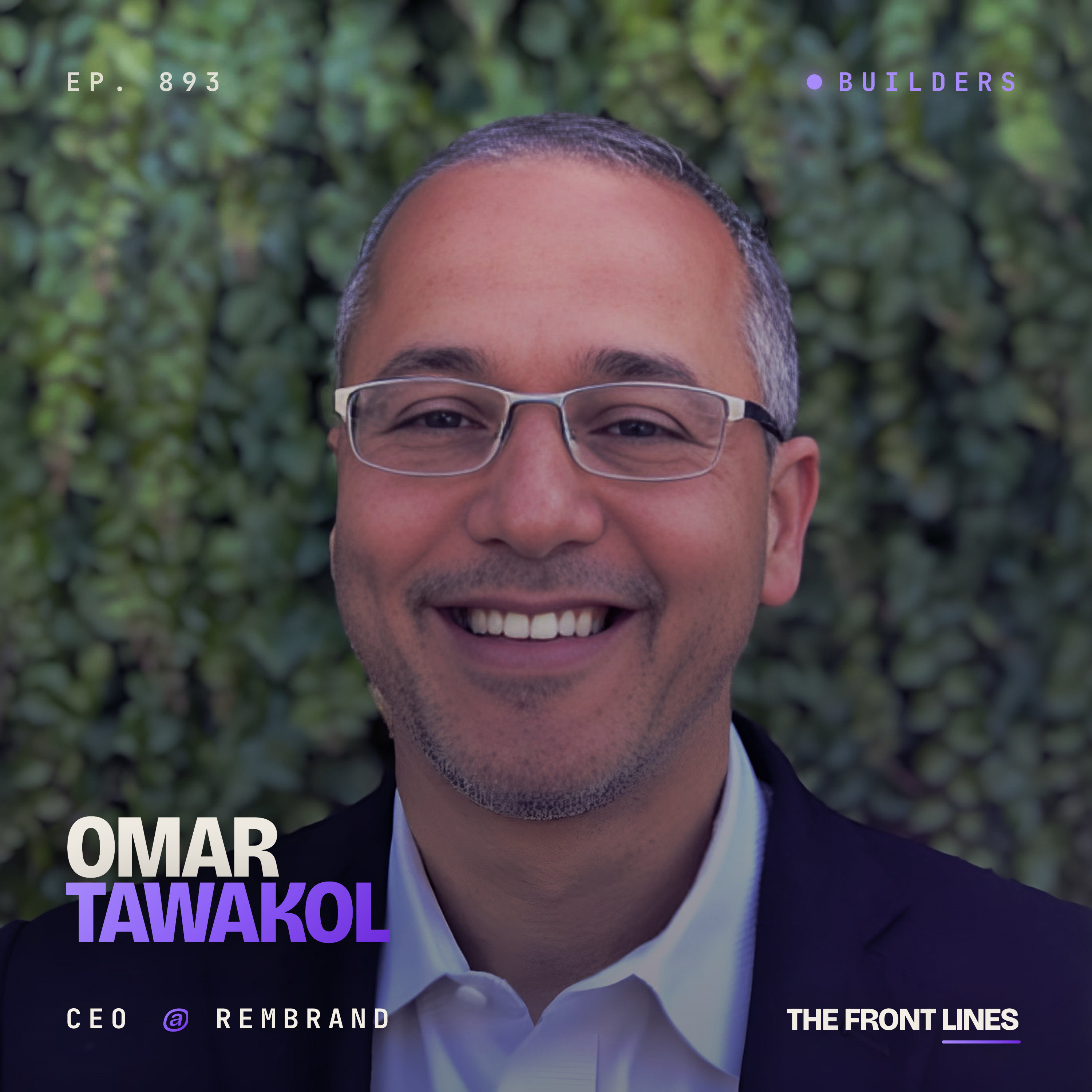
Welcome back to another episode of Builders. As always, this show is brought to you by Frontlines IO, Silicon Valley's leading B2B podcast production studio. If you're bringing technology to market and want to learn from your peers, we have a library of more than 1200 interviews with Venture backed founders and marketers. Where they talk, all things go to market. Of course, if you want to launch your own podcast, we offer podcasts as a service to more than 80 tech startups. The idea there is very simple. You show up and host and we do everything else. Now, with all that said, let's jump into today's episode. Our guest today is Omar Tawakal, CEO of Rembrandt. Omar, welcome to the show.
- [00:49]
A
Thanks for having me.
- [00:50]
B
Of course. I want to put you in a time machine and take you back to 2001. Take us back to 2001 and talk to us about what you were up to.
- [00:58]
A
Yeah, that was really exciting time. At that point we had built a startup and we were small, less than 10 people, a bunch of PhDs from Stanford. I was surrounded by them. I was lucky to have all these geeks around me. And what we were doing is we were building recommendation engines for everybody other than Amazon. So we got lucky. We landed Barnes and Noble, they went live with us and stayed with us for, you know, probably a decade. We were working with Nordstrom, we were working with Tower Records. So it was a really exciting time. Here's the amazing thing. I'll tell you what, I didn't call it. I didn't call it an AI company for recommendations because we didn't know to use those words. But that's exactly what it was. People would hand us their data and we would compute the recommendations and we'd hand it back to them and they would just pay us a monthly fee and they would load it up into their websites and people got recommendations. And the more data we had, the better the recommendations were. We had multiple styles of algorithms, some that were purely based on sales data, some on browsing patterns, other ones by reading the actual product descriptions and figuring out similarity in a similarity space. All this stuff is stuff we know now. I wish I had the marketing words that we have now to have conveyed then. And we got bought. So it was, you know, not a big deal. It was just getting to first and second base.
- [02:13]
B
And when you compare the dot com mania to the AI mania, if it's, you know, fair to say that it's a mania right now. Like, how does that compare?
- [02:21]
A
It's so damn similar. I remember, you know, John Doerr had this statement back around before the bubble burst or similar to it, he said, the Internet is underhyped. And this is when everybody was like throwing stones at the guy. And so he was like unbelievably right and unbelievably wrong. And that's what people don't understand from a market pricing of stock. He's wrong. It was overhyped. There was a bunch of companies that were like, bricks don't float. And tying two bricks together still don't float. And there was all this stuff going on that shouldn't have been going on. But his underlying point was that the impact of this innovation in the long run is much bigger than you are even envisioning today. And he was right. And that's why when you see what's going on with the AI infrastructure today, where you have, you know, OpenAI and Nvidia and Oracle and all these companies like recirculating money and it doesn't take a genius to know that there's something a little bit, you know, overvalued somewhere in that. I don't want to like point fingers to any of them because they're all super, super valuable. But where they are correct is that what they're doing is just scratching the surface. The future is still going to have so much demand for all those companies. So you can't confuse tomorrow's stock price with the underlying long term value. And those corrections may come in the marketplace and they may come in layers, just like in the dot com world that it started with the consumer Internet and retail. And then there was an adjustment at the infrastructure layer. And then people said, oh, let's go to B2B. Okay, now let's go to companies that are profitable. And all these like waves of adjustments occurred, but then the next wave people realized had value. Same thing's gonna happen with AI. And what we don't want is people just say, oh, is there an AI bubble or not? That's a silly question. It's not granular enough.
- [04:03]
B
Mm, I see. That makes sense. Now, we talked about that acquisition. I know that you've been part of many other acquisitions. You've sold a lot of companies. What have you learned about selling companies? And I'll skip over, you know, all those details. I want to get into what you're building today. But just to give a high level, what are some of the things that you've learned from selling companies.
- [04:20]
A
Yeah, number one is don't sell a company, get bought. The difference is big. In particular, like when I was building Blue Kai, you know, one of the people on the executive team wanted to get bought by a certain company and his eyes would twinkle when he talked about the company and I took him aside. I'm like, please don't do that. Let's play long ball. Like don't get excited about getting bought. Get it? Like as long as we keep our eye on building really, really big value and solving problems, we will become more and more valuable and either will IPO or we'll get bought. And in the end we got bought. But by not focusing on getting bought and not focusing on selling and really focusing on building value, that just really, really helps. Now it doesn't mean I'm naive. It doesn't mean if somebody who's a really good acquirer comes and is going to have a conversation with you, then I'm going to say stupid things to make them run away. It's just I'm not going to wake up every morning and try to figure out how to be pretty for a date at the bar. What I'm trying to do is build long term value and good things happen.
- [05:17]
B
It seems like many good things have happened to you as a result of that strategy. So it seems to work very well. Now let's maybe just talk about opportunity. So I would imagine given the success that you've had, I'm sure the network you have, the relationships that you could found and you could create probably any company and find investors, find early customers. The current company today, Rembrandt, why did you decide to go tackle this problem in this company specifically?
- [05:41]
A
Yeah, so you know, Rembrandt has like some really good strategy behind it and then it has some just like simple gut feel. So I've been in the ad industry, you know, from the very beginning of digital advertising. And I love this industry and I know a lot of the major players and we were really important in building the data piece of this industry. But there's so many innovators who like built, made up a great industry. So I was part of it. But then I'd go home and I stopped seeing ads for a long time because I pay to not see ads. I was using Netflix, the subscription version, Amazon prime and I go into rooms with all the execs and you know, I ask what people are doing, they're like, yeah, I'm watching Netflix. I'm like, okay, you are the guys who are in the room who allocate hundreds of billions of spend on advertising, and then you go home and not watch ads. So one of the things that really motivated Rembrandt is we basically said, stop betting against consumers. Consumers are literally pulling money out of their wallet to get you to not show them an ad. What does that mean? So how can we have a thriving ad industry if that's what people are doing? And that's when we started to think about a more native form of video experience. And we reached back into history and said all the interesting innovations advertising came through embedding the brand and the content together. So search. They tried banner ads, and then they realized, you know, you need to sponsor listings. If you look at early days of Facebook, all the talk in the market was like, how are they going to make money? This inventory isn't really good for advertising. They figured out how to make it part of the social feed. Same thing with TikTok. Now the same discussion's happening with OpenAI. And so that insight, it doesn't take a genius. It's quite obvious that this is the pattern. But where are people spending their time in video? 55% of people's global time in content consumption is video. Video needs a native solution, and that's what we've been focused on. And it's a hard problem, and it's a really impactful problem. So that really led us to, you know, what we did with Rembrandt.
- [07:35]
B
This show is brought to you by Frontlines Media, a podcast production studio that helps B2B founders launch, manage and grow their own podcast. Now, if you're a founder, you may be thinking, I don't have time to host a podcast. I've got a company to build. Well, that's exactly what we built our service to do. You show up and host, and we handle literally everything else. To set up a call to discuss launching your own podcast, visit Frontlines IO Podcast. Now, back to today's episode, and can you maybe expand on why it's such a hard problem?
- [08:01]
A
Yeah. Oh, my God. This has got so many angles to it. So, first, technically, you take a movie. The old way of doing it is two years before the movie gets written, gets produced. You're negotiating to get into the script. And, you know, if you're Harley Davidson or you're Aston Martin, you're figuring out how to get your car, your motorcycle into the script. You know, the problem is, marketing decisions at a campaign level are made weeks or months before the campaign's launch, not two years in advance. So the timelines absolutely do not match up. And given modern technology, I should be able to show vitamin water, which is, you know, I'm drinking here to me, and maybe show you a Perrier. And so none of that stuff can happen when you're baking it into the video. And so what you want to be able to do is take a brand and put it in video. But when you have a movie or a TV show, they've spent millions on it, it's high quality, the director cares exactly what's on scene. They do not want to lose control and all of a sudden show a champagne bottle, you know, in a Sesame street episode, right? And so you've got those kinds of problems of control on the content owners. And then you've got the pure video AI problem, which is before we came along, the way people handle this, if they're not doing physical product placement and they're doing virtual product placement, they would literally have a VFX person take every single frame, you know, 32 frames per second, and literally stitch in the image of the vitamin bottle and adjust the occlusion and adjust the color grading and adjust the lighting. Man, this thing was expensive and too long. So technically you needed to be able to insert into high quality scenes with moving camera, moving people. And the AI models just were not built for that. They were built for creating a scene from scratch, but not altering a high quality scene with all that motion in a way that the human eye would be happy. And so that's a very hard AI problem, one that we've been focused on solving, you know, for more than three years. The business problems, very hard also, sometimes
- [10:00]
B
even harder maybe to help visualize that. Let's just talk through the eyes of the consumer. So if I'm a consumer, what am I seeing exactly? What does it look like?
- [10:08]
A
Yeah, you know, so basically a lot of the times our consumers don't know that we've done what we've done. So they're watching, you know, an episode of a show or a movie, and they see a Pepsi can there. They see, you know, Fritos on the table. It's an outdoor scene and they're walking in the city and all of a sudden you see this really big billboard of Audible and it has a book highlighted on it. That Audible billboard isn't there. That Pepsi wasn't on the bottle. The Fritos was on the bottle. Sometimes we, you know, we've actually put in a Cadillac in a scene. The Cadillac wasn't there. And if you didn't realize that we had done it, We've done our job. If you ever realize that we did it, virtually, we have failed. And in the beginning, actually, we used to do this in creator, in social, and we didn't do it with TV shows because we wanted to, like, improve our algorithms and move faster and do things easier. And at the beginning, we used to animate our stuff so we would actually, you know, put in. I remember even once put in a Garnier bottle on a table, and it was two people playing chess. And then we animated the Garnier bottle and people started like, what the heck is going on? Why is it happening? And so we'd pay attention to how consumers respond to this stuff. And then a couple years later, we got into TVs and movies where, you know, by then we don't do anything cute like the directors want us to do nothing cute. Make sure it looks like it's actually there.
- [11:23]
B
Have you ever seen the documentary the Greatest Movie Ever Sold?
- [11:27]
A
Did I hear about that? Tell me more.
- [11:29]
B
It's the guy, I think he just died, actually. Morgan Sherlock, I think was his name. He was like the McDonald's guy. But he did a documentary about product placement. But what was funny about it was he was selling product placement to fund the documentary. So he's like running around, you know, doing these meetings with the brands, pitching the idea for the Greatest Movie Ever Sold and then getting people to do product placement within it. Given your space, I would imagine that you would enjoy that one. It's a very fun watch.
- [11:54]
A
Oh, my God, that sounds amazing. I'm embarrassed. I either seen it and forgot it or didn't see it.
- [11:59]
B
It's an old one.
- [12:00]
A
Yeah, well, we have been in pitches before where we talk about product placement on some really, really sexy product. And, you know, the folks on the team will say, could you just send us the real product? And we're like, that's not how. But I get why you want that.
- [12:14]
B
When it comes to the category of advertising, is it product placement? How do you describe the category here?
- [12:20]
A
Yeah, we absolutely don't call it product placement. And thank you for bringing that up. We call it in content advertising. And I'll tell you why it took us a while to get there because we used to say virtual product placement. We're building a media category. And when we looked at product placement and we looked at media categories, oh, my God, they're so different. Product placement, everybody wants to negotiate exactly where it goes on the scene, the content owner. And because you can do anything with AI, you know, sometimes you want to do something super special and bespoke and stuff. Media is very high scale, high volume. You have to have standardization on supply, standardization on demand, standardization on measurement, standardization on how you buy. None of that happened product placement. So we realized it was the wrong analogy. We call it in content advertising and we have really started to focus on this idea of a currency. I want to be able to take a video and automatically generate inventory opportunities that the content owner can approve without even knowing what brand is going in the scene. I want to have standards on how many seconds it's there when a webpage launches. You don't get time to debate, oh, does the banner ad or video go here or here? It's all figured out in specs. So systems know how to trade it, they know how to measure it. That's what we're doing to this category. And we had to call it in content advertising so that we really signal to people all the standardization. We actually even sell not to the classic people who buy product, product placement. We sell to the brand who wants to get news out about their brand, who's used to buying video ads and used to buying it out of a video budget, used to measuring it with like Nielsen and Kantar, with eye tracking studies. So we've worked hard to distance ourselves from product placement.
- [14:01]
B
So is it fair to say this is a category creation play then for you?
- [14:05]
A
Absolutely. And I've made so many mistakes along this journey that I didn't think I'd make, but here we are and we're thankfully on the other side of learning from those mistakes. The biggest one, I'd say, is that in building this category, we got stuck in the first two years because it's AI and we can do anything. Let's go do the sexy thing. And the sexy thing gets you the first deal, might even get you a renewal. But it doesn't really scale very well. And that's where we started learning, because we started to survey the rest of the world and we found a bunch of countries in Asia, Africa mainly, also the Middle east, where they started to scale this stuff precisely because they weren't doing the sexy things, they were doing the repeatable things. And we started working with some of those folks, giving them our software so that they could do this in a more automated fashion and learning how to really turn this into a currency that could massively scale the US market. So, yeah, building a category is hard, but if you pay attention to scalability and repeatability over sexy and bright lights, it really makes a difference.
- [15:09]
B
If you just look at it from a line item perspective. Where are they pulling the budget from? So if they start putting it into your category, are they taking it out of the product placement category? Is it coming out of the somewhere completely different? Cause I guess you said it's a different buyer, so, yeah, it wouldn't come from product placement. Where's it coming from?
- [15:25]
A
Yeah, it's coming from digital video investments and it depends on the market. In the US we're mainly looking at video investment buys that would target ctv. In several Asian markets, we're doing video investment buys that are part of their linear TV buys. And in some of our categories here, we're going after essentially social budgets and programmatic budgets. So it depends upon the market and the sub product. But I generally avoid, as much as possible two types of budgets. Number one, pure product placement. Number two, pure innovation. This show is brought to you by the Global Talent company, a marketing leader's best friend in these times of budget cuts and efficient growth. We help marketing leaders find, hire, vet and manage amazing marketing talent for 50 to 70% less than their US and European counterparts. To book a free consultation, visit globaltalent.co.
- [16:22]
B
how do you get yourself out of those buckets if someone you're trying to sell to pushes you in those buckets? I've had product lines where I'm trying to create a category, go down that path. And as much as I want to scream that it's a new category, I still get put into the buyers who are buying the old category.
- [16:37]
A
You just reminded me of that saying that says, everybody has a plan until you get punched in the face. Yeah, yeah, totally. Like, I can give my sales team all this stuff. This is how we've done it 10 times. And then they come back and they're like, but they have an innovation budget. And look, most of the time I'm not going to tell a salesperson, look, they're really interested in learning and they're going to do innovation budget. That's fine. What I do say is like, okay, look past the innovation budget. What measurement studies do we have to do so that we can fit into exactly how they do their repeatable buys, even if we have to fund that ourselves? It's more important for me to think about the repeatability than, you know, just this deal tomorrow. So there will be cases that will do that. I tend to get a little bit nervous on those cases because I've been fooled before. I'll tell you, we had a situation a year and a half ago where we had repeat purchases from brands in three different countries, across multiple campaigns, multiple years, over a million dollars. Every single signal of product market fit was there. And I thought I had product market fit for the way we were doing it. And I was still wrong. What we had was a very seasoned sales team and good connections and a really sexy product. But it wasn't until we figured out how to fit into more repeatable budgets with very strong measurement, with a very clear job to be done for a very clear specific buyer, that we really identified the fit.
- [17:59]
B
What signals do you look at to know if you have product market fit or not?
- [18:04]
A
Yeah, two years ago I thought it was very simple. How much repeat purchase do I have signaling that they're happy? And I thought that is all I need to look at. And I was wrong because I didn't calculate that I'm not a first time founder and that my co founders are also not first time founders. So you get a little bit of allowance from your clients in those situations. And I didn't counter calculate for that. What I really needed was very clear metrics on their side on how they plan to make these buys even when we're not in the room. Like what line item are they planning for to fit this budget for every year and how do we nail it for them so they know that they need to allocate a certain percentage of their budget to that line item. So what's the measurement they use? What do I bar do I have to clear to know that I get a bigger piece of their budget? Kind of that deeper clarity that goes beyond the fact that I'm getting a renewal.
- [19:01]
B
What else did you believe about the business and product two years ago that now looking back current times today, you say that was a mistake or that was wrong or needed to evolve.
- [19:09]
A
Yeah. So another area that we turned out we needed to evolve was early on, none of the diffusion models could do the things we needed because we needed physical understanding of the space you're in closer to what you're seeing now. With what they call world models, we needed to actually map out the three dimensional environment that's represented by the video. So we actually built all these algorithms on our own. But what we found was, and some investors like that idea that they considered. You're building foundational technology and a lot of our people were in the AI team. So we fit that pattern. But we weren't spending billions on training. And we started seeing people spend billions on training and we're like, either we're going to be like them and spend billions, but the go to market side wasn't yet making billions. So what do we do? So that's when we realized there was another pattern that was super useful. And that is we started taking some of the open source models out there and we built a really rare and proprietary data asset that would allow us to fine tune and do training of those open source models on essentially your own data moat. Now what happens is another one of these models come out. We take it, they might have spent billions developing it. We take it, we have 10 years of data that's unique and we take that data, we do the fine tuning and the retraining of those models and now we have a defensible moat that allows us not to have to spend billions on the training. And so our new defensibility became building this data moat, building this own workflow that plugged us into an ecosystem that is unique. It's not a B2C model. Like if you look at Sora OpenAI, they had to close down Sora because it was burning a million dollars a day, right. And they didn't have the business to fund it. We have a B2B use case that in many of our countries is actually profitable. So we can afford to train these models for this B2B use case and we didn't have to spend billions doing it. So it was a change in the technology strategy that took me two years to execute because we have a really good team. I shouldn't even say it took me because I didn't write a single line of code there. So that was an important change.
- [21:17]
B
How painful was it to make that change?
- [21:20]
A
Yeah, quite painful. I was scared because I saw that we had to make a change but you couldn't make it in a day. You know, our science team kept telling me, omar, these are long term investments, like stop giving us just quarterly deadlines. These are big changes. And I didn't stop giving them quarterly deadlines because I think a quarter's a lot too long anyway. But you know, they were right. It took a long time to really get all those problems solved. And we're live now. Every day there are like TV shows, movies, ship, various countries all over the world with our AI capability putting the products in. So we finally hit that. We did before in the beginning, but they were creator videos which were easier. But to get to the benchmark of all these shows being distributed in some of the biggest publishers in the world and all these different countries, that took a while.
- [22:05]
B
When you just think about the future of the business and where you go from here, we can zoom out however far you want. We can go three years, five years, 10 years. What's the big picture vision for everything that you and the team are working so hard to build?
- [22:18]
A
Oh, so many really good innovations that we have that are going to be rolling out. Number one is, you know, using programmatic product placement to basically, you know, have UC Perrier and BC the vitamin water and being able to do that at scale across the globe. There's a lot of business innovation that has to happen to catch up to the product innovation. So that's number one. Number two, everything we do now makes sure that you're not interacting with the product. It's the Coke can on the table and stuff like that. But the vision for how this changes, you will be able to interact with the product. I remember we did this cute version early on where we put a stain on someone's shirt and then this Tide pen flew in and erased the stain. So that was a little bit interactive, but mostly everything else we did wasn't. But I think in the next couple years we're going to be having you like, you know, be able to do things with the product. Now I don't want to do that too fast because again, I want everything to be standardized so that we can go for scale. So sometimes even with the technology support something, you have to be careful to make sure that you can scale the application of the technology. But we will get there. The third thing that will start to happen is you will be able to basically have actors and actresses who are authentic, real people come into a studio for you to capture their likeness and all that stuff. But then you'll be able to use that technology to change how they interact with the product with their permission and so on. So I think those things are going to really make it so that products can be truly integrated into shows in meaningful ways to the brand and look different per person watching the show.
- [23:50]
B
And final question for you, this will be more of a general one. It can be about, you know, all of your experience that you've had combined. If you're looking at just advice for founders that are bringing technology to market, what would be your number one piece of advice that you'd want to just hammer into them?
- [24:04]
A
Yeah, one of the things I would say is that if you've had successes selling companies before, you have this tendency to surround yourself with people who have proven themselves and run big teams, sold companies and stuff like that. But when you're building new stuff in a fast moving, keep young yourself by reminding yourself that everything you know, has a shelf life of maybe 48 hours, okay, that's extreme. But having that level of humility to realize the world is changing so fast, you think you know stuff, you know, tone it down and surround yourself with people who are younger in the team who naturally have that. So don't err on the side of people who've just, like, you know, hit the ball out of the park, have all the accolades and proof and all that. Make sure your team is balanced with young energy that can move super, super fast.
- [24:55]
B
Amazing. I love it. All right, that's where we're going to end things. This has been so awesome. I'm a huge fan. I'll keep following along. You'll have to come back on every six months, nine months, and just keep us updated on the progress. And for those listening and I just want to follow along with this epic journey. Where should we send them? Where should they go?
- [25:10]
A
Yes, Rembrandt.com has all the news about what we're doing in kind of in content advertising.
- [25:16]
B
Amazing. Thanks so much.
- [25:18]
A
Great talking to you. I had fun. Thank you.
- [25:22]
B
Well, that's all for today's episode of Builders, brought to you by the Frontlines. If you want more amazing content like this, visit Frontlines IO, where you'll find the library of more than 1500 interviews with founders, marketers, and other GTM leaders, where we unpack the tactical lessons from their journey. And of course, as always, if you do want to launch your own podcast, we'd love to have a conversation with you. Visit Frontlines IO podcast as a service. Mention that you listen, mention you love the show, and we'll give you a 10% discount. Thanks for listening. We'll catch you on the next episode.