Loading summary
Transcript54 lines
- [00:00]
A
I was doing 3, 400 calls in a day. Just kind of working my way down the list.
- [00:08]
B
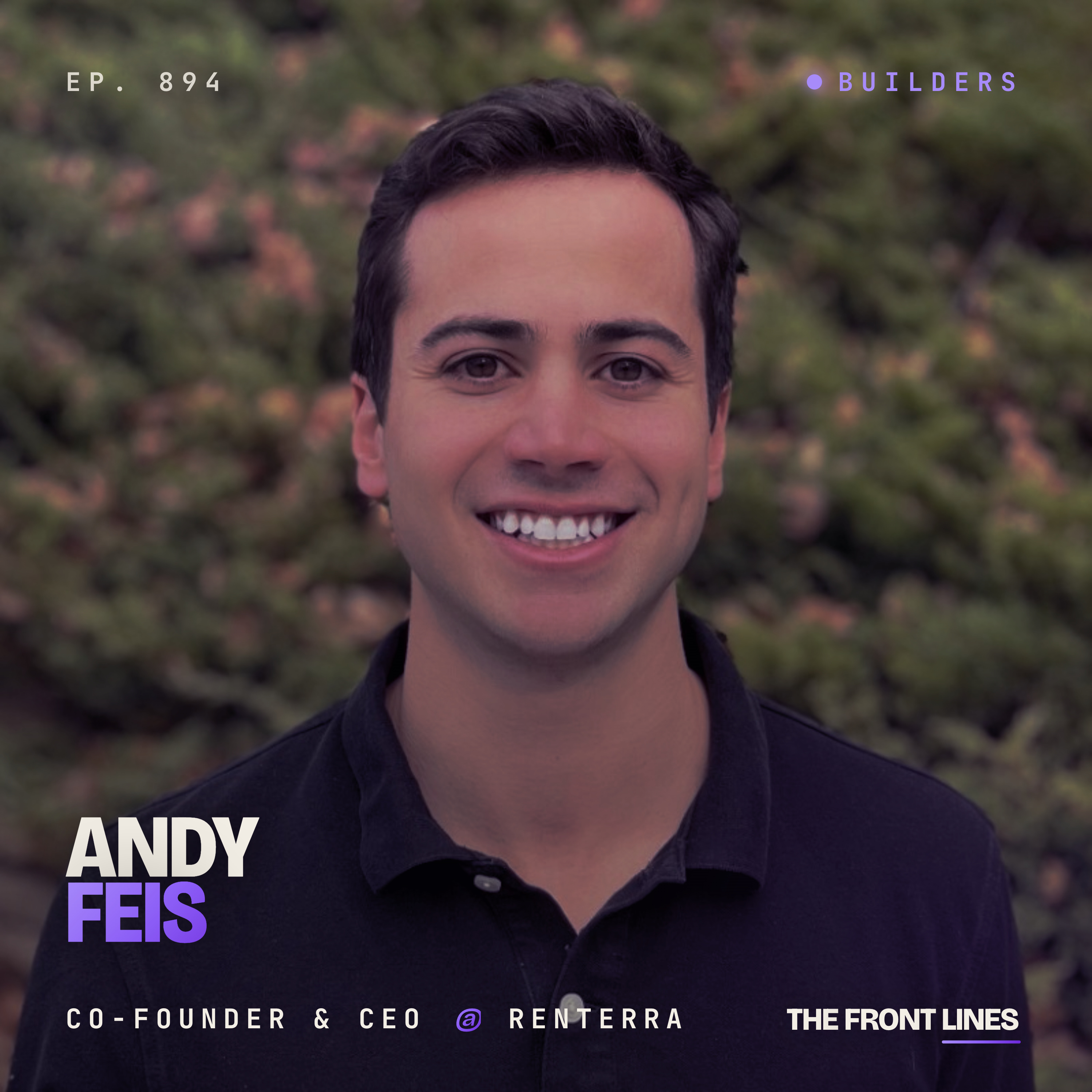
Welcome back to another episode of Builders. As always, this show is brought to you by Frontlines IO, Silicon Valley's leading B2B podcast production studio. If you're bringing technology to market and want to learn from your peers, we have a library of more than 1200 interviews with Venture backed founders and marketers. Where they talk, all things go to market. Of course, if you want to launch your own podcast, we offer podcasts as a service to more than 80 tech startups. The idea there is very simple. You show up and host and we do everything else. Now, with all that said, let's jump into today's episode. Today we're speaking with Andy Fais, co founder and CEO of Renterra. Andy, thanks for being here.
- [00:46]
A
Great to meet you.
- [00:47]
B
So what was going on in your life that you decided to go out and build technology for heavy equipment rental companies?
- [00:53]
A
Yeah, great question. So, always knew I wanted to start some kind of business, just didn't know exactly what it would be. And so out of school, I wound up working for one of the large management consultancies. Basically spent five years all around the industrial sector. So a year in manufacturing, year in mining, year in distribution and logistics, and then a couple of years in construction and ultimately wound up being in the world of equipment rental. And I think the crazy thing was this is a $100 billion market that runs on pen and paper or legacy systems that look like, you know, should be on a computer this deep. And so, yeah, got deep enough into it that was like, holy cow, this is so obviously a major opportunity for good modern software. And years later, here we are.
- [01:40]
B
I feel like with these types of markets, when you just start digging, you start uncovering just fascinating facts and details that you just don't know as an outsider. So I'm obviously a very, very much outsider as far outside as you can get to this industry. What are some, like, interesting things that you've learned as you've dug into it?
- [01:55]
A
Yeah, so maybe just some factoids about the market itself for anyone who knows nothing about construction. If you were to, like, see, you know, a high rise going up or, you know, construction on the side of the road or a house, there is now a 60% chance that the construction company does not actually own the equipment that they're running or that they're using. So they go to some, you know, think Hertz rental car in their town and just like you go get a Ford Taurus, they're Renting an excavator to go fulfill that job. And so yeah, there's close to 15,000 of these local rental businesses that are renting billions and billions of dollars of equipment out to local contractors. So yeah, most construction companies don't own most of the assets that they're using.
- [02:36]
B
And why is that?
- [02:38]
A
Yeah, a few reasons. Second factoid that's very interesting is that used to be only 20% of the equipment was rented, not 60%. So over the last 10 years there's been a huge shift in how equipment is sourced for construction. A few factors that have driven that shift. First is during COVID there were massive supply chain shortages in the equipment themselves. So if you were a construction company and you wanted to buy something, there were two to three year lead times to actually get your hands on the equipment. And so you were forced literally to go rent the equipment because you couldn't buy it. And then the second things are is rates, you know, were very high. You know, just people didn't want to put the capex on the balance sheet. It was easier and cheaper to rent. And then the third more recent trend is has to do with equipment specialization. So as the tech has gotten better and there's more niche equipment for more specialty jobs, you know, you might need a, you know, glass installer that has special suction cups that you might only need for one out of 20 jobs. And so it doesn't make sense for you to own it. But there's a rental company that will have that specialty equipment. So those are a few of the underlying drivers.
- [03:43]
B
And given like you said, this industry runs on pen and paper. What's that like breaking into an industry that is that way, that's been resistant to technology? I guess maybe let me back up, like why are they resistant to technology?
- [03:55]
A
I think one of the maybe biggest shockers to me overall is that was my assumption. Going in is like the whole challenge here is going to be convincing an old school mindset to adopt technology when really that hasn't been a hurdle at all. I think there's a ton of excitement about adopting technology. It's just the market forces that allowed capital to come in to invest in top talent building great modern software. I think nine times out of ten when we explain what we're trying to do or we show them the product, it's like God, we've been waiting for this. Versus having to explain why doing something on your phone would be valuable or why some AI feature might save you a lot of time. And so I think it's Just the products weren't offered to them in an illogical way.
- [04:42]
B
That's interesting. So they're not resistant to technology. It just literally was not ever offered to them. What'd you say, a hundred billion market and no one was offering technology to them?
- [04:49]
A
Yeah, you know, certainly there is some segment of the market where you have to get overcome the pain of change. So for folks that are using one of the legacy systems, there's sometimes I see the value, but is the value big enough that it's worth undergoing the system change, you know, required? And that's a classic software challenge. But by and large, for the majority of the people that we talk to, they're very, very excited. And it's just a matter of like, do the dollars make sense and is it the right time? But the value is very, very clear.
- [05:17]
B
And how do you get them past that change and that idea that there is change. What do you do to make that process easier for them?
- [05:24]
A
So our number one success metric once we close a deal is usage on the actual product. So we invest extremely heavily in the implementation process. We do not charge for implementation. We do it very white glove. We offer unlimited trainings, unlimited support through that process. We are very, very committed to making sure that it's as little work for their team as easy as humanly possible, and that they get up and running and see the value of the product as quickly as possible. Because we think that once we have a customer up and running using the system well, we have them for a very, very long time. So, yes, that's expensive to do. It's a big investment, but we think one that will serve us very well over the long run.
- [06:05]
B
And what have you learned so far about building out that implementation program? Any big lessons or evolutions or iterations that you've made so far?
- [06:13]
A
Yep. So like I said, we started very, very labor intensive white glove. You know, you could imagine for even a small onboarding, maybe doing five to 10 meetings. And we just made the decision, let's start somewhere. Maybe it's very, very high effort. And then you could always find efficiencies along the way to, you know, whittle that down. So if I were to look at where we started from our onboarding process to what it is now, we're probably 80% faster. And, you know, the amount of work required for our team has cut dramatically. But I think for any team, you got to start somewhere. You can always make it more efficient. But that was our approach was just like, do as many meetings as humanly possible. Do all of the work. Don't make your customer do anything. Nothing automated. And then we just made it dramatically more efficient.
- [07:00]
B
This show is brought to you by Frontlines Media, a podcast production studio that helps B2B founders launch, manage and grow their own podcast. Now, if you're a founder, you may be thinking, I don't have time to host a podcast. I've got a company to build. Well, that's exactly what we built our service to do. You show up and host and we handle literally everything else. To set up a call to discuss launching your own podcast, visit Frontlines IO Podcast. Now, back to today's episode and was there any pushback internally of, like, why are we spending so much time and energy on the implementation instead of sales? Or did everyone across the org just get it, the importance of it right away?
- [07:34]
A
I think, you know, a big, like, actually, let me start this one over. A big core value for our team is customer empathy. I think it helps a lot selling to blue collar users that we feel like we have a huge luxury working behind our computers all day, that our whole team has gotten the idea beaten into their head, like, if we can make a customer's life easier, it's well worth doing. And so I don't think it was that hard to convince our team that going above and beyond and working hard to help the customer is like, a valuable thing to do. I think in general too, what helped both on the sales side and the customer success side is I was the first, you know, salesman from end to end, you know, cold calling to selling deals. Also the first implementation manager, onboarding manager. And so I did all of these processes myself as like a solo operator for a while when they were the least efficient they ever were. And I think like, as a founder, if you can get your hands dirty, prove out that something is doable and that you're willing to do it, that really helps the team feel like it's not above anyone to be willing to do that work.
- [08:43]
B
At what point did you get it to the stage where it felt like it was repeatable enough that you could hand it off and start building a
- [08:49]
A
sales team for both the sales and the customer success side? It was about six to nine months of like really grinding at it myself, tuning it a bit. Then I would say probably another six to nine months once we had our first couple of people in seat of like, really building the systems out for scale. So, you know, I always laughed at our first CRM was literally a spreadsheet and notion that I was like, keeping track of Dropdowns and you know, it just builds over time. So yeah, it was probably six to nine months solo. Six to nine months with our first few team members to really get it humming.
- [09:24]
B
And did that feel like the timing was perfect? Do you think you waited too long or was it just right?
- [09:29]
A
I think it worked really well for us. Like, you know, I always think of the whole startup operation as like an assembly line at a factory. You know, there were times where you'll feel like the product is like the limiting reactant in the assembly line. There's times when sales does and there's times when customer success does. I think it was at the moments that sales felt like, oh, it's really getting pinched, that we really invested heavily and we opened the aperture there. Same for customer success. So for us the timing felt natural. I don't think in hindsight we would have done anything differently. So. But you never know. I'm sure moving faster is always better.
- [10:03]
B
And I have to imagine that a lot of the founders listening and are probably jealous of the market that you're in. A lot of the people that are listening are building enterprise technology, selling in the core function. So hr, to cybersecurity to it, et cetera. But you, you're in this different market where I feel like that playbook probably hasn't been as exhausted that everyone comes in and runs like the enterprise SaaS playbook. Maybe the downside of that is there's not as proven of a playbook for you to come in and implement. So from a marketing perspective, maybe unpack that playbook for us.
- [10:33]
A
Yep. So it's a good point. Yeah, it's not as like, you know, fully playbooked out. It was, I would say what you gain in perhaps sales cycle speed and directness, you also pay a price in grittiness. And so we opted very much for a phone heavy playbook. We literally got the numbers of like thousands of our potential ICP customers and one by one just dialing the main, like store operations, asking to speak with the owner and getting pretty good results that way. I mean, for anyone who's done that before or attempts to do it, like you need to be prepared to be beaten and bruised a fair bit along the way. That's a hard game. But yeah, I think just by doing that we learned a lot and actually found it to be quite effective. It's still our number one way of sourcing customers is just calling businesses, asking them to speak to the decision maker and, you know, fighting that fight. And so yeah, I think the more Local you go the more. Some of these direct tactics work well, but I think it's also can be a little bit grittier and what you have to deal with along the way.
- [11:34]
B
How many cold calls do you think you personally did before you started to hand it off to others?
- [11:39]
A
Oh, thousands, probably ten plus thousand.
- [11:43]
B
What's the most brutal story that you have?
- [11:46]
A
You could choose if you want to keep this in the podcast or not. But you know, the way I had cleaned up the data, you know, for some of the phone numbers we had the rental company owners names affiliated with it. And so for one of them it was husband and wife running the rental shop. And so, you know, I would always call and say like, hey, is, you know, Bill and Mary around? As, you know, one of my opening lines. And you know, I just get how the hell do you know my wife? That took, you know, unexplaining to do. But, you know, those are the stories you get just from calling tons of businesses. So yeah, that was a funny one.
- [12:25]
B
And how much market penetration do you think you have right now? You said there's about 15,000 target customers that you could go after. I guess that's in the U.S. yep. What kind of penetration do you think you have so far?
- [12:34]
A
Yeah, we have a couple of percent right now and think, yeah, there's certainly plenty of green grass still to run. So yeah, growing about 3.4x in the last year and hope they do the same this year as well.
- [12:46]
B
This show is brought to you by
- [12:47]
A
the global talent company, a marketing leader's best friend in these times of budget cuts and efficient growth.
- [12:53]
B
We help marketing leaders find, hire, vet and manage amazing marketing talent for 50 to 70% less than their US and European counterparts. To book a free consultation, visit GlobalTalent co. And to have that be, you know, let's say 50% or 30 or 40%, like what do you think would have to happen? What needs to change? More cold calling.
- [13:15]
A
Yeah, you know, honestly a lot of it is just like I said with that assembly line, like there's constantly the different pinch points between is your product moving fast enough to support, you know, the outer rings of your icp? Is your sales motion sophisticated enough to actually reach a bigger customer base? And then especially with the, you know, pretty high intensive implementation process, can you support that many customers both in the onboarding process and successfully over time with ongoing maintenance and support? And so, you know, we've been very, very intentional to try to maintain a brand of like, the best support and experience in the industry. And so we're very cautious not to move too quickly. I think some companies, you know, to get to that next number a little bit faster, get a little bit ahead, you know, get out over their skis and wind up really hurting the customer experience. And so, you know, we're obviously moving with good urgency, but also don't want to move too quickly that we ever sacrifice the customer experience.
- [14:12]
B
What does the tech stack look like behind the cold calling machine that you have today? And like, just out of curiosity, like roughly how many cold calls is it doing every day or every month?
- [14:21]
A
Yeah, it depends. Like, you know, for our reps now, like ideally they're doing a few hundred at least every single day. You know, I would say in my busiest days, yeah, I was doing 3, 400 calls in a day, just kind of working my way down a list. And then as far as the tech stack, you know, I guess it depends what you mean. It's a full end to end operating system, mobile app. And then we also power like an integrated e commerce experience on top of our backend software. So without getting like too deep in the weeds of the actual tech providers.
- [14:51]
B
Yeah, I bet. Like the sales tech, if there was like any interesting tools that you're using. Yeah, the sales side, sure.
- [14:56]
A
Yeah. So we use HubSpot now as our main CRM and we've actually recently started using Gong for coaching. And then we now are building a bunch of AI tools on top of those to get better insights and to, you know, smart leads to call at the right time, grading and coaching on performance so we can get better at both calling and coaching. And so those are kind of the two core tools that we use.
- [15:19]
B
And is there ever a point where you think that it's going to be just saturated, where you're going to sit there and be like, all right, like we've cold called like every single person that's possible in this market. Because like the numbers, if you're doing that volume, even if you know an individual rep, it seems like at some point you would hit a wall there. Or is that the wrong way of thinking about it?
- [15:35]
A
I think it's something that I thought would be a much bigger issue than it has proven to be. I think in our experience we've done some experiments, like we could speak to the same person every two months. They probably don't have a recollection that we actually spoke to them two months ago or they're just things in their business or timing has changed and that a call may not have been fruitful two months ago. And then Is very, very fruitful two months later. And so, yeah, certainly, you know, you can't call a business every single day. And I think, you know, you can get a little bit smarter about calling people at the right moments. But what might be a very memorable moment for you as the sales rep and you know, when you got told off by that company to not call again, they will have no recollection of that a few months later. And so that's always important to keep in the back of your mind.
- [16:20]
B
But it has to be nice too. Cause it's cold calling, right? It's not email. I feel like I get annoyed if someone's like spamming me over and over again. And I look, I'm like, dude, I've told you to unsubscrib like 50 fucking times. And you're like, still going, a phone call. It's nice. Like they don't have a record of it, most likely.
- [16:32]
A
And you know, these folks are doing hundreds of conversations a day and frankly are just. We're very lucky to have a very nice customer base that's like willing to chat with us even if they're not interested right now. They might give us advice or give us feedback on the call. So that helps a lot.
- [16:46]
B
What about on the marketing side? It sounds like, you know, very sales heavy Org. Do you spend any time thinking about marketing right now or is it all in on how do we just cold call more people and have better scripts and have better conversations?
- [16:57]
A
So marketing will be one of the big frontiers for us this upcoming year. I think we feel really, really fortunate that now a very meaningful slice of our business comes inbound just by direct word of mouth referrals. We've built enough of a loyal following that, you know, a rental company owner will tell their friend, who tells their friend, and we get direct inbound business organically. We've invested very, very little into direct marketing thus far. But I think that as we think about how to materially scale the operation, that will be the new element added to the assembly line as the marketing engine, which we think will come both in the form of, you know, direct paid marketing, but also creating educational content to bring the industry up to speed on, you know, the latest and greatest happening in technology.
- [17:40]
B
And what does the competitive landscape look like? Are there other founders who've been sitting here and saying, oh yeah, there's like this $100 billion market that's just sitting here ready for technology. What does that look like for you?
- [17:50]
A
Yeah, of course, like every market is somewhat competitive. So in our Space. It's dominated today by some legacy players. So think 30, 40 year old pieces of software typically on prem, you know, that have meaningful market share, you know, in the meaningful double digits share of this market. And so certainly they're not going to sit on their hands forever and you know, just like to, you know, let the market innovate away and do nothing about it. So that's a big slice of the market. And then there are companies like us that are going out and attacking this problem. You know, we're not the only one doing it. And so yeah, I mean it's not 500 companies trying to do it, but we're not the only ones.
- [18:29]
B
And is one of those legacy providers like a giant? Like do you have the equivalent of like a salesforce in your industry or is it super fragmented?
- [18:36]
A
There's definitely one or two that are like meaningfully bigger than the rest. But there are also a bunch of other ones that are, while significantly smaller than those biggest ones, meaningful in their own right.
- [18:46]
B
And we'll do one final question here for you. So let's just talk about the future. Where do you go from here? Let's maybe paint a picture of 3 years or 5 years or 10 years out. However far you want to go. What's the big picture vision?
- [18:57]
A
Yeah, you know, we want to ultimately be the technology layer for rental companies. I think we're entering a time where what software looks like, you know, in how I run my day to day life, looks very, very different than it did 12 months ago. We want to usher that in to our customers. You know, we've built a great core product that underpins a marvelous experience today. We think as the technology evolves over the next few years, continue to take the lowest value work off of our customers plates. You know, automate things that should be automated, help them make smart decisions very, very easily to take all of the work that's not in the field, moving actual machines around in a way that's cost effective and yeah, very, very simple. So yeah, it's moving very, very quickly. I would say the people that try to predict exactly where it will be three to five years out are probably doing a fair amount of guesswork. But the companies that could stay nimble and keep adapting, those ones will likely do pretty well.
- [19:49]
B
Amazing. I love it. All right man. It's been a really fun conversation. I've really enjoyed it. For those listening in that want to follow along with you, where should we send them? Where should they go?
- [19:56]
A
Yeah, they're welcome to shoot us a note@contactetrendtterra.com if they want to get in touch with us or check out our website at get renterra. That's G-E-T R N T E R R A dot com. You know, we're constantly hiring. If you're in Chicago and looking for a role, we're always looking for great people, so please feel free to reach out.
- [20:15]
B
Amazing. Well, thanks so much for taking the time. Been a lot of fun. Well, that's all for today's episode of Builders, brought to you by the Frontlines. If you want more amazing content like this, visit Frontlines IO, where you'll find a library of more than 50, 1500 interviews with founders, marketers and other GTM leaders, where we unpack the tactical lessons from their journey. And of course, as always, if you do want to launch your own podcast, we'd love to have a conversation with you. Visit Frontlines IO podcast as a service. Mention that you listen, Mention you love the show, and we'll give you a 10% discount. Thanks for listening. We'll catch you on the next episode.