Loading summary
Transcript45 lines
- [00:01]
A
I was talking too much in a technical positioning talk and lingo versus talking more in a simple layman term. ROI lingo.
- [00:15]
B
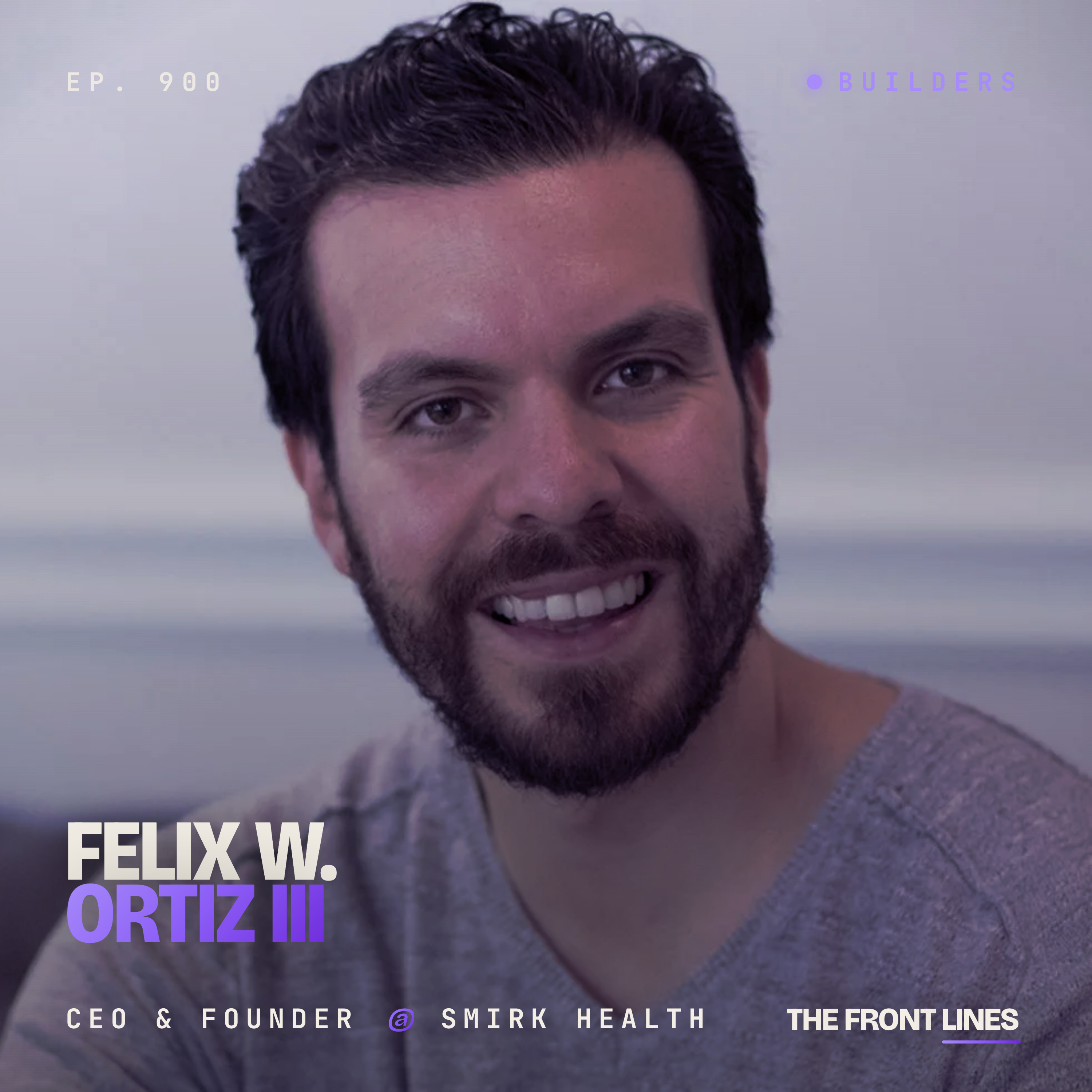
Welcome back to another episode of Builders. As always, this show is brought to you by Frontlines IO, Silicon Valley's leading B2B podcast production studio. If you're bringing technology to market and want to learn from your peers, we have a library of more than 1200 interviews with Venture backed founders and marketers. Where they talk, all things go to market. Of course, if you want to launch your own podcast, we offer podcasts as a service to more than 80 tech startups. The idea there is very simple. You show up and host and we do everything else. Now with all that said, let's jump into today's episode. Today our guest is Felix Ortiz, co founder and CEO of Smerk Health. Felix, thanks for being here.
- [00:54]
A
Thank you for having me, Brett.
- [00:55]
B
Of course. Looking forward to this one. Let's go ahead and, and let's go way back. Let's go to the year 1929. What happened in 1929, well beyond the
- [01:03]
A
revolution that was going on in 1929, is when insurance started. So that's where vice president at Baylor University created what we now know as health insurance with a group of nurses. And that's how the blues were born. And then in 1940, the evolution of that became a recruitment tool for employers to use as a way to acquire talent during the wartime. And then in the 70s, that's where the ERISA act was born, which is how we know today to have group insurance.
- [01:32]
B
Have there been any innovations since or did it stop until, until you came around?
- [01:36]
A
No, there have been people trying to innovate in the world of insurance. You know, you think about self insured type of products or direct primary Care models or iChras, but really it's tied back to the employer. If you think of the self insured model or the ICHRA model, it's tied on the group side. And so, you know, the way we look at the world is that as we move into a AI driven world where it's basically going to become a what I call a micro shift economy, the way that insurance was designed is no longer relevant for the workforce of today and tomorrow. So that's starting to create a leakage in the business model and the product offerings, allowing there to be innovation.
- [02:21]
B
And what does that look like? Just to visualize it, what does the end product look like?
- [02:24]
A
The end product is a product that essentially allows individuals to have ownership and agency of their own insurance and that it's Personalized and tailored to how they live, what they want to pay and ultimately what services they want within the insurance. Right. You think about auto insurance, you have the base coverage and then you can compound it with other add ons. In the case of health insurance, some people may say, well, I don't want to have a fully medical comprehensive plan and pay $14,000 out of pocket if you account for deductible and the annual premium. They may want to focus just on basic everyday care, which, you know, if they're healthy and they want to keep doing that for their purposes, they would be able to do that. So it's really having a personalized plan that you have agency and ownership and that stays with you no matter where you are and how you work.
- [03:17]
B
As this all gets adopted, as this all happens, who stands to be disrupted or maybe a better way, ask like who is going to hate you if you become more and more successful?
- [03:27]
A
You know, I think about it as the blockbuster Netflix model. You have firms that are still making money in the legacy P and L models and they're trying to figure out, you know, you think about the large insurance carriers, they could be partners, but they could also get disrupted. Right? You know, you think about the way that business works in the Fortune 1000 or Mid Market cap companies where they have brokers, you theoretically could, you know, disrupt them as well. But I think of the market as an opportunity to partner and collaborate and bring this level of innovation to these firms and these organizations that allows them to also become even more sustainable with the ability to generate more revenue through the type of tech stack and products that we're developing.
- [04:16]
B
Given the level of innovation here, do you view this as a category creation play then? Or is this just reimagining the legacy benefits category? How are you thinking about category?
- [04:25]
A
You know, I view this as a category creation, right? Because if you think about who are these individuals, you know, these individuals are your UPS driver, that is a 1099. These individuals are your frontline workers. They could be obviously your gig workers. And so when you think about that, the insurance that is offered or they can access is very limited and not aligned to what their needs are. And so therefore not only are we creating alternative plans from scratch, but we also are layering in our agentic tech stack to create that personalization and that really, you know, like I think about it as their patient guide or health guide through the process to really provide everything from understanding what's covered, what's not, and also what the price transparency is and having the highest Quality care for the lowest amount of cost and who
- [05:20]
B
are the customers that you're selling to and what does that go to Market Motion look like today?
- [05:25]
A
So we are focused on an embedded distribution through, you know, organizations, whether they be Fortune 500 or whether they be unions. For today's workforce, it's really embedded through those channels, right? And so that's the segment that we're, you know, focused on.
- [05:43]
B
And was that the initial segment, day one that you said we're going to focus on this one, or is it more iteration and evolution to get to that point?
- [05:51]
A
Initially, we were testing on the direct to consumer side to understand the behavior of the Persona, to understand, you know, how many variations of this Persona exists. Right. Is it a pre retiree or is it your Uber driver and what does that behavior look like? So we tested pretty aggressively across that segment and to understand the segmentation and then really narrowed that data in to optimize our funnel and then focus on the embedded distribution channel.
- [06:21]
B
This show is brought to you by Frontlines Media, a podcast production studio that helps B2B founders launch, manage and grow their own podcast. Now, if you're a founder, you may be thinking, I don't have time to host a podcast. I've got a company to build. Well, that's exactly what we built our service to do. You show up and host and we handle literally everything else. To set up a call to discuss launching your own podcast, visit Frontlines I.O. podcast. Now back to today's episode. If that was the plan from day one was to use DTC just to get data faster and then go into B2B or what was the original thinking there?
- [06:53]
A
So the plan from day one was originally D2C. You know, we thought, oh, you know, let's go to market, let's go with dental. That was the initial plan. Let's go disrupt dental insurance and bring it to the consumer. But as we quickly learned, we were able to evolve that to essentially not only focus on dental, but drive medical as well as part of that those learnings and really understand that in order for us to scale rapidly at the most efficient and cost effective way, we, we knew that it was to be through the embedded distribution of the corporate channel. So that's where we narrowed our focus on strategy on.
- [07:29]
B
And how painful was it to make that shift? I guess probably depends how early on you did it and how much had been established. But I know a number of companies that I've had on, they talk about going from D2C to B2B or even going from SMB to Enterprise. It's a totally different motion. Everything's different from a GTM perspective, everything's different from a marketing perspective. How painful was that for you?
- [07:49]
A
You know, it wasn't as painful as I thought it would be because we did it early on to your point. You know, I think had we waited another quarter or two, it would have started to become somewhat painful. But the fact that we started literally within a few quarters of us, you know, launching the company gave us the flexibility to adjust accordingly.
- [08:10]
B
Your first big customer that you landed, take us back behind the scenes on that deal. You don't have to name them, of course, but give us the high level.
- [08:17]
A
Yeah, look, it's an organization that has 530,000 folks involved with it. It went from almost not happening to happening. That was like the period where I couldn't sleep where I basically said, you know, this is our anchor and we need to make sure we get this anchor. But it took I would say about four and a half months to get this organization to signature. And early on they were interested, they were willing to take the bet. But it was really towards the end, as we were getting close to sign that we ran into some bottlenecks that was really more around their bandwidth constraint and understanding how we would implement this in partnership with them and all that jazz. So that was a good experience. Kind of a nerve wracking one at the same time, but it worked out.
- [09:06]
B
Yeah, four and a half months. That's. I have to imagine that's very fast in healthcare.
- [09:11]
A
No, I mean, I would say that's on the faster side. I had a previous existing relationship with the CEO of that organization and so that helped. But yeah, I mean, we started with dental. That was the reason we were able to accelerate so quickly. Had we started with medical with them, I think it would have been more than six months.
- [09:28]
B
And what's the gtm. Org look like today?
- [09:32]
A
So we have a handful of people on that side, both from operating, supporting execution. We're very, very focused on being a product first led type of company, which obviously ties in our tech stack and AI and all that good stuff, but we'll continue building that out. But no, I mean, we're still lean. We're using a lot of AI for middle management as part of our operating model. So while we may have a handful of people on that end, it's like we're operating maybe with like 8 or 10 people leveraging our agentic layer.
- [10:01]
B
And when you reflect back, I know you founded a bunch of previous companies. How has Your thinking around GTM and GTM team building, how has it changed? Apart from, of course, AI is here, I would guess it wasn't there yet for the other companies he founded.
- [10:14]
A
I would say as an entrepreneur, it gave me now this being my fourth company, this gave me a sense of more being more calm at the wheel, not reacting frantically or being in a situation where we've pinned ourselves against the wall. It's really an element of maturity. I think as founders continue building companies and they learn from each company becomes a foundational build and knowledge base. And so for me, it's more around making sure we have a vision. Just like execute the vision, learn and iterate quickly, experiment quickly, and having the right people with the right skills in the right seats, letting and getting out of their way and letting them execute. I think if they were me and my first or even maybe second company or even third company, probably I would have gotten in their way and thought I could do everything. And I think for this company, having learned a lot, I kind of realized, you know, move out of the way, let them execute, provide the North Star and drive the outcome and everybody has ownership along the way and accountability.
- [11:16]
B
You mentioned experiments there. Do you have any experiments that come to mind that you thought were just going to be very successful and they turned out to not be successful? I guess D2C sounds like that was maybe, maybe one of them. What else would you say would like an experiment that you thought was just going to hit and then it didn't?
- [11:31]
A
I would say the experiment on pricing related to our dental product, we thought that the original price that we were going into market with would hit hard. We quickly realized that it didn't. So we were able to pivot relatively quickly on the pricing and that helped scale. That was one, I would say, how we thought the users were going to interact with our AI actually turned out that they want to interact more than we originally thought. We originally thought maybe they didn't want to have so much Big Brother associated or have that element of like guide oversight. And that turned out to be accurate. I mean, those are just some of the lessons that we've learned from experiments. I'm sure you know, there's many more, but some of those are the ones that come to mind. This show is brought to you by the global talent company, a marketing leader's best friend. In these times of budget cuts and efficient growth, we help marketing leaders find, hire, vet and manage amazing marketing talent for 50 to 70% less than their US and European counterparts to book a free consultation visit GlobalTalent Co and on
- [12:38]
B
the category creation side, I think what's always tricky about that is oftentimes you end up needing to create the demand to capture as opposed to if you go after an existing category, it's just capturing the existing demand and saying no, no, no, no. What you're actually looking for is this, where do you sit there? Because obviously there's existing demand for health benefits. Do you view it as you're capturing demand or do you have to go out and create demand?
- [12:59]
A
I would say today because of the pressures of P Ls and businesses having so much expenditure on healthcare, it's creating a sense of what else is out there, right? So you have a market dynamic of pressure, you have a regulatory dynamic and then you have a legacy dynamic triangulating into the ability to create something new. And so I think that there's demand already, but then there's also the element of education because what we're doing is so new. And the way that we've designed our plans and products so requires an individual who may have been in the HR or total rewards world for maybe 30 years or 20 years to have a sense of an understanding to wrap their heads around it because they're used to one specific way or a few specific ways which may be deal with the broker, deal with the group, plan and then that's it. That world is shifting very quickly.
- [13:57]
B
How do you find balance between communicating this story of innovation and knowing that change scares people? I think that's always the issue. When it's too innovative or when there's a lot of innovation happening is there's certain buyer groups you can just get afraid because change is scary. And when things are different, that's not ideal for a lot of people. How do you balance that just general message out to the market?
- [14:18]
A
I always put myself in the seat of that person that I'm talking to. Any risk that they take could potentially cost in their job or impact their employees which impacts the brand of the company. And you never, you only have one reputation and I think as a founder you never want to oversell or overstate or over promise because every the world's small, it'll come back and hurt you. And you only have one shot. When you go in with pretty big companies, maybe you have one or maybe two shots if you go to a mid market cap, you know, SMB. But with a big corporate you cannot mess around. And so I always, number one, fully transparent on how hard product works and what we offer and never tried to oversell or misrepresent on that front. But second, it's putting yourself and being empathetic in their shoes to understand, you know, and read their energy on how far can you navigate them and where are they willing to go. And so that's tie I interpret which way to navigate in terms of communicating a specific, you know, overview or do I communicate a more conservative overview? And if it's the more conservative overview, I then take them to like this is what a pilot may look like and so on and so forth. Because those people are going to step very slowly. You may. And then when we start stack ranking, these people, I go tier one, you know, means like earlier, you know, first adopters, second tier, third tier. And then, you know, they follow, right? So once you get your first big tier ones and they're pretty big firms, then they have FOMO like it's a small community, right? They all want to be the people. And so it's, and it's a matter of just making sure you have the right logos and the right executives that are part of that.
- [15:56]
B
Is there a specific moment where you just see people really get it, where the light bulb goes off, that aha moment, and then if so, what was the journey like to figure out that aha moment? I feel like as a founder, that's always the magical time when it's, yeah, okay, it's resonating. What we're talking about is really hitting the market. What's that been like for you?
- [16:14]
A
I can tell you, when we first started talking to Enterprises, there was one company and you know, we won't name them, but these executives just couldn't wrap their head around it. And I left that call because in my brain it made common sense to this is a fit, right? But then I started to reflect on that conversation, on what we did right, what we did wrong, and how can we improve the messaging. And I took those to the next meeting that I had and that's where I met this well regarded executive from a well regarded company that basically re engineered how I positioned to his or her peers, right? And that was the aha moment. I was talking too much in a technical positioning talk and lingo versus talking more in a simple layman term, ROI lingo.
- [17:11]
B
And final question for you, let's just zoom out. We can go 3 years, 5 years, 10 years, however far out you want to go. What's the big picture vision for everything that you're building here?
- [17:19]
A
It's to create a company that will have a lasting legacy and imprint in society and change the course of how we know insurance today for this micro shift worker and become the, you know, I think of what exists today as blockbuster. I view us as like the Netflix. And I, you know, ideally take the company all the way and in 10 years still have the same hunger and energy to innovate, never get comfortable and continue to build a large organization that if we're lucky enough, we can take public. And that's the goal. And by default, we help millions of people in their life because they otherwise don't have access to care.
- [17:59]
B
Amazing. I love it. Super fun chatting with you, man. Love it. You can come back on anytime. Keep us updated. When you ipo, you have to give us the first interview. You're on the road.
- [18:07]
A
All right, awesome.
- [18:08]
B
Thanks so much. And where should people go if they want to follow along?
- [18:11]
A
Yeah, they can follow us@smerkhealth.com Amazing.
- [18:17]
B
Well, that's all for today's episode of Builders, brought to you by the way, Frontlines. If you want more amazing content like this, visit Frontlines IO, where you'll find a library of more than 1500 interviews with founders, marketers, and other GTM leaders, where we unpack the tactical lessons from their journey. And of course, as always, if you do want to launch your own podcast, we'd love to have a conversation with you. Visit Frontlines IO podcasts as a service. Mention that you listen, mention you love the show, and we'll give you a 10% discount. Thanks for listening. We'll catch you on the next episode.
- [18:48]
A
It.