Loading summary
Transcript68 lines
- [00:01]
A
Just find a problem, stick to it, and if it's an important problem, you'll be able to build a good company.
- [00:09]
B
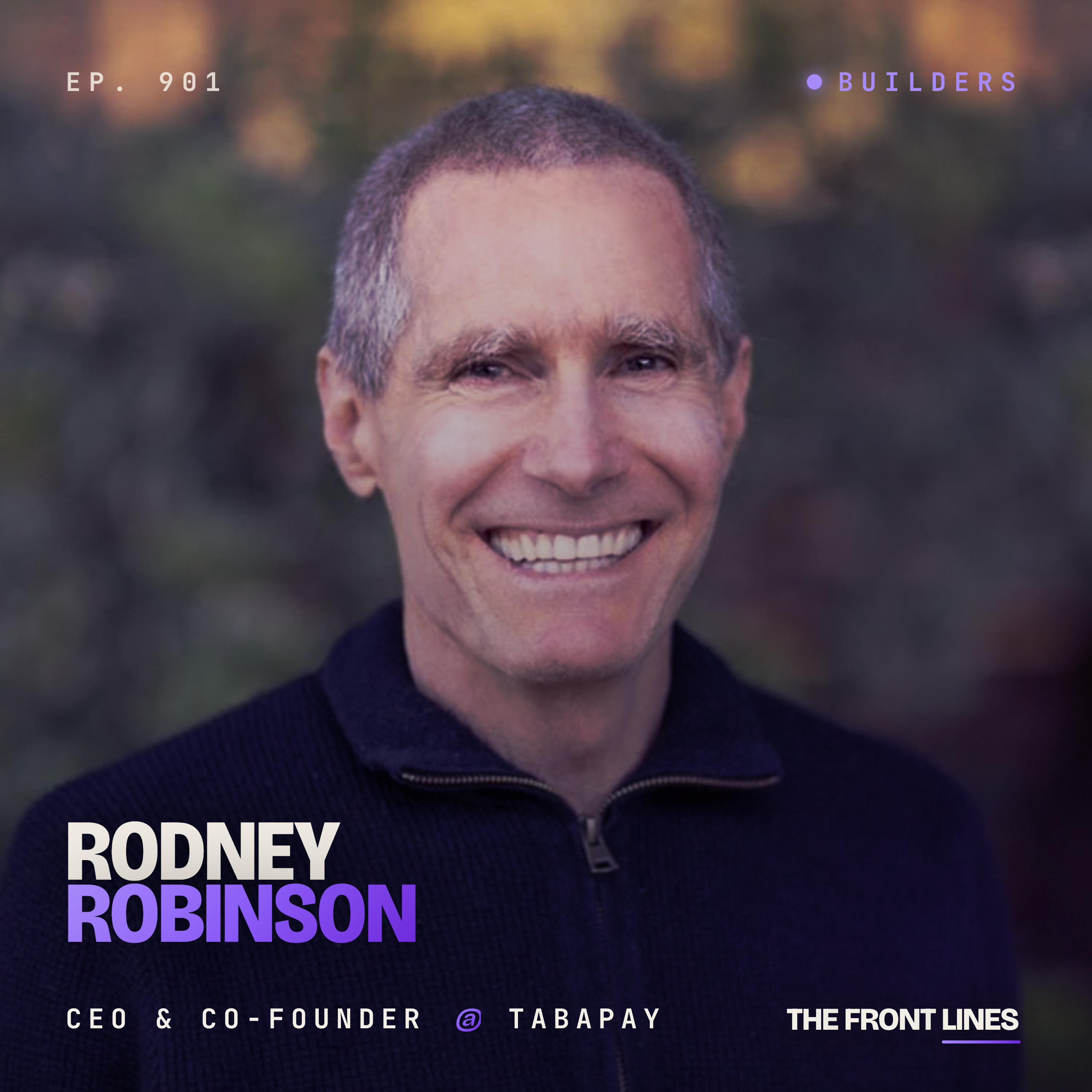
Welcome back to another episode of Builders. As always, this show is brought to you by Frontlines IO, Silicon Valley's leading B2B podcast production studio. If you're bringing technology to market and want to learn from your peers, we have a library of more than 1200 interviews with Venture backed founders and marketers. Where they talk, all things go to market. Of course, if you want to launch your own podcast, we offer podcasts as a service to more than 80 tech startups. The idea there is very simple. Simple, you show up and host and we do everything else. Now with all that said, let's jump into today's episode. Today our guest is Rodney Robinson, CEO of Tappa Pay. Rodney, welcome to the show.
- [00:48]
A
Hey, thanks. Appreciate you having me.
- [00:50]
B
Of course. So you've been building companies for a very long time. You've had a lot of success. Is there a through line through all of the companies that you've built?
- [00:57]
A
They all solve a critical customer problem and that's one of the reasons they've been successful. Just find a problem, stick to it, and if it's an important problem, you'll be able to build a good company.
- [01:08]
B
What's the methodology to find those problems? Because what you said makes sense to me and sounds great, but how do you actually do that in practice? And how do you do it over and over and over again? Because you've done this many, many times
- [01:17]
A
now I go deep. Let me tell you my favorite. So when I was, I think 17, I was driving a liquor truck delivering liquor to stores and I realized that you were unable to interstore liquor across state lines because of taxes. So I took that and started my first company. We wrote a software program that let stores within a state aggregate liquor, then get volume discounts. First company learned it by going deep in the liquor delivery business. But I think it's a mistake a lot of people use now. They think you can just start a company by sitting and not understanding. Deep in an industry, maybe with technology you can solving a technical problem, but if you want to solve a real world problem, you have to know the business.
- [02:04]
B
When you think back to that first software that you built and compare that to today's world with Claude code and all the tools. How big of a gap is that in terms of the time that it took you to build it?
- [02:13]
A
Well, I don't think an AI could ever drive a truck, but it took us probably it was a Summer project and we actually sold it, but it took us about three, four months to write everything. It was me and a couple people, a couple of my friends, Claude Coda probably do it pretty quickly, but Claude would never figure this thing out. So liquid delivery is immune to AI.
- [02:33]
B
Okay, makes sense. What other industries do you think are just totally immune to AI? Obviously there's a lot of doom and gloom here with AI. What else is immune?
- [02:41]
A
So I think any company has to be more than software nowadays. If you look, software will no longer be a competitive advantage. Okay. And so we're trying to build a business with multiple pillars. Software is one of them, but that can be replicated easily. But compliance is a critical one. So we have many transmission licenses which AI can't replace. It's a regulatory requirement. And banking. Right. And so you need different pillars to build your business on. Software is one. You better have more than that or you aren't building a real business. And I would question a lot of the investment going today into AI companies. Certainly the big LLMs that are getting built by OpenAI are important, but these companies built on top of it that are really just software companies with only software built on top of LLM, I think they aren't very durable and I think the investment going to them may be wasted. Certainly the big guys writing their LLMs are interesting, but they're replicating something that AI can do quickly, if that makes any sense.
- [03:42]
B
Yeah, that does make sense. And given your time in this space, I would imagine that you probably have some stories and we always like to ask for those stories. So if you just think about Silicon Valley in the early days, does anything come to mind? Do any stories really stand out?
- [03:55]
A
Well, I was involved in the early days of the Internet and I was with IBM at the time. And I remember meeting a lot of the early pioneers. Right. I was on an IBM deal team and we looked at Internet companies and whether IBM should buy them. And I remember going over to Netscape and this is in the early, early days, right? And I went back to IBM, I said, you should buy. These guys said they're doing OS2. But there were a lot of deals like that. When I was at IBM where IBM just passed and I felt that gave up so much opportunity by trying to build everything themselves. And I replicate that across my 40 plus year history. I've seen that over and over again where companies miss the early stage of an industry and they fail to acquire that would get them into it. Okay. But I do have a lot more stories, but for another Day we'll save
- [04:45]
B
it for part two. Now, how do you compare the mania of the early Internet boom to the AI mania that we're in today?
- [04:52]
A
I think it's very similar if you look at what survived on the Internet. You know, again, I was at IBM, we were trying to solve real problems, right? Or create opportunity, right? If real problems we were trying to solve software distribution and bug distribution, real problem because it was done by tapes, right? But the opportunity we were also trying to pursue his financial services, delivering banking over the Internet. Wow, what a new concept built over the Internet. New concepts, not solving a problem, but really opportunity. I think AI is similar. It will both solve problems and open opportunities. And your company, if you have a new one, decide do you want to solve a problem or do you want to create a new opportunity? I would argue it's easier to make revenue off of solving a problem because people easily buy it and be self evident where pursuing an opportunity requires convincing. Right? And IBM at the Internet days was very similar and we chose to do both. And some were good, some were bad.
- [05:46]
B
Speaking of problems, let's talk about the problem that you've been tackling since 2017. So if you're like most founders, I know somewhere whether it's a notepad or on your phone, there's just a long list of problems that you want to solve or business ideas or opportunities or markets. What was it about this opportunity, this problem that made you say, okay, that's it, I'm going to go spend the next 10 plus years building?
- [06:07]
A
So this company came from a genesis of a few things. I ran a money transmitter and this was back in 2013, 2012. And I had a hard time getting card acquiring and when I did get it, it was really expensive and I was really upset and I was dealing in money. Money transmitters, banks, lenders, dealing money. There's no profit on money except what the customer sees. When you're trying to transmit $100, you have $100 at the customer's money and whatever you charge, the customer sees. That's different than selling a TV where the profit is invisible and built in. So you need card acquiring that is cheap, so it doesn't take all your profit. So when I started this, I had that problem and I wanted to solve it. Additionally, when I was at, I sold the company to MasterCard. In that company was an instant payment business on the push side. But all my customers wanted pulse. So I put the two together. Companies dealing in money don't want to pay a lot for payments because it Hits their margin and you can't hide it. And number two, anyone that wanted instant push name on an instant pull payment, a lender wants to disperse and then collect, right? And I put the two together, go, wow, can I deliver low cost instant payments that makes this round trip? And I went to IBM, I sold the company, did push, I went to MasterCard and I said, hey, this is what I want to do. And they said, well, we don't want to really do that. We want to compete with our acquirers. So we started this company nine years ago and it's been a success. In the saying that I tell everyone is that lenders are people too. What I mean by that is that any business, any underserved market, if you can solve a real problem, you can win in the fintech or money space. Nine, 10 years ago, it was hard to find banking to find reasonably cost payments. And if you could put the two together and make this round trip payment, you give them banking low cost payments and you can solve this round trip payment, you can win. And that's all we did. We solved a customer problem. And we treat lenders like people. Lenders like real businesses. They're big businesses. They should be able to get good processing. And that's what we do. Does that make sense?
- [08:15]
B
Does make sense. How clear were you on the icp? So if you think back to day one, when you're thinking about who you were going to serve that ideal customer, is that spot on still who you're serving nine years later or what have been some of those evolutions on that journey?
- [08:28]
A
This is the only company I've ever done where our theory nine years ago holds true today. The customers that we targeted nine years ago are still targets today. We broadened who we can serve though. So more companies have problems than we originally envisioned, which is good. It means our business has grown and gotten bigger than I intended. But the original target market is exactly who we serve today. But it's grown quite a bit.
- [08:54]
B
This show is brought to you by Frontlines Media podcast production studio that helps B2B founders launch, manage and grow their own podcast. Now, if you're a founder, you may be thinking, I don't have time to host a podcast. I've got a company to build. Well, that's exactly what we built our service to do. You show up and host and we handle literally everything else. To set up a call to discuss launching your own podcast, visit Frontlines I.O. podcast. Now back to today's episode and how do you think about that expansion when you start to look at new markets, to go and serve and solve problems for. How do you make sure that you don't lose focus on that core customer group?
- [09:26]
A
I tell our company that I like to do one degree of difference from what we do today. Either I take my same product and go to a new market, that's a new market, one degree, or I take my market and deliver a new product to it. So I don't like to go off of my one degree theory served me well. And so that's what we do. So if we go to a new market, we want to take our existing product to that market. Because then it's. I don't have to have a huge engineering build and take engineering away from my current market. Or if I go and want to deliver a new product to my current market, that's again, easy. That's how I tell people. We move one square at a time without breaking the company. Okay.
- [10:06]
B
Have you ever broken your own rule there and gone 2% or 5% or more like, where did that come from? Because that sounds like there may be some pain in that, that wisdom that you just shared.
- [10:15]
A
I am sure I've done it in my younger days, but I don't recall, but I'm sure I have. I've never broken a company, but I've come close.
- [10:23]
B
Come close. What's the closest that you came that comes to mind?
- [10:26]
A
When I was running a company that I had bought, that was a money transmitter. And when you get into money transmission and you buy a company, you buy a lot. You buy software. You also buy an existing client base. And if the existing client base is doing strange activity, you'd better investigate it first. So the reason the company almost broke is when we bought the company, we bought the client base and there were a lot of crooks in the client base. And I broke my rule by going two degrees away just to get away from the client base. So I had to invest money, a lot of it, at the same time I had to get rid of these clients. It was tough.
- [11:00]
B
So you had a good reason though, to violate your own rules. It sounds like crooks are a pretty good reason.
- [11:04]
A
Oh yeah.
- [11:05]
B
When you think about marketing, maybe that's. I'll back up there. How much time do you spend thinking about marketing? Like for you, Are you a technologist, you're a product guy? You want to go out and solve the problem? Are you more of a brand guy? Like, where do you sit there?
- [11:17]
A
My background is product management and I take a very expansive Silicon Valley view of product management. With the general managers. And that's where my background is. I look at the problem to solve and I want it self evident when you deliver a product that customers understand what it is and it solves their problems and so they call in. So you ask about marketing. I don't believe in large outbound, outside sales. I'm not sure that's useful. But what I do believe in is having a product that's obvious what it solves. Doing marketing to deliver inbound lead generation. So that's what we do here, that's my focus for years, is to bend very small sales forces, spend money on marketing and channel distribution to get inbound sales.
- [11:58]
B
Okay, have you ever had moments where you want to switch that or where you say, okay, we want to really accelerate growth and pour some more cash in? Or is that not an equation that matters for you? Are you able to get growth without it?
- [12:09]
A
So I've never desired to have a large sales force in a company. I'm not sure that would be in my DNA or my head of sales. Right. I think we both believe that channel distribution is the best. Getting the word out through marketing and getting inbound is how to win. Now we're enterprise. I've never been in the consumer business, but I imagine consumer would be different. You'd have to sell to consumers, which I. Why do I never do it?
- [12:34]
B
I can't wrap my head around consumer businesses. I know Enterprise B2B and I can fully understand that. But my friends who are in consumer. It's a tough game or different game, I should say.
- [12:42]
A
It is never done. It never will.
- [12:44]
B
When did you begin the marketing efforts here then? So founded 2017. Was that like one year in or did you withhold it for like five years before you were doing really any marketing?
- [12:53]
A
So we left MasterCard in April of 2017. First thing we did was we built a website and that was delivered two months later. It was a marketing website. MasterCard got so upset at me. They thought we had been working on this thing for the entire time we were at MasterCard that they threatened to sue me. It is true, okay? And I said, I'm not live, guys. It's just a marketing website. They didn't believe me, right? So we went through this whole rig and they finally realized we went live, didn't have anything. So the bottom line is I try to sell ahead, right? If you look, we always know how we're going to get there. And once we know how we're going to get there, we start selling. As long as it's not going to take us years to get there. We start selling ahead of getting there. And that's how I've always done it. And that's how we've done it. We did it here in the early days, even though it irritated MasterCard that we just left thinking we stole everything. Right.
- [13:47]
B
For you. When you think about product management, how do you find amazing product managers?
- [13:52]
A
In the interview, I asked them what big problems they've solved in the past, what their focus is. Right. And if they can explain clearly the business problem they're solving and how they found it. Those are the folks we want. We also want those same people that have a technology background. Right. This is about explaining clearly, engineering, what your instructions are. And the perfect pair is the product manager that can have a vision, translate it and have engineering build it, and then you have a good pair. Interesting enough, we're now looking for product managers that are good with AI. And the reason for that is that we think a product manager now should actually build a working prototype with AI. It's not going to be production code, but it's a great statement of what the manager wants to build. Right. And so we're looking at people that can do that now in product management,
- [14:37]
B
does that make it easier to test those PMs and evaluate them then? Because you can have them go out and actually physically build something before you hire them.
- [14:44]
A
That is the interview you give the product manager a problem product, say build it in cloud or something, and they build it. And if they can, great. If they can't, well, go find jobs somewhere else. Right. And if you look at it, once you build this prototyping cloud or whatever tool you want to use, you can actually do usability testing on it. You can develop perfect product requirements before you give it to engineering, then engineering can do what they want with it. But it's a great way for product management to operate nowadays.
- [15:12]
B
Any major red flags that you watch for when you're having these conversations, when you're doing these interviews, the worst interviews
- [15:19]
A
are when you see their eyes moving because they're using AI to do everything. Yes, we see that all the time now. It's awful. And also inexperienced product managers. I think a lot of college grads think it's a sexy field. A lot of founders come from product management. But I'd argue it's hard for a fresh college grad to be a great product manager. They just don't have the business experience in an industry or even building applications for real people. So I tell a new college grad Cut your teeth somewhere else first, especially engineering or even sales before you go into product management. My view, product manager is a general manager. It's the center of the company. It's hard for a new grad to fit into that role.
- [15:58]
B
This show is brought to you by
- [16:00]
A
the Global Talent company, a marketing leader's best friend. In these times of budget cuts and efficient growth, we help marketing leaders find,
- [16:07]
B
hire, vet and manage amazing marketing talent
- [16:10]
A
for 50 to 70% less than their US and European counterparts. To book a free consultation, visit GlobalTalent
- [16:17]
B
co. Has that always been how product management has been perceived? Not just in your companies, but as a whole? Early on, when you got your start, how was product management perceived? Was it viewed as the core of the organization?
- [16:30]
A
I learned product management at IBM and Intuit. Intuit was fantastic and it was the core of the organization. And so I really learned my product management at Intuit. And that's. I think companies should go to school at Intuit to learn that. It's fantastic. And I worked for a guy that worked at Procter and Gamble. That's the master of it. Other companies don't have that. So I know at Oracle, product management's attached to engineering and it's really. They follow engineering's league. Right. And that's different. Every company is a little different. But I think good product managers are general managers.
- [17:03]
B
Okay, and what about just the impact of AI on the business and how you're thinking about AI? I think every leader, every founder, every human, I guess right now is thinking about AI. How are you thinking about it?
- [17:15]
A
I'm looking at it. Let me give you my view on all the layoffs that have occurred. So our company, we can't build enough stuff to sell. It's good to be in that position. We have a lot of ideas and I wish my workforce would quadruple their output because I could sell four times as much stuff. I am shocked that companies like Block and Facebook are laying people off because they're getting productivity gains from AI. My question to Dorsey and Zuckerberg is if you can innovate, come up with new ideas and sell everything your team builds, why are you laying these people off? You should applaud. They're getting 4x the output because I know if I could get forex output, I'd sell four times as much stuff. And I'm shocked that these companies are laying so many people off of experienced engineers and people. That means they're out of ideas and that's a shame for them. That's my view of this thing. And so we're looking to increase our productivity by deploying AI. And I'm not going to lay them off. I'm going to sell off more stuff. Okay.
- [18:16]
B
The quote that I read the other day, and it's. I wouldn't even recall it. A quote is like a random person on Twitter posted something and I took a screenshot because it resonated and they just said that if you're strictly viewing AI as a way to reduce your cost, you're completely missing the point. It's all about increasing your ambition and saying what's possible. Now that deeply resonated with me.
- [18:35]
A
It is. You can become a huge company by productivity gains with your workforce block. Facebook, they could get such a lead in their competition if they forexed productivity of their workforce. Laying people off, that's the worst decision, unless you're losing a lot of money. They aren't. They're crazy anyway. That's how I think about this thing.
- [18:54]
B
Well, that's what was interesting with the Coinbase announcement, was that yesterday or a few days ago, the company's doing well. It's not like things are bad. They're having. I think it was one of their best quarters or. Yeah, a very good quarter. So it's interesting to see, like, do you think that's really AI or are these organizations, did they just hire too much during COVID and now they're trying to like right. Size themselves?
- [19:13]
A
I think they're weak organizations and I see this sincerely. We let bad employees go. It's important to us is employee engagement, curiosity, innovation. Our employees need to demonstrate that, as I'm sure these other companies like Coinbase, My belief is that these companies hired too much, did too little management of employees and they finally realized we have too many people that are underperforming. This is not AI. This is just performance management. And they aren't going to tell you. And I think that's what's going on with these companies. Poor performance management.
- [19:45]
B
Okay, so AI is just they're out effectively or it's an excuse that they can use and everyone will just say understandable.
- [19:51]
A
That is exactly what's going on. And I think it's a shame that they're saying that because they're giving AI a bad word amongst employees. They're going to be scared to use it. They're going to replace their job instead of making them productive and selling more stuff. Right.
- [20:05]
B
And I don't remember what the numbers were, but there some study just came out maybe last week or the week before that, a Very large percentage of the workforce is completely resisting AI. And their orgs are trying to bring it in and they're saying like, no, or probably not saying no, they're just not using it. But it makes sense. There's a lot of fear right now. Why would they use it?
- [20:21]
A
Let me tell you what I told my team is that we have certain earnings per employee numbers and EBITDA per employee numbers. And we read about OpenAI and their $500,000 bonuses and annual salaries. They're losing money, but we have to compete with that. What I tell my folks is that use AI to increase your productivity, we sell more stuff. And if these numbers go up, revenue per employee, EBITDA per employee, I'm going to pay you more money. And the more they go up, I'm going to pay a lot more money. The way you get to a half million dollars is double my EBITDA per employee through AI. And if I was block, I would tell my employees the same thing. And that's how you build a good company. You get employee loyalty through letting them be more productive, drive your numbers up without hiring a lot of people, and then you give them a lot more money. And this is what AI should be doing. The dream of AI is work hard, double your output, double your salary. Hey, that's how it should be. But that's. These guys aren't doing it. They're crazy, right?
- [21:20]
B
Sounds about right. Now for you, you mentioned there that you have effectively unlimited demand or there's more demand than you could possibly serve right now. Has that always been the case for you in this company? Or have you ever had a point where there just wasn't enough demand and you had to go out and hunt for it and find ways to drive demand?
- [21:36]
A
When we were early on, right, we had to deliver what I call a base set of features. And so if we had more engineers, we could have done it faster. We could have brought in revenue into the company faster. We've always been in a position that we engineering is just run, product is running behind, and we'll never catch up because we have a lot of ideas we want to get done. So bottom line, this company, we've always been behind, we'll always be behind. That's just life, right? But AI should make us less behind, I hope.
- [22:04]
B
And what are you thinking for 2026 and beyond? What's the big picture vision for everything that you and the team are working so hard to build right now?
- [22:12]
A
So, as I said, software is no longer an advantage. It's not durable. Right. So we're working now on three legs of a stool, which is software extending that compliance through money transmission, licensing, and then banking. We're working right now on products that leverage banking and compliance. Right. Because two guys in the garage can't do all three. Two guys in the garage can write software, but not what we're doing. So you're going to see 2026 focused on products that wrap all three of these together. Okay. And in 2027 and beyond, again, wrapping all three together and adding additional non software advantages to what we're doing. Okay.
- [22:51]
B
Rodney, you have so much wisdom. I feel like I could keep you here for probably like four hours and try to mine that wisdom. But let's just leave with one more piece of wisdom. What advice do you have to Silicon Valley founders who are just out there right now? They're earlier in their careers or earlier in their company. Like, what should they be doing thinking about right now?
- [23:09]
A
Number one, find the big problem to solve. Have more than just software. Maybe not today, but tomorrow. Find that durable advantage. Find the big problem to solve, and don't spend your money until you find both.
- [23:22]
B
Okay, that's where we're going to end things. And Rodney, for those who are listening in that just want to follow along with you in this journey, where should we send them? Where should they go?
- [23:28]
A
Website would be great.
- [23:29]
B
Rodney, thank you so much. Really appreciate it.
- [23:31]
A
I've enjoyed it. Thank you. It's been fun. See you.
- [23:37]
B
Well, that's all for today's episode of Builders, brought to you by the Frontlines. If you want more amazing content like this, visit Frontlines IO, where you'll find the library of more than 1500 interviews with founders, marketers, and other GTM leaders, where we unpack the tactical lessons from their journey. And of course, as always, if you do want to launch your own podcast, we'd love to have a conversation with you. Visit Frontlines IO podcast as a service. Mention that you listen, mention you love the show, and we'll give you a 10% discount. Thanks for listening. We'll catch you on the next episode.