Loading summary
Transcript54 lines
- [00:00]
A
The common failure mode is selling a capability, not a workflow.
- [00:07]
B
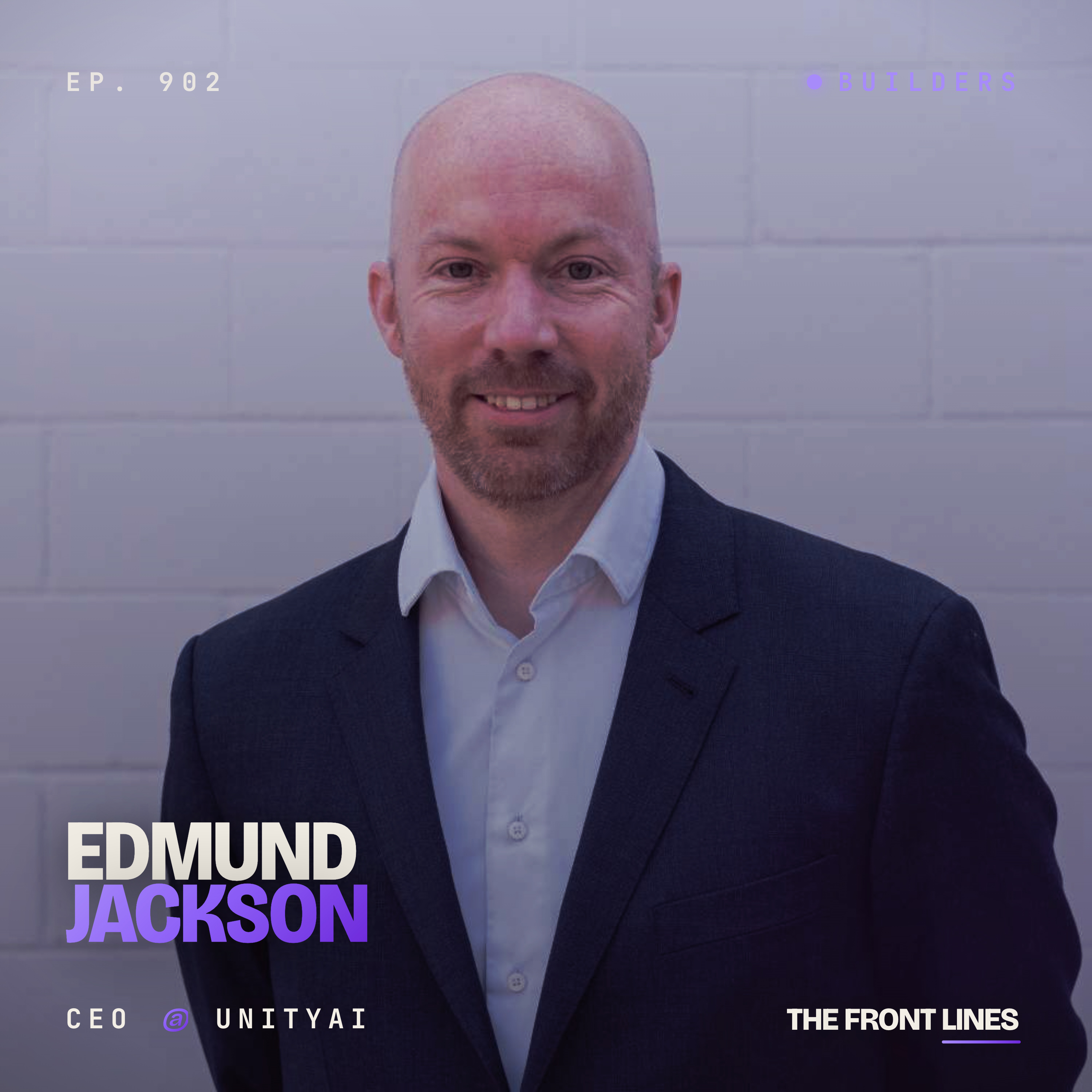
Welcome back to another episode of Builders. As always, this show is brought to you by Frontlines IO, Silicon Valley's leading B2B podcast production studio. If you're bringing technology to market and want to learn from your peers, we have a library of more than 1200 interviews with Venture backed founders and marketers. Where they talk, all things go to market. Of course, if you want to launch your own podcast, we offer podcasts as a service to more than 80 tech startups. The idea there is very simple. You show up and host and we do everything else. Now, with all that said, let's jump in today's episode. Today our guest is Edmund Jackson, CEO of Unity AI. Edmund, welcome to the show.
- [00:46]
A
Thank you, Brett. Thanks for having me.
- [00:47]
B
Of course. Looking forward to this conversation. So I want to talk about your previous role. So, Chief Data Officer, big, big organization. What did vendors get wrong when they were trying to sell to you and trying to market to you?
- [00:58]
A
There was a daisy chain of vendors coming to sell me solutions to problems that I didn't have. That's a common denominator. Healthcare is just a really, really difficult thing. So I was at HCA Healthcare, so 200 hospitals across America and people would come with solutions to things that just weren't real. So yeah, that's the issue.
- [01:16]
B
And what was the root cause of that problem is that they're just incubated out of Silicon Valley and they've never talked to the end customer. Why do you think there was that big disconnect?
- [01:26]
A
Just ignorance. There's a tremendous amount of detail that goes on in a complex healthcare environment that's just simply invisible from the outside. Unless you've gone and done it, you just don't know how it works. So coming with a point solution, it's just not going to work. It cannot be integrated into the workflow. This is the common failure mode. The common failure mode is selling a capability, not a workflow. For something to actually hit in healthcare, it has to be the end. To end, what task am I going to achieve? What are all of the prerequisites for that task? Who's doing it? How are they doing it? How does it all interconnect? And how do I get all of that done? Coming with a capability, oh, it's a voice or it's rpa. Nothing.
- [02:05]
B
And for you, as you were thinking about what you wanted to go out and build, let's talk about that gap. Was that just one vendor after another? You were so tired of Hearing these pitches that didn't understand your problems, that you had to go out and solve the problems or what happened there that made you go out and build a company?
- [02:21]
A
I just got footloops, you know, so I was too young for the 90s.com mania. And I thought that the crypto mania was stupid. I was stupid. So I missed both of those. And I thought, you know, AI healthcare. I have a PhD in AI. I am in healthcare. I could probably figure this one out. And so I just sort of left with that inspiration of I know enough about this to apply it correctly and do something meaningful. Let's go figure that out.
- [02:43]
B
And how much has the idea evolved today? And maybe let's start with, you know, what's the problem that you're solving?
- [02:48]
A
So we do central orchestration in healthcare. So what we try to do is create the optimal clinical schedule in an outpatient, like an ambulatory environment. So think something like a dental clinic or a radiology clinic or an infusion clinic. We try to make the schedule excellent. And there are a ton of workflows that go into that. On the one side, you're calling patients, you're getting them scheduled, you're checking their benefits, you're checking their co pay. If they call to reschedule, you reschedule them. If they don't call, you call them back, you reschedule them that workflow. On the other side, there's the staffing workflows of making sure that there are clinicians to take care of the patients who do show up. There's somewhere between 120 and $150 billion a year lost in America just on people don't show up for the right. Don't show up for their care, or do show up and don't take care of them. So we're trying to solve that problem by making the schedule great. We do that through all kinds of complex stuff. So one of the shiny thing is the voice AI. People get all excited about voice AI, which speaks. That's just a sideshow. The core problem is the optimization and the orchestration. It's just delivered by voice.
- [03:47]
B
And why is it so hard, you know, to an outsider like me, it seems like, well, I don't know, you just, you know, plug it in some tools and, you know, have a calendly and it's easy. Like, what am I as like an outsider? Like, why is it so much more complicated than what I just described? Which, of course I realize it is much more complicated than that.
- [04:02]
A
You're provoking me. You're provoking me. Rule one, there's no API around the patient. So getting hold of a patient is really hard. A lot of healthcare is episodic. You don't necessarily have a good relationship. They sure as hell aren't logging onto your portal or have an app to you. Nothing like that. So getting them is difficult. Part A, Part B is a healthcare visit is a unique end of one thing. It's not like a haircut. Like anyone can schedule me for a haircut. And that's not just because of my situation. A healthcare visit is totally different. It's N of 1. Your genetics, your pharmacy, your complaint, your prior history are different. The provider's the same. So getting the match right, right clinician, right patient, right time, right place is a difficult problem. I'll give you a third one. The actual technologies underneath it are very archaic and not well integrated. The government had to bribe health systems to use electronic medical records because that's how bad it is. And they're preventing the flow of information. So actually connecting an HR system to a clinical system, to a billing system, to all of those things, it's really difficult to do.
- [05:08]
B
I had on a guest a while back. That's a very different world. But I'll connect all of these threads. So they're in food production, robotics. And he came on and basically said that there was a graveyard of companies that have come before him. They had tried to solve a very heavy problem and were unsuccessful. And he kind of broke them into buckets. He didn't name names necessarily, but he said, you know, here was kind of effort. One, here's why it didn't work. Here's effort. Two, here's why it didn't work. Does something like that exist here? Like, I would have to imagine there's been many others that have tried to solve this. Like, what are the patterns for, like, why they've been unsuccessful in solving this problem?
- [05:41]
A
Yeah, it's a long list. So IBM, Watson X, remember that guy? You know, they won Jeopardy. And thought they could become a doctor. That wasn't great. Babylon AI out of London, similar story recently. Olive AI, remember those guys? They raised 900 million, maybe a billion dollars, valued at 4 billion sold for parts two years later. The common thread is there are two. One is, I said it earlier, it's trying to sell a capability, not a workflow. And two is a lack of humility in solving something tractable. You know, in Silicon Valley, you want to solve this huge giant TAM issue because that's how you raise money in healthcare. You can't actually fully do that because of all of the nitty gritty I told you about earlier. You can make a big promise, but you can't deliver on it in reality. And all of those companies had that same problem. We have to say what is actually tractable, what can I actually solve and go and solve that and grow from there.
- [06:34]
B
Makes sense. And for you, icp, is it the same ICP today that you thought it was going to be three years later?
- [06:40]
A
No. I came from the hospital world so I thought, I know hospitals, I can sell to them. These fools and their 12 to 18 month sales cycles, I can beat them. I was so very wrong. So we do business with health systems, but it's very hard. The 18 month sales cycle is a real thing. And so we do business with some really big names, but that's not the core thrust. The core thrust for us is PE backed roll ups in the ambulatory space. So we like something like a dental roll up or a radiology roll up, an infusion roll up, a veterinary roll up, where you have 70 to 150 sites of care, national scale, that have a corporate structure. So what it means for us is that one, they have sufficient scale that we can make a meaningful difference to them. They have PE backing so they care about efficiency and they have capital to actually invest in a solution such as ours.
- [07:24]
B
What was the journey like to uncover that? To me that sounds very niche. Like you couldn't map that out before you began. Like, how did you, I don't want to say stumble into it, but like how did you navigate your way into this being the market that you ended up serving or focusing on?
- [07:38]
A
Yeah, I let pain be my guide, Brett. So we had to do a bunch of experiments. So we started in health systems because we knew our way around. And when it became clear that that wasn't going to build a sustainable business, we literally ran five different experiments saying, let's look at pharmacy, let's look at pbm, let's look at lab, let's look at payer, let's look at provider. And the one that hit first was this. And so we didn't assume to know beforehand. We tried a bunch of stuff and saw what stuck. And this is stuck.
- [08:04]
B
This show is brought to you by Frontlines Media, a podcast production studio that helps B2B founders launch, manage and grow their own podcast. Now, if you're a founder, you may be thinking, I don't have time to host a podcast, I've got a company to build. Well, that's exactly what we built our service to do, you show up and host and we handle literally everything else. To set up a call to discuss launching your own podcast, visit Frontlines I.O. podcast. Now back to today's episode and how big is that market overall? Like, how many rollups are there underway right now?
- [08:33]
A
Infinity is basically the answer. I'll give you an interesting theoretical answer. The hospital systems are delaminating. So you do think about healthcare. It was all under one roof because you had to have all the doctors and the nurses, everybody in one place. Now you don't need that. And so services are splitting off. So hospitals are becoming more and more acute and the less acute things are spinning out and being rolled up. So think of something like radiology. If you wanted an mri, you should go to a hospital. Then it got spun out because you can take it in an outpatient setting. Those then multiplied as physicians started to do this. PE came and bought them up and consolidated them. That's happening with all these different services in healthcare. So the market is actually everything other than like the most acute things, like organ transplant.
- [09:12]
B
When you look at ambulances and like, I'll probably get some details wrong, but I read this, I don't even know how long ago, but a number of years ago, I read about how like the unexpected impact of Uber was, you know, felt in the ambulance industry. Because there were a lot of things where you didn't necessarily need an ambulance, like a broken arm or like a broken leg or a minor injury where you could just press a button and have an Uber take you instead of, you know, a very, very expensive ambulance. Is that accurate? Like, is the industry under pressure right now for that and for Waymo's and like all of this technology that's coming.
- [09:43]
A
Sure. You know, we're actually building, I won't say release. We're building such a thing where when we're scheduling a patient, like, can I get you a Waymo? Because in several of the constructs, like a value based care construct, actually getting the patient to the clinic to have care is so vital that you'd be prepared to pay for a Waymo or an Uber to get them there. So that's like a service you can offer and it's achievable today. So yeah, that's 100% it. There's issues with this. You know, where's liability if the patient has an infectious disease and the driver gets sick, what's the story there? If they crack? Like, there's. There's stuff. Right. So it's not a slam dunk. However, the, the broader situation, the demand is infinite in healthcare with the aging population and just the needs and services that are available to them. Ambulances are super interesting. Everybody thinks of like the 911 case of like get you to the hospital. A lot of it is not that it's like inter facility transport where you're taking grandma from the hospital to the skilled nursing facility or you're transporting a bunch of people to a shared site. So for instance, people having infusions done, so drive around and collect and get them to the infusion center. There's a lot of these really niche things that are hidden in the details of healthcare. And so yeah, there are new entrants, but it doesn't mean they're displacing the old entrants. It's just bigger, there's more.
- [10:52]
B
I've only been in an ambulance one time and it was in Puerto Rico and I was here, I thought I was dying, basically. I remember them telling me they're like, we're not going anywhere until you give us a credit card. And they brought their machine and I had like swiped my credit card for the ride. And I've always just thought that was so funny.
- [11:06]
A
Yeah, I don't think we do that here.
- [11:08]
B
Yeah. Now for you, in terms of the marketing program, how you're approaching marketing, give us the high level philosophy there.
- [11:15]
A
So the high level philosophy is being very, very crisp on who we're going after and then finding them in the native habitats. So fortunately, coming from healthcare, we're not going to the market, we're in the market. So we know most of these people and these companies. Just given that we're in Nashville for a start, which is truly the healthcare provider capital of America. And so a lot of this is through personal connections. It's through being in the right conferences. You know, it's all great to go to Vive and health, no health systems there. What are you doing? So you won't find us there. So it's those types of deals and then it's. A lot of it has been organic based on success with clients. So one client uses to another. Da, da da. That's particularly powerful in PE portfolios where if you have a bunch of these PE companies specialize in rolling up different types of companies and sharing that same playbook. So if you succeed in one, you get the rest of them.
- [12:07]
B
That makes sense. What have been the biggest evolutions of that marketing program so far?
- [12:11]
A
Having one evolution.
- [12:14]
B
One.
- [12:15]
A
I mean, honestly, I'm an engineer, I'm a product first Guy. And so the idea that one might want to run ads was kind of news to me. So then just even having one became something of an evolution. And then it's just building out the team to get after it and be highly specific about who we target and how and when.
- [12:30]
B
How do you find team members? Are you looking for people that have industry experience? Like, how important is industry experience for you? I can see on one hand some people are like, oh, I have to have it. And others are like, no, I don't want it. Because that's where the bad habits come from.
- [12:42]
A
It's a mix. You kind of want it as an alloy. Right. So the first thing we're looking for is we want people in Nashville. So we're very much an in person culture, which I appreciate is not what everybody's cup of tea is these days. But at the speed we want to move and with the difficulty of what we're doing, having everybody in the same place at the same time around a whiteboard with coffee helps a ton. And so that's one of the primary things. We do need people with experience. A lot of those are people who've done this before. So people who've run clinics, people who've been nurses, we employ many of those because that lets us make sure we're solving the right problem. To my first point. And then the rest is, yeah, there's a lot of nuance in healthcare data, healthcare interoperability that just requires a bunch of experience. We do broadly there. We're also like, not part of whatever this fable, don't hire young people thing is. Like, that's just nonsense. We continue to hire junior devs because one, they come in AI native and so that's extremely helpful. And two, they're extremely hungry. Right. There's just something about the energy of having first grads who really, really want to like cut their teeth and do a thing. So across the board and for you,
- [13:43]
B
when you think about the future markets that you'll serve, at what point will you say, okay, we've won the market or the market we have as much as we're going to reasonably capture before you move on to a new market.
- [13:53]
A
Is there such a thing? Brett, I'm done. It's okay. No, it's interesting. In healthcare, again, there's almost no winner take all dynamics here anywhere. On the provider side, HCA Healthcare where I work is the biggest. And they're 5% of acute care. They're the biggest. On the tech side, you have a group like Epic, which is an EMR company. They're 40% of academic medical centers, so that's pretty damn big. But they've been at it for decades and if you step out of that space, radiology, dental, veterinary, they're not there. Right. And so the fragmentation is significant in this space. So I'm not sure anybody ever gets to a place where I've eaten the entire market. There's always going to be competition for growth and I. Yeah. This show is brought to you by the global Talent company, a marketing leader's best friend in these times of budget cuts and efficient growth. We help marketing leaders find, hire, vet and manage amazing marketing talent for 50 to 70% less than their US and European counterparts. To book a free consultation, visit globaltalent.co.
- [15:00]
B
i mean more on like the PE backed ambulatory care. Like is there a point where you say, okay, we've won that market?
- [15:06]
A
Yeah, so we're already looking beyond that. So we're continuing to focus our efforts there despite the fact that health systems are slower. We have, as I said, three clients in that space because the TAM is just enormous there and the LTVs are through the roof, so it takes longer to acquire them. But we're already starting to move in that space. So the motion there looks like identify and create solutions on the fast moving PE backspace. Let's talk radiology. Right. So figure out how to orchestrate staff and patients to create optimal schedules in radiology. Get that Right. Then bring that as an all finished product to the health systems and sell it to them. If you arrive with a let's co develop, you'll be dead. So that's kind of what the motion is, is solve it outside and bring it into those systems and sell it that way.
- [15:50]
B
And why is that? If you were to co develop, you'd be dead.
- [15:52]
A
There are too many people and processes in acute care. That's not a criticism. The risk in acute care is extremely high. People genuinely die in hospitals every day and the posture is very, very mature with respect to risk. So innovating in those spaces is necessarily difficult and hence slow. So we really want to solve it in a subacute type of environment and then bring that over where a lot of it is solved and you're not provoking the same reaction of risk in the guardians.
- [16:25]
B
How do you think about the market category? What's the line item that buyers are buying?
- [16:29]
A
It's autonomous operations is the market category that we're living in. So a lot of that is optimization and orchestration of workflows.
- [16:36]
B
And if you think about Your customer base, are they currently in market and you have to go and just capture that demand or do you have to go and convince them that they need to be in market and then you can capture the demand?
- [16:47]
A
No, a lot of the time then people are in the market, right? But they're in the market for the voice. So people are like, oh yes, I'd love like a nice AI voice to answer my phone calls, you know, because 25 to 30% of incoming calls go unanswered today. You know, 1% of calls are answered on the 1st, are resolved in the first call. It's a real problem. PE backed roll ups have spent untold money making offshore call centers that just suck. So it's a real issue on the voice side. What we're doing is educating people that the voice is just the edge of it. Right? So it's one thing to have an AI talk to a patient, it's another for it to say something intelligent and then orchestrate with the rest of the system. So we enter by one motion, then we educate through another and expand.
- [17:25]
B
That way if someone doesn't say yes to you or says, you know, we're going to go with a different solution or we're going to keep just doing it ourselves. Like what are the most common reasons why that would happen?
- [17:34]
A
Highly competitive. So people sometimes go with a competitor who has a deeper specific workflow in a vertical that happens. We've had a couple, interestingly where they're like, you know what, we're just going to vibe code this sucker ourselves. So I encourage people to do that. I think it's great, we should try. But you know, making software is like making children. It's a lot of fun to make it, but then you got to maintain it and that's where the grub lies, you know. And running real time orchestration systems is very difficult. It's like it's a, you know, many nines. So we've had a couple like that. I don't think that's going to last. I think there's an unreasonable optimism around what you can do with vibe coding. So that's passing. Yeah. But no, we have a pretty high at bat rate here.
- [18:13]
B
I like the organization, like I like Klarna, but I think that was like a year ago, right, where they made some announcement that they were, you know, firing, I think with Salesforce and Workday and they were going to build it themselves and they were getting rid of some team members like all of this stuff. And I remember right, they had to walk back Quite a bit of that and realize, like, oh, wait, that's like A, hard. And I think B, it's a distraction from the core business. And I don't know, it's hard enough.
- [18:34]
A
Business is hard enough. And again, like on, you know, we're primarily in sort of an engineering organization, so most of our headcount are engineers. And there's sort of two arguments why I think that the world's got it upside down. Like, one at our size, if AI lives up to its promise and we can't leverage our staff to be more productive, we just suck. From an imagination perspective, it's different if you're Microsoft and you have 10 gajillion engineers, but if you've got 30, that's a different matter. But part B is it's not doing all of that. We have written so much code and so much of it is garbage. And we have to wind that back a little bit. Okay, we've kind of slopped ourselves here. Let's figure this out. And so there is a fine line and a practice about how we hire, how we hold ourselves accountable to what goes into the code bases, how we use the tools. It's not an easy buff.
- [19:21]
B
And if you just zoom out as a whole AI in healthcare, what's the general sentiment right now?
- [19:27]
A
It's scary. There've been some real wins. So AI, unlike many technologies, has actually delivered value in healthcare. I'm speaking specifically about scribes, so I'm sure you're following all of those stories. That's actually worked and it's actually made physicians more productive and more satisfied. And so AI in general gets a leg up because it actually did a thing unlike so many other techs. So that's been good. It's also sort of winning on Rev cycle. So that's where payers and providers argue about who owns who, what and why. Because a lot of that is to do LLMs, processing charts, claims ledgers, they're really good at that. So there's really good momentum there. I mean, I think the whole thing is mad, but anyway, there's been space there, but when it comes to touching patients and staff, there's a little bit of reticence because everything is moving so fast that a lot of CIOs are looking at this and saying, well, I don't know, I'm just going to wait for it to settle. And it's not going to settle. But that's where a bunch of them are. So there's that. There's been some really great groups that are trying to help companies through that to say, okay, here's how to think about AI, here's how to think about the ethics and choosing things and making sure that it's right. So there's like a support structure coming around healthcare to enable the adoption of the actual tools. So shout out to my buddies at Optura AI, they're doing awesome work in that space.
- [20:45]
B
Love the plug. And final question for you, let's zoom out. Three years, five years, 10 years, however far out you want to go, what's the big picture vision for everything that you're building?
- [20:53]
A
It is headless, interfaceless processes in healthcare. So I really do believe in this environment where we don't have screens and keyboards doing what we need to do in healthcare. You know, the saddest picture I ever saw was a picture by a kid of his visit to the doctor. The doctor's got his back to the kid typing on the patient, like, taking care of the emr, treating the emr. If we get all this stuff right, that goes away, right? And everything becomes ambient. Conversations are ambient, scheduling becomes ambient, reminders become ambient. That's what we're trying to build towards.
- [21:22]
B
And where should we send people if they want to follow along with this journey?
- [21:25]
A
Unityai co. That aim is real expensive.
- [21:31]
B
Well, I appreciate you taking the time. It's been a lot of fun. Love what you guys are building. Well, that's all for today's episode of Builders, brought to you by the Frontlines. If you want more amazing content like this, visit Frontlines IO, where you'll find a library of more than 1500 interviews with founders, marketers and other GTM leaders, where we unpack the tactical lessons from their journey. And of course, as always, if you do want to launch your own podcast, we'd love to have a conversation with you. Visit Frontlines IO Podcast as a service. Mention that you listen, mention you love the show, and we'll give you a 10% discount. Thanks for listening. We'll catch you on the next episode.