Loading summary
Transcript38 lines
- [00:01]
A
All of a sudden we started getting eight to 10 inbounds a week without a cold calling plan. And everyone kept saying I was referred by X, I was referred by Y.
- [00:14]
B
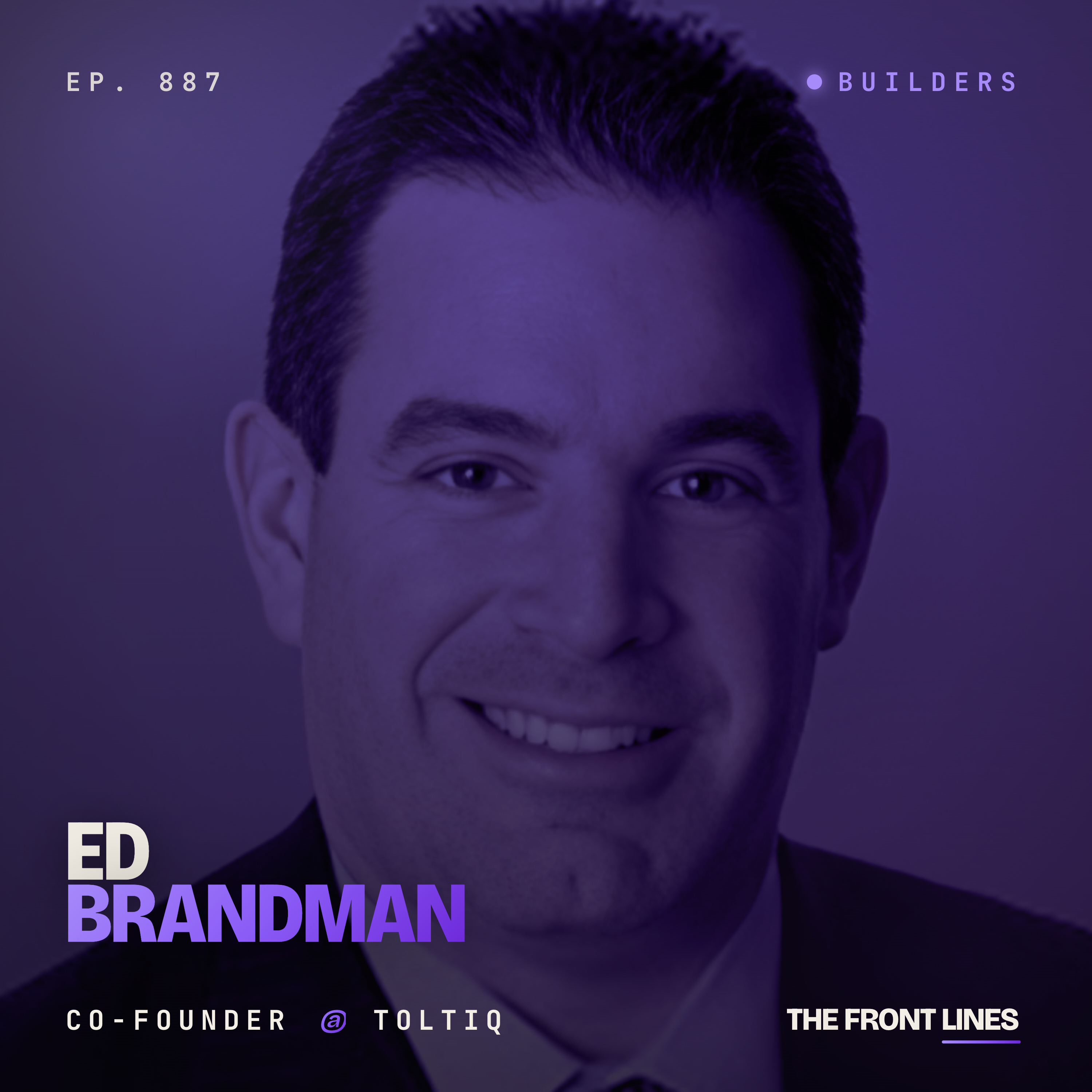
Welcome back to another episode of Builders. As always, this show is brought to you by Frontlines IO, Silicon Valley's leading B2B podcast production studio. If you're bringing technology to market and want to learn from your peers, we have a library of more than 1200 interviews with Venture backed founders and marketers. Where they talk, all things go to market. And of course, if you want to launch your own podc, we offer podcasts as a service to more than 80 tech startups. The idea there is very simple. You show up and host and we do everything else. Now with all that said, let's jump in today's episode. Today our guest is Ed Brandman, co founder of Tilt iq. Ed, thanks for being here.
- [00:53]
A
Thanks. I'm thrilled to be here, Brett.
- [00:55]
B
Looking forward to this one. So let's talk a little bit about your background. You retired five years. You made it five years. You're back. What did you do during those five years and what made you decide to come back?
- [01:04]
A
I was blissfully, happily in those five years. I always had a desire to get out to the U.S. national Parks and visit what I would describe as my own backyard. Because I spent the bulk of my career in financial services, traveling around the world to major financial services hubs. And so when I finally retired in 2018, I got in my truck with my Belgian Malinois dog and we spent five glorious years driving coast to coast on three week jaunts with a Garmin GPS so my wife would know that I wasn't dead in a ditch somewhere. And I made it to 27 national parks in five years and each trip was about 4,000 miles across the country. And I never knew why I was sleeping from day to day. I had a tent in the back of my truck. I slept in cabins in the woods, Airbnbs and dog friendly hotels. And I had the time of my life.
- [01:55]
B
What is your favorite national park? I said no hard questions, but I lied.
- [01:58]
A
Here's your hard one. I have one. I found Bryce Canyon in Utah to be the most breathtaking place I've ever visited. You might as well have told me I was on Mars because it was so otherworldly when we were hiking there.
- [02:12]
B
Amazing. Amazing. And let's talk a little bit about the most recent role, kkr. I think everyone knows kkr. I'm sure you learned a ton from that experience. Like, was there a Big takeaway. Is there something that's really stuck with you as you've gone out to go and build your own thing?
- [02:24]
A
Yeah, there are a number of takeaways. The first takeaway was, look, I joined the firm in 2007 when it was only 390 people, which is shocking at that point. The firm was, you know, around 40 years old. And I thought I'd be the newest guy forever. Henry and George had a Monday morning meeting with the whole firm. They're obviously still very much associated with the firm, even as they've named co CEOs. And you know, every single meeting, they infused the culture that they felt was most important into the people. And every single meeting we had, at some point they talked about do business with people you like and trust and whether that was your colleagues, whether that was your LPs, whether that was the companies you were buying. Their view was, if you're doing business with people like and trust, things happen. And so that was one of my biggest takeaways as I ultimately came out of retirement and formed a business. I was like, I want to do business with people I like and trust. And now it's my candy store, so I can do that. So that was one big takeaway. The second takeaway was I had no idea the direction the firm was going to take, meaning kkr. When I first joined, they had a vision of where they wanted the firm to go. And I, through sheer force of will, but also the experience they had in the industry, they bucked the trend of where other people were going and they cut their own path. They built a balance sheet for the firm. They entered these other asset classes that the firm had never been in, you know, and turned into the company they were. So this idea that you can dream big and execute was inspiring to me as well. And you know, I think the third takeaway was hard work really pays off if you put your head down. You know, if you reward people on a meritocracy basis. One of the most innovative things they had done in the firm when we were still private is everybody in the firm shared in the carried interest of the funds, not just limited to the investment partners. They reserved a 1% pool for everybody. And you can imagine when the firm's small and you reserve that, you know, whether it's your assistants, your kitchen staff, your technology team, your ops people, that creates real wealth for people. And so that was also an important part. When I created my firm, I was like, I want that to be part of the equation too, so that everybody's Got an equity stake in what we're doing.
- [04:41]
B
You know, the other day I was talking with a friend and I was complaining to them. We have a studio now and it's like a five minute walk from my house, so I have no commute time anymore. And my commute time was my thinking time. So given your five years of retirement, all of this traveling you did, I would imagine you had a lot, a lot of time to think about ideas. Let's talk about the idea, the company that you founded and then maybe let's talk about why that idea. Cause like all that driving, I'm sure there are a lot of different ideas that you could have pursued.
- [05:07]
A
There were so many different ideas I could have pursued. And honestly, being very transparent, like I had all this time to think about amazing things on long cross country drives and hikes with my dog. And you know, my biggest takeaway from all of those journeys, to be honest, was about like how diverse the country is. And honestly my biggest takeaway in terms of an idea was I wanted to figure out how do we bring people from rural America to the cities and figure out how to bring the growers to the distributors and the distributors to the growers. And wouldn't that be an amazing thing as a country that we could do? I didn't have the bandwidth or the capacity to pull that off. I was literally at the tail end of a national park trip when my now oldest son, who also happens to now be my business partner, called me up and was like, I think this AI stuff is going to change the nature of the way people work. I was really just discovering what ChatGPT was in 2023 when the 3.5 model came out. He was running cybersecurity at Duolingo and you know, he was pushing me on, hey dad, like what aspects of the business at KKR were most painful and the most interesting thing to me when we ultimately landed on this due diligence process and how to use AI was I don't think it's actually intuitive around where the bang for the buck is with AI right now. Meaning I think people gravitate towards the operational processes of firms and that actually isn't the biggest bang for the buck right now. The biggest bang for the buck is on the front end of businesses, right? Whether that's a diligence process, the capital raising process, how you interact with your investors, the marketing side of the business, the sourcing side of the business, that's really where at least the current power of all these AI models are. And so as we were talking about it, he's like, hey, let's go through the things that you did at the firm. And so in addition to kind of running technology and operations in the firm, I had been fortunate enough to got and brought over the wall on diligence activities. And as we talked about that, he actually was the one who said to me, hey, how about that diligence process you're talking about? It's incredibly labor intensive, right? Like, tell me more about it and how the business works. And so the more I did, he was like, I think that's it. And I'm like, why? Like, you know, I could barely spell GPT or GTP and what was a transformer. And he was the one with kind of an engineering background. He graduated from Northeastern with Cybersecurity and ComSci, and so he knew a lot more than me. So I brought the business knowledge, and he brought the engineering, and that's how we wound up. And honestly, that was before the models had such small token capacities. You couldn't upload files. I didn't know what a vector database was back then. It turns out that's a really powerful part of our moat today. And so that's actually how we landed on it. It's his fault. I mean, in a good way, but it's still his fault. And it's the reason I'm not retired anymore.
- [07:51]
B
Do you still have national parks left, or is that all of it? How many are in the U.S. i do.
- [07:55]
A
So I set a goal for myself in 2018 to get to 50 of the 63 national parks. My view was, I'm not making it to American Samoa. I don't think I want to take small little biplanes in Alaska to get to about six parks. So I narrowed it down to 50. So I've made it to 27. I've got 23 more to go. I don't think I can wait until I'm retired to start that trek again. So I've got to convince my team it's okay to at least let me go away for 10 days once a year and hit two to three national parks so that I get done in time. I originally set a target date at 2028. I think I might have to push that to 2030 or 2032. But my goal is to get to the 50 on my list.
- [08:34]
B
This show is brought to you by Frontlines Media, a podcast production studio that helps B2B founders launch, manage and grow their own podcast. Now, if you're a founder, you may be thinking I don't have time to host a podcast. I've got a company to build. Well, that's exactly what we built our service to do. You show up and host, and we handle literally everything else. To set up a call to discuss launching your own podcast, visit Frontlines IO Podcast. Now, back to today's episode. You'll have to come back on the podcast after you've done that, and then we can talk through it.
- [09:02]
A
That would be awesome.
- [09:03]
B
Now, what did those early conversations look like with customers? So I would have to imagine, because of your background, like, you knew how to speak their language, obviously. Like, did they just get it right away, or was it still a process of iteration for them to really understand how you were solving it maybe would be a better way to describe it.
- [09:19]
A
So it was absolutely an iterative process. You're absolutely right. From the perspective of, look, I came from inside the industry, and so I did speak their language. I knew the terminology, I did understand the pain points. And I could at least sit across the table from investment professionals and oftentimes technology teams or AI teams and say, not only do I understand your pain, I sat on your side of the fence. And so I opened with, look, here's how I think about security. Here's I think about the diligence process. I'm going to be very transparent with my clients around what we can and we can't do. And by the way, that has literally been shifting every single month as models have changed their capabilities. But, you know, two and a half years ago, I had to say to clients, I don't know how to read and understand a chart or a graph. I can't process a 300 page, you know, credit agreement. But all those things, I keep changing the story, to be honest, and not because I want to change the story, but because the capabilities keep changing. And so that's been kind of a driving and a motivating factor with clients is we're very transparent and honest with them about what we can and can't do. They're on the journey with us. We're learning alongside them. I mean, an interesting aspect of what we do is really only about 50% of what a client is doing on our platform are what I thought they would be doing. And that's because the other 50%, they learn through discovery, because the limits of what AI can do with documents and connectivity keeps changing. And, you know, everybody's got their own way of doing work and solving problems. And so we're giving them a platform and a tool. We're giving them guidance on use cases, but we're not being prescriptive. And that really allows them to explore. And oftentimes the power users are the ones that do some of the most interesting things. But there's also a side of it which is sometimes even the episodic user that that saves an hour a week. And now all of a sudden that's down to 10 minutes worth of time. That's a meaningful impact on what they're spending their week on when that adds up over the course of a year. And so I think my relationships and my team's relationships, because honestly, 70% of the team comes from inside the industry, including the engineers, including my cfo, including my client team. And so we get them, we understand them. Clients were willing to make a bet. To be honest, the first eight clients I reached out to were all former KKR colleagues that had gone off to other firms and were having success in their own right. And they were willing to take a risk on us, but we had to iterate on that a lot. We also were very fortunate early on that PwC became a partner to the firm. And their transaction services business was exploring how our tool could be used as they look to transform how they do diligence. And so we learned a lot together with all of these clients, GPS people, PwC, a handful of family offices, and that really allowed us to grow quickly. Although we were very disciplined and wanted to make sure our clients continued to have a very high touch experience with us along the way.
- [12:13]
B
You know, I started a new company about two years ago with a friend. I have a co founder, We've both been in tech for about 15 years now. So we have a lot of founder friends. And what we did at the start is we made a list of, you know, all of our friends and you know, all the people that they knew. And like we had a massive list. And that worked. You know, the business grew very, very quickly. But we hit this point where we like ran out of friends. We didn't have anyone else to really sell to.
- [12:32]
A
Right.
- [12:32]
B
We had like kind of saturated all of our friends. And then for us, our go to market had to completely change. Like the go to market when you're selling to your friends or your people that you have in your network is completely different than when it's cold. Have you hit that yet or do you just have way more friends than we had?
- [12:46]
A
No, I definitely don't have way more friends. In fact, probably I have less. A really interesting thing happened to us on that journey though. And I would describe it in three phases. The first was 100% what you're describing. It was all the friends that we knew in the industry who were willing to give us a shot, which was huge. The second thing that happened that I didn't see coming was all this time that we spent with our early clients. And some of them were small and some of them were large. I think because of the time we spent with clients, the way we onboarded firms, all of a sudden we started getting eight to 10 inbounds a week, which without a cold calling plan. And everyone kept saying, I was referred by X, I was referred by Y. And so even though I ran out of friends, all of a sudden, the extended group of friends who were now suddenly the users of our platform who appreciated the way in which we engaged with them, they were referring us to other friends in the industry of theirs. And so their friends became our friends. And we kept that going. That actually powered us through all of 2025 and part of 2026 already. And only actually at the tail end of 2025, into the beginning of 2026, did we actually start our outband campaign. And so up through that process, we were still getting 8 to 10 inbounds a week, but we wanted to get to 20 inbounds. And so we realized, okay, we've extended our friends. We've expended the network, by the way, still bringing new people in, but if we really wanted to go 2x, that we needed to develop the outbound campaign as well.
- [14:15]
B
And is outbound working for you?
- [14:17]
A
So it's early days, but yeah, I mean, I would say we're already up 50%. Wow. We've been very targeted. And I think the upside of our outbound campaign is we make heavy use of AI internally. So not only is our tool AI, but we're consumers of Claude Enterprise and ChatGPT Enterprise and Gemini Enterprise. And we've plugged in HubSpot and our Slack channels and our Gmail and our Google Drive. And so I literally have two people doing outbound, Brett, which is mind boggling to me that that's all I have. And that's now resulted in, you know, ultimately 20 inbound a week, of which half of that is still coming from referrals or kind of a friend of a friend. And so it's actually working. I think we won't know for another couple of months how often those pilots then turn into commercial clients. But at the earliest days of it, it's actually working pretty well. And I'm excited about it.
- [15:14]
B
Without AI how big do you think that team would be to get the results that they're getting now?
- [15:18]
A
Oh, I think that team is 3 to 4x. Wow. Yeah, we are. I would describe it as doubling down as maybe the easy one. I think we've tripled down on all aspects of everything we do. Leveraging AI both operationally to streamline how we track information, but also using AI on the discovery side of what do I know about Brett and where did he work and who do I know that he knows? And, you know, I don't necessarily need to search just on LinkedIn. Like, the models themselves can scrape the web and connect the dots and look at my past emails and who did I know and why? So that's really. Look, we're 30 people in total. My closest competitor has over a hundred people and we're doing the same type of business. And, I mean, I have no interest in being 100 people. Like, if I get to 50, that'll be like peak employment for my team. This show is brought to you by
- [16:17]
B
the Global Talent Company, a marketing leader's best friend.
- [16:20]
A
In these times of budget cuts and efficient growth, we help marketing leaders find,
- [16:25]
B
hire, vet and manage amazing marketing talent for 50 to 70% less than their US and European counterparts. To book a free consultation, visit globaltalent.co. you know, one thing that I read the other day, and I'll probably get the quote wrong, but they were just saying, how did they word it? They're like, if you're using AI and thinking about it just to decrease cost, you're looking at it wrong. It's about increasing your ambition because all of a sudden these things that, you know, were never before possible because, like, you just couldn't get the manpower, you couldn't afford the manpower to do these types of things. Now all of a sudden you go to cowork, you build it and it's working by, like, and the day, right? It's like last night my wife was mad at me when I came to bed because it was 2am and I was like, sorry, I got stuck in cowork. Like, I was just playing with it. So fun. And, like, it's done, like, this idea that I had at like 9pm, it's done at 2am and like, I can't even, like, articulate. It's like, impossible. Like, you know, it would not have been possible and, like, the humans required to do it. So that's something I'm also finding very interesting now is, like, there's obvious workflows to apply AI to, but then there's all of these things that like, new things are possible, which is I just find to be very, very exciting, the
- [17:26]
A
level of discovery and different directions you can take. You know, you could start researching someone or a business that could lead you down a new business idea, that could lead you down a product development that could lead you to create a series of artifacts that you could mock up and send to your team. And the time in which that all happens is so wildly compressed from the stream in which we should do. And then the fact with the latest capabilities in the models, where I can say, hey, I know we talked about this in the last week, like, let's try to pick up where we left off now. That memory and that knowledge base, I think is still a very rapidly evolving area with models. But even that's really powerful in terms of, you know, especially as a founder, like, there's a hundred things in my brain and it's very possible that 90 of them exit my brain and I don't retain. And so now I've kind of got a companion that keeps track of everything we're talking about because I keep talking to the model. And so that's really powerful in terms of how do I manage my day, day to day activities, how do I interact with my clients, how do I think about product development? I'm just, I'm in it every day. Like I think like you, I'm down the rabbit hole. And I'm also trying to experiment all the time. I think this is a thing that people miss about AI, which is how do you use the tool iteratively to discover the capabilities of things. People don't even spell out what the models are capable of doing. And you can't do that without experimenting. There's no YouTube video to watch, there's no book to read. Sure, there's talking to people who've had a similar experience, but unless you're in it, unless you're rolling up your sleeves and trying, I think you're not learning what's possible. And that's why I really think it's important people have this hands on experience with whichever model they want to experiment with to figure out what the art of the possible is.
- [19:13]
B
It's almost like that's an old way of thinking. Like my way of learning forever has been I need to do something, I go get a book, I learn it and then I go and do it. And like with AI, it really is like, just go play with it. Because like there is no book, right? It's like, I'm not Going to read a book about AI that was published two years ago that's going to help me be better at using Cowork today. Like when I first really got into co work it was like probably two months ago. Like it had been out for like a week. It's like what am I going to consume other than, you know, the threads on Twitter. But like the thing that worked was blocking off time, grinding away, playing with it, experimenting with it. And like I'm still like early, early days of like what's possible, like.001% but like it's just very, very exciting times. But it is interesting. It's like kind of flipped how people learn, I think.
- [19:50]
A
Yeah, I would agree. I think, you know, I was having a really interesting conversation with someone the other day also around who right now are the people getting the most uptick from using AI? And I was out to dinner with like three other friends and we talked about the fact that nonlinear thinkers are some of the people getting the most bang for the buck out of AI because they're not stuck in the swim lane of how to do the work. They're willing to explore different ways to solve a problem. And I just thought it was a really insightful thing that the types of people that used to win in business may wind up being very different people going forward in an AI enabled world.
- [20:31]
B
Yeah, I mean it's a good insight and it's true. Which is crazy to think about, but the world's crazy. If you think about your peers or maybe former peers like CIOs, you know, at similar sized firms, how would you articulate kind of the state of AI in their org and like what's their general mindset when it comes to AI.
- [20:48]
A
I don't envy any of my former peers in corporate America right now. Whether it's in finance or the rest of industry, I think it is overwhelming the number of AI solutions coming at them. It's not just the AI solutions, it's the fact that the underlying models are changing so rapidly and they're trying to figure out how to fit that in. It's unclear who the winners are going to be. And so you know, when we all adopted Microsoft Office, right, or Google or you know, a particular platform, there aren't multiple versions of word processing, right? We use Microsoft Word largely, we use Google Chrome, right. Like there's a very finite. But right now that's not obvious. And so in corporate America they're like, how many chatgpt licenses do I need? How many Claude licenses do I need? How Much of this stuff do I try to build myself? What does the vendor offer me? How does cybersecurity work in this new world? What should I be connecting? Like there's a set of challenges in rolling out in particular AI native solutions as opposed to okay, Salesforce or Workday or Box has layered AI on top of this traditional platform. That's kind of easy to understand how you think about. But AI native tools and AI native development are just brand new and everybody's figuring it out. And when you think about even how we all interact with AI, you know, we spent the last two years in a chat based experience, right? Conversationally, I don't think that wins long term. Like, I think the next iteration of what is successful in AI is not just going to be native chat, right? It's got to be the model understands me more, it understands my documents, it understands my data, it surfaces things automatically for me. And it's not so much a spoon feeding, but it should be able to give me direction on where to go next. I still want to be able to do deep dives, I still want to use my brain, but I really want that companion to kind of step up and assist me as opposed to me mean, you know, no longer maybe is it talking to that first year associate or analyst, now it's talking to the second or third year associate or the principal who like knows what to do and how to go about surfacing it. And so I think the nature of how we all interact is going to change. And so the challenge for my former colleagues or CIOs and CTOs is they've got just an overwhelming flood of vendor solutions and products coming at them. They've got demand internally from their board saying, how are we adopting AI? How are we measuring success? And by the way, you're still trying to keep the machine running. Like that's not an insignificant part of the job. In fact, at most firms that 70% of the job is keeping the engines running, right? And so you're keeping the engines running, you're introducing AI. You had this roadmap of how you were going to upgrade all your existing tech and ops and now you gotta put this into the mix as well. And so I think it's a really hard challenge for most CTOs. And by the way, you need to move rapidly to gain the benefits that you want. You can't just be like, oh, I'm gonna figure this out over the next six months. I mean, not that you can't do that, but you're gonna fall behind your Competitors, and maybe even you're gonna fall behind smaller competitors who are willing to be more nimble. The largest firms I actually think are struggling the most with how to adopt this at scale. I think mid sized firms and smaller firms don't have the luxury of kind of the process flow that might exist at a larger firm, but it's actually enabling to move much faster. And I think AI is democratizing a lot of things that you used to not be able to do because you needed resources and capabilities and technology budgets to do that. Suddenly this democratization means I can do a lot more with the small team that I've got.
- [24:27]
B
And final question for you. I see that we only have two minutes left here. We always like to end with advice. So our audience, they're mostly Silicon Valley technology founders. A lot of them are trying to sell to CIOs. So if you can put on your CIO hat, like what advice would you have to founders like, what should they absolutely not do when they're trying to sell to CIOs of orgs like the ones that you've been part of?
- [24:47]
A
Do not downplay security in financial services. It's not just table stakes. If you get it wrong, like you'll damage your reputation in the industry. Two, don't oversell. I know everybody thinks hire the right salespeople, they'll sell you anything. But honestly, in particular in the AI world, people have AI exhaustion given kind of the transition that's happened over the last two years. So have empathy for the challenges that the CIOs and CTOs have been experiencing. And three in particular in financial services. I think this is probably true in most industries, but I think it's particularly acute in financial services. Don't come to the table and just talk about technology. If you're not talking about the business problem. Like, don't be the solution in search of a problem. Like you should be able to understand and talk the language of the industry, whether that's asset management or brokerage or private markets. If you're going to sell in private markets, don't think that private equity and private credit are the same thing. Like the business knowledge and the workflow matters. So I think those are the three pillars of the advice I would give, by the way. And I think it's particularly hard right now because on top of the business you're trying to build and the product you're trying to offer, the Frontier model providers in particular OpenAI and Anthropic, are creating a platform, not just a model, but they're creating platforms that on the edges are going to be very disruptive to lots of SaaS solution providers. So think long and hard about what your mode is.
- [26:16]
B
Amazing. That's where we're going to end it. Ed, this is so much fun. We'll have to bring you back on for that next big milestone for the national parks. Thanks so much for taking the time to chat. Loved it.
- [26:23]
A
Thanks, Brett. Bye bye.
- [26:27]
B
Well, that's all for today's episode of Builders, brought to you by the Frontlines. If you want more amazing content like this, visit Frontlines IO, where you'll find a library of more than 1500 interviews with founders, marketers and other GTM leaders, where we unpack the tactical lessons from their journey. And of course, as always, if you do want to launch your own podcast, we'd love to have a conversation with you. Visit Frontlines IO podcast as a service. Mention that you listen, mention you love the show, and we'll give you a 10% discount. Thanks for listening. We'll catch you on the next episode.